
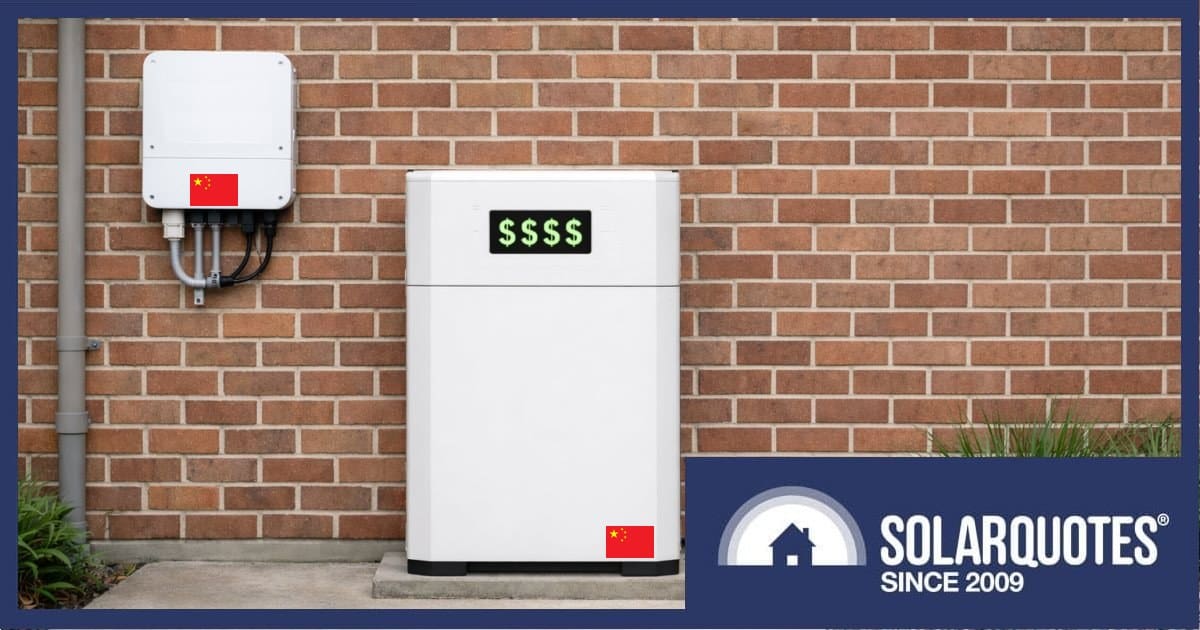
Currently super-cheap solar panels will be a bit more expensive and the federal home battery rebate will buy less capacity if changes to China’s export tax rebates are passed on to Australian solar shoppers.
Why Could Panel And Battery Prices Increase?
Starting April 1 2026, the Chinese government will totally drop the country’s value-added tax export rebates for solar photovoltaic products. The export tax rebate for PV products was previously reduced from 13% to 9% in December 2024.
For batteries, VAT export rebates will be slashed from 9% to 6% between April and December 2026 and done away with entirely from January 1, 2027.
How Much Of An Impact Will This Have?
According to a report from Reuters, manufacturers had been using the rebates as a price discount for foreign buyers. If that also held true in Australia, then wholesale panel prices could jump 9% and batteries by 3% from April 1; with battery prices increasing another 6% from the beginning of next year.
Solar Panel Prices
Thankfully, panel prices are currently very, very cheap. Post-VAT rebate changes, they’ll still be very, very cheap.
For example, budget (but good quality) 440-Watt Chinese panels listed on the SolarQuotes solar panel comparison table are generally around the $120 – $140 mark RRP.
If the typical business applies a gross margin of 24% on wholesale prices, a 9% increase will boost that RRP range to approximately $130 – $152. A 10 kW solar system consists of around 23 panels (adding up to 10.12 kW); so for such a system, the panels will cost:
- Currently, $2,760 – $3,220
- Post VAT rebate changes – $2,990 – $3,419
So, only up to a couple of hundred dollars extra for a 10 kW system.
Home Battery Prices
For batteries, it’s a little more complicated as pricing is all over the map. But to use an example of the Sungrow SBR HV 16 kWh; we currently have that listed on our battery comparison table as $6,720. This is RRP, includes the federal rebate and excludes installation.
After the April changes, such a battery could cost around $200 more – approximately $6,921. But the bigger hit will be in January next year, when the same battery could cost around $600 more than now; ~$7,324.
Added to that, the Cheaper Home Batteries Program (CHBP) rebate has three reductions between January 1 this year and January 1 next year. The CHBP reduction in May 2026 alone will add approximately $1,800 to the cost of this battery compared to what it was in December 2025; even without factoring in any VAT tax rebate reduction impact.
Will Inverter Prices Also Go Up?
I’m not clear on whether solar inverters are incorporated under the definition of “photovoltaic products” with regard to China’s VAT tax rebate reduction, but it’s likely. If they are, then inverter prices could head up 9% after April 1 too; adding up to a couple of hundred dollars for premium models.
Overall impact
For a full 10 kW solar + 16 kWh Sungrow battery system after China’s VAT rebate reductions and CHBP reductions factored in, this system could cost up to $2,400 more in May to December this year than it did in late 2025. And it will cost more again from January 2026 when China’s battery VAT rebate is removed entirely and another CHBP reduction occurs.
Still, Don’t Rush A Purchase
Don’t let FOMO (Fear Of Missing Out) be a major driver in a purchase decision as that’s when bad things start to happen. To learn all you need to know about buying solar well, see our Solar 101 guide.
In terms of batteries, even if you were to order one today from a decent installer, expect a wait of 6 weeks or even longer for installation. Bear in mind how much of a federal rebate you’ll receive is based on when the system is installed, not when the sales contract was signed.
Whatever you’ll be forking out, it will be a considerable sum even with the federal rebate and you’ll be living with your battery for a long time, so it’s best to get it right from the get-go. The SolarQuotes comprehensive home battery guide will help you towards that goal.
Also check out our home battery reviews section, which contains reviews and ratings of a bunch of brands from Australian customers. Based on these reviews, we’ve compiled a list of the top 10 best solar battery brands that regularly updates as new reviews come in and the situation changes.
From an installer’s perspective, you can see what installers in our network voted the best solar batteries in 2025 in this year’s SolarQuotes Installers Choice Awards.
Trivia: The vast majority of solar panels purchased in Australia are Chinese-made, with various reports indicating more than 90% of panels installed here originating from that country (some estimates as high as 96%). And according to a 2024 report from consultancy firm SunWiz, Chinese manufacturers accounted for more than 70% of the Australian solar battery sector at that point in time.
 About Michael Bloch
 RSS - Posts





I hope all the price increases all settles out as a “soft landing” for the industry, but I have my doubts.
Let’s hope it’s not just the start of more and more rises as China has a monopoly on it !!
There are non-CCP options so if they price gouge too bad, Aussies can simply buy non-CCP, as many already do.
Frankly the bigger pain is likely to be Labor’s New Vehicle Efficiency Standard (NVES) scheme which theoretically could wipe out non-CCP car brands other than luxury European ones.
Hi John,
The NVES will save the country millions of dollars in running costs.
How is updating our standards to meet those already in force overseas going to decimate the cars imported from the same overseas markets?
Despite mass production of Na+ batteries beginning at the end of last year, they appear to be no cheaper than LFP on day1, and it may well be 2030 before they are down to half the cost. But higher cycle life and high charge rates (up to 5C) are attractive. I have also seen one product which greatly flattens the droopy native discharge curve of Na+, by means of an improved anode.
Much has been made of their non-flammability, but LFP already qualifies there, I think.
If on-grid, I’d find an old envelope and do some sums on how much can be saved by shifting cheap (free?) midday energy to the morning and evening peaks. (Compare a BEV purchase: 2yrs of fuel-free driving have saved me around $6k off the $33k purchase price – it’s only a matter of time before the car is free.)
The battery in the BEV is cheaper than the house battery, and can provide greater payback, if you’re anywhere near changeover on one of the family’s cars. (“nuther envelope, perhaps … more numbers)
Couldn’t agree more !! 👍
In 2000 I installed a 1.5kw stand-alone system. About 10 yrs ago I wanted to upgrade it – not to get more max power, but to get more in low light/grey days, which was the critical issue. I was amazed at how the solar suppliers couldn’t understand this. They all wanted to throw out everything I had – batteries and all – and replace everything (including the inverter-charger) at huge cost. One at least just didn’t understand that the panels were operating at about 30v max, and had no idea why I’d need a fairly big cable! One got quite narky with me! In the end I bought another 1.5kw of panels and another regulator etc (& 35(?)mm² cable!) and installed it myself. Total cost about $2000 and still working well.
I’m an engineer, so well placed to know what’s what. I fear for others with less knowledge!! (And I should add that suppliers recommended by Solar Quotes were the same as any!)
The intent of this comment is to advise caution, not to declare war!