
 About twelve years ago, there was a quiet wave of solar company bankruptcies in Australia. They were not caused by dodgy panels, bad installs, or disappearing warranties. They were caused by tax.
Solar businesses that were otherwise healthy suddenly received letters from the ATO demanding payment of GST they did not realise they owed. Some of the bills were eye-watering: hundreds of thousands of dollars. Many companies simply could not pay. They closed their doors.
A Simple Tax Mistake
The root of the problem was simple, but deadly if you misunderstood it. Some solar companies were charging GST only on the amount the customer paid after the solar rebate was applied. If a system retailed for $11,000, installers assumed the GST component was $1,000, and that was what they paid to the ATO. But that is not how GST works when a government rebate is involved.
The tax is calculated on the gross price before the rebate is applied. If that same system received a $5,500 rebate, the taxable price was actually $16,500. Which meant the correct GST bill was $1,500, not $1,000.
On one job, the difference might be only $500. Easy to miss. Easy to rationalise away. But companies that had installed a thousand systems suddenly discovered they owed the ATO hundreds of thousands of dollars they had never collected from customers. By the time they realised the mistake, the money was long gone. The tax office still wanted it.
Game over.
A Familiar Trend Returns
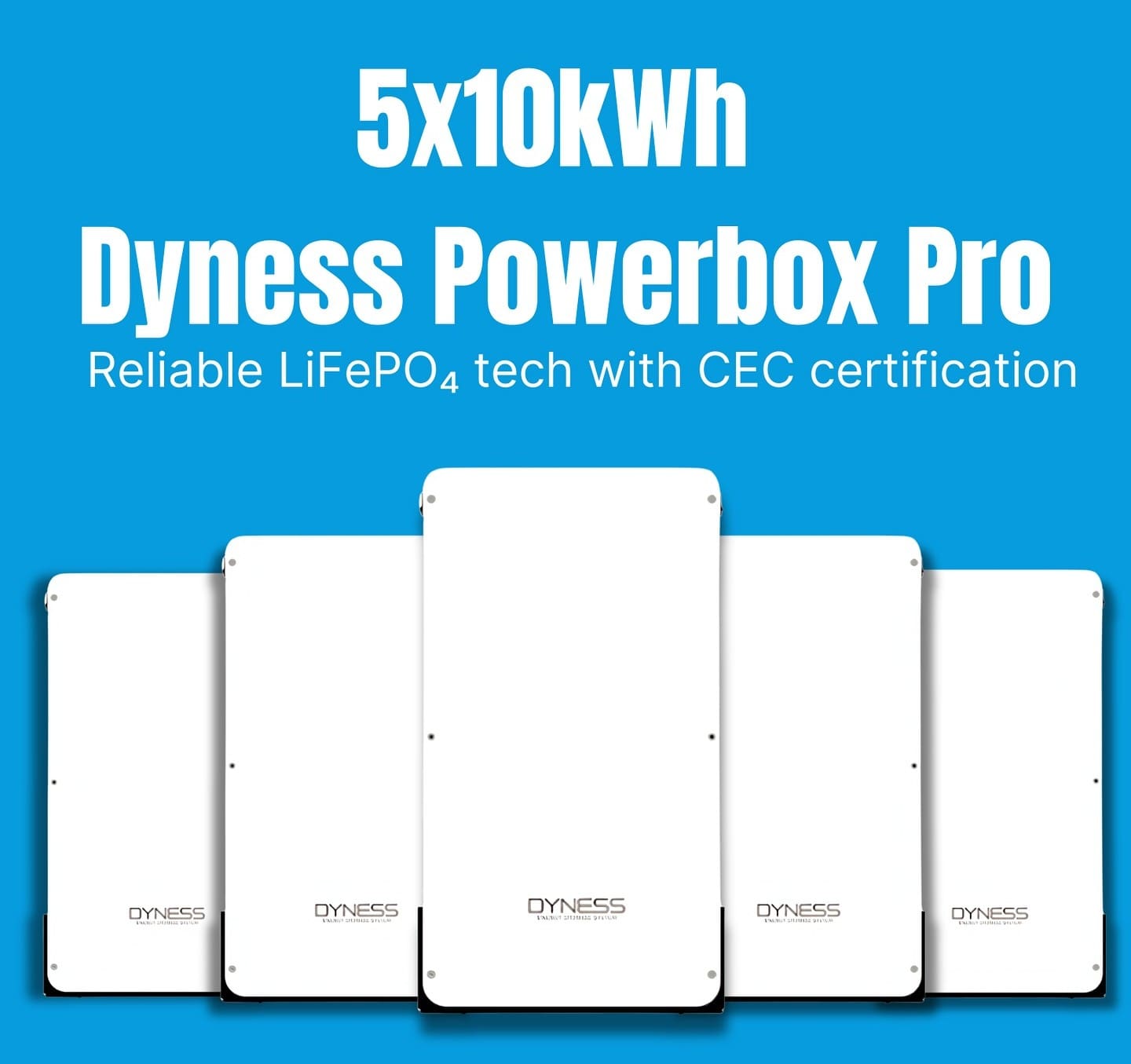
Some of the deals for 50 kWh battery systems out there might look good value, but the maths doesn’t always add up.
Fast forward to today, and battery rebates are beginning to reshape the market in much the same way solar rebates once did. The advertising has already started to look familiar – and not just because of misleading claims that the rebate is ending. I am seeing 50 kWh batteries promoted for as low as $6,000 installed. On paper that sounds extraordinary value, especially when you consider that the current maximum rebate on a battery that size is about $16,800.
Now watch the maths some consumers are doing.
They assume the installer only pays GST on the $6,000 retail price. So they subtract roughly $545 for GST and assume the installer has $5,450 from the customer, plus the $16,800 rebate. In their mind, that leaves $22,250 to cover the battery hardware and the installation. Then they search online and see some low-cost 50 kWh battery stacks advertised for around $20,000 and conclude there must be roughly $2,250 left over for labour. In their mind, a few hours’ work, a couple of electricians, done by lunchtime. Anyone charging more must be gouging. Right?
You can see how the accusations start.
But the maths is wrong, because the GST assumption is wrong. GST is payable on the gross system value before the rebate is applied, not the net price the customer pays. In the example above, the system value is not $6,000. It is $6,000 paid by the customer plus the $16,800 rebate, which means the taxable price is $22,800. GST on that amount is $2,073. Once the installer pays the ATO, the remaining amount to buy and install the battery is about $20,727.
Not $22,250.
Which means if the battery hardware costs $20,000, the installer is left with $727 to supply the inverter, mounting gear, wiring, protection equipment, labour, transport, insurance, compliance paperwork, warranty risk, and a margin that keeps the business alive.
No one can install a battery for $727.
Will History Repeat?
So when you see prices like this, something has to give. Either the installer has misunderstood the GST rules, the battery hardware is frighteningly cheap, or corners are being cut so aggressively that the system will come back to bite someone later. None of those outcomes ends well.
Because the ATO eventually notices. And when they do, they do not ask how the misunderstanding happened or whether the rebate scheme created confusing optics. They simply issue a bill for the GST that should have been paid.
History suggests the result will be familiar: naive new installers collapsing, customers left with unsupported systems. We saw it once already during the solar boom.
There is a real chance we are about to see it again.
Phase Shift is a weekly opinion column by SolarQuotes founder Finn Peacock. Subscribe to SolarQuotes’ free newsletter to get it emailed to your inbox each week along with our other home electrification coverage.
 About Finn Peacock
 RSS - Posts





Except for one critical thing you missed. The solar business does not owe the gross GST amount to the ATO. When completing their BAS for the period they add in the gross GST amount collected on all sales and then deduct GST paid on all inputs leading to an amount owing which is lower. There would be GST on the direct inputs to the solar/battery sale eg inverter, battery, wiring etc but also on indirect business expenses such as plant and equipment, consumables etc. How much it all works out at is incredibly variable but may still be a significant cost if not accounted for.
Surely any accountant would advise a business of this?
Correct, but the end result is that the business eventually gets a bill for unpaid GST which – in many cases I personally witnessed – sends that business to the wall.
I am in tax. I agree with Finn. Many installers have recipient created tax invoices when they work for some companies. These are less likely to be a concern. As “head office” does it properly. The company does this because they really dont want the rebate to be subject to gst as it means they lose profit fast. Just the sale of the gear and the installation. The rebate is just how the invoice is paid.
My invoice is spot on. The rebate is just treated as a payment.
In any event, the customer isnt chased.
There is a similar side of this rebate coin for the unwary consumers.
They pay for a solar system and battery that is cheap with rebates etc, but those rebates are one time only for the battery, and only doable again with a new inverter for panels.
So when they install a system for $25k out of pocket, they naively wander along and increase their house insurance by 25k to cover their expenditure.
Not releasing that replacement cost for their system with no rebates is far higher than that, by the time a damaged system is removed and replaced, it may be as high as double what they paid, and to add insult to injury, may take a year to happen, so they are paying high power bills at the same time.
Unless you burn down your whole house (and has to rebuild the whole house), that’s not how insurance works. Most policy will add solar and battery onto the whole house sums, not as separate insurable items.
Some policies also allow up to 10% higher than insured amount in such event.
The chance for your scenario is so low, it’s not impossible but it’s not worth worrying about.
Hey Finn – you’re actually in the industry and have been for a long time. Instead of writing scare articles against large cheap batteries, using click bait titles, and then using an inflated battery estimate to make the installers profit look impossible, how about you instead have a genuine attempt at the price?!? That is, what is a the actual price on a Fox ESS EQ 42kWh battery that an installer can buy them for, including the extra installer rebates/incentives they are receiving from FOX? I know it would not make your article so “scary” to read, but it would at least be “truthful and objective” – the bit that seems to be more and more missing in the last few years, perhaps even more so since been taken over by one of the majors. Because obviously companies like Aussie Solar Batteries who are currently installing this battery and a 8kW single phase inverter for $5499 (their current advert) are doing it neither at a loss, nor with the GST incorrectly calculated.
The post is about 50kWh systems that max out the rebate. The cheapest batteries at the wholesaler I can find today are $370 per kWh (exc GST). 50 x $370 = $18,500. Compatible (undersized) 5kW hybrid inverter is another $1,200. Making one a master battery is another $200 extra. $18,500 + $1,200 + $200 = $19,900. That’s without any BoS components. No inflation here. Paying less than $370 per kWh IMO is frighteningly cheap.
Aussie Solar Batteries does not get Home Building Compensation insurance, which they need to under the law. I checked their license there was zero HBC listed.
If they offer $5k for the install and receiving $16k rebates, that makes the work over the $20k (inclusive of GST) threshold. They are required to get HBC insurance in NSW. In fact one person who claimed to be a sales manager of a battery brand argued with me on MEEH facebook page that it is not required, I can’t remember the brand now, but that is wrong. This insurance typically cost about $750 which they dodged every single time.
Wouldn’t be the first solar installer to fail to supply statutory building insurance in NSW. Ours didn’t and topped that off with a 25% deposit on the battery component when they should not exceed 10% in NSW. TBH these were the least dodgy things our Solar Quotes sourced installer did.
Hi Matt,
We’re more than happy to hear about who did your installation and what didn’t measure up to expectations.
It’s customer feedback that allows us to keep installers in line.
In fact many times we become their quality assurance, because end users will communicate more readily, seek clarification & make complaints they’d not normally push back to the people who are obliged to offer warranty.
In some instances we are the business coach they didn’t know they needed because we twig their licence has expired & deposits are too steep.
https://www.solarquotes.com.au/installers/reviews/
While mine one wasn’t great but they did provide me with HBC insurance (was quoted as inclusion in the price since the beginning) and they went back and fix the issue with installation quite promptly.
I usually filter the installer by doing a quick search on their license and ABN. How long have they been around and if they at the very least know what they need to comply with. Also HBC insurance is there in the event that they vanish within 6 years.
Great article, thanks Finn appreciate the clarity.
The company offering these cheap battery have their strategy all worked out. Maximize the government subsidies with the cheapest batteries you can find, get any subcontractor with an SAA licence to do the installation for $2.5k+ (for an AC coupled battery), do that until it runs out, arguably May 2026 given the cliff in subsidy (where their business model no longer works), then file for bankruptcy before the first few systems start to fail and the number of warranty jobs becomes unsustainable.
It’s a feature, not a bug.
And of course, they will try to dodge the GST bill…