
EV range figures — and fuel economy for fossil fuel vehicles for that matter — provided by auto manufacturers can be on the optimistic side; but by how much? Recent and ongoing testing in Australia reveals the differences from real-world driving range can be substantial.
What’s WLTP Got To Do With It?
WLTP (Worldwide Harmonised Light-Duty Vehicles Test Procedure) is a laboratory-based test for measuring new vehicle fuel economy, electric range, CO2 emissions and other pollutants. WLTP values are currently widely used in Australia by vehicle manufacturers for EV range labeling, but the WLTP test cycle is not a mandatory legal standard for all new vehicles just yet.
In April 2024, the Australian Government adopted three new Australian Design Rules (ADRs) for light vehicle emissions; one of those being WLTP. Newly approved vehicle models supplied from December 2025 became subject to the ADR’s and new units of existing vehicle models supplied will be covered from July 2028.
Why Is WLTP Still Problematic?
WLTP is more realistic than previous metrics such as the New European Drive Cycle (NEDC); developed in the early 1990s and last updated in 1997. According to RAC WA, the NEDC test procedure results in approximately 20-30 per cent lower range/mileage than motorists can expect to experience in real-world driving.
WLTP testing runs longer than NEDC (30 minutes vs. 20), further (23.5 km vs. 11 km) and has more driving phases; 4 vs. 2. It is conducted using a dynamometer. The car doesn’t move – the dynamometer works by using large rollers to spin the wheels or a direct engine link. Under WLTP, vehicles are subjected to speeds up to 60km/h, 80km/h, 100km/h and 130km/h.
But as the WLTP lab test is also carried out in ideal, controlled conditions it doesn’t fully reflect real-world variability such as wind, hills, A/C use, traffic, driving style or heavy loads.
Scandal Sets Wheels In Motion: Australian Real-World Testing
The 2015 Volkswagen scandal (aka Dieselgate or Emissionsgate) revealed increasingly strict regulation of vehicle emissions encouraging car makers to optimise vehicles for laboratory instead of real-world performance.
The scandal eventually sparked Australia’s Real-World Testing Program that was started in 2023 with $14 million of Commonwealth funding and is being run by the Australian Automobile Association. The program tests vehicles on a 93-kilometre circuit in and around Geelong in Victoria.

As at December 2025, the program had released results for 131 internal combustion engine and hybrid vehicles; revealing a whopping 76% of tested cars exceeding the fuel consumption recorded in lab tests — and one in five also exceeding noxious emissions limits applicable to lab tests. The program had also begun testing electric vehicle models, with the results of more added early this month.
The program aims to test up to 200 different vehicle makes and models — Internal Combustion Engine (ICE), hybrids and battery electric vehicles — over its four-year duration; running to 2027.
For battery electric vehicles, when an EV’s low state of charge (SoC) warning displays or the battery’s SoC reaches 15%, it is fully charged to 100% and real-world performance calculations made.
Real World EV Range Results
Here are the EV numbers so far from the AAA, with figures reported in accordance with Australian Design Rule 81/02.
Update 2.40 PM: I’ve been made aware some of the AAA-provided mandated lab result figures below are NEDC rather than WLTP and the AAA results don’t make the distinction. An example is the Atto 3. As well as the NEDC figure, the Australian BYD website also notes the WLTP range of the Atto 3 Extended Range as 420km. I’ve clarified the values in the table, noting the figures used in the AAA results in bold.
| EV Model | Mandated Lab Result | Real World Result | Difference |
|---|---|---|---|
| BYD Atto 3 2023 – Extended Range | NEDC – 480 km (WLTP – 420 km) |
369 km | -23% -12% |
| Kia EV3 2025 – Air Long Range | WLTP – 604 km | 537 km | -11% |
| Kia EV6 2022 – Air | WLTP – 528 km | 484 km | -8% |
| MG 4 2023 – Excite 51 | NEDC – 405 km (WLTP – 350 km) |
281 km | -31% -20% |
| Smart #1 2024 – Pro Plus | WLTP – 420 km | 367 km | -13% |
| Smart #3 2024 – Premium | WLTP – 455 km | 432 km | -5% |
| Tesla Model 3 2024 – RWD | WLTP – 513 km | 441 km | -14% |
| Tesla Model Y 2024 – Long Range | WLTP – 533 km | 490 km | -8% |
| Tesla Model Y 2025 – RWD | WLTP – 466 km | 450 km | -3% |
Speaking from our own experience with a BYD 2023 Atto 3 Extended Range:
- 60 kWh battery.
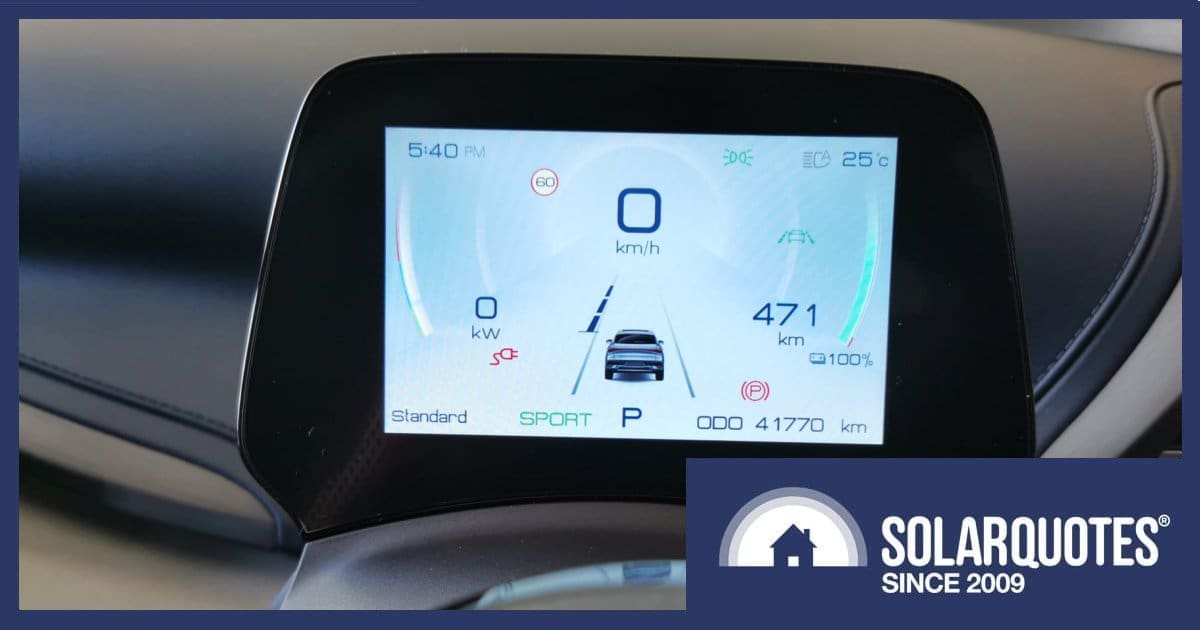
- 41,770 kilometres so far mostly around the streets of Adelaide.
- Mainly flat road conditions and lots of expressway driving — around half our travel.
- Significant air-conditioner use.
- Over the entire travel time distance and including non-expressway bits of the daily drive, average speed range of 34 – 45 km/h (lots of peak hour driving).
- Cumulative AEC (Average Energy Consumption) of 14 kWh per 100 kilometres over the 41,770 kilometres according to the Atto app.
Assuming the app is correct, it works out to approximately 428 kilometres range per charge vs. BYD’s NEDC 480km figure; still higher than I expected and significantly more than the Real World Testing results, but very close to BYD’s WLTP figure. While our car sees higher than average use, it has a pretty easy life in terms of driving conditions.
Trivia: According to the Australian Bureau of Statistics (2020), passenger vehicles travel 11.1 thousand kilometres on average annually in Australia, or a bit over 30 kilometres daily average.
The AAA’s Real-World Testing Program isn’t the only show in town. Other resources include the Electric Vehicle Database, which pegs the Atto 3 Extended Range at 340 kilometres.
Got an EV? How are you charging it? Discover everything about choosing and installing a hard-wired home EV charger, and with one how solar panels on your home (and how much capacity you’ll need) can make your cruising even cheaper and greener. Home solar power is the perfect match to really accelerate your electric transport savings.
 About Michael Bloch
 RSS - Posts






MG4 here, 16,080 km in 23 months, almost all highway driving, so 100 km/h . As wind resistance increases as the cube of velocity, I’m wondering how that was modelled in the dynamometer testing. Even with my worst case driving pattern, the on-board computer calculates 300 km range. That correlates well with the observed 16.5kWh/100km and 51 kWh battery. So, yes, 280 km range, with 20 km reserve, worst case. That’s ample for a shopping wagon, even when that’s a 65 km round trip out here. Hauling a bigger battery around wouldn’t do anything for me – my trip to Sydney in two weeks will be by air – 1000 km is too far to drive.
Given the wind resistance cube law, 110 vs 100 km/h is 1.1^3 = 33% higher propellant consumption – not great when paying for fossil fuel. It amazes that the 16,080 km of pollution-free motoring has been propelled entirely by the photons which would otherwise merely have heated my roof.
The beneficence of Ra is boundless, at least by mortal measure.
Nice to see the EV manufacturers are maintaining the ethical standards set by ICE vehicle manufacturers…
Range values for ICE vehicles have always been a joke, it was a fairly safe bet you could add a 2 to the claimed highway, and a 3 to the city, claimed consumption values.
I bet you the EV manufacturers could provide real “real world” range values within a month of the vehicles hitting the show room floors. You would have to be pretty naïve to think they were not gathering exactly that sort of info from their customers vehicles.
One of the problems with stating a range for any vehicle is the very different driving conditions (topography, traffic, how the driver actually drives, average speed, wind conditions etc.) any vehicle will be used under. My daily commute has a change in elevation of over 300 metres from start to finish, which is different to the topography if i drive in the other direction, into the city, which is mostly downhill. And going to and from the city therefore also gives me very different efficiency figures.
I think it’s unfair to ask manufacturers to provide a single range figure that will apply across all trips. Maybe they should be able to quote a range of ranges, depending on things like topography, temperature, wind speed, top speed etc.
Michael, we own 2 EVs: an Atto3 & a Kona (2020: part of the first batch.)
The Kona now has 160K Kms+ on it, & is very economical. We still get 360Kms+ at highway speeds on a full charge. The Atto3 is a different vehicle: We did a trip to Victoria in the cold & quickly learnt to not trust the guessometer. I charged in Vic to what I thought was a reasonable amount for the distance to travel about 200Kms, so charged to 300 indicated: We got to the next charger on 0!: cold conditions on LFP batteries. I feel the Kona would have made that trip easily on 300 indicated.
We have now had the Atto3 for 6 months, & I love it. Different to drive to the Kona: The Atto Cruise control slows in corners which I hate, & the Atto ride can become wallowey on washboard roads, but it is much quieter than the Kona, & much roomier for a similar sized car. The Atto3 was 3yo, & 60K kms when we bought it from its original owner. Very good value.
(We still miss our Imiev tho!)
Regular internal combustion engine fuel economy figures have always been inaccurate compared to the real world too but people don’t seem to get as uptight about that (or perhaps aren’t aware).
As you said in the article the fuel economy figures are achieved in a controlled lab type conditions on a dynamometer where there is no wind and no hills and the same no-road conditions – all the things that have significant affect on fuel economy.
ICEVs have the benefit of far longer ranges than EVs, far more accessible ‘recharging’ options, and far far faster ‘recharging’.
Yes wind, hills, and other factors do affect energy consumption, whether petrol or battery, but it’s less of an issue when range anxiety is not a concern.
Hi John,
You’re not talking about LPG powered cars are you?
The only way combustion vehicles get long range is by adding enormous quantities of energy to their tanks, 70% of which goes straight out the exhaust and radiator, unused and wasted. It’s like using a sledgehammer to crack a nut.
Interestingly when you look at vehicle range over the past century, it mostly plateaued at around the same 500km mark that EVs can already achieve with current battery technology. It was only the introduction of consumer diesels, and direct injection petrols etc. that edged the ranges higher.
And most discussion on range are predicated on long holiday travel-type trips. Not the driving most people do most days of the year.
To be fair, range in the city isn’t an issue – 250km of city driving would be about the most I would drive. I just want to be able to do the typical trips that I’ve always done (3-450km a few times per year) without spending an inordinate amount of time waiting for charging. Of course on 300+ trips it’s likely I will be taking a meal break regardless of drivetrain.
John Alba: – “ICEVs have the benefit of far longer ranges than EVs, far more accessible ‘recharging’ options, and far far faster ‘recharging’.”
I’d suggest the range of the Tesla Model 3 Long Range RWD with 18-inch wheels: Up to 750 km WLTP (New 2026 model) is nothing to sneeze at.
https://www.tesla.com/en_au/model3
As for “more accessible ‘recharging’ options”, it depends on where one is. It seems the number of petroleum fuel stations in China is reducing.
https://www.eco-business.com/news/china-may-have-reached-peak-petrol-station/
It seems it’s a similar situation in Norway: https://youtu.be/CVBmFFS6Sbc?t=163
So I think it’s only a matter of time when (not if) the number of petroleum fuel stations in Australia starts to reduce. Then range anxiety for ICEVs becomes a reality, perhaps in the early-2030s?
It could come sooner if China decides to attack Taiwan.
https://www.abc.net.au/news/2025-07-05/fuel-security-electric-vehicle-uptake-solution/105481348
Hi Geoff,
Range anxiety for LPG users is already here.
New & redeveloped stations aren’t getting gas pumps.
Existing station owners can’t be arsed spending the money to recertify tanks, so they fill them with nitrogen.
The first question most average people ask about EVs is, “how far will it go?” That has been the question since they landed on the market and one of the first statements listed in your average car review.
The first question most average people ask about ICEs is, “how much power has it got?” And again, that is one of the standout comments in your average car review.
I think that incorrect mentality, is going to be with us for a long time yet.
One argument about ICE range over time, is the size of the fuel tank. I learnt to drive in a Datsun 200B, had a 60L tank in it to give it a good range, but pretty poor fuel consumption compared to now days. Compare that to a current ICE hatchback of similar size and tank sizes have shrunk to 40 or 50L, but range is the same or better, because of better fuel consumption.
Unless you’re calculating consumption, people base fuel economy on how often they refuel. My dad fills his 4wd once a month, but that doesn’t mean it has good economy.
Not sure if you own an EV yet, but it is a different mindset to owning ICE. When one first owns an EV, it is common to keep it fully charged ´just in case´. Over time, one gets to look to the needs & charge accordingly. Our family does a lot of Kms (abt 40K kms/yr with 2 EVs) The only time we 100% charge is when a trip is planned.
On long trips, it is generally faster to only charge en-route to about 60-70%, because the time spent waiting for the charge to go to 80 or 90% is longer than an extra quicker stop. Of course, with newer cars, the charge rate is much faster, so less of an issue. My cars only charge 67Kw & 75Kw fastest.
I find the cost to charge at fast chargers approaches the cost of ICE fuel particularly when the road charge is added in the future. However, most of my charging is done at home, mainly off PV, so very low cost.
You’re right, I don’t yet have an EV, but will probably get one in the next 5yrs.
As you have mentioned, I have heard about different charging rates, depending on how full the battery is and that is something that I will need to learn through experience. I assume different EVs will have different characteristics, dependant not only on battery chemistry, but how the manufacturer manages the battery in the car.
As a side note, I’ll be one of the lucky Australians that will have either a garage or carport to charge our future EV and won’t need to rely on a paid charger most of the time. As I said to an EV friend of mine, you have to consider the overall cost of ownership. In an ICE, I need to pay for petrol and time to drive to a service station. In an EV, I just plug in at home, no extra energy spent and only minimal time.
You missed mentioning the lower service costs: about 1/3 to 1/2 the costs of ICE machines. Have a look at Used EVs: I bought a 2yo Atto3, 60K kms, immaculate for just over $30K. Good value.
Move to an EV as soon as you can, I suggest.
The Real-World Testing Program is fine, their data source is a problem though.
Manufacturers can submit either NEDC or WLTP under ADR 81/02. And it doesnt specify on Green Vehicle Guide which was submitted. You have to confirm with the cars specsheet or do some googling.
What AAA is doing is comparing NEDC to WLTP with some of the vehicles, the Atto3 & MG4 are NEDC ranges. Every other EV is WLTP.
If you compare AAA RWT against those vehicles WLTP data you get around 12% difference in range for the Atto 3 and just under 20% for the MG4.
Not a great showing from MG but the Atto 3 is ballpark like the rest of the WLTP vehicles ranges, which is just fine in my book!
WLTP Ranges
420km 2023 Atto 3 Extended
350km 2023 MG4 Excite 51
Thanks for flagging the NEDC/WLTP issue with the results. I updated the article noting that and updated the table yesterday afternoon.
No worries Michael. I went and read the legislation a few months ago to win an argument (Yes, I am that much fun!)
I want to mention your BYD app figures. Or even any vehicle app/display.
One of the larger differences between the apps and the WLTP energy consumption testing results would be charging losses. WLTP testing records them and are part of the final value that goes on the sticker. The cars care not about those losses.
Our Model Y is getting 131 Wh/km, but with losses it would be close to what AAA got in their testing, 148 Wh/km
The other EV, an Ora, says its around 145 Wh/km, add in losses and I would say it gets its WLTP of 160 Wh/km.
I feel despite all the complaints I see about the RWT AAA is doing, its a far better representation of what you actually get in the real world than the lab test. NEDC especially.
Herv,
There’s another range comparison, Atto3 vs MG4. The former has frequent overpriced mandatory services; the latter has zero service intervention in the first four years. That informed my choice of MG4 vs my sister’s Atto3 – that and the price difference … oh, and the difference in handling – I’m a sucker for a road hugger.
But, yes, the base model MG4’s range does not readily make it a tourer – more a zippy commuter, capable of a couple of 100 km return trips in a day, with reserve.
With my driving, it’s more like 310 km range than 350 km, but it’s very pleasurable driving, given the handling.
Don’t get me wrong, just because the MG4 didn’t do well in one driving test doesn’t make it a bad car at all. Who buys vehicles on stats alone?!
For its 51kWh battery, its getting an acceptable range IMHO and it was on the list for a smaller runabout when we were looking last year.
Found a demo Ora extended range for $28k with only 42 km on the dial. So it wiped away any other consideration.
Another adjacent issue that is also a mismatch between the EV dream and EV reality:
DC fast charging speeds.
It’s never what the manufacturer claims, and it’s so complicated. It depends on the car (what % are you charging from? are you charging past 80%? is it hot or cold out? have you pre-conditioned and what even is that?)…
…and it depends on the EV charging station (are there other cars charging? is both the car and station 400V or 800V? why am I getting 100kW when you clearly advertise “UP TO 200kW” and oh yeah, what does that “UP TO” bit mean anyway?)
Hi T,
We appreciate any feedback we can get on the blog but some comments do equate to “old man yells at cloud” sadly.
Battery temperature & charger availability are prime concerns for charging speed and they’re hard to predict.
Same as 6.6kW of solar seldom ever delivers full output, especially when you only fit a 5kW inverter.
Doesn’t mean you shouldn’t offer a rating for your products.
Your assumption about the BYD app providing accurate consumption data is not supported by my personal experience. After 24,000km, my BYD Seal shows a cumulative 16.2L/100km compared with my carefully logged calculation of 17.8L/100km. The car computer is claiming consumption that is 9% lower than reality. Furthermore, I’ve found that charging draws about 15% more electricity from the grid than what is stored in the battery – the extra energy is lost to heat transfer during charging.
I have been driving an MG4 Excite 51 2024 model for the past 14 months which is almost always charged at home from roof top solar.
They are sold as having a range of 350km and my experience has been that I get very close to that.
Driving conditions are varied, town and highway and the aircon usually gets heavy use due to living in Innisfail Qld.
I am satisfied that the car is performing as it should plus it being a delight to drive.
Why can’t the advertised range be a dynamic figure?
You need to start somewhere but after a few months in the market manufacturers would have collected a bucket load of data from 100’s of cars driven in various conditions, they should then change the “sticker” number to show what the average customer is achieving in the real world.
John: – “Why can’t the advertised range be a dynamic figure?”
Too many factors, including:
* Driving Style: Aggressive acceleration & high speeds use significantly more power; smooth, steady driving conserves energy.
* Speed: Higher speeds increase aerodynamic drag, reducing range, especially on highways.
* Vehicle Weight: Extra passengers, heavy cargo/towing or roof racks increase load, forcing the motor to work harder.
* Tires: Incorrect tire pressure and poor tire quality increase rolling resistance, demanding more energy.
* Temperature: Cold weather is harsh on batteries, reducing range; heating & cooling the cabin also draws significant power.
* Terrain: Driving uphill uses more energy; hilly routes generally reduce range more than flat ones.
* Wind: A strong headwind acts like driving uphill, increasing energy demand.
* Accessory Use: Using infotainment, headlights, wipers, etc., draws power from the battery.
* Battery capacity & health.
That would be useless for many people. Remember, something like 64% of Australia’s population live in 1 of 5 capital cities so it’d be their driving that would set the average customer data, not those in the country who have to drive highways to get anywhere. Yes those in suburbia may do a lot of highway driving too, but they do far more ‘city’ driving too. Unless that urban v non-urban driving distinction is made …
Hi John,
“That would be useless for many people. Something something 64%”
Remember, 11% of Australians live in towns under 1,000 people or very remote areas, reflecting Australia’s high urbanization rate.
Approximately 300 towns and localities in Australia with populations over 1,000 people are more than 200 km from any other such settlement, primarily in remote outback areas of Western Australia, Queensland, and the Northern Territory.
So EVs might be a challenge for people in Longreach, Coober Pedy or Mt Isa until more infrastructure is built.
We bought the BYD Seal Premium and it is EXCELLENT!
Just such a joy in every way.
Turns out NEDC stands for Not Even Damn Close to 650 km
and WLTP is Would Like To Pretend to get 570 km
much more like 450 km because we live in the country and it’s all at 100km/h. So that is enough, and we are content. CDA is .219 which could not get much better and is very pretty. 82kWh battery.
The WLTP of the BYD Atto 3 2023 – Extended Range is advertised as 420km. This is very close to your own real world 428km. The MG4 also has inflated “official” test figures, the WLTP of the MG4 excite 51 is 351km in all marketing including carsales.com. This is disingenuous to use a lab figure of 405km that is not from a uniform standard. WLTP is the standard as you have pointed out. I also question the test calculation method from the Automobile Association for the MG4, 20kwh per 100km would require a severely impacted vehicle, or stuck handbrake. We would also surely see forums lighting up but all the posts I have read point to around 14.5kwh or thereabouts. May be worth investigating.
Thanks for flagging the NEDC/WLTP issue with the results Cearan. I updated the article noting that and updated the table yesterday afternoon.
Cearan,
My base model MG4 yields 16.5 kWh/100 km on 91% highway driving @ 100 km/h. That’s 309 km range for 100% dead flat at arrival. (It’s 23 months old, but has done only 16,200 km) Range might vary slightly over Jan-Feb, with increased aircon use.
The heavier LFP battery might reduce the range/kWh cf the Li-Ion models. But as LFP can be kept at 100% SoC with much less degradation than Li-Ion, I’m much happier keeping that well tanked up. 100% x 51 kWh ~ 80% x 64 kWh.
Thanks Erik, your figures are very helpful. The Australian Automobile Association real world test claims the MG4 only delivered a range of 281km. Given you are achieving better than that with 91% highway driving, there certainly seems to be a problem with their test for the MG4.
The whole notion of range completely alters when one gets an EV, because all the behavioral around ‘refuelling’ changes.
Most driving most of the time is energized at home, so one isn’t checking charge & calculating when it is time to go for a full up at the local gas station. My Atto 3 is almost permanently cabled up to either capture solar energy during the day or 5 cents per Kwh grid power from midnight to 4 am.
‘Theoretical range’ is irrelevant in this context. When city driving, I never even come close to testing the ultimate range of my vehicle. Getting my energy at the cheapest cost is. It is the only consideration I have to worry about. Paying 30 something cents per Kwh ‘worries’ me.
On the open road, ‘the range’ is determined far more by my need for a “rest break’ than anything else. My ‘range’ is about 2 to 2 & a half hours driving before ‘a coffee break’ is in order. And I do not not like to wait around with my coffee for more than 25 minutes to get my 85% charge.
Christopher, worry not & just buy one! Our first EV had a range of abt 100Kms. Our Kona has an effective Highway range of about 380Kms.
In the real world, most driving is within 30Ks of home & range is never an issue (if you remember to charge occasionally). On the open road, it is fairly easy to find chargers (apps such as Plugshare), & one needs to stop abt every 2H anyway. One rarely charges to 100% on a trip, it is better to have an extra stop & use the higher charging speeds (EVs start at high KWs, then abt 65% drop to abt 1/2 , then drop again at abt 80%. The last 10% can be disproportionately long.
I have now driven over 300000Kms in EVs. I NEVER want to own an ICE ever again! EVs are so quiet, & cheaper to run.
I’d love for you to dig into the AAA real world results more and write an article on the inaccuracies.
The BYD Atto3 has a WLTP spec of 420km, the NEDC is 480km. Why then do they compare the range to 480km? If I remember correctly, this isn’t the only one where they are inconsistent. Which of course has led to some of the sensationalist headlines about EV range, all because they’ve not used the correct figures.
It needs someone with a big platform to expose it.
Thanks for flagging the NEDC/WLTP issue with the results. I updated the article noting that and updated the table yesterday afternoon.
Thanks Michael for another great article.
In the early days of driving my MG4 (the 77 kWh Long Range version which I think has a different battery chemistry to the 51 kWh Excite) I was fairly obsessive about trying to calculate the efficiency and I was maybe surprised to find it wasn’t too far away from what was quoted.
Since then the novelty wore off spreadsheeting, I upgraded my solar system and added a battery so now the electricity I charge with is abundant and virtually free (from this point forward, sunk costs notwithstanding)… so even if the efficiency was a bit lower than claimed I’m not really bothered. I’ll just keep it plugged in a little longer.
I feel a lot of resonance with this article Finn wrote a while back:
https://www.solarquotes.com.au/blog/efficiency-is-dead/
TBC
Pt 2
I guess it doesn’t matter to me so much because close to 100% of my driving has been within city limits, the longest trip so far being maybe 70 minutes each way – so I’ve always charged at home. It would certainly matter more if I had to plan charging for long trips.
Rather than install a fixed charger, I had a 3 phase outlet installed in the garage (the house already had 3-phase supply) and I bought a portable charger with a 3-phase plug. It’s secured to my wall with a removable bracket so I could unscrew it and take it travelling if I ever needed to (haven’t yet…).
It’s not a smart charger and actually I’m OK with that – again because I have a biggish array and battery I don’t feel I need to squeeze every last drop out of the system. The MG app lets me set a timer or switch charging on and off remotely, combine that with SunGrow’s remote monitoring app and I have everything I need.
Very satisfied customer for MG, EVSE Australia and Sungrow!
Scott,
Do you think that with ample battery and array, just charging the BEV at full whack is more effective than “solar only” so-called smart charging? The BEV is topped up quicker, you can confidently go out earlier, and the house battery recoups the difference while you’re zooming down the highway – it’s equivalent to partly charging the BEV while driving! (Compared to solar-restricted charging.)
Any energy losses are just free photons, and a bit of a cycle is a fraction of what petrol costs would be.
Here, even 15 kWh from the house battery for cloud fill would be $1 ($6k/6000 cycles). That’s 90 km in an MG4 = 1.1c/km for house battery wear, but only for the part of the charge taken from it – if 25%, then 0.28c/km. That sounds a bit like tyre wear.
The grid can’t have too many big batteries.
Hi Erik… probably yes. I don’t really have any extreme fear of inducing additional wear and tear on the battery every now and then. I bought the battery to be used.
Thing is, most of the time I don’t really need to. I live in a suburb well-served by public transport, commuting to the city is a no-brainer (parking costs greatly outweigh petrol or electricity consumption for each journey). The car is used mainly for errands during the week and then some leisure on the weekends. Most of the time I’m only topping up the battery from 65% to 80%, I don’t often get down below 50% unless I’ve had a few big trips in a row.
I do like the idea of smart charging in the same way I like the idea of a hot water diverter – both control the charge in a way to perfectly match inverter output and ensure the best possible use of the PV electricity which is great when a battery isn’t in the system. Now that I have a battery, I think those smarts aren’t really necessary.
Hello,
I just wanted to pick out a small error in the above article regarding the WLTP range of a BYD Atto 3. The BYD Australian website clearly states the WLTP range of the Atto 3 Extended Range as 430km. The website also states the NEDC range which is 480km. Somehow the above article has got the two values confused. It would be great to have this rectified as the article is quite misleading in its current state.
I note that the BYD ATTO 3 does display a range of 480km when it’s fully charged. However, BYD doesn’t claim this is the WLTP range. I think it would be best if they did change this to the WLTP range, but that’s not really point of the article. The article is comparing WLTP ranges not displayed ranges.
Perhaps it would be best to check all the other values stated in the article against the manufacturer’s websites to confirm correct values are being used.
Kind regards,
Rob
Thanks for flagging the NEDC/WLTP issue with the results Rob. I updated the article noting that and updated the table yesterday afternoon.
Continuing from last post:
So, once I am locked into 85% max charge on a long trip say from Melbourne to Adelaide, I restrict myself to hops of around 200km. And if I am having lunch & choose to slow charge over 85%, I leave my name & phone number on the dash.
The main difference between fossil & electric car driving is the amount of planning involved. Range only becomes an issue if you haven’t done enough of it.
My holiday house is 110 km from Melbourne, which is just under a 1/3 of a tank. If I drive only locally, I can get home & recharge @ 5c/Kwh on my 7Kw home charger.
If I do so some holiday regional driving, I can trickle charge overnight @ 28c/Kw
If we do a last minute unplanned for inter-regional trip, I can nip down to the local 50Kw public charger @ around 60c/Kwh. One pays for expensive to produce convenience infrastructure.
Even with a 1 charger stop 3-400 km day trip, most of the power is from home.
There are no range issues here. Range is for petrolheads@180+c/L.
Hilly terrain, passengers, other loads (luggage / gear, ute loads), towing, headwind, highway driving, all can affect EV range so much . . . combine any of them and look out.
Add to this the drop in SOC on earlier EVs, my sons Model X 95D has gotten to the stage of about 280km – 290km at 100% SOC, and 3 or 4 x 80% – 90% charges on the Adl – Mel or Mel – Adl drive each way (a good 1hr – 1.5hrs !).
(His new long range Model Y is 2 x 15 min stops each leg.)
We’ve taken over the X, great for around town here in Adl, it wasn’t worth selling, the depreciation a killer.
We charge more and more on solar on sunny days, but up to now more on mains at the EV night rate 8c (0000-0600), which means charging from say 50% to 80% on that low rate mains tariff costs at most $2.40 (max 30kwh usually) . . . still working out the per km cost, maybe about 100km urban driving, so I think it’s about 2.5c/km at most . . . far less than the 2014 Elantra, which at say discounted $1.70/lt ULP = about 13.6c/km.
Might want to include a couple of ICE test results for comparison.
I expect the resulting difference between lab/real world will be mostly the same just with an added emissions factor.
I have a 2024 Tesla Model 3 rwd refresh, 60kWh BYD LFP battery. I rarely get below 500km range in near 2 yrs of ownership. Maybe in the height of summer with a/c on, as Perth is hot, I just dip below 500km. My driving is mostly city driving 60% but once a fortnight or so I drive into Perth 240km round trip on the freeway at either 100 or 110km/hr. How you can get as low as 441km range is beyond me as I already am a bit of a lead foot!
Pollutants are harmful and toxic substances. Without CO2 we’d all be dead. CO2 is not a pollutant, although the modern narrative likes to portray it as such.
Hi Jim,
Atmospheric carbon dioxide is currently about 0.04–0.043% of dry air by volume, i.e. roughly 420–430 parts per million (ppm).
Tiny amount right?
If that was the same percentage of alcohol in your blood, there would be measurable effects in cognition, judgement, reaction time & coordination.
If we had 280ppm of cyanide in air (incidentally the same amount of CO² in the air before the industrial revolution) everyone would be dead in minutes.
Where you only need 3ppm in your bloodstream to kill.
Arsine (arsenic) gas is toxic, with 10–25 ppm in air potentially lethal in under an hour.
While arsenic isn’t used as a tonic anymore, it’s still useful to treat leukaemia.
The point is that dosage matters, however you’re spouting thoroughly debunked misinformation and we aren’t a host for that sort of bullshit.
Jim McMahon: – “CO2 is not a pollutant, although the modern narrative likes to portray it as such.”
CO₂ is a GHG, which is a primary driver of planet Earth’s current net energy gain state. While the Earth remains in a net energy gain state the planet will continue to warm.
The Earth System is already at more than +1.4 °C GMST anomaly.
https://apps.climate.copernicus.eu/global-temperature-trend-monitor/
Planet Earth has not been this warm since the Eemian interglacial period (130-115 thousand years ago).
It seems the Earth System is likely to cross at least 5 tipping points already at the +1.5 °C GMST anomaly, per Johan Rockström’s 2024 presentation:
* Greenland Ice Sheet collapse;
* West Antarctic Ice Sheet collapse;
* Tropical coral reef die-off;
* Northern Permafrost abrupt thaw;
* Barents Sea ice loss.
https://youtu.be/Vl6VhCAeEfQ?t=575
Humanity is on a collision course towards a +3 °C GMST anomaly, or more; a world beyond any past human experience.
We’ve had 4 EV’s so far and the actual range vs quoted WLTP has varied quite a bit:
– our Volvo XC40 Twin had a quoted WLTP range of 418km but it would never get near that even with just city driving, and on the highway it was way worse – I’d be expecting <250-300km range in reality with any significant highway driving
– our Hyundai Kona Extended Range – WLTP 484km – again it wouldn't get near that but it was a lot closer than the Volvo
– our BYD Dolphin Premium – WLTP 427km – with city driving and even with significant highway driving it does acceptably well
– our Xpeng G6 LR – WLTP 570km – the efficiency of this one is the best – it generally gets this and sometimes more – even with significant highway driving I've seen it get the equiv of over 600-650km of range
Bang for the buck beats range, I figure. An MG4 was around $33k last time I looked – tens of thousands cheaper than a long range BEV. (The difference buys a lot of chocolate.)
I solar-charged 45.5 kWh into mine today, 23.1 kWh in the morning, followed by a 65 km Boxing Day shopping trip, then the rest on return in the afternoon, ending the day on 100% SoC, i.e. full range. Who needs more?
(So the BD discounts were 100% gain, given zero fuel cost.)
What is the range of an ICE car on $0.00 fuel & oil expenditure?
So the Chinese MG4.is about the same price as Toyota Corollas which are made in Thailand (sedans) or Japan (hatchback)?
There is a huge difference between an MG4 51 kWh’s 210 km (Highway – Cold Weather) to 445 km (City – Mild Weather) – figures from (https://ev-database.org/car/1707/MG-MG4-Electric-51-kWh) and a current Toyota Corolla which as a minimum range of about 1,000 km (fuel tank capacity/fuel economy) while even a 2000 Corolla has a range of about 600 km.
Anyone who regularly travels distances akin to an MG4’s maximum range (under certain conditions) simply can’t afford to switch to that EV option as tow truck fees are expensive!!! And that’s without factoring in the 30% capacity loss over 10 years, or the recommendation to NOT charge EVs to 100%, but to instead keep it between 20% and 80% of capacity.
There’s a reason why ICEVs remain popular!
Hi John,
I dont know about you, but I dont make a habit of running out of fuel and adding tow trucks to my regular running expenses.
The one time I was deliberately pushing my luck, the RAA brought their portable charger to get my EV home.
My 13 year old EV has only lost 26% of it’s firts of type air cooled battery.
Seeing as the iMiev was released in 2009, the technology is some 16+ years old. Newer batteries last longer and in fact cells of the same physical size are nearly double capacity now.
Peogress will be made despite the fossil fuelled fear of running out.
John,
I agree with you – the Chinese MG4 is doubtless better made than Corollas from Thailand and verifiably better made than the 100,000 Toyotas currently being recalled due to grenading engines. (V35A twin-turbo V6) The BEV manufacturers also have a much longer viable future.
In the past you would also have been right about long-trip range – before fast chargers were invented, or at least before Australia woke up and began installing them. But the holiday season is soon over – a year before that’s relevant again, if at all – I fly long trips – can’t be bothered risking my life in holiday traffic, thank you very much.
Base model MG4 has LFP battery, so there’s no 20/80% SoC limit. Na+ will drop price, with no SoC limits, either. Li+ is history, forget ’em.
We don’t have cold winters here, so 300 km MG4 range is the actual 100 km/h highway range, I find. If I were to range further, then I’d pull in to a charger. Only your Toyota with the unreliable ICE would need a towtruck. 😉
Na+ only handicap is its power & energy density so will only go into small cars. Bulk will go into home and grid batteries.
Sodium and a range of other battery types have a lower power to weight ratio than lithium batteries so are not suitable for use in cars. Also the power to weight ratio and efficiency of lithium based batteries is continuously being improved taking them further ahead of the others for automobile use.
IMO lithium based batteries of various types will be the power source for EV’s for many more years while other types of battery replace lithium for bulk storage and other non-transport uses.
One thing that has not been commented on here is the effect of tyres & tyre pressure. On my Kona, the Nexens were economical but dangerous in my estimation due to lack of traction. Went to Bridgestones: lost abt 1.5Kw/100. Currently use Continental EcoContact 6s on the Kona, & 6Qs on the Atto3. Not as economical as Nexens, but I feel much safer. Has anyone tried the TX31s yet? Wondering about their grip. (Kona needs tyres soon).
Very happy with Michie Primacy 5s. Very little aqua planing on Kona 22 elite.
We’ve had a RWD 2024 Model Y for 18 months and have done 34k km. It’s the best vehicle I’ve owned, period. I still have the 2013 CX-5 but barely driven 5k km in the same period. I wanna trade it in for a second EV, probably the upcoming Geely EX2 or the new RWD Dolphin.
Everybody argues about WLTP vs NEDC until it started raining. I once did 100+ km/hr on the freeway, in the winter rain at night and my consumption was ~30% more than normal. That’s something you gotta keep in mind for a long road trip but the Tesla Supercharger network is improving drastically.
While we’re on the subject of the AAA testing, it’s worth noting some other major issues with the way results are reported on their website https://realworld.org.au/ . Firstly, the percentage score for EVs is opposite to ICEs – a negative score is bad for EVs while a positive score is bad for ICEs. That’s because EV scores are based on range while ICE scores are based on average fuel consumption. It makes the EV to ICE comparison more confusing (and misleading) than it should be. Secondly, focussing on range of EVs can be misleading because it depends on consumption, battery capacity, and recharging behaviours. For the latter, I mean that almost noone operates an EV by starting at 100% then recharging only when they get to 0%, which is precisely how range is calculated. In my view, we should all standardise on average energy consumption of EVs, reported as kWh/100km just like ICE is reported as L/100km.
Overall mixed cycle efficiency ratings are of limited use in the real world. For city driving it’s unlikely you’ll burn through your charge before another opportunity to top up overnight. The only time range becomes a concern is when you’re doing a trip at highway speeds.
I would like to see breakdowns of the WLTP modes so I can make useful side-by-side comparisons but these figures are difficult to come by. In the end I had to resort to user experiences in forums to get some understanding of the efficiency people are really getting.
Ben,
Even highway driving in a low range BEV is fine, I find. My MG4 gives only 300 km range at 100 km/h, and it’s a 65 km highway round trip to buy milk and Tim Tams. But that still allowed two trips to town in one day; one trip with a light trailer loaded with big boxes of stuff. (And that left range for another two trips – even the womenfolk wouldn’t do more shopping than that.)
Here, off-grid charging is solar-only, so it sometimes takes a couple of days to fully recharge after taking it down to 40% SoC. But even at 60% or 80% half way through, it’s still ample mobility – and that’s out in the sticks.
I’m a leadfoot, and the MG4 is giving me 16.5 kWh/100km on average. But that’s entirely gratis photons, so only range counts for anything in my calculus.
(That and the fact that it is very nifty to drive.)
An EV with a WLTP range of 450km is ample for us. In our sixties, our WLTP (We’d Like To Pee) range is only about 300km.
I still don’t get why dino-drivers feel the need to ICE-splain about how refueling a petrol car works. Do they think we rode push bikes along the highway for 40 years before buying an EV?
EV charging is a delight compared to what I used to do each week. Across a year, I’m way ahead in time and money savings including the occasional long distance trip.
We live in a select country in a tiny window of human history where the populace has the resources to drag three tonnes of crap 3,000 kms in the name of amusement; belching pollution all the way. Some seem to think this is an unquestionable right — some of us think it’s intergenerational bastardry, as Dr Ken Henry frames it.
ATTO 3 here, not the extended range mod l that averages 13.7 kWh per 100km after covering 7669km in 3 months. I do question how they were driving when doing the testing as I drive normally and do a mix of freeway and stop start traffic. As a result I cannot trust these “real world” tests. It seems they started with the concept of trying to disprove manufacturers claims rather than being neutral.
The biggest difference you will see between your car/app stats is the AC charging losses. They are included in the final Energy Consumption shown in AAA tests. So it includes any inefficiencies with the equipment in the vehicle, etc.
The vehicles don’t measure/record that.
If I recall correctly the WLTP Consumption/Range for the Atto 3 Standard was 14.5 kWh/km/345km
13.7 kWh/km + charging losses would put you around the WLTP.
Which is still better than the so called “real world tests”
Not many of these comments mention the real reason to have an EV (although I didn’t read them all). My real reason is to stop contributing to the humongous climate pollution of the CO2 and NOx waste products. Add to that the fact that Australia has one of the worst vehicle and hence fuel specifications in the world, mainly thanks to irresponsible ICE car lobbies and stupid/selfinterested politicians.
The additional benefits – very cheap driving with my home charger; it costs me less than $4 to “fill up” my Tesla, thanks to a happy deal with OVO; the curious lack of a road tax (sofar) – are merely the cream on my delicious cake.