
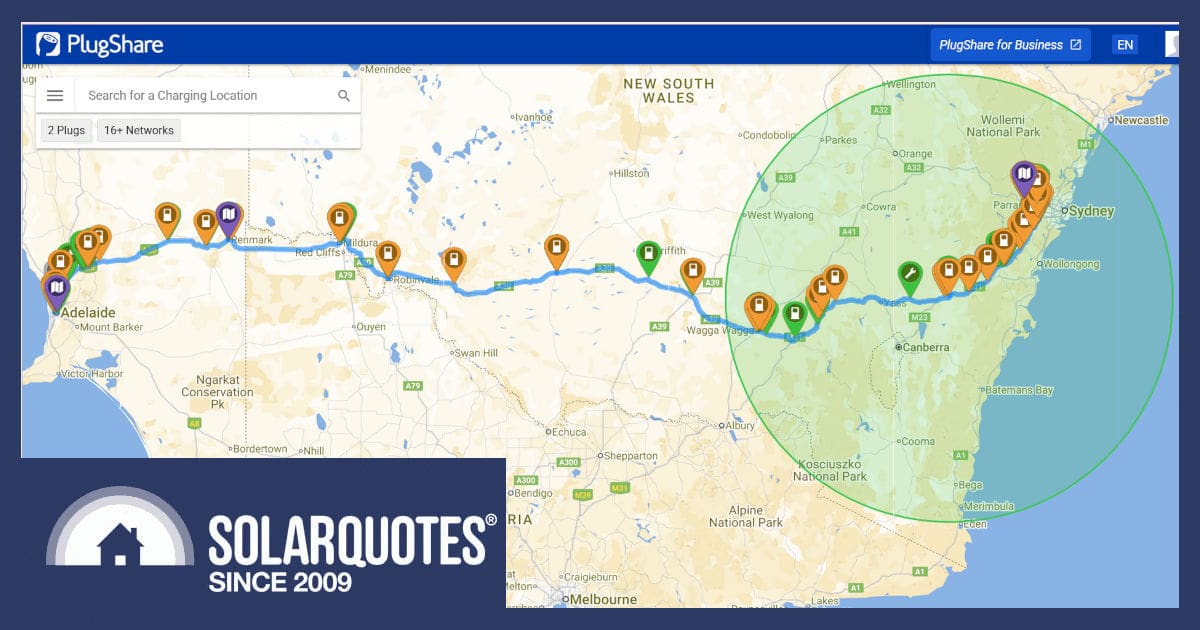
You might say Adelaide to Sydney via Renmark, Hay and Gundagai is a bit of a journey.
So can you do it these days with an EV? I think the answer is yes, certainly.
However there’s also room for improvement to take electric road tripping from just possible to being a most pleasant experience.
To be honest I think “holiday” is a pretty loose description for a`1400km car journey with 3 kids under 8 in the car, but rest assured dear reader, I’m trying to make the best of the situation.
For interest’s sake I’m seeking out the EV chargers in whichever place we stop. This is by no means a comprehensive review, but more of a survey to secure support for a possible future EV purchase.
Plug In Hybrids Are Old Hat
As much as they’re popular, I think you’d have to be a real chicken to buy a hybrid these days. They’re complex, expensive to service and most likely to catch fire. A petrol car with a semi-electric transmission is a turn of the century idea.
Toyota have gone from industry leaders to absolute laggards, while the last Subaru hybrid I looked at was a 1.1kWh joke. They took years to develop about one fifteenth of the capacity of a Mitsubishi.
We’ve enjoyed the experience of a plug in car – there’s much more useful grocery getting range in the moderate sized battery you get with a Plug-in Hybrid Electric Vehicle (PHEV), but a hybrid is sort of the worst of both worlds now.
However after some 8 years pouring petrol on the problem, my better half still wants some reassurance. As an early adopter, we’ve recently made Mitsubishi install a new battery in the 10 year old Outlander. It’s been an excellent car but at 50% state of health the original battery was getting a bit doughy.1
While they were working on it we had a standard loan car which proved one thing – repeatedly tipping $90 of petrol into it wasn’t well received.
So what better way to demonstrate the availability of charging infrastructure than to force the whole family to do a driveby and get a photo.
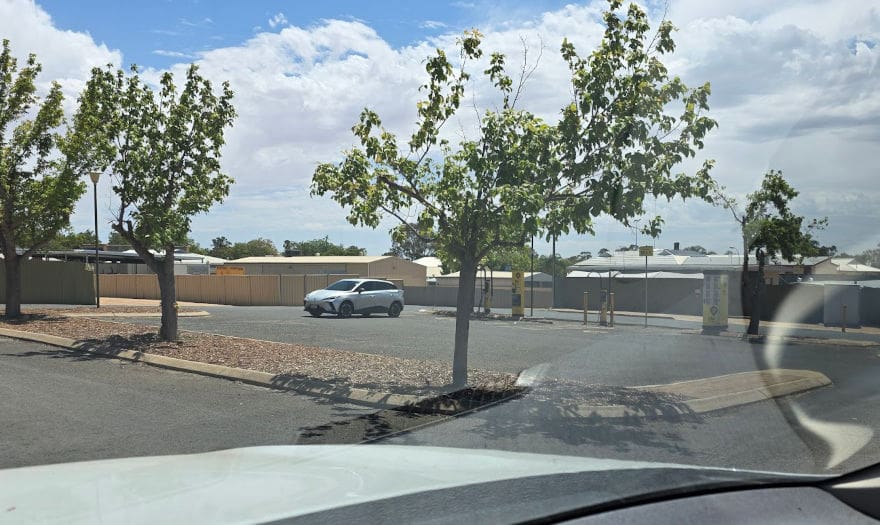
Barmera has a useful setup, trailer accessible with CCS and CHAdeMO for the Japanese EV tragic. However, despite the cameras, it’s concealed at the back of the pub, and this might be a dauntingly dark spot.
Charging Should Be Child’s Play
If you’re travelling with kids, wearing them out is a great way to make the car journey quieter – a charger near a playground is a winning combination for road trip breaks.
My Mum has a fond lament about interstate trips with kids, having to stop at every playground that had a spiral slippery dip, but it seems they’re out of fashion these days. Sadly playgrounds have been thoroughly sterilised since I was a back seat passenger with an eagle eye for concentric slides.
And we’re not going to mention Monash, other than to say what’s there is a piss poor imitation, a travesty against adventure and a heartbreak for anyone who remembers the real one.

Flying fox and a spiral slide, what more could you want?
Chargers Must Have Toilets
For years now the authorities have been trying to get the message through about REST, REVIVE, SURVIVE.
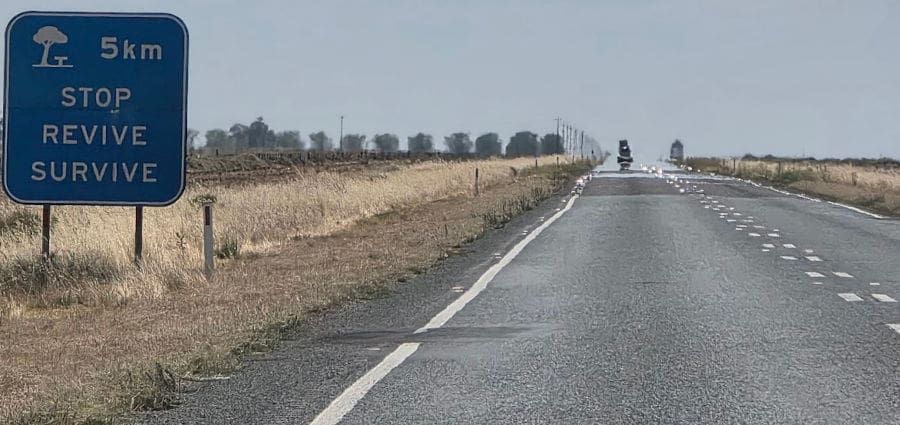
I’ve driven this at 55km/h in a hundred year old car.
While I’m sure many of the diesel diehards insisting on nothing less than 1000km range will reject the road safety people making motherhood statements, fact is we should be stopping every couple of hours. In fact I’ve done a Bathurst trip with a Falcon ute, the V8 was great for overtaking, the thimble sized fuel tank made us stop regularly.
So wherever there is a charger there must be some amenities, but we don’t have to build everything from scratch.
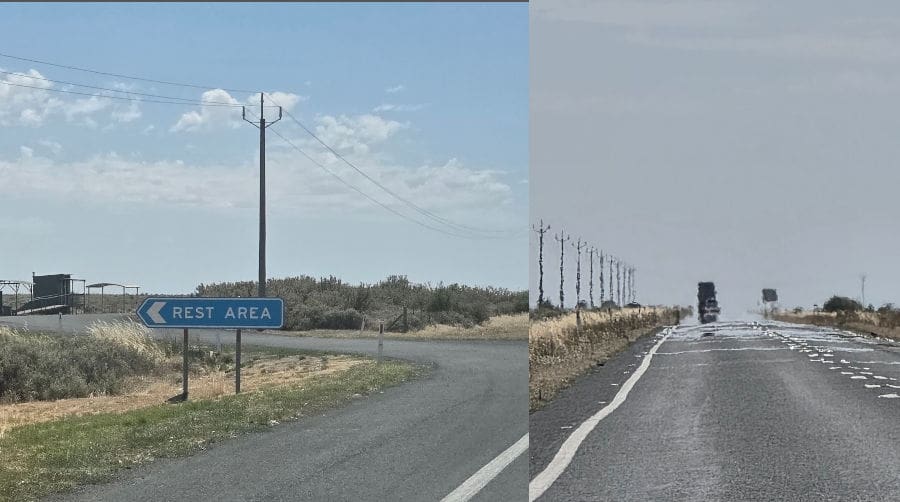
It’s hard to get the whole Hay Plain into a picture, but at least some of this pretty featureless flat landscape has places to pull up and power lines to tap.
Bypassed Towns Can Draw Weary Travellers
Between Hay & Wagga there’s a well worn truck stop at Waddi, but venture just 2km off the highway there’s a lovely little town called Darlington Point that’s dying for an EV charger or six.
If the proprietors of the well reviewed Punt Hotel had half an inkling, they could pull purses off the main drag for a meal, as could the community sports club.
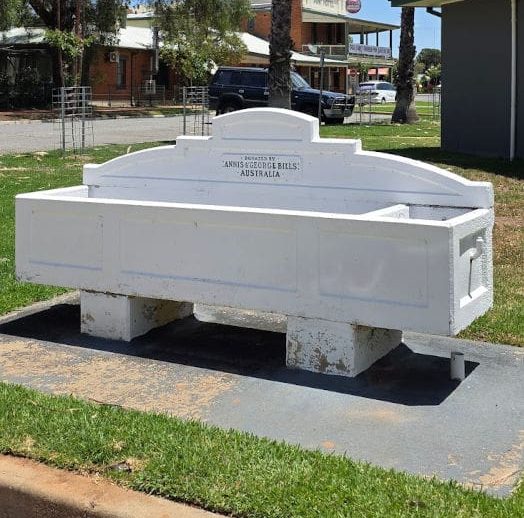
Transport infrastructure was a little simpler when watering the horses was top priority for the Punt Hotel
Wineries have installed cheap & slow Tesla destination chargers to attract clientele for a decade now. It’s about time small businesses qualified for some concessional loans to expand EV access to “the bush” while community clubs could turn a dollar or two selling electricity from their rooftop solar.
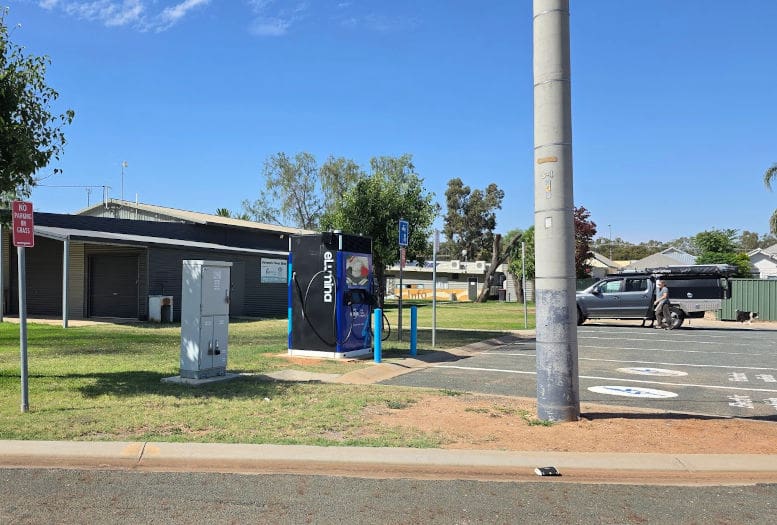
Balranald got it right, except like most, you can’t readily access this unit with your trailer in tow.
Gundagai’s Gunna Leave Us Agog
At Coolac there’s a bank of Tesla mega super duper chargers, very fast, very convenient to the Hume Highway, but plastic porta potties aren’t pleasant. While there’s work being done on an adjacent pub, over the road there’s a brand new petrol station.
What simply astounds me is the town of Gundagai already has the perfect location, 375km from Sydney, on the road to Melbourne; with zero chargers.
Imagine a broad but quiet main street, tourist information bureau, public toilet, grassed park, established trees and brilliant playground.
Plus there’s an RSL club serving meals across the road, right next to a motel. Oh and a major supermarket carpark sandwiched between them.
The precinct surrounds the local council office carpark, you simply couldn’t ask for a better spot to stop.

Gundagai has a lot going for it, not least of all angle parking and other amenities
Searching yields a 22kW slow charger at the caravan park, but it’s been broken for years. Someone cares enough to laminate a label, yet “Sorry for the inconvenience” is so weathered, it would be more honest as an erect middle finger.
With these opportunities going begging, you begin to wonder, what is wrong with these people?
Civilised Services
Does anyone remember “Full Driveway Service” at the petrol station? My brother had a job pumping fuel as a youth, so I guess it was close to 40 years ago. It’s still law in the US state of New Jersey.
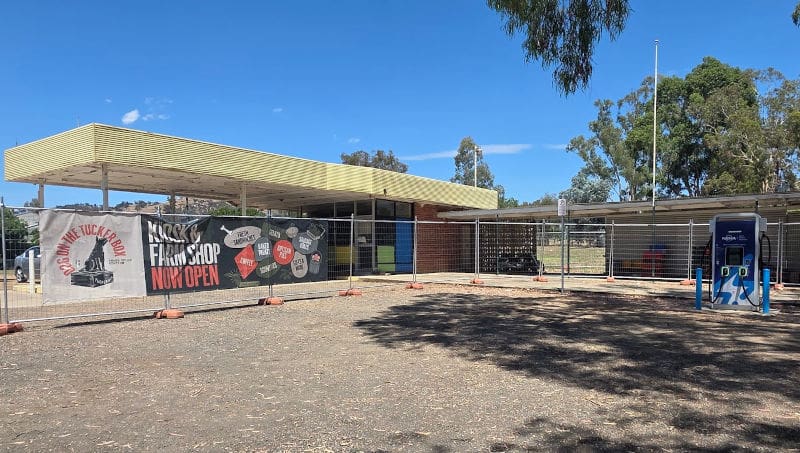
As petrol recedes, scenes like this at The Dog on the Tuckerbox will become common. We should use the opportunity to repurpose them with EV charging, antique stores, record shops & caffine dispensary.
These days, attendants would pour coffee instead of engine oil, but simply having a person at a well lit petrol station with a charger would make things better for EV owners.
It makes my blood boil when brain dead vandals ruin the one charger you really need, because it’s unsupervised. The last thing you want late on a cold, damp winter’s night is a phone pressed between your ear and shoulder, both hands on a charging lead, speaking to tech support to remotely start your charger session. Been there, done that, made it work thankfully.
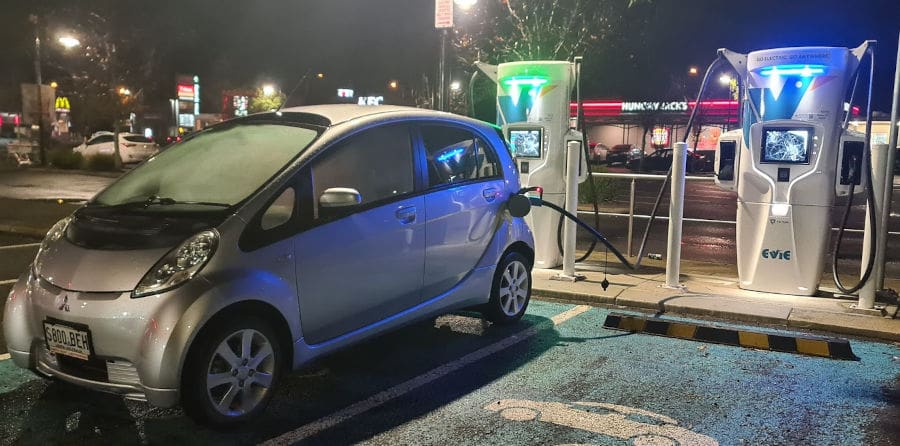
Given a battery upgrade our old iMiev would be an interstate contender, but this particular evening was a battle with smashed EV charger screens.
Anxiety Isn’t Just About Range
We’ve already seen some EV households move back to fossils. Not because the vehicles are inferior or the owners don’t love them. Rather it’s simply because when plugged in, your car is immobilised and the locations of some EV charging infrastructure makes women in particular feel uneasy.
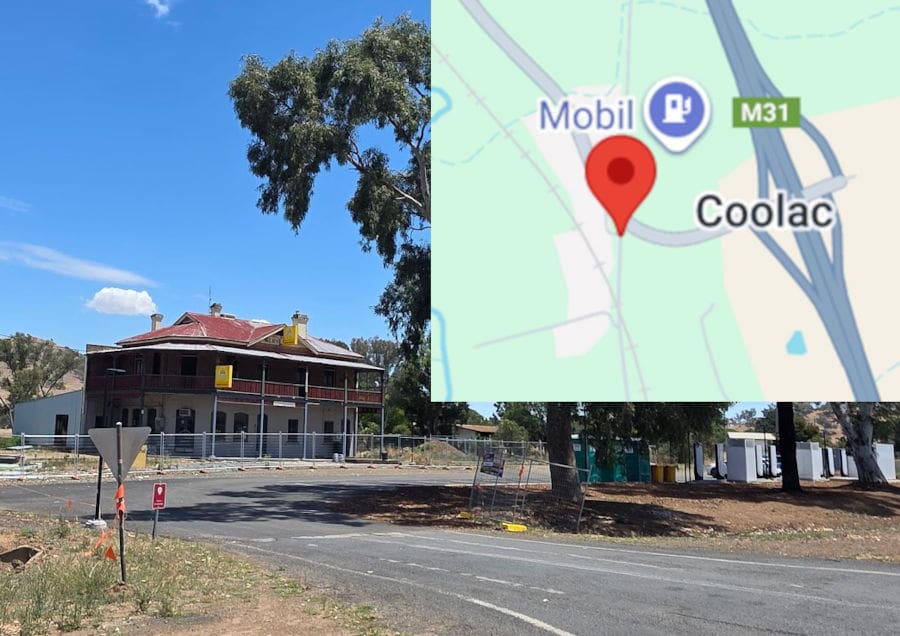
Tesla have installed charging but this pub/motel is sadly derelict, so EV owners must hoof it over the road to the brand new petrol station.
Parking down the back in the dark is enough to give people the creeps, and some accessory makers have recognised this fear. For US cars they sell break away adaptors, where you can drive off without unplugging in an emergency.

Coolac petrol station doesn’t include EV facilities
Rolling Out Better Travel
Good friends of mine recently drove Adelaide to Melbourne for a concert. They opted for a basic 15yo petrol wagon over the 2025 Hyundai EV they also owned, because even though route planning is easy and range is plenty for a two stop trip, they didn’t have the confidence to just go for it.
While EV charging is vastly improved over the last few years, with fast chargers installed roughly every couple hundred kilometres along major interstate routes, getting from possible to preferable still needs work.
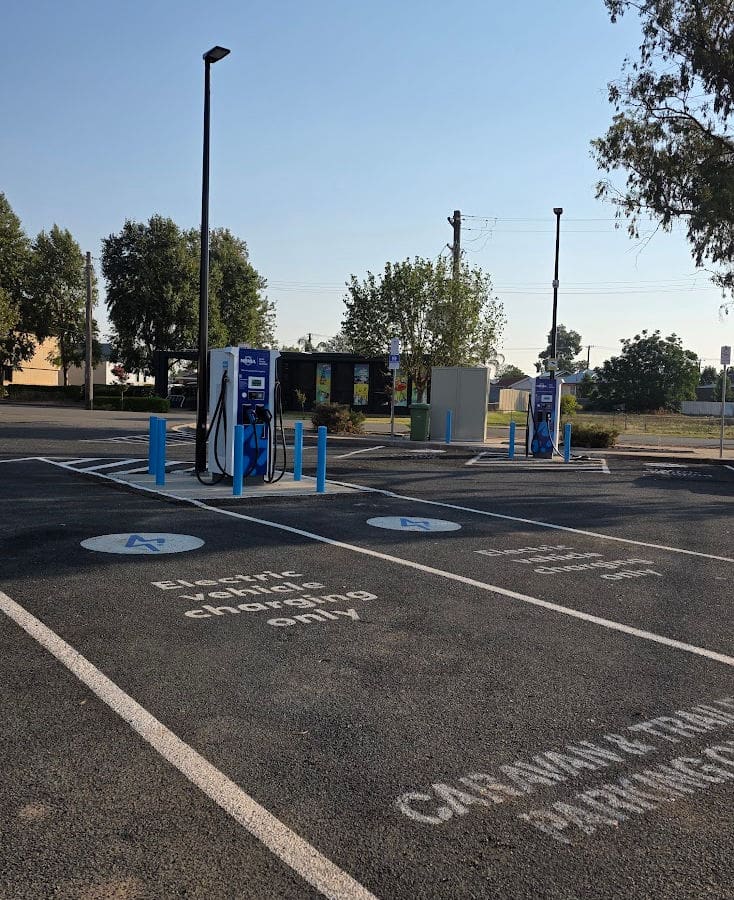
There should be more pull through charging for trailers. West Wyalong has an adjacent public library, but imagine if your EV charging account would open the doors after hours.
Still when I spoke to the operator at the Euston Servo it soon became apparent that for those running LPG powered cars, range anxiety is going to be a thing soon, if it’s not already. Selling $100 of gas per week made no sense when the bowser repairs were $2000 & pressure testing the storage tank is next.
I’m looking forward to a time when road trips aren’t just about flogging across the country in one day flat. Having nice places to pull up and the expectation to use them will make travel much less dreary.
For all the focus on public EV charging infrastructure, most charging is done at home – to get up to speed read our guide to home EV chargers.
Footnotes
- We’ll write a whole story on a PHEV battery soon. ↩
 About Anthony Bennett
 RSS - Posts






The aspect of this topic that is rarely (never) discussed, is how fossil fuels habituated us to long trips in the first place. We’re hypermobile societies now, which causes all sorts of problems, including living the consequences of the first law of traffic engineering, that what creates traffic is roads.
This idea you mentioned that our everyday vehicles need that 1000km of range diesel enthusiasts request should strike us as socially absurd, that this is now some baseline capacity we need regular use of. We turned the every now and then long holiday trip into some sort of core feature for all driving.
As is happening now in urban design, a lot of the assumptions that a century of motoring introduced into our social lives can be ignored and re-framed. Like this idea that we always need to be out, going somewhere, guzzling energy because we’re a fundamentally ungrounded culture. The grass is always greener somewhere else. As the 15-minute city ideas target, just move about less.
Why limit it to diesel? The reality is families are often scattered, not just different towns, but different states, even different countries. Expecting 1,000 km of range as baseline capacity isn’t particularly exceptional.
Worse, there seems to be a view by (inner?) city dwellers that EVs with an absolute maximum of 200 km or so are the way to make things cheaper, more available, and more than sufficient for daily use. It seems incomprehensible to them that some folk do well over 100 km in a single trip on a single day.
There’s a reason ICEVs remain popular – they have range and they’re easy to refuel, unlike EVs. As for that 15 minute city idea, sure, great if you can get it to work in the inner city, but for the rest of the country it doesn’t.
The causation is backwards. Families for example now increasingly live vast distances apart because fossil fuels made regular long trips feasible. This sounds like a great thing, but to achieve the same sort of close family contact that we already had by burning 3 million years’ worth of energy in 300 isn’t progress.
As the new urban design realised, if you prioritise mobility over all, then all spaces become meaningless, because they’re all interchangeable with everywhere else. I imagine aliens observing our cultures, scratching their heads and saying to each other ‘where is everybody going?’
Nick: – “This sounds like a great thing, but to achieve the same sort of close family contact that we already had by burning 3 million years’ worth of energy in 300 isn’t progress.”
…and releasing huge amounts of greenhouse gases at an unprecedented rate into the atmosphere we all share in the process, driving the Earth Energy Imbalance (EEI) higher and higher.
https://www.co2.earth/daily-co2
https://bsky.app/profile/climatecasino.net/post/3m5yhfcn7bs2b
While ever the EEI remains in a net energy gain state, then planet Earth will continue to warm.
More greenhouse gas emissions means ongoing warming towards a planet incompatible for human civilisation, likely well before the end of this century.
https://images.squarespace-cdn.com/content/v1/5bc6826490f904980a50659a/0105c0ea-c715-4925-97e3-c484b9e04380/HCN-FullSequence_c.gif?format=1500w
I fundamentally disagree. People move because of jobs, lifestyle, health, marriage, and assorted other reasons. Proximity to family is a consideration, but not an absolute.
Urban designs mostly do make spaces meaningless – they all tend to look the same and offer next to no view. Mobility and quiet are two of the few big differences.
Oh I think there’s plenty of reasons imaginary aliens could observe our cultures and think they’re nuts! Mobility and reliance on fossil fuels are not two of them though – most SF presupposes even more mobility e.g. interplanetary travel, though power has usually shifted from fossil fuels to nuclear, anti-matter, H-fuel, or something else even more exotic or imaginary.
Hi John
They move because it’s an option. And then the option becomes the normalised expectation, that people will ‘move to where the jobs are’. Remember “all roads lead to Rome”? That wasn’t a celebration of the ease of getting from A to B. It was a recognition that universal mass, easy transportation leads to centralisation of everything into a few hubs.
Moving around lots just means space and territory has lost its agency, the first thing putting a new big road through an area tends to do is empty that area of people and their previous social and cultural lives.
Nick, folk have been moving for centuries – how else do you think Australia became a country? And that was pretty much pre-fossil fuels – steam trains started early 19th century, so a couple of decades later.
All roads lead to Rome reflects the role of the empire’s capital, and probably military interests.
Space and territory don’t have agency. Roads grant people easy access to hitherto inaccessible, or difficult to access, areas. As development increases, more people move in, though it’s somewhat circular – more people leads to more development leads to more people …
Now if folk want country living, and an area turns city, yes those folk may move on because of the change in society, environment, and culture, but that’s not quite the same thing. And depending on pace, it may be generational.
Hi John,
The bicycle is not only one of the most efficient machines ever invented, it had the greatest impact on human genetics, because it gave people 4 x range and thus more options.
We must go back to more bike riding.
I had the Gundagai experience. Pulled up at the Olivers place, but, only Tesla incompatible chargers. The boy in Olivers said”Yeah they came and took them away a few days ago. We’ve been getting enquiries”. I rang Chargefox, who told me the nearest chargers were in Tumut, and said “Have a nice day”. I went to the caravan park but the woman explained that half the caravan park blacked out when a car was charging, so they dont do it any more. I had to book in for a night at the Poets Recall motel, which has an overnight charger. The proprietor told me that trickle charging is highly dangerous. (People often tell me alarmist things about electric vehicles)
I called in at the information centre, where there would be lots of space for chargers, and was told that Council rejected an application to have chargers installed there. The reason? It was not necessary and there was no call for it.
The chargers are being installed in crazy places. They need to go in at petrol stations
Behind Olivers 100m from the ChargeFox ones out the front, there are six Tesla only 120kW chargers. Olivers is 200m from The Dog on the Tuckerbox
Tesla only according to PlugShare app
Chargers should be in petrol stations, shopping malls, information centres—places with other amenities. In Young they are in a back street. In Wagga there is a bank of Tesla superchargers at the other end of town.
Vandalism is a big problem in country towns. Chargers at petrol stations could be supervised.
Is it true that the German government mandated that all petrol stations must have electric chargers installed?
All chargers should be fast chargers. What is the point of slow chargers?
And, why all these separate cards and brands? If chargers were at petrol stations we could surely pay by waving our phone at the little black gadget like petrol buyers do.
Fast chargers can be a bit annoying. Not fast enough to sit and wait to finish, but too fast to go and do something else meaningful.
I’ve had to interrupt my lunch on numerous trips to go an unplug the car because it had finished charging, (because after 5 minutes grace another steeper type of charging begins…$$)
Aside from fast chargers, councils and businesses should be installing lots of 3 phase 11/22kw AC chargers (simple / reliable / cheap to install and operate) in the centre of town to allow travellers to leave the vehicle and enjoy a coffee and a succulent lunch in a local cafe and spend some time and money in local businesses.
From a drivers perspective the kwh price of power delivered via an AC charger is less than half that paid for high speed equivalents, and causes less stress on the cars battery.
Hi Craig,
You make a good point, I’d like to see lots of slower chargers absolutely everywhere cars get parked.
The reason that isnt happening is because the business model to encourage it hasnt yet been found. I suspect I’m like most current EV drivers who can charge at home much more cheaply than even the cheapest AC charger so dont generally bother with charging away from home unless I need to.(Unless of course my workplace or business has decided to provide them free, but thats not realistic at mass scale). Most car trips are to routine places, not for occasional long distance travel, so if AC charging could be provided at a comparable price to what I can do at home to the extent that I’m motivated to charge wherever I am that would be the game changer
OK this is a good and important point. I have owned an EV for 2 years and charged at home 100% of the time. I don’t have much need for long car trips, if I’m going away for a holiday it’s more likely on a plane than in a car. Maybe one day I’ll do a long car trip, but life would be fine if I didn’t.
I suspect most urban EV owners are like me, with cars doing 98-100% of their work in a 50km radius. It would be pretty fair to ask the question – who wants to invest in a charger in an arbitrary town with a small chance of serving my needs (and the needs of my 10,000 lookalikes)?
I thought there was a push somewhere to make chargers in petrol stations a requirement but don’t recall details. I recall hearing that a guy who wanted to have his own station opted out because the required EV charger investment was a huge waste of money that negated the profitability of the business.
Honestly, it’s not clear it would be viable given the narrow margins so many of them have, and there’s already far too many stories about staff being (illegally) underpaid in a bid to cut costs. Add in the grossly overpriced food and drink most of them sell to try to break even and …
If you only need 1 reason to buy a Tesla (even if you hate Elon) it is the charging network. Nothing beats it. 8 years owning a Tesla, road tripping all over NSW and Vic and driving Sydney-Melbourne every long weekend is a piece of cake.
>Tesla … charging network
It’s a pity they are all only 400V chargers, with many new vehicles having 800V architecture, it makes charging at Tesla comparatively slow at only 80-85kW. I still use them as they have the lowest pricing, but sometimes on a long trip a bit faster charging would be nice, such as I get at Evie and some others.
Though I am certainly not a luddite, I am not up to date on current EV technologies. I agree with the principle of vehicle electrification but am not there yet myself.
What I don’t understand in terms of practicality is how will petrol/diesel owners ever be convinced to convert when there seems to be nothing like the convenience of the typical petrol/diesel vehicle refill: a vast network of places where a driver can pull in to a servo, then 5mins later your vehicle is full and you’re back on your way.
Serious question: will EV’s/battery tech be able to reach that level of convenience?
We have just done the Adelaide, Barossa, Port Augusta, Baird Bay trip and then return direct to Adelaide in a rented Tesla Model Y (big shout out to SIxt who are leading the way in EV rentals in Australia)
We (I) researched the trip before we left from Sydney to check it was doable in an EV without having to go out of our way looking for chargers etc.
Using a combination of Google Maps and A better Route Planner (ABRP) it was eminently doable with little to no anxiety along the way.
The scariest part of the whole trip was staying in an eco resort in Baird Bay that was at the end of a long thin electricity line – line voltage kept sagging at various times so the Tesla Granny charger kept cutting out – but as we were there for 3 days we just kept resetting every morning and night and got there in the end.
We were an adult couple so did not think/worry about playgrounds etc – but they are good points.
Only the Tesla superchargers in Port Augusta did not have readily at hand toilets.
We had a similar experience a bit over a year ago visiting friends in Perth, then driving anti-clockwise around to Albany and back in a rental Atto3. Sixt were offering free Chargefox charging at the time so combined with an auto club discount the rental was great value! Maybe not so much for Sixt after all our fast charging. Once we had confirmed that yes, there were enough fast chargers dotted around the place (thanks to a fairly recent charging infrastructure build out) a combination of Plugshare, ABRP and the Chargefox app was more than sufficient. We had our first charger chat with a lovely couple from Colorado, and were generally able to combine charging with lunch or evening stops. We got progressively more comfortable with the behaviour of the in car range estimate so ran it down to 13% on one leg on the way back to Perth. EV get up and go is certainly useful for a quick sprint past road trains.
PS Yes, the climbable portion of the one open peg tree was duly climbed.
In theory that will absolutely be a possibility. BYD have recently announced a 1MW charger which can do 400km range in 5 minutes, while it isn’t 1000km range in 5 minutes you would also be able to do the other activities that would normally happen at a stop like that while “refueling”. The idea that we are stuck with current technology for the rest of time just doesn’t make sense.
While what you say may be true for the long road trip, how often are those done? For lots of people that maybe once or twice a year (or almost never if those longer “holiday” trips are within the range of your car and you can charge at the destination). The rest of the time there is nothing like the convenience of never having to go to a petrol station. Once you are used to just arriving home and plugging in, it is a real drag having to go to a petrol station every week to fill up (before you even consider the pain of all the money your handing over).
People seem to often fixate over the rare potential for some slight inconvenience and forget all the increased ease and pleasure of the day to day experience.
Hi Ken,
Very well put. For those who are susceptible to the propaganda that EVs are a “war on the weekend” we just need to keep reassuring them.
The dual cab ute with bullbar, roof rack, awning, canopy, slide drawers, fridge, max tracks… all sounds really good for your annual easter holiday, and a massive waste of time for the rest of the year.
Hopefully we can make EV camping a thing soon.
Its funny how we are blinkered to the compromises. 90% of the time charging my EV is more convenient than my diesel wagon, but 10% of the time the charging can be a more of a faff (find a charger, is it working, do i need a cable, do I have the right app installed, will it work or will I need to call tech support, how long will I wait to charge etc). Yet people seem fine with the clunky Ute or SUV that they need to tow the van twice a year but for the other 48 weeks is heavy, slow, thirsty, has crap visibility for pedestrians and doesnt fit in the garage or shopping centre carpark. It gives somewhere to store the maxtracks and roof top tent though…
Yes! The thing I least appreciated about buying an EV was how much I wouldn’t miss filling up the car.
I also completely agree that the convenience for the majority of the year outweighs the slight inconvenience for the annual road trip, hence just ordered a second, bigger EV and about to sell the Prado. Though the resale value of the Prado indicates that the vast majority don’t appreciate this, they’re in high demand. Second hand EVs, not so much.
Toyota sells 13 to 14 million a year, byd with massive government subsidiaries sells 2/3rds hybrids and 1/3 rd electric even with Chinese government interference
Every week? Depends on your vehicle and mileage. There’s plenty of folk who do it fortnightly or less, include it as part of their regular travel, and keep an eye out for discount fuel making it zero pain.
Pain would be having to remember to plug the car in every time you get home, and monitoring the solar all the time to know if you need to switch off your car charger because you’re drawing from the grid and paying instead of getting it free like the EV crowd promote.
So long as we have actual freedom to choose, we can do as we each prefer.
If you’re fuelling you’re ice car fortnightly, or less, then you would need to charge your ev less as well surely. Even if you’re paying for off the grid electricity it’s still cheaper than fuel The only reason I dont have a ev is I cant afford a brand new car. As for convince, the most inconvenient thing is a break down, and evs have far less moving parts.
Actually no, because ICEVs offer far far better range than comparably priced EVs. Thus where I’d rarely need to refuel the ICEV, I’d need to do the EV after every trip – it’s a factor of distance x regularity.
I don’t know about you, but breakdowns are rare! That makes the inconvenience mostly theoretical – mostly because I actually have experienced one. It was just outside the supermarket on the way in, not out, thankfully, as anything frozen would have been thawed by the time I was home!
My point was obviously less km’s done means less charging required. And the point about breakdowns is valid. Both from a convience AND financial point. The only reason I don’t have a ev is upfront cost of a new car. Also I’m 6″8″. I’ve never been more comfortable in a car than I was as a passenger in a Tesla Uber. Its not nice having your knees in the dash as I do in heaps of ice vehicles. That Tesla was so comfortable.
Why not buy second hand then. There are plenty of very good used EVs out there for sale.
John Alba (at January 15, 2026 at 5:58 pm): – “Actually no, because ICEVs offer far far better range than comparably priced EVs.”
Evidence/data? ICEVs typically offer from 300 to over 600 miles (480 to 965+ km) on a full tank, with a common median around 400-412 miles (644 to 663 km).
Volvo have just launched their new EX60 BEV model with 3 variants:
P6 RWD: 80 kWh net – 18 minutes 10-80 % SoC
P10 AWD: 91 kWh net
P12 AWD: 112 kWh net – WLTP range max. 810 km, means 500 km / 300 miles real-world motorway range probably
DC 800 Volt battery fast charging 320 or 370 kW (AWD models)
See review: https://www.youtube.com/watch?v=SDHEm5aFOuE
I’d suggest this technology will inevitably flow through to more & more BEVs in the the next few years, & then your statement will no longer be valid.
Drivers need to have regular rest breaks every 2 hours to minimize fatigue.
https://www.mynrma.com.au/open-road/advice-and-how-to/driving/stop-revive-survive
Hi John,
Any decent EV charger will work in “solar surplus” mode, where it harvests nothing more than the available sunshine. There’s no pain because it does it automatically.
If you can remember to close the door behind you, plugging the car in is also pretty painless.
And even if you had to use grid electricity, it’s still 60 or 70% cheaper than buying petrol. Again painless because it’ll happen while you sleep.
What’s even more painless is that you don’t have to keep an eye out, or calculate if it’s worth driving a few extra kays for cheap fuel.
Painless is forgetting to even look at the price of petrol when driving.
Plugging the car in would actually be a pain in the neck – powerpoints, cables, and access – yes some decluttering might be in order, but the main issue the garage isn’t designed with EV recharging in mind.
Is it? I’m not sure the c/km for kW v L, prices vary a lot, and there’s the whole road tax on ICEVs v free ride for EVs, plus electricity will soar as demand increases and reliable supply vanishes.
Who keeps an eye out, or drives extra? Okay maybe 2 km locally there and back off route to get air in the tyres and fuel in the tank, but that’s a 2 for 1, and an EV would be worse – heavier car so more tyre issues. Conversely the main long run goes straight past a cheap place so it’s easy savings and no fuss.
I mostly don’t think to look, but occasionally I do an ‘ooh that one’s expensive’ or the alternative ‘ooh look it’s down to $1.50’ or whatever.
Hi John,
Read here, and you’ll find an image of a very vintage garage that has been retrofitted for electricity, it’s really not that hard, we’ve been doing it for over a hundred years.
If people can’t work out how to plug in an appliance in order to save thousands of dollars per year, then I’ll assume they can’t be helped.
Hi Shane, to answer your question, yes eventually batteries will be able to charge in 5 minutes. But it will require battery technology to have 1 or more step change improvements. Also, there will have to be huge improvements in charging and electricity transmission technology. as the amount of energy flow required to charge an EV battery in 5 minutes is massive!
Great question! Keep asking.
Shane W: – “Serious question: will EV’s/battery tech be able to reach that level of convenience?”
Can one top up ICEVs at home using fuel sourced from home? Nope. Petroleum fuels are primarily (93%) imported, derived from finite reserves.
BEVs can re-energize at home using home-based electricity generators.
Volvo have just launched their new EX60 BEV model with 3 variants. The 800 VDC traction architecture has 320 kW (RWD variant) or 370 kW (AWD variants) fast charging, allowing 10 to 80% state-of-charge in 18-19 minutes.
Per EV Database, for the P12 AWD variant range (with one intermediate 15 minute recharge at max rate):
Mild weather: 849 km 1-Stop Range
Average weather: 742 km 1-Stop Range
Cold weather: 659 km 1-Stop Range
https://ev-database.org/car/3443/Volvo-EX60-P12-AWD
I’d suggest this technology will inevitably flow through to more & more BEVs in the the next few years.
Drivers need to have regular rest breaks every 2 hours to minimize fatigue.
By far the most relevant / important factors in EV travel are ignored by so-called ‘expert’ journalists, suggesting that they have had little if any actual experience travelling in an EV
There are still far too many Tritium DCFCs out there and as every EV driver knows full well, Tritium chargers are more likely broken than working. I think all the original Australian-made units are dead and buried by now but the later Indian-made disasters are probably even worse in terms of lifespan. At best these things last a few months although they have been known to cark it within weeks … for example the Gold Coast Council head office at Nerang had one that lasted ten days and was never repaired. The original Queensland Electric Highway units and many other Tritium units were / are MIS-managed by Chargefox, a company with no financial stake in the chargers and hence no interest in whether or not they are working. Others are managed by Evie and those are usually in working order.
The half-life of Tritium is about 12 years. Similarly the half-life of Tritium chargers is about 12 months. After a year, half of them have decayed.
I can’t agree with you about Tritium chargers. I like them. If I have a choice of charger on my travels I opt for Tritium. I find them easy to use and, these days, pretty reliable. I feel they have an unjustified bad reputation that was gained in the early days in Australia because they had the market in DCFC almost to themselves. In the late teens and early 2000s they were about 95% of all DCFCs in this country, so if someone stopped at a faulty charger it was nearly always a Tritium charger. Thus the reputation. I also noticed that a number of times people complained on PlugShare that ANOTHER TRITIUM charger was unserviceable, it was not a Tritium charger at all but some other brand. As you mentioned yourself, most EVIE chargers are well maintained and the vast majority of EVIE’s chargers are Tritium.
COVID didn’t do them any favours either as quite a significant amount of their internal equipment was Chinese in origin and their supply of spare parts halted during Covid.
Current Tritiums are indian made and their longevity is measured in weeks..The only reason some are working is that Evie (unlike Chargefox) puts its own money into the business and installs multiple units. That said, NRMA is replacing its Tritiums with Swedish made Kempower units for reliability reasons.
Actually you are incorrect. An Indian company Exicom Tele-Systems owns Tritium but the engineering centre is still in Brisbane and manufacturing is done in Tennessee.
Regardless, they are still sub-standard short-lived rubbish. Very few if any of the original Qld Super Highway locations north of Brisbane are ever working, the Gold Coast Nerang one lasted less than two weeks, and NRMA wouldn’t be replacing all theirs if they were reliable. Try finding a Chargefox Tritium that is working … although the who cares culture of Chargefox doesn’t help.
Huh? Gundagai has a bunch of chargers both Tesla and others? Near the dog on the tuckerbox. Also facilities there including food. Are you specifically talking about destination EVSEs?
Hi John,
Have a read of the captions on the pictures for more nuance. Cheers
Your words
“What simply astounds me is the town of Gundagai already has the perfect location, 375km from Sydney, on the road to Melbourne; with zero chargers.”
There isn’t much nuanced about that – you got it wrong. I’ve charged my Tesla there on the way back to Melbourne – as you suggested ideal location.
Hi John,
Was it Olivers at Dog on the Tuckerbox that you used? Or the NRMA charger pictured in the article? They’re 6km away from the town of Gundagai.
Or are you confusing Coolac, 16km away from Gundagai and also featured in two images with captions?
There’s only two destination chargers in Gundagai, one private (attached to accomodation) and the other is broken.
Yeah, still a time of adventure for EVs. And children.
Thinking back to those driveway service days reminded me of a great service
NRMA (& other motoring organisations I think) used to provide. Strip maps. These would show everything you needed to know like toilets, refueling, playgrounds, points of interest, interesting history, etc for a small 50-100 km strip of road. When I was going any distance I used to grab a collection of strip maps from start of trip to destination, along with a few (outside of route) diversions along the way. Interestingly one of the main uses of these was in fact picking out refueling points.
I wrote to NRMA pointing out that in the EV universe such a product would be excellent, but they just referred me to the internet!!??
So guess I’ll just have to ask AI to create something similar.
I remember the Hay Plain had a great entry – “road is flat for next 30 miles, then rises 8 feet, then flat for another 20 miles”
Tony. I am a long time EV user. In the last few months I travelled 3600Kms fm N Coast NSW to Melbourne in a round-a-bout way. Recently purchased Atto3. Only 1 time I was really worried, but all OK.
Unfortunately Gold Coast Council removed all their chargers that were financed by the Electric hwy. Pimpana was great, but no longer.
As far as planning trips: Plugshare is the app to use. AS long as users update if they see a problem, I have found Plugshare is great.
I have found good fast charger access as long as it is not tourist season. I travel during the week usually.
Forgive my incredulity Doug, but what sort of ignorance is prompting people to remove EV charging?
I think the reason some chargers have been removed is unreliability. There is no point persevering with units that fail constantly. Hopefully that won’t be as much of a problem in the future as Tritiums are recognized as being rubbish and installers choose Kempower and reportedly good Chinese DCFCs.
We drove our BYD car from Sydney to Thredbo a couple of weeks ago. The “range” at the start was 490km. I expected that driving on the motorway at 110km/h would reduced the range. By the time we got to Canberra (312km from home) the remaining range was just 30km! So motorway driving reduced the range by about 30%.
Had a great italian lunch while fast-charging at the Manuka shops (4 chargers)
At Thredbo there are several Type 2 chargers in the eastern-most car park. We charged the car from one of these while we did a day hike.
For the return trip we used public fast-chargers at the Woden Kia dealership (2chargers) and the Mittagong shops (4 chargers).
So the trip was a little stressful but we realised a little planning makes it work.
High Michael,
Sounds like a great trip. Highway mileage certainly does chew battery up, to the point that people are discovering the retiree caravan enthusiasts are right, 90km/h gets you much further than 110km/h.
Now if we could only teach them to pull over and let the 110km/h traffic through…
Air resistance follows a cube law, so just upping to 99 km/h from 90 km/h increases drag by 33.1%. When towing a caravan, drag at high speed has to be much higher than rolling resistance. (It is the large flat untapered bum end of the caravan, which maximises drag, through the vortices created.)
And 110 km/h vs 90 km/h is (110/90)^3 = 1.8257, i.e. 83% more air drag.
That’s expensive in a fossil-burner, and range-reducing in a BEV.
What I don’t understand is cars doing 90 km/h where there’s no overtaking, then accelerating to 110 km/h as soon as there’s an overtaking lane. It is so frequent that this perverse psychology must be quite prevalent. (We engineers are said to be linear thinkers – means we try to relate causes to effects in a rational manner? And human behaviour often defeats that. (Yeah, global heating, too.))
Hi Eric,
It’s very noticeable in a little EV Kei car what drag does. With the aerodynamics of a toaster, battery consumption falls significantly when you tack onto the back of B-double at 100km/h.
I’ve always been curious to know if the truck is aided by filling the void behind it? If you get out of the bubble, the buffeting is quite significant.
Don’t start me about overtaking lane speedsters. Dad always said if he could have a superpower, it would be to issue flat tyres at will… some of them deserve a blow out and speedy excursion into the bushes.
Why should the rate payer pay for your ev charger
Hi Ian/Jenny/Ann,
Why should the ratepayer be forced to breathe your tailpipe emissions?
I think i mentioned in a previous blog that the 4 fast chargers at Manuka (and likely many other locations) have a combined overall charging limit. So when I first plugged in I was only getting about 25kW as all others were in use. Later this increased to 75kW as chargers became unoccupied.
Yes this is the worthless reality of current DC charger technology and the local electricity grid I suspect. I was plugged into a 75kW DC charger the other day and verified I was getting 75kW from it and the time it would take to recharge to 80% then went into the nearby shopping centre. Saw on the app while I was getting shopping that someone else had plugged in next to me and my rate had dropped to 50kW so I had to hang around for longer. Other car was only getting 25kW I noticed. I knew this was a risk but it was pouring rain and this charger was in an underground carpark and I was passing through on a road trip so lots of things causing me stress that day.
This is what I was talking about elsewhere in this comments section, “50kw” is more than what 3 single phase houses can pull if everything is turned on at once that can be on and not blow breakers, 63A single phase is 15.2kw. So when BYD mumbles something about a 1MW DC charger available soon I think to myself where is the backing Grid infrastructure that will allow that to be in place and to work at full capacity and not affect anything else around it.
To me, at present we who are getting whole of house battery systems are in effect turning our houses into zero grid loads at worst and (exporting at best) yet in the system when that occurs does that free up capacity and mean that if someone wants to put in place a 150kw DC EV charger can do so without having to pay for a new substation to be installed next to it so that the businesses and houses close by wont brown out etc. I think managing capacity in front AND behind meter systems as a grid is at best V complex
Michael,
That’s quite interesting data. It suggests that your rolling resistance is of the order of 10% of air drag at 110 km/h. To minimise drag, WIndrose replaced external mirrors with multiple cameras on their BEV semi-trailers. It makes a difference, even when hauling a 50 tonne load at speed. (But it still takes a 729 kWh battery to give 600 km range with that load. Once prevalent, their 2 MW (per vehicle) chargers will be noticeable on the network, if distributed firming is slow to deploy.)
In a decade, road traffic and the grid will be a whole new world … or we’re in deep doggy doodoo. (Saw 4 Teslas in 50 cars the other day, an 8% blip in the general 2% BEVs observed that day on two highways, Vic & NSW. Let the S-curve rip!)
When there are enough chargers available you can be pretty certain you can drive up and plug in, and you can just tap your credit card to start charging without having to use anyone’s “app”, that’s when the level of convenience will make such a trip a pleasant experience.
Until then it is still an “adventure”
My next car will likely be a PHEV, as my wife is also leary of being stuck somewhere scary trying to charge on a trip, or even not being able to find a charger at all.
Hi Andrew,
As a PHEV owner I’m pleased I still have 60 or 70% of the factory brake pads in it at 147,000km.
However the oil changes, iridium spark plugs, various filters & extra transmission fluid changes done as a precaution for longevity are all a bit irksome, as is the time to organise them. My diesel ute is about to soak up $2000 for a timing belt at 125,000km, with coolant and $250 water pump, just because you’d be mad not to change that while you’re up to your elbows in it.
I’d rather waste time and resources on enthusiast vehicles than the appliance white A to B transport.
absolutely… but wife…
Hahaha…. remember that forgiveness is easier to obtain than permission 😉
Hi Andrew.
I have had an EV for 3 years now. My wife hates ANY new tech. She had driven my car twice in the 3 years. A couple of months ago we needed to buy her a new car and to my great surprise she agreed to get an EV. Her comment a few weeks ago was “I didn’t realise how easy it would be to own an EV”. She now lives in regional Victoria and regularly takes 300km trips.
Iridium spark plugs good for 100000 to 120000.
Oil change takes me a leisurely 1hr of my time.
Transmission is 60-80000 kilometers and takes 30 leisurely minutes.
Timing belt for your diesel ute with water pump at $2000 your mechanic is stealing from you.
My 1jzgte twin turbo timing belt kit with water pump is $347 delivered from Japan with another $200 for install or 2hr job.
Hi Jenny/Ann/Ian,
My mechanic is known for quality of work and fearlessness in invoicing.
They’re also people I’ve known since before I could walk, people I’ve worked for previously, so they’re not ripping me off.
If I wanted to be defrauded I would go to Solitaire in Adelaide.
They’ve previously refunded $900 service because they simply didn’t do the work ticked off their quality assurance checklist.
EVs simply don’t have these complexities or the need to deal with expensive or shonky dealers.
Curious to know the cost of the new battery?
Thanks!
Hi Mark,
The PHEV battery was replaced under an express warranty.
I would prefer to use the repacked battery available from OzElectric Vehicles. Instead of the factory 12kWh, the extended upgrade 18.5KW Pack offers 80km range. Installed for $12,900 INC. GST
$13000 is very expensive, maybe not for a very well off person like you but for the average person it is a lot of money
Hi Jenny? Ann? Ian?
The Outlander PHEV was about $55,000 new or a bit more than the diesel model at the time.
I couldn’t afford it new but for $30,000 with 20,000km it was good value.
Either way the car hasn’t depreciated as tragically as most and it delivers 7.5lt/100km economy on the highway loaded to the gunnels.
At 10 years of age $13,000 might be a significant lump sum, but so is a reconditioned engine or transmission.
Around town, the bulk of it’s 147,000km covered, it costs us about $0.57/100km for electricity.
So your PHEV battery alone is a third the cost of a new Corolla, yet still fails to offer more than double digit range?
Hi John,
Australians, (and that includes Corolla owners) seldom drive more than 20km journeys on average. In fact many journeys are a tenth of that distance.
The Outlander PHEV can be fitted with a new battery using first world Australian labour rates & taxes and it’s still only 23% of the sticker price on the car when it was new.
And the advance in battery technology means it offers 30% more capacity and thus 30% more range, better battery lifespan and improved regenerative braking.
If you had the engine fully reconditioned in your 10 year old Corolla I’d be surprised if it didn’t cost a similar amount.
And I guarantee you it won’t offer 30% better fuel mileage. In fact it won’t go any better at all.
After twenty thousand caves driving up and down the east coast in my e v six I don’t even think about it, charge when I need a coffee,charge when I need a a toilet break,I have more ladder anxiety send charging anxiety, would not go back to an ice car
My sons mantra John, charge at every opportunity, but only to 80% . . . trip charge time efficiency and battery care.
He had his MX 7 years, 300k km, battery now about 80% comapred to new.
He just bought a new LR MY, and the X is worth $40-$50 k, yeah a $170k EV dropped $17-$18k each year.
He loved it though, and because it’s worth so little to sale, gifted it to us.
We will use it around town, absolutely amazing vehicle, still perfect in all respects, just the range is 300km now from 100%, so that woudl be a pain on highway drives.
He’d charge that on his regular Mel – Adl trips 4 times x 20 mins, adding 1-1/3 hours to the 8 hour drive is untenable to me.
His Y does it easily one charge, but he does 2 x 15 min stops, and the 80% thing.
Long range models are the only way to consider an EV now in Oz, and then there is the charger fiasco, too few, too many not working, too many not up to specs in speed, and some places not enough grid power available (especially with sharing when busy).
…. hmmm. So as more EV’s come into use, and coal powered power stations are allowed to decay / switch off, I can see things are going to get a WHOLE lot better when it comes to charging the car 🙂
Hi John,
You’re right, when we don’t have to rely on steam engines like Eraring & Calide the energy system becomes much more reliable and we don’t have to waste the wind and solar that’s already being switched off for hours on end every day. Having cars to charge during the day is a no brainer.
Curtailment Wind Solar 5 Years
Clearly a trend. However you might notice that curtailment was particularly low for November in both 2023 and 2024, but not 2025.
Summary Statistics for Period
Solar Energy Curtailed: 10,175.45 GWh
Solar Curtailed % of Solar Produced: 15.43%
Wind Energy Curtailed: 9,007.67 GWh
Wind Curtailed % of Wind Produced: 7.40%
Wind Curtailed (No Solar Curt): 1,307.51 GWh
Wind Curtailed % (No Solar Curt): 1.73%
The last two show the wind curtailment when there was no solar curtailment occurring.
Thanks to Craig Fryer

The Plug Priming Initiative involves the construction of a network of EV charging parks of 20 by 50kW type 3 chargers throughout the populated areas of Australia such that EVs would not have to drive more than 100 km between charges. Copilot estimates this would require between 100 and 150 parks and the chargers at $25K each would cost between $50 and $75 million. This estimate excludes land acquisition, grid upgrades, maintenance, and operational costs. If grid infrastructure needs significant reinforcement or solar + battery storage is added, costs could increase substantially. Allowing three times the cost of the chargers for ancillary costs would produce a figure of between $200 million and $300 million.
The network would remove the last argument against EVs, that of range anxiety. This would accelerate the goal of 50% EV penetration which would result (according to CoPilot) in foreign exchange savings of $18 billion per year, increase national energy security and avoid large gree
What counts as grocery getting range? The link directs to a Mitsubishi Outlander 2014 PHEV page but I couldn’t see range on it. A quick Duck suggests a mere 52 km when fully charged, and likely less. That’s not grocery getting range for plenty of folk.
Actually I believe the anti-EV crowd consider PHEVs to be worse than EVs. It’s unclear about hybrids. Mechanics advice here is ICEV. (or maybe hybrid?)
No, Toyota remain industry leaders, they’re just not pursuing EVs, or weren’t. Looking at alternatives – hybrids, hydrogen etc, is an entirely reasonable approach. The former leverages the existing refuelling infrastructure, the latter experiments with a possible alternative, though global numbers to date are perhaps only 20,000 or so.
As for Gundagai, odds are nobody has an EV, wants an EV, or cares about EVs. Remember, Gundagai to Canberra – the closest big city, and back is over 300 km. Folk don’t want to spend the night recharging their battery.
Hi John,
Over 90% of Australians live in urban centres of 1,000 people or more, getting groceries takes minutes.
ABS/BITRE reports the average daily round-trip commute distance is approximately 37 km (about 18.5 km one way), taking 63-64 minutes total.
Approximately 35–50% of car journeys in Australia are under 5 km, based on city‑specific data and national estimates.
Perth: 67% of daily car trips under 5 km (2.8 million of 4.2 million).
Brisbane: Over 50% of private car trips under 5 km.
Victoria: About half of trips under 2 km are driven, with broader short-trip dominance.
National work trips: 23% of car commutes under 5 km; nearly half under 10km.
Toyota have been campaigning *against* fuel efficiency standards that would lower running costs, because it would hurt Hilux sales and they have no BEV products to offer.
By all means buy a Mirai though, you’ll get no further than 250km from Geelong before you’ll have to go back for fuel.
Bennett, unless those figures are based on getting groceries from your local convenience store/dairy/superette/whatever I’m skeptical. It may take minutes to get to the edge of town or your suburb, or the Coles/Woolies in your suburb – if you have one, but if you have to travel then the odds of your grocery trip exceeding 18.5 km one way goes up. And if you prefer a specific store like a neighbour of mine does, well then you may be doing a 100 km trip each time.
As I keep saying, something like 64% of Australia’s population lives in 1 of 5 capital cities. It stands to reason that many trips are shorter – the whole 15 minute city concept.
A quick look on the Toyota site says Altona, Victoria, and they’re only available to business fleet leasing. I mean you’ve the right state at least! : – P
Hi John,
Turns out you can get from Clayton to Geelong with hydrogen, but you’re still not leaving the state to get to any of the other nine fillers nationally.
Meanwhile EVs are lapping the country, 13,500km in 10 days or filling up at leisure with any of a few million power points.
John Alba, how are hybrid & hydrogen-powered vehicles “an entirely reasonable approach”?
On longer journeys (i.e. roughly more than 50-80 km), plug-in hybrid vehicles use non-renewable, 90+% imported carbon-based fuels producing greenhouse gas emissions which contribute towards driving planet Earth to becoming increasingly hotter, ultimately becoming incompatible for civilisation.
https://www.solarquotes.com.au/blog/ev-travellers-need-more-than-just-fast-charging/#comment-1731480
Australia has a very limited number of hydrogen refueling stations, with around a dozen identified as operational or under construction as of late-2023/early-2024.
https://www.carsales.com.au/editorial/details/new-hydrogen-car-refuelling-station-opens-in-victoria-143565/
That’s range anxiety on steroids!
And BEVs are much more energy efficient.
https://theconversation.com/why-battery-powered-vehicles-stack-up-better-than-hydrogen-106844
https://x.com/transenv/status/899976235794788352
Geoff, hybrid not PHEV. So long as you’ve fuel in your tank there’s no anxiety, unless you’re driving some bizarre remote area without petrol stations.
I’m worried about range, reliability, cost, security, things like that. Plant food emissions, or indeed any other exhaust emissions, really aren’t on my radar.
Given human civilisation already covers oh probably close to 100°C (Death Valley or summer equator to Siberia and near polar winter), a couple of degree difference makes next to no difference, especially considering the average global temperature is something like 10°C below the averages of assorted prehistoric eras.
That’s actually considerably more than I was aware of.
As for range, it’s less cause for anxiety because the range is longer than many EVs.
John Alba: – “a couple of degree difference makes next to no difference, …”
It seems you are confusing global mean surface air temperature (GMSAT) anomalies with local extreme temperatures.
Per DEGREES OF RISK: Can the banking system survive climate warming of 3˚C?, page 10:
https://www.breakthroughonline.org.au/dor
Humans exposed to 50+ °C air temps & direct sunlight risk rapid onset of heat stroke, organ failure & death.
John Alba: – “Plant food emissions, or indeed any other exhaust emissions, really aren’t on my radar.”
Until it is. Human-induced climate change threatens global food security. Key impacts include:
Availability: Higher temperatures, erratic rainfall, & extreme events reduce crop/livestock output & fisheries, while pests & diseases spread.
Access: Disruptions to transport, storage, & markets cause food price spikes, reducing purchasing power for low-income consumers.
Utilization: Elevated CO₂ can lower protein content in crops, & extreme events increase food contamination risks (e.g., mycotoxins).
Stability/Reliability: Increased variability in supply & access leads to unpredictable food availability & higher prices, destabilizing communities.
https://www.sciencedirect.com/science/article/pii/S2212096322000808
Food is a fundamental biological requirement for survival.
https://en.wikipedia.org/wiki/Maslow%27s_hierarchy_of_needs
We have an EV mostly charged at home. 5months after we got the EV we towed our caravan (about 1250kg full height) from Yeppoon in CQ to Sth. Gippsland a 6000km round trip.
Did we take the easier route with many chargers enroute ? No, we went west then south.
After leaving Rockhampton the charger along the way Emerald was in Dingo. There was no charger at Emerald at the time but we had friend who owns a cattle property about 40km towards Springsure, so we stopped there over night and managed to go from a 7% to 70% charge overnight from there on we got powered sites at caravan parks after a number of stops overnight at caravan parks we got to St. George where the is a 50kW charger then on to Diranbandi and charged at a CP, Lightning Ridge CP but after we got into NSW there were more chargers so we mangaged more km’s per day.
As we approached Vic through the Snowy Mountains we had to use a couple of CP’s again once we got to the top it was all downhill to Camm River, all after that.
Hi Tom, that sounds like a fun journey. Bravo.
A 150kw DC charger can dispense in an hour what 200 houses combined will use in an hour. When you have 6 of them.lined up and all in use then combined they represent a small towns worth of electricity demand. If ideal looks like double the density of petrol stations where each would have 6 hi speed chargers then what distribution network is able to deliver that? Sure we don’t need it yet…but at the same time if we aren’t making great progress towards it we will never need it because people won’t swap… I own a big PHEv. It only gets petrol put in when I’m towing a camper van or I’m travelling long distances and don’t want to add 4hrs to the journey time for 3 at least 80% charges.. the rest of the time it operates in full EV mode charged by my sigenergy 12.5kwDC charger…
82% of our charging (>2 years) is at home from solar PV or free grid energy. It’s easy and costs almost nothing while the chargers were part of the home solar/battery system installation.
18% is mostly from DC fast chargers and the occasional destination or local AC charger. Per km, DC fast charging is roughly cost equivalent to an efficient petrol car.
Our average DC charge time is 21m18s.
I just don’t go places without chargers or charge options en route. It doesn’t rule out much but for those it does, meh, they just miss out on our $$.
My rule of thumb is to first look for all access Tesla Supercharger stops because they are just more numerous and reliable. Ones with good facilities close by are preferred. I consider other charge networks as backup options but in general they are less reliable and you are more likely to have to wait.
The Tesla website has a great interactive map with a filter to show where the all-access supercharger sites are. It’s pretty decent coverage.
Brilliant outline thanks Alex.
It’s great getting real world data to show the doubters how it’s done.
We live 2 hours west of Brisbane; after careful thought went with Outlander PHEV at end of 2023. Then (maybe still?) perception was limited number of EV chargers further inland. I do professional work that could run 1200km round trips; I pass tons of petrol and a PHEV can’t be stranded due to lack of electricity.
Does it work?
* PHEV battery quoted as 80km range, but I don’t see that. Maybe on flat ground without using A/C or any of the car’s electronics. The car has reported 110km charge range running on ICE, so take all the metering with large grains of salt. 60km battery is likely in hilly territory.
* we recharge on solar; round town is essentially free
* between home and BNE (airport) I’d typically get half way on battery then ICE, cruising at 100kph on flattish ground. Despite mid-way hills, average is 6l/100km in overladen car, and sometimes better. I’ve seen up to 9 on ICE only. Around town “1”.
* our next 2nd car will likely be EV, but the PHEV is a really good workhorse.
Absolutely—EV travellers need a lot more than just fast charging. Reliable availability, clear signage, easy payment options, and well-located chargers near cafés, restrooms, and safe rest areas make a huge difference. Route planning support, real-time charger status, and overnight charging at hotels are just as important for a smooth journey. When charging is integrated into a comfortable travel experience rather than feeling like a delay, EV travel becomes far more practical, enjoyable, and accessible for everyone.
By far the most important issue to me is factual / up to date information about the status of DCFCs. Currently there are still far roo many of the extremely unreliable Tritium disasters out there, many of which are MIS-managed by Chargefox with its ‘who gives a rats’ culture . Certainly a few of these things have been replaced but there is no consistent website info .. its a pig in a poke whether or not one will find a typically broken Tritium or something that actually works.. Some suggest that since Chargefox does not own DCFCs, the company shouldn-t be expected to post reliable status info, however this is nonsensical. What are these clowns ‘managing’ apart from banking a cut of EV drivers money ??,