

Energy minister Chris Bowen spruiks Labor’s battery plan during the federal election – a scheme that has been revamped less than six months after launch.
The federal government has earmarked an additional $4.9bn for the Cheaper Home Batteries Program, while revamping it so incentives taper off for oversized home batteries that were rapidly depleting the scheme’s budget.
How Is The Federal Battery Rebate Changing?
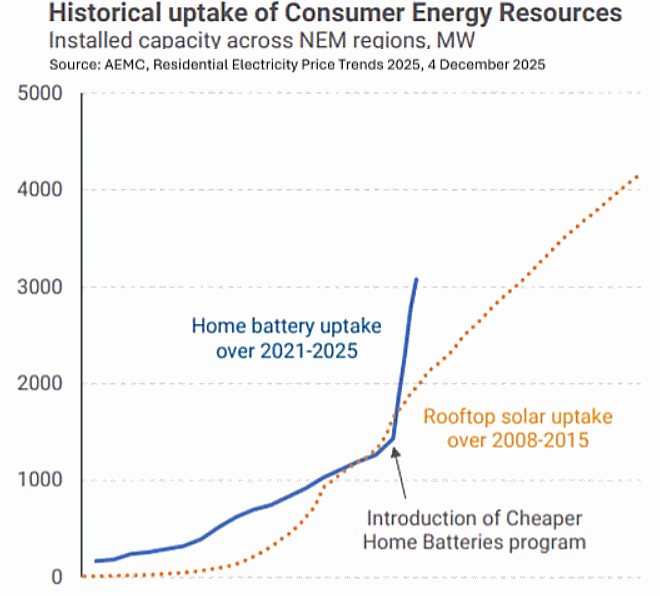
The original $2.3bn budget has been massively expanded to $7.2bn over the next four years. The federal government expects this will see more than two million Australians install a battery by 2030 – double the number initially predicted.
This is anticipated to deliver 40 gigawatt hours of additional storage capacity.
The funding boost will be accompanied by tightened requirements, with the rebate to decline at a higher rate every six months, instead of the annual reduction initially planned.
The value of the rebate will in particular be reduced significantly for larger home battery systems under a new tiered system.
All these changes will only apply to home batteries installed from the start of May, 2026, before further drops each January and July through to the end of 2030.
Why Is The Scheme Being Revamped?
As first revealed by SolarQuotes, the federal battery rebate was on track to churn through its original allocated funding by mid 2026.
The $2.3bn budget was supposed to last across the four-year forward estimates period, but SolarQuotes’ resident fact checker Ronald Brakels crunched the numbers and found it was on track to run out in just one year.
We’ve been sounding the alarm on this issue since late July – less than a month after the scheme launched.
The Department of Climate Change, Energy, the Environment and Water claims the incentive has been reworked to align with declining battery costs, with the aim of maintaining roughly a 30% discount for battery systems.
Federal government officials however did not forsee just how many large batteries would be installed under the scheme.
“We want more Aussie households to have access to batteries that are good for bills and good for the grid – because it means more cheap, fast, safe solar energy is available in our homes night or day, when and where it’s needed. By responsibly managing the budget, we’re able to fund the things that matter most to Australians such as strengthening Medicare, cheaper medicines, slashing student debt, expanding our Cheaper Home Batteries program and tax cuts for every taxpayer,” Energy Minister Chris Bowen said.
Incentive To Drop Faster & More Frequently
The Cheaper Home Batteries Program discount is provided through government purchases of Small-scale Technology Certificates (STCs).
Subject to regulations being made, the STC factor, which determines the number of STCs a system is entitled to create per kWh of useable capacity, will drop every six months instead of every year, and by a steeper amount.
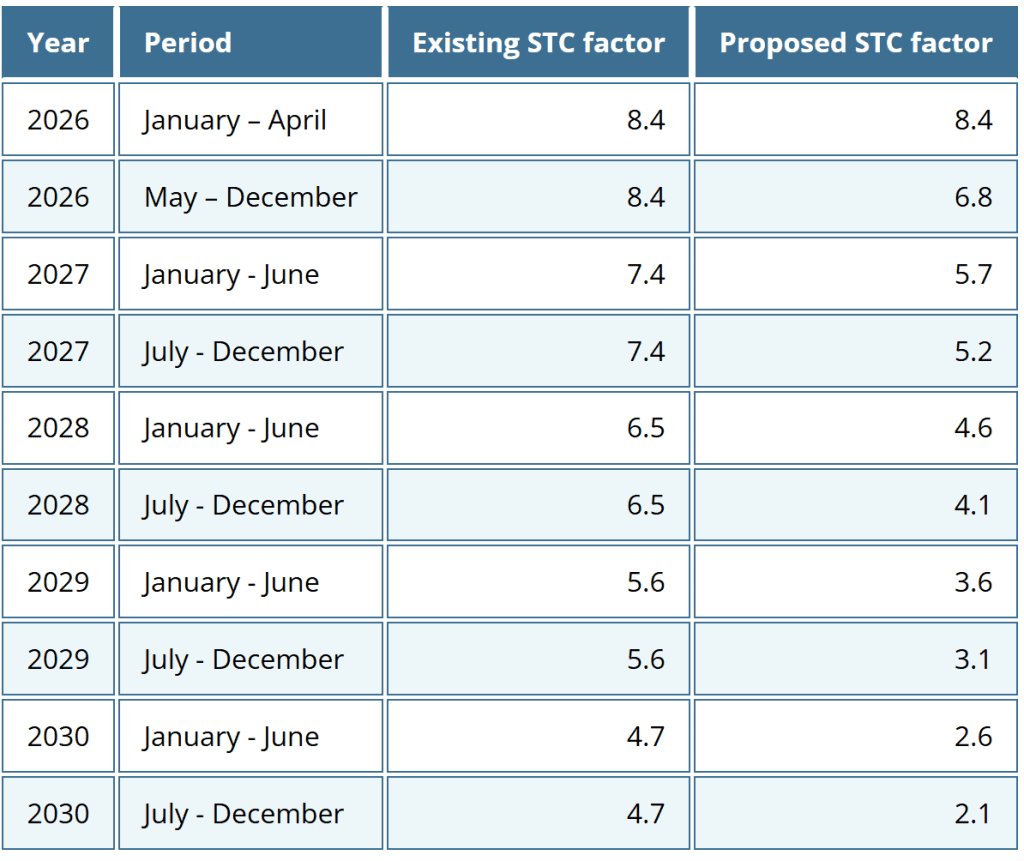
Source: The Department of Climate Change, Energy, the Environment and Water.
To translate that into terms of how much the revised scheme takes off the cost of a battery, here’s the estimated value of the rebate per kWh:
- Rest of 2025: $372 per kWh
- Jan-April 2026: $336 per kWh
- May-Dec 2026: $272 per kWh
- Jan-Jun 2027: $228 per kWh
- Jul-Dec 2027: $208 per kWh
- Jan-Jun 2028: $184 per kWh
- Jul-Dec 2028: $164 per kWh
- Jan-Jun 2029: $144 per kWh
- Jul-Dec 2029: $124 per kWh
- Jan-Jun 2030: $104 per kWh
- Jul-Dec 2030: $84 per kWh
Reduced Rebate For Larger Batteries
The main reason the rebate is being used up so quickly is due to households installing much larger home batteries than expected – and in many cases larger than homeowners actually need.
At a Smart Energy Council briefing earlier this week, it was revealed that battery sizes had averaged about 28kWh since October – well up on last year’s typical install size of 10–12 kWh.
To rein this in and encourage households to install more appropriately sized batteries, the rebate will only fully apply to smaller systems, and taper down for larger capacity batteries:
- Up to 14 kWh (inclusive) the STC factor will be applied at 100%.
- For every kWh greater than 14 and up to 28 kWh (inclusive) the STC factor will be applied at 60%.
- For every kWh greater than 28 and up to 50 kWh (inclusive) the STC factor will be applied at 15%.
This change will also come into force from the start of May, subject to regulations being made.
So a 48 kWh VoltX Neovolt Package that gets roughly $17,840 off today due to the rebate will from May 1 only get a $6,880 reduction. For more specific examples of how the changes affect prices of specific brands and sizes read our explainer.
It appears that as before, batteries up to 100 kWh nominal capacity are eligible under the Program, but STCs will only be provided for the first 50 kWh of usable capacity.
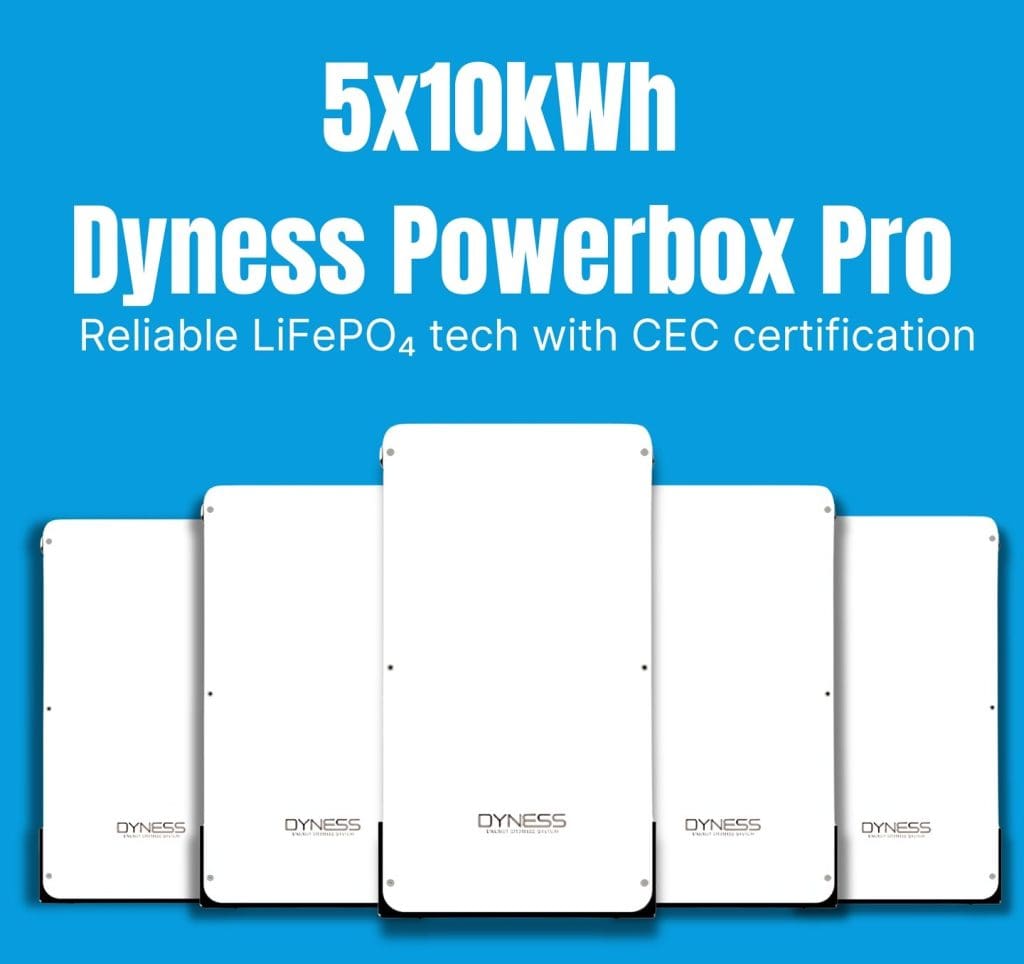
The original structure of the rebate helped fuel an epidemic of offers for batteries much bigger than homeowners need – often paired with inadequately-sized inverters.
More Rules Add Complexity
SolarQuotes founder Finn Peacock told the ABC that because the scheme had launched with an approach to pay out “per kilowatt hour, not per battery”, it had effectively incentivised installers to sell consumers the biggest possible batteries that were eligible.
“So if there’s X kilowatt hours’ worth of cash in the pot and people are getting bigger systems, then fewer people can benefit from it,” he said.
The federal government is understood to be unlikely to make further changes in the near future, and is reluctant to mandate Virtual Power Plant participation out of fears it would kill uptake of the scheme.
Industry Accepts Need For Changes
The Smart Energy Council noted that with changes not to come into place until May, 2026, there was ample forewarning for industry and consumers.
This ensures that installers and homeowners getting batteries in the next couple of months won’t suddenly be copping a reduced rebate for jobs already booked in.
“We are a responsible industry that believes in spreading the benefits of solar and batteries to as many people as possible. If that means changes to the rebate we support that,” Smart Energy Council Chief Executive John Grimes said.
That sentiment was echoed by GoodWe Australia Country Manager Dean Williamson.
“We do agree that ensuring the ongoing viability of the scheme is essential and support calls to adjust the program. We need time and sensible adjustments, but believe the industry would rather have this than a sudden end,” he said.
Jim Hill, CEO of Nepean Solar, said the “sensible” change could soften the industry’s tendency for a boom-bust cycle.
“As a small business owner we need to be able to plan for the ordering of stock, training and upskilling of staff, and indeed the taking on of new apprentices, this approach allows us to do that with confidence,” he said.
A Boon For Australia’s Energy Storage Needs
The scheme has been hugely successful in pushing home batteries into the mainstream and adding significant storage capacity to the grid at a critical moment, as coal plants reach the end of their operational life and large-scale renewable projects roll out slower than needed.
The tweaks to the scheme follow the federal government’s decision earlier this week not to extend energy bill subsidies.
Stay up to date with the all the latest on the battery rebate by subscribing to SolarQuotes’s free weekly newsletter., and read up on whether solar batteries are right for you in our deep dive guide.
 About Max Opray
 RSS - Posts






About 30kWh is about as much as can be useful to the wider public footing the subsidy bill, so this sounds about right.
About 10kWh for overnight and then about two hours of your export limit – 10kW at best on single phase, so 20kWh. Total: 30kWh.
E.g. on Amber you can generally get two hours in the evening peak at 20c/kWh or more; and retailers are getting their heads around something like this being a viable peak FiT from batteries. You need at least 15c/kWh to cover what you pay up front for every cycled kWh (LCoS), so 20c is reasonable for making the whole investment earns its keep.
Once VPPs get a bit better at addressing these basic battery-owner economics, this kind of peak exporting from bigger batteries (and great public benefit) shouldn’t be too hard as set-and-forget.
At the least, we should see a battery home use 5kWh for their dinner and export the same for two neighbours.
What this should do to peak gas-lead price spikes and average prices should pay for the scheme.
I wish the government had taken a different approach. Say after 14 kWh, anything above that must be available as part of a VPP. And say have the connection be a requirement for 7 years for example.
This has a few benefits. The Australian public gets access to a distributed (no additional transmission), on demand power (reduces evening peaks) that also absorbs the glut of daytime solar power. The public gets that access with most of the cost voluntarily paid by the private owner. The owner now avoids electricity costs, gets the better peak evening tarrifs as well as the full big battery in the future.
It feels like a good opportunity missed to drastically increase our electrical storage capacity right where it’s needed, at a great price and quicker than what large utility scale facilities can achieve.
You don’t need a VPP to reduce the evening peaks – the pricing of non-VPP provides the same incentive. The only benefit to the grid of a VPP is the ability to call on power in a time of an unexpected shortage of supply.
I have grabbed a larger battery (42kWh), although primarily due to having about double the normal household usage. It works very well and most days I am feeding back into the grid between 6pm and 9pm (getting 30 cents per kWh from a non-VPP). Works very well and have cut my bill by over $10 per day since the battery has gone in.
which battery did you get, and how much did it cost you? Thanks.
In SA. Look Mum , no base load !
https://explore.openelectricity.org.au/energy/sa1/?range=7d&interval=30m&view=discrete-time&group=Detailed
I am glad that another myth was debunked: “only wealthy people from inner city are installing home batteries”.
I can’t prove it but I think that smart people are installing home batteries.
Now, let’s work on debunking other myths such as “only wealthy people can afford electrical vehicles, in Australia there is no need for home insulation if you have AC, large PV arrays do not pay off”, and another myriad of other myths and half truths that people believe without questioning!
I’m surprised many of you aren’t more concerned that the grid won’t take your battery storage just when you need it. That’s in the ISP and in state emergency legislation to access private batteries in grid connected systems. Your investment at their disposal. It’s a subsidy system with a sham pricing scheme attached. Big solar will win at every turn with contractual guarantees and standby payments for BESS. They also have the huge advantage with grid batteries of accessing coal and your solar at negative wholesale prices during the day and selling at peak demand.
Good luck but I’d be looking at off grid if you can swing it.
Gezza, Australia could opt for the Texas solution where Big Green is financially responsible for reliability and thus have to pay for BESS themselves.
Big Solar does not currently, as I understand it, have the advantage over home solar since homeowners dump their power on the market for whatever FiT they’re offered – largely down to 2c-3c/kWh now.
Yes Big Green can ‘buy’ when power is negative, fill their BESS’ (battery energy storage system’s) then resell during peak (evening) demand for pure profit. But local councils and communities can sometimes block them being developed – depends on legislation and local interest. Since cities are the ones mostly benefiting from BESSes, they should be the ones providing the land for it.
Off-grid remains an interesting option, and will remain such, until such time as electricity adopts the water model – charging for connection proximity rather than actual supply. If you have to pay regardless, off-grid is pointless because you can’t disconnect.
Hi John,
Texan regressives now explicitly exclude wind, solar and battery storage from new subsidies, Senate Bill 2627 offering low-interest loans, bonuses and grants to incentivise construction and modernization of gas-fuelled power plants.
Despite renewables remain the dominant source of new generation, and grid operators continue to plan for significant additional wind and solar projects.
Texas added over 9,700 MW of solar and 4,374 MW of battery storage in 2024 alone, and wind continues expansion.
Wind and solar now supply about 30% of the state’s electricity, up from 18% in 2019, and on some days renewables have met over 70% of demand.
Solar generation has more than doubled in the past two years and is now often the largest source of new capacity added each year.
Texas doesn’t do anything that doesn’t pay.
https://shalemag.com/texas-renewable-energy-growth/
Bennet, you’re confusing Texas with California and the like. Regressives control the Blue states, Texas is Republican which means Conservative, of some flavour.
I wasn’t thinking subsidies, but rather S.B. 715 which requires reliable energy – unreliables e.g. wind or solar are responsible for the costs of the natural gas or BESS required to provide reliability else face penalties. Australia’s current just in time approach to power generation favours wind and solar over the likes of coal.
And yet Texas’ electricity is still cheaper than that of the likes of California, New York, or New England.
Has it, or your other ‘myths’ actually been debunked?
Inner city is mostly apartments and high rises so obviously not a lot of solar and batteries. Those installing batteries do tend to be those with higher incomes, while those going off-grid – which obviously requires batteries, tend to be more rural.
EVs remain more expensive than ICEVs, and there’s not much of a second hand market. The evidence suggests EVs remain the province of those with higher income, somewhat akin to those who buy RAMs, though obviously not precisely the same group – ‘utes’ or rather American Pickups, continue to outsell EVs.
Technically AC means insulation is not required, but it’s very inefficient i.e. expensive!
And large PV does not pay off these days, not unless you have a double digit FiT. SQ itself argue self consumption is where the value is i.e. use your own power rather than pay 46 c/kWh grid power costs some places.
Hi John,
Utes are popular because they’re subsidised.
Dual-cab utes (load of one tonne+ or not primarily designed to carry passengers) are exempt from Fringe Benefits Tax (FBT) for “minor, infrequent & irregular” private use.
If used extensively for school runs, weekend trips, FBT exemption shouldn’t apply in law, but is often treated leniently or willfully misunderstood.
Businesses can claim instant asset write-off for commercials without being constrained by the lower “passenger car” depreciation cap.
Remove the subsidy for these grotesque, grocery getting “trucks” and apply it to EVs, then we’ll see improvements in passenger safety, pedestrian safety, productivity, fuel prices, current account deficit, air quality, road conditions/maintenance plus improve efficiency in the electrical grid.
https://www.acoss.org.au/wp-content/uploads/2024/04/ACOSS-Submission-to-HOR-inquiry-Electric-Vehicle-2024-.pdf
In other words ‘utes’ – really American pickups these days, are popular with tradies and the like so the subsidies are justified. You can of course argue private use should invalidate the subsidy, but that’s a separate debate.
Frankly I’m more offended by all the high end vehicles sporting government plates you see running around the place. What’s wrong with a Yaris for government employees if taxpayers have to provide them with a vehicle? Okay I’d make an exception for those going bush, most don’t!
I’m not seeing any evidence that EVs increase safety or productivity, nor do I understand what you mean by account deficit. More EVs means more demand on an already overburdened grid. The fuel prices argument is subjective – demand v supply, and assumes demand continues at a threshold where supply is viable. Yes air quality would improve in cities, but that’s not most of Australia. Road conditions would actually deteriorate as EVs weigh more.
Hi John,
Comparing small cars (≈65k units) to all 4×4 utes (≈203k units), utes are roughly three times as common in new vehicle sales.
We should not be subsidising them.
Using 1400 kg as a representative small‑car kerb mass and 2100 kg for a typical dual‑cab 4×4, the ute is about 50–60% heavier. That means each dual‑cab ute carries an extra 0.6–0.8 tonnes around compared with a sub‑$40k hatch or sedan in the same traffic.
No matter where they are driven, these light trucks are heavier & do more damage in accidents and to the road.
Australian averages indicate EVs are just 3–20% heavier (68–400 kg)
Nearly 90% of Australians live in towns over 1000 residents, 95% live on sealed roads, pandering to those who don’t is to slavishly follow car company marketing. It’s as ludicrous as it is stupid.
I can promise as somebody who works with road engineers every day that nobody is worried about damage to roads. It’s another one of those ludicrous factoids the anti-EV crowd throw into circulation to ‘flood the zone with shit’ (to use Steve Bannon’s phrase).
I have a Toytoa non-EV, and an EV. The Toyota is about 500kg heavier.
The other argument I’d give as an engineer against our ridiculous obsession with dual-cab utes is that they’re hopeless in every function they’re designed for. They’re not good utes (trays are usually restricted in size), they’re terrible passenger vehicles, they have the aerodynamics of a brick and are missiles on the road in terms of road safety.
Hi Nick,
I like to point out that a Falcon Wagon is a better “ute” than all the dual cab juggernauts.
No need for a rooftop tent, you can sleep inside a wagon when you go camping.
It’s comfortable to drive, has a decent turning circle, good visibility, pedestrian safety, plus the tyre and fuel mileage is cheaper.
Not bad for towing either.
@moderator, now utes !?
Another perfect example of how ‘the market’ is a myth. And leaving the rollout of renewables to this fictitious market is a recipe for chaos and corruption. Without proper regulation fo this scheme for example, people do what they always do in the absence of regulation – they milked it for maximum status. The bigger the battery, the better.
Influencers and ordinary folk following them installing ridiculous oversupply of home storage, way beyond any sensible cost-benefit calculation. And also feeding the Robinson Crusoes out there, the off-gridders who see the grid as the enemy (spare me) and begrudge spending even a dollar a day to access it.
It’s great to see the government leading here, and they should have been targeting households from the beginning of their first term. It would have derailed much of the anti-renewables strategy.
Nick, where is daily supply a dollar a day? I think you’ll find the average is more like $500/year.
The grid is not the enemy per se, it’s simply increasingly non-economic with off-grid close to being a more affordable option. Whether that holds true for 3 phase as well as single phase, I can’t say.
Hi John,
We need to repeat it for the slow crowd, going off grid in the suburbs is dumb.
As well as uneconomical for the individual and the whole society.
The off grid system needed to run a family home and a number of EVs isn’t hard to build, it’ll just need $200,000 and diesel poured on it from time to time.
And to repeat it for those apparently wanting other employment, insulting your readership or opting for naked partisan politics, is unprofessional and a good way to violate your terms of employment.
The economics for individuals varies. Clearly some see the value in it. And given Labor are advocating decentralised power, off-grid is simply the next logical step in the process.
I’m not sure what sort of draw you’re imagining, but $20,000 is probably more realistic. Yes I’d want to get a new quote from a trustworthy provider before confirming that as fact. But you’re assuming a multi-EV household which is what, less than 1% of Australian households? Standard solar systems are either 6.6 kW or 13.3 kW, and most household have such meaning all that’s required is a battery compatible inverter, plus batteries and a generator. Using SQ’s own figures that’s be about 23 Tesla Powerwall 3s i.e. 310 kWh of power, which is plain nuts, and more with cheaper brands!
Hi John,
I would love to debate the virtues & vices of debt, but colour me unsurprised, you’ve attacked the messenger for being partisan, not the substance of the message.
Have a read of this link and take in Arni’s ready reckoner for well supported, warranted and properly engineered off grid power.
A system designed to reliably deliver 20kWh/day will cost $85,000. (Pre CHBP program) That suits a modest and efficient house, add an EV or less conscientious consumers and you could double it, add three phase and triple it.
You still need a very large roof space and diesel for winter.
I’m not sure if you’re identifying with the slow crowd? I’m not here to make insults but simply to rebut unsupported arsertions so that casual observers have some factual context.
We’re here to help but we can’t assist those who refuse to read the evidence, including the hyperlinks presented.
Another broken political promise.
Why am I not surprised.
Can you outline which promise has been broken? This is the original promise:
https://alp.org.au/news/labor-to-deliver-one-million-energy-bill-busting-batteries/
Seems to me they have delivered on it.
Small businesses and community facilities will also be able to access the subsidy, with support for up to 50 kWh of batteries sized up to 100 kWh eligible.
50kWh batteries Not Intended For Households !
ah, can’t you see the before and after table included in the story? I think that tells the tale.
Show me where the “before table” was part of their “broken” election promise?
They rolled out their policy, did it on time, its was very popular, so popular that they reviewed its uptake after just a handful of months and in collaboration with the industry decided to announce some prudent adjustments ahead of time to improve the policy’s long term sustainability so that the stated goal of achieving 1 million home batteries is attained.
Interesting to see you’ve gotten the information early? When do these changes take effect? – especially the teired rebate allocation ?
As most installers I know are booked with 3 months of work nearly and accepted quotes?
All changes will apply from the start of May, to ensure they don’t impact battery installs that have already been booked.
Max,
I agree that there should be a staged reduction on battery size and time. But to shorten the time period just encourages customers to bring forward their installs to get the maximum rebate and places more pressure on suppliers and installers. Another boom bust cycle instead of spreading it out.
Feels sensible but also a missed oppurtunity to require these heavily subsidised overly large batteries to join a VPP. Giving people a huge subsidy to essentially become non-participants in the network is counterproductive. There should be some joint responsibility here that if the taxpayer is going to give you a heap of coin you should also have a responsibility to share that benefit with the wider community. Not everyone can fill their roof with solar and a massive battery, but they should be able to share in some of the benefits of their neighbours system that they have helped fund. It might also demand a higher quality product and install than some of the rubbish that might be being peddled. Requiring participation in VPP ( well designed) seems like it should have been on the table
I for one would not join a VPP in a fit especially a compulsory one. The govt or market changes the rules and you get screwed. Not thanks, I prefer to control my own destiny and my usage to min my grid usage at the most benefit to me. I don’t live in the Soviet Union.
Do you dread the DRED (Demand Response Enabling Device) ?
https://www.sapowernetworks.com.au/industry/relevant-agent/supported-technology/
But your aren’t too idealistic to not accept the taxpayers coin to pay for a generous subsidy on your battery and PV. Subsidising a battery is one (good) thing. Subsidising a hugely oversized battery for your needs with no obligation to use some of that capacity back into the grid when it will lower everyone else’s costs, while being fairly remunerated for doing so, is just selfish. No one deserves my tax dollars to do that
I dont want an oversized battery nor do I understand why govt allowed/ incentivised this in the first place. My wife and I (retired) only need 15kWh max to cover our evening and night usage for 90 to 95% of the year (rainy season in winter & summer Central A/C shortfall) according to the modelling tool.
That will include an 8.2kW panel system (max on my roof using 750kW panels) a 5kW inverter (max allowed by Synergy in WA). Taking advantage of state and federal subsidies modelling show the best payback period is about 10 yrs not brilliant but acceptable to proceed.
My new Tesla EV uses a constant trickle charge base use between 9am and 3pm most days. Synergy FIT after 3pm is 10c/kWh but before 2c/kWh. The FIT just about pays for my fixed costs of connection to the grid.
So I am already helping my neighbours and the broader community without a VPP & it risks.
Hi Media,
Sounds like a good setup and properly sized as well.
WA does allow larger inverters now.
https://www.solarquotes.com.au/blog/fronius-winter-solar-wa/
I’ve done similar to you. I havnt joined a VPP either. I’m really only talking about the batteries that are extremely oversized for their household needs and only make sense as a tool for subsidy capture.
It doesn’t reduce everyone costs
The end user still pays the same over price. The power companies get the benefit from the tax payer coin and your own dollars and want to give you nothing for it under most VPP. Why shouldn’t the person putting in the batteries befit? Instead of the power companies. As they will be the one’s replacing it at the end of life and they need to make their cost back to replace the system.
There are good and bad VPP, but none of them give you nothing. The person putting the heavily subsidised batteries is getting a great benefit. And the taxpayer has contributed heavily to it. If you don’t want to give a bit back then don’t take the subsidy. Stop talking rot.
https://www.solarquotes.com.au/battery-storage/vpp-comparison/
Well that is a good proposition.
If you survey the offerings of VPPs ,you will find they do not reduce the cost of energy to a Prosumer.. Instead it is another project for the large GenTailers to use the natural monopoly of the Distributed Network Services Provider (DNSP) – polls and wires company -to hold prices high .
Architecturally speaking you are still faced with a centralised pricing model via the National Electricity Market (NEM) and not a decentralised P2P market of ‘bid and ask’ spread. Amber Electric is the same, where they give you access to the NEM price server via an API. In that respect LocalVolts seem to be the only decentralised pricing model on offer in Australia.
South Australia currently runs a gas, wind and rooftop solar generation model with the highest per rooftop penetration in the country *and no base load*. Utility solar is playing ‘catch up’.You would think there is some opportunity for someone to be a VPP retailer in a true VPP P2P manner.
Agreed this seems a sensible adjustment to spread the benefits more widely and stably.
However, as one of those ‘greedies’ who did put in the biggest battery i could (48kWh), I observe I’m still committing 70% of MY hard-earned capital to activities that will reduce evening peaks, whack-a-mole the nasty, gassy price spikes that significantly drive up average prices, reduce renewable curtailment during the day and eat coal’s supper all the way to dawn by shifting green energy to all-night consumption.
These all benefit the taxpayers who have dropped in the 30%, more than they realise, because we only have to go from 5% undersupply in the peaks to 1% oversupply to hammer the prices. When that happens, i might not get as good a return on my 70% as the rest of the peeps get on their 30%, which in reality is small $ per capita to my large $.
This sounds like a sensible move and I agree we don’t want to make the rules too complex.
I hope there is scope to adjust the other way if this ends up reducing demand for household batteries.
14kWh gets us through a couple of cloudy days but we are far more frugal with energy use than most households.
Let the moaners scream about SUBSIDIES, but if this scheme reduces peak period demand, it is worth every cent.
It’s going to like July 2025 again, but this time installers will be spruiking 50 kWh batteries with gusto and everyone who hasn’t has a battery will be getting them even at higher than today’s prices.
FOMO
I had been saying for years the government should be putting batteries into everyone’s home. I for one went a 48kw system and haven’t required to take power from the grid. But have put it back in at those times when it is required. Like everyone I was sick of the power company changing me more and more. Went from not paying anything a year with solar with now paying over $100 a month. With them trying to tell me they giving me a good price. When I stated not true as clearly on their website. They told me I had to sign up I pointed out they were able to put me on the worst plan so they can do the same and put on the best they hang up. The rebate has allowed me to possibly go even with a pay back between 3 to 6 years winning. Also moving to Amber has shown me how much the power companies are ripping people off. That system needs to be fixed if you want cheaper power from the grid.
Goodwe, in supporting the reductions, will no doubt continue to not provide the single phase 10kW/48kWh ESA systems that it pretended to launch over eight months ago, in its contempt for its customers and prospective customers, preventing WA residents from being able to access the full benefits of the subsidy, for the ESA systems that Goodwe refuses to provide to WA.
I believe that the term is unconscionable conduct, in addition to misleading and deceptive conduct.
Goodwe pretended to launch the single phase 10kW/48kWh ESA systems, over eight months ago, and, apart from refusing to provide critical specifications for the ESA systems, has refused to provide the systems to WA residents, while the maximum rate of the subsidy is available, and, now supports elimination of the subsidy.
Goodwe has no intention of supplying the ESA systems to WA, and, is actively supporting preventing WA residents from benefitting from the subsidy.
Goodwe’s Williamson faked the launch and supports the cuts.
Howdy, I have a question. Where it says “from 0 kWh up to 14 kWh (inclusive) the STC factor will be applied at 100%.” I honestly thought the min capacity was 5 kWh? Has that changed now to 0 kWh, or did I misunderstand there was a minimum capacity?
A smart pick up, but I’m not sure that it matters – is there a CEC approved battery less than 5kWh? And would you want one that small (even the Enphase IQ 5P, which looks good)?
Chris Bowen says he has nothing to be embarrassed about with his half baked scheme. My god he is like a baby Trump.
Use your words Ben.
What does he have to be embarrassed about?
This is a very successful policy which was always subject to an Annual review.
He absolutely doesn’t have anything to be embarrassed about. You, on the other hand… such an awful thing thing to say about any politician. Slander, defamation and outright callumny I say!
A big part of why people go big is because you only get one shot at the subsidy.
They want to ensure they can be covered for usage even into the future.
If the policy was tweaked to allow subsidised expansions later they’d have less people going all out at the start
100% this, not sure why it doesn’t follow the same model as buying panels…
Some politicians obviously skipped Maths class in primary school…
The decrease in subsidy is insane, and as Renan pointed out, it will be another rush before May 2026.
Concrete examples:
15kWh battery – installed in…
Jan 2026: $5,040 subsidy.
May 2026: $3,972 (-21%)
Jan 2028: $2,688 (-47%)
25kWh battery (best for most households)
Jan 2026: $8,400
May 2026: $5,604 (-33%)
Jan 2028: $3,792 (-55%)
40kWh battery
Jan 2026: $13,440
May 2026: $6,580 (-51%)
Jan 2028: $4,452 (-67%)
Conclusions:
– All (dodgy) installers will push for as many 50kWh system as possible until May 2026, defeating the purpose of the measure. Those who sell these systems have never installed a battery in their life, let alone seen an electrical schematic. Pathetic.
– The decrease is disproportionate and too quick. All those who absolutely wanted a battery already have one or are waiting for one to be installed. Those left will be the cautious people who waited for the dust to settle to make the call.
– The decrease in subsidy should be linear, and not brutal steps with this nonsensical “factor” that drop from 100 to 60 to 15.
– The size is completely arbitrarily selected (or is it?). I guess selecting 13.5kWh was a little too obvious… so they picked 14kWh. And 28kWh is exactly the same story… The vast majority of the market now comes in 5, 8 or 10kWh modules, none of which match the selected thresholds.
– As someone pointed out, it shouldn’t be a 1-off rebate. Because the majority of the market now offers modular battery stacks, you should be able to buy a 16kWh battery if you believe this is all you need, and be able to add 8 or 16 more at a later stage, if your habits have changed (new EV car, gas to electrical HWU, etc…). This forces consumers to buy a little more than what they need, because they only have 1 shot at it, and it’s better to overshoot than undershoot.
– Apartments residents are, once again, completely forgotten. When you have a building with 50 units, adding a 100kWh battery (maximum allowed with the current rebate), means 2kWh per unit… completely undersized. Given they give full subsidy per house up to 14kWh, there should be a similar rebate for apartments with a full subsidy up to 14kWh/unit.
This rebate was a great idea with a terrible execution, rushed-in to win an election. It worked, and now they are over-correcting course in the other direction. There is so much better to do.
There are advisory bodies that are neither lobby groups nor solar retailers (Wattblock, Rewiring Australia, GSES) who could have given a better outcome than this half-ass policy. Such a wasted opportunity.
Wouldn’t it be up to each individual apartment to decide whether to mount one on their wall or whatever?
Most body corp & apartment owners dont want a bar of it for insurance risk premium reasons (fires).
So unless the building puts PVs or Batteries or both in to cover common property power usage, benefiting everyone, not going to happen other than by exception.
That was before…
Now, we have Allume, an Australian company (rare enough to mention it) offering their World exclusive Solshare35 system, that splits inverter power (20kW) between up to 15 units…
Both Victorian and NSW governments currently have a grant to install this type of system in strata buildings (SoAR, in NSW).
So yes, it’s not a pipe dream anymore, neither an expensive endeavour, it is a reality, happening today!
And yes, they are left out of the federal battery rebate.
I have two major issues with this.
Firstly, capping rebates based on capacity is absolutely idiotic. We just signed a deal to replace our hopelessly undersize 10kWh Sungrow system with a 42kWh system from another supplier. Their prices was 75% less than Sungrow’s price. So how does setting rebates based on capacity make any sense at all in this context? If I can get a much larger system installed for the same price as others are paying for stupid Sungrow pricing, why should I be punished?
Secondly, the “urgent” nature of these changes is just horrible. If you want to make changes, ok, but what about people who have signed contracts and are waiting for their install? What now for them?
It’s a very disappointing outcome all round imho.
Hi LP,
Everyone who runs a responsible & ethical solar business is railing against novelty oversized batteries delivered by rebate hungry shonks.
Nobody should be applauding $18,000 of our tax dollars being wasted on cheap rubbish.
https://www.solarquotes.com.au/blog/dont-blow-rebate-on-big-battery/
For reducing peak demand & increasing diversity we’re better off giving everybody a 10kW battery than 25% of people having 40kWh.
In any case I would caution against anything that’s 75% cheaper than one of the already competitive, long established, well supported market leaders.
Cutting prices always leads to cutting corners.
Ok, 40kWh might be a bit much on single phase with 10kW export, but three phase with 15kW export (and the right inverter f course) it is not oversized; it is just big. An it can earn its keep if exporting ~20kWh per night.
I have 32kWh (10kW export (once my de-rated Sig inverter is replaced)) that I work hard, capturing all the solar that I can, exporting what I can at night and doing some daytime imports during minimum demand.
I’d like to point out that reining in the big batteries (the 28-50kWh segment) is for the politics of the spend more so that the grid-scale effectiveness of it. 4 x 10kWh installs versus 1 x 40kWh install is also 4x inverters, wiring, man-hours, etc. You’d know better than me, but double the cost perhaps?
So, if we accept that it is an effective govt spend either way, it’s not necessarily true that 4×10 is better than 1×40 when 10kWh just does self-use and 40kWh can do more grid service.
Tell you what, 4 x 40kWh used well would be tops!
Hi OB,
I take your point but true economies of scale mean grid scale batteries are much cheaper but they’re quite impersonal of course. Community and pole top batteries have the worst of both arguably. Small scale, equally impersonal, but obliged to meet very expensive commercial/utility requirements for quality, reliability & longevity.
Rubbish outcomes are assured when we have 5kW inverters and 50kWh batteries delivered by blowflies who don’t design but simply sell cheap crap.
If everyone had a 5kW battery it would be fully utilised every night, whereas it takes a large user, or a real enthusiast like yourself to make good use of a big battery. At least until retailers catch up with offering a decent VPP and they gain broader support. Right now not enough people trust them.
Anthony,
A reply delivered with your usual level of informed impartiality. Nothing unexpected there.
As I’m certain you’re already aware, the prices Australians have been forced to pay for batteries by the major solar manufacturers (and to a lesser extent Inverters) have for years now been several times that paid by consumers in Europe, the UK and the US. For the exact same equipment. Installers don’t complain because of the monumental margins they make. Instead, they, like you have done here, try and tell us that anything less is “cheap rubbish”, but without supplying a word of evidence to support this assertion.
As I’m sure you also know, companies like Fox are very well established all over the world> Fox have been making high quality batteries for over ten years. The actual cells they use in their batteries are literally identical to those used by scammers like Sungrow. Perhaps you should be more worried about our tax dollars going to the cartel that controls our Aussie market?
Fox well established? Over 10 years of battery making.
Maybe you should inform yourself and realise Fox ESS only started in 2019 and only started making batteries in 2022. But hey, I guess whoever you bought it from gave you alternative facts which you were happy to believe because of the price tag. And you should add the rebate back into the price before you do a price comparison in %. if it is 75% cheaper after the rebate has been applied, the real price difference is a lot less.
Bennett, is there any amount of taxpayer funds that’s justified being wasted on cheap crap?
A 10kWh battery is likely too small to power most homes for 24 hours, let alone those without solar. It’s grid support i.e. supporting corporations, not real battery backup. Barring a large reliable solar system the average household likely needs 20 kWh at a minimum, and there’s always the generator consideration.
John,
You cannot benefit from the federal rebate if you do not have (or install) a PV system, so there is that…
If the Greens would be serious about their pretended concern for the environment, they would block the cuts to the subsidy, and refuse to further provide supply and confidence unless and until the subsidy is continued indefinitely in its present form, instead of the Greens merely being yes men and retaining their membership pf the ALP/LNP/Greens cartel..
Oh, and, I have evidence supporting household BESS capacity of 50 (and, even 60) kWh, but, I am not allowed to post that evidence to this forum, and, too many people, especially, people in power, dismiss valid evidence, anyway.
Hi Bret,
We’ve touched on novelty oversized batteries before.
https://www.solarquotes.com.au/blog/dont-blow-rebate-on-big-battery/
Though lowering grid demand is a desired outcome, sharing energy is the real benefit we must keep in mind.
https://www.solarquotes.com.au/blog/battery-cash-grid-crash/
The idea of withholding supply from a legitimate Governement, especially one with such a huge majority, is both fantasy and irresponsible hyperbole.
Throwing weight around would serve to decimate the greens & reinforce notion that the only other time supply was withheld, we were actually subject to a coup.
Read the last paragraph of my post to which you are responding.
Just because enough gullible voters, without regard for the consequences, managed to elect a government with a significant lower house majority, should not mean that the government should be allowed to rule with absolute unaccountable corrupt and tyrannical power to cause harm to the country in whose interest, it is supposed to govern.
The numbers in the upper house, mean that the Greens, in conjunction with the other non-government members, can hold the government to account, but, unfortunately, as always,they put self-interest before representing their constituents, and, before acting in the interests of the country, for which the parliament is supposed to provide, and, fails to provide, responsible government in the interests of the country.
It is simple too many people in power, putting lining their pockets, and their personal power, before the interests of their constituents and before the interests of the country.
It’d be interesting to see the Greens show some principles, but I doubt that will occur.
I believe this is the planned maxium rebate (50kwh system):
Rest 2025: 18600
Jan-April 2026: 16800
May-Dec 2026: 6990.4
Jan-Jun 2027: 5859.6
Jul-Dec 2027: 5345.6
Jan-Jun 2028: 4728.8
Jul-Dec 2028: 4214.8
Jan-Jun 2029: 3700.8
Jul-Dec 2029: 3186.8
Jan-Jun 2030: 2672.8
Jul-Dec 2030: 2158.8
Unfortunately this is irrefutable proof of three things.
1. The majority of customers are clueless about their battery requirements and/or will take something for cheaper even if they don’t need it.
2. The majority of installers are greedy and will over-sell/over-scope a battery requirement to make more money with less installs.
3. Finally, the Government failed by not getting good advice on how to implement.
And before you jump on Government too hard, the industry representatives advising them would have known this but kept silent.
Poor taxpayer.
Is it? This article said a Smart Energy Council briefing revealed average battery installation size since October was 28 kWh, up on the pre-subsidy 10-12 kWh installations.
An article elsewhere said peak demand, not average demand, is what battery sizes need to be selected for. A 15 kWh battery is too small to do more than cover average overnight use sans AC, or perhaps a single low solar no AC day.
Ultimately Labor need to determine what they’re trying to do, and who they’re supporting with taxpayer funds.
Yet another Labor fail by those who rule from off in Canberra?
Unlike electricity which flows from positive to negative, the political landscape runs on Bull – and it flows from negative to positive. A few “industry representatives” knock the scheme and the Gov panics and gets it wrong again. This country urgently needs batteries and a lot more storage. The installers have years of work booked ahead of them. You can trickle in 50000 of 10Kwh Batteries or you can roll out 10000 of 50 Kwh batteries. The result is in both cases is the same but the labour cost is significantly less. A battery scheme really only works if the storage is available to the grid controller. That is the real travesty of this – that a few people are getting tax payers dollars that will in the long term only benefit the individual. Keep the subsidy, but if you want bigger you should be locked in a VPP. That way my neighbours get to use my storage and they can still afford the overseas holiday that I went without to pay for a bigger unit.
Cheers everyone.
I think the changes are sound and focused on the sustainability of the scheme.
Earlier adopters got the greatest benefit (including myself). I count myself lucky to have got such a subsidy, but I followed the rules as they were and bear no self guilt at maxing it out.
The program though wasn’t fiscally sustainable or viable and needed change. Socially I prefer all households with solar equipped with a battery at 14kWh than allocating a finite pool of cash to a smaller cadre of users at 48kWh, but don’t blame me for taking the cash when offered.
An experience government would have seen where it was going and tiered it right from the start, but mistakes will always happen. I prefer a government to acknowledge and fix the mistake rather than pretend there was nothing to see and watch the program max out meaning others miss out.
Hopefully this also takes the heat out of the industry, making their growth slower but more sustainable in the longer term.
A tick for me.
While reading much opinion based on this “Should” or that “Should”, I’m moved to observe that any laissez faire S-curve transition initially moves glacially, in this case not fast enough to fill in for slow and costly grid upgrades, critical to a future stable grid.
The yield on the limited (FOMO-inducing) $2.3B carrot was so good that it’s worth another $5B, more thinly sown, now that the herd is on the move. Domestic peak smoothing remains well subsidised – a problem ducked. Bigger VPP-capable batteries are proven less wanted – for the present at least.
A funding first gear for a standing start, second gear for ongoing economy and effect. Dead smart.
Wholesale battery costs are falling. Creating this volume market, then trimming the incentive, compels the supply chain to pass on some of the savings in order to maintain valuable market share. And by 2030, Na+ batteries – cheap as.
Our clearsight and endeavor are globally admired:
https://www.youtube.com/watch?v=qfzULvKaSoc
I agree Na+ or similar breakthrough tech will render rubbish the batteries we are installing . Not only obselete but in hindsight a great waste of money. We should wait a few more years and no subsidy from the poor bleeding taxpayer will be needed !
The grid needs cheaper grid batteries $/KWh now home batteries later but hey who cares about economics or engineering. Just sell the ideiology to the masses to get reelected.
In the real world, the Na+ batteries are not quite as good as LFP, just cheaper.
OK, they don’t self-ignite either, but the voltage sag in their discharge curve requires pulling more current after a bit – that has to increase losses. (Sorry, for the engineering detail.)
However, pundits are waving arms in the general direction of US$10/kWh wholesale price, at some stage. Then no-one cares if you need a bigger battery to offset sagging.
But a bigger problem is a cycle life of only 2,000 to 3,000 cycles currently, hoping to reach LFP’s 6,000 cycles to 80% SoH one day. Buy cheap, get cheap apparently.
Did I omit, above, the link to the thoughtful “Just Have a Think” piece on our world-leading domestic battery program?: https://www.youtube.com/watch?v=qfzULvKaSoc
What’s actually selling is fast-tracked grid stability, prosumer self-reliance, reduced energy costs, reduced fatal emissions, and climate resilience – less so to slow learners, admittedly.
I am an electrical engineer now retired but keenly interested in battery tech. Cycle life and sag are issues to be soved with new battery chemistries meanwhile existing chemistries are being tweaked for different application.
Stationary batteries unlike EV batteries dont need compactness or light weight but need increased cycle life and to be cheap as chips.
Thousands of engineers all over the world are working on this and will solve it as it is all still a very new field.
Cheap as chips, ha.
Weight doesn’t matter, ha ha.
As a battery installer, I can tell you that.
1) Weight does matter. When you have to lift an 80kg battery up a 40 degrees driveway, or walk down stairs at the end of a narrow corridor, the only thing you think about is the bloody weight of these damn batteries!
2) Battery cost is only one part of the equation. Currently, crap solar retailers subcontracting their work (because they are just here to grab the subsidy… and will disappear once it’s gone) offer $2,500 per (cheap) battery installation to the contractor. Add in some margin, you see the cost…
So yay, you have a Na+ 100kWh battery costing you $1,000… and you’ll only have to add another $3,000+ to cover installation. Suddenly, life cycles matter a little more.
I meant weight as on per Kwh basis. The way to solve this is to modularise the battery pack to handleable max 30kg blocks.
Many manufacturers are moving that way with modules as small as 3kWh but 5kWh is more common with 7Kw also around.
Certailny Tesla 110kg ,13.5kWh pack is indeed a bit much although they use a special cradle/trolley but I am sure you would find it still too cumbersome.
As for rogue contractors as a consumer I am terrified. It reminds me of the early days of roof bats and PVs, subsidies bring out the parasites to make a quick buck.
Erik, are battery prices actually falling? Or is it that there’s just high subsidies at present? I’ll likely get another rough quote – possibly on-grid v off this time, next year, especially if my FiT changes!
I’ve a relative who’s expressed interest in the sodium option but last I saw it wasn’t ready to compete in terms of price or performance. If things change …
John,
Na+ cycle life is improving in development, but when you see good ones in volume production, at the prognosticated low prices, please shout out to the rest of us.
I’ve read several places that gridscale battery manufacturers are paying US$108/kWh (A$163) for LFP – that’s in very high quantity, but nevertheless indicates the cost of retail + installation + support.
Two years ago I paid A$390/kWh for LFP cells, no subsidy, 16 off @304AH for a 15.5 kWh 48V battery – with a good BMS. That’s only $355/kWh now, down 9% + inflation ~ 13%? Oh, and only $244/kWh for a 32 kWh kit, no subsidy. (Retail in Australia; cheaper from China even after duty.)
Chinese truck sales were 22% BEV in early 2025, higher now. 18,007 units in June alone. There’s 729 kWh in a Windrose semi, selling as cheaply as a diesel, around NZ$500k – that’s $686/kWh with a free semitrailer, so maybe halve the battery cost?
So it’s cheaper LFP cells, also in BEVs, but boxed & CEC approved, are very retail.
As an American fortunate to now call this great country home, I feel deeply grateful for the thoughtful planning and sound execution of the Battery Rebate program. In the United States, rebates and discounts for solar, EVs, and batteries have largely disappeared or are quickly fading as a matter of policy despite substantial public interest
By contrast, the Australian government’s commitment to consulting with solar and battery installers early and often is truly commendable, ensuring smoother implementation and fewer obstacles.
And now, as the program’s success brings it close to reaching its funding limit, proactive action to manage the transition in consultation with installers and inform installers and the public is simply smart, forward‑thinking policy.
I can’t comment on the USA situation but I can on the hopelessly rushed policy to rollout home batteries in Aus.
Numerous reports highlight rooftop solar and batteries are more costly to instal/kWh than grid equivalent due to economies of scale. However, due to transmission line costs and losses and all the other ancillary equipment costs it reverses and Grid supply becomes more expensive to deliver to the home.
So embedded behind the meter renewable gen and home batteries to ensure near total self consumption is the sweat spot not oversizing to export. The policy setting now proposed but only starting from May means we have squandered taxpayer $ yet again, for a year, with policy disconnected from engineering & economic wisdom.
I’m waiting for V2G to be implemented. My BYD ATTO 3 has a 60kW battery and is V2G capable. 🤗
Be mindfull unless your flipping the EV in only a few years V2G eats up useable life of the battery. Your modrel usrs LiFeP chemistry which has a life somewhere between 3000 amd 5000 cycles sufficient for the life of the car. So V2G and low mileage cat usage maybe ok.
This is why Tesla with the same battery in the base model 3 has not allowed V2G even if the software is their ready to be turned on.
Absolutely.
Only in a fossil fuel supply crisis might we drain the family car to fuel the lawnmower.
And in an extended grid outage it might make sense to drain the BEV to save the icecream. (But not in fire season, when mobility = survival.)
As battery abundance materialises, the habits of scarcity will evaporate.
It’s coming faster than you think. ($Billions well spent – a civilisational saviour – nearly.)