
 Norrie is a long-time reader who just spent $8,300 on a home battery. The install looked tidy. The installers were pleasant. Then the surprises landed after they were gone. He was told only one circuit could be backed up. Not the fridge and lights together. Not the air conditioner and lights. One. He was also told that in a blackout he must go outside to the switchboard and pull a lever to get power. None of this had been mentioned beforehand. He now feels stitched up and is wondering whether he has any recourse.
The Battery Rush Is No Excuse For Installers To Rush
I am hearing versions of this story more often. Demand is booming, rebates have deadlines, and installation crews are being pushed to move fast. Some systems are mounted, powered on, and abandoned without a proper handover. The homeowner is left with an expensive box on the wall and no clear idea of whether it is working properly or what it will do when the grid goes down.
Here is the bare minimum testing that should happen with you standing there before the van leaves. This is not advanced tuning or clever tariff setup. It is simply proof that the thing you bought behaves like a home battery and not an expensive ornament. Before any of these tests, your monitoring must be working and you must know how to open the app and interpret the power flow screen. If you cannot see where energy is going, you cannot verify anything.
Test #1 – Solar charging test: does excess solar go into the battery?
On a sunny day with the battery not yet full, your monitoring should show spare solar flowing into the battery after the house has been supplied. Charging power should climb toward the inverter’s rated charge limit if there is enough solar. If the system is exporting to the grid while the battery sits idle, something is wrong. The most common cause is a CT clamp installed backwards or in the wrong place, which means the inverter does not know how much surplus solar is available, so the battery does not know how much it should be charging.
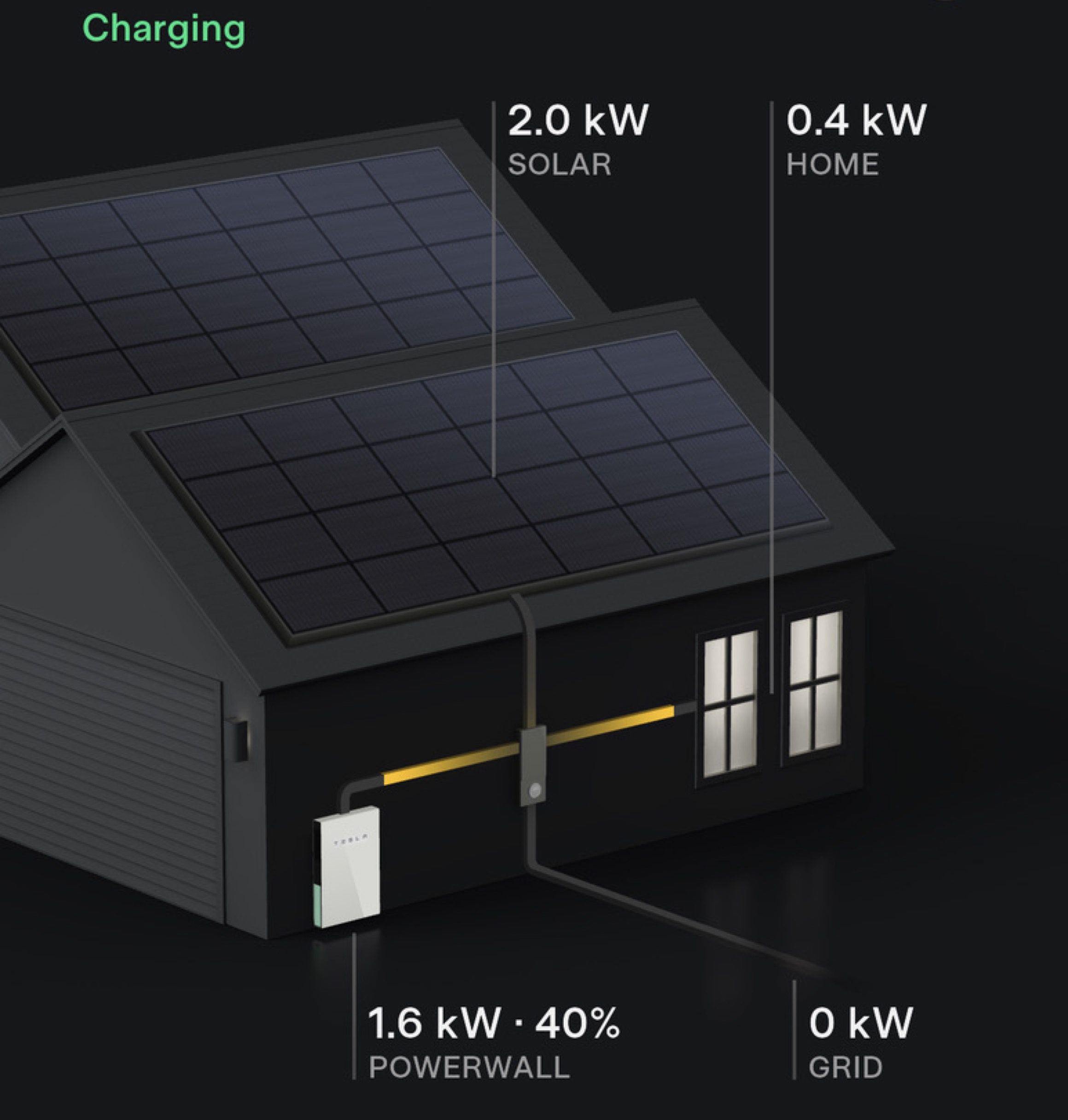
2kW of solar, 0.4kW of home load, with the excess 1.6kW charging the battery.
Test #2 – Self-consumption test: does the battery cut grid imports?
Now turn on enough load so your house is using more power than the solar is producing. Kettle, oven, air conditioner, anything normal for your household. The battery should immediately begin discharging to cover the gap, keeping grid imports at or very close to zero. This mode is where most savings come from. If the grid starts feeding the house while the battery does nothing, the configuration is wrong, or the operating mode is not what you were promised.
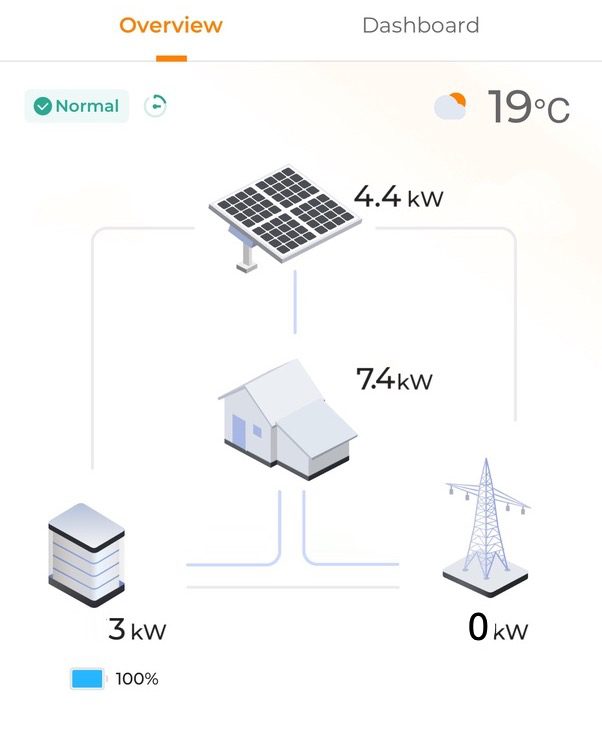
7.4 kW home load, 4.4kW from the solar, 3kW required from battery to avoid grid imports
Test #3 – Automatic blackout test: does backup actually work?
Your installer should simulate a blackout by switching off the main supply to the property. The lights should stay on, solar should keep running, and every circuit you were told would be backed up should still have power. If only part of the home remains energised, confirm that this matches what you agreed to. Partial backup is common, but discovering the limits during your first real outage is not a pleasant surprise.
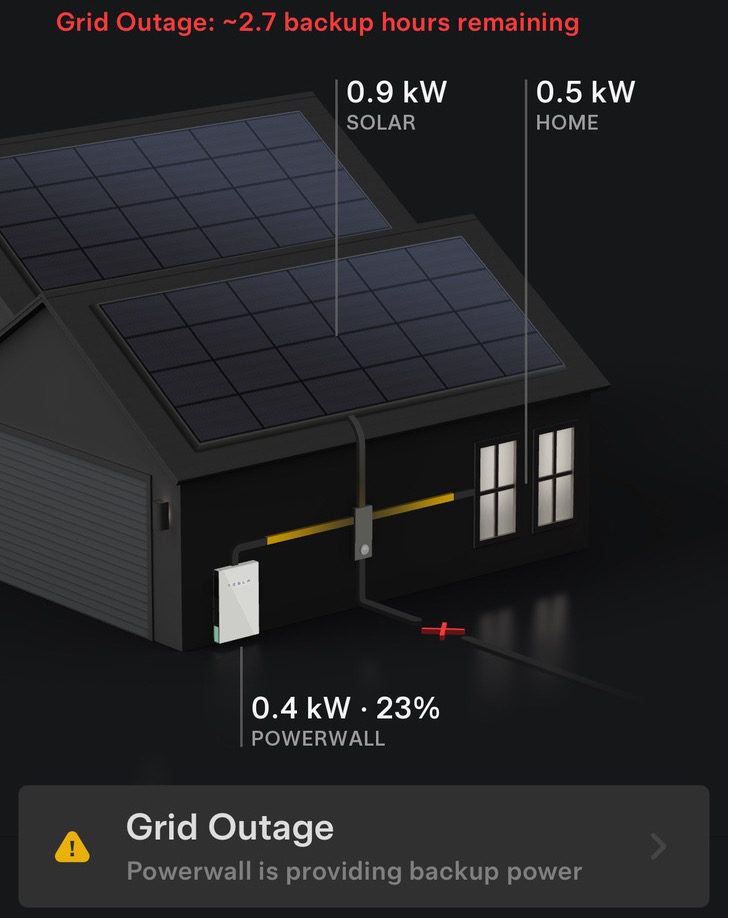
Grid disconnected, home and solar still operating. 0.9 kW of solar powering the home and charging the battery.
Test #4 – High load test with the grid connected (DC-coupled systems)
Reconnect the grid. Now switch on the appliances that sit on the backup circuits and that you would realistically run together. Lighting, fridge, kitchen gear, perhaps one air conditioner. The system should carry on without tripping or complaining. If the hybrid inverter shuts down under normal conditions, the design cannot support everyday usage and needs to be fixed before anyone signs off.
Test #5 – Failure and bypass test: what happens if the inverter dies?
Some hybrid systems cut power to the backup circuits if the inverter itself fails, even though the grid is still available. Ask the installer to isolate the inverter using its AC isolator while leaving the grid connected. If those circuits stay alive, the system can pass grid power through. If they go dead, you need a bypass switch to restore supply during an inverter fault. If a bypass exists, get a live demonstration and record it on your phone. Months later, in the dark, you will not want to be guessing.
These five checks take very little time to confirm that the system performs its core duties and that you know what to expect in daily operation and during an outage. Don’t feel bad about politely insisting these checks are done before the installers leave. It is basic due diligence.
Phase Shift is a weekly opinion column by SolarQuotes founder Finn Peacock. Subscribe to SolarQuotes’ free newsletter to get it emailed to your inbox each week along with our other home electrification coverage.
 About Finn Peacock
 RSS - Posts





I had my PW2 replaced with a PW3 + expansion pack late last week. Very reputable installer, very satisfied the tests were done.
One behaviour is curious. On the day of install, at commissioning the PW3/expansion duo charged at the maximum rated 8kW. However the next day, the maximum the battery duo would charge at is 5 kW. There was plenty of spare solar, and I have 3 free grid hours to supplement in the middle of the day as well.
The only explanation i can think of is, I had it in TOU mode, and at 5kW it easily reached the SOC target within those 3 free grid hours. So maybe the battery didn’t see a need to up the charging rate to 8kW, and opted for a lower rate to preserver the inverter and battery chemistry? On Day 1 of course the SOC was lower, with trhe battery being new, so maybe that made it charge at the full 8kW?
Nick,
What was the battery SoC on day 2? If the high charge rate on day 1 had brought it high, then charging should throttle back for good battery life. (And tends to, naturally, while voltage limits are observed.)
Mid-40s. I spoke with Tesla this morning and they said I have the just-released firmware that should bring charging rate to 8kW. WIll see!
Finn Peacock put us right on the way back up works. Our installer didn’t even connect that or the Wi-Fi, simply because they didn’t know how to do it!
It was only after reading Finn’s backup story with his SUNGROW battery that I found we had no connection, not even the cables! The company did send a different installer and completed the job. Now, we have had 5 blackouts, and only once was the battery not enough. A couple of them, we didn’t even notice as the changeover happened so fast; the computers stayed on!
SUNGROW instructions are too complex, but worth the effort in learning to use them to force charge from the grid at off-peak times. We now only use about 1500 watts a month at peak times.
The listed tests listed hit the mark, I was lucky, i had a reputable salesman who explained the system that was in his quote, how it would work, the pros and cons. He explained to me what other options were available and was happy to modify the quote once i understood what i actually wanted and how i was happy for it to work.
I suspect poor Norrie is a victim of his own lack of knowledge, and not knowing what questions to ask the salesman
To late once the installer is on site putting in the quoted system.
I will add another one – check that your AC still works.
I had a PV + battery install, and the next day when I turned on the air conditioning it did not work. Somewhere along the way one two of the phases for the 3 phase got swapped.
Installer came back and fixed it with no issue, but would have been cleaner if I tested before he left.
I had exactly this as well! Was it a 3 phase Sigenergy system? During the install, their commissioning app told them to swap some wires. Then the next day my aircon didn’t work, they came back the next day and swapped some more wires and the air con worked again. But I was still convinced there was a problem as my pre-existing Enphase was getting weird readings about consumption. Eventually I got them back, we carefully traced each phase wire, and they swapped back to how they were originally. He got on the phone with Sig as his app was still telling him there was an issue, but the Sig guy said they’d just clear the problem on their end. Now everything is happy – the aircon, the Enphase and the Sig.
No, it was a Tesla power wall 2 and Fronius inverter.
They had to redo the circuit board to plug in the backup circuit.
Either they got the colours wrong, or the original wiring was wrong and the AC unit was giving an error that the supply was out of phase.
Easy fix, but would have saved effort to get it checked at the time.
Ah interesting. My guy didn’t use different wire colors for each phase, which made tracing much harder. On the third visit, I asked why and was told the bosses said it was cheaper to only carry one color in the van. I was a bit disappointed in the shortsightedness of that – he had to spend two more visits fixing things, which surely would have cost a vanful of wire.
It is very much “Caveat Emptor” – “Let The Buyer Beware”.
Regarding the “Norrie Scenario” – “He was told only one circuit could be backed up. ” – this depends on a combination of factors – the inverter capability, in addition to the installer capability, and, in a case like mine, the “pig-headedness of the customer”. When our existing system was installed (I am waiting for the Goodwe 10kW/48kWh single phase ESA system to become publicly available in WA, to upgrade the system), we had a 5kW limit on single phase inverter capacity. So, to protect the household connected appliances and devices, I insisted on total household protected circuit, excluding bore pump, solar HWS booster element (3.6kW) and air-conditioner (ducted evaporative – up to about 1kW). The restriction on total household internal load (5kW – 20A), is frustrating, but it (mostly; when the backup switchover works properly, which it not always does) protects everything, and, provides relative continuity.
Frustrations are an opportunity for improved system design, I find. (Funds permitting) Here, off-grid, I have two PV inverters and two battery inverters, for redundancy – continued operation in the event of equipment failure.
If on-grid, it would seem frustration-avoiding to wire up that equipment set to power two AC main boards, one grid connected, one not. The former could have a crazy-small 5kW inverter (10 kW in less loony states), the latter usefully bigger – able to put 7.4 kW into a BEV, and drive aircons, HWS, pumps, etc. – say 15 or 20 kW if we want a bit of capability as the world goes electric.
My Victron battery inverters have a grid *input* port, referred to as “shore power” by boaties. That could allow an on-grid installation’s off-grid circuits to draw grid power when the battery has done its bit and the sun has packed it in too. It would appear as another grid load, not liable to on-grid output limits.
Sheep are easily confined. Be a goat, I figure.
“Test #3 – Automatic blackout test: does backup actually work?
Your installer should simulate a blackout by switching off the main supply to the property. The lights should stay on, solar should keep running, and every circuit you were told would be backed up should still have power. If only part of the home remains energised, confirm that this matches what you agreed to. Partial backup is common, but discovering the limits during your first real outage is not a pleasant surprise.”
Another component to the test, is observing what exactly happens when the switchover to emergency power, occurs (if it does occur). As an example, with our Goodwe GW5000-EH inverter, (switchover time specced at “<10ms"), and Finn's Sungrow system, switchover should occur with disruption to lighting, of no more than a flicker (as Finn had reported his observation). Sigenergy, switchover time 0ms, should be no disruption at all, to lighting. Disruption to lighting should reflect specced switchover time.
“Test #5 – Failure and bypass test: what happens if the inverter dies?”
Some inverters (for example, the Goodwe EHB range) incorporate an A/C bypass switch.
I believe and contend that it is far better to have an A/C bypass switch, that is external to and physically removed from (but wired to) the inverter.
Our Goodwe GW5000-EH inverter is about 10m from the switchboard and grid connection. When we got it installed, I insisted on an A/C bypass switch. The A/C bypass switch (the first one was dangerously inadequate, and, I believe that the current one is also unsafely inadequate) is inside the house,adjacent to the switchboard.
If an inverter catastrophically fails, involving fire and/or fused wiring/internal components, I would have no confidence in an incorporated A/C bypass switch. I contend that an A/C bypass switch physically removed from the location of the inverter/BESS, inspires much more confidence in its efficacy and safety.
Finn,
Would it be a boon to consumers and the industry if your quoting service delivery included a one page commissioning checklist, with test descriptions and big fat tickboxes? Included in handover paperwork, its use could help a lot of beginners deal with this pioneering stage of a fledgling industry, not yet quite on top of the technology – at least in a few too many instances.
A “This is not a regulatory safety test list.” disclaimer might be in order, though, as people can be funny, sometimes.
An “Add your tests here” tickbox might also head off inevitable quibbling about what else could be checked in corner cases and weird installations.
Not every SQ user will have read all the blogs … nor the installers, perhaps?
Caveat emptor only applies to selling second hand products not involving businesses. So installer should take into consideration the expectations of the customer and sit down and explain what is required to achieve there goals for a system. As long as the customer is upfront with requirements and everything is discussed in theory should be no problem. There will be exceptions that will need to be discussed with the customer and documented to cover all bases.
As Eric notes, a good test of backup changeover is that a desktop computer stays on. Our Powerwall 2 system did this well during several grid-outages over the last few years.
After 7 years of living with a home battery I agree this a very good list. I have an old system but I actually like doing a manual switchover to the back up. First I really know the grid is down. Second, it allows me to hit the circuit breakers on the oven and AC to make sure they are inactive before doing manual switchover. One issue I learned from experience. During a long outage I have to configure the inverter as off grid and reboot it in order to get full solar battery charge when the sun returns (e.g. during Cyclone Albert when the grid was down for a week). This may only be an issue with some old systems but worth mentioning. I appreciate having this level of hands on control
Hi David,
Sounds like you’re all over it.
Many people like yourself enjoy having a good degree of control & involvement. I think it’s an excellent way to give the punters a real appreciation of what’s going on, especially with something like a cyclone.
However many people are electrical novices and unless things are automated, they end up having a poor experience.
I’m glad you’re getting the most out of it.
Had our system for two years now, Fronius/BYD combo, and happy with it up to a point. On the final day of a five day installation back in 2024, our installers just up and left, with no explanation regarding system operation. I just noticed that they were gone, and their vans had disappeared from our driveway. Oh ok.
I contacted the company and I was assured that they would be back to explain things. But we never saw them again. The company forwarded a User Manual which bore no similarity to our system, with no mention regarding the secondary switchboard, and all its breakers. So many breakers and labels.
Recently we experienced three grid outages over several weeks, with the last one lasting 20 hours over hot weather. Luckily, our two split systems in the living area kept working. Except they weren’t on any of the backup circuits. Odd. I am waiting for the company to send a sparky out to check things over.
Motto – follow Finn’s advice!
One can only wish… 6 weeks in from the install. 3 issues, many phone calls, many promises. Now worse… At first the system would dump 5kWh from the battery TO the grid at sundown. Then next morning at sunrise (no solar power yet) the battery charges (from the grid) to make up for yesterday’s discharge.
Normal solar activity though the day, export ok. Any power required after sunset is provided by the grid. After 3 or 4 calls, finally they decided to upgrade the inverter firmware. Went through ok, but killed the app. Re-installing the app failed because the inverter was tied to the old app. 2 weeks later, they reset the app from their end, and it worked. But now the app shows no export at all, and the battery doesn’t do anything. According to my retailer’s data, the system is exporting when solar is available, but after hours consumption is as it used to be before installation.
I had a call yesterday. It looked like they read “Test #3” above as they kept saying stuff from the test.
My bak up system keeps tripping battery and fault state system overload when my kitchen appliances are on installer states its because inverter is only 5 kw my existing goodwee inverter is 8 kw which remains i am not electrician what does all this mean
3 phase and on automatic backup? Common problem under sizing inverters with 3 phase systems, 5kw a circuit is woefully inadequate.
But single or 3 phase, if you want to boil the jug make toast and cook your bacon all at the same time you will throw out a 5 kw inverter every time.
My son go sox sick of his 15kw 3 phase 5 kw a circuit) inverter throwing out continually, he upped the size of his inverter to 30kw and put in a 50kwh battery at the same time
Thank you. Anyone used E Green Electrical. I’m wanting 3 phase , new solar and battery. Don’t want to get underpowered. They seem very professional and knowledgeable.