
 In response to a draft proposal from the Australian Energy Market Commission (AEMC) for higher fixed network charges, new analysis projects that a flat fixed fee for energy bills could disproportionally raise bills for energy-efficient households, and largely wipe out the value of the federal battery rebate.
What Does The AEMC Proposal Mean For Solar & Batteries?
The Institute for Energy Economics and Financial Analysis (IEEFA) analysis finds that a plan for bills based entirely on fixed network tariffs could hike bills for low-consuming customers and reduce them for high-consuming customers.
Under a scenario where energy bills are a flat fixed cost instead of based on consumption, low-income households – which tend to use less energy – would be particularly impacted, along with households that have invested in solar and batteries, IEEFA energy finance analyst Jay Gordon warns.
“A household that installed a 10kWh battery in 2025 could pay an additional $5,800–$11,500 in electricity costs over the battery’s lifetime under predominantly fixed network tariffs. This would more than outweigh the estimated $3,300 rebate under the federal government’s Cheaper Home Batteries Program … The shift could also weaken the financial case for most other household energy upgrades. With longer payback times, households could be deterred from installing efficient electric appliances or rooftop solar,” he said.
What Is The AEMC Plan For Fixed Charges?
Limited detail has been provided, but the AEMC has proposed a draft policy for “predominantly fixed” network tariffs. Under the changes, the dynamic charge based on a home’s actual energy consumption would be zero most of the time.
The changes aim to address the growing divide between the energy bills of households with rooftop solar and batteries compared to households that don’t – including renters and people living in apartments.
Fixed network charges currently make up roughly 39% of a typical electricity bill.
What Did The IEEFA Modelling Find?
IEEFA compared retail tariffs available in capital cities in the National Electricity Market against a scenario where network costs are recovered entirely through a fixed charge shared equally across customers.
The analysis found:
- Payback periods for upgrading inefficient electric appliances to efficient appliances at their end of life could lengthen by 0.5 to 2.5 years;
- Homes with rooftop solar could see bill increases of $239–$564 annually;
- Payback periods for new combined 8kW solar and 10kWh battery systems could increase by 1.2 to 4.4 years.
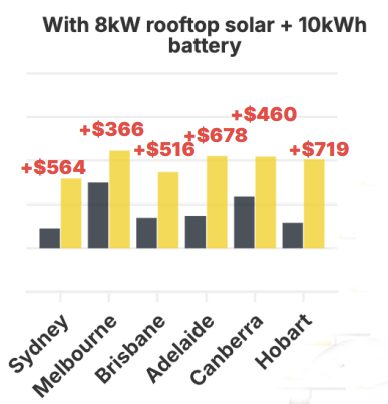
The estimated impact of higher fixed network charges for homes installing rooftop solar and batteries, with current total costs represented in black and projected costs in yellow.
Getting Off Gas Would Still Make Sense
The analysis did note a small benefit for home electrification – by lowering the per-kilowatt-hour charge for electricity, it would become modestly more appealing to switch gas appliances over to electric alternatives.
End-of-life electrification paybacks would be reduced by less than a year for a typical home, or less than 0.3 years for a home with rooftop solar.
The IEEFA has called for an independent review into electricity network economic regulation.
“Our electricity network economic regulations were designed before households had widespread access to rooftop solar and batteries. As more consumers start to rely on these technologies to meet some of their energy needs, and the potential for these technologies to support the broader grid becomes clearer, this raises questions about how costs and risks should be allocated between customers and networks. We are calling for an independent review of electricity network economic regulation because we know changing tariffs alone cannot resolve these underlying issues,” Gordon said.
That’s without factoring in AEMC’s other plans to increase the cost of joining and leaving gas networks.
Solar Owner’s Sense Of Betrayal
New solar-and-battery owner Andrew McDonald told SolarQuotes that if the plan were to go ahead, it would amount to a shifting of the goal posts.
“Last December, my wife and I invested heavily in solar and battery for our home with the economics suggesting a seven year recovery of outlay. We thought that we were following a government initiative by helping grid stability through the easing of demand at peak times. This … however, suggests a major change in the goal posts which makes us feel betrayed by the government,” McDonald said.
Earlier this month, SolarQuotes in-house installer Anthony Bennett argued it was false that solar households aren’t contributing their fair share to maintaining the grid.
“Some operatives whinge that solar customers put expense on the grid, but that’s only because there needs to be some smarter hardware to control the network. What they ignore is that solar behind the meter lowers grid demand. The poles and wires need not be as big so we don’t have to go around gold plating the infrastructure to make sure things don’t melt in a heatwave,” Anthony wrote.
Rewiring Australia Suggests Alternative Path
Among the submissions to the plan submitted so far was one from Rewiring Australia, which argued that the AEMC is correct to recognise that the status quo is no longer fair.
“If non-solar households, renters, and low-income consumers come to perceive that they are subsidising the energy choices of wealthier homeowners, the political coalition for electrification will fracture,” the Rewiring Australia submission reads.
Rewiring Australia however warned against fixed flat charges, and instead recommended “property-value-scaled fixed charges levied on property owners rather than electricity account holders, combined with stronger dynamic network pricing that rewards batteries and flexible loads for
genuinely reducing system costs.”
High Volume Of Submissions
Written submissions to the draft report closed on 13 February. The AEMC noted that “given the high volume of submissions received for the draft report, it will take some time to process and upload them.”
The submissions that have been published so far can be found here.
Final recommendations are due to be released in June 2026.
Subscribe to SolarQuotes’ free weekly newsletter to follow this story as it evolves.
 About Max Opray
 RSS - Posts




While I love my solar and batteries, this development rams home yet again that most of what drove the uptake of home solar here was the privatisation of electricity, leading to large increases in costs to consumers, who then looked for alternatives. It’s obvious that the economics of solar rely upon retail electricity being too expensive, otherwise who would bother, except dedicated survivalists and tech nerds?
This has also made me wonder about what happens with domestic solar when renewables eventually drive down the retail cost of electricity. It will probably still make sense economically to get your own solar and batteries, but subsidies will likely go, which changes the sums significantly.
This is easily the most insane idea the retail bloodsuckers and friends have ever conceived, if implemented it will explode in spectacular fashion with wholesale disconnections from the grid.
. . . and the next step (you just know it) will be the same flat charge to have the power supply simply running past your home / property / commercial and industrial premises.
Charged on capital home value like rates and water.
Yes you sell for 4 to 6c/kWh then the retailer buys this to sell later at say 20c/kWh using say an expensive grid battery in the evening. However, thats not how it works. A person goes on a retail plan with fixed prices for certain times of the day or all day. The retailer needs to cover the swings and roundabouts just as you would at home being a generator. The margins after expenses are single digits most of the time. The media talks about the big swings in price but that is rare and insufficiently long to make windfall profits. If it was traders will pile in to profit from it and destroy the price by flooding it with supply. If the supply is not available consistently someone will build another grid battery or peaking plant or offtakes from suppliers. One way or another the elecricity market is a volatile and perilous place. As for distributors they get a return on assets for transporting power. They have regulated returns which are nothing to crow about but it is guaranteed.
I agree- but the problem is it’ll quickly become like water and sewerage – if they pass your front door, you pay whether connected or not.
They WILL find a way to screw us all, one way or another.
ie: Gotta keep the profits and big salaries for the executives no matter how it’s achieved.
I’ve got an EV that I charge at home.
Under this scenario, sounds like I’d end up ahead!
(I still think it’s a crap idea.)
You will pay a far higher fixed daily charge
I won’t be paying ***ANY*** fixed charge as I will disconnect from the grid immediately the bloodsuckers try that stunt, and I do know exactly how to prevent any jiggery pokery.
FWIW, a retailer in New Zealand tried this nonsense and unleashed a storm of proportions never before thought possible. Australians are by nature apathetic but I can’t imagine anyone standing for this.
Doug, Would this be what you’re referring to?
https://www.stuff.co.nz/money/360722461/rising-line-charges-hit-power-consumers-hard
No it wasn’t .. I was on about King Country actually, however your info is extremely interesting as it appears tonidentify a far bigger issue. I understood that only one isolated area was impacted whereas it looks like a national problem. We are weighing up the possibility of relocating to New Zealand so this is important. What will be critical though is whether or not its possible to go completely offgrid in our chosen area of NZ to avoid this bullshit.
.
Hi Doug,
Going off grid usually requires about 4 times more solar & battery than a reasonably self sufficient grid connected setup.
You’ll also need a diesel generator that wants maintenance, fuel, filters, cranking batteries and most importantly a phone number for the people who are going to make it work.
It’s not cheaper than the grid.
“property-value-scaled fixed charges levied on property owners rather than electricity account holders” Wow the most elequent response I have to that is probably not allowed on here.
That won’t hit landlords as they will simply raise rent to cover this cost.
Linking the value of your house to electricity charges is a bizzare form of wealth tax. You don’t have to be wealthy to have what would now be an expensive home to purchase. We already get hit with that by some greedy tradies who quote based on property value and then council rates are based on the same. The land your house is on is worth twice the blocks 500m away now, you can pay more for everything.
I assume you would have to pay all the fixed fees even if you disconnect from the grid?
I have always said your supply charge is cheaper than having a back up generator, maybe that argument won’t hold in the future?
While landlords usually don’t pay for power connection*, or of course usage, it will hurt people greatly with all the other pressures inflation is causing.
*This may differ in some states, I think it would be rare for power to be included in the majority of rents, but some complexes may have group metering panels where a landlord would have to pay the supply charges, and yes, then pass these on in their general costs.
I imagine if there was heavy grid disconnections with people capable of funding proper off grid systems and leaving the grid, then the next step would be to have the fixed change for supply running past your home / land, much like rates and water.
Corporate will be protected it seems, if this gets up it basically confirms the goal posts are always going to be shifted to suit that.
“property-value-scaled fixed charges levied on property owners rather than electricity account holders” From this statement a landlord, the “property owner” would be forced to pay the equivalent of a supply charge and the renter pays the new low electricity rates.
Based on regional supply charges at around $2 (some much higher, not many plans cheaper) that’s an extra $30 fn the rent would have to go up. If it is going to contribute to making electricity rates lower then it would likely be much higher.
Money / cost effectiveness is not my primary concern ,total independence from parasitic grubs is infinitely more important to me. My contempt for retail bloodsuckers and indeed all of officialdom is well off any known scale, consequently I will do what is necessary to opt out of as many rackets as is humanly possible.
Hi Doug,
Maybe you missed the advice but I’ll reiterate the “parasitic grub” you’ll need to employ is a person like me. Ask any remote area power system technician and they’ll tell you, the main purpose of a generator is to make my phone ring, charging batteries in winter is a secondary function.
The mains are 99.998% reliable in Australia and at $1/day it’s well cheaper than just an annual service for a genny.
A lot of people have been sold the myth of “rugged individualism” without realising it’s cooperation that got us where we are as a species.
We now have Medicare, vaccines, schools, roads, reticulated water, sewers, all designed as a public good to keep us safe and healthy.
Selling them off to private operators with a profit motive is a failure according to the ACCC.
Sadly it’s eroded people’s trust in institutions more generally.
I can assure you that 99.8% grid uptime is a fairy story in my area with at least three outages every week. As for the generator, I’ve used it twice in ten years..Maybe your scenario does apply in some cases but definitely not mine
Hi Doug,
Firstly, just to clarify, 99.8% would mean 1¾ hours of outage per year.
Whereas the rules are 99.998% or 10½ minutes per year.
If you’re losing power 3 times a week, and the outages are 5 seconds each, the DNSP will owe you money for breaking the rules.
Secondly, a remote area power system is best set up to auto start the generator and run it for 10 minutes once a week, or at very least once a month.
And there will be a long overcast week, (or several each winter) where the generator will wail for hours on end in the afternoon or evening.
The generator’s job is to keep the lights on and care for the battery. In fact most battery makers won’t offer a warranty on systems that dont have an auto start genny.
I don’t think the grid is fair, it could certainly use reform, but we shouldn’t abandon such an expensive first world luxury just to spite the incumbents.
Better to give away your solar yield to the grid for free; and damage the viability of coal in the process.
The grid is a wonder of the world. The thing that I think is most misunderstood about it, which I remember from my engineering days (others can correct any of my memory of the details here) is that it doesn’t transmit electricity like pipes, the most common misconception. It transmits energy, it’s an enormous continent-level electromagnetic field that pulsates in real time with the ever-shifting loads. The grid isn’t in the wires – it surrounds them.
Energy is transmitted near instantly (speed of light) from wherever it’s generated, whether that’s a power staton or your solar panels exporting, to everywhere else in the grid, in a dynamic, never-ending pulsation of energy. The current/electricity that’s used in devices is within the wires, but it’s not transmitted there from generation sources, they transmit energy through the electromagnetic filed surrounding the wires, which then activates and moves the electrons in the wires/conductors at the point of use.
I am now a retired electrical engineering from thr generation business. The grid has been developed and refined for over a century since Edison invented the light bulb. People take it for granted but its a technical marvel not just transmitting power across large distances at low losses but also in a stable form, no easy feat. Today as new technologies evolve like renewables snd batteries its role is changing from bulk supply from central sources to dispursed generation & distribution with backup and with it lowest cost of the grid operation. The greatest challenge has always been on the fringe of the grid where backup and reliability is most challenging to achieve cost effectively. Inevitably owners have had diesel backup generators to deal with the non perfect supply. However, with new technologies even these issues are being addressed with microgrids and the like. Self sufficiency seems very idealistic as it doesnt come cheap but you can get close without blowing the bank account.
The underlying premise of network charges is a guaranteed rate of return on capital – being the Regulated Asset Base of the transmission and distribution network providers. What about the previously assumed return on my capital investments? Some $30k of solar, battery and electrification off gas (plus the EV) later, I have some recouping to do. So we get a capitalism that favours big players and penalises small ones – how very 2020s.
Retail bloodsuckers are immune to laws..We have hours with no grid power every week and there id no recourse !!! My battery isn’t subject to a generator condition, which isn’t needed anyway as I have more than adequate solar capacity most of the time..Mind you this is an industrial sized installation rather than the toy thst most have..Free export ? Not on your life !!! I won’t give the bloodsuckers one free miliwatt.
This does not surprise me one bit, inevitable actually.
FIT tarrifs started high in 2010 today its next to zip as we have excess home solar generation going into the grid incentivised by subsidised taxpayer solar installations.
Grid provides backup to homes but homes are becoming more self sufficient especially with subsidised taxpayer batteries on offer. So to pay for the backup fixed fees go up. Its not rocket science.
What isn’t rocket science is that the private owners of much of this infrastructure are passing on close to all of the costs for their upkeep back to consumers, to retain returns to their shareholders.
Sorry hate to blow that myth apart.
Firstly, the East coast, NEM, is mostly deregulated but subject to strict scurtiny and the rates charged are set by govt regulators not the private players.
Secondly, I live in WA, Synergy- govt owned, owns the power distribution wires and most of the generation in the SWIS, either directly or under contract. Western Power- govt owned owns the major high voltage distribution. Both are broke, 7 yrs ago they broke even and has been going into the red ever since because of primarily home renewable generation thats starving them of revenue.
You either subsidise the players via the taxpayer or you recoup it from the customers. No free lunch wether govt owned or private.
Or the government pays for it as an essential service, as it used to. There are no ‘players’ needed.
https://reneweconomy.com.au/transgrids-latest-cost-blowout-raises-a-key-question-what-was-the-point-of-privatising-energy-networks/?fbclid=IwY2xjawQLR6NleHRuA2FlbQIxMABicmlkETIwbkpneVNCQ0dSeGhadEpoc3J0YwZhcHBfaWQQMjIyMDM5MTc4ODIwMDg5MgABHgjRhYP1jY2hAj60PMqdk3jPcZ6mqr_2bwx5tnOrCuqs5C8Y1rCFogl0Rdqg_aem_hxHM8PzRz7sU0fKovQaOwA
Sorry to blow this bubble again. No large project in Aus run by govt or private sector is now run well. Everything is now over budget and late. So to blame privatisation as a scapegoat is plain incorrect. Pass through costs to consumer is as old as contracting started in Roman days.
Socialism of the electicity supply, who’d have thought ?
As was once said, socialism looks ok until you eventually run out of other peoples money . . . that will equate to a socialist electricity supply is great until you run out of peoples willingness to invest in solar or solar and battery.
Don’t they see people that have invested $10k to $15k or more just for solar (or double or triple that for a decent solar and battery) are taking a load of pressure off the grid ?
After installing solar in late 2023, the following year and again last year it became clear that to keep pace with changes of the goal posts annually, we would need to get a battery . . . after spending $40k for a new iron roof and 11.2kw solar, not that keen to spend more with the way they protect corporate power companies.
If this idea gets up, it will have a fairly profound effect on a lot of household budgets, and certianly force a lot into greater hardship.
It will punish renewables investment and low power users.
Any significant increase in connection fees may trigger a shift to “off the grid” in suburbia. I know I will look into it. As a long time small energy consumer, and high PV energy provider; I have been on the journey of reducing FiT. Which I understand. The justification of a grid connection is slowly becoming harder and harder to justify. And technology is moving more towards self sufficieny being achievable.
As soon as my EV can easily support V2H (I know lots can), between my house battery and car battery and solar, I can see off grid being possible without generators, or super large home batteries.
A few days of overcast weather = drive to the nearest supercharger and top the car up in 15 minutes to go back home and power your house for the next few days.
Exciting times.
I suspect it would be political suicide to annoy the millions of Australians who are solar homeowners, particularly with headlines like “this change wipes out the benefit of the battery rebate”. Any modern government will run a mile from something that potentially explosive.
We can hope.
I can assure you a domestic home with 10kW PV with a 15kW battery will not cut it. Not even cloe to go off grid with or without an EV with V2G as you need to drive it ! You need to so overbuild which no house in the burbs can handle.
Some folk have been critical of my utter contempt for the retail electricity racket, however this latest stunt only goes to underline my attitude abd views..There is absolutely no way I will ever play the game .. I am already running off-grid 95% of the time and the only reason I have a grid connectuon is because of the 59c FiT until 2928..After that the bloodsuckers can stick their electrons and their fees where the sun doesn’t shine. I sincerely hope many others follow suit. .. hit the grubs hard where it hurts.
Running power lines past a property and charging for it might possibly be a case of the “corporation” digging its own grave. I’m not actually off grid, I’m waiting for winter to come to see how close I can get. With the number of households with batteries and panels increasing, the potential for “off-gridders” is also increasing, and a scenario comes to mind; houses pull their plugs and the suppliers try to gouge the cost of non-connection to them with big “service charges”. They refuse to pay and get taken to court. Would the amount of community support be enough to discourage further action? I’d certainly be willing to donate hundred dollars to fund their defence.
Next, the war in Ukraine is in its fifth year and a tactic used is to strike infrastructure such as energy. The more domestic generation/ storage of power would tend to render this tactic less effective. So it may be argued that rooftop solar be considered a “defence/ security” issue.
Depending where you live, winter is absolutely not the problem. The big issue for many parts of Australia is storm season, the periods where you get 3 days in a row with heavy cloud, and possibly rain. That results in single digit generation even with a larger than standard system. You could survive that if you strictly control power consumption, or have a large enough battery, but a generator is likely necessary.
Yes houses being independent for power could indeed be considered a national security matter, BUT that depends on the brand. Given concerns around CCP China, choosing a system with a backdoor that can simply brick your entire system should Canberra fail to kowtow to Beijing is itself a critical threat. Yes some may argue the same about Tesla and Washington DC, but I’m not seeing that threat. And it’s even harder to argue for Austrian products. Beware Vienna? : – P
I very much doubt China is an issue in play in this or at all really. China has greater issues than little old Australia. They can buy and sell with us readily and have no need to change that.
Beijing already plays plenty of attention to Australia and is a clear risk.
Yes the CCP have plenty of other things they focus on – invading Taiwan, seizing SEA territory, fighting with India, internal issues, disputes with America, and plenty more, but that doesn’t mean they’re ignoring Australia.
You’re assuming buying and selling is all they care about vis-a-vis Australia. It’s clear that’s not true.
Personally I would prefer to be a state of China than a state of the US.. What country has stuck its nose in every world conflict in recorded history ?. What countey claims to be ‘rich’ but doesn’t have a workable / accessible medical / hospital system ?.What country has an excuse for an education system.that doesn’t teach its students who won WW2, which country initiated the Pearl Harbour event / what countries were on the allied side ?, which country elected the orange baboon but can’t remove the idiot ? what country executes corrupt politicians / bureaucrats / judges / business crooks ? (and no it isn’t yankeeland), what country facilitates murder of schiol kids / ordinsry citizens ?
Obviously you aren’t familiar with CCP China, or you don’t care they’re a police state.
I’m not sure what criteria you’re using, but the US has not stuck its nose into every world conflict in recorded history. In the 20th century alone it tried to avoid both WWI and WWII but got dragged in.
Countries without workable\accessible medical\hospital system? Some would argue Australia given shortage of GPs, waiting lists to get on hospital waiting lists, ambulance ramping etc. Countries like Switzerland or the Netherlands mandate private health insurance.
I don’t recall being taught who won WW2, and Pearl Harbour was never mentioned. Another AU failure?
Is orange baboon another term for Winnie the Pooh, though he wasn’t elected by the country but the party.
There’s plenty of countries that execute corrupt folk, including North Korea, though corruption is open to interpretation.
Canada? Government is the 4th cause of death.
Seems like you have quite a phobia affecting you!!!
Hi John,
The United States has been in a near-continuous state of war or foreign military intervention since 2001.
Analyses indicate the U.S. has been at war for 228 of the last 245 years, or 222 out of 239 years.
The U.S. has been involved in military conflicts for the vast majority of its history, with estimates suggesting it has been at war or engaged in significant military interventions for roughly
220–230 of its 250 years, or over 90% of the time since 1776. While only 5 wars were formally declared, the U.S. has participated in over 400 military operations.
Bar WW2, can you name any wars that the US has “won” by any objective measure?
China are not interested in us, other than to sell us solar panels, batteries and EVs. We should mind our own business and look after the interests of Australians not the USA. The Chinese ‘disputes’ with the US are those of the US who feel their hegemony threatened.
Joe,
It is a mobility & logistics security issue, as well as a balance of trade boost. If / when global tensions threaten our fossil fuel imports, it’s the BEV vehicles which still still be moving. And if that’s on rooftop photons, then there’s the climate resilience of being able to ignore weeks of grid outage after storms, fires, or other disasters. The time will come.
Here, 27 kW of panels, 24 kW of inverters, and 46 kWh of batteries are off-grid overkill for one occupant – it would do for a family. The panels are cheap, so max out the roof, but 30 kWh of battery would do, and maybe 15 kW of inverters, as a 63A main switch only takes 14.5 kW anyway. Then maybe $50k is enough – just about.
This morning, in total overcast, solar yield was 2.5 kW, just 9% of nominal. But that runs the 2.3 kW HWS with zero battery draw, and I’ll finish the day on 100% SoC. (It’s there now, even though the overcast hasn’t budged all day.)
Production beats storage. Off-grid removes inverter limits.
At present. the US is easily the greatest threat to world peace. China isn’t even in the equation..The only good thing to come out of the US in 2025 / 2026 in universal recognition that the US is a rogue state run by a senile homocidal maniac and hell bent on self destruction. Trump has far more in common with Mad Kim than even his unhinged mate Putin.
Oh please, this is delusional thinking ! China is not yet militarily a superpower so its using covert tactics and economic cooercion including it Belts & Roads program to entrap countries in debt ala Sri Lanka. Domestically its an autocratic state with minorities severally abused. Tibetan genoicide and 2M muslin youth incarcerated in so called reeducation camps that are nothing but sweat shops producing goods for re-export through domestic supply chains. BMW was caught a few yrs ago having from memory part of car seats made from these camps. I could go on so please takeoff your rose colored glasses.
Hi Media,
The US & China have roughly the same prison population, taken from 330 million & 1 billion respective populations, that means “the land of the free” gaols it’s own people at triple the rate of one party authoritarian China.
We could argue about the virtues of lifting a billion people out of poverty and simultaneously murdering political agitators.
We could lament insane gun policy, unlimited political campaign spending, popularly elected judges, for profit prisons and a “health” system that hunts people for sport and skins them for their life savings.
However these political rantings dont help people with home electrification.
Michael would not approve so the comments will stop here.
Cheers
Attempts to “Reply” to Dreg’s 0854am comment fail in the lodging process.
Herewith was my attempted comment.
Dreg,
Quote
A few days of overcast weather = drive to the nearest supercharger and top the car up in 15 minutes to go back home and power your house for the next few days.
Unquote
Sorry to be a killjoy, Dreg, but you need to insert somewhere “and get on the queue of cars queued up around to block, behind drivers who had exactly the same idea”.
Just half-a-dozen drivers with the same idea = a one-and-a-half hour queue.
Sigh!
Funny you should mention long queues waiting to recharge their EVs. I was riding my (electric) scooter last night heading to Perth and on the other side of the road there was a PETROL servo with a very long queue of at least 20 cars all lining up to buy “cheap” petrol. I returned about an hour and a half later and there was still about 10-12 cars hanging about in one lane waiting to refill. I got home, parked the scooter in its garage and next morning I plugged into my house battery and by 9:30 it was at full charge.
Joe,
My comment was not a general comment on charging queues for EVs. It was on the specific circumstances outlined by Dreg. The point I was making was that Dreg would not be Robinson Crusoe when it came to topping up in the situation he described.
Just as I would not be pointing out that in the same circumstances of your 20 cars waiting at a petrol servo (of, let’s say, 8 bowsers at say, 5 minutes each) = something less than15 minutes wait at the back of the queue
whereas 20 cars waiting at Dreg’s bank of say, 3 superchargers = the best part of a 2 hour wait at the back of the queue.
Oops, sorry, I just did. :>
Please: I was responding to a described, specific scenario by Dreg.
And bear in mind he was not talking about topping up his bike. He was talking about keeping his house functioning for several days and that was why he was going to be at the supercharger in the first place.
“My comment was not a general comment on charging queues for EVs. It was on the specific circumstances outlined by Dreg. The point I was making was that Dreg would not be Robinson Crusoe when it came to topping up in the situation he described.”
I fully understand what you’re saying, but you are commenting on a situation which MIGHT happen, whereas I was commenting on what I had actually observed WAS happening – a whole gaggle of Robinson Crusoes. So much for “range anxiety” as a reason to not have an EV. 😀
I am on my second EV, about 120,000km in 8 years and no real range anxiety. Saved a small fortune on dinosaur juice, contributed nothing to middle east terrorism and really appreciate the independence from the establishment. I doubt that I-ll ever use VPP, V2G or any technology which impacts my 8ndependence from the grid.
So a good policy gets upended by the private sector, through the regulator.
Users making a significant personal financial contribution in storage to load shift is rewarded through profit gouging.
Time to nationalise the grid.
You forgot to mention ….then you pay $2.8/kWh for the power.😳 As grid power will become super expensive as no one wants to pay for backup power. Hmmm self defeating me thinks🤔
What exactly are Rewiring Australia recommending? It sounds somewhat akin to a Californian proposal – charge people according to income, not according to a fixed price, for power.
And when they say charge property owners, are they aiming to eliminate the on-grid off-grid debate by ensuring everyone pay for a grid connection, use or no use?
The whole idea sounds dangerously ideological to me, even if I might gain more than I’d lose, financially, under it – assuming I remain on-grid.
1 scenario of this – not necessarily what Aus will go with
I’m not sure if SQ are aware of the king country region of NZ that has fixed charges (line fees – and how they are calculated )- also the external review of how that works and its effects
Worth understanding that situation as it was a primary reason for not purchasing a property in the area for me
I would be interested in your review
I just wonder why the Aus govt and industries are so fixated on maintaining power companies profits to the detriment of people – seems the opposite of what a govt is for ?
Probably 17 years ago and nehbour of mine put panels on his roof and was paid 60 cents per kw. Then I knew we were being screwed by the government because our electricity bills were paying that 60 cents. Soon after that (very soon) I bought panels, batteries, inverter and controller and went off grid for everything except cooking and hot water. (As soon as you privatise a service the maintenance and upgrade of that service comes last on the list in place of profit for shareholders and that is what they did to pay that 60 cents). I could go gas and dice the grid but it’s handy to hae it there for welding and a few days of rain. I’m 83 so buying an electric car that would suck my batteries dry is a waste of the kids inheritance and I do enjoy maintaining my car..
Another aspect is that in these times of uncertainty if the grid goes down its nice be independent of it.
It seems to me that people have reduced their consumption due to rising usage costs. The corporate generator and distribution system bumps up the supply cost to claw back more money. Meanwhile, the piddling solar rebate of 4-6 cents is on sold at say 20 cents/ kW/H, but still not enough profit. With the expansion of A.I. power hunger data center’s, the average domestic consumer is expected to subsidise grid and renewables expansion and curtail their use so A.I. does not go without. The though of making off grid user pay for the power passing their property. just makes me want to go off grid just for spite. Reminds me of a soliciitor threatening to disconnect my tank water. I offered to provide an axe just before I turf him off my property. Would the power company dare to interfere with an off gid system?
Any perceived loss is emotionally painful – we don’t like it. But the crazy last-century early-adopter FiT subsidies are, understandably, rationally, history now. Panels are a tenth of the price paid then, so the cost of generation is a tenth – 60c/kWh becomes 6c.Simples, eh?
Solar farms get 5c at best, so complaint makes no sense – you have to compete or go home. If you lack the charm, don’t expect to win the girl. Life is real. BUT self-consumption pays ~ 30c self-FiT – more if you drive a BEV. Get one, to really stick it to them.
OK, mooted on-grid daily charges would reduce savings, but would also unquestionably be the start of the death spiral. Faced with dwindling demand, the reason for grid existence gradually disappears – first in remote areas where isolated farms rapidly drop off-grid, then villages switch to a micro-grid with ample batteries. Those first steps are win-win. But then?
The sun does most distribution, given a big roof & cheap batteries, so: Grid play nice!
Big powerful entities are by nature pshchopathic. They are driven purely by profit and have absolutely no ability to comprehend harm inflicted on customers or indeed anything else. Our collective complacency / disinterest / apathy / incestuous relationships with piliticians / ability to purchase justice and even a kind of respect has encouraged the likes of the retail bloodsuckers to consider themselves gods entitled to gouge customers..That will eventually destroy the bloodsuckers. I did some research on king country New Zealand where the bloodsuckers tried the huge connection charge trick and predictably it went down like the proverbial lead balloon. Given the ability of many Australians to go off-grid,I predict a massive backlash in Australia, and while power company friendly politicians will attempt to protect the bloodsuckers, the end result will be the bloodsuckers getting run out of town by an army of cattle-prod wielding citizens
That generous FIT is mostly likely payed for by the taxpayer or by other consumers. Qld govt for eg was running an annual $1B loss for 15 yrs ! Subsidies, cross subsidies, outright handouts by govts have become the norm and you wonder why the electricity market doesnt work as intended. Aus now has the 2nd highest retail price for power in the OECD. In 2000 even as late as 2008 before the renewable push kicked off Aus had the 3rd cheapest retail prices in the OECD. Govt policy failure 101, you cant blame the market participants or the consumer!
Hi Critic,
If you want everybody in the island nation continent, with one of the stringiest lowest density networks earth, to actually have electricity, then the cities will cross subsidise the country.
They always have, like roads, sewers and Medicare.
The benign hand of the free market simply doesn’t work without regulation, so for natural monopolies, things we accept are a public good, they should be nationalised.
Nobody should conflate the introduction of a profit motive with the cost of reinvestment in networks that need transformation.
Price gouging never goes unpunished. As we have seen with solar panels and more recently batteries, enterprising consumers will always find ways to defeat the bliodsuckers. This latest intended rort is no different, an unexpected mass exodus of victims from the electricity racket will probably herald an end to collusion between governments and their favoured corporate entities.
Even prior to 2000 city and country power prices were the same, good govt policy a cross subsidy that made sense. I am not talking about that I am talking about failure of govt policies since. The worst is probably not having a gas reservation system for the east coast when the Glad LNG export terminals were first mooted. WA already put this in place to ensure domestic WA consumers paid reasonable prices to cover operator costs while exporting LNG for a nice profit. However, the Fed/Qld govt didnt ensuring the Ukraine induced gas price explosion hit every east coast gas consumer and fed straight into the
wholesale power price which still is an issue today. Pile on top the numerous subsidies, incentives around renewables without considering the impact of unintended consequeces and you have a stuffed marketplace. Market participants/consumers are not to blame for the failure of govt leadership that continues. Home battery subsidy being another bandaid fix changed within 6 months !
So i then reset my solar so it is curtailed just turn my pv off. Then buy cheap and charge my battery. From 0% to full. I give nothing back. My solar is off grid. Not battery. Idiots.. F you all. There is no benefit to solar
Hi Paul,
It’s easy to forget that when you have solar you can use it, right then and there, for free.
Cycling energy through a battery is expensive, given how much they cost and their warranted lifespan.
Exporting solar is a *chefs kiss* to the fossil burning industry, I’ll do it for free knowing it’s costing them.
And even if you’re not off-grid, the Street-FiT of BEV charging boosts our balance of trade, while reducing oil burning. An ICE is less than 30% efficient, so around 3/4 of the energy is wasted while hastening planet stewing.
Fill enough roof, and you can do both, as a big array soon charges the car, especially with a DC charger, then you can stuff electrons back up the coal-burners’ pipe.
Anyone not finding substantial ongoing savings in solar is just not trying, I submit. (Or hasn’t been able to save up for a BEV yet – that’s when it kicks in. Calculate the fuel cost saving as a loan interest offset – then it’s affordable earlier!)
I believe the climate change is largely caused by our Grid with emphasis on the use of the Low Voltage Network being the loss of efficiency cause because the SOLAR Roof-top system uses mainly the Street Distributors and High voltage system efficiencies are not possible. I believe the total roof-top system to be about 35% percentage Power Delivered wise and the only way to improve efficiency is to avoid using the Grid with SOLAR PV.
Using my tiny experimental system that I installed in 1967 as my model, it was 95% efficient because it was OFF-Grid, and used to supply 12V DC loads without an inverter. The system was emergency Back-up but could be used independently.
The possible 95 % or 85% using an inverter is only possible by keeping SOLAR PV OFF-Grid and at ELV DC.
I( started my interest in SOLAR PV in 1942 when my father showed me his experimental SOLAR system using Selenium Rectifiers as his Absorbers. I was just 7!
Across the National Electricity Market using central generators to consumers the transmission losses was about 9%. With distributed generation ie renewables it will be higher but not much so but will increase as renewable penetration increases. Grid batteries will account for another 9% loss and pump storage hydro about 30% eg Snowy Hydro 2.
As for co2 emission by far the largest source are from industrial processes, the power gen, transport etc. Power gen is the easiest to reduce with renewables. With transport its EVs. Industrial processes are the elephant in the room.
IMO the loss of efficiency due to an inverter is more than compensated for in a real world situation by the vastly more cost-effective mainstream appliances as opposed to typically low volume and hence expensive ELV equivalents