
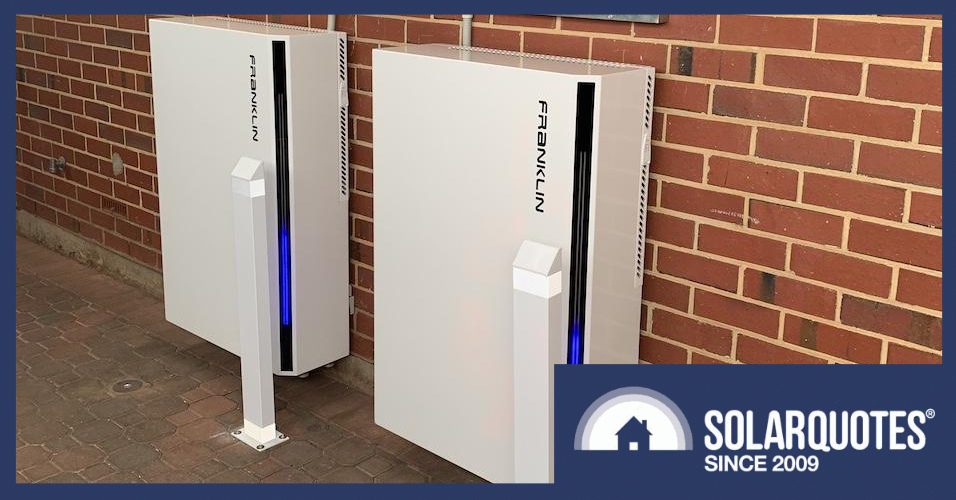
 FranklinWH are busy making themselves a compelling reputation for Australian customers.
So should you consider one for your place? Yes, if it’s an AC coupled solution you need.
This article is by no means a comprehensive product review but given how lively the comment section was after SolarQuotes founder Finn Peacock’s recent post on AC coupling, I thought it was worth mentioning a couple of key features for what is one of the few non-hybrid batteries on the market.
Franklin’s VPP Warranty
I had a call recently with FranklinWH’s refreshingly good technical support, and they mentioned the company has organised an integration with Origin’s Virtual Power Plant programme called Loop (full disclosure: Origin owns SolarQuotes). Now the economics of using a VPP at your place can be as variable as the weather and your mood for air conditioning, so we’ll leave that aside.
What I thought was interesting is that Franklin have expressly stated they will warrant the battery while you’re operating as part of a VPP. I think putting this down in writing is excellent.
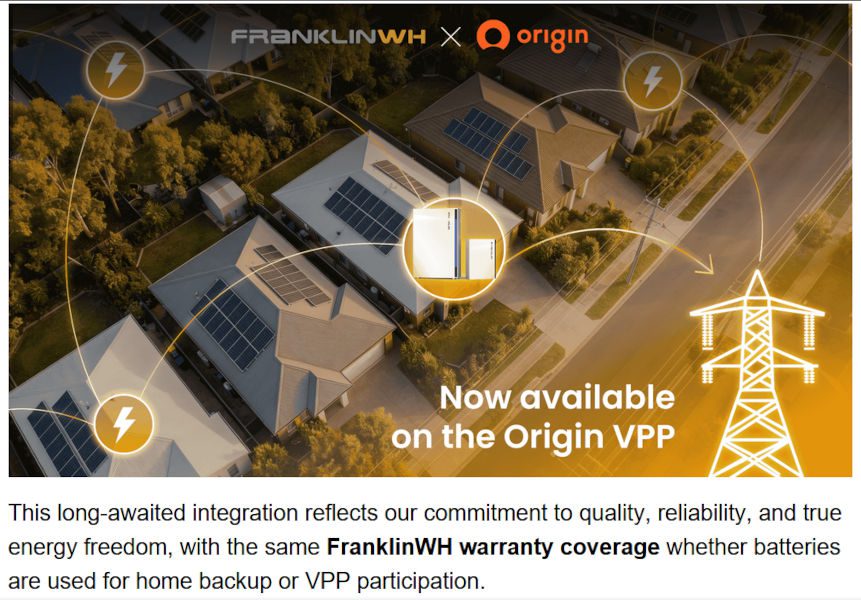
While batteries are supposed to store and discharge energy, some other brands effectively shorten or perhaps even void the warranty on the equipment if you decide to use it doing the work it’s designed for – weird. They’re afraid that a VPP will damage or prematurely degrade a domestic battery with a commercial workload.
So flogging your battery too hard is ruled out, but I’d liken a VPP to using a light passenger car for commercial deliveries. It’s something that happens every day, just think of the Uber operators and taxi drivers out there and how they’d respond to being told they have no warranty.
Really a battery should be warranted no matter how you use it. If there’s technical limitations then the battery management system is perhaps where the manufacturers should be looking to place limits, not the fine print.
Franklin’s Quality Technical Support
The reason I was reaching out to Franklin in the first place wasn’t VPPs, but a question posed to me by a bloke who has two 5kW Fronius Primo inverters on a single phase property where they’ve recently installed a FranklinWH battery.
Problem is, only one of the solar inverters is AC coupled so that it works to generate and recharge the battery during an outage, when the customer ideally wanted them both running to use all his solar.
Bench Racing Some Ideas
When Finn and I recently visited a potential electrification project on a difficult inner city home, we were pointing out and talking through all the myriad ways available to tackle the different problems it presented.
While I was gesticulating about how to route a new supply to the switchboard, where you’d put the inverter and how the hot water could be integrated, Finn was peering at aerial imagery of the equally problematic small shady roof.
As a card-carrying aficionado of the AC-coupled club, he arrived at a microinverter solution for the solar, and I had to admit he was right. This is one of the niches where DC coupled solar could work but something like Enphase makes perfect sense. Easier wiring to the roof, no box on the wall, efficiency individualised down to single panels.
Of course this means an AC coupled battery solution was in order, even if it was a hybrid that just didn’t have solar panels connected.
Some years ago all the cool kids had a Powerwall 2 (or several of them) and a stack of solar using Enphase. The Tesla app provided a nicer user interface than Enphase’s Enlighten, while many soon forgot the panel level monitoring they were so keen on during the sales process.
The only thing that brought it unstuck was if there was an outage and the battery went flat overnight. Generally you needed the grid to get things going again. And depending on your DNSP, sometimes the bigger problem was a connection limit, which at worst hamstrung you with 13.5kWh of storage and 6.6kW of solar, because the total inverter capacity hit the allowable 10kW ceiling.
Control Is Needed
In many respects, the grid has an infinite capacity to soak up solar power, but once you’re disconnected there must be much tighter control. You can’t just keep pouring energy into a battery, and with AC coupling you don’t want a solar inverter to overpower the battery inverter either.
Some innovators would use a relay to signal mains failure and close a dry contact that might throttle solar output or simply cut an inverter off.
With the 5kW Powerwall 2 there was an integrated control, where the battery could signal an outage and cause a Fronius (or other compatible inverter) to throttle it’s output to 5kW. In this instance, I suspect the installers didn’t know and didn’t care to learn this wasn’t the case with FranklinWH.
How Does Franklin Work?
Like many brands, FranklinWH uses a gateway to connect everything together and relies on frequency shifting to actively control solar inverter output.
This allows oversized solar inverter capacity up to a hefty 30 kW to be connected to and controlled by the FranklinWH system during grid outages ensuring stable and safe system performance. So if you have a decent-sized single phase solar power system, Franklin might just be the simplest solution to add a battery.
Just make sure that the installers aren’t making it their simplest solution. Sometimes a DC coupled hybrid really is the best answer but installers may cite warranty concerns as an excuse to smash in a simple AC system, when really they’re just too busy (or a little too lazy) to replace an inverter and move DC wiring.
Let us know if you have any other AC coupled questions and we’ll look further into the subject. For now Franklin looks like a good option but if you have Enphase already, I wouldn’t discount the batteries they offer, even if Enphase need to discount the price.
 About Anthony Bennett
 RSS - Posts





I could be wrong, but I doubt 30kW solar is a good idea on an AC coupled system that can’t charge (read absorb 30kW). Frequency shifting is fine, but it does not happen fast enough to absorb voltage spikes in open circuit power failures. And these voltage spikes are dangerous to anything in your home. If you keep the solar size below what some vendors call the 1 : 1 rule, the inverter can avoid the voltage spikes by absorbing/charging the battery with the excess power until frequency shifting can take the fraction of a second to throttle down.
In truth, when Tesla released the PW2 they originally also said they could support unlimited solar. It was only after I pushed it with them to explain how they could deal with this issue, they eventually realised the issue they had no clue about and revisited there design limits down to account for this.
Can you ask there tech support how they deal with this. Unless they can explain this, it probably can’t.
Having to grid-isolate to be able to connect the 30 kW inverter to your system seems madly impractical for on-gridders. In Vic, only 10 kW is allowed on single phase, and you can’t frequency shift on grid either, so charging control is gone!?!
On-grid, with only 10kW inverter allowed, a 7kW BEV charger & 3.6 kW HWS leave zero rooftop power AC deliverable for aircon etc, no matter how big the arrays. To actually use 30 kW of PV on-grid, the Sigenergy 11kW/25kW DC BEV charger *can* use more than 10 kW solar, it seems. (But how much from the hybrid, how much from battery?)
A Victron battery inverter can manage a Fronius or Fima inverter on-grid by data comms, for On/Off-grid charging control. Selectronic too?
Better is: 10 kW on-grid inverter, and 12 kW off-grid inverter to HWS & garage. Then a 30 kW array can *deliver* to 22 kW of loads, not be 10 kW hobbled while on-grid.
The described AC-coupled low-on-grid-performance concoction seems designed to drive folk off-grid?
Part 2:
Once the prosumer-hostile 10 kW per phase AC inverter limit is removed, *then* on-grid AC-only solar power delivery might become practical. But not before.
Letting battery charging rob you of self-consumption is self -defeating – within a tiny 10 kW AC prison it is economic self harm indicative of low intellect, I submit.
A (even partly) DC coupled system, with battery charging via one or more discrete MPPTs, allows controlled battery charging over and above the ridiculous on-grid 10 kW AC solar delivery impediment. A good hybrid inverter does the same, I understand. DC is the secret sauce which circumvents the money-clawing 10 kW AC delivery limit.
Charging my 46 kWh battery at just 0.3C can take 14 kW of DC solar output, while also delivering 10 kW AC to BEV, HWS, and aircons. That would max out the 27 kW arrays, even on a good day.
Off-grid there’s still a 14.5 kW AC limit if the main switch is 63A, but a sparky can upgrade for a more capable system.
Thanks for the continued AC discussion. We have an 8-year old 5.3kW solar Enphase equiped bunch of panels, so our new 24kWh battery is AC coupled. One battery installer would only quote on a 5kW inverter as they believed the micro inverters contributed to the 10kW single phase limit. We chose a different installer and have a 10kW hybrid inverter included with the battery. To add more panels, should we DC couple them or expand with micro-inverters. Do these options have different regulatory caps? Ta
FranklinWH Tech support here, we fully acknowledge that customisation may be required, and we work closely with installers to determine the most appropriate solution based on the site conditions. That said, all systems must ultimately comply with the relevant DNSP connection rules, which define the maximum allowable system size and export limits.
A single aPower can absorb up to 10 kVA for up to 10 seconds. With three aPower units, the system can absorb up to 30 kVA for 10 seconds. In an on-grid operating mode, the aPower independently manages its charge and discharge. Solar generation will first supply site loads, with any surplus exported to the grid strictly in accordance with the approved export limits. If an over-export condition occurs, the system will immediately open the solar relay to prevent non-compliant export.
If your battery system was not installed with VPP and SSO in mind, we suggest you consult your installer to ensure cabling and circuit protection is appropriate.
Energex Dynamic compatibility is a must for QLD installs. Otherwise, on single-phase the system is limited a 5kW solar inverter and one aPower. Currently, if we exceed this limit, we must set a 1.5kW import & export for the solar & battery system to be compliant with the dynamic export requirements.
“So if you have a decent-sized single phase solar power system, Franklin might just be the simplest solution to add a battery.”
I’m deducing this marvelous-sounding product isn’t available in three phase?
As with most US based battery (Tesla) they don’t… Yet. You can always have 3 of them, one for each phase, but they are really designed for single phase because that’s what it is in the US.
Thanks Clive, FranklinWH can be installed on 1,2,3 and SWER (split) phase situations but we’re predominantly a single-phase solution.