
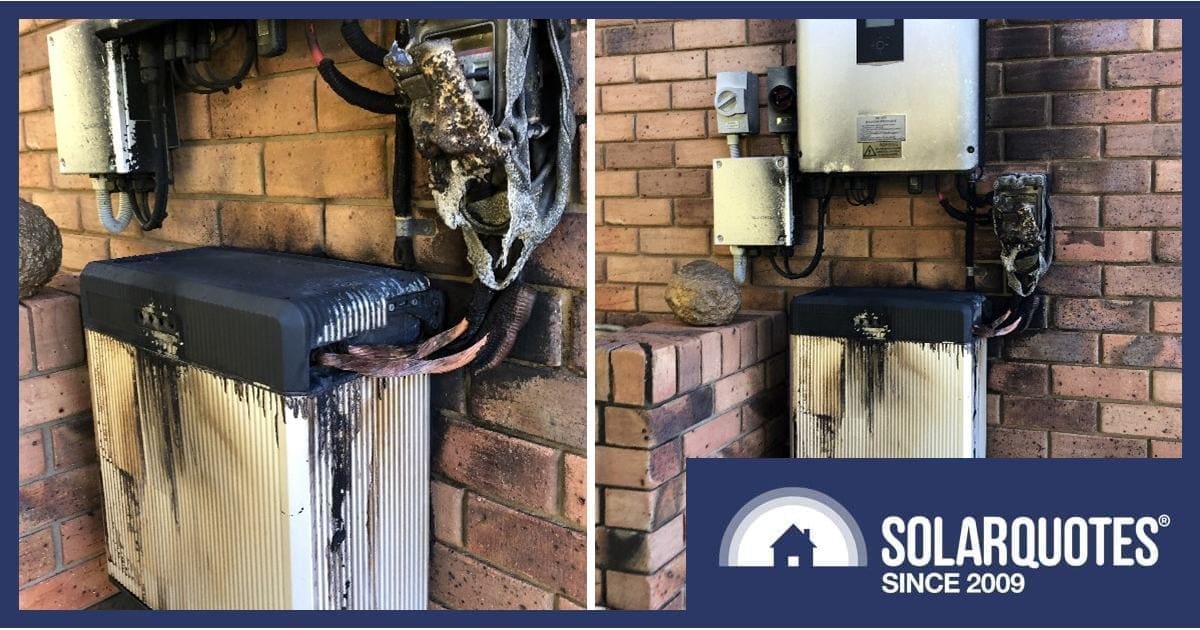
At last published count, a substantial number of LG Energy Solution (LGES) solar batteries at risk of fire and subject to a recall that began in Australia nearly *5* years ago remain unrectified.
What’s The Current Status Of The LG Battery Recall?
After ongoing concerns that LG’s recall advertising approach was inadequate, on 17 May 2024 the Australian Competition and Consumer Commission (ACCC) accepted an enforceable undertaking from LGES committing it to take certain additional actions. Then on 24 November 2025, the ACCC accepted a variation to this undertaking, which:
- Provides affected consumers with expedited access to replacement or refunds for all affected batteries.
- Provides for the implementation of an optimised communications campaign to locate recalled units
- Reduces the administrative burden associated with the Undertaking
- Improves the accuracy and readability of the Undertaking.
How Many LG Batteries Are Still Yet To Be Rectified?
LG has been keeping a status page updated semi-regularly, their last update on recall progress being October 15, 2025.
Replacement Recall notice
- Number of affected batteries: 7,840
- Number rectified: 6,909
- Number unrectified: 931 (comparison: 1,309 on December 16, 2024)
- Total number of affected units whose location LGES is aware of but remain unrectified: 24 (69 on December 16, 2024)
Diagnostic Software Recall notice
- Total number of affected batteries: 9,928
- Number rectified: 8,570
- Number unrectified: 1,358 (2,127 on December 16, 2024)
- Total number of affected units whose location LGES is aware of but remain unrectified: 64 (183 on December 16, 2024)
- Number affected that were subjected to a forced switch off: 92
Which LG Batteries/Packs Are Affected?
LG Chem RESU models and nickel manganese cobalt oxide (NMC)1 battery packs from specific production lots manufactured between approximately 21 January 2016 and 30 June 2019 are subject to the recall. Initially, it was thought to affect hundreds of batteries, but expanded to include thousands; including to several other brands using LG battery packs.
To identify affected systems and the course of action owners should take, see the LG recall page. If you know of someone who owns an LG battery or a brand using impacted cell packs; it’s important to let them know. Injury and damage to property has occurred as a result of the issue.
And it’s not confined to Australia. For example, a 2019 LG battery installed on a German home reportedly caused an explosion early this year, completely destroying one wall of the building and requiring the house to be demolished and rebuilt.
Are Solar Battery Systems Safe?
But it’s also worth noting a study from RWTH Aachen University in Germany published last year found the fire risk for home energy storage systems in that country generally was just 0.0049%; and uptake of systems has been very strong there.
The LG battery recall debacle aside, good quality battery systems professionally installed are safe; particularly given strict standards applied in Australia.
Some rubbish invariably make its way through the cracks though. But as an example of how rare home battery fires in Australia are, there was just 1 incident in 2022 and 3 in 2023 in New South Wales. While that represents four incidents too many and there are many more systems installed now than even just two years ago, safety features and requirements are also continually evolving.
Furthermore, with solar batteries now eligible under the SRES (Cheaper Home Batteries Program), the Clean Energy Regulator has begun conducting installation inspections. No doubt they’ll pick up on a few cowboys with profits their priority rather than quality and safety; which is always an issue when rebates/subsidies are involved with anything.
“We’ll publish inspection data and provide access to state and territory regulators including insights on any key learnings and risks,” states the Regulator.
The Clean Energy Regulator’s first report containing battery inspection data is yet to be published.
Thankfully rare LG-type events aside, living worry-free with residential energy storage isn’t an onerous proposition — it just involves the right choice of home battery and installer from the get-go; and very basic ongoing maintenance post-install. Read our guide to solar battery system safety.
Footnotes
- While Lithium iron phosphate (LiFePO4) cells are widely considered the safest chemistry, NMC isn’t “unsafe”. Design and safety features, quality of cells/other components, and care in manufacture in quality control are key. ↩
 About Michael Bloch
 RSS - Posts




I had the affected LG batteries subject to recall, replaced after 5 years. If you have LG batteries installed, I have been advised by my installer, who is still in business by the way, you are not eligable for the current battery rebate to add to these batteries.
The houses burning down due to lithium battery fires in Australia are regularly reported to be succumbing to cheap NMC or similar chemistry e-bike or power tool batteries left unattended while charging – often at night, with occupants asleep. (Only one last week?)
Paranoia protects – I leave my cordless drills on bare concrete, even when not charging – nothing combustible nearby. They are the only risky lithium batteries I allow indoors. The base model MG4 BEV has LiFePO₄, my house batteries are LiFePO₄, and the new electric excavator is LiFePO₄. No highly flammable electrolyte.
In addition to the LG Chem immolations, there was an indoor (USA, I think) non-LiFePO₄ battery farm which auto-ignited.
LiFePO₄ is cheaper, safer, less SoC sensitive, typically has double the cycle life, and uses zero Cobalt. It’s also a bit heavier – good in a baby excavator trying to dig a hole without falling in. (Some users add lead weights to diesel units.)
Carelessness costs lots – randomly.
Easier said than done choosing the right battery and installer as LG was widely considered a premium brand at the time and even with an established local installer you never know who your gonna get on the day eg my installers wife had a baby and he subbed in another installer.
LiFePO₄ batteries vent explosive hydrogen gas apon failure, i wouldn’t consider bolting any current chemistry lithium battery to my house personally, they’re all unfit for purpose in various ways (IMO)
Hi Neil,
Have you looked into lithium titanate? Zenarji make a pretty mean battery as far as I know. Toshiba have them too.
Anthony,
The Zenaji LTO batteries are ideal … except for price. The best chemistry is a bit like IBM in the old days – “If you want to eat hippopotamus, you have to pay the freight.” (My brother has 25 kWh of them; only issue: matching new model units to old after several years – don’t. Good for ToU export, though, @ 20,000 cycle life)
But as you’ve pointed out petrol cars self-immolate 25 times as often as Li-Ion, and I haven’t heard of an LFP one burning, except when set alight by the ICE beside it, or a house fire. The closest was one LFP battery smoking in a garage in USA – the fire brigade attended, said the smoke is toxic, and watched the rarity out of curiosity. A moist cloth wiped smoke stain off the adjacent painted wall, and that was it.
Do e-bike batteries lack a BMS? They’re the firebombs, statistically. The charger for the new BEV mini excavator says: 87.6V. For a 24S battery pack, that’s 3.65 V/cell = LFP abs max. The BMS should stop charging below that.
I think I’d be more concerned about getting hit by a meteorite than concerns about LiFePO4 batteries as long as they’re from a reputable manufacturer.
(I also have LFP batteries in our caravan. They’ve been there for ten years with absolutely minimal degradation, and are protected by a recently updated, good quality BMS. I would be far more concerned about hydrogen vented from lead acid batteries.)
Is this part of the reason battery evo is currently out of buisiness due to this? They where buying pallets of lg batteries. Im currently using one of battery evo’s set ups.
My battery recall and put me new 1
But is problem with my inverter because old 1befor burnt fuse!
Aft new change
Still problem no charge
I try to call electrical to fix or replace my inverter !no body want come after heap lg battery!
All running and don’t o touch
Now is over 1 year I have no solar battery!bill is very high
Hi So,
If you fill in our web form, and add some notes about the repair you need, we can probably find you someone to look at it.
Where abouts are you?
I’m in Adelaide
I need solar electrical to fixing or replace t converter and connect with solar lg batteries
Who can do? Please help me and send me company thanks
Hi Seangkhimpen,
If you follow this link:
https://www.solarquotes.com.au/quotesv3/start/
You can enter some details, select “repairs & maintenance” and then add some details at the end.
Please let us know if that works for you.
Cheers