
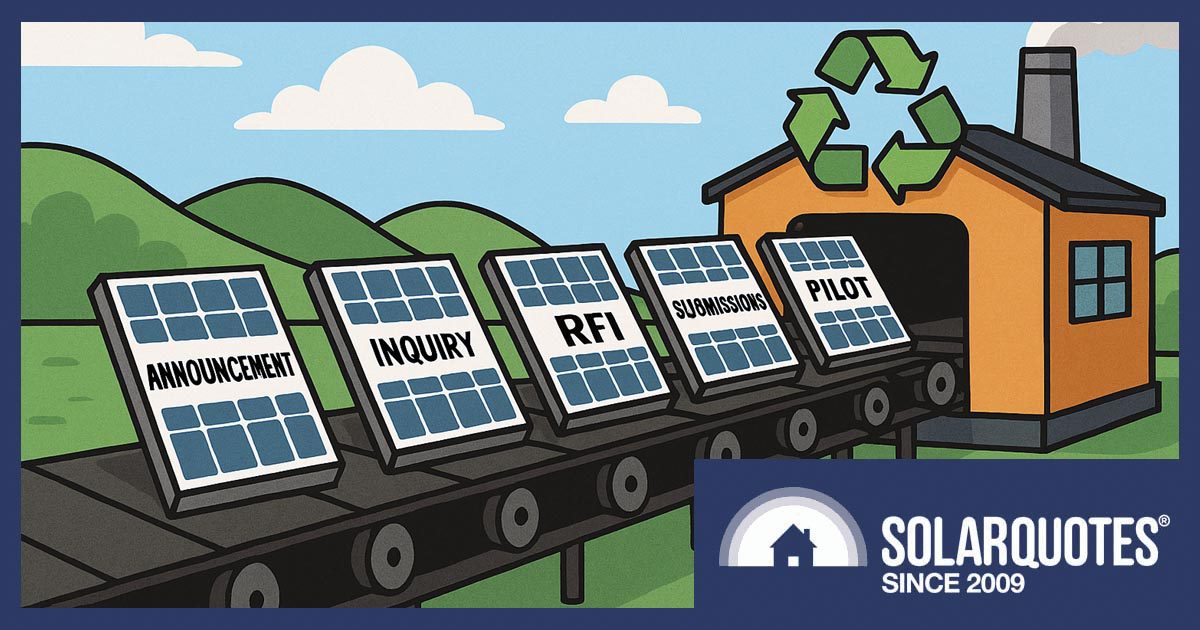
 Following the announcement of a national solar panel recycling pilot, a parliamentary inquiry has now opened alongside formal requests for industry and public input — signaling that the wheels are finally turning. We spoke with recyclers to get their perspective.
What Is The National Solar Panel Recycling Pilot?
The pilot itself was announced earlier this year, backed by federal funding to test how end-of-life solar panels can be collected and recycled at scale. Since then the government has released a Request for Information (RFI) to industry, seeking practical input on how a national pilot should operate, while the parliamentary inquiry has opened the door for submissions from industry, experts and the public.
According to the Department of Climate Change, Energy, Environment and Water, the pilot is expected to move into an open procurement phase later this year, with an administrator appointed to run the scheme.
The pilot is slated to begin in mid-2026, testing collection and recycling pathways across around 100 sites nationwide. Its purpose is to gather real-world data on logistics, costs and recovery outcomes, and use that evidence to inform what comes next — including any future national stewardship scheme.
Solar Panel Recycling Challenges On The Ground
To understand what the system needs to grapple with, it helps to look at what’s happening on the ground. Recyclers working in Australia today describe a sector that is technically capable, but structurally constrained.
Anthony Vippone, CEO of Lotus Recycling, points to the lack of consistent standards and oversight across the industry. Without clear definitions and accountability, it’s difficult to know what happens to panels once they leave a site.
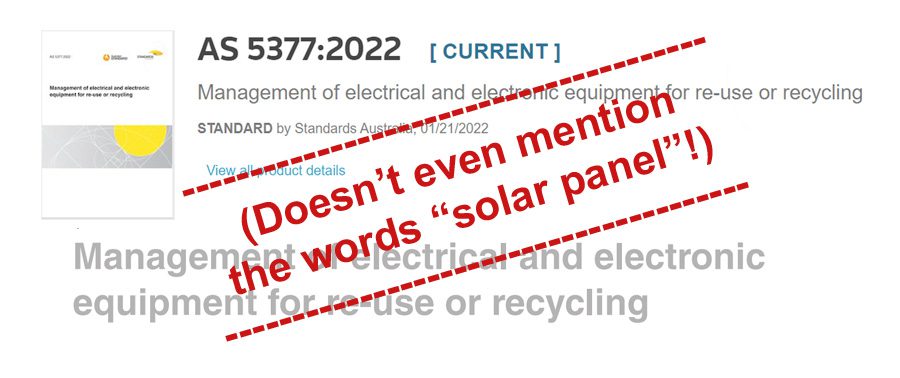
“The (national) standards for solar panel recycling are zero. AS/NZS5377 (E-Waste Management Systems Certification) doesn’t even mention solar panel recycling requirements, recovery rates, or reporting obligations,” he says.
This absence of a clear recycling standard and stewardship scheme creates a situation where panels can end up in landfill, stockpiled, or illegally exported. In some cases, the public’s goodwill is exploited, with some questionable recycling operators offering to recycle panels, but with no accountability they end up in landfill or buried in a farmer’s paddock.
“We need accountability — massive fines for company directors who mislead the public,” Anthony adds.
“In terms of the pilot program going forward, an analogy would be – it would be pointless have speed limits on roads if there were no penalties for breaking them.”
Local Recyclers Undermined By Offshore Exports
James Petesic, founder of solar panel recycling facility PV Industries, agrees that operators taking advantage of the current void in compliance are undermining the commercial viability of legit companies that are trying to do the right thing.
“The major roadblock to our industry has been the illegal offshore export practice. It means that we lose feedstock. The biggest thing that dictates the viability of a recycling business is throughput. If we’re losing up to 80 or 90 percent of panels that are being decommissioned, that’s a massive handbrake on our industry as a whole.”
“The best way to counter these illegal practices, instead of policing it better, is to make the economics for the panel (getting to a recycling facility) stack up. So instead of the installer getting paid X amount and offloading to a dodgy operator (for the cheapest price), they should be incentivised to have them properly recycled.”
Further to the viability, James says the economics of disposing of a solar panel in landfill versus a recycling plant is not the major sticking point it used to be.
“Over time solar panel recycling has improved and is now comparable (economically) to disposing in landfill. We’ve got better at recovering more of the panel, and increasing value of the materials on the back end,” he says.
Industry Input Shapes The Pilot
Taken together, Vippone and Petesic highlight some of the gaps that have held the industry back: unclear standards, lack of oversight, and challenges getting panels to recycling facilities. Their insights illustrate exactly the issues the government is now asking industry, experts, and the public to weigh in on through the parliamentary inquiry and RFI.
Have Your Say
The inquiry is open to anyone — industry participants, researchers, environmental groups, or concerned members of the public — and submissions close on the 27th of March.
Meanwhile, the government’s Request for Information (RFI) invites industry input specifically on how the national pilot should operate, with responses due by the 3rd of March.
For potential stakeholders, if you move quick, there’s an industry briefing on the RFI on Monday 16 February at 2:00pm AEDT. Email [email protected] for a meeting invitation.
Contributions to both processes could help shape the design of the pilot and inform future national policy.

Looking Ahead
Australia’s solar panel recycling sector is still finding its footing, but for the first time, there’s a clear pathway for real-world data, practical feedback, and potential reforms to come together. For those following the industry or looking to influence its future, the inquiry and RFI offer a chance to move beyond talk — and toward a system that actually works.
In the meantime, perhaps the best thing that can be done to reduce solar system waste is to get panels that last a long time – the good news is that most old solar panels appear to be living up to warranty promises, although other new research indicates found a significant minority of panels degrade faster than expected.
 About Kim Wainwright
 RSS - Posts






They don’t just need a strategy, they need some idea of volume both in the short term, as well as the long term. That is – what will be the steady flow, not what will be the peaks.
One would suspect with the battery rebate, we are in a peak – people with old systems wanting a battery and hybrid inverter taking advantage of subsidies and upgrading old panel systems.
Come 1 May that may start to drop away fairly quickly.
Then in a couple of years, people currently on legacy solar systems getting good feed in tariffs will be unshackled from their current systems / inverters (change the array / inverter lose the feed in tariff i believe?). No doubt there will be a fair percentage of them decide to upgrade panels and inverters and get batteries at the point the high feed in tariffs end for them. Assuming solar still makes sense at the point with the current push for higher fixed connection charges
.
Reduce, Reuse, Recycle. Were not seeing a Reduction in panels being “consumed” and apparently, Reuse is illegal by cecc rules or by shipping overseas, so we are left with Recycle. No mention of changing rules for Reuse?
Given that the life of solar panels is at least 30 years, recycling rather than re-use is very bad policy..There are countless good panels being removed for upgrading …. these are quire suitable for offgrid systems for which there should be significant incentives.
Completely disagree with the thrust of this article. Rather than recycling solar panels we need to reuse them. The real problem is that over 90% of panels pulled from existing installations are still functional. The CEC approved list needs a legacy list for second hand / obsolete panels that allows them to be both exported overseas for charitable use and used in Australia for budget installations although obviously they won’t come with a warranty or RECS.
The idea that perfectly good solar panels have to be recycled merely to support a struggling industry is not very “green”. The recycling industry is either economically viable or it isn’t.
John, I completely agree — reuse should be the first option where panels still have useful life.
FYI the federal parliamentary inquiry is literally titled about “solar panel REUSE and recycling https://www.aph.gov.au/Parliamentary_Business/Committees/House/Climate_Change_Energy_Environment_and_Water/Solarpanelrecycling — so reuse is in the official policy conversation.
The barriers to reuse have all been well discussed for many years. This article can’t possibly cover them all again – it’s simply about the latest developments to address this issues – including reuse.
If you believe so passionately that reuse needs to be addressed (like we all do) I urge you to do something proactive, and make a submission. That’s why I wrote the article. The link is now in this comment section as well as in the article.
EXACTLY ….there is an obsessuon with g9vernment supported upgrading but no thought has been expended on re-using the hundreds of perfectly usable grid inverters and thousands of panels. No installer in the country wants tonknow about these since they can’t get their cut of the government money that is thrown at new components. Governments add to the schemozzle by constantly changing rules that redult on good equipment being made obsolete / unusable. Then again. common sense and politicians are mutually ezclusive.
“The major roadblock to our industry has been the illegal offshore export practice. It means that we lose feedstock. The biggest thing that dictates the viability of a recycling business is throughput. If we’re losing up to 80 or 90 percent of panels that are being decommissioned, that’s a massive handbrake on our industry as a whole.”
What on earth is this nonsense? How can shipping used panels overseas for reuse where they are needed be illegal? Insanity like this reminds me that almost nobody in power actually believes in climate change – if they did, repurposing of valuable clean energy generation equipment to where it is needed would be incentivised, not made illegal to serve the profitability of the clean energy industry.
There is no way the embodied CO2 and materials in used panels can be offset by crushing them up, sorting all the materials out and remanufacturing them into new panels.
Hi Beau
How can shipping used panels overseas for reuse be illegal?
It isn’t — until it is. Exporting for genuine reuse is allowed. The problem is that many so-called exporters flout the rules: panels aren’t properly tested, documented, or shipped to stay intact, and often arrive broken. At that point it’s not reuse — it’s exporting waste from one country to another, which breaches rules like the Basel Convention.
On recycling: The energy and resources needed to recover materials are significant, so the environmental benefit isn’t guaranteed. The recycling process is getting more efficient, so I’m quietly optimistic that if not now, then in the future, recycling will be a positive environmentally as well as economically.
As you’ve taken the time to comment here, I encourage you to be proactive and share your thoughts with the inquiry. They’re literally asking for the public’s opinion (link in the article).
Hi Kim
Thanks for the info – I wasn’t aware that legitimate channels intended for export of usable solar panels were being used as a clandestine means of cheap disposal of damaged goods. I’m very glad to hear that good used panels are being repurposed where they are needed.
I will indeed put my 2c into the inquiry submissions, thanks again for the informative response.
Hi Beau – this is the sort of thing I’m talking about re illegal offshore export of e-waste https://www.dcceew.gov.au/about/news/big-fine-export-hazardous-e-waste-singapore
Well said … the hypocrisy is astounding !!!! Then again anything goes when people with connections decide they are losing money.