
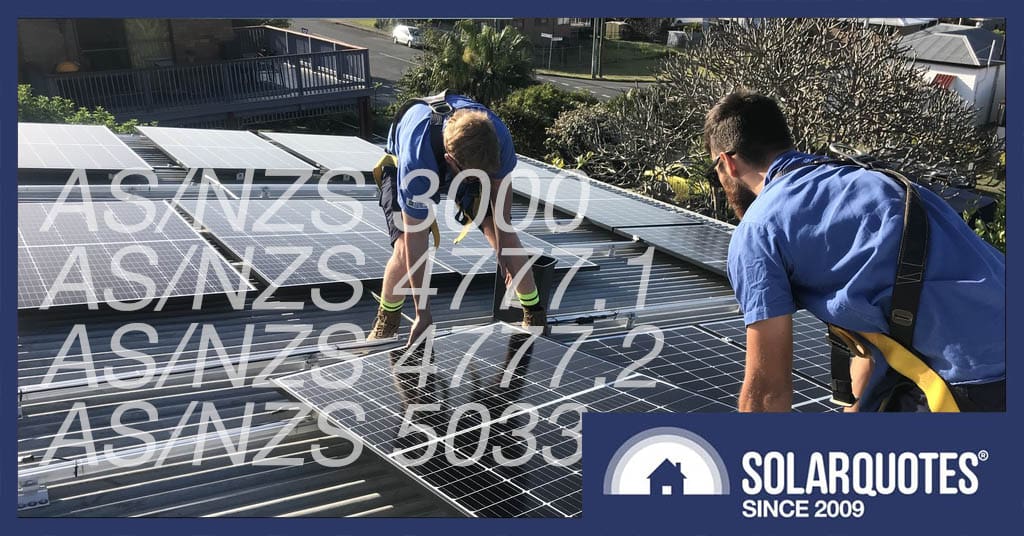
Image credit: MC Electrical
Whenever we discuss new rules or solar standards on the SolarQuotes blog, we invariably get comments asking if these rules apply to the commenter’s situation.
This blog explains the hierarchy of national standards, state regulations, DNSP rules and SAA guidelines and what that means for everyone buying, using and especially working with solar energy.
The Hierarchy of Electrical and Solar Regulations
#1 Australian Standards
National Australian Standards are the cornerstone of safety and uniformity in Australia’s solar industry. Key among these is AS/NZS 3000, known as the Wiring Rules, which supports other critical standards like AS/NZS 5033 for photovoltaic systems and AS/NZS 4777.1 for grid-connected energy systems. These standards govern crucial installation and safety aspects, ensuring that all solar installations maintain high levels of safety, promoting public trust, and supporting industry growth.
#2 State/Territory Regulations
State-specific rules also play a significant role. For instance, Victoria may have unique installation guidelines that slightly vary from those in Queensland or New South Wales, tailored to meet local environmental conditions. Your electrician is required to follow both national and state-specific regulations.
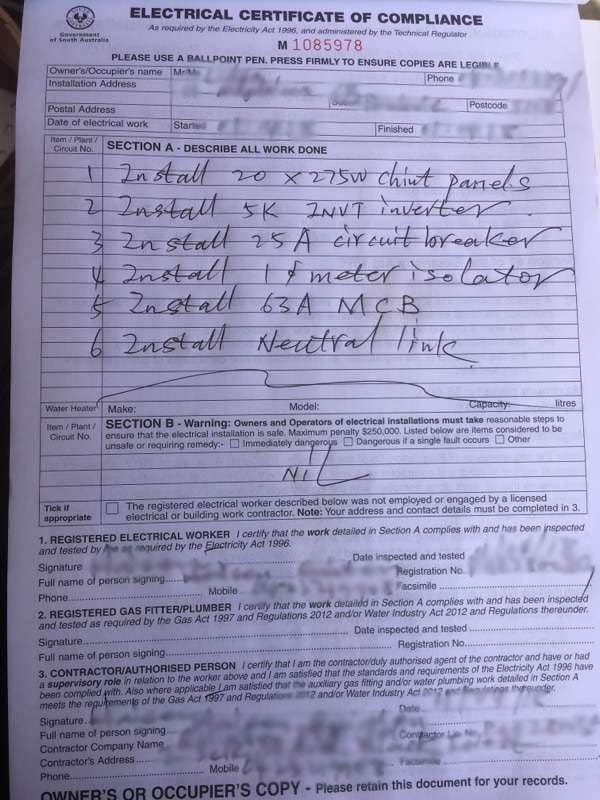
An example of an Electrical Certificate of Compliance for a solar installation, illustrating the detailed documentation required for regulatory adherence.
A Focus on Victoria
Rather than go through every State and Territory’s rules, as a Victorian electrician, I’ll use Victorian state rules as an example.
While Australian Standards provide the framework, Victoria’s specific regulations, such as the Victorian Electrical Safety General Regulations (ESGR), tailor this framework to meet local needs. These regulations mandate compliance with key safety and technical requirements.
Victoria’s rules focus more on practical skills than theory. They also require strict inspections for solar installations, considered major electrical work. This differs from most other states that don’t mandate inspections and only act when there’s a problem.
#3 DNSP Rules – Connecting to the Grid
When connecting solar installations to the grid, Distribution Network Service Providers (DNSPs) play a crucial role. As the owners and operators of the electrical grid, DNSPs enforce specific regulatory standards to ensure that any new connections do not compromise the grid’s integrity and safety. This introduces another layer of complexity for solar installers, especially in areas serviced by multiple DNSPs.
Across Australia, there are 14 different DNSPs, each potentially with its own set of connection requirements. However, one constant among all DNSPs is the mandatory compliance with AS/NZS 3000, AS/NZS 4777.1, and AS/NZS 4777.2. AS/NZS 4777.1 covers the requirements for grid connection of energy systems via inverters while AS/NZS 4777.2 focuses on the inverter requirements for grid connection.
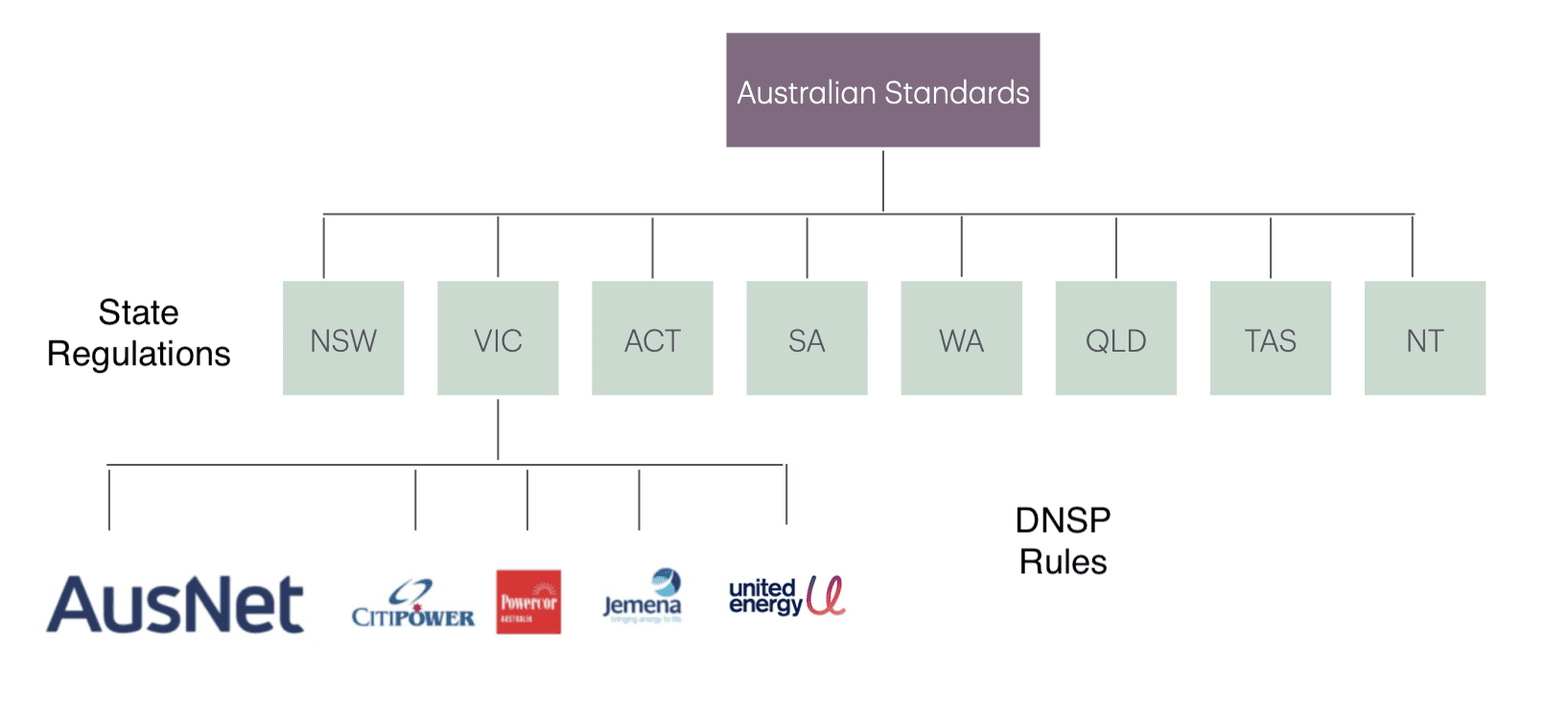
There are 14 DNSPs across Australia, and this diagram shows the five across VIC. Your postcode determines your DNSP, and each DNSP has its own rules for connecting to its grid.
For installers working across different states or regions with multiple DNSPs, this can pose significant challenges. Each DNSP may interpret and enforce these standards slightly differently, requiring installers to be extremely diligent and well-informed about the specific requirements of each DNSP under which they operate.
Alex, one of the contractors I inspect systems for, says:
“Dealing with multiple DNSPs can be quite a headache, especially as a relatively new contractor in the solar industry,”
“Each area has its own set of rules and application processes and I’ve found myself occasionally mixing them up which sets back our installation timelines. It’s a learning curve making sure we align with the right DNSP’s standards from the get-go.”
To effectively navigate this intricate landscape, solar professionals must establish strong communication lines with DNSPs and stay updated on any changes to their requirements.
#4 SAA Guidelines: Required For STCs
Small-scale Technology Certificates (STCs), part of the Federal Government’s Small-scale Renewable Energy Scheme, are pivotal in promoting solar adoption through the ‘solar rebate‘. However, securing these benefits adds another layer of compliance – specifically, Solar Accreditation Australia’s (SAA’s) Installation Guidelines. These guidelines are SAA’s interpretation/clarification of various Australian Standards, including controversial rules like the solar array oversizing limits. If your installer doesn’t follow the latest guidelines, you aren’t eligible for STCs on your new solar system.
Conclusion
Solar professionals must navigate not only national Australian Standards but also a myriad of state-specific regulations, DNSP rules, and SAA guidelines.
The distinct rules of each state can make compliance daunting, particularly for installers who operate across multiple jurisdictions.
And it can confuse the lay person reading about the latest rule or regulation updates. Going forward, when we explain a rule on this blog, we’ll be clear to identify it as either:
- an Australian Standard
- a State / Territory Regulation
- a DNSP rule
- or a SAA guideline required for STC creation
Then, you can refer to this post to see if it affects you.
Are you a solar professional or consumer interested in understanding more about how these regulations affect your projects and investments? Join the conversation by sharing your experiences or asking questions in the comments below. If you’re looking for more detailed guidance or need assistance with specific regulatory challenges, don’t hesitate to reach out. Let’s work together to ensure that our move towards renewable energy is both efficient and safe.
 About Pat Southwell
 RSS - Posts




My only complaint is that Australian Standards are used in writing laws. As such, they should be available to view by any member of the Australian public. How else can a homeowner/user have any chance to check an installation compliance?
I feel all Australian Standards should be available to read at any local library (probably on-line access).
Precisely.
Hear hear.
Where do we sign the petition?
I am astounded that complying with the law requires a citizen to expend some hundreds of dollars before the citizen can even read what they have to comply with.
There is a legal precedent in Australia that basically says that a consumer does not have access to the Standards so cannot be held responsible for a product not complying with the standards. It is the seller’s responsibility.
[this legal case was for a motorbike helmet that met EU standards but wasn’t certified for Australia. The owner purchased the helmet from a helmet retailer]
So if the installation is not compliant, then it is wholly the responsibility of the supplier/installer.
So its going to cost you hundreds of dollars to know whether the product that you are going to buy, complies with Autralian laws. What kind of system is that?
In the interests of safety and security, not to mention efficiency, it is surely better to have a simpler system of rules – the 14 sets of rules as Pat Southwell has so clearly explained is just ridiculous – the existing complexity mitigates against the stated aim of safety embedded in the Australian Standard (as exemplified by the quote in section #3 of the article). Are there any experts such as your good selves advocating for the needed change?
Hi, I hope this thread is still being monitored?
I have had 2 installers provide quotes for an upgrade to an existing (4 year old ) solar system.
The upgrade will include 6kw of panels to add to the existing 6kw panels, a new 10kw inverter and a 24kwh battery. (Sigenergy)
As the existing panels will be connected to the new inverter, one installer says they MUST replace the rooftop DC isolators on the existing panels and rerun the cabling to be compliant.
The other installer says they won’t touch anything on the roof and simply run new wiring from the inverter to the switchboard and leave the rooftop switches in place. They say this is perfectly legal in Victoria.
Both installers are listed on Solar Quotes recommended list.
Can anyone give me some guidance please?
Thanks
Peter
Hi Peter,
It boils down to what you deem a repair.
If the existing DC wiring from the array needs a plug crimped onto it and half a metre added to reach the new inverter, I’d deem that a sensible & pragmatic repair that doesn’t open a can of worms.
ie When fitting a new light switch you don’t have to replace all the wiring in the house. (Unless it’s 70yo cotton covered rubber, I digress)
However the rooftop isolator is a fire risk & should be eliminated if possible.
(Maybe if it was a Benedict+Jaeger unit I’d installed & verified as dry I’d say it’s OK, but someone else’s junk without a metal shade I wouldn’t trust.)
Strictly speaking that means replacing the DC cable with the latest spec & making sure the conduit is routed to current standards, so you’re rewiring from the array down.
That usually means lifting at least one panel so new mounting hardware might be needed too.
Hi Anthony,
Thanks for your valued reply.
The current switches are protected with a metal shield but I can’t confirm the brand.
As the price for removal of the switches and replacing cabling will add >$5000 (25%) to the project, I’m reluctant to do this if it isn’t a requirement for compliance.
I’m have a third installer coming today – I hope it adds clarity rather than more confusion! 🥴
Cheers, Peter
No worries Peter,
Without seeing the job $5000 sounds expensive. Perhaps they’re pricing some risk of having to deal with warranty liability for legacy solar?
It’s not strictly compliant but I’m sure some pragmatic electricians will remove a faulty isolator & repair the existing wiring without replacing everything downstream.
Provided there’s DC conduit in good order, changing the cable simply because it doesn’t have an IEC standard number printed on it is really just box ticking.
Let us know the upshot.
Ever since the bloody Nexen company did my solar installation in 2017, I have suspected that it was not working to full capacity. I recently had a complete Tigo installed and this shows that there are 10 of the 40 panels that are doing nothing! Years ago I made the mistake of forcing them to come back and “fix” it all and they paid me back by dropping the panels edge on onto the zincalume roof, putting in cuts which I have to fix at regular intervals. Just what you would expect from a bunch of dropkicks! I now know enough to know that the way to fix my system is to have 1 string of 20 for the North facing panels and the other string of 20 for the South facing panels. This would be OK under the revised AS/NZS 5300 standard, but two installers have told me that the slack NSW regulators have not bothered to alter AS/NZS 4777 to allow me to exceed the 600 volt PV DC string voltage limit for grid connected systems. I know that the 15 amp and the 11 amp MPPT inputs on my inverter can handle the current, and the MPPT input voltage maximum is 1000 volts. I am now 73 and I am beginnig to despair of ever having a properly functioning system before I die. Can you give me a reply to this sort of complaint, or do I just have to suck it up, because that is the way the renewables industry works?
Hi Patrick,
Sorry to hear about your problems but all is not lost.
AS4777 will be updated this year we expect (it’s already been rewritten) so once that drops you’ll be able to have 1000v DC grid connected residential systems. Click “I’m ready” and put your information into the front end of the SQ website, include these details at the end under comments and we’ll see if we can match you with an installer to help out.
Nexen should have given you a yield calculation as part of the initial quote. That’s a document you can hold them to in court if you’re interested in pursuing it. (Assuming they’re still in business?)
Thanks for your prompt reply Anthony: in an age when genuine human communication seems to be withering away it is heartening for me get this from you.
I may have used an unfair stereotype in my comments, so perhaps you could edit it out before exposing my message to public scrutiny.
I have a good relationship with the local installer who set up my Tigo monitoring (he liked my cappuccino and raisin toast at the 10:00 A.M. tea break: I must double the amount of raisin toast next job, for his apprentice).
He has assured me that he is monitoring the progress of the AS/ANZS 4777 update, but you seem to have a definite connection to the upper levels, whereas my installer and I are lost in the bureaucratic regulatory fog.
Thanks.
Hi Pat,
Toasted ham & cheese sandwiches, fruit toast, coffee… they all go down pretty well.
(Believe it or not there are some people who ask you to work on their house and then offer directions to the nearest public toilet)
I’ve done some training with Geoff Bragg who helped write the new AS4777 but I still don’t have a date for it sorry.
Anthony
Is the upgrade to 1000pv allowance definitely happening or still a maybe / unknown until the revised AS4777.1 is released?
Hi John,
The actual change in the solar array standard AS5033 was made in 2021 for memory. That enabled 1000v systems.
However the standards aren’t harmonised so AS4777 for grid connect inverters referred to 600v… meaning for some years now you could have a 1000v solar array but only if it wasn’t grid connected.
1000v is coming, they’re implying that it’s by christmas.
Anthony
Yeah, knew about AS5033 and most thought at the time that gave 1000V the go ahead, but as AS4777.1 still had the old 600V then everyone had to comply with that.
Reason for asking as currently looking at Sigenergy for a new install and with 600V allowance can only install 14 panels per MPPT. If the 1000V comes into play then can go 24 panels per MPPT (that’s installing 440W Jinko panels).
Makes a big difference for those who have the roof space to install plenty of panels (we could squeeze a maximum of 68 panels onto our 1 storey house).
Thanks
John