
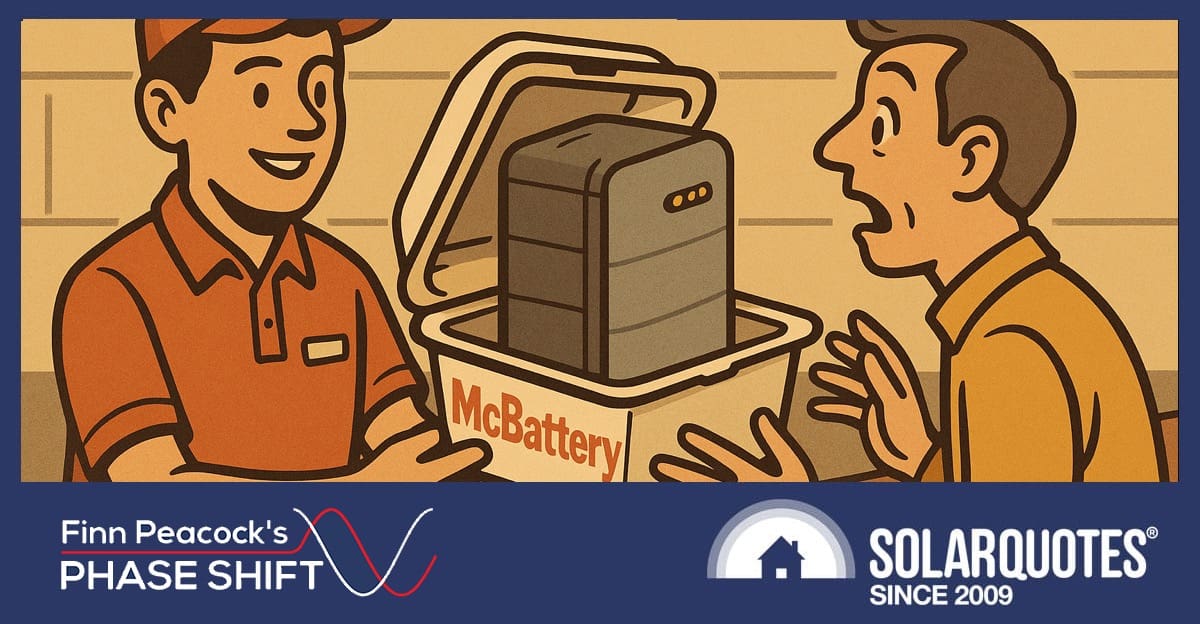
 Aussies love big things.
After the rebate, battery systems are heading the same way.
But bigger systems can bring bigger inefficiencies.
MC Electrical recently tested battery round-trip efficiency across a few systems. One result got a lot of attention. A Sigenergy battery stack with a 20 kW inverter was charged at 10 kW and discharged at just 700 W. Measured round-trip efficiency was 63%.
That sounds bad, but it’s not surprising.
At small loads, big hybrid systems struggle.
And seven hundred watts is being generous. Many homes draw closer to 300W overnight to power the fridge, lights, and standby loads.
Why Size Hurts Efficiency
Inverter efficiency is not a single number. It’s a curve.
As output drops to a small fraction of rated power, efficiency drops fast. At the same time, the battery system must still operate its control boards, power electronics, DC-DC converters and cooling systems. When output is low, that fixed overhead becomes a large percentage of the energy flowing through the system.
The result is a large battery stack working harder than it should to supply a very small load. More heat. More losses. Less useful energy out the other end.
MC Electrical also tested a smaller setup. A 10 kW Fronius inverter and battery stack discharging at just 300W measured at 82% round-trip efficiency.
That difference matters.
If Battery A is 30% more efficient than Battery B, then 20 kWh of the efficient one can give a similar real-world outcome to about 26 kWh of the less efficient one. Capacity numbers alone can mislead.
Here’s a gentle plea to anyone rushing to lock in the battery rebate before it reduces in May:
Between now and May, your feed will be full of ads shouting urgency. Big batteries. Big stacks. Big numbers. “Get in before the rebate drops by $10,000.”
That message plays straight into panic buying.
Before you sign, pause and consider how your system will operate most of the time. Overnight loads are small. That’s where batteries spend a lot of their life. A smaller, better-matched inverter and battery can outperform a huge system once losses are taken into account.
It can also soak up less of a taxpayer-funded rebate while doing the same job.
(You can check how much battery rebate your choice of battery is gobbling up with our battery rebate calculator – just updated with the latest changes to the scheme.)
Yes, a giant battery with a giant inverter will still cut your bill a lot if it’s working properly. And as a bonus, some of the wasted energy will help warm your garage in winter.
But in my experience with energy systems, good design ages better than brute force.
The McBattery looks great on the menu.
But once you get it home, you may find you paid for size you never use, and losses you didn’t need.
If You Already Went Big
If you’ve already bought a giant battery, don’t panic.
Check your monitoring after a few months. Look at how many kWh of battery sit unused most days. If there’s plenty of slack, consider a Virtual Power Plant or a tariff that pays well for battery exports.
Pushing more energy through the system by exporting to the grid can improve efficiency, reduce heat, and put some money back in your pocket. Big systems tend to behave better when they are kept busy.
Phase Shift is a weekly opinion column by SolarQuotes founder Finn Peacock. Subscribe to SolarQuotes’ free newsletter to get it emailed to your inbox each week along with our other home electrification coverage.
 About Finn Peacock
 RSS - Posts






With companies all publishing fairly similar round trip efficiency figures, how can consumers find real world use data to compare systems?
I am fairly confident our BYD / Fronius system is performing well, though we probably could have installed two MacElectrons r Us systems for the same price.
The Sigenergy battery stack is not indicative of large batteries, per se. As the article mentions, it has a DC/DC converter on each battery module, which allows mixing of old and new batteries – not always achievable. Observe that 64% is 80% x 80%, i.e. the chain efficiency of two average conversions, the second being the DC/AC inversion. Do *any* other large batteries do that?
My 46 kWh triple-battery assembly does not. Its efficiency is identical to a little 15.5 kWh battery – it is in fact three of them in parallel, so bigger makes *zero* efficiency difference here.
Nightime efficiency, at a miniscule 200W load, is limited to 87% by the 29W idle power of my Victron battery inverter. But here, I have a hot-standby for off-grid redundancy, so it’s 75% – for security, not battery size. OK, if 5kVA instead of 8kVA inverters, then 84% due to lower idle power.
BUT ample PV = surplus free energy = *zero* cost of inefficiency, if battery big enough. Rebate tweaks fixed hogging, anyway.
Regardless of how yumcha the fat battery stack is, to me it seems a better ‘investment’ to grab a big battery now (while they’re so heavily subsidised), and flog the crap out of them via a VPP.
Bank the money from that and upgrade in 5 years or so when the batteries are better, we seem to be on the cusp of better battery tech (but then again, we always do).
CATL appear to have Na+ batteries hitting volume production more or less now. Said to be 1/3 the cost of LFP in high volume, anything more than 2/3 at retail is a rip-off. But with installation, maybe 15% cheaper initially?
They are good at very low temperature, take 3C to 5C charge with minimal degradation – so nifty for BEVs, once the energy density improves a bit. Their high cycle life also outlasts a BEV’s mechanicals so much that most of its life will be spent in subsequent stationary storage.
I thought they’d be iffy with existing battery inverters, due to big discharge curve voltage sag, but a Victron will cope, just drawing more current as the battery goes flat, taking the last bit down faster.
Solid state rides to the rescue … one day … hopefully. But expensive, initially at least.
A big bunch of LFP does me. With global heating already increasing overcast skies alarmingly, only another 65 solar panels is a better buy. Put ’em out in the paddock. Get some sheep.
Australia needs a national energy plan. A fundamental component of that plan would creat mid sized community owned sodium ion storage batteries. These batteries could facilitate the requirements of at least 100 individual homes. They would be cheaper to build, would last for as longer time and the maintenance issues would be a lot simpler and far more effective. Putting individual storage batteries into every home creates a complex system to maintain and is very expensive to build, furthermore it is not flexible in terms of meeting the energy needs of the local community.
Community scale batteries have fallen in a bit of a no-mans land: too big for mass production, too small to offset the one-off design costs.
Synergy in WA (our mostly delightful state owned electricity retailer) has run several trials. Poke around and you can find the costs and they’re not pretty.
https://www.synergy.net.au/Our-energy/Pilots-and-trials/Community-Battery
Ultimately, big-a$$ home batteries have won the battle. Finn should be promoting them, along with the VPPs needed to put them to use for the country.
The government is subsidising the installation of individual home storage batteries.
The Government has not developed a national plan to build the most cost-effective system for energy storage generated by roof top solar.
As a nation we need to design a mid-sized sodium Ion battery with an energy storage capacity in the vicinity of 1Mega Watt hour.
These batteries have to be made in Australia by an Australian owned company.
To achieve this end our government needs to allow the entity that makes and installs the batteries to be unimpeded by Australia’s draconian taxation system on manufacturing activity.
The government needs to declare this area to be completely tax free.
By achieving this end, the entity that makes the batteries would be able to operate at a profit and supply those from the community with a sustainable4 Return on Investment.
The members of our communities have access to the capitol needed to create the factory by choosing to invest a proportion of their Super.
Diarmuid:
Great idea. But (Always a but) I reckon the Gov has gone the way it has (subsidising home batteries) for a number of reasons:
1 It gets them out there and installed sooner. Nothing like runs on the board to tell the public their plan is working. Less opportunity for the opposition to press the “too expensive white elephant” button.
2. People would rather invest in their own battery. They get it now (ish) get it going sooner.
3. There is the “what I’ve paid for I will use for myself” people. A bit like the American health system vs our’s. We are ok with our taxes helping everyone’s health. The Americans can’t think why they should pay taxes for someone else’s health.
4. If the plan is out there and running well, the opposition cant stop it if they win the next election. If a VPP is half way through construction, they can abandon it as being a waste of taxpayers money and “typical Labor yadda yadda”. OR, use the established infrastructure (for the new VPP) to install nuclear.
I agree with you Jeff, but the current idea supported by the Government is not necessarily the best for the nation. Community situated mid-sized storage batteries that are made in Australia by an Australian owned company utilising sodium ion technology would cost less to install and maintain. They would be more environmentally friendly instead of the quick fix currently promoted by our government. Very poorly engineered leading to a multitude of problems down the track. I understand that is all about the money and making a quick buck which is not solving the problem for the long term future of our nation and the people who live here.
Diarmuid,
Good idea, but it falls a bit short, perhaps. Your car is not flexible in terms of meeting community transport needs. Why not socialise it out of existence as part of the program? Walking to a bus stop is beneficial, anyway, and reduces taxpayers’ health cost expenditure. Putting individual cars into homes likewise creates a massive maintenance burden. Then putting people in blocks of 100 flats would also be cheaper and more efficient – they could share washing machines in a common laundry. I think you’re onto something. 😉
It is too often forgotten that the public spend on behind the meter batteries is about doubled by the private capital. $330/kWh installed from the government side (and going down) is far cheaper than neighbourhood batteries. While Ausgrid says they can do it for $500/kWh, the truth is that everything they have done to date more than doubles that on average. And they aren’t for the local community as anything other than as paying customers in any case. If you want a real community battery, you can’t ask the government, you have to mobilise actual community.
DER is actually a simple system to maintain because behind the meter alongside every battery is an unpaid project manager – the homeowner, who also arranged it all. Then paid out to the hundreds of small local businesses who did the hard work.
Absolutely – tripled…. For all the Government subsidising solar battery, etc, how many of us back in 2018 or so, spent their total Electricity bill projection to 2030 – or forward – installing solar etc..
NOW, I am in the situation, I am only importing ~2-3kWh of electricity a day (average across the year), and my bill is nudging back to ~50% of what it was in 2018(less sign on bonuses). Yes I have had bill relief for those years – only paid around $150 in total electricity bills.. (Costs are increasing, FIT are decreasing, we are being squeezed back in to the “consumer mould” before the domestic grid collapses under the weight of so many small generators..
The Behind the meter spend is what the government has been passing forward the gold plating costs, ever since is became “economic” for the early adopter, or the “energy independent” types… (the ?/ 2009 Gillard solar push with the 60c GROSS FIT was all about looking good to the International Paris accord dilettantes ..)
Why isn’t the gov limiting battery sizes to what households actually use plus say 20% to make it more equitable?
It complicates every install.
Ie you can’t assume everyone consumes 200w power at night during idle. I consume around 2kw idle and much more if my ducted AC kicks in.
My usage during the day depends on many factors, weather being a big one. I’m running 54kwhs of battery and use around 70kwhs a day.
Who determines what households use?
Complexity. Remember this is fed govt, just be grateful they didn’t blow the whole $5b budget on the IT system for the whole thing!
Because they want lots of active arbitrage capacity – they want private money to spend them out of a baseload drought.
Who cares if the overnight efficiency is lower than it could be? so long as the system is covering near 100% of your consumption or better, then what do a few wasted watts matter. It makes no difference to your power bill or the environment.
This single minded focus on efficiency can be counter productive. Example – replacing resistive HW systems with Heat Pumps. Sure they consume a lot less power than the a regular HW system, but if its all being covered by solar + battery then you’ve saved nothing on your bill and spent $3k+ for a HW with a lot more parts to service that probably won’t last as long.
I believe there was a blog post here recently that covered exactly that.
Yes very good point, sometimes efficiency can be overated. The cost of such being less than the return. Hot water being a good example. Why spend big dollars to save a few cents?
Plius one for basic electric HWS. Bought my 1974 built house in 1979. Standard 135 litre tank lasted 38 years (installed in a rumpus room under the house). When that failed I bought a 2nd hand 250 litre tank that was only a few years old. That hasn’t missed a beat for 13 years.
Powered mainly by solar for 12 years.
P.S. In any energy delivery system, idle efficiency is secondary to working-load efficiency. It’s how much is lost from the bulk of energy delivered which determines the aggregate efficiency of the daily cycle. A few hundred watt-hours of nighttime idling matter nought so long as the system efficiently powers the aircon all day, and makes hot coffee for zero incremental energy cost – i.e. there’s a bit of sunshine to make up the modest loss.
ICE car drivers dream of reaching 25% peak fuel efficiency under load, with around 0% at the lights, polluting their derrieres off all the way.
“Fill the roof” with PV, and even a less efficient battery stack with DC/DC converters will help save the planet.
Just get rid of the fossil burners, please. They’re the real problem.
OK, awaiting better BEV range? I get it, but a shorter range commuter soon, and a 600 km BEV when their price falls enough. Na+, coming now, will accelerate that, and outlast the car three times over.
Which ICEV drivers dream that? If there’s a dream it’s maximum mileage per tank of fuel – range and fuel cost, not efficiency under load. And no there’s no concern about ‘pollution’ either, at least not outside high density areas, but that’s akin to too many people\sweaty bodies at the shops – relative scale not absolute.
PV coverage on a roof is something people have very different ideas about. Cover 1 side, or 2, or 3, or …? There’s loss of efficiency if you have too much diversity. Plus if your roof isn’t flat, but has angles and jutting out bits – beloved by house designers, then wiring the units together becomes both a pain, and a visual eyesore.
Nope. Whether the current ‘fossil burner’ survives to 2035 is TBD, but its replacement will be another ‘fossil fuel burner’. Why? Because it’s reliable and costs less. An EV is simply not an option.
A budget install might run exposed PV conduit – if the homeowner goes along with it. My 65 panels on 4 planes have zero exposed conduit – it’s all in the roofspace.
Yes, weird roofs on old or irrationally fashionable houses can be PV unfriendly. I designed mine with a 26-panel 25m long 40° tilted single plane facing north, for maximum winter efficiency. Another, facing west grabs late afternoon sun, to extend production. (Planning is the most important part of any endeavor.)
We’re in several days of total overcast now. The diffuse light comes from all directions then, so none of the 4 planes are unilluminated. Every bit counts, as it’s raining – only 800W from 27 kW nominal arrays. … Ah, rain stopped, 3 kW in total overcast = house + 2.5 kW BEV charging. This is when the south facing 26 panels earn their keep – total self reliance in murk. Multi-orientation doing its job. Not even any need to start the generator = zero CO₂ emissions.
I doubt this article will convince a single person to spend thousands of dollars more on a much smaller system just to chase some abstract notion of efficiency with the sheer abundance of renewable energy available to anybody connected to the grid, PV on their own roof or not.
More battery capacity is far more useful than differences in efficiency given the scale of solar curtailment that happens across both residential and grid scale solar installations. I am only able to capture about 50% of my PV production for my own needs as it is – an even larger battery than my current 42kWh stack would be very useful to me.
My battery system cost ~$8k which would only get me 15.8kWh of Fronius battery – 46kWh in Fronius would cost ~$26K. I’ll cop the efficiency loss to get an extra 26kWh for the same price or save $18K for the same size thank you very much.
It depends on use. I initially installed 30kWh of Redflow batteries in order to to gauge in practice how much rooftop PV power capacity I needed to charge to 100% every day, with the objective of expanding to 70kwH, so that I always had at least 60kWh on hand at the end of each day to discharge 5kW to the grid all night. I live in the tropics, so 12 hours of darkness is almost constant throughout the year. 12 hours x 5kW (1ϕ house limit) = 60kWh.
With Redflow going under, I need to look at alternatives to the best household battery chemistry in the world.
https://www.relectrify.com/ is currently looking like a front-runner, being built of “depleted” EV cells, so less polluting than virgin cells.
Most people that buy larger batteries are doing it so they can engage in energy trading.
Also, how can you compare two comoletely different brands and say “big battery not as efficient as small”?
And just one test is meant to speak for all battery sizes and brands?
Idk about this article.
Im Sorry but this is a crock! Argued this way you can end up with horrible efficiency percentages that look scarily bad to the consumer, but as a percentage of battery being wasted the low level overnight household losses is say 1.2kw and the export example which works everything much harder has great efficiency percentages still looses say 3kw of battery capacity to heat/noise and other forms of losses.
But lets be clear given that efficiency is a curve every combination of coupled inverter and battery has one and it will have a worst case efficiency that is horrible and equally will have a best case that isnt too bad. picking a model where the low curve efficiency is bad and fits your argument and equally a competitor whose curve and chosen discharge rates match its best case, simply says for that for those circumstance solution B is a better match.
Any battery if left standing unused long enough will fully discharge and then the efficiency will be 0%, how useless is that OEM!!
Everyone is pushing sigenergy but I have recently found that FranklinWH has a much better round trip efficiency around 20% difference. I believe Franklin was 82% efficient compared to sigenergy 60 odd% efficiency.
That shows how bad they truly are, Franklin is a AC battery while sigenergy is DC and still Franklin in real world situations is still better.
Franklin is also all metal, much better design and can be submerged to 1m. Great for flood prone areas.
This effect is real, but it is not an unavoidable consequence of “big batteries”. It is largely a control strategy problem.
What is being measured is fixed inverter overhead and part load inefficiency, which is well understood in power electronics. At very low loads those fixed losses dominate. But there is no technical reason for a 10 or 20 kW inverter to stay awake all night just to supply 300 to 700 W.
A simple mitigation is logic based operation. If the system sees a sustained low load, say under 400 to 500 W for 30 to 60 minutes, it should hibernate the battery inverter and let the grid supply overnight base load. Hybrid inverters already monitor load, state of charge, tariffs and temperature. Adding a low load dwell timer with a sleep state is trivial. Wake on load step, PV surplus, tariff change or backup requirement.
The takeaway should not be “big systems are inefficient”, but that poor control strategy wastes energy
The comparison seems to be between a 20kW and 10kW inverter rather than battery sizes, no? And seems to be turned into Sig vs Fronius (or Franklin and a frankly undersized 5kW inverter in the cited video) comp rather than 20kW vs 10kW inverter with a small overnight standby load of 300W (and therefore at a scale where less efficiency doesn’t matter too much)
And a 20kW inverter – how real world is that anyway? For a home on single-phase, who gets more than a 10kW export limit; and even on 3-phase, more than 15kW? Why have a 20kW inverter?
What about Sig with 10kW inverter? Which, incidentally, I have on 32kWh of battery (that has been put to work for $52.87 in earnings (and duck squishing) over the last two days on Amber, justifying the size). The MC Electrical test referred to actually disclosed that it isn’t quite a fair test without running it with a Sig 10kW inverter.
And it doesn’t really say anything to discourage a hefty bundle of 8kWh modules underneath it?
There is too much of the rubbish above, written and published by theoriticians who refuse to accept evidence and the truth.
I have the evidence to justify the use of 50, even 60, kWh batteries, but am not allowed to post it here.
It is like the “1984” Ministry Of Information.
Solaredge claim a roundtrip efficiency of >94.5%, which is likely due to the ~400VDC battery string of the 9.7kWh battery and coupled to their own inverters. I think the 94% seems a high for lower loads and probably even a bit too optimistic for the higher loads. I’ve based my calcs for value on 90%. System is (hopefully after many delays) installed this week, so I should be able to check the efficiency over the coming weeks as the HVAC gives it a nudge and base load trickles it out.
I would think that the average householder doesn’t need 95% efficiency and when we consider losses in cabling and other degradation, they would be hard pressed to tell anyway. If you can make use of the battery to 90% of the nameplate capacity, it is huge win for most people as FIT us now effectively non existent for more of us so why pump that PV power to the grid.
I’m a bit disappointed Finn. First part of this is a real eye opener but then I think you’re gone astray recommending smaller setups.
Is the efficiency of a 20kw/50kwh system at just 500W really a problem? Even for 20hrs/day that’s only 20% of the batteries capacity.
Most houses will use the bulk of their stored energy at high load – a/c, cooking, gaming with an RTX5090 😜.
You should be pushing big batts and VPPs – that’s how we get energy prices down for good.
(funny stuff – 600W GPU Loads aren’t high, Cooking yes and AC, – or pool pumps, those are the large consumers.)..
Organisation should partner with Councils to invest in community batteries and have them installed at public places like playgrounds that have power already connected for irrigation systems and overnight lighting. These locations are likely very low power consumers and would have a household equivalent grid connections. Playground are typically close to households, so the efficiency transmission loss will be reduced.
VPP system in many locations around the city should reduce grid capacity peaks.
Personnel ownership of home batteries are benefiting only those that can afford it and might decide to not be part of a VPP.
If a system could be fully charged at 0 cost and fully depleted daily, with the battery degradation curve of 3653 cycles, how many kWh can be exported?
It would then be the system cost over that export kWh to be the electricity reference price of the system.
Interesting article, Finn!
I have noticed this inverter inefficiency at low loads on my AlphaESS SMILE5. Drawing 100W is about 70% efficient, and 3000W is about 96%!
So, I can definitely believe 60ish% round trip (which also adds the energy wasted while charging?) from an inverter 4x the size!
However, isn’t that basically independent of the battery size?
e.g. if I buy a 5kW battery inverter with 50kWh or batteries,
the efficiency at 700W draw should be similar to the same inverter with 10 or 20kWh of battery?
It might be a bad decision for other reasons (charging at 5kW is too slow if the battery is empty, and won’t quite cover oven+large-air-con), but SuperSize battery…
• is cheaper per kWh,
• will cover periods of cloud+rain,
• provides more scope for the owner to trade energy & make a few ¢
I have a 9.24 kw solar system
Just added a 30kw voltx battery in July 2025 so far very pleased with it’s performance we use the ducted air continuously and even with the current heat wave am nearly 100% self sufficient
I could never go small on batteries.
Last i checked the absolute minimum i could go is 30kwh.
And that idle load number really doesn’t factor in things like where you are/etc.
My house used approx average 55kwh a day year round.
Thats after already having minimised power consumption as much as feasible.
Hi Nathan,
That’s a good deal of energy use. I’d be fascinated to know what the loads are.
I can’t recall where I saw the figures for the average Australian house being 16 to 20kWh/day.
Seems low to me – 2 person household here (Brisbane) and we average 28kWh Winter, 32 kWh Summer. And we have a well insulated house with energy efficient appliances. No pool or EV (yet).
Average Household usage is a bit meaningless anyway when applied to individuals, going to vary wildly from State to State and depending of the number of people in the house.
I think with all the solar systems installed, the average that is reported is going to be below the actual. For example, my power bill showed pre battery that I was using 25kWh per day when in fact my actual usage was closer to 50kWh. Most of that was hot water and pool pump.
With a battery now, my daily usage is averaging 60kWh as AC is now run when required/desired making full use of my 40kWh battery. A 32kWh battery could work, but it would be stressful keeping it from dropping to zero (no thanks).
It’s none of your business what Nathan grows in his garage, Anthony.
Merry Christmas to you both!
Hi Glen,
I’m sure it’s orchids, tropical fish or some kind of digital s#itcoin?
Renewables are great for them, in fact I’ve installed batteries that paid themselves off in 4 hours, because they saved $20,000 of fish in an outage.
Primarily a air conditioner (2kw load) and a dehumidifier (500w load)
Even if medical issues didn’t effect my ability to handle temperature the local climate is not particularly good the lowest we get is a rare 30C day with usually more than 70% humidity.
And the 55kwh calculations are for without the current solar system.
At least as far as i can tell it does appear that the aircon never manages to wind down (no other way to use as much power)
And I’m at the limit of reasonable energy efficiency improvements for the house as well.
—
Though i should redo the calculations soon as we had a solar DC air conditioner put in the lounge which dramatically lowers the heat buildup in the rest of the house in the day so maybe that’s dropped power usage a bit.
Nathan Holt: – Even if medical issues didn’t effect my ability to handle temperature the local climate is not particularly good the lowest we get is a rare 30C day with usually more than 70% humidity.”
Without air con. it seems your place may already be exceeding your survivability limits.
30 °C dry bulb temperature & 70% RH at sea level means a wet bulb temperature (Tᵥᵥ) of 25.45 °C.
https://people.tamu.edu/~i-choudhury/psych.html
Nature Communications 2023 paper by Jennifer Vanos et al. included:
https://www.nature.com/articles/s41467-023-43121-5
😵
Maybe shut down the backyard aluminium smelter every other day.|
¯\_(ツ)_/¯
😉
55kw may sound like a lot (and to me if I was without PV it sure would be!!) but to put into context, a kettle drawing 2400w that happened to be on full time without any thermostat turning it off, then the power draw for a full day would be >57kw so no aluminium smelters required, just a single 10A circuit on full time…..
Given that modern aircons operate with a EER of about 4 then a single 10A circuit should be producing about 9.6kw of cooling effect. Given also that a modern Aircon should operate as a dehumidifier and that no one should operate an aircon at 100% duty cycle then assuming a 50% backoff to 50% DC on achieving desired temp/humidity then you have an aircon size that should cool a large 4 or 5 bedroom home imho…I don’t know if you do or don’t have a home this size but that’s what should be achievable plus or minus a bit. If yours varies much on that and you are paying at Grid rates rather than solar through a battery maybe worth reviewing…
YMMV
Also, I may be mistaken.
😁
Hi Gregg,
Your mileage may vary, but there was a time I was thought I was wrong; thankfully it was a mistake. 😛
One’s agility to undertake the financials could limit options – also one’s ability to fil said battery from available resources. (solar available, most notable..
I personally are sketched out by the current offers of ?? 42kWh for under $5k AUD, WITH bult in 10kW inverter….
– I know Mr Sneezy is giving away grid parity for a song, but EVEN with the 30% rebates on offer (that is really it is) , these stupidly low cost offerings have to have a severe “catch” – ie, no real support, international product dumping, low quality cells / used e-BUS cells with no known life remaining… ?? I would love to love all these offerings, I thing there is a scam in the offing.
My own battery system – a DIY effort, keeps a fridge running rain hail or 3 days with blackouts… NO 50kWh system available, but it reduces our grid draw to under 3kWh on average (we export ~80% of or solar generation FiT are abominable these days..- – 2 person household with a historical Solar Thermal hot water system…
So when you were on the grid, was your power bill around ~$10-20 per day???
(26c/kWh results in $14 / day , 35c/kWh results in $19.25 per day, or a quarterly bill of $1771.00 AUD).. $577.50 / month…
That is astronomical – sorry if my belief system is in disarray – a little… (I hope there is an energy relief plan for those whose medical condition requires 24/7 Air Conditioning at 22 degrees C – a large Ide box may be a good investment, they call them “Thermal PODs”)…
– I know many whose solar installation has allowed AC to be run 24/7 with little bill impact – this is a great humanising feature of “environmental energy”….
I am sorry for your predicament.. the “Aluminium Smelter comments could be qualified by a household constantly boiling a hot water system – would qualify as a very well patronaged professional CAFE, and could very well be a great FiT for a 10kW Solar system to provide daytime coffees with no additional investment…
I would have to dig out the old bills but doesn’t sound too off I believe it was in the $1500 range usually we got in the ground early for solar still currently on a 44c feed in but it mainly reduces day time costs since its used instead of exported.
Fully plan to upgrade when i can to being all but off-grid.
Though the rebate adjustment hasn’t helped there since the price is going to shoot back up seriously. Hopefully those newer types of batteries iv been hearing about turn out good for home use. And actually at least half as cheap as they claim.
I’ve got a 48.35kw sigenergy unit, with 17.6kw of panels. We can use all the power we want all day and all night and still have some to sell if we want. We used 2.5 kWh from the grid last month… Your efficiency concerns mean little to us.
Question. As batteries degrade over use, isn’t it better to get larger then what you need in order to last longer?
Yup. Not only will 80% of more than you need still be good after the 6,000 cycles expected of good LFP batteries before dropping to that SoH, but a bit of oversize makes it take longer to do those cycles.
In addition, if you have an oversized PV array (27 kW here) then the bigger battery can absorb higher power levels that would stress a smaller battery, shortening its cycle life. (Can charge at 15 kW here, and it’s still only 0.3C) That’s nifty when there are short sunny patches in days of overcast.
Here, it’s the BEV which is run lowest, waiting for a sunny day. (41.4 kWh of photons went into it yesterday, after several consecutive overcast days.) If the house battery had been down, it’s big enough to take a hefty charge
I have a Sigenergy 48kWh battery with a 20kW 3 phase inverter. I got a large battery and inverter as I have joined Amber and I hope to make some money.
Over Christmas demand for electricity has been low as many industries are closed, this has resulted in low export tariffs evening during peak periods. If export prices are below 15c/kWh I don’t export as I had thought the financial return wouldn’t cover the wear on the battery. It looks like Amber SmartShift follows this strategy as it doesn’t instruct my battery to export when prices are low. But this article suggests I should export to the grid every night to keep the battery ‘busy’ (so long as export prices aren’t negative).
Should I export every night regards of the export tariff (so long they aren’t negative)?
@Chris Jones – recommend you use AI and ask it to work out what your warrantied cost per kwh is for your battery depending on how much you paid for your battery installation it should give you an estimate of what your personal minimum feed in tarrif you need to dispatch power to the grid.
– No need for AI on this.
Pretty typical daily cycling for 70% residual capacity after 10 years, 3652.5 cycles (some state 6000 cycles then insert 10 years – that will mostly be the limit)
So for a 48kWh battery – with 33.6kWh remaining after 10 years, warranted kWh are149022 (or thereabouts) IF the installation cost was $18k out of pocket – then the “minimal breakeven” cost per kWh is $0.1208 (12.8 cents).
IF the Up front cost was $6000 then the breakeven export cost is $0.0403 or 4 cents. At Precious market prices of 800/kWh, the same installation would have a breakeven of $0.2577, 25.7 cents.. (real cost)
Everyone needs to realise the government isn’t spending to be gracious, this is the lowest cost, highest user contribution model they have come up with to “encourage” market minded people to participate in their experiment. Just as a coal fired power station requires inputs – so does a battery firmed renewables grid, that input is more batteries on a never ending cycle.
I got a Sig with battery in late July early August and Ive watched the duck curve since then as I’m managing my own exports with automation. The Labor Governments cheaper home battery is going to be fantastically good for all of Australia at the macro level, but not so much moving forward for individuals if you were looking to make money off playing the market.
The duck curve has calmed down dramatically since July of last year. In this week Ive seen results than in the main over 24hrs fall between 9 to 10c when the suns down and -1c when its up…..No one is going to make money when that’s reality. When the weather is at extremes, then yes the curve will vary, but that’s the becoming more rare exception rather than the rule right now, and hopefully it’ll remain that way.
I live in NSW and got the first year of whatever the NSW state government calls its “be part of a VPP” plan…. I doubt there will be more years that follow, or if they do they’ll be much smaller in amount
Would love if solar quotes could report on 2025 battery installs by brand – average capacity installed, total number of installs. Is this information tracked and reported anywhere?
Hi ARH,
I believe Sunwiz do an excellent job of tracking a lot of metrics but I’ll have to work on the management to get them to spend $6000/qtr for the reports.