
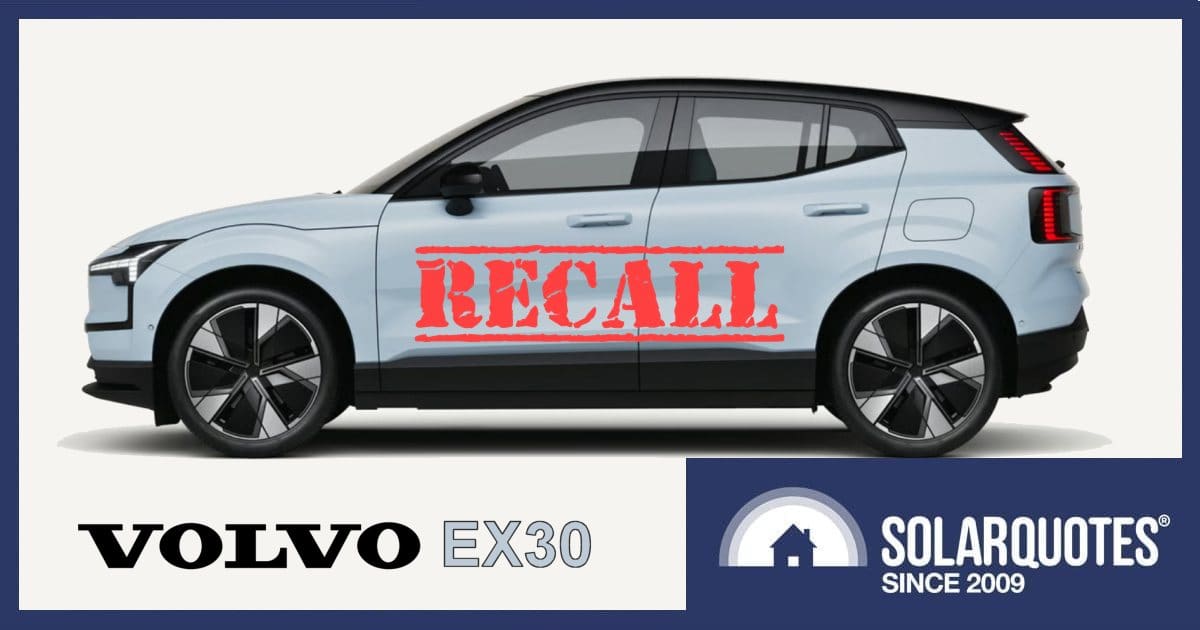
All Volvo EX30 electric vehicles manufactured in 2024 are being recalled in Australia due to an issue that could potentially lead to a fire. And there’s no real fix yet. Here’s what we know.
What Does The Volvo EX30 Recall Issue Involve?
On 9 January 2026, a notice was published on the Australian Government’s Vehicle Recall website (Notice: REC-006524) warning that all variants of the EX30 manufactured in 2024 were affected, totaling 2,815 cars.
The warning provided is the battery cell modules may overheat at high charge levels, and if this occurs, it could lead to a vehicle fire.
What’s The Fix?
At the time of writing, there was no proper fix identified and until one is, owners have been advised to keep the battery charge level below 70%. This can be set in the Charging setting menu in the vehicle display (Settings > Charging).
When a fix is available, affected Australian owners will be contacted by Volvo requesting them to schedule an appointment to have the repair work carried out at no charge.
The contact points for this recall are:
- Contact phone: 1300 787 802
- Contact email: [email protected]
- Contact website: https://www.volvocars.com.au
- Vehicle Identification Number (VIN) checker
There’s also a downloadable VIN list available here in CSV format for owners to check their vehicle against. The VIN on a Volvo EX30 in Australia can be found on the dashboard (visible through the windscreen), on a label in the driver’s door jamb, in the Volvo Cars app, via the centre display (Settings > System > About), or on registration/servicing documents.
It was disappointing that there was *no* related EX30 announcement on the Australian Volvo website when I checked as recently as an hour ago. And as far as I’m aware, there haven’t been any press releases from the Australian division yet either.
However, in the UK the company has reportedly released a statement indicating while there have been no reports of related personal injuries (yet), Volvo is treating the situation very seriously. Apparently, Volvo began notifying regulators in various countries about the battery issue last month.
In Australia, the Department of Infrastructure, Transport, Regional Development, Communications, Sport and the Arts is the responsible regulator for this recall.
Which Company Manufactured The Batteries?
The Volvo EX30 uses Nickel Manganese Cobalt (NMC) batteries for extended-range and performance models.
Volvo sources batteries for its EX30 from several manufacturers. These include Sunwoda for extended-range NMC packs in markets such as the UK, US, and China, and CATL along with LG Chem1.
About the Volvo EX30
The Volvo EX30 is a compact, all-electric 5-seater SUV. The EX30 is built in China and based on the Geely SEA EV-only platform. Volvo is owned by Geely.
Volvo Australia announced pricing and details for the EX30 in June 2023, with the first customer deliveries beginning around late 2023/early 2024.
The MY 2025 Volvo EX30 is priced at $66,290 drive away in Australia for the Single Motor Extended Range Plus and $73,580 drive away for the Twin Motor Performance Ultra. That’s without optional extras.
The Single Motor Extended Range Plus NMC battery’s capacity is 69 kWh and offers a WLTP range of up to 480 km according to the Australian Electric Vehicle Association (AEVA). The Twin Motor Performance Ultra also has a 69 kWh NMC battery and a claimed WLTP range of up to 460 km.
Electric Vehicles And Optimal Charging Levels
For daily use, some EV manufacturers recommend charging to a maximum of 80% to 90% to preserve battery health and longevity. Consistently charging to 100% can accelerate the degradation of certain lithium-ion battery cells over time; particularly in NMC chemistry batteries. It doesn’t appear to be such an issue where LFP (Lithium-Iron Phosphate) batteries are used.
For daily driving and outside of this recall, Volvo usually recommends charging the EX30 to 90%.
Battery charging rates slow down significantly after reaching 80% in all electric vehicles. This is a safety feature, as shifting to a slower ‘trickle charge’ prevents risk of overheating, reduces chemical stress, and prolongs battery health.
That’s why when topping up an EV at public charging stations when out on the road, the generally accepted etiquette is to charge to 80% and then move on to free up the charger; particularly at busy locations.
Footnotes
- LG is no stranger to battery recalls, but given multiple potential manufacturers, LG’s involvement (if any) in this recall isn’t clear. Volvo has only reportedly said “a particular supplier”. But there are a few reports around the web concerning Geely recently filing a lawsuit against Sunwoda over battery quality issues. ↩
 About Michael Bloch
 RSS - Posts






There are at least three cars based on the same platform. Are these also affected?
It seems only the cars with Sunwoda battery is being affected, Geely is suing Sunwoda in China because of this.
We have LiPO battery in our EV.
The different battery chemistry allows LiPO batteries to charge to 100% without the adverse effects of 100% charging to Li-ion batteries.
There should be an explanation of the different chemistries on charging in the above article.
I think you mean LiFePO4 or LFP – Lithium Ferro Phosphate? The reason why some cars use NMC is that they’re higher performance and require more energy instantly than LiFePO4/LFP can provide.
Not really higher performance than LPO if you only charge NMC to maximum of 80% or less. NMC loss of capacity if always charged to 100% is a very big negative and extra dead weight of 20% battery you do not use is another big negative.
We have had a house LPO battery for over 7yrs years charged to 100% most days from solar still has full capacity. Tesla Model 3 RWD with LPO battery 4yrs old still has 100% of capacity (range) despite trickle charging most days to 100%.
NMC is lighter, but has shorter life span than LPO and the disadvantages mentioned above, roll on solid state Sodium batterries.
Sorry, I wasn’t clear. I meant the car was higher performance not the battery. The reality is that NMC batteries can produce a far bigger initial jolt than LiFePO4 which a lot of dual motor EVs need. There seems to be very little in the lifespan of the two different chemistries given that you look after the NMC batteries properly. Yes 80% is the normal max charge for NMC unless you’re about to go on a long trip. I usually charge it up to 95% just before leaving so that it doesn’t stay that high for long. Never charge it to 100% because as I discovered that disables the regen braking which gave me quite a fright the first (and only) time I did it!
Fair enough mistake.
As I said, role on the new battery chemistries like solid state Sodium etc.
Just to be clear – this is Volvo being highly precautionary
There have not actually been any fires in any of the ‘affected’ vehicles
This is not actually a battery issue, it is a software issue.
Australian Government says it’s a manufacturing issue, not a software issue.
“Due to a manufacturing issue, the cell modules installed in the high voltage battery may overheat at high charge levels.”
If you have a link directly to a Volvo announcement stating otherwise, please provide it.
Where does the Australian government say ‘ not a software issue’ Michael ?
‘Manufacturing’ would generally include the software to control the battery. Any battery allowed to be charged beyond a safe capacity may well overheat.
The software needs to limit the charge to a safe level – Volvo are being extra safe by suggesting that they don’t be charged beyond 70% until they send out a fix – which will undoubtedly reduce the maximum to a safe charge level – that does not mean it has a faulty battery.
Where does Volvo say it’s a software issue? Do you have a link to a statement from Volvo? Genuinely curious.
It’s good to know that Alistair has inside information on this- obviously a direct line to the (software) engineers at Geely.
Hmmm. Would you believe….
David – there is more than enough information available to understand the issue – if you don’t, you could just keep slagging other commenters off – maybe that makes you feel smart
I own a EX30 its VIN is on the list but I’m not concerned.
It is a brilliant car to drive. We have done 40,000km in it, 12,000km towing a caravan. Battery SOH is 97% after one and a half years.
The battery would have been stressed pulling the van through the Snowy mountains and if it was going to catch fire that would have the time.
Best cat I have ever had.
I also own a twin motor EX30,10 months old today and just short of 10,000 klms.
Great little car, my first Volvo,and first fully electric
I only found out about the recall purely by chance,and am very disappointed not to have had any direct advice from Volvo re the issue.
At 90% charge I get a claimed 351 klm range , but at freeway speeds,I get just enough range to complete a regular one way 2 to 3 hour trip once a month without need to charge along the way.
At 70% I will need to charge at least once which will waste time I do not have on the day .If the fix is to limit charge to 70%,this would be totally unacceptable to me,and I’d need to look at getting something with a reliable
range, not 20 to 30 percent less than what I was advised at time of purchase.
I have never needed to charge to 100%.
IF the issue is the battery,not software,surely Volvo would have an obligation to replace the battery with one that meets their stated charge capacity?
Naive?
I believe the affect batteries may be from Sunwoda.
Volvo had apparently formed a joint venture with the company for supply it was noted that Volvo has taken Sunwoda to court over the quality of batteries they supplied. I think Volvo may have been aware of the issue from late last year.
Partially correct. The truth is NMC is more energy dense and is better at reducing weight for longer range. It’s also because China has almost exclusivity on LFP that many EV are still being fitted with NMC, only in the past few years China is now licensing LFP tech to other battery cell makers. Up until a few years ago, LFP simply isn’t available to non Chinese market EV.
LFP is now boasting fastest charging speed (1MW) and supercar level of power (2MW of power in the Yangwang U9 Track edition and also the fastest EV ever at 472kmh speed), so no NMC is no longer better performance.
The fix when it comes is obvious.
As owners have been advised to keep the battery charge level below 70%, (this can be set in the Charging setting menu in the vehicle display [Settings > Charging] the fix will be a software change that permanently limits the Charge Level to 70%.
Lawrence Coomber
Agree – probably based on 85 or 90 – they are likely being cautios
Hi Lawrence,
We bought this car specifically so that we could have a compact car that had the range to get us from our country location into Melbourne and back without having to spend time (and money) charging before our return trip.
If the solution is to limit us to 70% I’ll be asking for my money back.
As an aside why is it that those of us who own an EX30 have had to find out about this by reading websites etc. Surely if there is a danger that the batteries could cause a fire we should have been notified by Volvo.
I wonder if somebody’s house burns down how they will defend their lack of communication.
NOT GOOD ENOUGH VOLVO.
Jim N
Still no update from Volvo despite another month passing.
Seems they have little concern about the inconvenience and cost the issue is causing customers
In Japan,
Volvo Cars Japan has announced a major recall affecting 2,447 Volvo EX30 electric vehicles imported into the country between October 2024 and September 2025. The recall stems from a defect in high-voltage battery modules that could lead to overheating and localized short circuits. The root cause lies in incorrect settings on manufacturing equipment, which created an imbalance between anode and cathode capacity in certain modules. In critical situations, this imbalance can trigger a short circuit within the module, resulting in unusual odors, overheating warnings, and in rare instances, a risk of thermal runaway and fire.
The manufacturer emphasizes that no fires or related incidents have been reported in Japan. Nevertheless, as a preventive measure, the company is replacing all high-voltage battery modules with fully functional ones. Volvo’s technical centers will perform the work at no cost to owners.
This recall formally expands a notification filed in February 2025.
So just called Volvo Australia (again) as they are currently just not responding to emails requesting an update as we are about to hit the 3 month mark since the EV recall was announced
They are very sorry but can provide zero further information,so “please just be patient.”
Just wondering if anyone else with the EX30 has heard rumours re an impending class action against Volvo by Australian customers?
Especially as it appears that customers in other countries are being treated much better.
Thanks