
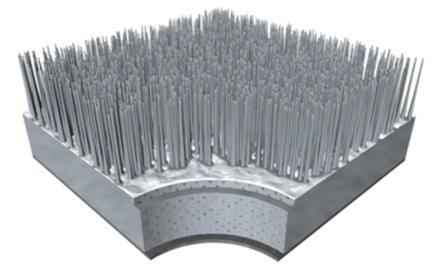
Nanosilicon contacts like these can go underneath the solar cell instead of on top where they block some of the sunlight. Pic: Bandgap Engineering
It must be really depressing being a solar nark these days. With the increased popularity of solar power throughout Australia and the world, and regular announcements of improvements in technology, better storage capacity and cheaper prices, solar power is going through the roof (or on the roof). The more the narks whine about what they see as the limited capacity of solar, the more breakthroughs in technology occur to push back the possibilities of clean, solar, renewable energy future for our world.
One of the key developments in recent times has been the drop in cost of solar cells along with improvements in the generation of power by each solar cell. The latest breakthrough in this latter category comes from innovative U.S startup company Bandgap Engineering.
Using nanotechnology, the firm is looking to develop a “super” solar cell that could eventually generate as much as twice the power as conventional solar cells. Double the power? Yes, but that’s not all folks as the technology will also reduce the cost of solar cells. According to this October 16 MIT Energy Review article, the firm will develop “…silicon nanowires that can improve the performance and lower the cost of conventional silicon solar cells”.
These “super” solar cells — surely a narks worst nightmare — are planned for the not-too-distant future but Bandgap is developing a version of the technology which will have an almost immediate impact. Using existing manufacturing technology the company says it’s nanowire-improved silicon cells with help boost the power output of solar cells by increasing the amount of light the cells can absorb.
“For example, by increasing light absorption, it could allow manufacturers to use far thinner wafers of silicon, reducing the largest part of a solar cell’s cost. It could also enable manufacturers to use copper wires instead of more expensive silver wires to collect charge from the solar panels,” said the MIT article.
The money pitch is that these changes could see “solar panels that convert over 20 percent of the energy in sunlight into electricity (compared with about 15 percent for most solar cells now) yet cost only $1 per watt to produce and install,” as a mid term goal, and a long term goal of efficiencies over 30% according to Richard Chleboski, Bandgap’s CEO.
So there you have it solar fans, the latest in what is the latest in a continuous line of technological breakthroughs in relation to clean energy. Congratulations to the team at Bandgap, this is great news …unless of course you’re a member of that rapidly diminishing group the solar narks.
Talk with us more about this over at our Facebook Page.
 RSS - Posts




So a “nark” is someone who questions and decides not to go solar due to the impact on the environment in making and later disposing of limited life solar panels. Got to love how “the greens” vilify anybody who has a different opinion to theirs.
Mmm there’s so many political parties in history that have done just that and ended up being vilified themselves. German socialist party for one.
Thank you Robbie for proving Godwin’s Law
Robbie did prove the law but his point about being derogatory about the anti solar lobby is valid. The term “nark” is loaded.
Sorry Kim but the very definition of Godwins Law states that Robbie invalidated his entire argument by invoking the Nazis.
Although I have to concur with you, even as die-hard solar user/supporter, that the use of the word ‘nark’ to describe (I assume) the anti-solar pro-oil lobby (prefer the term ‘Kocheads’ myself) does detract from an otherwise informative article.
well you could consider the term “nark” a let of when you consider implications of failing to adapt in addition to the already current effects on life quality – especially in the case the science and the proof has now long contradicted comments of these “narks”, or perhaps better described ‘pessimist’
“Although I have to concur with you, even as die-hard solar user/supporter, that the use of the word ‘nark’ to describe (I assume) the anti-solar pro-oil lobby (prefer the term ‘Kocheads’ myself) does detract from an otherwise informative article.”
I think your preferred term could also apply to someone who can turn an article about a wonderful breakthrough that could potentially make solar a economically viable alternative into a childish “nah nah” rant.
Is this really where journalism is going these days.
Godwin’s Law is not a law – just as Murphy’s LAw is not a law – it’s just a quaint little internet tactic used by those without any understanding of history or politics (i.e all greenies)
John Galt: I love the irony in your choice of handle. I wonder if you appreciate it too?
Luddite’s would be a better term. Even so, the reality of solar is found in some very simple calculations found here: http://ergobalance.blogspot.com.au/2006/06/slim-chance-for-solar-energy.html
Hmmm, Written in 2006, he’s been proven wrong on pretty much all his predictions since then.
The CO2 debt of worldwide solar panel production has already been paid off by PV generation worldwide. The PV industry is saving more CO2 than it generates. Details here:
http://www.solarquotes.com.au/blog/newly-crowned-as-net-producer-pv-looks-to-full-payback-of-dirty-energy-debt/
I notice he also predicts that the price of polysilicon will increase! The price has fallen off a cliff in the last 6 years.
Well Finn, as a sailor, I’m a fan of solar. I’ve lived off of it exclusively for many years. However, I’m also an engineer, and I know the only energy source capable of meeting the exponential growth in demand is nuclear. When peak oil comes, and it will, it will not be able to close the gap…not even at 35 or 40 efficiency. Do you think I’m wrong?
I’m a big fan of nuclear power. Most engineers are because they look at it rationally not emotionally. My first job was designing control systems in a nuclear power station. Unfortunately the world isn’t building nuclear and there’s not much I can doi to change that!
We are on the same page then. My basic felling is that petroleum is far too vital for other important aspects of life like textiles, drugs and chemicals to be burning it as an energy source. I firmly believe a energy mix of solar, nuclear and ethanol will eventually meet the needs of the global demand for energy, however that realization will only come after it is too late and massive upheaval in economies and society are forced to make the change. It seems to be the human way.
No need for nuclear. Solar Thermal, with storage, is a proven technology already producing 24hr energy on an industrial scale, in Spain and USA. No need to go nuclear, and much quicker to build, and economically competitive with coal over the total life of a project. Producing more jobs too!
There is a Melbourne university based group of engineers who have developed a fully costed and peer reviewed solution for repowering Australia with Solar Thermal and Wind in just 10 years.
All that is lacking is the political will.
Get informed at Beyond Zero Emissions – http://bze.org.au/
I’d like to see more work in the liquid thorium salt reactor (LFTR) area .
But there won’t be because it’s not easy to make weapons grade uranium with those reactors.
Trim, I am for nuclear as well but, nuclear has problems with limits in some of the materials need to build nuclear power stations. I think the future is going to be a mix of technologies depending on the location.
Just to be fussy. The National Socialist German Workers Party (renamed Nazis by the British) were just one party at that time to include Socialist in their name, one of the others the Social Democratic Party of Germany is still a major political party to this day (wouldn’t want them to take offence would you).
So the term social or socialists was more in reference to people than a style of politics, the right wing lie of Nazis being left wing.
I nark fart in your general direction
“Sorry Kim but the very definition of Godwins Law states that Robbie invalidated his entire argument by invoking the Nazis.”
How very convenient..
“Godwin’s Law” is no such thing…merely a useful device invented by lefties in order to avoid (often justified) comparisons with Nazis. (aka the National SOCIALISTS).
Well said, KG.
A nark is a nark is a nark, to (mis)quote Gertrude.
What’s in a name? ~ Shakespeare.
If the cap fits, wear it ~ Someone or other.
“German socialist” is a bit opaque, but much more likely to refer to left-wing politics than Nazism, hence Godwin is not triggered.
sO Too be Trendy tehn use street names like nark so sounds tough huh. well I just may like 10 million in jail for narcotics offences, whilst u sleep under silly cones and hope the wooorld goes goody too shoes. Reform inhumane treatment of your fellows photon lovers. Or else and do a telsla and suck on a pidgin. U will all stuff it anyway there is absolutely no hope when treaviality reigns with language like nark..when us should have said tard.
Wow! I’m sure you said something really powerful, Marvin. Unfortunately it all got lost in the badly developed irony and ridiculous generalizations. But I do like ‘Suck on a pidgin’. If only it wasn’t so hard to suck.
@ Finn Peacock:April 25, 2013 at 9:25 am.
Nothing wrong with invoking Godwin’s Law if the comparison is appropriate. After all, that “law” was invented by leftist progressives for self protection by pre-empting, through implied ridicule, of such obvious comparisons. It is a fascist tactic of the worst sort It is rebutting an argument by simply calling upon Godwin’s law by the use shallow ad hominem self-defense strategies that are bereft of any substantial content. .
Interesting juxtaposition of Socialist and Fascist in your statement Finn. Considering Socialism is (ostensibly) left of centre and Fascism is extreme right politically. I can’t see fascists invoking Godwins “law” because it is completely inappropriate for them to do so as their views are diametrically opposed to the socialist position and Godwin’s “law” would be anachronistic to their politics. They already are not associated with socialist politics by definition.
All this political hair splitting, left and right, it’s really not important, just a big act and maybe people are starting to realise that?
Man made climatic catastrophe is of course real, it’s proven here.
And as for left and right, it was Mickey Gorbachev wasn’t it who reckoned man made climatic catastrophe was the key to unlocking the new world order.
And the greens, you can’t say they’re left or right, which is meaningless anyway, but they were formed after ww2 with their buddies from the Nazis and the commies getting together to do their thing. and for that matter, people are starting to ask about things, like the Japanese bombing pearl harbor on second thoughts, I mean after the twin towers, starts to have an eerie kind of common contrivance going on there to it?
So, saying the sky is falling or whatever, la la la, it’s not a new thing to have this climate thing. that’s the ozone layer, cfc, carbon dioxide, greenhouse gas, but not a greenhouse, really subatomic generation of heat that has no scientific basis, kind of climate change right?
Whether y’all understand what’s really wrong with your sick little hippy minds, not sure. but it’s of little consequence, right now the world is changing. not that climate change is the problem, but oxygen deficit units might be seen to be better applied in parks and wildlife rejuvenation products with a focus on nitrogen enrichment.
No, Finn. Godwin’s Law is about reference to the Nazis in debate. Nazis were the National Socialist Party. He referred to the German Socialists – a very different group.
Good catch, but my guess is he meant to write National Socialists. Hardly anyone knows of the German Socialists.
I suppose that if you were present when the Wright brothers made their first flight, you would be busy telling everyone that it will never catch on. The passengers would get cold sitting out in the breeze, it’s too slow, insufficient range, unable to go to the toilet whilst flying, and will never be able to take enough passengers to be viable. Ditto with the first steam engine.
The world is full of Narks, all deserve to be denigrated for being clueless mental pigmies.
That’s not fair on the pigmies
I do not think that the Wright Bros business model included having the Government steal large amounts of money from the tax payer to fund your un economical business. If all subsidies for this useless and uneconomic form of generation were removed all of these solar companies would go broke. This already happening by the way with the largest manufacturer of panels in China just declaring bankruptcy.
Wow – that’s rich.
Did you not realise that:
* Every coal fired power station in Australia was paid for by taxpayers (I’m talking 100% paid for, not subsidised).
* All the transmission lines in the pre-wind/solar age were paid for by taxpayers (as opposed to today when the wind or solar farm pays for its own transmission line).
* coal is (even now) subsidised by taxpayers (due to the deals done when the coal stations were privatised).
But other than that I’m sure you’re right.
Not so.
There are quite a few coal-fired power stations which were entirely paid for by private investment. And of the majority of them, I am assume you are refering to the ones built by the old State electricity authorities. Those were paid for by electricity consumers, not taxpayers. None of those authorities relied on general taxpayer revenue, they borrowed their investment capital on the bond market and paid it all back with revenue from electricity consumers.
Solar and wind farms do not pay for their own transmission line, they only pay for the line to connect to the existing grid nearest to their facility. The electricity grid network is used to convey their power to the customers. The electricity grid network is also paid for by electricity consumer, not taxpayers, and not the solar and wind farms.
Virtually every new technology that is deemed to be useful is supported by government in the start up stages. Canals, Railroads, Roads for motorists, airports for air transport, etc.
One problem we have now for solar is that, despite being a profitable Cash Cow, the fossil fuel industries are still massively subsidised by government, due to the power of their lobbying.
Fossil fuel’s rearguard action now is only about continuing profits for as long as possible. In the medium to long term fossil fuel burning will have to be banned.80% of the stuff we know about has to stay in the ground,or the planet will simply be cooked, populations decimated. check out what the International Energy Agency has to say on the matter.
So for the sake of continuing and more profit$ for a few billionaires like the Koch brothers, we are delaying properly addressing a truly life threatening situation, possibly beyond the point of no return.
Koch bros and mates should be spending their money on getting into renewables, instead of denying the inevitable, and funding the obscurement of the suicide track the human race is currently on. But Koch bros and mates are not entrepreneurs, innovators, They are simply stand over merchants who threaten politicians unless they get what they want.
Fossil fuel industries are basically global drug pushers. They don’t care the harm they are doing, just about the profit$.
@mich. Your deceptive attempt to distinguish electricity users and tax payers as seperate when referring to the revenue raised for power stations, is weak and argumentatitive. There is little dfference between the two catagories. Tax payers use most of the electricity created and are therefore the same people you claim to be electricity users only.
It is so mich…….. They paid for a small % of their own stuff the rest is covered…. Like always….
Cyril, your uninformed, if the subsidies paid to the oil companies were also removed and they damn well should be, youll be paying £10 a gallon for petrol if you could get it, this then level playing field would shake down to natural energy as it would be cheepest, cleenest, and inexaustible,. also keep in mind, if the Earth continues to warm and it will with fosil fuel, and the ice cap on Greenland melts, never mind the poles, just Greenland, then the Earths seas will rise 24ft world wide, bang goes your holiday in sunny bloody Blackpool mate and Skeggy, well its gone so yeah remove the subsidies on solar panels but also remove the subsidies on oil.
I live too far from the beaches. I need a beach to come to me. Melt baby melt. Long live CO2.
Uninformed, I am pretty sure everything you just stated was false.
Absolute nonsense. The oil industry is massively taxed. The wholesale cost of production of petrol in Australia (and the UK is similar) is about $US 0.50 per litre. The retail price of about US$ 1.30 per litre includes $0.60 excise (tax). In the UK, you pay even more for petrol, because you have even higher taxes on petrol and diesel. In the US, prices are lower again, because taxes are lower again.
If there were no taxes on petrol, it would retail for the world parity price of approximately 60c per litre.
So, fossil fuels (petrol and diesel in particular) are massively taxed; solar energy is massively subsidised. And still solar energy is not cost effective for grid power.
We keep hearing of these breakthroughs which will dramatically reduce the price of solar power. And it is still many, many times more expensive than coal. If solar energy actually becomes cheaper than coal, then people will build solar plants. Please let us know if and when that happens; at the moment, it is just another failed technology.
@ Weterpebb: If solar is “just another failed technology” then kindly ask China why they’ve built the world’s largest solar farm.
@waterpebb…. Failed? it is bloody amazing you could do your part and put some on your roof, Stop being useless and do something rather then just cry about what you do not know…
But if someone is talking about alternatives to optic fibre then it’s okay to be a Nark.
PV panels for on-grid use are a little like the Concorde (or TU144). It was a technological breakthrough however they were also expensive to run and could not carry a lot of passengers ect. Once the race had been “won” there was little point in spending more money to further the technology.
The word “nark” generally means someone who unpopularity tells of others misendeavours. In the case of the Concorde the “narks” told of the huge cost of running these planes so therefore they only saw limited use and did not become a mainstream option used by most airlines.
I am a huge fan of the Concorde and the history of it however I think it would have been a massive waste of money to ensure that most commercial flights were with this type of plane and then to try and subsidise the costs of that with rebates and subsidies.
PV panels should be paid for by the end-user entirely and if any taxpayer money is going to be used it should be into research of new/improved technologies or building CSP projects (large mirror arrays that concentrate and collect the suns energy).
I do have to agree with the article in say that the narks are doing a good job of ensuring that PV technology continues to improve by scrutinising its ROI and demanding better products instead of blindly subsidising immature technology that has a negative overall effect on the environment.
Its interesting that opponents of subsidies conveniently ignore the massive savings from not having to build horrendously expensive power generation facilities. In Queensland particularly, PV systems make a significant contribution to electricity supply when homes & businesses have airconditioners running full-bore. Without all those PV systems, the local grid couldn’t hope to cope with the load, resulting in the need to purchase excess electricity from interstate grids at a cost many times what is given to PV system owners.
Andrew T,
your comparison with the Concorde is very appropriate.
Aeronautical enthusiasts would conceivably have demanded that governments subsidize supersonic passenger craft but commonsense prevailed.
Wind and solar power, however, are articles of faith with the green religion, and whenever religion is involved the faithful will use any falsehood and any logically corrupt argument to push their cause.
We saw the same with both communism and fascism. The Marxist true believers, and the media and academic worlds are full of them, still push their beliefs. They maintain that every form of actually existing communism was a corruption of the true faith, just like some Christian fanatics maintain that Christianity has never been tried.
Ecofanatics who push wind and solar power, as well as other forms of self-sufficiency and sustainability, are motivated primarily by their faith.
And you do a great service in revealing the falsity of the rationalizations they employ to cover their illogical religious belief.
Warwick, you do realise that you response is motivated essentially by your dislike for green policy. Progressive technology in itself is not the bastion of Green or Left politics. It has just been co-opted because the outcomes are compatible with their politics. Why not look at it from another angle?
By locking down your world view you essentially kill any libertarian motivations of self sufficiency and personal choice.
I’d rather invest in solar tech and reduce my reliance on the grid. I smooth out price fluctuations and create jobs which are service based and are not geo located to brown coal deposits.
An investment in Solar is shared amongst franchises for service and installation. Look at it from a point of a network, with power stations controlled by a single entity you have one path to failure. With everyone generating and battery tech, plus solar thermal (molten salt batteries) the technology to manufacture the PV can be shared across multiple manufacturers and will improve possibly in the same fashion as Moore’s law. Within a generation there will be a service fee for grid connection in your new home and if you chose to disconnect, then your energy costs at home will be almost nil. You will pay a sparky to service it once a year and maybe a local guy who comes in cleans your gutters and squeegees your PVs clean.
To all of you invoking Godwins law and claiming renewables are greenies in control, try flipping the conversation and take ownership of your own environment. By arguing for coal burning and gas burning you are essentially the marketing and PR for some very big foreign companies who love the fact you don’t want to leave them.
I want to capture and filter my own water and pay a small service fee to a local business to maintain it once a year. I want to capture and store my own energy and pay a small service fee to a local business to maintain it once a year. When a river floods a brown coal open cut in Gippsland I don’t want to explain to my customers why I can’t deliver the goods
Who’s with me?
Andrew, I am with you all the way. And many will stay the same as you. It is now time to rethink of our future, not to mention, the future of the one and only earth we have. Be the alternative is more expensive financially (as what the anti solar group say), many will still go to solar and other clean alternative source of energy. Money is nothing compared to clean air and water.
How’s the progress on getting electricity from moonlight ?
Thought so.
Solar cells can generate electicity from moonlight as it is reflected sunlight. Maybe you should have thought about that.
bullshit
I have thought about it, and they don’t. The intensity of moonlight is only about 1/100000 th part of the intensity of sunlight.
While a solar panel will produce energy even if you shine a torch on it at night, I’ve done this myself and seen the (very small) numbers on a multimeter, it is so small as to be irrelevant. Just how much power do you think a 100W panel produces under moonlight Rhino? That was a very silly “comeback” as I am sure you know very well that PV is useless at night, and even an overcast day dramatically reduces their performance.
Fact is that solar is a very, very long way from ever being a replacement for fossil/nuclear energy. Energy storage for use while the sun is not shining being one of the big stumbling blocks, as well as the general inefficiency of PV cells (yes, of course that will get better over time, but just how much time?).
Add to that the fact that some of the biggest solar manufacturers are going broke (http://www.economist.com/news/business/21574534-troubling-bankruptcy-troubled-business-sunset-suntech) or shutting up shop after huge losses (http://www.pv-tech.org/news/bosch_shuts_down_solar_division_total_loss_amounts_to_2.4_billion) and the future looks a little bumpy for PV industry.
FYI: I will soon be relying on a stand-alone PV system and am not against PV tech at all, I just don’t like unreasoned PV evangelism that trumpets PV as a replacement for our current mainstream/base load power supply. It is quite clearly nonsense.
If you look into the background of most of these renewable energy fanatics it is notable how few have an engineering background.Except for the experimenters , the supporters seem to be of the same ilk as
the UFO believers.The Greens , if they have any higher education at all, are mostly from the “Yarts”.
The Labour Party members are similarly untechnical, but this does not keep them from pie-in-the sky promotions.
Like all the scientists that design them, all idiots I suppose. yawn
John,
Last time I checked I was a chartered electrical engineer, who has built, nuclear, coal, wind and solar. I’ve done the math, I’ve designed the power plants, and I have decided that solar is the way forward.
Almost every engineer I know (except a few very old school die-hards) support renewables.
Cheers,
Finn
You have built nuclear power stations? I very much doubt it.
You may “have done the math” but you don’t produce it when asked. That *you* have decided that “solar is the way forward” is hardly proof.
And almost everybody in the world “supports renewables”, but that doesn’t mean that they agree with any assertions you have made concerning the costs of solar energy.
You are one step away from being in breech of the Trade Practices Act. That one step is that you never ascribe the savings to a particular product; as long as you never mention a specific product name as meeting these claims you are within the law. So you can lie all you like. As you have obviously worked out for yourself.
I find it sad and depressing that someone who presumably got into this for the best of motives is now reduced to telling some pretty obvious porkies to drum up business. Ends justify the means, I guess.
Wow, you really are a deeply suspicious and angry fella.
I have physically built control systems inside real nuclear power stations. Is that so hard to believe? Yes I have actually designed and physically wired up their control systems with my own bare hands deep inside the reactor building. That’s generally the kind of work that real engineers get paid to do. But hey – you don’t have to believe me.
Your misspelt ramblings are getting tiring. The calculator here, which is available for everyone to use:
http://www.solarquotes.com.au/calc3/indexsavings.php
shows real, dollar savings for any good quality solar system. I really can’t be any more transparent than that.
The costs of solar systems in Oz are here:
http://www.solarquotes.com.au/how-much-do-solar-panels-cost.html
If you doubt these costs, please feel free to get 3 quotes through this site.
I have a 6kW Tindo solar system (solar bridge microinverters) on my roof and the LCOE is 12.8c per kWh. It is guaranteed for 25 years with <1% degradation per year. You are welcome to come and inspect it. Alternatively, just look on 1 in 10 roofs in Australia if you want to see real solar systems, in the real world paying for themselves. Yes they do exist - get out of your cave and you'll see them.
The calculator you provide shows savings only if you get a healthy feed-in tariff. This is only apparent if you click “advanced options”. Set the amount sold back sold back to the electricity company as zero, and the cost of the electricity doubles and exceeds retail. Very deceptive.
But your sales pitch is that solar is economic even in the absence of feed-in tariffs. Your own calculator shows this is false. It produces a figure of about 34c per kWh, more than double what you claim as the cost of solar power. This 100% difference between what you claim in the text and what your own calculator shows is not explained. Imagine a car company that quoted a certain fuel efficiency in their advertisements which was double what their own calculator showed as possible.
I don’t just doubt the costs of solar; I doubt the benefits. How many of these companies will give me a guarantee of total kWh per year? How many actually believe in their product enough to install it on my roof and charge me for the electricity I use? None.
I can’t see 1 in 10 roofs in Australia “in the real world paying for themselves”. I can’t see dollars being produced and consumed from the street. I can see lots of comments here and elsewhere from people who have installed it, that domestic solar is not cost effective in the absence of feed-in tariff. You have never produced a worked example showing solar is a good investment in the absence of feed-in tariff.
You try and present yourself as a scientific/engineering person. But you blogs are pure sales and marketing. Instead of worked examples we get shonky calculators. Instead of analysis which is based on measured energy outputs of installed and commercially available domestic solar systems, we get unexplained infographics from other companies which also appear to be based entirely on wishful thinking.
If you were directly selling some system and claimed the benefits that you do (eg electricity generation at 16 cents per kWh) you would be subject to the Trade Practices Act. Because you cannot demonstrate the savings to be true, it would be deceptive and misleading advertising. If the product didn’t produce electricity for 16c per kWh, consumers would be entitled to a refund of purchase price. But as you don’t claim any specific system will produce electricity at this cost, you avoid the Trade Practices Act.
Doesn’t it worry you that your advertisements are highly misleading? That you cannot sustain them with a single example of anybody who has ever installed a domestic PV system which produces electricity for 16c per kWh?
You may once have been an engineer. Now you are a sales guy trying to drum up support for a product you are involved with. To do this you lie about what the product can do (eg this 16c per kWh fiction). If you want to be considered as an engineer, start telling the truth.
Please provide a screenshot of the calculator giving an LCOE of 34c per kWh.
(Also to repeat myself a third time “THE SOLAR SYSTEM SITTING ON MY ROOF IS AN EXAMPLE OF AN LCOE BELOW GRID COST”. You are welcome to look at the online monitoring to see the kWhs, and see how much I paid for it ($15,000) and do the maths yourself. It is not a complicated sum.)
Unfortunately, I can’t show screen shots in a text newsgroup.
But here you go again, claiming that you have a system which is cost effective, telling me that I am welcome to inspect it and do the math for myself, but alas you don’t actually provide the numbers from which the “math” can be calculated. In fact you never do. You love your shonky calculators and infographics, but never want to actually provide real production numbers so we can check for ourselves.
So, have you ever been involved with a domestic solar system which generated energy for 16c per kWh as you claim?
If so, you should give us the numbers so we can all see the savings. How much did it cost to buy and install, how much is the manufacturer’s annual maintenance, what energy does it produce by time of day per day on average (so we can compare with typical tarrifs), what degradation should we expect, and what is likely to need replacement over the lifetime of the system, when and at what cost?
If not, and you have never been involved in a domestic PV system that generated electricity for 16c per kWh as you claim, then frankly you shouldn’t make that claim. It is lying.
So, still looking for a real life example of a domestic solar user producing electricity at a net cost of 16c per kWh. Are you going to back up your claims with an example of a single person who has ever achieved these savings, or are you going to keep making claims you can’t substantiate? Engineer or shonky salesman?
Yawn. This is the last time I am going to repeat myself:
How much did it cost to buy and install: $15,000 (similar setups now cost under $12,000)
How much is the manufacturer’s annual maintenance: $0 (apart from feeding the communist pixies making the electricity!)
What energy does it produce by time of day per day on average: 28kWh per day, typical solar generation profile as per this graph:
http://www.solarquotes.com.au/do-i-get-paid-for-my-solar-energy.html
I will post the URL of the live monitoring system with minute-by-minute data soon.
What degradation should we expect? 0.5% per year
What is likely to need replacement over the lifetime of the system? Nothing. If it does – I have a manufacturer’s 25 year full replacement warranty. So cost to me will be zero.
—
BTW: Google “Sungevity” if you want to lease a system in Australia with guaranteed kWh per year output and pay the installer for the electricity generated at less than current retail cost per kWh. All maintenance included.
Gee, another “typical” energy graph. Not real numbers.
And the graph shows that about half the power is exported to the grid. It is your claim that solar is cost-effective even in the absence of a feed-in tariff. Unfortunately your “typical” graph is more of a cartoon than a graph; it does not actually even specify what proportion of the energy is used and what has to be on-sold through a feed-in tariff.
Why are you so unwilling to produce figures which can actually be used to verify your claim that domestic solar is cheaper than grid? Why not simply produce an actual real-life home configuration, document its cost, document the energy output by day and the profile of the household use of electricity usage so we can work out how much of this energy is used by the house and hence the cost of each unit of energy?
It won’t be 16 cents per kWh as you claim. I do look forward to some calculation from you which produces some actual figure for the cost of solar energy. So far, you haven’t provided a single calculation showing any costs at all for domestic solar on kWh basis (which is how I buy grid energy).
If you claim that domestic solar has a production cost of 16 cents per kWh, and that it is cheaper than grid power even without a feed-in tariff, then you should be able to substantiate these claims. You haven’t because you can’t; its nonsense. You haven’t even tried.
Ohh, and you were wrong about Sungevity. They will not install a solar system on my roof and allow me to just pay for the electricity I use at a fixed rate. Because they could never make money that way; the cost of production would exceed the retail cost of electricity and nobody would buy it. Of course, if solar actually was cheaper than grid power this would be a great business model. But all solar companies are very, very careful to transfer all financial risk to the purchaser. They know that the systems are not cost effective replacements for grid power, so they won’t sell you the electricity that their panels produce for less than grid rates, or at any fixed rate. They will only sell you the panels so you are taking the financial risk. If solar companies know enough to not guarantee their energy is cheaper than grid by selling it to you for less than grid, I suggest you should assume its not until demonstrated otherwise.
For your curve, the yellow bit is the solar power that you can directly use. It represents about 40% of the area under the blue line (total household power consumption). About half of the area under the yellow curve is shoulder usage (before 2:00 pm) and about half at peak rates.
I pay $1600 pa for electricity. According to your curve, my bill should go down by about 0.4 x $1600 = $640 pa.
The system according to you costs (if you bought it now) $12,000 pa. Cost of capital is about 8%, to buy this on a 25 year lease would cost $1,440 pa on normal rates. Add in a very modest 5% pa for maintenance (as you would hopefully be aware, most maintenance packages on hardware is 15% – 18% pa, even for equipment in controlled environments) and this works out at about $2,000 pa. Which is three times the cost of buying this energy off the grid. Indeed based on the average of shoulder and peak costs for grid power, the three times greater cost works out at about 70 cents per kWh. Which is a lot more than your claimed 16 cents per kWh.
Your own figures show the cost to be almost five times greater than you claim.
So where on earth did you get this ludicrous figure that domestic solar power works out at 16 cents per kWh (its many times that), and the ridiculous assertion that its cheaper than grid power (when on your figures it is at least three times as expensive)?
Maybe you should post the calculations which showed that it costs 16c per kWh? Or maybe somebody just invented this number? Or maybe the calculations are so obviously wrong that you don’t think you can get away with posting them? One thing I am certain of is that you cannot and will not produce a reasonable analysis showing domestic solar works out at 16c per kWh, because pretty obviously the real figure is many times higher.
Bit sad when you have to lie to sell your services. I assume that you do this because you think it will save drowning polar bears, and the ends justify the means. Maybe you should go back into engineering, where you presumably didn’t have to lie to make a living. Indeed, after Saturday we may have an economic rationalist government, and the raft of subsidies that prop up this inefficient industry (particularly MRET)will start to be rolled back and electrical energy prices may actually start to fall, and you might have to go back to building conventional power stations for a living. As I have pointed out in the past, only a fool makes a business decision based on the belief that government subsidies will last forever. They don’t.
The whole argument is academic anyway as those who think they are saving the planet by putting solar panels on their roofs are only fooling themselves.
To be truly Solar one must bite the bullet and pay through the nose for batteries, store their output and use it at night instead of relying on dirty coal power to light, heat and entertain them when it is most needed, after the sun goes down.
Until that time it doesn’t matter how many graphs you produce you are still reliant on mainstream power most of the time and the monetary bonus you get doesn’t even compensate for the carbon released in the manufacture and installing of those or so delightful panels on your roofs. Talk about living in a fools world.
Dear weterpebb, and anyone else who can bother replying. I am confused. I have read a bunch of stuff on solarquotes about how to get the latest whizzbang panels, – question is…do I need them? My bi-monthly electricity bill is horrendous..around $700 to $800 for 60 days. Five in the household, two fridges, aircon the usual nightmare. These bills are ruining me. Well, recently had a windfall. If I don’t spend the money on a score of solar panels it will surely get spent on something else, and I’ll still be stuck with the big bills. House empty most days, all working (so less usage during daylight hours). So, who is right, you weterpebb with your paltry annual electricity bill, or solarquotes? Help! (I am in Perth)
If your house is empty during the day, then solar is of very little direct use. It generates all of its energy during the middle of the day (when you are using almost no power) and zero in the evening when you actually need it.
It might be a worthwhile investment if you can sell your power back to the grid. To make sure this is a good investment, you will need two things. Firstly, the solar cell provider must guarantee that your panels will generate a certain amount of energy (in kWhs) over the course of the year. You also need a contract which guarantees your local electricity distributor will rebuy this power at an attractive rate over a long period of time (years).
Then you can work out whether the profit you make per kWh multiplied by the number of kWhs your solar supplier will guarantee your panels produce. If this income works out to exceed the capital and running costs, then it is a good financial idea.
I doubt very much the numbers will work out. The price paid per kWh by electricity companies for domestic solar electricity has crashed as government rebates have been wound back. It is quite possible that you may not be able to sell your excess electricity (basically all of it) at any price in the future; many electricity companies might consider this whole business to be more trouble than its worth and reduce the buyback to zero.
If you still live somewhere with a heavily subsidised electricity buyback, you could make money in the short term. But it is an incredibly risky investment in this form; all that has to happen is a government official to decide your scheme is too generous, wind it back to zero, and your expensive solar installation will be doing little more running your fridge during the day.
Caveat Emptor.
Hi Oskanna, I think you’ve missed the boat, but I suggest you go to a company to get your budget sorted before anything else. The very generous subsidies for solar (thanks, taxpayers) meant my 5kW system was bought and installed for $4,900 (amazingly, within 48 hours of ordering, it was producing power) and I get to feed excess power to the nice electricity company (who get re-imbursed by the government – thanks again taxpayers!) at a whopping 50c per kWh – and until 2028!! In summer my bill goes to zero and is halved in winter. Family of four, with AC, but we try to avoid using it. Just installed heat pump hot water including reduced cost installation ($700) for RECs, so expecting to reduce annual power consumption further. Switching to LED bulbs… and low power pool pump (more RECs…). The motivation has nothing to do with reducing emissions – which is negligible on a world stage. Australia could reach it’s emissions targets overnight by halving agricultural exports. Like most easy solutions, the issue is noone wants the financial impacts. France got it right with nuclear – 20c/kWh and too much power, they have to export it, and a robust distribution network which is ripe for electric car introduction. In Aus we’re spending untold billions on a new broadband network and still have electric wires strung along the streets on wooden poles – go figure.
Good comment from one who knows.
But don’t mock yes, a pricey NBN, pls?
I assert that these types of “leftie” [right-of-centre left] infrastructure projects are subverted by right-of-right-of-centre right wing fanatics across these types of industries, those who have grown into their respective trades and professions from church schooling, so from an inherently self-centred, right wing indoctrination, almost all of the “sub-contractor” self-interested class.
The NBN if ever finished, is a, if not the best type of telecomms and internet infrastructure we could have, and, if there IS life after about 2020, will serve the whole polity very well – until the next “best invention”, that-is.
It’s key problem, is that the polies are not techies, nor engineers, at the levels we need to decide and ensure a smooth and fault-free construction. That doesn’t make the project itself bad.
All the delays are quite deliberate subterfuge, and is the way things are now, with everyone fanatical for their own beliefs system and cult, so ready to do the subversion for their own mobstas.
Thanks Barry and weterpebb.
20 individual AC 250W of those South Australian panels each with microinverters produce 5000 watts (5kW) (or average around 22kW/hs per day? with North facing roof, some minor occlusion from the West) and will cost $13,000 after federal rebates to install.
(W.A.govt) Synergy’s sad RESB buyback rate for residential is only just under 9 cents/kWh.
I use around 2900 units every 60 days or 2900 kW/hs.
Cost (charge) is around 23 cents per kW/h. Around $760 every two months.
That equals 48 kW/h per day. Up there with Al Gore.
As I said, have two fridges, and security cameras 24/7 but much of the use is at night.
I have no idea how to do the calculations properly but looking here and there on the web expect to save around $1250 off my annual bill, at a guess. My $760 bill will reduce almost $200 for two months period. Sound about right?
Bill before =$ 4560 p.a.
Bill after = $ 3438 p.a.
It will only take a mere eleven years, including State Govt setup costs, for the system to pay for itself 🙁
Question is, do you think my guestimates are overly optimistic? If they’re about right, I am still going ahead to get quotes 🙂 What do you say, Finn?
No, I don’t think your calculations are correct.
Solar electricity you use yourself “earns” you 23 cents per kWh through cost avoidance. Electricity you sell “earns” you 9 cents per kWh through the feed-in tarriff. So the percentage you can use and the percentage you have to sell makes a huge difference. And its not in your favour.
Your unit produces 5 kW peak. You house is unattended Mon to Fri during the day, when you are producing solar power, no way you will be using anything like 5 kW. So virtually all of your solar power during the week will have to be sold. Even on the weekend, your average daytime use will be far lower than 5 kW. If you have a pool, you can reprogram the solar heating and recirculation to occur during the day, which will productively consume some of your daytime power, but nothing like 22 kWh per day.
So you have to assume that the majority – 80% or more – of your solar energy will be sold at 9 cents per kWh, as you simply have no use for 5 kW in the middle of the day.
The figure of 22 kWh per day seems way too high for an average figure. I suspect this is the output on cloudless days. If this is what the solar company is telling you, get them to supply a figure for the energy produced each year, and get it in writing. This is the important number, and I suspect their figures for energy production are massively inflated by telling you daily production on sunny days instead of the average production across a year.
Even going with these figures, 22 kWh/day x 365 days/year x $0.09 per kWh
= $722 per annum
It costs you $13,000 after Federal rebates. Even if the system never cost you another cent – and you will be up for maintenance charges – and you got a 0% interest loan to pay for it, it would still take you 18 years to repay the capital cost.
Realistic figures for energy production would increase this payback period. Realistic assumptions about maintenance would increase this payback period. And nobody is handing out 0% loans.
On the figures you have given, and the usage profile you have provided (ie little use for power during the day), and at a feed-in tariff of $0.09 per kWh, this is a long, long way from being a good financial investment. Do it for other reasons if you wish, but be aware these other reasons are costing you a *lot* of money. You would be far better financially off sticking the $13,000 into a fixed term investment and continuing to use the grid for all your electricity.
I checked my figures on Finn’s calculator, numbers crunched out the same as my guesstimate:- eleven years to pay back the $13,000, and save a couple-hundred each two-monthly bill. Also, I was surprised that the cost of the new mini-inverters on the South Oz-made AC panels was not much more (maybe $3,000 more) than the same 5kw setup with old style DC panels plus big inverter. However, I am extremely grateful for weterpebb’s challenge to this modestly optimistic scenario, and will consider his words carefully before any purchase. Am now looking at our usage and ways to reduce it. Nevertheless I am concerned not to miss out, if there is any cut in federal solar installation subsidies by Abbott, and also Barnett’s plan to privatize our WA generators after improving their saleability (read: improve bottom line by jacking up everyone’s power bills). Thanks to all.
enno you muppet…strangley enough it can still be windy at night and waves still roll in and tides still change…oh…there is also this amazing thing called a battery…welcome to the 21st century mate…did you just unbury your head from the sand for one second this century?
Batteries? They are the thorn in the side of any stand-alone PV system owner, especially if you live in a cool/cold climate. And the article is talking about a “clean, solar, renewable energy future for our world” which presumably means PV replacing fossils on a large scale. Just how big will these battery banks be, and how enviro friendly? Or are we going to go down the inefficient road of having hundreds of thousands of stand-alone systems powering individual homes?
Even if PV cells were 100% efficient, battery/storage tech is the bottleneck and still needs to come a very long way, and as a stand-alone PV system user I wish it would hurry up and happen.
Does noone know that the snowy hydro scheme has 4000MW of ready made , rapidly dispatchable, and complimentary generation capacity . If this was used to cover those times when solar and wind power are inactive then far more cheap but intermittant solar and wind could be installed. In fact with a relatively small investment the snowy hydro scheme could be modified to provide pumped storage facilities.
And indeed we have many coal powered power stations that could be run at night. But that is the unfortunate thing about solar power – you have to build two power stations (solar+hydro, or solar+coal) to do one job – doubling the capital cost.
Indeed, the highest power consumption occurs from 6pm to 7pm each evening, when solar power is useless. Even with very significant use of solar, we still have to build sufficient power stations to cater for the 6pm peak (when solar doesn’t work), so solar power does not reduce our need to build conventional power stations at all. We have to build two power stations to do one job.
Yes, we could use some form of battery (eg pumped storage as you suggest), but this is very expensive – both in capital and running costs. No, we can’t use the Snowy scheme for this; the 4 GW available from the Snowy is already used to cater for peak use periods. If you want to rely on being able to use 4 GW from the Snowy to backup solar, you need to build in another 4 GW of generating capacity and the capability to pump water uphill during the day. This would be like building a second Snowy scheme.
The fact that solar only works during the day and peak consumption is in the evening means that solar is spectacularly poorly suited to provision of baseline loads. The economics of solar come nowhere near adding up.
The hardest thing for a peon soaked in the “U.S. psychology” to understand is the notion of “renewable = perpetual” energy! For as long as your current, and very temporary, natural gas abundance flows, and long after it it all gone, the Solar, Wind, Wave, Hydro, Tidal, Geothermal, Biological, renewable, domestic systems will still be there, as the very backbone of your economy, and unlike nuclear by Uranium Enrichment, offer no hidden, humanocidal waste disposal expenses, no harmful leaks to clean up, no high and hidden decommissioning costs, no anti-terrorist security costs, lower initial installation costs. Even China’s thrust towards Thorium LFTR technologies promise better than the American Nuclear Experience, is plutonium free, and cheaper, safer and easy to fuel. U.S. peons, caught in an ‘economic energy trap’, corporately controlled for the shareholder’s benefit, not designed to build a strong nation, not designed to build a strong people, not designed for a safe and secure future for progeny, not designed to produce a strong infrastructure, not designed to produce or accommodate a well educated population, Strictly and legally limited to shareholder benefits. The “Post WWII German psychology”, is very different. They rejoice when a car made from renewable power is sold, realizing the 100% profit in benefits to the general populace of Germany. They understand an austerity not yet suffered in the U.S.A. They see gains in an educated working population, They require for their very survival, well educated, hard working, frugal, people. They defend cleanliness and environmentally proper care of their “Father Land”, they feel a certain responsibility for their own. Canadians have developed similar sentiments for their environment and ‘Fellow Canadians”. Americans seem weak in these areas, and more concerned with Capitalist and Corporatist, shareholder values? My Question: Is this the work of the Great Corporate American Propaganda Whore and her moanings, persuasions, illusions, on the American people? To maximize shareholder’s stakes even at the expense of the peon’s stake? In the new ‘Corpocracy” that America has become? The reason why, in 1999, Thorium was rejected, even though proven safer, saner?
So researchers are “looking to develop…”. ” It could allow developers to…”. We “could see solar panels that cost $1 per watt.” Could. Might. Perhaps.
Why don’t you write about this when it has actually happened, not the same pipe dreams they were writing about in the 70’s.
In the real world, governments are forcing those without solar panels i.e. those on social welfare, renters, itinerants, the low-paid to subsidise the electricity bills of rich middle-class hypocrites. Utterly immoral.
I totally agree. I’m a low income renter, my energy bill is around $2,000 in arrears and growing despite paying $60/fn, more than 10% of my income.
No one seems interested in helping us become green, gov and landlord too busy feathering their nests and green washing the climate warnings written on the wall.
So you’ve got a problem with the Government and the Corporate fossil fuel dinosaurs not with the green lobby – you need to vote accordingly
Sigh, and the source for your last statement is? Maybe you should look at the facts (the real “the real world”) of where solar panels are being installed: http://www.energymatters.com.au/index.php?main_page=news_article&article_id=3392. Turns out “A broad range of communities have accessed solar under the RET scheme and the figures explode the myth that the RET is supporting metropolitan middle class welfare and is evidence of the RET’s equitable effectiveness”.
(itinerants?? you mean tenants?)
Also, the actual component on our electricity bills of how much we pay to subsidize people with solar panels is tiny (a few percentage points max). Check AEMC sources for that.
Ali,if you are really that keen to become greener you should do your own homework. There is lots of information available, even from government. What do you expect? That they come in every night and switch off your appliances and lights for you?
Why do people have to turn these issues into an “us vs them” battle? Stop whinging and start taking actions that will save you money.
@Ali Cat: It seems you have other issues like turning on aircon and heaters instead of opening a window (or turning on a fan) and putting on a jumper.
If you are paying more that ($60/fn ~ $120/month = $360 per quarter) $360 per quarterly bill then you need to look at turning off the second and third fridge also…. unless you are a hydroponic type of person and the business has not kicked off yet?
Seriously you are saying you pay more than what 3 adults living in a unit pay per quarter (over several years our highest was $320 and we used the drier and heater)? and the only income is less than $600 / fortnight? something does not add up. Maybe you need to provide more details before complaining about green policies.
It may pay to switch off everything and have a look at the meter to see if it is still spinning as you may have an earth leakage….
Actually, one of the problems might be her hot water system. I’ve found that most units without gas hot water have small, inefficient tanks in them that cost an absolute fortune to run.
Well I’m a landlord and a solar generator and frankly it’s the same dumb schmucks that pushed for these stupid “green” policies that are now pissing and moaning because they can’t afford to benefit from them.
Ah but $1 per Watt is happening now, in fact wholesale prices are at about 50 cents per Watt, with system prices, that includes installation and all the hardware like the inverter at about $1.5 per Watt. Return on investment can be achieved in 3 years, and then free power from then on. That is the reality.
Your numbers on the cost per Watt are correct, but not the return on investment – at least in Victoria. As I am retired , I used our “smart meter” to record the hourly consumption through the day (in Jan this year with an aircon on sometimes in the afternoon), and compared that to the generated power estimate for a 1.5Kw North west facing system (provided by quotes i had requested). Given the 8 cent feed in tariff that now applies here in Vic, the payback period was between 12 and 15 years which is probably outside the life of the system – and certainly nothing like 3 years. probably much more effective to swap over my halogen downlights with LED ones as and when they need replacing?
I too went solar (I live in a block of units: yes it was much easier to get approval than I expected as most Strata managers and *MOST* installation companies can handle the paperwork and are happy to help) and found the bill drop by around 1/3 we were not big users but seeing a $300 a 1/4 bill drop to around $200 means the investment of around $2600 will be recovered in around 6.5 years… HOWEVER, we tend to use more power now, just during the day instead, so effectively saving even more and we are about to come to the anniversary of the install and although Mark Group were not the cheapest BUT they were one of the most professional I dealt with as the original company I was trying to work with suddenly became busy and could not fit me in as a unit would take longer to do than a single storey dwelling… ie the installers would do 2 houses compared to 1 unit.
If I had known it was so easy to get approval in a unit I would have done it when the 60c/kw was offered here in NSW and started making money, but alas 6.5 years is still a good ROI.
Of course, the only reason that you get a 6.5 year payback is that the electricity company is buying your excess electricity at a massive loss. They are required by law (the MRET scheme) to do this. The savings on your bill derive from the higher costs that other electricity consumers must pay to subsidise MRET. It simply wouldn’t be cost effective without this mandated subsidy.
@weterpebb – close, but not quite… the excess is not at a loss, as they don’t sell green energy at $0.077 per kwh (aka 7.7cents!). The lower cost is actually the energy used during the day, I do not know why people will try and put down solar with these types of arguments.
Either way if I did or did not have solar, they would still charge me the same amount per kwh, I now use around 2/3 of what I used to use from the grid… that is where the savings are ROI come in.
I get a little bit more back. Given a good quarter, its more like a $2000 rebate 🙂 🙂 🙂
Just to rub more salt into the wound, I’m looking at getting another 6 – 8 panel off-grid system to run the house so I can sell the whole output of the big system to the grid for 52c per unit.
Anyone who lacked the foresight to get a solar power system when the time was right need not blame me, I merely accepted a business proposition that entailed mutual obligations & which was made freely available to any who chose to accept.
Well, that is one of my points, if I had known it was so easy to put on the roof of the units then I would have done it when NSW was offering 60c/kwh + the normal feed in tariff, but alas I found out after the fact, but still got the green rebate off the price selling the credits to an energy provider.
I’d originally intended getting a 5kw system but after doing the numbers it appeared 10kw would pay for itself inside 4 years (better payback than smaller system due to more excess to attract 52c FiT). Anything more than 10kw would have needed 3 phase power but then there was no more room on the north-facing 22 degree roof. The off-grid panels I’m contemplating will need to go on the 10 degree veranda & get jacked up to the optimal 22 degree angle. That gives me another 40 odd square metres, heaps to run a house that only costs me about $150 per quarter in electricity. Idea is that the $150 I’m using would be worth $300 to AGL & $1200 per year will go a long way to paying for a decent off-grid system. Doesn’t really need to cover all costs, I’ll do it just to spite the parasites.
I think payback calculations by weterpebb are not taking into account of income tax, inflation and the fixed or floating FIT rate over the lifespan of the unit when commenting on the commercial viability of a homeowner investing in a PV system.
For example, if you invested the capital cost, say $10k, in a fixed term deposit then your current nett after tax and after inflation return can be as little as $150 p.a (assuming highest personal tax rate) to off set a grid only consumption bill. Not even an eighth of some householder’s bills.
Conversely, as no income tax is paid on the reduction in your electricity bill, then (assuming the highest personal tax rate) nearly half of what is saved can be considered tax free income as the after tax dollars that would have paid that portion of the bill can now be spent on something else. It’s like the benefits of salary sacrifice without having to enter into a novated lease.
With the effect of inflation, If you are on a long-term contracted fixed FIT rate, then over time the increasing price of electricity will decrease the difference between your FIT and the retail Kw/h rate. This means that the best economic returns are are the beginning of the contracted period.
Conversely, with a non – fixed ‘going market’ rate for exported electricity, inflation means the rate paid will go up and so the system will earn more in the out years Thus more rapidly paying itself off towards the end of its economic life. Of course the payback calculations have to take into account that any borrowings are outstanding for longer and therefore will cost more in interest. But this is somewhat offset by having your future bills reduced in future dollars for the own consumption component. Eg a system bought today saves around 25c KW/h for power not bought from the grid. In say 2024, the system could be saving you 50c KW/h for power not bought. Yet at that time the principle and interest repayment is the same $ amount as in 2014 thus reducing any out of pocket difference between the two amounts in the future.
As you can see, there are more factors at play than just the system cost and it’s ROI.
The real problem, from a strict investment perspective for people with PV systems, is that with an average time between selling and moving house at 7 years, only a very few will own their system long enough to actually get any ROI. Real Estate agents tell me that, like pools, a PV system may make one house more desirable over another for the right buyer but it won’t translate into a higher sale price for the vendor. Thus the vendor walks away from the capital investment and the buyer gets the benefit of reduced electricity bills.
Another example of tall poppy syndrome that holds Australia back. The poor do not subsidise the rich and middle class who pay high taxes to support your Centrelink benefits.
Solar power is good for the environment, good for Australia, and means fewer coal powered generators have to be built. Get a job and save your money, solar power is not that expensive and will pay itself back in a few years.
HIGH TAXES? joke , “your” centerlink benefits , ? solar we agree on ,
I agree with the facts that Solar Power is good for everyone. Currently the problem is that people renting can not get Solar as they do not own the place and may not be able to stay in the same place long enough even if the landlord agreed to allow putting the solar in if the tenant pays for it.
The solution for this situation could be that the power companies who already own solar farms could sell people slots at their solar farm (expand their farms by allowing individuals to purchase extra solar panels, expand their inverters) meter those slots separately and deduct the power collected by those purchased slots from the individuals power bills. This way if a person moved, their power bills would still get the benefit from the solar panels.
You can already buy “green” electricity from power companies. They “guarantee” that it comes from renewable sources. (Not sure how they sort clean green electrons from dirty black coal ones inside the copper wires, but I’m sure they have a clever way to do it.
Anyway, even Renters can do this.
trouble is, it costs more than normal electricity…
My neighbour pays a couple of cents more per kWh for ‘green energy’.My power comes off the same line. I don’t pay extra, but still get the ‘green power’. How does my neighbour benefit?
If logic like that is typical of Australians, its no wonder we are going down the gurgler.
This “green” electricity is simply an accounting trick. You do not get or use any more renewable energy than the person living next door.
The amount of renewable energy available in the network is a tiny bit more than the minimum required by MRET. As renewable companies cannot charge any more for this additional energy than market price for coal energy (maybe 5c per kWh), renewables companies sell it for much the same cost as electricity from coal. As this small bit extra energy is not required to meet MRET, they can lable it as renewable power and sell it at a slight premium to people foolish enough to buy it.
It is the proper function of the serfs and slaves to suffer in the service of their superiors
to achieve great things. The Pyramids and countless other great works of civilization since would never have been built without the iron heel of the ruling classes upon the necks of the underclass whingers and would-be welfare recipients.
Ken, to extend your very fine argument, use could be made of the prison population to generate electrical power by pedalling on a stationary bike coupled to a generator.
Yeah, and the slaves revolted, took off across the Red Sea, proliferated to maximum population, spread west and north, then everywhere else, plundering everything along the way, developed the MAXIMUM CONSUMPTION zionist culture, whence they had to program up an Einstein and Oppenheimer to split atoms and now sunlight, to cater for the over-consuming WRONG WAY-ists of us, who cannot be happy with a nice river, bark canoe, a fishing line, or net, spear and boomerang [still one of the most brilliant weapons ever “divined”] made of natural materials, to knock down a ‘roo, and the sharing of resources in the perennial extended families, model of True Culture.
All mentioned energy producing concepts, are but band-aids over the terminally-errant whiteguy culture.
There is no energy-efficient means, other than dropping all our crazy insatiable desires and, going semi-naked, on foot, and return to the ways of “Eden”, by Communal, “Luddite” if-you-like, Extended Family Communalism, finding our pleasures with nature and relationships other than technological.
hedeho.
Getting used to it now, makes it easier for the future generations who will have no alternative.
As all the arguments and counter-arguments in these many many comments attest to, in the end, no modern options add-up, or save anything worth saving, long term.
But I’m all for employing whichever “labor-saving” devices we can afford, personally and governmentally, to get through the times now.
It’s just that we really are better fools if we try our best to not destroy everything getting and using them.
By the time the present generation of Solar panels are due for decommissioning, the energy used to recycle etc should be from clean renewables. The production of panels these days should also be from same.
Whether it is or not, particularly the cheaper panels from China, is another thing.
The term nark is somewhat pejorative but if it means somebody who objects to something without sufficient real knowledge of all the details around it, or nitpicks negative or magnifies missed details in order to criticise rather than constructively comment, so be it.
The antisolar lobby try so hard to undermine clean energy efforts, we have to wonder who/which of them are plain “useful idiots” and who are paid shills of dirty carbon (look up Koch brothers)
But “nark” doesn’t mean “somebody who objects to something without sufficient real knowledge of all the details around it, or nitpicks negative or magnifies missed details in order to criticise rather than constructively comment”. It means nothing like that.
People aren’t trying to “undermine clean energy efforts”; they are pointing out solar energy is very, very far from being a viable alternative for base load power, and is unlikely to ever become one. It is similar in this respect to nuclear fusion based power stations; great idea, but not economically viable.
Indeed, you will find many people (including me) who believe that solar power is a technological dead-end for baseload generation but are very enthusiastic supporters of other clean energy sources, particularly hydro power. That somebody is critical of solar power does not mean they are undermining or against clean energy; it just means that they have done the sums and realised that solar power is never going to cut it for the grid.
To try and make the argument that anybody who does not believe solar power is viable must therefore be against clean energy is patently wrong. I don’t believe solar power to be worthwhile for grid generation but I am a big supporter of clean energy. To suggest people criticise the economics of solar because they are being bribed to say so is ludicrous. I thing solar is a dead-end for grid generation, but I am not directly or indirectly paid by fossil fuel companies. Your argument is patently false.
‘That somebody is critical of solar power does not mean they are undermining or against clean energy; it just means that they have done the sums and realised that solar power is never going to cut it for the grid’. Never? Thats an extremely conservative statement from someone claiming to be broad-minded when it comes to renewable energy production, and seems to bely the claim of an un bias stance. Surely experts in the field are the most qualified to make such definitive statements, and even then should be
treated with reasonable skepticism?
Fair enough. “Never” is too strong a word, and “solar power” encompasses a lot of technologies that haven’t even been thought of. I was speaking colloquially, and using a colloquial expression.
I could quite believe that in 20 years time we will be using oil extracted from bio-engineered algae pumped through plastic pipes on large energy farms. You could argue that this is “solar power”.
The thing is that when people say “solar” they invariably mean photo-voltaic energy collection and maybe a tiny bit of thermal, all from a terrestrial collection point. The fact is that if you were to build a large array in the middle of the desert, you could maybe look at powering the entire country that way, but even forgetting about issues with transmission losses, you’re still removing all redundancy from the system and you’re one blackout away from crippling the entire country. Either ay it’s far from the way of the future in terms of the wider grid.
In fact what we need to start doing is associating solar with nuclear. Such a paradigm shift would mean not only changing just what energy we harness from the sun, but where we harness it from. Such a move would mean orbital energy collectors and terrestrial receivers – with a wide variety of energy cllectors, ranging from thermal, to optical, to electromagnetic.
Such a move would have interesting implications and if any type of solar power application has merit in terms of large scale power generation, it would be that approach.
Just noticed the date on this article.
And the second to last paragraph surely only applies to their proposed stop-gap solution.
Solar panels that cost $1 per watt, but are sold on to Australians for significantly more than that I bet…
Only because we have ‘sold out’ with manufacturing which means R&D also gets off-shored as the CEO of Ford US rightly pointed out with the US economy.
We need to push to get manufacturing back here… how about charging a ‘carbon tax’ for all imports to counteract the carbon used to manufacture the item overseas? Maybe that would level the playing field… but it needs to take into consideration the OH&S costs they save on in developing countries as well, this would make it easier, even with a strong dollar, to at least be self sufficient.
Vote for Big Clive in September, he’s got a few quite well thought out plans for bringing business back to OZ, in fact he might well bankroll halfway intelligent ideas. No point asking the RAbbott for business assistance unless you are a multinational.
I don’t think that the Pile of Blubber would have any ideas about saving the planet unless he was the number one recipient of any advantages thus generated
Unfortunately there are far too many devoted supporters of Red Headed Witches & Wacky Wabbots in this country.. Is it any wonder we are in deep diabolicals !!
RobbieJ enno and CRISP have it right.
Don’t get me wrong, it is great to see R&D into potential improved efficiencies of PV solar technology, but this whole article comes across as nothing more than reinterating the clickbait headline.
PV solar has its place, but overall from a grid stability and general consumer perspective, it is not in the grid connected arena. CRISP summed up the second point, as this will still not be economically viable without being subsidised by government/taxpayer.
As for grid stability, there are serious issues with a high percentage of grid connected PV solar in a given area and the base load generation required to cover this when something out of the ordinary happens, such as when a cloud goes over. This only becomes noticable once you get over 10% generation as PV solar. Typically the base load generation cannot increase output fast enough to pick up the slack and brownouts occur.
Solar has its place in stand alone and pumping applications, however, for grid connected situations (without storage) it is more trouble than it is worth once it becomes common.
If you are looking for a clean, safe, environmentally friendly source of power generation for the future look no further than nuclear power – specifically Thorium based reactors that cannot melt down.
I was just going to leap in and say Thorium nuclear, but you bet me too it.
Very interesting comments about grid–tie-in solar and brownouts. I did not know that.
Unfortunately the ‘brownouts’ assume everyone is home using 1.5kwh (or more for larger units) of power and all homes in the area are covered by the dense cloud cover, it is like saying evolution is true as it just has to happen once… there are brownouts already without solar in some areas so what is the difference?
Power suppliers are the ones responsible for monitoring the loads and they too have access to weather forecasts… so I can not see where there is an issue, unless it is privatised and they start cost cutting to make more profits for bonuses and dividends… whoops… forgot that was on the card as the NSW government wanted to push through the NW rail link at any cost….
frank…lookup DYESOL….works under cloud cover…wow…progress hey…now we just need a product called Ceramic Fuel Cells for home micro generation using natural gas at 60% improved efficiency compared to using large power stations to generate…and maybe chuck in your own small personal windmill and hey presto…
stop making excuses use whats available the market will push prices down and efficiency up if we can somehow not let the manufacture and development become monopolized. we have solar and dont have bills except for the installation costs and admin. the sooner we can get ourselves off grid the better and supporting good changes creates further good changes all the cynics need to get a life
To me, this is an entirely new use of the word Nark. I read the entire article thoroughly, wondering why a word used as a derogatory term for a police informer, fink or spy was used in this context, and wondering how it came to be connected to critics of solar power. I am still wondering …
My parents (born 1920’s rural Victoria) used to use the word nark in the same way as the author of this article. I think a word like ‘naysayer’ would be better. Same meaning but more mainstream English.
@jeff. Thanks for that. I agree ‘naysayer’ would have stopped me looking for some connection to a snitch, fink, grass, spy or dog. Of course there is also the word “narky” as in “Don’t get narky with me young lady” meaning upset or moody, and the slight hint of a possible reference to a narcotic addiction. I’ll have to admit it: As far as the use of Nark goes in this context, I’m a Naysayer 🙂
For context, this is a purely Aussie slang term:
4. nark. noun– Australian term — one who complains and spoils other people’s enjoyment http://www.urbandictionary.com/define.php?term=nark
It must be specific to a region within Australia… I’ve never heard it while living in WA & QLD.
I have heard ‘narky’, but never nark.
Ditto for Victoria.
Narky for someone being snide,.. Sure.
But ‘nark’, that’s a police informant.
I read the article thinking the journo didn’t know what the work usually means.
Betting it’s a Sydney-Centric thing, like a lot of the slang that you see reported as ‘colourful Aussie colloquialisms’ in international press.
“But ‘nark’, that’s a police informant.”
Isn’t it “narc”? As in, derived from the word narcotics?
Or am I nitpicking?
Thorium is the safer nuclear option.
Australia has estimated 30% of worlds thorium.
Thorium repeating myself.
Can you provide any links to mainstream policy discussion about Thorium reactors. I hear about them a lot in blog comment threads but i have never heard about them from anybody who, you know, counts.
Where are these utopian power generators being installed?
I hope I don’t sound like a “nark” (ha ha) I would love to hear news of a sustainable practical power source.
“generate as much as twice the power as conventional solar cells”
“convert over 20 percent of the energy in sunlight into electricity (compared with about 15 percent for most solar cells now) ”
I know I am not a math whizz, but anyone else see this?
Hi mills,
Good spot! I’ve edited the post to include their long term goal:
“[20%] as a mid term goal, and a long term goal of efficiencies over 30%”
Cheers,
Finn
Whilst I can’t wait for Solar becoming more prominent (Japanese investments in space based solar is pretty exciting), the tone of this article is nothing short of juvenile. In fact it’s almost counterproductive …
I’m confused, you blame the complaints of narks on the progress of solar technology:
“The more the narks whine about what they see as the limited capacity of solar, the more breakthroughs in technology occur”
Surely this cause and effect you’ve identified is a good thing and you should encourage narks to step up the complaining?
That is a loose use of the word ‘prove’.
Since 1980 when solar panels appeared in bulk on the market in NZ , I’ve been waiting for such improvement and I’m certainly not a nark ,all rather weird when there was an abundance of hydro power that was cheaper anyway.My green party believed the dams altered the climate and could burst, but I enjoyed cleaning my gutters,windows and car with boiling hot water anyway.
I love the derogatory comment. I have a small holiday shack on off grid solar. I am a solar nark because I cannot afford to pay for the full system I require. I am a nark because I resent taxpayers money subsidising systems for those that can afford it. I am a nark because I resent people like the article’s author’s condescending attitude to the not so well off like me. When solar gets cheaper, a lot cheaper such that the subsidies stop, then I will stop being a nark.
The 36 Megawatts used to process layers of sand and charcoal over 3 days to make basic Silicon glass will never be recovered in the life of a solar cell. Of course further refining is necessary using more energy. The protective glass is also energy hungry to produce, much the same for the aluminium for the frames. Alumina is heated by megawatts to melt and then electricity is passed through electrodes to extract the aluminium ..
A solar cell has no moving parts, and aside from exposure to the elements, shoddy (insecure) installation or large airborne debris damaging it…
My question is, how does one determne the “life of the cell”?
If, as I suspect, the life of each cell is indefinite, one could see the energy required to produce it as an investment. Of course, that invested energy may well have been “green” in nature but I concede this is unlikely.
You determine the life of a cell by measuring the rate at which its efficiency drops over time. All solar cells degrade in this manner, as the constant exposure to sunlight causes chemical changes in the material. Just like paint fades over time.
Your suspicion is incorrect. The life of each cell is not indefinite. They age, and get less efficient. Eventually they become useless. Different manufacturers provide estimates of how quickly their cells will degrade over time. You can look it up.
😮
Thanks for the concise explanation.
Reading some of the posts, I now understand that there are increasing balance issues related to any rising percentage of solar input to the grid. As solar input becomes more substantial, juggling the somewhat random solar injection is difficult given the lag in ramping up the base load supply.
I was wondering if an over-supply of power could be used to store energy to be converted to current at high demand periods later in the day?
Please don’t crucify me for making a suggestion. I’m no engineer, just a dreamer, and besides, its a while since I did a pee.
Here’s my idea for storing energy. Create a very large circular pool with a low-drag high gloss interior. Minute air injector holes cover the interior of the perimeter vertical wall to introduce a fine foam to reduce skin friction. At several points around the vertical wall. (At different depths) tunnels or pipe inlets run away from the wall at an angle. These pipes contain impellers attached to large pump/generators. The other end of these pipes are re introduced to the pool at a corresponding angle. The pool is filled with water. Excess electrical energy from the grid is fed to the pumps which then serve to rotate the water in the storage pool by injecting water at pressure through multiple angled jets around the perimeter. On site solar arrays could maintain or boost input to power the pumps. Over a period the body of water is moving briskly and the water level around the perimeter wall is higher than that at the centre. When power is required in the grid, the return injectors are closed, and the exhaust water from the pumps is redirected under the whirlpool through pipes to the centre of the pool and re introduced through the floor into the shallows. Power to the pumps is shut down and the impellers in the pipes now power generators. Deflector panels are opened into the water flow at the tunnel entrances to increase flow to the impellers. Fine foam injected through the millions of fine holes in the outer perimeter wall reduce skin friction, maximising the vortex action. Water exiting the impellers is drawn back to the low pressure area in the centre, reducing back pressure on the rear of the impeller blades. As the main body of water finally slows, larger blades could be lowered into the water from above the pool to harness the stored energy, almost to a stop in water flow. This may provide a coal fired power station some breathing time to ramp up when caught short on input. Anyway, I need to go take that pee.
What’s wrong with a mechanical flywheel?
The solution you are looking for is already proven in industrial scale use.
Solar Thermal plans (as in Spain, USA) use hot liquid salt (heated to ~600deg by concentrated solar) to store energy in a massive thermally insulated reservoir. Heat is drawn from this store to drive traditional steam turbines.
This has a big advantage over burning coal, as the draw from the heat source can be adjusted very quickly, whereas coal-fired boilers tend to run at one rate, and can only be slowly adjusted, becoming less efficient in the process. The solution the industry uses presently is to flog electricity cheap at night to encourage use!!
The whole concept of baseload power goes away. We have FREE energy from the SUN, cheap and massive storage of energy, on demand energy availability, supplementing other variable sources such as wind and wave power. Combined, these power sources can provide power as reliably as coal-fired power, without all the wastage and CO2 involved with coal.
Check out the fully engineered, peer reviewed plan at BZE.org.au
I don’t understand kW’s, nanotechnology, yada, yada.
I DO understand that my current coal-fired electricity provider is charging me up to 3x what they’re buying electricity for, and alternative suppliers are all about the same.
Technology to cut these b….ds out, bring it on!
I think you’re all missing the point. The current solar cells are useless and doubling their capacity will only make them slightly more effective, but, still useless. It’s good to see they’re trying though.
I think perhaps you are concerned about solar cell efficiency, being only around 15% – 20%.
But efficiency is meaningless when the input (Solar radiation) is FREE.
The real measure is the $ investment per megawatt-hours of production over the lifetime of the system.
Low efficiency units can be winners if they don’t cost much. Such as coating surfaces that are needed anyway, such as roofs and windows and walls.
What a rubbish article. It was really just a veiled attempt to introduce a new derogatory term. This is the standard tactic of the Maoists though. They cannot win a n argument with facts or logic so resort to name calling.
Typical climate denier
I have been looking for someone else to raise this question. When one uses solar power, the planet stays the same. When one uses fossil fuel, the planet has less resources. A fossil fuel company calculates its profits by reference to price and cost … but the cost does not include the depletion of the planet’s stock, just the amortization of the money costs incurred. With thinking like this, fossil fuels are a whole lot more expensive, and solar becomes the better buy without the distortion of subsidies!
The proce of fossil fuels is set by a world-wide market based (in part) on the costs of finding and producing new resources, from a finite (but large) base. The cost of depletion is already built-in.
BTW there is hundreds of years supply of coal, so the price won’t rise in a hurry because of depletion. There may be other reasons to use “price signals” to reduce coal consumption.
Oil and gas – perhaps 100 years supply but everything has been thrown open by shale gas and shale oil technology.
The real costs of fossil fuel need to include the cost to the commons of dumping the CO2 into our atmosphere, and the subsequent damage through Climate Change.. If these real costs, “externalities”, were charged properly to dirty fuel industries, they would be out of business in a very short space of time. And how about withdrawing the subsidies governments still give to fossil fuel industries all over the world.
No good having 100’s of years of coal, when solid calculations show that we cannot afford to burn more than 20% of fossil fuel reserves!
a “nark” is a police informer. It is derived from the Romani word “nak” meaning “nose”, an informer being a person who is too nosy about things that don’t concern them. It has shifted meaning in America where it is used to mean a DEA agent as in “Norbert the Nark”. Your usage is just confusing.
So, these new solar panels… They work at night time?
Yes they do.
But only if you BELIEVE they do.
Solar power can be generated 24/7 because the sun always shines on some part of planet Earth. The problem is that to make solar power 24/7 feasible without the need for back up fossil fuel or nuclear power, a transcontinental grid distribution system joining all the globe would be needed. This is unlikely to ever occur because of political, technical and economic factors. The technology of transmitting large amounts of power over long distances still poses a major hurdle so remote sites where renewable energy could be generated by example using hydro power are in many cases not utilized.
Solar Thermal, with storage, is a proven technology already producing 24hr energy on an industrial scale, in Spain and USA. No need to globally connect, just store the energy, with liquid salt stored as thermal eneergy being the preferred choice, but better batteries are also coming along.
Quicker to build, and economically competitive with coal over the total life of a project. Producing more jobs too!
There is a Melbourne university based group of engineers who have developed a fully costed and peer reviewed solution for repowering Australia with Solar Thermal and Wind in just 10 years.
All that is lacking is the political will.
Get informed at Beyond Zero Emissions – http://bze.org.au/
You can make solar cells as efficient as you like but until you can use the power when the sun isn’t shining you don’t have a viable technology. I live off grid and recently replaced my solar array for less than $2K (bought the cells from a Chinese supplier and soldered them together myself). The commercial panels I started with lasted only 12 years and though guaranteed for 25 neither the distributor or manufacturer are still in business. To replace my Lead/ Acid batteries with the more environmentally sound and much longer lasting Nickle/ Iron batteries will cost more than $10k. That, though is considerably cheaper than the 120K+ quote for connection to the coal fired grid. Original and now backup power is an Indian built 22HP Lister diesel which runs on filtered sump oil and 10% diesel or kerosene driving a US surplus Lincoln welder alternator. Flat out at 1000rpm it uses around 3 litres an hour and it is very quiet. So quiet that it would probably be viable in suburbia and we don’t have any transmission losses.
Personally I don’t give a rats whether the ‘experts’ are in favour of PV power or otherwise, I’ll never need to concern myself about electricity company price gouging and thats more than sufficient reason for me to have a BIG system on my roof. In fact I’m on another non-grid-connect system on which to run the house so I can sell ALL the power generated by the big system. Anyone content to chuck money at the Newman / Seeney / Nicholls dictatorship, Origin, AGL, etc is welcome to do so. Even if some bright spark beancounter trots out figures ‘proving’ solar power is financially unviable, its still well worthwhile to spite the bloodsucking parasites. .
Where is everyone getting those cool little piccies from? I’m very new to this argument, but its very informative! So far I’ve learned what a nark is, Goodwin’s Law, Greenland’s heating effects and a whole load of not so useful information. Keep it up! 🙂
MagLev Conical Solar Generators …. I suggest checking them out. Mr Bruce
Interesting scientific development.
Interesting article but if you want to be a journalist you at least need to know where apostrophes go. “Nark’s worst nightmare” (ie possessive: worst nightmare belonging to the nark; “its nanowire improved silicon cells” (ie a personal pronoun does not take a possessive apostrophe). It’s not rocket surgery.
But is it rocket science?
The only bloodsucking parasites around here are those leaches that were able to take advantage of the commie/green labor turds in the previous government who created a system where low income earners (I am not talking about unemployed) pay for the power systems of the bloodsuckers. Those that generate excess power and sell it to the power companies should get the wholesale price, no more. Those that are growing fat on the low income earners are filthy bloodsucking leeches, full stop. Rot in hell.
Firstly, you’ve been sucked in by the lies of various bloodsucking parasite politicians, even according to the stacked Competition Authority, PV power only contributes a few percentage points to power prices & without all those private rooftop systems, the state would be up for megadollars for new power stations. Imagine how much MORE they would cost !!
Secondly, people who purchased PV systems made a commercial decision that entailed a mutually binding contract. Nobody got their system for free, in fact mine cost me over $30,000 in addition to the $11,000 odd federal subsidy
Thirdly, the REAL cause of power price escalation (ueensland) is the billion per annum the gubmunt rips out of Energex / Ergon plus the four billion squandered on Origin / AGL / etc faccats, shareholder dividends & operating profits. Thats five billion extra because of privatization, or average $2500 per electricity connection on Queensland.
Spoken by a true them-and-us unionist.
If you are sufficiently indoctrinated to believe even one word expelled from General Disaster than I pity you. remember we are talking about the same bottom-feeding grub who masterminded the tunnel disasters, who ignored conflicting evidence from his own tame Competition Authority showing clearly that PV owners have stuff-all impact on retail electricity price, who invented the gold plated poles & wires porkie after he’d already sacked most of the electricity workers, and who blamed the 10% carbon tax for 50% electricity rise. The ONLY thing at which the despicable little worm excels is divide and conquer, ie pitting one sector of the community against another when in reality we all need to unite against Newman and the rest of his clowns.
Interesting reading.
No mention of pumped storage: boiling fluids rich in salt; and only a passing reference to Geothermal?
What stupid, loaded premise for an article. Everyone wants it to work. They just don’t want to hear breathless gush by some fly-by-nighter installer who is only in business because of a prevailing Govt Incentive. And won’t be there when the cells fail to reach the Warranted Lifetime.
We each need 2-4 affordable directly-charged storage cells that you just pick up and use in your electric car. Drive away, leave 1-2 charging from the Roof Panels, Petroleum Game Over (mostly).
How hard can it be?
Very difficult.
Do some sums. The batteries will be too heavy to lift; you will need some machine to remove and replace them. About 70% of the cost of a pure electric car is batteries; you have just made the cars 50% dearer by duplicating the battery pack. And if you want to travel any distance, you will need lots and lots and lots of very expensive solar cells for recharging. All with significant capital and associated costs.
Electric cars are a very marginal economic proposition even when recharged with cheap grid electricity. To saddle them with the additional higher costs of solar power won’t help.
If you have solar panels on your roof, the best strategy is to not use the electricity for any practical purpose – you should sell every kwh back to your electricity company in the middle of the day when your power consumption is low. No need for batteries. You can sell solar power to electricity companies for maybe 60c per kWh. You can then buy the electricity back later from the grid for 15-25 cents per kwh depending on the time of day. If you had an electric car and solar panels, the best thing to do would be to sell the solar power (energy, actually) at 60c per kwh, then buy it back a couple of hours later for 25c per kwh, and pocket the profit. If you use it directly to charge your car batteries you miss out on this profit, which is the only thing that makes solar panels cost effective in the first place.
@weterpebb – where will you get 60c/kwh these days? I know almost all of the state government incentives have evaporated, hence I get 7.7c/kwh, yes still cost effective over a longer term, it was never meant to be a get rich quick scheme from tax payer funded incentives, people like that don’t deserve to call Australia home as they have too much of an attitude of ‘entitlement’… and entitlement for doing what? sweet FA!
Most with that type of attitude tend to have just arrived and were not brought up in this country and see the Australian government for what it is, foolish! Next time you receive your government payment, ask yourself… what did I do to deserve it? In some cases people have paid taxes for years and fall on tough times and I respect that, unfortunately they are in the minority.
people like that don’t deserve to call Australia home as they have too much of an attitude of ‘entitlement’… and entitlement for doing what? sweet FA!
I’m a second generation Australian with a 10kw PV system giving me 52c per unit and I have no issues whatever with accepting the income guaranteed by a formal contract, My outlay was considerable & only entered into as a commercial decision underwritten by the contract. In fact I’ll be the first to sign up for a class-action lawsuit against any bloodsucking parasite politicians who attempt to change the rules. For that matter, I’ll gladly accept every possible handout available to me, after all if the country can pay red-headed witches & KRudds a half million per annum, it will have little difficulty with the meagre few dollars I can siphon off. Have you ever considered what all those illegals are getting & they aren’t even citizens ?? Personally I believe the best response to the bottom-feeding elected representatives is a HUMUNGOUS bulk-purchase of PV systems for every residence in the country, Cut the income from the likes of Energex / Ergon to half & watch the slimeballs sit up and take notice. It should be patently obvious that ***NO*** politician can be trusted to make a significant difference to electricity prices, if they were even remotely serious they would be re-establishing public sector retailers and admitting their rake-off from generation & wholesale facilities. Whatever, I’ll never pay for electricity, get too greedy and I can get batteries and disconnect from the grid within days. What does annoy me however are the ‘divide & conquer’ episodes used to divert the attention of the sheeple from the lowlife scumbags in Canberra, George Street Brisbane & wherever. Solar vs non-solar are only part of the story, we also have public servants vs private sector, big schools vs little schools, ratepayers vs renters, cyclists vs motorists etc etc. The sheeple need to awake to the realization that the REAL battle is between citizens & bloodsucking parasite politicians of whatever colour.
You seem quite upset, toplel.
The only thing about which I’m really upset is the utter duplicity of the bloodsucking parasites we’ve elected to look after our interests. These bottom-feeders have concentrated on feathering their own nests whilst keeping their own snouts firmly lodged in the feeding troughs and ensuring they stay on the gravy-train in perpetuity. None of them have any right to the ‘honorable’ title, in fact the words ‘honorable’ & ‘politician’ are mutually exclusive. Siphoning a billion per annum out of Energex / Ergon whilst ignoring the four billion cost of the privatized retailers is not only inequitable but its intentionally deceptive. Electricity price could EASILY be brought under control within weeks by any halfway honorable government, all thats required is a reduction in the squandering of public money to offset the billion dollar rip-off, and re-establishment of a public retailer. There is no need or justification for compensation to Origin, AGL etc as those companies don’t enjoy protection, in fact it would be unconstitutional for any government to guarantee private company monopoly, hence there is no real impediment to creation of a genuinely public owned essential services entity.
From what Ive read of your posts it would seem that you really dont give a rats about Solar as long as you can have a rant agianst Politicians. Second generation, probably Pommy extraction as they are the only ones i know who whinge like that incessantly. As for the rebate being given to those who had the money to pay for panels why should those who couldn’t afford them pay anything towards those that counld. That’s not the Australian way, the Australian way is that everybody pulls together and shoulders the costs to gether instead of some being disadvantaged by those who think they are above the others. I dont give a rats as i am 100% solar and need no subdises because I for one look after myself without being a burden on sociaety like some.
I seriously doubt that anyone would have borrowed over $32,000 for the 10kw grid-connect system or an additional $11,000 for the planned 2.5kw off-grid system had they not been serious about the PV scene. Furthermore, every property owner in the country had exactly the same opportunity as I was offered & they have only themselves to blame for ignoring the chance to kick the politicians & power company grubs in the privates. There is a very simple reason why I continually bash politicians, ie they are the ones totally responsible for electricity price escalation & rather than fess up to the electorate for their duplicity, they persist in inventing ever more fanciful lies which they hope will divert attention elsewhere. To date, the Newman dictatorship in Queensland has peddled three distinct flavours of male bovine dropping, firstly the gold plated poles & wires, secondly ‘solar people are evil’ and thirdly carbon tax. Note that one of Newmans first actions after getting up was to sack a significant number of those capable of doing any ‘gold plating’ & subsequently to dramatically wind down even essential maintenance. The ‘solar people are evil’ con is exposed instantly by looking at the figures produced by his own tame Competition Authority, and the 10% carbon tax clearly could not cause anything remotely like a 50% price increase. The ‘REAL’ truth about electricity price escalation is the billion per annum rip-off from Energex / Ergon and the four billion dollar cost of running Origin / AGL / rats & mice retailers, but then we really can’t expect a bunch composed largely of failed lawyers (who spent their previous lifetime inventing porkies) to suddenly start telling the gospel truth. I will refrain from getting into discussion of my ancestry, suffice to say its both completely irrelevant and very different to your proposition. .
What household PV systems do that no large scale alternative energy technology could ever begin to achieve is to allow the sheeple a measure of control over what they pay for electricity. Certainly a commercial size installation would possibly / probably be more ‘efficient’ in terms of operating cost relative to output, however any savings would be merely soaked up by big business & a big chunk would end up padding the already criminally exorbitant fatcat salaries. Furthermore, most if not all other power generation technologies are totally impractical for home use.
Interesting reply. (Lithium car batteries are that heavy?)
So that would mean the 60-24c = 35c differential is actually subsidised by tax revenue? As soon as most people are doing it, it will be withdrawn?
In any case, once most people are doing it, who will be consuming the electricity being sold into the grid?
So let me get this straight. If you have an engineering background, and can prove the inefficiency of Solar, Wind, Wave or whathaveyou through basic math. You are hereby automatically a “Nark” and are cast out to be a Pro-Oil Pro-Coal anti-green sustainable or renewable energy? Give me a break. Furthermore, 0.60c a KW? Give me a a break. Re supplying the Grid, now that is an even bigger farce. I have a 5KW system on my roof. I do not want a bloody thing for the so-called power I create which incidently does as much to help the grid out as sticking your finger in a GPO. Here is where they get you. You create for example 1000 KW for your bill period. As you are Not allowed and enforceable by government in NSW to store the excess power your excess goes directly to the grid (Basically shunted to earth). So at night while you are not using your own stored energy you take back from the grid. Let’s say in the billing period you sucked in 200 KW for your hours of darkness use. By that measure you are 800KW in front yeah? Hell no you are not. They charge you circa 22-26cents per KW for your use, then pay you your 6.7 cents for “Your Excess” then they do the subtraction. The only time you are actually winning is when you are creating your own power during the day. if your usage does not exceed it or there is a storm on top of you then kiss that days total collection goodbye. I love Solar as much as most people. But it is inefficient, yes I’m sure it will get better eventually like most things with private enterprise. I would rather granny down the road has her air conditioner on when its 45.1 Degrees, than she die of exposure because some twat thinks she is being selfish and should be ashamed of herself. So quite frankly, I am disturbed at anyone playing the Hegelian Dialectic in any discussion. And by the way, Socialism/Marxism/Fascism/Communism, it doesn’t matter. When you have people with guns pointed at your heads who want to dictate what you are going to like , who gives a shit! One can still debate the efficiency of a system, and have a valid point. The fact this article is on a Site called Solar Quotes says it all. The thread is compromised. Oh and by the way, it never escapes me, the hypocrisy that most Solar advocates live in verticle high-rises and are in the top 1% of this country’s rich. I would gladly place another 5KW inverter and subsequent panels on my roof in a fit, but only if I get to store it myself. I do. to want anything from the grid. I do not want to get paid for a lie either. I would rather granny get a free heater and the power to run it. By subsidising anyone, you are simply taking the money from those who least can afford it. But that has always been what they wanted.
Nothing will change until all of you who have Paradigm Paralysis die out.
>> yep Bandgap Solar did win an award once, but that was for their “Power”Point Presentation (not sorry, bad pun intended).
I was installing PV solar systems back in 1990, stopped after a couple of years, it’s all a green lie.
There ain’t no silver (or gold) in them panels guys & girls, that is the truth, not the ones they put on the average roof any-ways.
PV solar systems may be part of the answer if you are not connected to the grid, but to save the world from flushing it’s self down it’s own dunny (toilet) you have to stop worrying about the dollar return to yourself and reduce your personal consumption of what precious little remains of our one and only mother earth.
Start thinking of our earth as your children’s life capsule not a bottom less wallet you can flog stupid.
Thank you for your attention and reading this far <<
PELOHA – Olly (ex Country Technical Services/FNQ/Australia)
Who gives a rats whether its the truth or a lie, and whether whatever it is is green, purple, blue with yellow spots or fuschia !! What solar power means to me is that not only will I never pay another power bill but I also get an ongoing income & a tax break from depreciation. Furthermore I’ll do everything in my power to organize bulk-purchases to that everyone who doesn’t wish to bankroll the power barons can bypass their rorts. Those with shares in Origin or whatever are quite welcome to their skyrocketing electricity bills.
You are the one rorting the system. You get paid more for your energy than it costs to buy retail off the grid. Which us other customers have to pay for. You are the one overcharging for power and making unreasonable profits, not the utilities. Please, don’t boast about how everybody else has to pay more for electricity in order to subsidise your scam. In fact, please don’t sell your electricity at all; I am sick of my power bills being inflated to pay you more than your electricity is actually worth. What you are doing may be legal, but it is immoral.
Nonsense !! Even the tame ‘Competition Authority’ only attributes 4% of electricity cost to PV systems, a miniscule figure compared with the cost of the couple of mega-power stations that would be needed without all the rooftop systems & a mere fraction of what is paid for interstate power. I have no qualms whatever about accepting exactly what the formal contract provides. Wh3en its all said & done, the billion dollars per annum siphoned off Energex / Ergon & the four billion per annum cost of privatization are infinitely more iniquitious than what PV system owners get. No bloodsucking parasite CEO is worth remotely near the ten million per annum awarded to Origin / AGL fatcats.
To Olly
Can you say more about your perceptions? Re Green Lie?
So a major barrier to understanding this article is the term ‘Nark’. From the title onward, this term is not properly explained, defined or contextualised. What it does tell us is that by descending into Name-Calling, the journalist loses objectivity and credibility in an otherwise constructive argument.
My 1.5KW solar system cost $1500, or $1 a watt. Did the writer get his numbers wrong?
The $1500 you paid was not the true cost of the system. The installer will have claimed $1000’s in rebates on your behalf. So the actual cost was much more (depending on which solar credits multiplier you got)
?NUCLEAR -emotions, yeah when people suffer radiation induced injuries and deaths, there is some emotion involved , if your human?, if one get paid i guess that rational gets the boot, anyhow nuclear waste makes the industry economically and politically (no one wants it!) unviable!
Julius, your response is essentially the equivalent of the argument that all cars should be banned because dragsters have unstable fuel systems.
If you were to limit your argument to rod-core, water cooled reactors, then I would be in complete agreement with you. However when you take the broad brush argument and apply it to all types of nuclear reactors, you simply come across as uneducated.
The fact is that your argument soon falls apart when you start to look at pebble bed reactors. Pebble Bed reactors use less fuel, can run on thorium (meaning no weaponisation and only a 500 year half life compared to the half a million year half life of uranium), are much cheaper to build and most importantly, cannot melt down (the reactor works on a principle known as doppler broadening where the fuel “pebbles are geometrically aligned so that should the coolant fail, the temperature only rises to 1600 degrees before naturally cutting out – 400 degrees below the melting point of the graphite fuel cell casing).
Granted, you still have the issue of waste half lives, but there are already reprocessing technologies out there- such as hybrid reactors where electron bombardment based fusion reactors to dramatically lower the half lives involved. Furthermore what is to say that we wont perfect incredibly effective waste reprocessing techniques if we actually invested in researching them.
Off course this ignores the fact that fission should be merely a stepping stone to fusion, where the half lives, even without reprocessing, are in the vicinity of around 12 years.
In fact the biggest problem with the whole nuclear debate is just how uneducated people are on just what nuclear entails and base their entire understanding of nuclear power on the likes of 3-Mile Island, Chernobyl and Fukushima.
http://www.newscientist.com/article/dn23770-renewable-energy-to-eclipse-gas-by-2016.html
According to the latest projections from the International Energy Agency, by 2016 global electricity generation from renewable power will exceed that from natural gas – and should be double that provided by nuclear. We don’t need nuclear its so 1950’s. we have a huge fusion power source operating at a nice safe distance. We should be using that.
What’s really needed is a generator that runs on smug self-satisfaction and pretension.
I’m pretty sure that is what powers the Toyota Prius.
I wonder how many of those frantically attempting to find arguments to discredit PV systems are motivated by their discovery that their fence-sitting back when the feed-in tariffs were sufficient to render investment in a system attractive has left them vulnerable to the scandalous electricity price escalation we’ve seen in recent years. I contend that rather than admitting their earlier mistake, they now choose to invent all manner of arguments to justify their unbridled hatred of those insulated to some extent from the avarice of bloodsucking parasite politicians and their power-baron cronies. The reality is that even a small (say 1.5kw) PV system combined with careful attention to power conservation can still provide for a zero electricity bill without requiring a dark-age lifestyle. Obviously one wouldn’t run a humungous airconditioner or other high use devices 24 x 7, but its still possible to have a refrigerator, freezer, television, PVR, computer, washing machine & reasonable lighting. Many of these little systems have paid for themselves within four to five years. Bigger systems generating nett income sufficient to attract the attention of the ATO can be depreciated, thereby further reducing the payback period. I’ve attempted to arrange bulk-purchase of PV systems in quantities sufficient to get the price down however I keep getting told there isn’t sufficient margin for further price reduction. Whatever, its quite obvious that no bloodsucking parasite ALP or LNP politician will ever produce more than hot air re containing electricity price rises. I’ve tackled QLD energy minister McArdle re supporting community solar farms (as per other states) however he isn’t prepared to do anything that threatens the Newman / Seeney / Nicholls dictatorship revenue from Energex / Ergon. Their lies about PV system owners causing the majority of the price rises conflicts with the figures produced with their own tame competition authority, furthermore they conveniently ignore the massive savings due to the state not needing to build at least two mega power stations thanks to the contribution made by all the rooftop PV systems. Contrary to what many would have us believe, daytime PV output is actually significant in Queensland at least because of the almost universal use of airconditioners. Not too far back, Energex & Ergon needed to run supplementary generators in the suburbs during summer to prevent a melt-down of the mainstream generation system, however that situation has now been largely resolved as a result of the increase in the number of PV systems installed.
I have a dear neighbour who does have an electric car, and we get on well. But I punctured his personal radius by asking where did the electricity come from that goes to the wall socket that then goes into his car ( night time recharge ). Alas he then thought that because he paid his power distributor ( this is Victoria, so there are many of them quite separate from the generation entities ) a premium price to select/support ‘green’ generating methods. He went back to closely look at the explanatory notes ( asterisk near the tick-a-box for ‘renewable sources’ on his contract ) to find that the phrase ‘when available’ was present. Thus in fact there was no actual requirement for his ‘green’ wishes to ever be met. Meaning that renewable sources could in fact never be drawn upon by the distributor, and this would not be a breach of supply contract.
At this point he admitted that he’d initially chosen such things ( electric cars, green renewable premium on power ) because he felt better for ‘doing his bit’. At no small expense of his it is worth mentioning, what with buying an overpriced car ( comparing to features and performance of competitors ) and overpriced power. On inquiry he found that the distributor ‘could not provide’ detail of their renewable sourcing, either in the specific or the generality.
So we both reasonably concluded that given the significant price excess of some renewable methods over, say, coal fired generation ( which is why the green option existed on the contract ), then the distributor has a huge incentive to never touch such modes. Remember they’ve already got his money and his signature, and there is no legal foul if his ‘intent’ is not realised.
My reason for presenting this anecdote is my suspicion that I don’t this type of scenario is at all uncommon.
As regards doing your own home solar power and feeding into grid ( offsetting drawings from same, but at a discounted rate ), many I’ve chatted to feel ( there’s that emotional word again ) that it will be much like car LPG gas conversions : the rebate for the conversion does not lesson consumer cost ( increases to the converter’s profits ), and with general uptake LPG consumers get milked as per other fuels.
As for the use of ‘nark’ here, this language technique is borrowed from the climate crowd in order to deflect ( in advance ) critical query and thus debase discussion to group thinks and unnecessary adversarial stances, straw men etc. The ancient Greeks kicked this off long ago with their schools of rhetoric, but I guess each generation has to learn such hazards anew.
Some new news : Germany has/is winding down it’s solar power subsidies recently :
http://www.thelocal.de/money/20130709-50753.html
http://www.thelocal.de/money/20130714-50849.html
I guess one has to view this within the convoluted EU system – and German politics – so the lessons don’t necessarily translate. But I think there is an overall warning here regarding how green intentions may lead to misdirection, specifically : pollution ‘costs’ during production have been moved out of jurisdiction, and the lower quality ( you will get what you pay for ) will make the amortised position rather shaky.
I have to respond to your lpg put down. For a start it all comes from Australia, we only have one major refinery left, most is imported. good for the reefs when they have accidents. And the balance of payments ( that probably made no sense if moneys not your thing) Having driven an lpg car for the last 15 years on the saving alone I have saved my self almost 40,000 and the cars 2 of them cost me about 35,000. 2 free cars over petrol. I sold one car at 350,000 so I don’t know if they don’t last as long as a petrol guzzler.
Bah to your guvment subsidies, and “lobbyist” is another word for bribery. You all realize that none of this will get sorted so long as the criminals’ gang in parliment is running the show.
You green folk want solar, then buy it fit it and maintain it without having your buddies point guns at me and steal my money for your cause.
Matter of fact, any solution that you come up with that requires your thug friends to extort more of my hard earned, is a bad solution.
If you all stop arguing over who should wield the fist of power and just realize that the market will solve all problems if you let it, we might have a chance at saving our planet.
What the bloodsucking parasites have succeeded in doing is to set one section of the community against another section when we really should be uniting against politicians at all levels. They are the bottom-feeding grubs who caused price escalation, not PV system owners. Privatization would NEVER have resulted in lower priced electricity because the privately owned retailers want to make a profit, their avaricious fatcat executives believe they are worth ten million per annum, the shareholders expect dividends & the slimeball politicians siphon money out of the wholesale industry. In Queensland, corporatization & privatization costs us five billion per annum, thats $2500 average per electricity connection …. other states are probably in a comparable situation. Its high time we targeted the grubs responsible.
Agreed @Yes Minister, but have you ever noticed the politicians as soon as they come into office put forward a pay rise for themselves, and for the opposition (so it gets passed without objection). Also privatization looks good for the budget for THAT year… then they justify their bonuses and pay rises based on their financial budgets, yes they are crooks, no wonder the last election came down to 3 independents, because no one wanted any side!
The slimeballs have the temerity to crap on about the ostensibly ‘independent’ renumeration tribunal which involves a tame and totally compliant governor-general appointing a tribe of known politician-friendly drones who would never dream of not pandering to the wishes of the bloodsucking parasites. Queenslanders have also seen General Disaster creating another ‘independent’ tribunal, this one controlled by one of his cronies. GRRRRRRRRRRRRRR If the judiciary and / or the governor had the slightest semblance of decency, they would scream blue murder. One can’t expect any interest from the Queensland watchdog since the dictator had it de-fanged & emasculated. What really gets my blood boiling is the use of the ‘honorable’ title when in reality, the words ‘honorable’ & ‘politician’ are mutually exclusive.
Factually incorrect. Australian federal politicians’ pay is set as fixed ratios of the pay of senior public servants, which in turn are set by an independent body (the Remuneration Tribunal). It doesn’t matter what the federal opposition thinks (or even the Government); the salaries of senior public servants and federal politicians are set by regulation (not legislation) and hence don’t even go through Parliament. No involvement from politicians at all, and certainly no need for them to vote on it. So it works pretty much exactly opposite to what you have claimed. You should be happy to be mistaken.
The point is that the renumeration tribunal is stacked with drones who know they will be dispensed with the instant they buck the system, mind you it would never come to that because the selection process weeds out anyone with a shred of nous..
Can anyone explain the etymology of the term ‘nark’ as used in this article?
I only ask because the only time I have heard a similar term being used (narc), it was in reference to a narcotics officer and used to describe a person who reports the ‘crimes’ of another person to some form of authority.
Exactly. Rich Bowdon uses it as a derogatory term for those whose opinions are not as desperate as his own. Must make him feel superior, but it doesn’t disguise the fact that he’s the one who is whining.
I noticed that the technology mentioned here is, at the moment, only aspirational. Not really a time to be celebrating. Not until they actually make the new ‘super’ cells using the new ideas that they are thinking about potentially developing.
Its always aspirational. PV cells were invented in 1839 (a far older technology than say nuclear power) and despite almost 200 years of research and billions of dollars in R&D they are always 10 years from being cost competitive with traditional power. Reminds me a lot of nuclear fusion based power stations – always just around the corner, never actually here. PV should be added to the long list of technologies that looked promising initially but turned out to be technological dead-ends.
For a ‘technological dead end’ it works fine for me. Not only will I never get another electricity account but I also get an income & a tax rebate from depreciation. All luddites are welcome to keep supporting bloodsucking parasite politicians & their avaricious power retailer cronies but I for one have chosen to opt out of their rorts. Given the repeated posts from weterpebb, one has to wonder for whom he / she / it / whatever works, my guess is some entity that profiteers from the mainstream electricity industry.
It works “well for you” because your costs are being heavily subsidised by taxpayers and other electricity consumers. The wholesale cost of electricity is about 12c per kWh; most jurisdictions will buy electricity off consumers at about 4 or 5 times this cost. The electricity companies do this (pay hugely more for your power than it is worth) because they are required to do so by law. They pass the much higher wholesale price onto regular consumers (like me).
If the people using PV panels on their roofs were to stop selling their power back into the grid, the cost of electricity to everybody else would drop. The people who are “bloodsucking” are the people who force electricity companies to buy their massively overpriced solar energy (who have no choice; they are required to by law).
Please, don’t boast that you can force electricity companies to buy your massively overpriced power and hence make money. I am the consumer at the other end who eventually has to pay the difference in costs between wholesale grid power (maybe 12 cents per kWh) and your power (maybe 50 cents per kWh). You are ripping off other consumers and boasting about it. Not a good look.
So, who is the bloodsucker, exactly? The entities supplying electricity at 12c per kWh, or the entities who are exploiting badly devised legislation to force electricity retailers to buy the same electricity for 50c per kWh, and then boast how are they are ripping off the system?
And no, I have nothing to do with the energy industry in any way. I do however have a pretty good understanding of economics, sufficient at least to know if one supplier is charging 12c for something and another supplier is charging 50c for the same thing, then the 50c is the ripoff, not the 12c.
Use solar PVs all you like. But don’t force consumers to pay 4 or 5 times the market rate for your power in order to line your pockets at everybody else’s expense. What you are doing is bloodsucking; worse, you are boasting about it.
I’ve posted the following points a hundred times but obviously I need to do so again .
Firstly, I presume you comprehend the finer points of a legal contract ?? Every person in Australia was offered the chance to partake of same re PV systems and in fact a few million did so (as was their right). A number of fence-sitters chose not to (as was their right), however now its become obvious that jumping on the good ship solar was a very good move, the fence sitters have chosen to find every argument in the book and a few more besides to demonize the smart ones, Since there is a proper legally binding contract in place to back up a commercial decision involving many thousands of dollars invested in Pv systems, do you seriously expect us to throw the contract out the window ?? Personally I’ll be one of the first to join any class-action lawsuit needed to belt any bottom-feeding politicians who attempt to meddle. General Disaster tried that in Queensland and promptly changed his mind when threatened with a 400,000 plus plaintiff lawsuit.
Secondly, PV systems in Queensland have saved the gubmunt building two power stations to run all the daytime airconditioners. The gubmunts own tame competition authority tells us PV systems constitute a mere 4% of electricity prices, whereas two new power stations would constitute well over 20%
Thirdly, PV system detractors conveniently ignore the billion dollars per annum siphoned off Energex / Ergon by the past three gubmunts, plus the four billio0n per annum cost of privatization. Thats FIVE BILLION per annum additional cost purely because of corporatization & privatization, an average $2500 per annum (note **AVERAGE**) per electricity connection.Obviously a lot of connections don’t even use $3500 per annum but a lot of factories use tens of thousands per month, hence the AVERAGE. That makes the 4% associated with PV systems too trivial to mention .
Finally, have you gone to the trouble to check the price paid for spot power from the interstate grids ?? To save you the trouble its a wee bit higher than the 52c per unit I get, like several times higher !!
The entities you should be bagging are the bottom-feeding slimeballs infecting parliament house and the avaricious fatcats running Origin, AGL etc.
Hugely misleading statistics.
Firstly, you state that the existence of domestic PV systems has eliminated the need to build two coal power stations. This is not true. Because solar power is intermittent (doesn’t work very well on cloudy days), we still have to have sufficient traditional plants to meet peak demand on cloudy days. Solar doesn’t eliminate the need to build traditional power stations; it potentially reduces their load factor when the sun is shining.
Subsidising solar may add 4% to electricity costs, and two new power stations may have increased electricity costs by 20% (both very dubious statistics), but you haven’t described how much base load power is generated by PV versus two new power stations. Two new power stations would probably have added about 2 GW continuous to base load power. On most days, the peak energy demand is about 6:00 pm when lights, heaters, TVs and ovens start getting turned on. How much power does PV contribute at these peak times? 0 Watts?
Yes, you entered into a legal contract where the Utilities are forced to pay you far more for the electricity you generate than the wholesale cost from traditional power stations. Which of course the rest of us to pay for in higher electricity costs. So congratulations, you have signed up for a scam where you are overpaid for the electricity you generate, and the rest of us have to foot the bill. I can understand you want the scam to continue. But please don’t boast that you are forcing Utilities to buy your over priced electricity which the rest of us have to pay for; as a person who eventually has to buy your over-priced power I am not happy that I have to subsidise your inefficient electricity generation.
I would of course be very happy for you to go completely off-grid; then I wouldn’t be subsidising your electricity generation. But that’s not cost-effective for you, is it? These systems are only cost-effective if you can force somebody else to subsidise your electricity. The large majority of electricity users would be better off financially if you weren’t leeching the system. As one of the people being leeched, I find your boasting about it somewhat offensive.
You’ve clearly bought the utter crap being peddled by the lunatics we unfortunately elected … I’ll happily debate this subject all day with anyone but a person who believes ***ANYTHING*** uttered by a politician. For what its worth, the statistics I provided came straight from General Disasters own tame Competition Authority so if you dispute them I suggest you take it up with the grubby little man himself. Suffice to say PV systems can in fact give decent output during cloudy periods although nobody who hasn’t had a few could be expected to know that. Queenslanders use a **LOT** of power during daytime to ruin airconditioners & before all the PV systems were installed, Energex used to run mobile generators in many areas during the summer to supplement supplies.All that aside, I suspect the main reason you seek to demonize PV system owners is that you lacked the foresight to get them when the time was right and now you have no option but to pay through the nose …. tough !!!
@Yes Minister regardless of whether politicians say it or not, it’s still a fair comment. You seem to be forgetting that individual solar systems are going to fail from time to time and you’re also going to have issues with weather (which I can attest to growing up with a Solarhart on our roof). In those cases, you need the grid to provide redundancy. That’s far from political spin, that’s just common sense.
If you research it without bias, then Solar is uneconomical, most times comical exaggerations..
But Id rather subsidize not quite there solar tech now so its refined and as good as it can get before the oil crisis to come. But we do need to stop pretending solar is somehow carbon neutral and “there yet”.
give the manufactures incentives to refine the tech, not just subsidize home owners for imaginary power output as they do in Australia.
Solar is good, great and here to stay, but don’t pretend its good enough to replace coal gas nuke yet.
Call me a Nark if I think we should be driving solar research, instead of settling for its current level.
Silly misuse of the word nark, which is a narcotic’s agent or informer, which simply distracts the point of the article.
May I suggest a better term Eco-Reactionary. A weird collection of resenters who reject anything green on a “never liked it never will”, for no particular reason other than maybe they just love being dirty, wasteful and generally dupes of large corporations.
I use 100% off grid solar to power my house and that cost about $10,000 less than putting electricity on but still ran out at about $45,000.
Not cheap and this system is just enough to run a basic home for two people. Add to this amount the $1000 a year that I have to put away to replace the batteries when they die, $16,000 for a set and its not even economical. Now if you add to that the cost of manufacturing the Solar Panels, the batteries including the power needed then Solar is a dud.
If I want to use power tools then its start up the old generator or go without. Solar is usefull but not the answer. Nuclear is the answer but the Green’s and those opposed to anything that works properly break out in hives when anybody mentions it.
Just because junk food is heavily marketed and always put in easy reach doesn’t make it GOOD for you!
First step is to reduce the dependency on dirty coal, which has massive subsidies built in. Over time Renewables will become more competitive and catch up.
I am in 2 minds over nuclear but it would only be a stop gap. There simply isn’t enough nuclear fuel to go round and its byproducts are incredibly poisonous. Fukujima and Chernobyl show how people are the biggest flaw in nuclear safety, it only takes individual or group stupidity to take hold and the consequences are awful. What has been the cost of the land lost, poisoned environment, deaths, disease and poisoned food from just those 2 “accidents”? Who factored those into the cost of nuclear power?
Pollution and any clean-ups are taken to be free or swept under the carpet when you aren’t looking.
I detect the Lazy Man’s “Blame the Greens” for trying to do something. The Greens I know are really trying to balance the best of all options, when there are no perfect choices.
Watched Dick Smith’s doco on energy last night and his interviews with typical families. As an architect I am constantly amazed how the elephant in the room never gets a mention. The totally wrong houses we keep building 60, 70 years on from it being obvious which way they should face, be shaded and open up to the sun. Far from learning anything, the MacMansions have just grossed out to be morbidly obese monuments to our on-going stupidity, ludicrously far from work, facilities with no alternatives to the God Car.
Lets face it, we are where we are because we just want to pig out and bugger the consequences.
Thank you Kermit, I agree with (almost) everything you say especially the elephant in the room!
I forgot to mention that coal in itself releases radioactive side-products as well as heavy metals and other carcinogens. It is wrong, filthy and dangerous on SO many levels.
The bill, which they didn’t tell you about, for coal’s side effects is now being delivered and everyone wants someone else to pay for it. As usual it will be hoisted on the poor, even those rich buggers in their waterfront properties will find ways to get the government or insurance companies to foot the bill for their choices.
Just put your head around the fact that once we have finally bitten the bullet (probably too late) and shifted our economies to clean renewables and seen yet another lift in our standard of living, (which always seems to happen after these continental shifts in the way we do things) everybody will claim they were all for it all along.
Just like with democracy, the end of slavery, female emancipation, public health and education, the end of child labor, the 40 hour week, widows pensions, immunisation, fluoridation of the water supply, compulsory seat belts, the breathaliser, smoking bans and all the other changes that were going to be “The ruin of us all!” The Tony Abbotts will be with us forever.
At 8 star rated, my house is arguably the most energy-efficient in Australia & its paying off handsomely with heating / cooling costs. For example the average abode in my area uses 5 tonnes of wood in a winter (approx $1000 worth) whereas my usage is just over one tonne per annum. According to electricity retailer AGL, electricity bills in the area ivary between $1200 – $1600 per annum whereas mine is approx $600 which I don’t pay out of pocket anyway thanks to $7000 – 8000 PV system income. The only significant fuel cost is for petrol but I figure a battery-electric car with 200k range will fix that, especially if I add another few kilowatts of PV power. For the benefit of the peanut gallery, PV output does drop 40 – 50% during prolonged periods of overcast, typically thats 3 – 4 months per annum based on personal experience over a few years.,
So how exactly is a press release a basis for informed product research?
This is old technology that has not been used because of cost. The theory was developed for solar panel application when carbon nanotubes were born.
An interesting article (f factually true) but needlessly inflammatory. I wonder how he treats his wife. What is wrong with objecting to wealth transfer by paying middle-class users of solar power when the costs was 20-40 times the cost of coal? If the technology becomes efficient enough to be competitive, I will switch, but not until then. Why should I sponge of lower income workers so that I can bathe in my own smug feeling that I am saving the world?
The derogatory use of the word “nark” just lost you a couple of Brownie points, you radical hippy you!! Seriously though, solar will keep improving. Let’s just hope batteries do too. Efficient, cost-effective, environmentally-friendly and long-lived storage is the big hurdle that solar power needs to overcome.
Um, yeah. The word is used completely incorrectly. A “nark” is a type of informer. Such as ” Thanks for being a Nark, John. I thought you’d keep quiet about my crack habit.” In this article he’s using the word as if it means detractor or no-believer.
I agree, I have always understood nark to mean dob or tell on. Maybe he means wowser?
Exactly……..
A “narc” is American slang for a narcotics agent. NSA.
A “nark” is Australian and British slang for “an annoying person” according to Webster’s dictionary.
However I’ve never heard anyone use it in such a way, it’s always been used to describe people who dob to authorities. An informant.
@Chron_reader actually the biggest problem that solar has nowhere near the energy density of thorium based pebble bed reactors, or when we finally crack it, fusion (at which point our fuel comes from the ocean itself and mining giants no longer dominate the energy sector). After all, the achilles heel of solar has always been that it taps into a narrow bandwidth of electromagnetic energy resulting from a nuclear reaction collected from such a distance that the vast bulk of the energy has dissipated in other directions (compounded by losses due to the magnetosphere.
In solar’s defence, recent projects such as orbital collectors coupled with tight beam microwave transmitters ill give higher yields, however the transmission process can also then be affected by bad weather.
The fact is that realistically, solar will only ever serve in an auxiliary, rather than base-load capacity, however in that auxiliary capacity, it definitely has merit and will hopefully continue to improve with time.
Oh, this guff again? For 15 grand i took my business off grid 3 years ago, and I am avoiding costs of about 4,000/year by doing so. I cannot get a return like that from a bank or from the stock market. And i have not yet had a single blackout.
A solar panel is now about the same price as a window of similar size. “density” doesn’t mean a damn to me, the real estate on my roof is not otherwise useful. And I don’t see a Thorium Pebble Bed Reactor for sale at Harvey Norman.
@Brett Allen “Oh, this guff again?” Which is an utterly ironic post considering that your post is pure logical fallacy that just makes you come across as utterly ignorant. To begin with you’re equating an auxiliary solar power application (which with the exception of being aware of certain potential issues that may crop up, I have never argued against the viability of) to a baseload power scenario, demonstrating that when it comes to understanding the realities of just what is required from a baseload power grid.
Of course you well and truly nail your on coffin shut and destroy your credibility when you claim that electrical appliance retailers supply governments with large scale power solutions such as coal fired power stations through ignorant and uneducated statements such as “And I don’t see a Thorium Pebble Bed Reactor for sale at Harvey Norman”.
Oh and fyi, in terms of small scale power applications, I seem to recall that CERN was currently working on a throium powered car which if successful, would make the internal combustion engine a thing of the past. See it’s amazing hat happens when you actually both educating yourself rather than making utterly ignorant statements which just make you come across as uneducated.
Hi Andy,
It’s not CERN that is working on the Thorium car, a private US company called Laser Power Systems is working on it. Prototype available in ~2 years. 🙂
The 8g of Thorium in the engine should power it for over 100 years… but I’d take the $2000 engine out and use it to power my house for at least 30 😉
Although you are quite correct that Switzerland, among other nations, has been researching thorium power as a long term replacement for coal or uranium quite intently.
Oh, that sorts it. You called me Uneducated, guilty of Logical Falacies and Ignorant? QED. You must be right.
But you need to prove me wrong before you insult me, matey.
Density is a non issue at present PV efficiencies. The Sun striking an average house (let’s guess 250M2, shall we?) in Sydney, Australia (our biggest city) is well over 1000kWh of radiation/day, at a yearly average of around 4kWh/M2/day. The average energy usage is around 30kWh/household/day. Please do me the kindness of looking at a table of Daily Insolation Rates by Lattitude to confirm this for yourself.
I am intimately aware of the functioning of the National Energy market, because its what I look at every day. I am a scientist with a degree in Energy Management consulting to industry.
With technology as it presently exists we can integrate far more renewables into the grid than we now have in Australia, as they already have in Spain, Portugal, Scandanavia, Germany, and even the UK have brought significant wind resources online in recent years.
Even very small grids can hold far more than what we have in Australia. Check out Esperence in WA, or the Bass Straight Islands in Tas.
And I am sorry mate, but I see no good reason to wait for a Nuclear Powered car, or an orbiter with a microwave beam, or Pebble bed Reactors. I dig Thorium, and support research into it, and would support the construction of a plant in my baxkyard. But this in no way precludes the use of solar on rooftops, which these days just makes financial as well as environmental sense.
The only people I hear rabbiting on about “density” these days are Cittizens Electoral Council/LaRouche types, and your good self, sir. Are you of their number, by chance? And what is your background, please, as it is surely the basis on which you call me uneducated?
Brett Allen stops your little anti solar rant in its tracks and you resort to name calling, sad mate, very sad. Brett makes his point “You can’t find a Thorium Pebble Bed Reactor for sale at Harvey Norman.” quite clear, if you want to help yourself and the environment at the same time, then solar can be a viable option and his experience proves it (in his area, for his purposes).
If you want to be able to call someone ignorant when talking about the practical and real world operation of a technology, show us an example of where you have used it first hand and how it failed you. Until then, I’ll take Brett’s example as the more informed.
Brett and Keiran, you have no valid response and if you believe you do then you are simply demonstrating your ignorance, especially when Keiran, your response is that of some pseudo religious zealout effectively throwing around accusations of heresy (especially when besides pointing out some potential pitfalls to be aware of, I have never said that solar wasn’t a viable option for an auxiliary power generation application) .
Brett, your response has merely proved my point. What you are discussing there are household applications and small grids as opposed to large power grids. There is a vast difference between baseload power applications and auxiliary power applications. The needs of someone hooking up a solar power array on a factory or a house (which provided you’re aware of potential problems and are fundamentally different to power needs of a state government trying to cover an area of hundreds of square kilometers. As someone who has electrical engineering qualifications, I can honestly say that if you cannot understand the fundamental differences in requirements between baseload and auxilliary power generation, then you are completely ignorant on the subject.
Furthermore involving availability from a standard electrical retailer in an argument on baseload power, just destroys any crediblity that someone might have- especially when anyone who knows what they’re talking about knows that you’re dealing with firms who specialise in large scale power generation needs the moment you start talking about building a power station to deal with large scale baseload needs.
In fact the only nation in the world who may be on the verge of making solar viable at a baseload level are the Japanese who are developing orbital solar power applications, which significantly increases the energy density involved (although you will still get some losses from the microwave power transmissions). However the fact is that there is simply no getting away from the fact that solar is essentially incredibly inefficient nuclear fusion based power and that the moment you need to supply a large enough area, you run into significant physical constraints.
Righto, Mr Andrew Richards. Have at you.
1. I have given you examples of grids both large and small with significant renewable penetration, as the most cursory reading of my post will inform you.
2. Baseload. We have no shortage of it. Look at the NEM price for energy at 4AM, what you will see is a few aluminium smelters paying very low rates for energy. No-one is gunning for that market segment. Existing infrastructure is already in excess of present needs.
3. Density. This is an absurd LaRouchian myth. The area required to capture the entire annual energetic pruduct of the country, at an array efficiency of 10%, is significanlty less than the area already under roof in Australia.
There is no density constraint. If you wish to make an economic argument, I am ready. But desist with assertions that simple arithmetic can disprove.
4. No serious solar proponent of whom i am aware is proposing a 100% solar supplies mix. This is a stupid straw man argument, seeking to avoid the reality that the rooftop ‘real estate’ is unutilized and the generation from solar is presently economic at retail electrical prices, solar capital costs and the prevailing costs of capital. Companies purchasing solar are perfectly aware of solar’s lower capacity factor, and even allowing for this it remains competitive.
If we run our existing installed conventional capaity less, this is no bad thing. I am confused as to why you allege that I desire to remove infrastructure that is already built and paid for, which I do not. You are attacking a straw man, and i find it odius, sir.
5. I suggest you desist from calling me ignorant. It it very poor form.
dont feed teh angry troll.
Brent, I’ll deal with point 5 first. If you don’t want to be accused of being ignorant, then don’t make idiotic arguments about not being able to buy certain types of power stations from the likes of Harvey Norman when electrical retailers have never been in the business of providing them. Such arguments just make you look uneducated and ignorant and destroy your credibility.
Now to your points.
1. By your own admission in point 4 no serious proponent of solar would argue in favour of solar being the core of a grid, but rather serving in an auxiliary capacity. Funny how I’ve never argued against them being used in that capacity with the exception of in areas where polarisation issues affect local wilflife.
2. Existing infrastructure is a joke- having been left to rot and rust over more than 20 years of maintenance being determined by economic rationalism rather than in the iterests of keeping the power grids of this country at peak efficiency.
3. The fact is that whichever way you slice it, different power sources are going to have different efficiencies. Harvesting a tiny fraction of an output from a nuclear reaction where the output is already attenuated to hell by the inverse square law, is going to give you far less bang for your buck than harvesting the full spectrum of energy at a much closer proximity to the reaction. Likewise, energy produced by a chemical reaction is generally speaking, not going to give the same yields as a nuclear chain reaction.
4. You accuse me of attacking a strawman, yet that is the position you adopted from the outset. I made it clearthat I had issues with solar being used in a primary baseload capacity, while at the same time recognising that provided you’re aware of the pitfalls from things like dodgy panels and dodgy installs ( plus ensuring that there’s sufficient roof access in the case of fire) that solar certainly has merit in an auxiliary capacity, such as residential applicatios and small business. If your position is that it merely forms part of the grid and is perfectly fine for small scale power needs- rather than forming the foundation and majority source of say, the entire power grid for the bottom half of Sydney’s Central Coast for example, then why did you respond to me in a way that did come across as being in favour of baseload?
Brett and Kieran, don’t argue with id1ots, they’ll drag you down to their level and beat you with experience.
Paul, if you were trying to engage in irony by calling me an idiot, then congratulations, you just succeeded in spades.
What a useless, worthless article. I don’t know what ‘nark’ means and i’m confused the way the word is used in the article. What a waste of time writing rubish.
Good lord ppl – it’s called sarcasm. Get over it.
Great article.
Loved it. The sooner we learn to focus on Solar tech for our energy needs the better. The sooner we make some hard choices to move quickly, the less we and future generations will suffer from the greed and short termism of large corporates, the sooner we move to solar the quicker we can get away from corrupting Oil and Mining power, and the poor decisions of weak government. We don’t need more breakthroughs we need more guts to go solar now, and largely relegate the coal and oil companies to history with horse drawn carts and steam power.
Bring on the solar generation. Lower pollution, improved health, sustainable energy, fairer power supply.
Where is my damned country going to get it’s power from, will I invade a poor country and steal their oil, or will I open my eyes and look up and see the sun above, will I take some intelligent but tough decisions to fight against corrupting corporations and weak government.
It is our world, we will get what we fight for.
“Where is my damned country going to get its power from?”
Well, that depends on what country you are from. If you are an Australian, we don’t have to worry about that. We have massive resources of oil (the tar and shale oil sand reserves in QLD exceed the oil reserves of Saudi Arabia), coal, natural gas, and Uranium. We are a massive net exporter of energy. Indeed, the Ranger Uranium mine on its own provides the energy for about 5% of the world’s electricity generation.
You are quite welcome to use solar power if you wish. It is a very expensive and inefficient means of generating electricity. But if your motivation is that we are running out of traditional sources of energy, the short answer is that we aren’t. In 1920 the world’s proven resources of oil were sufficient for 15 years at constant consumption. Now its about 50 years. Thanks to new technology (eg for extraction of natural gas from coal deposits, oil from shale and tars etc) the world’s reserves are increasing much faster than we are consuming them. We are further away from running out of traditional energy sources (oil, coal, gas, Uranium) than we have ever been in history.
So if you want to use solar because of possible future resource depletion, don’t bother. The world’s reserves have been increasing far faster than we are consuming them. Worrying that civilisation will come to an end because we are running out of oil makes about as much sense as the 19th century notion that civilisation could not further expand because there was insufficient whale oil to provide indoor illumination for the developing world (thought to be a prerequisite of civilisation). Then they invented kerosene and nobody cares in the slightest any more about the world’s whale oil supply.
If you think growth in the Western world will be constrained by resource depletion, provide a single example (over the thousands of resources that we have relied on) where this has actually come to pass in the Western world. This argument that we are resource constrained has been proven wrong a thousand times in a row, and it is certainly just as wrong now.
A well considered response.
However, if “peak oil” never happened, explain the ballistic rise in energy prices (that happened to shadow oil prices). Or is that issue simply a multi-pronged conspiracy to prevent the masses switching to lower cost sources?
Aside from which, who ever said sustainable energy sources were needed as a sole response to peak oil?
What about the primary concern? Or has everyone forgotten that among the bickering over efficiency and subsidies?
CO2 emission reduction. Anyone remember that?
Peak oil hasn’t happened. We continue to consume more oil each year, which means we produce more oil each year. This will continue well into the future with the economic growth in China, India, Brazil and in many other emerging economies.
And energy prices have not “gone ballistic”. Energy costs as a share of world GDP has been dropping for 100 years; in the US (for example) oil consumes about 1.2% of GDP, versus 2.2% 30 years ago (see http://one-salient-oversight.blogspot.com.au/2011/10/cost-of-us-oil-consumption-as.html)
Proven world reserves of all fossil fuel types are increasing, not only in absolute terms (tons), but also in years of reserves. In 1920 the world had only 7 years proven reserves of oil at then current consumption levels; by 1980 it was 29 years and currently stands at 42 years (see http://chartsbin.com/view/t3t). Reserves have been increasing faster than consumption – in the case of oil, a lot faster. And the same is the case with nuclear fuels; we haven’t even begun to exploit Thorium reserves (thought to be much larger than Uranium reserves, which are themselves huge).
There may be arguments for reducing our use of fossil fuels, but running out of traditional fuels (fossil and nuclear) is not one of them. We are not supply constrained, and won’t be for a very, very long time – hundreds of years.
That isn’t what peak oil means.
“Peak oil, according to M. King Hubbert’s Hubbert peak theory, is the point in time when the maximum rate of petroleum extraction is reached, after which the rate of production is expected to enter terminal decline.”
Source: http://en.wikipedia.org/wiki/Peak_oil
So yes, that is what “peak oil” means.
The rising cost of energy is mostly optical. As was pointed out, as a percent of GDP it is declining. But inflation caused by overspending governments cause the perceived price to increase. Add to that, the fact that energy taxes are a major resource for governments, and like the golden goose, governments want to keep increasing their revenue so they keep increasing their taxes on energy.
Currently Solar is mostly for the well to do that can afford the investment. It is neat to be able to not pay taxes on energy just like it is neat to grow your own food and be independent of Government regulations and ersatz foods that have been over cooked, over salted, and oversold. But for solar to succeed, it needs to become cheap enough for the masses at which point I am sure the government will step in and start taxing sunshine. Hey Government employees have to eat too, right? And we need more government employees, right? So when you want government to help you out, with those ” narks” just remember one day your friendly government will be taxing your sunshine.
(I assume the term “nark” comes from those who make “narky” remarks. The term Nark originally was used to refer to a drug enforcement officer – someone unfriendly to those who smoked weed.)
taxing sunshine was back in the dark ages when people were charged for the windows they had in their houses…It’s been done. What I would like to know is why Australia charges it’s customers some of the highest rates for electricity in the world ?. Why if I install solar panels, I would now get only 8c/kwh for the electricity I produce, but pay 30c/kwh for the electricity I use.
Why we pay around 90c/litre for lpg when China pays 7c/litre for our lpg.
Rick:
Three different questions.
Firstly, “why does Australia charge some of the highest rates for electricity in the world”? I’m not sure we do, but high wage costs and high levels of environmental legislation (eg MRET) both contribute to higher costs.
Secondly, the reason that electricity cost 30c per kWh retail but you get paid 8c per kWh for solar is because the wholesale price of electricity is about 5c per kWh. You actually get paid more for your solar energy than the distribution companies pay for energy from a traditional power station.
Thirdly, the reason you pay 90c per litre for lpg at the pump (much higher than the wholesale price) is due to fossil fuel taxes in Australia (lpg is taxed under the fuel excise scheme); as China does not have fossil fuel taxes on lpg, the price of Australian lpg is much lower in China.
The spot price for electricity on the National Electricity Market actually fluctuates between zero cents and $13.10 per kWh depending on demand and supply. So there will be instances where the spot price is $13.10 and solar owners are getting $0.08 per kWh exported.
Solar supply has massively reduced the peaks on hot days where the spot price can get up to $13.10 per kWh, reducing the average wholesale price and really hurting the incumbent generators profits. This is all documented by the AEMO, NEM and others.
Good description of NEM operation: http://en.wikipedia.org/wiki/National_Electricity_Market
Wow 30c per Kwh for electricity and 90c per litre for lpg at the pump, ramping to extreme. China fuel price is the same as everyone else. The benchmark price set in Singapore is us$900 per tonne, do your sums, 7cents per litre is BS. Having just returned from China I can confirm the price’s same as ours(oz) less taxs.
Finn:
The peak price is meaningless, as it occurs for only an extremely short period of time. The meaningful figure is the average price. From a coal powered power plant, it is 5c per kWh. A rebate of 8c per kWh is paying more than the average wholesale price of 5c. Other electricity users are subsidising higher rates for solar.
And as for your comment:
“Solar supply has massively reduced the peaks on hot days where the spot price can get up to $13.10 per kWh, reducing the average wholesale price and really hurting the incumbent generators profits. This is all documented by the AEMO, NEM and others.”
You forgot entirely to provide documentation of that fact by AEMO, NEM, or others. It sounds very unlikely to me. Electricity demand has been falling since 2007, and so has the spot price. An increase in solar generation should have little effect in the face of falling demand, particularly as it is the most expensive source of electrical energy available to distributors.
Could you please provide a reference to where AEMO and NEM say that solar supply has massively reduced the peaks on hot days and are really hurting incumbent generators profits? I know total demand is falling and hence so are spot prices, but where do AEMO and NEM say what you claim they do?
The peak price is meaningless in such a non-linear system? I thought you were a mathematician?
The generators that make 25% of their profits from 36 to 100 hours of peak electricity prices per year would beg to differ with your analysis.
What the heck. We have infinite resources, just pollute away.
The oceans can absorb it all. Oh, its growing more acid and destroying shellfish and making the oceans fit only for jellyfish.
The atmosphere can absorb it all. Oh, the CO2 has more than doubled and temperatures are starting to steadily rise. A little heat and tropical diseases are good for you.
The forests will grow faster with more CO2. Oh, if only we weren’t chopping them all down!
The ice can absorb all the extra heat. Oh, the glaciers are rapidly shrinking, and we will have major floods followed by water shortages in the major population centres that depend on the summer melts.
The sea level can rise all it wants. Oh, low lying fertile deltas and mega-cities along with Venice etc will be inundated, no big deal.
So now’s the time to frack the water tables and fertile farmland. A little industrial poisons in your water supply and food never hurt anyone, especially if there is some gas and oil in it for the multi-nationals.
…all so you can sit in your car for the endless slow commute from the outer suburbs, because you NEED the space to stash all that cheap stuff that you use to take your mind off just how shitty you are making everything else.
This might be a bit of a diversion from mainstream solar power stuff however I believe its relevant as my interest is reducing reliance on bloodsucking parasites (whether gubmunt, bureaucratic or corporate) as far as is humanly possible. I’m effectively self-sufficient in energy & 80% so with food, next thing is transportation. Its a pity nobody is selling battery-electric cars at a halfway sensible price (remember they are infinitely simpler than petrol or diesel equivalents & the techology isn’t exactly rocket science). Seems the most cost-effective solution available at present is the plugin / extra battery conversion Prius, reportedly 200k EV only range. Been looking at electric bikes too however I need more than the 250w legal power to get up hills around here … anyone know how diligent the QLD blue-uniformed fundraisers are about checking the power of electric treadlies ??
I assume you avoid using any facilities supplied by these bloodsuckers such as schools, hospitals and roads.
Know what I object to most with the rush to fracking?
The fact that the States assert ownership to the resources under privately owned land. Farmers/owners should be within their constitutional rights to deny access.
I sure hope the courts agree!
Hear hear,
Although it depends where you live. In Australia a residential / agricultural lease only extends 6′ into the substrate. If you want mineral / resource rights then you need a different (& expensive) mineral lease.
Different circumstances to the US given Aus was initially and largely settled via state sponsored /forced migration vs the freeholder tradition and private investor settlement in the Americas.
https://www.google.com.au/url?sa=t&rct=j&q=&esrc=s&source=web&cd=2&cad=rja&ved=0CDUQtwIwAQ&url=http%3A%2F%2Fwww.youtube.com%2Fwatch%3Fv%3DumFnrvcS6AQ&ei=pPCXUsGvIcSAiQeU3ICYCA&usg=AFQjCNE6Sa9L_NviilCGGPm6Wid6qzaNfg&sig2=aa1eiYlGy4uJsOLd1ZSzXg&bvm=bv.57155469,d.aGc
Ugh. Obviously there was supposed to be more content to my reply. It is obvious weterpebb doesn’t understand exponential functions. We, after all, know the volume of the earth and subsequent layers on which we reside. Then we get to the faulty premise of ‘technology will save us (if x really is a problem).’ The above video covers both those issues very well.
Infinite resources. :sigh:
I understand exponential functions extremely well (I’m actually a mathematician). But I also understand history and evidence.
Putting aside the unusual and controversial example of Easter Island, humans have never had a problem with resource depletion. And this is across thousands or tens of thousands of resources which have at various times been strategic or economically important. This is because of resource substitution and technological development.
About 1 million years ago, parts of planet earth were running out of triangular shaped stones suitable for spear heads. Quite possibly, somebody pointed out that the number of humans increases geometrically and faced with a finite supply of triangular stones we won’t be able to make enough spearheads to be able to feed everybody. This lead to a new technology (stone flinting) and ultimately resource substitution (metal spearheads). Triangular stones are no longer a strategic resource.
And this has been happening for a million years. We didn’t run out of wood to build ships. We didn’t run out of whale oil to power lanterns. We didn’t run out of hemp to make ropes. We didn’t run out of peat for fires. E didn’t run out of bees wax to make candles. We didn’t run out of lead and tin to make cans. We didn’t run out of Potassium Nitrate to make gunpowder. We didn’t run out of horses for transport.
This exponential argument sounds convincing, right up until you see if it could possibly be true. And its not. We have been dependent on thousands of different resources over thousands of years, and resource depletion has never been a problem. According to the theory in the video, it should always have been a problem. The error is that the video does not consider market forces and in particular new technology and resource substitution. These are so powerful that rather than resource depletion always being a problem, in practice it has never been much of a problem.
We are at less risk of resource depletion than at any previous time in history. We have good substitutes for almost every resource we use. If oil really does start to be depleted, then we will convert our cars to run on synthetic oil made from coal. We have had this technology for 60 years, and there is plenty of coal. Compare this to (say) wood in the 17th century, which was needed for weapons, transport, and construction – a very finite and in some cases unreplaceable resource which was shrinking fast. Then along came the substitutes. Wood isn’t even a strategic resource any more. Any more than are triangular stones. Even though our population has increased exponentially since those times.
weterpebb, I agree we are aware of more resources now then we ever have been aware of in the past, however If I’m not mistaken in say the 1920’s with 1 barrel of oil you could mine 50 barrels, in this day and age with 1 barrel of oil you can only mine about 5 barrels, and is including how efficient machines are becoming, so what will it be in 10 years then? with 1 barrel you can get 2 barrels of oil, now fuels are getting expensive.
Ezra:
This raises an interesting but seldom discussed aspect of future energy mix. Shale oil deposits can need 50% of the power from the shale to power the extraction process. The Canadians are considering building a nuclear reactor on top of their shale oil deposits. The nuclear reactor would directly provide the heat needed to extract the oil from the rock. This means 100% of the oil is available. And as their tars are in mostly remote places, the nuclear reactor is well away from population centres and NIMBYism.
The interesting twist is that even if the process consumes more energy than it produces, it can still be economically viable. Energy in the form of oil is a lot more valuable than energy in Uranium (or coal for that matter) as it can be used for transport. In a situation where energy consumed by the mining and extraction process is the same as the energy in the oil which is produced (ie net energy production is zero), shale oil become a means of converting electrical energy into oil. The medium term problem is not a shortage of energy, it is more likely to be increasing costs of liquid/gas fuels for transport. Shale oil solves this problem.
What REALLY amazes me is the news that ex QLD Premier Peter Beatty (AKA Teflon Pete) is standing in the federal seat of Forde and more so that some utterly mindless dumbclucks are actually planning on voting for the clown. Remember that he was the ‘brains’ behind retail electricity privatization (and hence the massive price hikes), the abortive super-councils, the health department payroll disaster, and his chosen protege GoAnna the Blight (easily the most inept Premier in recorded history) one would think those little issues would disqualify the galah from ANY political position.
Solar panel could be 20% efficient in”nearest future” (10? 20? 50 yers later?) but always will drop the efficiency to zero as panels will (and ARE everywhere where they are installed!) cover with dust,carbon and other smog residue!
Those who advertize SP never mention about this factor!
Your local solar installer can, today, sell you a panel with an efficiency of 21% (sunpower 327).
Your devastating problem with solar panel technology can be solved with a high tech device known in the trade as a ‘wet sponge’.
Wow, you should go into engineering! Absolutely no-one has ever thought to clean or maintain the solar panels once installed!
Oh, wait I just got this flyer in my letterbox offering to clean solar panels.
Is that you?
I’m confused, are there really people out there informing the police about people with solar panels on their rooves? I understand that there is some way to get in trouble if you power your own requirements first, and put excess back to the grid, instead of the way the electricity companies want it, but are neighbours informing the police often about this?
So, where does that leave those of us who wasted 5 grand on solar 2 years ago for a promised ‘good deal’ which has been very disappointing.
Do we now have to spend another 5 grand to upgrade our existing system for more supposed benefits?
Count me out!
It’s interesting to see how many people will spend a lot of money generating extra electricity, but almost no money reducing the amount of electricity they consume. In Victoria Smart Meters are here and yet most people are unaware that they can be used to save power. I think I’ve saved more money with a $100 in home display from mysmartmeter than I did with a Solar installation.
Smart meters are for idiots! Why would you need to spend 100 bucks to help regulate your use of electricity? Can’t be that smart, when common bloody sense tells you that a switch means OFF as well as ON. Regulate your own use and keep the money in your pocket.
On your second point, I’m one of the ignorant masses with regard to the smart meter savings. It was already here when we moved in about two years ago, but there was no documentation provided. It uses a pre-paid card and has a few buttons on it and an LCD display, so I can only assume it’s a smart meter.
Your first point…yes!
When “Australia’s largest solar company” (TVS) saturate with TV ads such as “Families are missing out on trips to the movies, eating at restaurants and taking holidays, just to pay their increasing power bills…” Well, really?
They’re talking about discretionary spending. Anyone who knows how to budget will prioritise and save for such things. And these tales of woe come to us from within a McMansion with its typical vast, open areas that take more energy to heat and cool!
Their other ads practically encourage entrenched high consumption behaviour with phrases like “Protect your lifestyle” and “Our lifestyle protection package”. What I find most offensive about these jokers is this: their business would be a tiny fraction of what it is today were it not for the Rudd/Gillard subsidies.
They showed their appreciation by echoing the LNP fear campaign in the lead-up to…”THE CARBON TAX IS COMING!!!”. They continue to sound like an LNP slogan parrot.
Oh, and let’s remember they’re major sponsors of…
Essenden 😮
All very confusing ! – keep getting the feeling that I should hold off because panels are getting ridiculously cheaper and better ??
Also, there was recent press about when the use of private solar panels reaches a level ( approx. 30%) within a certain …area there is a real risk of voltage surges within that network area, damaging appliances etc.
The article concluded that the real future for solar power lay not in the installation of panels on private homes, but in the creation of distinct solar power stations which then feed into the network – as per existing power stations. ???
That makes commonsense, having a central solar power station instead of us all uglifying our rooftops with heaps on panels that need occasional cleaning and are vulnerable to hail storm attacks.
That sounds like utter twaddle to me. Firstly the power companies gladly accept all the solar farm power however they don’t pay **ANYTHING** for it, at least in Queensland. Yes Martha I HAVE looked at that for people who haven’t got their own PV system and that incomparable idiot McArdle advised me that the Queensland gubmunt wouldn’t provide any assistance whatever. Given that politicians everywhere are duplicitious self-serving bottom-feeding slimeballs, I doubt any other states are more enlightened. On the other hand, those of us who paid ridiculous prices (by todays standards) for PV installations will never pay for electricity while they stay above ground levels (ie they aren’t pushing up daisies). Dunno about the ‘narks’ but I know what works better for me. All that aside, I’m absolutely ropable about the elected scum who fabricate whatever crap in order to support their own male bovine dropping. Furthermore, the extent of their opposition to genuine cost-saving endeavours I’ve investigated on behalf of non-PV folk is absolutely amazing. Moral of the story, politicians are easily the lowest lifeform in creation. !!!
But the point of the article I was quoting had nothing to do with aesthetics or politics, just better technology !
i.e. > 30% household ‘suppliers’ to grid = voltage surges = damaged appliances
therefore large distinct Solar plants = way to go, NOT EVERYONE having panels…
Happy to hear if this is correct or not
You may well be correct on a purely technical basis however after fifteen years and three PV installations, I’ve never encountered as much as a hint of voltage surge trouble. Mind you I always have professional quality surge protection installed in my switchboards to protect computer equipment (couple of servers & related stuff). My primary reason for criticism however was / is to do with the untold avarice of both the bottom-feeding scum we elect & their various cronies / hangers-on. Unfortunately any solar-farm (in Queensland & probably every other state for that matter) will never result in financial benefit for consumers whereas a home PV system certainly will to some extent depending on system size, power usage patterns etc etc. Personally I view the exponential escalation of retail electricity prices as a massive social issue that will never be properly addressed by either ALP or LNP. Sure RAbbott & KRudd will crap on as is their wont, but the point is they will never do anything bar padding their own pockets. Some of us were fortunate enough to bypass the system but many others missed the boat. Recently I attempted to establish a solar farm to provide cheaper power to those in my community who for one reason or another couldn’t install their own PV system … predictably the bloodsucking parasites in gubmunt put every possible obstacle in the way. Note particularly the blatant lies being spread about PV systems causing the price rises when corporatization & privatization (in Queensland) added five billion total per annum, or an average $2500 per connection per annum to power bills. (five billion divided by 2 million connections. And yes Martha, I do realize not everyone pays over $2500 per annum but a lot of businesses pay tens of thousands per month, hence the **AVERAGE** figure.
This whole thing is geting out of hand. Firstly people are saying that if they, remember they, put solar panels on their roofs the Government should pay for it or at least subdisie it and then that they be paid better than the 8c now offered for their power. What ever happened to paying for ones own decisions or is that asking too much. No people now expect the Government to subsidise each and every personal decision that they make up to and including solar panels, maternity leave, first home buyers grants and the list goes on an bloody on.
I also noted with satisfaction the WA has passed a bill cutting the rebate allowed for power back to the grid and wonder how long before other states follow suit and those being provided for by the Tax Payer pay thier own way again.
Firstly, governments actively encouraged homeowners to install PV systems because it obviated the need for governments to build a bunch of power stations. Particularly in Queensland, daytime use of electricity for airconditioners was such that Energex / Ergon emergency generators were run in many suburbs simply to stop the grid crashing. You won’t hear that from the bloodsucking parasites in George Street, but then neither will you hear about the five billion per annum additional cost of corporatization / privatization.
Secondly, installation & FIT subsidies were needed at the time many of us purchased PV systems at around twice the current price, otherwise we wouldn’t have been convinced to assist governments to avoid their responsibility to build power stations. Whether or not the previous level of assistance should be provided for installations now is another question. All that aside, formal contracts must be honored otherwise the biggest class-action lawsuit in recorded history will eventuate. For what its worth, I understand that the WA government has been forced to back down after being threatened with a lawsuit from Solar Citizens similar to the threatened one that convinced Queenslands General Disaster to pull his head in. Note particularly the FIVE BILLION additional cost Queenslanders have been slugged as a direct result of corporatization / privatization …. thats where price escalation REALLY originates. Unfortunately our politicians being the duplicitous lying slimeballs they are, obfuscation takes precedence over truth.
The domestic solar energy schemes had nothing to do with eliminating the need to build additional power stations. Domestic solar installations generate a tiny amount of electricity, and on cloudy days almost none at all, and don’t meaningfully reduce the requirements for reliable grid power. In States other than QLD, solar could not possibly reduce the requirement for generating capacity, as this peaks at 6:00 pm – 7:00 pm when solar contributes nothing.
The various governments introduced the scheme to buy Green votes. Far more cost effective than building a large solar plant; lots of people make money from it (always a vote buyer) and as people can see the installations on roofs they act like billboards advertising the government’s Green credentials.
The schemes are being wound back because they were massively over-generous, and people now obviously care somewhat less about climate change and the environment generally than they did a decade ago when these schemes were introduced.
As to the people who put solar on their roofs in the expectation of continued large government handouts – well, relying that government handouts would continue forever is a bad business model. If your solar installation is not a good idea without continued government handouts, you shouldn’t have done it. If it was a good idea even without continued government handouts, then you really haven’t got a problem.
‘If your solar installation is not a good idea without continued government handouts, you shouldn’t have done it.’
Too late now, we’re stuck with the bloody system. I certainly shan’t be servicing it or buying any attractive ‘add ons’ in the future. Just put it down to another expensive white elephant. There’s a new scam every day.
PV panels are indeed getting cheaper, I could replace my 3 year old system for half what it cost me, nevertheless its not only provided me with FREE electricity for the time I’ve had it & its already 75% paid for itself. Had I opted to sit on the fence and wait for prices to reduce, I’d have forked out several thousands for my electricity and would not have a nearly paid-for system that should keep producing a meaningful income for another twenty years. All that aside, the opportunity of subscribing needlessly to the parasitic establishment was more than sufficient motivation to install a PV system although it must be said that three years ago I had little concept of how avaricious the politicians & power retailers would become. Its clear that we can expect escalating greed in the near future, especially with LPG, petrol & diesel fuel pricing, consequently I’m planning on solar hot water to replace the instantaneous gas system & battery-electric car to replace the ICE ones. Thumbing my nose at the establishment looks more appealing with every passing day.
Just waiting for Graphene tech to get off the ground, 60% efficient at the moment, works at any angle to the sun and 1/1000 the weight of silicon panels. graphene can also make super batteries. I did have silicon panels, moved, and now I’m prepared to wait 5 years to see how graphene goes.
China is the current source of 90% of the worlds graphene. A graphene/silicon price war ?
As always, weterpebb hasn’t a clue what he / she / it is on about. Firstly, at the time the Queensland Solar Homes Program was rolled out, the **official** reason was to avoid the state incurring the cost of building additional power stations. You could easily verify that by reference to newspaper advertizments posted at the time. Secondly, PV systems do in fact produce meaningful output when its overcast. For example, during the first quarter 2013, my area was consistently cloudy / raining for the entire period, nevertheless PV output was still slightly more than 50% of what I get during a completely sunny quarter (as demonstrated both by the number of units exported and the amount deposited in my bank account), And yes, the meter **IS** read (not estimated) every quarter, as is standard practice with every PV installed property that consistently returns a negative bill. Thirdly, before large scale uptake of home PV systems in Queensland, it was necessary for Energex / Ergon to run their mobile emergency generators in certain suburbs right through the summer. This hasn’t been necessary for some years & no new power stations have been built, in fact the daytime output has been scaled back in many cases. Fourthly, the people who installed PV systems in the past made a commercial decision backed up by a formal contract … but then I don’t suppose you have any more idea what a formal contract implies than you do about PV output in cloudy conditions.
Of course that was the ***official*** reason.
You don’t really think they would state the official reason is “we are trying to buy Green votes through a massively expensive energy program which has the sole benefit of advertising our Green credentials through lots of rooftop installations visible to lots of other voters” ?
This argument that there was a net economic benefit to the subsidisation of solar doesn’t bear scrutiny. Firstly, they don’t want you to scrutinise the argument, which is why they publish no figures on how much power that domestic solar injects into the grid at daily peaks, or how much the government is paying for it. In fact at the moment it is precisely zero; the peak consumption in QLD currently occurs at nightfall (around 6 pm) when domestic solar contributes nothing. But of course, they won’t publish the figures; they don’t want their customers to know how much money is being wasted in this way.
And if the idea is to minimise energy costs, as solar is many times more expensive than coal plants, electricity companies would build more coal plants if their motivation was cost. They are forced to buy uneconomic power through the MRET scheme, and that is the reason they subsidise solar.
Ohh, and your argument about cloudy days doesn’t hold water. Sure, over a period of weeks or months, these average out. But weather patterns (being overcast) can affect a large geographic area (eg the whole of Brisbane) for hours or days at a time. This reduces solar cell output at that time (when it is cloudy) to almost zero. So if we were relying on that power – for factories, offices etc – then these would have to shut down when its cloudy. And if we aren’t relying on this power, then we have built sufficient generating capacity to handle peaks even without domestic solar, and hence solar has not reduced our need for traditional power stations.
Solar is a joke for grid power. Its not reliable (doesn’t work at night or properly on cloudy days). So it has to be backed up by something which is reliable. Like a coal power station. Or we get brownouts when its cloudy, and blackouts at night.
Its obviously escaped your notice that Queenslanders use airconditioners during the day & funnily enough those things use electricity at exactly the same time PV systems are working at peak capacity. You only need to check with Energex & Ergon to see what contribution PV systems have made although anyone who has driven around the suburbs with their eyes open would have noticed the absence of the emergency generators that used to be a common feature during summer.With that in mind, Blind Freddie could see how PV systems have seen how additional power stations have been avoided. I don’t intend to buy into the relative economics or coal vs PV generation on a commercial scale, or even solar farms for that matter …. what matters primarily to me is my cost of living, and thanks to an investment in solar power, I’ll never need to pay for electricity again. Even if the numbskulls in George Street manage to stuff-up something, I’ll only need a few batteries and the system can go to Hell. Furthemore, if the parasites we elect had and semblance of decency, I’d establish a solar farm for residents of my community who for one reason or another can’t have their own PV systems.Even if a coal-fired community power generator was ‘cheaper’, (highly doubtful on a small scale) environmental considerations would quite obviously prevent it being allowed in a ‘green’ area. Point is the parasites don’t want the sheeple to have cheap power, and given your closed-mind attitude toward breaking the price nexus, its blatantly obvious that you prefer to support avaricious power retailers & the politicians who pander to them rather than embracing presently available and cost-effective solutions which allow the hoi-polloi to maintain some quality of life & at least some independence from those which regard them as simply milch cows to be exploited.
No, you can’t ring up the electricity companies and ask them the contribution made by domestic solar at times of peak demand. (The peak demand determines the total generation equipment required, which you argue incorrectly is reduced by solar). They don’t keep these statistics. They don’t need to. The answer is zero.
On the Australian grid (which QLD is connected to), the peak demand for power is between 6:00 pm and 7:00 pm, when ovens, TVs, and domestic lighting gets turned on and many offices have not yet turned their lights off.
So the contribution of solar to peak network demand is zero, as the peak occurs as it gets dark when solar produces nothing.
So the total generation capacity required by the network (which is capacity needed to met peak demand at 6:00 pm to 7:00 pm) is completely unchanged by the existence of solar power, which contributes nothing at times of the peak demand.
All those rooftop PV systems are a terrific advertisement for the Green credentials of the State Government, and the government is prepared to subsidise home owners heavily to have such advertising on their roofs, but they do zero to reduce infrastructure (eg generation) costs of the network. Well, not quite zero; as PV power is nowhere near as clean as generator power, PV solar slightly increases infrastructure costs for power companies as they need to provide additional filtering and conditioning hardware.
Its a nice little scam between the government and home owners. The government appears to be green; home owners get money from the government and power companies. The losers are of course the taxpayer and normal electricity users. Congratulations to you for exploiting this little scam, but as one of the people paying for it, excuse me if I think that publicly boasting about it is a little tasteless.
“Well, not quite zero; as PV power is nowhere near as clean as generator power”
Does that include coal-fired “generator power”. Very sad assertions there, not knowing anywhere near as much as you seem to. But it’d help it if you defined “generator power”, pls?
The power coming out of coal fired power stations using traditional generators is far cleaner than out of a PV system. Traditional power stations produce a rock steady 50 Hz sine wave with effectively zero impedance. Solar cells produce intermittent power which usually looks very little like a sine wave, is not closely phase locked to the grid, and has transients. This needs to be fixed by the electricity company before it can be resold. This produces higher infrastructure costs for the energy distributor. Large scale generators (eg in coal fired plants) produce very clean power without anything like the same conditioning costs.
All costs born by regular electricity users to subsidise inefficient domestic solar systems.
I’d describe an average 25kwh per day exported to the grid during months of consistent heavy overcast as something slightly better than ‘not working properly’. Sure its less than I get during periods of bright sunlight, but its still far more than needed to give me a meaningful rebate at the end of the billing period. Vehement opponents of PV systems love to throw up all manner of poorly researched arguments that don’t hold water. ‘Backing up’ doesn’t necessitate coal-fired power stations, even stone age lead acid batteries suffice on a domestic scale & sodium technology batteries promise far more cost-effective energy storage than we’ve ever seen previously. A number of associates have gone completely off grid even with their stone-age batteries and still manage to have most of the trappings of modern society without having to run a generator for more than a few hours per year. That to me constitutes an infinitely greater advancement than supporting the bottom-feeding establishment. Sure there may be bigger & fancier ways of generating electricity in the future, but its inconceivable that any will allow ordinary folk to escape the clutches of power barons to the extent that PV systems have done. ‘Efficiency’ isn’t necessarily the same to everyone … personally I much prefer a lower efficiency arrangement that results in lower cost of living, but then I’ve never been one to support corporate profitability / globalization or whatever. Those who subscribe to those schools of thought are welcome to their beliefs, just don’t expect me to follow.
“I’d describe an average 25kwh per day exported to the grid during months of consistent heavy overcast as something slightly better than ‘not working properly’”.
I doubt very much if you actually get months in a row when it is always overcast. The issue is short term loss of power due to it being overcast, lasting minutes or hours. Over the long term (months) this average out, but this doesn’t help during those minutes and hours when it is heavily overcast.
So I don’t understand why you keep using this misleading and irrelevant fact that over a period of months it averages out. That’s not the issue.
Why don’t you just wait until it actually is heavily overcast, and them measure the power output of your panels? How much are they contributing to the grid? This is what the electricity companies can be sure to get from domestic solar, and all the rest they need alternative generating capacity for, because people still use electricity even if it is cloudy. I bet you get very little power from your PV when it is heavily overcast, so the electricity company still has to supply the same total generation capacity whether PV is used or not.
As always, you are unbelievably thick !!! It just so happens that Queenslanders have a lot of airconditioners and these things not only get turned on during daylight hours but they also use a lot of electricity at exactly the same time that PV systems are producing peak output. Since I not only live in Queensland but also have business connections with Energex / Ergon, I’m aware that its no longer necessary to run the mobile emergency generators all summer, as used to be the case before all us evil people installed PV systems.Strangely enough, there hasn’t been any other power input to the grid in living memory and the population has increased significantly. Whether or not daytime constitutes ‘peak’ electriciy usage is immaterial, PV systems are producing sufficient to power stuff that used to require a bunch of diesel generators. Whilst it is certainly possible for Queensland to purchase electricity from interstate, the cost of this is vastly more than whats paid to PV system owners (check the QCC report for details). I suggest you have a close look at the QLD governments billion dollar rip-off from Energex / Ergon and the four billion dollar annual overheads of Origin . AGL / rats & mice retailers before you crap on about PV costs.
Peak power consumption on the grid occurs between 6:00 pm and 7:00 pm. PV cells don’t operate at this time. The existence of domestic PV does not change the traditional generating capacity required for peak times at all.
“weterpebb says:
August 26, 2013 at 3:59 pm
Peak power consumption on the grid occurs between 6:00 pm and 7:00 pm. PV cells don’t operate at this time. The existence of domestic PV does not change the traditional generating capacity required for peak times at all.”
And when everyone is on the smart meters, will they use the air con more during peak times or off-peak? Smart meters WILL change the way people use power and when if they all go to ‘time of day’ usage model.
so… you maybe correct for the short term (maybe not) but long term (which Australians seem to forget about hence we are no longer manufacturing much and importing cheap crappy reject food) it will have a dramatic effect.
Omg solar cells is as good as communismm.
Solar cells are ***MUCH*** better than communism. Whereas communism or indeed any political system invariably provides disproportionate benefits for bottom-feeding parasites who consider themselves ‘leaders’, together with the ability to concoct all manner of justifications for their utter ineptitude, PV systems allow any of the hoi-polloi to avoid at least some of the male bovine excreta produced by the ‘leaders’. Note that all of the political persuasion adopt the ‘honorable’ title when in fact the terms ‘honorable’ & ‘politician’ are mutually exclusive.
[bottom-feeding], [bloodsucking]
parasites
slime balls
scum
grubs
We get it.
Could you dig up some new adjectives please? It’s getting boring.
If / when our elected representatives demonstrate they are worthy of being respected, I’ll be only too happy to do so. Unfortunately they constantly prove beyond any shadow of doubt that all of the above apply. In short. the words ‘politician’ & ‘honorable’ are mutually exclusive.
It seems you’ve forgotten theold axiom:
We get the politicians and governments we deserve.
They pander to the lowest common denominator; the swinging voter, aka Bogans of every stripe. Is it any wonder they play us like the fools we are?
The last “time” the “west” had “Communism” was before the “fall” from the Garden of Eden. Using the word “Communism”, when referring to any system we can only read about, in seriously “winner-writes-all” historical documents and DVDs, fails the word’s user, for their shallow political understanding of the human being and of history.
A society/nation/planet run by modern, free-market-gushing geeks with outright rejection of the depths of insight into human psychology, and of how good governance works, as found and expounded by the likes of Karl Marx, Henry George, David Ricardo, Et Al, is a failed society/nation/planet. :]
Basically, that’s where the world is headed, for anonymous smart-arses and modern technology.
“Good governance” is a contradiction in terms. Anything truly ‘good’ doesn’t need the coercion of ‘governance’.
Over 4 billion years the only consistently effective guiding principle (providing survival) has been the evolving of instincts in each evolving species. That would still be the way today except that our species has outlawed the operation of Natural Selection.
Hence we arrive at ‘Democracy’:- the brainless concept that two morons are smarter than one genius. And the natural evolution of that little sideshow has inevitably produced endless streams of politicians who in their turn have given us coal-fired power stations.
The more profound question ~ raised here previously ~ is why do the voters continue to vote for them and submit to the extortion of taxation to pay for the bastards?
….oh, wait! I forgot! Two out of three of those voters are NOT geniuses.
Here’s an option: a friend of mine recently interviewed by the ABC:-
https://open.abc.net.au/explore/82086
So why would I invest in solar cells now when I could wait and get double the power later? Maybe even octuple the power further down the road?
I should say thank you to the early adopters I guess….
Why would you buy a computer/ipad/iphone now when you could wait and get double the processing power in 12 months?
http://en.m.wikipedia.org/wiki/Moore's_law
Ipads and computers are not designed to generate power.
If I believed they were only going to cost half as much in 12 months time, I would definitely wait.
And yes of course if the solar PV cells were (effectively) only going to cost half as much in 12 months time, then you would be better off waiting. There is no way the “savings” from operating a PV system 12 months earlier could possibly offset the 50% saving in cost from waiting a year.
You keep claiming the argument for solar is based on financial considerations, but you provide no financial information. As soon as a comment comes close to being about financial issues – like this argument that you would be better off waiting – you run away from the financial argument and start talking about iPads. As if iPads had anything to do with it.
I guess if you have no objection to paying the utterly scandalous prices demanded by Origin / AGL / rats & mice retailers for however many years then you certainly should wait as long as it takes, mind you one would probably pay for a few PV systems in the meantime. Personally if I was building a new house in 2013, I’d certainly include off-grid PV whether or not the technology will improve in the future, but then I’ve never been one for subsidizing grossly overpaid fatcat CEO types. That said, I have no problem with others doing their bit for the poor dears if such is their wont. My present grid-connected PV system will be switched to off-grid the day it becomes financially advantageous for me to do so.
Whether my PV system produces one milliwatt or a hundred megawatts at any one point in time is the very least of my concerns. What does matter to me is the size of the FIT rebate I receive quarterly, and that halved in the first quarter this year when the weather was consistently overcast, and yes it was ‘consistently overcast’ as is typical for the particular location at that time of year. For what its worth, certain places relatively remote from the rat-race / industrialization enjoy largely similar weather patterns year after year. The profitability and / or the output of whatever power grid players does not, and never will even figure on my radar. Those don’t give a rats about my financial position so why FFS should I give a rats about theirs ?? I have no interest in energy shares, in fact the more I can do to detract from their profitability the more I like it.
READ THE ARTICLE – THEY HAVE NO PRODUCT.
Just spruking for investors.
Instead of lobbying for “silver bullet” new energies. Lobby for NO 4WDs and other large motors in major cities. Limit plane travel (see CO2 a return trip to London creates). Ban large yachts and fishing boats for the rich. My mate uses $1500 fuel just on saturday fishing trip offshore……..because they are rich enough to do so. And that is only a $700,000 boat.
ITS ABOUT HOW WE USE OUR ENERGY IS WHERE the argument needs to go !!
I had an argument along those lines with the local authority. I’d just about finished a new house that in all respects bar one was / is arguably the most energy efficient one in Australia. The sticking point was a 160 litre hot water system that was judged ‘not energy efficient’. Mind you I export an average 50 – 55kwh per day to the grid so I provide many times more ‘green’ electricity than I ever use. The ‘experts’ wanted me to purchase a horrendously expensive ‘energy efficient’ hot water system that would have given me well over twice the hot water I need IF it worked in my area (which it wouldn’t for various reasons). To keep the lame-brained ones happy, I installed a quick recovery gas system however I’ll eventually switch to solar once I sort out a logistical issue. Point is I have a tiny carbon footprint compared with most, but thats clearly something beyond the comprehension of the shiny-bums.
Good On Yer, Baz!
All the geeks, while lost in their own buzz-headed electro-opinion wars for and against solar, miss that point entirely, aye?
Energy supply/demand = satiation v insatiability = techno v natural jollies = lost tribes of whiteguy v the Wise Tribes.
The issue for me is nowhere near as esoteric as some have sought to make it. As far as I’m concerned, the entire political / bureaucratic / media / energy establishment is corrupt beyond imagination & as such I’ll do everything in my power to reduce my reliance on parasites which exist only to siphon off as much as they can. I’m about 90% self-sufficient in all other areas except transportation & I’m currently assessing options to avoid having to make contributions to camel-herding terrorists & oil barons. As with PV systems, there are members of various peanut galleries wont to crap on about irrelevant male bovine dropping, none of which bothers me one iota … the exercise is purely about telling the parasites to rack-off hairy legs.
pineapples are a good food, maybe we should power the world with them?
warming Australia and fires question for Tony
I just watched abc news about the hottest year on record frightening fires and Tony Abbott plan to cut climate change action funding. He will have a good time convincing me this is the right course of action. Try Googling me “savenaturefree” we are number 1 on Google search with just over 500 members.
2012 (the last year we have figures for) was far, far from the hottest year on record globally. Although measurements differ, that honour probably belongs to 1998.
And, I might point out, in these bushfires one house was destroyed and nobody died. Nothing very “frightening” about that. Bushfire death rates have to do with suburban encroachment into bushland and regulations concerning land use and clearing. They have almost nothing to do with climate change.
Some years ago I was in Adelaide & had an opportunity to drive through the Hills District. Its not difficult to see why there was so much devastation there, Houses perched right on top of ridge-lines with thousands of acres of tinder-dry timber on the slopes below. makes for a very effective bonfire. I doubt that even a rigorous scheme of back-burning would be effective in that particular area. That said, if perchance climate change causes rainfall patterns to alter to the extent that dry periods lengthen, particularly in summer, then bushfire rates must increase. Mind you that doesn’t by any means excuse people building houses in extremely dangerous locations. I live in a rural area too however the vast majority of the forest is wet, and what little flammable area exists here is regularly burned off by the rural fire service.
Be pleased to be advised otherwise, but I certainly can’t remember bush fires this big this early
I think everyone misses the main point (in “fossil fuels v renewables”), consistently.
Fossil fuel entrenches the “infrastructure” model, where a “supplier” sells a product (energy). The majority of solar research is geared towards the “self sufficiency” model, where a household can produce it’s own.
As such it is not a question of the raw cost of power generation that is the question or “battle” – it is the very relevancy of the “grid”. If every household could generate enough power for it’s own use (and adequately/efficiently store excess for later use) then the “grid” is irrelevant.
That’s an awful lot of capital that’d become VERY expensive to upkeep and less profitable, at exponential rates. Who that capital represents – your end opponent to the renewables effort – is a rather more than considerable grouping.
“…enough power for it’s own use (and adequately/efficiently store excess for later use) then the “grid” is irrelevant.”
Interesting comment for someone using this name ! – technology to store excess is a long way off
Forgive me for making you look foolish because of your ignorance, but home battery technology is available right now, not a long way off, this is in fact that next big wave in home energy supply improvements, and it is a big problem for the grid people, because as they gnash and gnarl (raise prices, reduce FiTs), it becomes ever more compelling to ditch the grid completely.
I do believe this isn’t necessarily a good development, but the responsibility lies squarely with the utilities they have no one else to blame.
And there are things that can be done, other than sticking your head in the sand, just as an example: Energy network company Vector in New Zealand is offering leases for solar panel combined with battery storage to householders.
http://reneweconomy.com.au/2013/future-grid-networks-focus-on-solar-storage-for-consumers-66152
Your argument is that it is less capital intensive to construct lots of self-contained solar systems with batteries than it is to use centralised grid infrastructure.
This is nowhere near correct. And it will never be correct. There are huge economies of scale in using shared centralised power stations, deriving from what are called aggregation gains. Basically, the peak power usage of 10 houses is far less than the sum of the peaks of the 10 houses, because people have different usage profiles. These “aggregation gains” are why we centralise infrastructure where we can, and is why you don’t have a dam in your backyard, a heliport on your roof, an airport in your front yard and a mobile phone tower down the side of your house.
Come back when you actually can produce a self-contained solar power system which caters for the same power demands as the grid for a typical hone at lower cost. Its a dream. A very implausible one.
As always, weterpebb chooses to totally ignore the reality that big companies invariably regard their own profit as the ONLY thing that matters. Whilst its possibly true that a centralized PV power station could possibly be more economical to construct than a zillion itty-bitty ones, there is simply no way known that consumers would ever benefit. If there were savings realized, those would only result in even bigger bonuses for the already grossly overpaid grubs at the top of the pile. On the other hand, privately owned PV systems allow the average person to insulate themselves to lesser or greater extent from the predations of avaricious fatcat CEOs & bottom-feeding politicians. The utter crap peddled about private PV systems being responsible for electricity price escalation conveniently ignores the billion dollars per annum successive governments since that of Teflon Pete have ripped out of Energex / Ergon and the four billion cost of supporting AGL, Origin & the rats and mice retailers. The Murdoch press (never one to let the truth get in the way of a ‘good’ story) recycled the same tired old ‘PV system owners are evil’ claptrap in the Sunday Mail yesterday claiming PV systems cost everyone else a whopping $32 per annum. Gee whiz, personally I would have thought a five billion dollar per annum impost rated a tad more significant, but then Rupert would never dream of allowing any story detrimental to his grubby LNP mates.
*roll eyes*
no that is not my argument
maybe you should read my post again because you’re clearly reading something into that isn’t there
Before you get all gooyey about batteries here are a few things you should know.
Firstly they are expensive, both to buy and to manufacture and in their manufacture they create an inordinate amount of polluting gases. A small household of two people usually needs about 12 x 4vDC x 1030AHr batteries to make it through the day and night with each and every appliance checked for the amount of power they use during the day. A set of batteries will cost about $16,000 and have a life of between 10 and 15 years before needing replacing. Then add the extras like wiring, installation, special cabinets to hold the batteries, regulator and the list goes on and on. It all sounds nice to have ones own power factory but even this system has its limitations and the reliance on coal fired power is still there or a dirty back up generator and battery charger. What makes me laugh is these sanctimonious clowns that rave about solar power but still rely on coal fired power to get through the day and night. If you are really that keen bite the bullet disconnect from the grid and live on 100% solar as we do or shut up.
Batteries are indeed a costly thing. I’m working through a lot of options right now & part of my solution is reducing electricity load as much as is humanly possible in order to minimize battery requirements. I don’t believe I’ll need anything like the capacity suggested as the house is arguably the most energy efficient in Australia. Mind you cost isn’t necessarily the ONLY motivation for me …. there wouldn’t be another person in the country with a lower regard for energy companies & their political compatriots, consequently reducing my reliance on these bloodsucking parasites is just as much a factor as cost-effectiveness. I see the price of LPG is also set to escalate by 300% or whatever, maybe that will give Murdochs lazy reporters something else to write about instead of bashing PV system owners.
well that’s the thing, even in your overpriced scenario, $16,000 over 10 years is a good deal, if say you were to contemplate building a house that costs $400,000 and instead of of putting Italian marble in the bathroom, you merrily have some tiles, and put the difference into a system that will isolate you from energy utility shenanigans for ever it doesn’t sound so painful.
If you spend a little more on panels and batteries, and an electric car, you can even immunize yourself from bowser shock.
Do I think if everybody becomes self sufficient is the ideal outcome? no I don’t, the best case scenario is, as always, when the most number of participants are reasonably happy.
The grid is a very valuable (and not just in money terms) public good, even if it is owned by private companies, so what needs to happen, is that people who have invested in their own generating capability are treated fairly, those with batteries be connected to the grid so this storage capacity can be used to buffer against the peaks are also treated with respect, which presents the greatest cost in infrastructure investment by the utilities, which also need to be reimbursed by higher electricity prices, while they also write off the value of their assets. And this is not negotiable because the only alternative for the utilities is the death spiral.
What overpriced scenario, that’s the cost as I can attest and that’s just for a modest home where we don’t use an electric kettle and a toaster at once, where we don’t have every light on , where we turn off everything that has a standby every night, where we don’t have a millions gadgets that need constantly charging overnight, where we don’t have children that need to be”entertained” with TV, Games Consoles and the like, where we don’t have air conditioning. Have a good look at some of the prices being charged for homes with stand alone power that use the average power consumption per day of an Australian household and the price will triple, quadruple or even more.
As for people who have invested in their own generating capability being treated fairly are you alluding to those that have by virtue of being able to afford Panels on their roofs forcing the price to those who cant afford it up and up. Its time this farce was scrapped and the most that people putting power back into the grid should be paid would be a quarter of the price that Power Companies charge the regular consumer or put the tariffs up for those people on the .44c buy back so that they are indeed paying an equivalent to those not so fortunate.
The idea of being 100% Solar is to be self sufficient and not be connected to the grid in any way shape or form and on looking at the habits of a typical Australian family, 2 adults, 2 kids there is no way that they have the self control to actually make this work and the screams when the power fails would be almost human.
Yes Minister, Yes batteries are indeed an expensive item but not just in the purchasing of them . They are also detrimental to the health of the planet as the raw materials needed have to be mined, then they have to be processed into the final article all taking coal powered power to make, then fuel to transport and deliver. Add to that scenario and the cost of just letting ones guard down for a moment can be costly as well. I deliberately ran my home as most people would run theirs, lights on, standbys left on more appliances etc, etc and in one week the batteries were so low that I couldn’t run my refrigerator and freezer all night without the power shutting down (and they are the most efficient items of that nature that are available),that it needed 15 hours of generator charging to get them back to a suitable standard to run the house again. The maintenance is always ongoing, not costly but has to be done religiously or the batteries will not last the required time and more expense will fall upon those who have this idea that 100% solar is a doodle and trouble free.
This argument about people with PV systems forcing the price up is as fallacious as the concept of politicians being ‘honorable’. Even the QLD governments own tame Competition Authority admits that only an infinitesmal component of electricity price is due to PV systems. What is ***NEVER*** admitted is the billion dollar per annum ripoff from Energex / Ergon & the four billion dollar per annum cost of private sector retailers. That five billion dollar per annum surcharge is ***INFINITELY*** more significant than all the PV systems on the planet. Furthermore, the price paid for interstate power is also many times that of even the highest FiT. Whats really going on here is a gubmunt orchestrated attempt at ‘divide & conquer’.
Better batteries might not actually be beneficial for the solar power industry.
The issue is that low cost batteries would probably have a more beneficial effect on traditional power costs than on PV power. Coal plants have to run all night. Because of low demand at 2:00 am, energy is cheap at that time which explains why off-peak power rates are much lower. If we had cheap efficient batteries, the most cost-effective use would be in conjunction with coal plants. Charge up the batteries at night when energy is cheap, and discharge them at times of peak demand when prices are highest. This would very significantly reduce the amount of generation capacity we would need (as coal plants could operate at near full load 24 hours per day) and hence electricity costs.
Off-peak water heaters use a similar principle, but they store the electrical energy as heat in the water, much easier/cheaper than storing it as electrical energy.
Better batteries would change the world in many ways. Yes, they would improve functionality of PVs, but they are just as likely to reduce costs for traditional power, negating any competitive benefit for PVs.
Two problems I see with ditching the grid. Firstly it is the height of foolishness to remove such a fundamental level of redundancy (although if it were reduced to a backup, then it ceases to become economically viable for profiteers and instead becomes state owned)- especially when it is environmentally irresponsible to use them in areas where their polarisation will affect breeding cycles of fauna which lay their eggs on water.
Secondly, the notion that pv-based terrestrial solar collection is the ideal approach is shortsighted and farcical thinking when you start talking about baseload power (ie supplying 30k-50 k properties). The fact is that solar has always had 2 glaring flaws. The first is due to losses resulting from distance and the inverse square law. There is no way around that. The second though is that due to our magnetosphere (which as an aside, has been known to be in a weakened state for some time and a major cause of the radical climate change we are currently experiencing- compounded by cosmological issues due to our galactic orbit), the very radiation filtering by the upper atmosphere that makes life so desireable, also rips the guts out of the efficiency and effectiveness of solar power. The fact is that optical energy is merely a fraction of the solar energy which can be harvested. The moment you move from a terrestrial collector to an orbital one and move beyond the sole use of pv collection, you’re suddenly looking at a vast increase in energy collection. Such an approach would still use pv collection, but it would also collect and up/downmix and convert all of the accessible em radiation (such as microwaves and xrays), beta radiation and gamma radiation (even if only using a steam turbune) into a tight beam transmission and beam it to ground based receivers.
Of course the irony is that at that point, you cease dealing with solar power and instead are in the realm of nuclear power (gasp shock horror). At that point you also discover just how much of an effect the inverse square law has had and how large a grid an orbital fusion collector can power. However such a paradigm shift really is a game changer in terms of the viability of solar power in any kind of baseload capacity.
Nuclear, another finite resource for rollercoaster prices(that’s just for the fuel supply), the industry is still “cleaning up” after Chernobyl, Three Mile Island, and with Fukushima currently/blithely polluting the coast of Eastern Japan/Pacific Ocean(still no idea when and how the disaster site will be contained), and 60+ years down the track, “Where the hell are we going to store these millenial unsafe nuclear fuel waste products?”, did I mention the massive time it takes to build a nuclear plant and their ginormous cost to build? Nuclear fuel for the future, you have got to be kidding!!!
beeden, sadly yours is the very type of ignorant response to nuclear which due to just how common it is, is precisely the reason why there has never been an educated debate on nuclear power in this country. Noone with any level of common sense would allow dragsters with unstable fuel systems to be driven on our roads. Likewise noone with any level of common sense would suggest that because dragsters with unstable fuel systems should be kept off our roads, that we should ban all cars. Yet analogously speaking, that has been the state of play and the later of the two is analogously speaking, exactly what you have argued here.
To begin with we never would have had the disasters you mention had the world gone with high temperature pebble bed reactors. Yet as per usual with these things, the reason we got the rod core, water cooled reactor was because it was better suited to nuclear powered submarines. Then the very testing phase which would have proved the design was a ticking timebomb was circumvented because of cold war propaganda needs. Never let it be said that military intelligence isn’t an oxymoron.
The fact is that we never would have had “three mile island”, “chernobyl” or “fukushima” had the world gone with pebble bed reactors as they are quite literally meltdown-proof. By all means research this for yourself and educate yourself. A great starting point is a wired magazine article from 2004 which last I checked was easily found by typing “wired let a thousand nuclear reactors bloom”. The moment you shift to that style of reactor, your entire argument about safety goes right out the window.
Then you have the fuel argument. I completely agree that using uranium was a completely shortsighted move. Between the half million yearhalf life and the weaponisation aspects of it, it was only ever going to end in pain. Conversely thoruim only has a 500 year half life and cannot be weaponised. That’s ignoring waste reprocessing techniques such as hybrid fission-electron bombardment fusion reactors which dramatically bring that half life down.
Furthermore you don’t merely stop at perfecting fission but then look at perfecting fusion, whereby you’re dealing with helium3 amd deuterium. We already know there are rich helium3 deposits on the moon and besides the fact that deuterium makes up 1/6000 of seawater, the gas giants may well prove rich fuel sources for it.
In short, by all means we should have a serious and informed debate about nuclear power before we implement it- comprehensively weighing up the pros and cons. However that means calmly weighing up the facts objectively as opposed to having a “discussion” along the hysterical and uneducated more reminiscent of the likes of the Salem Witch Trials.
The “Narks” are utterly correct when they say Solar must compete economically with fossil fuel before it can be adopted. Get it right Solar and you will be number one but until then stfu because you will break our economies with your fantasies.
I like the idea of solar power….but….your not going to get the full benefit from any solar panels for one important reason. If you know whats happening in our skys u will know that the sun is being deliberately blocked out most days by toxic chemtrails that turn into toxic chem clouds, so u end up with very little sun & as you know solar pannels need direct sun to work best. If you don’t know anything about chemtrails you best google it & find out all u can about it because the media is gagged from informing people.
Male bovine dropping. During the first quarter this calendar year, my area experienced almost exclusively heavy overcast for the whole period, nevertheless PV output was still 50% 0f peak. Narks are quite welcome to dream up all manner of fanciful nonsense but just remember they don’t have any effect on reality.
If the peak power production of your PV cells is only twice what you get on heavily overcast days, then there is something wrong with your setup. Peak power should be many, many times higher than what you experience when it is heavily overcast.
What do you mean by many times WeterPebb. If there is a %50 reduction in the incident solar radiation then, then you would get twice as much out at optimum solar flux. If it is a %80 reduction, then you get five times as much. The point is you don’t get peak output apart from 1-2 hours a day and if you don’t have an energy storage system you can’t use the energy generated at the peak output. Peak output does not correspond with peak consumption in time which is generally between 4pm and 8 pm at night.
There is a considerable daytime spike in electricity consumption due to the almost universal use of airconditioners in both homes & businesses. Funnily enough, this just happens to be the exact same time when PV systems are operating at close to peak efficiency. Some years ago, it was normal practice for Energex / Ergon to trot out their fleets of 300kva / 500kva / 1100kva emergency generators & park them in high consumption areas for the duration of the summer. Since the widespread installation of PV systems, this is no longer necessary. Note particularly that the generators were ONLY necessary during daytime, whilst they were left in place, they were only turned on in the mornings and off in the afternoons. As for the claim that peak PV output is only achieved for 1 – 2 hours daily, that is probably true with systems facing east or west, however a system sited for maximum yield ie due north at a 20 degree angle, will give close to maximum output for many hours. Whilst I’ve never felt the need to inquire in detail, I suspect photovoltaic cells work with a relatively wide spectrum of radiation, not necessarily the visible component, hence the higher output than expected by some when the sun isn’t shining..
Yes Minister:
1. There is no daytime spike in power consumption. I have already posted the figures for NSW power consumption over a 24 hour period (and I believe other states are similar) which clearly shows daily maximum consumption occurs in the early evening. When the most lights are on. Because it is getting dark. At which time solar produces nothing.
2. Energex didn’t stop deploying emergency generators because of the widespread installation of PV systems. They have stopped doing it because total demand for electricity in Australia is decreasing, and has been since 2007. We are, as a nation, producing and consuming less power than we have in the past, so there is no need for emergency generators. So more expensive facilities – such as emergency gas turbine generators – are being phased out as demand falls. Nothing to do with solar power increasing supply; the driver has been increased energy efficiency reducing demand. We now have plenty of conventional power stations for our needs.
weterpebb says:
There is no daytime spike in power consumption.
Hmmmm, and I always thought airconditioners used electricity, Maybe the ones you have in NSW are steam powered !!!! Interestingly, I’ve seen the electrical load figures for south east Queensland and believe it or not, there is indeed a very significant ramp up corresponding with all the airconditioners getting turned on. Furthermore i have regular contacts with Energex management and am more inclined to accept their explanations rather than those of some clown known to invent fairy stories.
Yes Minister.
Yes, there is a considerable ramp when airconditioners get turned on. But the peak use of electricity occurs in the early evening. When the Sun doesn’t shine.
See for example http://energyaction.com.au/peak-demand-what-is-it which shows average power consumption by time of day. Note the peak occurs on average from 6:00 to 6:30 pm, at which time households are using almost the most energy (people come home and turn on lights) and commercial use has not ramped down much for the evening.
Perhaps if your “regular contacts at Energex management” could supply a graph of average daily peak use by time of day which you claim to have seen, as I have done? So we aren’t relying on your recollection of some conversation which turns out to contradict published sources?
In any event, we no longer have problems with daily peak power. Electricity consumption in Australia has been falling for 7 years in a row. On the east coast of Australia (which is connected into a grid) we now have excess generation capability. So more expensive means of generation designed to handle peak loads – such as gas turbines – are effectively being mothballed; in the face of decreasing demand we have no need for additional generation equipment. The crazy MRET scheme is forcing companies to subsidise additional (and extremely inefficient) generation equipment when we already have more than we need. MRET is economic lunacy in the face of falling demand.
In any event, solar does not help us with daily peak loads. Firstly, solar doesn’t operate during the daily peak (which occurs as the Sun sets in the evening, when people need artificial lighting). Secondly, as demand for electricity is falling, we already have more generation capacity than we actually need.
By all means install solar power for yourself. I don’t care how you generate electricity. But don’t kid yourself that you are doing the rest of us a favour; you are not. And in particular, if you use a feed in tariff of more than the wholesale price of electricity (maybe 8c per kWh) you are simply ripping-off other customers who are forced to buy your more expensive electricity. Just because this FIT scam is legal doesn’t make it morally justified.
For my system to produce more than twice the output on a clear day as it does with heavy overcast, it would require a 10kw installation to generate something like 20kw output, or in excess of 100kwh per day. Unlike a few self-proclaimed ‘experts’, I’m in the situation of having actually owned a few PV installations over many years, consequently I’ve had the opportunity to observe what really happens under different climatic conditions. For what its worth, it doesn’t necessarily conform with the beliefs of solar philistines.
weterpebb says:
Yes, there is a considerable ramp when airconditioners get turned on. But the peak use of electricity occurs in the early evening. When the Sun doesn’t shine.
you are playing with words …. makes me think you’ve worked in the legal area perhaps because twisting words is typical of legal practitioners. Who gives a flying f**k when ‘peak’ usage occurs !!, My point remains that PV contribution to the grid is CONSIDERABLE at the very times all the airconditioners are running full blast. During Queensland summers, it would be difficult to find even one house or business premise which doesn’t have airconditioning running & they certainly aren’t all 1kw units !!.
But don’t kid yourself that you are doing the rest of us a favour;
I never at any point suggested I was into doing favours for ANYONE. My objective was simply to insulate myself from the predations of greedy politicians & their corporate mates. As for ‘ripping-off other customers’, thats far from correct & nothing more than parroting the verbal diarrhea from General Disaster & Co. Even the QLD governments own tame Competition Authority identifies only a tiny contribution to electricity prices from PV system owners despite the politicians choosing to crap on as if the major cause of price escalation is PV power. What they will never confess to is the five billion dollar per annum cost of corporatization & privatization, a figure VASTLY higher than that due to PV systems. Furthermore, the price paid for power from the interstate grid is many times that paid under even the highest FiT, but again the philistines invariably ignore that as well.
NARKS? I have heard of Coppers Narks.
when are they going ti invent a super storage that would replace all those battery banks i have solar thats connected to the grid so dont have batteries
Great question – it has already been invented and proven: molten salt.
http://www.solarquotes.com.au/blog/solar-storage-breakthrough-spoil-narks-party/
Finn, I am somewhat bemused at the lack of discussion on CSP. Back in 2006 on the 27th Nov an article by Ashley Seager in the Guardian caught my eye “How mirrors can light up the world” It was a fascinating read, not least the part about the development of HVDC cables which can transfer power over a distance of a thousand kilometers for a loss of a mere 3%. The thought of a chain of CSP powerstations across North Africa connected together covering several time sections of the globe and across the Mediterranean to Europe, made me think of what could be done across Australia with such a system. PV panels are great but real power from the sun requires CSP to produce enough to power communities. The sun is always shining somewhere. The problem is sending the power to where the sun doesn’t shine. (Try to resist a smart remark) I am tempted to send the whole article to you but it might take up to much space, Cheers!
Good idea in theory, however any community based endeavour that bucks the established system to the extent that it costs some major entity money, is guaranteed to be a failure. I attempted to establish a solar farm in my area however the ‘renewable energy division’ of the state government advised there would be no assistance or incentives (in reality the clowns took action to render the project unviable) …Reason given for the concerted opposition was that such a project had the potential to reduce the profitability of the government controlled power generation & wholesale businesses. So much for a mob supposedly into ‘renewable energy’ !!!
As far as I’m aware its not available commercially as at October 2013. I recall speaking to some professor mit funny name (russian perhaps ??) supposedly at a southern university a few months back & he said its quite functional … he’s got some tribe working on commercializing the project. Hopefully it won’t get bought out by the power company parasites and/ or their grubby mates.
To begin with, Godwin’s Law doesn’t apply here because the historical record shows that the remnants of the Nazi party (such as Prince Phillip), the SS (such as Prince Bernhard) and the British Eugenics Society (Sir Juylian Huxley) all fled to and founded the modern environmental movement. In fact, the fact that the modern environmental movement in essence argues for mass genocide (in fact it is on record as wanting to “combat overpopulation” to the point of reducing the human race to under a billion- ie committing genocide against over 5 billion people) rather than on space colonisation and exploration and developing the high level technologies to make it possible for the bulk of the human race, speaks volumes in that regard.
Of course the fact that the average person associates what is actually eugenics with being a solely Nazi ideology, solely associates the Holocaust with the Jews (which made up just over half of the victims of Hitler’s genocide programs) and solely associates it with the Nazis, rather than organisations like the Fabian society (which funnily enough was the impetus for the Stolen Generation and which by at least 2010, Julia Gillard was still officially a member of- in addition to the likes of Obama I might add), is the reason why we will never come up with the high technology we need.
To take it back to the technical debate though, here’s an interesting breakdown someone laid out on comparitive energy densities (Megawatts per square meter):
Solar–biomass .0000001
Solar–Earth surface .0002
Solar–near-Earth orbit .001
Fossil 10.0
Fission 50.0 to 200.0
Fusion trillions
Notice that on the figures there, that to be competitive, Solar-Earth Surface, which is the type of technology in question, has 50,000 times less energy density than fossil fuels, which are your baseline. Even if you double that, then you’re still out by a factor of 25,000.
Don’t get me wrong, Solar has auxilliary uses, but considering the energy losses due to the inverse square law that Solar is plagued by (essentially you’re siphoning fusion power at an incredible distance from the reactor with solar), it’s highly unlikely it’ll ever have the energy density to be a reliable baseload source – not unless you destroy large tracts of land to facilitate a power plant hundreds of times the size of a standard coal-fired power station to make it work.
Yes you have solar-thermal, but even then you still need a significantly larger power plant to make it work and there are still issues with QC in practice on solar cells.
As others have said, nuclear fission is the likely immediate solution, but even that should be a stepping stone to fusion.
The fact is that nuclear has never been properly done in the modern age save for Germany in the 80s, South Africa and China. The original pebble bed reactor was scrapped in favour of the rod core reactor because of the needs of nuclear submarines, was never properly tested due to cold war propaganda, is dirty, unstable and for anyone looking at the technology and its history, Fukushima, 3-Mile Island and Chernobyl were foregone conclusions.
The fact is that we need to look to pebble bed reactors as the next step to mass power. Not only is it impossible for them to melt down (due to the laws of physics [the ‘melt down’ temperature is 1600 degrees, but the graphite casing on fuel cells has a 2000 degree melting point] as opposed to the walls and walls of systems and redundancies on rod core reactors), but they use far less fuel than rod core reactors due to doppler broadening.
The moment you switch to thorium as a fuel your half life drops to 500 years down from half a million years. Then you have waste reprocessing techniques that can radically speed up that process, such as using electron bombardment fusion reactors (not yet self sustaining or cost effective, but operational enough that we could use them in this capacity).
As others have said, we need to take another look at nuclear for baseload power- but a serious and genuine look at it.
However the ultimate goal has to be fusion power. If we can get fusion working, not only does tritium (the waste product) have a half life of 12 years, but deuterium makes up 1/6000 of our oceans, making extracting it (and again, safe extraction methods could be found) quite possible for most nations on the planet (those without coastlines could even look at offshore extraction plants) and giving them energy independence.
However such an outcome is unlikely. The same big oil who pushes fossil fuels are controlled by the big banks – who are run by the very types of individuals who are ultimately calling the shots of the environmental movement and have absolutely no interest in a thriving, intelligent, high-energy, high-technology society.
Alternative / renewable technologies are certainly unlikely to be properly implemented on a large scale for exactly the reasons mentioned, however they are nevertheless still quite viable on a small scale even though the ultimate ‘efficiency’ may not be realized. Those of us with an all-abiding contempt for the parasitic establishment choose to take advantage of alternative technologies that reduce our reliance on the system that exists purely to extract the absolute maximum from us whilst returning the absolute minimum possible. Reducing ones carbon footprint also reduces ones cost of living, and reducing ones cost of living significantly reduces the number of pre-tax dollars one requires in order to maintain a desired lifestyle …. the fact that this ‘bucks the system’ is a very good thing when one has as low a regard for the political / bureaucratic / multinational establishment as I do.
“Yes Minister”, as I said, solar works in an auxilliary capacity.
Although given issues with solar panels and fire, as well as solar panel QC issues, we should be encouraging people to not mount them on their roofs, but ideally on slabs in the backyard with some kind of isolation in the event of shorts and fires.
Regarding things like carbon footprints though, we need to realise that while climate change is real, the evidence points to cosmic forces being far more of the problem than human activity.
The big problem we have currently is our weakened magnetic field, making us more prone to cosmic radiation, which in turn is causing additional tectonic activity- which the Haiti earthquake of 2010 proves we have a flawed understanding of – or the model would have been right. It’s no coincidence that in light of that and the natural disasters we’ve faced, that the rim of fire is currently active.
Of course, what is compounding this is our current galactic orbit. Currently the solar system has crossed the galactic plane and is at a sinusoidal peak in its orbital path- an event which happens every 62.5 million years. The problem with this peak is that we no longer have other star systems shielding us from extra-galactic radiation.
In fact the fossil record has been found to contain records of mass extinction events to corresponding to this orbital movement. If we really want to save the planet, then we need to focus on expanding our cosmological knowledge and applying those understandings technologically in ways which assist our magnetic field and actually minimise the effects of the current cosmic phenomenon on the biosphere.
Hypothetically, an increasing solar magnetic field could deflect galactic cosmic rays, which hypothetically seed low-level clouds, thus decreasing the Earth’s reflectivity and causing global warming. However, it turns out that none of these hypotheticals are occurring in reality, and if cosmic rays were able to influence global temperatures, they would be having a cooling effect.
http://skepticalscience.com/cosmic-rays-and-global-warming-advanced.htm
The article is seriously flawed. It contains the following: “between 1970 and 1985 the cosmic ray flux, although still behaving similarly to the temperature, in fact lags it and cannot be the cause of its rise.”
However, ice core records also shows that CO2 increases lag temperature increases in a similar manner. This is entirely discounted by the climate “science” community, who say that this inversion of cause and effect proves nothing.
Yet, in a slightly different context, this inversion is taken as “proof” that cosmic ray flux has not contributed to increased temperatures.
Climate “scientists” cannot use one argument when it suits them and the exactly the opposite argument to prove the opposite when it suits them. Well, they can, but they shouldn’t expect people to believe them. Which is what is happening.
Overall, about 90% of the global warming occurred after the CO2 increase (Figure 2).
Figure 2: Average global temperature (blue), Antarctic temperature (red), and atmospheric CO2 concentration (yellow dots). Source.
The problem with that article Finn, is that it hasn’t looked at the whole picture and has taken far too simplistic an examination of the problem. For starters, you need to look at what the fossil record is telling us- namely that there’s a 62 million year mass extinction cycle and that we’re currently approaching the next one.
As for external forces themselves, “cosmic radiation” is not the only type of stellar force you have to deal with. Currently the Milky way is being pulled towards Virgo on it’s northern side (which we’re exposed to at the sinusoidal peak of the Solar system’s orbit) which in turn creates bow shock. This distortion, which affects gravity, would not only have an effect on the planet’s tectonics, but affect solar activity. which would in turn affect the planet’s temperatures.
That can’t be a coincidence in light of volcanic activity under the poles and the string of natural disasters that have taken place over the past few years that have correlated with the rim of fire being active.
I suspect you’ll find the following article and the comments section listing further reading on the subject, most eye opening:
http://www.centauri-dreams.org/?p=1378
Finn:
This graph was actually from the skepticalscience web site that you love to quote; it is quite misleading. A lot of what they say is. The graph only goes back 22,000 years. The age of the earth is 4,300,000,000 years. They have selected a slice which is 1/200,000th of the earth’s history.
Fortunately, elsewhere on the skepticalscience site they have graphs which represent more than 1/200,000th of the data. For example, http://www.skepticalscience.com/co2-lags-temperature.htm has proper graphs covering a significant fraction of the earth’s temperature history and states “However, based on Antarctic ice core data, changes in CO2 follow changes in temperatures by about 600 to 1000 years, as illustrated in Figure 1 below.”
So on one page, and based on 1/200,000th of the data, skepticalscience claims that temperature follows CO2. On another page, which doesn’t have a narrow timeslice carefully cherry-picked, skepticalscience points out that CO2 follows temperature by 600 to 1,000 years.
Its not science. It is badly written propaganda which nobody bothered to proof read to see if it was even internally consistent. And you use this site as an authority?
Your link is the page I took the graph from. Have you actually read the page that you link to? It completely demolishes your argument.
To make it easy for you, just watch this – no reading required:
http://youtu.be/8nrvrkVBt24
Your mention of solar panels & fire is the very first time I’ve heard of it. I’ve owned a number of properties with PV installations & have regular contact with many other owners, none of whom have ever mentioned their systems catching fire. Furthermore, no insurance company I’m aware of charges any extra for properties with solar power & given the propensity of those bottom-feeders to charge for everything imaginable, I’m certain there would be a penalty if indeed there was any risk involved. The nearest I’ve heard of are rumours of issues with lithium batteries however I doubt that would amount to any significant number given that the vast majority of hybrid / off-grid systems still use lead-acid batteries for cost reasons.
“Yes Minister” if you’re using dodgy panels or use a dodgy installer, you wind up with a nasty trifecta of issues. If you use dodgy panels, then the panels can be prone to shorting out and due to the high voltages involved, causing electrical fires. If you use a dodgy installer then not only can you not have things like isolation switches installed, but dodgy wiring itself can cause an extreme fire risk.
The problem that you have is when a building does go up (and not even in terms of the solar panels starting fires themselves), solar panels in some cases can actually make roof access to a building impossible and in some cases it has resulted in the policy of buildings being left to burn down in the case of fire due to the extreme risk of injury to firefighters.
Here are a few articles on the subject I found with a quick google search (and yes I am aware that one of them is Fox News heh):
http://www.heraldsun.com.au/archive/news/danger-fears-over-solar-panels-in-fires/story-fn7x8me2-1226167564759
http://www.triplepundit.com/2013/09/rooftop-solar-panels-really-hinder-firefighters/
http://www.foxnews.com/us/2013/10/02/firefighters-alarmed-by-dangers-posed-by-rooftop-solar-panels/
As an aside, solar panels actually kill off insect populations due to the polarisation of the panels playing havoc with insect breeding cycles (confusing them for water and laying their eggs on panels instead.
I’m by no means saying solar should be avoided. However it’s something which people need to go into with their eyes wide open on.
Also if we’re keen on preserving the environment, then there needs to be some factoring in of where not to allow solar panels in terms of disrupting insect breeding cycles.
Nark? As in slang for a narcotics agent or someone who works as an informer for them? What’s that got to do with solar power? Next time don’t embarrass yourself by using slang you don’t understand.
ye olde cultural whazzat??
Australia—nark = irritated complaint.
narked off = annoyed.
narky =in a bad mood and picky about it.
America—-nark = federal or state narcotics agent, da fuzz.
all this is a bit likeAustralia
wowser = prude, wet blanket, Mr and Mrs Grundy, spoilsport,
pain in the neck or arse.(an ass is a donkey)
America
wowser +yippee, yay and so forth.
goddit?
A very appropriate use of the word Nark, many energy companies that know this tech is on the horizon are flogging off their old stocks more quickly than you can say ‘nano tech’. Nano tech has also been subverted by the military as a biological weapon with a kill switch.
Whatever the waffle, I live in a notoriously wet part of southern Victoria and I haven’t had an electricity bill for 15 years. I did replace my batteries two years ago (under $5000). For a couple of weeks around the shortest day (which is shorter here than in Qld) I have to watch my electricity usage. I could just buy a few more panels but it isn’t worth the trouble.
What batteries were / are in the $5000 battery bank & how old were the previous ones ?? According to advice I’ve been receiving, battery price is expected to drop dramatically in the next five years so if thats true, there isn’t much point buying top of the range ones now.
I only have grid-connect at present but hope to get an off-grid system installed in the new year. Whilst i have a substantial excess of power so no bills for me & a handy income, I’m still ‘using’ electrons that I could sell for more $$$$ than the ones for which I would otherwise pay, consequently the off-grid system will pay for itself albeit not quickly. Output does drop during long periods of heavy overcast but typically only to about half. I’ve done a lot of investigation of the pros & cons of whacking more panels onto the grid -connect system as opposed to a different off-grid system. Whilst its a lot cheaper to just add panels, I’m advised they would probably shorten the life of the inverters, thereby reducing the viability of that option. A complete off-grid system is obviously far more expensive with (probably) a longer payback but shouldn’t have any reliability issues.
And here was i thinking Nark was a Narcotics Officer, and that, cointerpoised with a bed of what look like Hypodermic Needles,… oh never minds I was obviously wrong.
Pejay, you win, it’s only taken 6 months for someone to answer the original question !
LOL, Bazinga.
Talking to a very well respected installer of Solar last night and its very disturbing. He is saying that the panels now being put on roofs are so badly made that they are falling apart as we speak, or type. People say their panels are german or swiss but have a good look and they are made in China or indonesia. Some panels being installed have only a 12 month warranty and are being slipped into the system illegally and sold to unsuspecting people who pay top dollar for shoddy panels and installation and when they fail have no recourse as the installer wont even answer the phone and the manufacturers warranty isn’t worth the paper its printed on.
As in every industry there are good installers and bad installers. The CEC has actually done a fantastic job with their accreditation and Australian Standards for Installation. But yes there are some companies that cut corners. And yes – some shonks try to pass off Chinese made panels as German:
http://solarquotes.com.au/panels/german/
That is why I am so fussy about who I let quote through SolarQuotes. I have turned down hundreds of solar companies because I don’t believe they will give the service befitting of a SolarQuotes installer. So rest assured, kimalice, if you get solar through this site you will end up with a well installed system. 🙂
If you want to know the truth about solar warranties this will help also:
http://www.solarquotes.com.au/blog/your-solar-panel-warranty-what-you-need-to-know/
Yet Finn, this is the exact type of nuanced debate we don’t tend to have with the issue of energy sources. We tend to have an attitude of nuclear=”evil”; solar=”sacred magic bullet” where dogma, far more than beliefs, tends to rule the discussion.
The fact is that as your own post here proves, while solar certainly has merit on a small scale, it’s not without it’s share of pitfalls. Where is the public discussion on issues with panel QC issues, installer issues and in issues of fire, roof access/safety issues in terms of firefighters? Where is the discussion on nuclear which actually factors in HTPBRs? Where is the discussion on the limitations of a solely PV based approach to solar, as opposed to a comprehensive, nuclear power approach to solar where we look at collecting more than just optical energy from the sun (dramatically increasing the output of solar in the process)?
Surely with something as critical to modern society we need to move toward such a measured and rational approach as to what is feasible and where, the limitations of various approaches and here each power application will give society the optimal result.
lets hope this system doesnt end up like the 100 miles per gallon carburetor the fuel companies bought out and destroyed
I’m in the process and panels are so cheep now that I intend not to use the hot water converter but rather use surplus electricity to heat my water. We get diddly squat for putting it into the grid so why not hot water, why not 2 tanks, 3 tanks whatever and this is then in effect a way to store energy without batteries.
What do you do with all the hot water? I was wondering the same thing, if only you could heat water and then use that heat energy at a later date, say at night – but how?
You can’t. There are theoretical limitations to the efficiency of heat engines which means that even a perfect heat engine couldn’t extract more than 10% of the energy used to heat water for a domestic hot water system. And even this would require a heat sink capable of absorbing the energy without appreciably warming, fine if you have a backyard swimming pool but otherwise impractical. (For a mathematical treatment of this, Google “Carnot cycle”).
In practice, reliable heat engines which operate at low temperature differentials do not achieve anything like the theoretical efficiency, low that this is. You would be lucky to get a few percent of the heat out as electrical or mechanical energy.
Which is a huge pity. If we could build efficient, reliable heat engines which operate with low temperature differentials, our energy problems would be solved. We would simply pump up cold water from 100m below sea level (uses very little energy as the density of sea water at 100m is the same as the density of water on the surface) and use the heat engine to transfer heat from warm surface waters to the colder water from deeper in the ocean. This energy is free and essentially unlimited. The only thing making it impractical is the fact that we haven’t got/invented suitable heat engines.
As I keep saying, the world is awash in energy resources. 50 years from now oceanic heat engines may well be the cheapest way of producing electricity. They operate 24 hours a day, require no fuel, and the only pollution is very localised cooling and warming of oceanic waters – which occurs with all thermal power plants anyway. The only impediment is technology, and that is something we humans are good at.
To Andrew Richards and Weterpebb, thank you for a very interesting read tonight.
I wasn’t aware of a these things you mentioned, but will now go and investigate.
Thanks again for sharing your knowledge.
As for the rest of you, please refrain from commenting on such trivial matters, forget about “Nark” as clearly there are more important things to discuss.
Geo Thermal Energy is the go, still works when it’s dark. A good base load energy source.
Geothermal definitely has merit, however last I checked, weren’t there issues with exactly where you could put a geothermal tap (without doing a stack of drilling to manufacture one that is). Ultimately, we need to head towards fusion. Even if it doesn’t get used much on the planet itself; at some point we’ll need to look at colonising space, and helium3 holds the most promise in terms of a fuel source for interplanetary travel. That of course ignores the usage of iy in being able to recycle 100% of all landfill.
I’d dearly love a geothermal setup in my backyard but even if I could afford to pay for a couple of thousand metre deep drillhole, I don’t believe the equipment is available on a small enough scale for home use. These kinds of technologies are all very well but they don’t take account of the main reason most people install PV systems, namely to minimize their reliance on greedy energy companies & duplicitous politicians.
“minimize their reliance on greedy energy companies & duplicitous politicians.”
See these types of arguments are precisely why our infrastructure is in a mess. Never mind the fact that what we need on macroscopic level is for the national grid to return to a place where it, like other pieces of infrastructure exists for the sake of the general welfare of the people and to facilitate industry and business as opposed to existing for the sake of economic rationalisation. Never mind the fact that the system clearly needs to be held to account and needs everyone to demand it en masse. No, instead what you have responded with here is the cynical equivalent of the very “she’ll be right mate” attitudes which are the very reason for the very state of play you claim to take issue with.
Any personal power generation a person can safely and effectively use will always be a bonus, however this notion that we should move away from having a grid on the sole grounds that the administration of it has become corrupted, is utterly ludicrous and completely irrational.
I’d love nothing more than to see the utterly crooked system cleaned up and in particular, all essential services returned to their rightful public control. Unfortunately I cannot imagine that occuring as long as the present culture of corporate greed & political male bovine dropping is tolerated. As I’ve commented countless times, the concept of large scale alternative energy technologies are all very commendable however its inconceivable that consumers will ever see any benefits, in fact I can well imagine arguments being mounted for significant price increases. That in a nutshell is why I am far from convinced that there is any point in pursuing alternative energy on a macroscopic level. We’ve already see the results of allowing big business get its grubby claws on essential services and nobody in their right mind could possibly support any expansion of this nonsense. It may well be that stifling innovation is the result, but there is nothing new about limiting new technologies when they threaten the profitability of multinationals.
Many years ago there was a statement made about the love of money being the root of all evil & the significance of that was never more obvious than it is today. Blind Freddie can see that corporatization / privatization of essential services must inevitably lead to MASSIVE operating cost escalation regardless of any possible ‘efficiency’ increase. Public companies exist only to make an operating profit whereas the original concept of public sector entities was to minimize overheads by ensuring they remained ‘non-profit organizations. Politicians as a race (being mostly failed lawyers with all the ‘interesting issues’ endemic to that mob) are experts at stuffing their own pockets with public money whilst avoiding any possible semblance of accountability / responsibility, hence the headlong rush to flog off every asset not securely bolted down. It matters not that the sheeple are expected to pay extremely dearly for the aspirations of those they appoint to look after their (ie the sheeples) interest.
There seems to be this idea that somehow Governments are going to have to fund alternative power generation when in reality it is the so called grubby industrialists that will be doing it. Government cant afford the outlay and the ongoing costs of maintenance whilst big business can. This fact and this fact alone should tell people that alternative power will be more expensive than what we have now as big business is not going to outlay billions upon billions of dollars without making a profit. Only those who live in lala land would think anything different. The cost of power whether coal fired, nuclear or alternative will get more and more expensive not cheaper as that is the way of things. The only real alternative is to do what we have done, 100% solar power and a backup generator for when the sun doesn’t shine for a couple of days but of course there will be those who think the Government should pay them to do this. Take resonsibility for yourselves and stop expecting the tax payer to fund a lifestyle that you choose.
Yes Minister, the problem with that response is that it’s precisely everyone responding that way and giving up which allows that very status quo to continue. Often people say “I’m just one person, what can I do?” The answer is, that if you and everyone else ho felt that way got together and saw what you could do collectively, your mind would most likely be blown.
Kimalice, your claims about governments being able to fund large scale infrastructure are a myth. In fact the Commonwealth Bank as initially set up to do just that. The fact is that if our government looked at the resources it owns (including mineral resources and its capacity for growth and generated that credit to itself as a loan (much like a business getting a loan) then that issue would soon go out the window. Need 100 billion for a national high speed rail network? Done (the railway pays for itself both directly and indirectly in terms of the commerce it facilitates). Same goes for any kind of infrastructure project you can name, including power generation, big water projects and low interest loans for things like manufacturing. The truth is that contrary to the myths of politicians, we don’t need big business to fund infrastructure- just that by having backroom deals, politicians can secure post political retirement jobs for themselves, as well as jobs for the boys.
Need 100 billion for a national high speed rail network? Done (the railway pays for itself both directly and indirectly in terms of the commerce it facilitates). I don’t think so. Most of us would be dead and buried before any government spent that amount of money on something that just might make money but probably wont because the cost to the customer would be prohibitive.
Look at the money spent on Tunnels in Brisbane and the failure one after the other where the expected usage came in so far below that they couldn’t even service their debts. Their initial solution to the problem was typical, bump up the price to the consumer and that will fix everything except as usual it didn’t .
Here’s another doozie, in Queensland we were told by the then Premier that because our Climate Change Commissioner had, using the best science available concluded that we would never have enough water to ever fill our dams again so we would embark on a water infrastructure scheme to drought proof Queensland, meaning the South East. So we spent billions on a pipeline that now sits idle and has never been used, we spent billions on a desalination plant that sits and rusts and take millions each year to maintain and you go on about Government financed infrastructure. More infrastructure like that and this whole state would be broke.
That’s the way Government do anything and that’s the way Tax Payer money is wasted hand over fist. Your hypothesis sounds great but fails miserably when there is any Government or Government entity involved.
In response to Andrew Richards, I am in fact active in a number of consumer groups which have achieved a measure of success, however I don’t rely on pressure groups to ‘fix’ everything. I also attempt to get elected officials to extract their digit & whilst there are a few who make at least a token effort, the majority are nothing but overpaid oxygen bandits. Personally I won’t take on a political position until / unless they are made voluntary / unpaid (as was the case with many local authorities not that long ago) .The system of paying top money to attract top people has obviously never worked, all that does is encourage the kind of grubs we’ve had for the past twenty years or more whereas voluntary / unpaid positions would appeal to those with a genuine interest in their community. There is no shortage of highly capable folk with the ability to provide a few days per week without expecting a kings ransom in return (as is the case with the present crop of incompetents).
Criticisms of public sector failures are generally justified & the dismal lack of accountability is certainly deplorable. On the other hand, it can’t be denied that Energex / Ergon in Queensland were infinitely more cost-effective electricity retailers than the AGL, Origin, rats & mice retail entities with which we are presently saddled. Same goes for the local authority water entities compared with the ostensibly ‘more efficient’ corporatized replacements. Essential services don’t need a greedy ten million dollar fatcat, they don’t need a bunch of shareholders all clamouring for dividends and they really shouldn’t be regarded as profit making centres. Had successive politicians not decided to get their grubby claws into power and water, the issue of privatization with all its nasty side-effects would never have arisen. Furthermore, the retail electricity price wouldn’t have risen dramatically if at all, and the ne3ed for PV installations on every second house in the country would never have existed.
kimalice, all you’ve done here is show that you are incapable of grasping the practical realities of building large scale infrastructure. If we followed you line of argument to its ideological conclusions, then we’d have demolished and completely rebuilt the Sydney Harbour Bridge ten years ago. After all, by your argument infrastructure should only last less than a lifetime and pay for itself in less than a lifetime.
Sydney’s Rail Network was built 150 years ago for example and it has only been in the process of being reconstructed as of the past decade. Why does something that lasts 100-150 years need to be paid for quickly, or even make a profit as opposed to breaking even. Furthermore let’s run the sums on what it would need to break even.
Suppose you have 20 million people with access to the network. Over the hundred year period, ignoring income from commercial sources like fright and supposing that that revenue had to come solely from private citizens, you would need to recoup $50,000 from each person on average for it to break even. Let’s take that over a 100 year time frame for example. If each person spent an average of $10 in rail fares each week, that works out as being $500 a year, or $50k over 100 years. Considering the current cost of the average rail fare, that $10 is incredibly conservative. Again though, that also ignores streams of revenue such as freight, which on high speed rail, is far more competitve than road. Yet according to you, this is an unfeasible option? Your anti-governemnt dogma has clouded your reasoning skills here.
You say you hate govt involvement in infrastructure and make it clear you are pro-privatisation. Let’s take a good look at what deregulation and economic rationalisation (including privatisation) has done to this country. Our roads are in a mess, our manufacturing industry is almost extinct, our police are underfunded, organisations like DOCS are so underfunded that the system has more cracks and holes in it for victims of abuse to fall through than a giant block of Swiss cheese, our education system is in tatters, our power grids are on their last legs due to poor maintenance and our hospitals have record high waiting lists. All of this caused by the dogma of privatisation and economic rationalistion completely taking over state and federal governments for the past 30 years.
Let’s take a good look at what deregulation and economic rationalisation (including privatisation) has done to this country. Our roads are in a mess, our manufacturing industry is almost extinct, our police are under funded, organisations like DOCS are so under funded that the system has more cracks and holes in it for victims of abuse to fall through than a giant block of Swiss cheese, our education system is in tatters, our power grids are on their last legs due to poor maintenance and our hospitals have record high waiting lists. All of this caused by the dogma of privatisation and economic rationalisation completely taking over state and federal governments for the past 30 years.
Let’s see, our roads are Government funded, not privately funded, our manufacturing is in such a mess because the Unions have demanded and got, through intimidation, wages that verge on the ridiculous. Take a Holden worker just as as an example. He or she is paid 3 times the normal wage for the work they do and that’s before the 26 special conditions are bought into play. Now the Unions are backed by the various Labor Governments that have blighted this land over the last 50 years so there is another example of Government stuffing this country.. Everything that you have shown as examples of Privatisation is actually Government funded so your whole argument backs me up completely, thanks.
Privatisation without Government interference is the way to go. Wages have to be curbed and the power of Unions stopped as this is what is making Australia a laughing stock and forcing our manufacturing overseas or to close down.
I was an employer who had workers on wages and was getting crucified by the Union demands that were backed up by the Government so I sacked the lot and took them back as contractors. Not only did they make more money but they turned out more product with less faults as they were paid per item, I made heaps extra and everybody except the Unions were happy, that’s how private enterprise should work and work well.
kimalice your statement about the roads of this country is completely false. In fact it’s an open secret in that Sydney for example, that the owners of the vast bulk of major roads are none other than Macquarie bank, while the railways are also now privately owned here.
As for the rest of your argument (or is it Marie Antoinette), attitudes like yours are precisely why this once great country has been destroyed over the past 30 years. Firstly, working conditions and the unions have nothing to the collapse of manufacturing. Working conditions here are due to union influence were alive and well prior to the 1980s along with that high standard of living and our manufacturing industry thrived.
What killed our manufacturing industry was throwing tariffs out the window where our own workers were forced co compete with places where workers are paid $2 a day and the vast majority of the population lives below the poverty line – to the point where we now have, as you yourself demonstrated, governments subsidising them to keep them in the country, to overcome a problem in terms of the local market, that was never there when import tariffs were in place to begin with.
Yet here you are arguing for this country to take a leaf out of Gina Rinehart’s book and have people on $2 a day when the cost of living in this country is out of control and families are already struggling with the cost of living as things stand (funnily enough, due to duopolies and deregulation where it is big business that has all the power)? Do I even need to point out the glaring flaw here.
Finally, the net end of privatisation is government control of assets going right out the window- where they are bought, paid for and run by big business whose primary aim is maximising their profits from them, regardless of the net effect it has on both the well being of that area’s people and the productivity of the nation. If you cannot grasp the basic fact that privatisation is the government selling off infrastructure which is then bought and owned by private companies, then you just destroyed any and all credibility you have on this subject.
Base load is Coal, in this country. And it should be that way. We don’t import coal, we export it. Our infrastructure has been developed around the cheapest energy source available – coal. We can use natural gas, but it is supplementary to coal fired turbines and that is exactly how the other power sources fit into our base load system. Wind turbines, natural gas, domestic and commercial solar, geothermal, wave power are all in the same category. Each is important in its own right, and each one of them contributes to a cleaner energy outcome by replacing some of the coal base load power supply.
This is not rocket science, everyone should understand it. Although some people read the words Commercial Solar and imagine that it means a massive stand-alone solar power generation system contributing to base load. In reality, commercial solar is 300 panels on the roof of a winery, or a large processing plant, or, in my case, a small commercial solar system consisting of 56 panels on my winery roof, with two inverters. That is all I need at present, but I know of other commercial solar installations on bigger wineries where 200 to 500 panel systems and on-site storage are included.
The best way to get up to speed on solar, is to invest in a system which suits your circumstances and requirements. People with good solar installations do not spend time on negative blogs, and they are usually very happy customers. People who sell and install the systems invariably have a lot of very happy customers, and they benefit from word of mouth referrals. The only people I read about who are not happy, are people arguing about imaginary problems. Well, there are virtually none, so go ahead and place an order.
Actually there is reason to doubt that at least some assets were ‘sold’ in that evidence of payment is impossible to find. I’m aware of two situations where privatization was reversed and compensation paid despite no recorded payment for the asset in the first place. Both of these issues occurred in transactions with EXTREMELY ‘interesting’ elected officials in the middle of the deals and one individual in a position to tip the bucket has received threatening phone calls advising them to ‘drop it or else’. Unfortunately there are no possibilities of recourse in Queensland since we have no upper house, no opposition, a toothless watchdog and a totally compliant judiciary.
Actually Yes Minister, there have been multiple problems with the system. The first is the infiltration into both sides of government by societies and organisations that have agendas contrary to Australia’s best interests- namely the Mont Pellerin Society and the Fabian Society.
In fact it’s highly telling that for example you have an ALP Prime Minister making the national apology for what happened to the Stolen Generation and then his successor who is actually a part of the very organisation who were the legal impetus for what happened to the Stolen Generation (aka the Fabian Society). Additionally, the ALP policies regarding the NT intervention have been criticised for being rather paternalistic and the Gillard government’s adoption of a QALY based health care system reeks of the proposals of Sir Julian Huxley in the 1936 Galton Eugenics lecture.
Conversely, in classic example of “voting for puppet A or puppet B” at the last election, due to Rudd’s alleged affiliations (and the bail in moves behind the scenes certainly give credence to those allegations) we had both the ALP and Coalition being driven by Mont Pellerin Society interests.
The large bulk of this can be summed up by the sway the big banks globally have over both sides of parliament in this country.
In fact it’s highly telling that Hawke got into power wanting to implement the findings of Campbell Report- proposals so economically radical that even the Coalition rejected them and when he got into power, commissioned a dummy report, the Martin Report to make it look like it was an ALP idea. When you hear Howard an Keating go at it over who is the most responsible for Australia’s economic reforms over the past 30 years, that’s why.
The second problem is the more visible one and in this regard, there is some crossover – namely the political donation system and the, at the very least suspicious, relationship between big problem and government in this country. I’m sure we all remember the trope that went around a few years back of “John Howard doesn’t run this country; Kerry Packer does”. Meanwhile the fact that key privatisations went through under the Carr and Kennett governments where Macquarie Bank was the chief beneficiary – only for senior members of both governments (including Carr himself) to wind up senior positions in Macquarie Bank after their terms in power, looks at the very least, incredibly suspicious.
The problem is that we are increasingly heading towards fascism- where the power of corporations have overthrown the power of governments. Detroit, where there’s now a banking dictator in place over the elected officials, is where it all looks like it ends up- where those calling the shots don’t even bother hiding the state of play anymore.
It’s only when that nefarious link is broken and our politicians start working for us, instead of their financial overlords, that we’ll finally be able to begin the task of getting this country back on track.
I’m quite aware of the issues you’ve noted and agree with your thoughts. If anything, I believe its even worse than you’ve suggested. Defeating that system is another issue again as its exceptionally well entrenched, not only politics but also banking & the il-legal circus, and not only in Australia but through the whole english-speaking world. A few folk of my acquaintance are doing their best although its often difficult to distinguish between genuine opponents of the con and plants appointed to collect info on dissidents.
A few things Colin. Firstly, Coal is now essentially a 500 year old technology which is antiquated, dirty and can be replaced with far more effective alternatives, even if that means some additional research. If you want to play the abundance card, the same argument could easily also be made for thorium, where we hold arguably the largest deposits of thorium on the planet.
As for baseload, others read, as I did, the article making the argument that this new technology was going to form a new backbone for baseload power. It’s simply unfeasible unless you start talking about a massive solar energy collection array. If you think 300 panels on a winery is going to supply a something like 30,000 homes, then you need to revise your figures.
The fact is that no matter how much you talk about auxiliary sources, they will never form the backbone of you large scale grid – not unless you construct massive arrays out in the middle of the country- at which point you’ve ripped a stack of redundancy out of the system.Anyone with any electrical engineering training whatsoever would tell you that only a fool would advocate for ripping virtually all levels of redundancy out of the system.
Also, Imaginary problems”? You mean like issues with roof access and the flood of cheap dodgy panels and dodgy installers on the market? Wow way to prove my point about the dogmatic “magic bullet” attitude to solar.
Your response here is an example of precisely why the “the science is settled” crowd are every bit as bad as creationists with their anti-scientific approach.
The situation isn’t quite as simple as some would have it. a common gripe has been that PV isn’t suitable for baseload and while there may be at least some justification there, in Queensland during summer at least there is CONSIDERABLE load on the generation system during daytime, exactly when PV output is at its maximum production. Personally I don’t use my PV output to run an airconditioner as the place was sufficiently well designed / energy efficient as to my need airconditioning. A lot of other houses in the general area however do use airconditioning and no doubt my excess is supplying those places with green electrons. OK maybe that doesn’t constitute baseload in the sense applied by some, but it certainly does reduce reliance on dirty generation facilities. Another situation usually shoved under the carpet is the substantial incentive for householders to minimize the extent of rip-off electricity price. The argument has been raised multiple times that small (ie household) PV systems are relatively inefficient as compared with humungous solar farms. That may be correct in one sense, but even the most ‘efficient’ solar farm won’t do diddley squat for individual home or business electricity bills, ergo ‘efficiency’ isn’t by any means the only criteria that needs to be considered. As for the various nuclear technologies, I wouldn’t want the task of flogging fission reactors. Whether or not reasoned arguments can be mounted in favour of them, its inconceivable that the sheeple would even consider their use in Australia. it remains to be seen if ‘clean’ nuclear (thorium or the like) can be developed to the point where its usable, and then there is the issue of convincing those of us thats its really what its purported to be and there won’t be a repeat performance of Three Mile Island etc etc.That said, the bottom-feeding yankee media grub would try anything he thought would make him a few more billion.
An energy company I once worked for bought up a Geothermal outfit a few years previously, at great expense. They drilled the required 20 metre holes in the side of the hill uphill from a street full of new houses but they hit water. The water escaped with great enthusiasm and flooded out three of the properties at the bottom of the hill. It cost them millions in damages and to plug the leak – that was the really expensive bit, because they had to contract an oil well driller to re-drill and plug the hole. They lost all enthusiasm for geothermal after that. So, it would be great, but not if you live up-hill from other properties. Definitely a good thing, especially if you combine it with heat pump technology.
Kermit my friend, you summed it up exactly.
SP Ausnet came out to the Redbox winery to program the smart meter at 1 pm today. 9 months after the paperwork was submitted and re-submitted twice more. No changes to the paperwork, all was in apple pie order. Seems like any excuse will do to discourage customers from generating power. in five hours since 1 pm, my system has drawn “0” kw from the grid, and sent over 400 kw back. Looking forward to seeing what a full sunny day can deliver. On the battery issue, a taxi operator said that they were going to use hybrid Camry cars after Falcon and Commodore are finished. The most important bit of information he had was that the battery pack replacement is down to $2400. That trend is putting the automotive battery pack into the zone for PV storage. Just need to get a pack out of a wreck now.
Solar PV is quite an exciting game, but only if you are playing. So, all those negative detractors, get a quote and go for it. You will enjoy reading your meter every evening for years to come.
From what I’ve been told by a number of cab operators, the Prius / Camry batteries are lasting extremely well. Interestingly they are some relatively old technology rather than supposedly state of the art lithium polymer. If indeed the replacement cost is around $2400, that would definitely make them more than competitive with lead acid deep cycle ones and consequently very attractive for household use. I wonder however if the $2400 is actually for a complete brand new battery pack or rather an exchange / refurbished one with only a few dead cells fitted ?? I’m particularly interested in getting a battery-electric car as fuel cost presently represents my most significant living expense. One of the options I’ve explored is the bigger (lithium) battery pack mit plugin conversion of a Prius although its only marginally cost-effective. If however the $2400 battery pack story is correct, a long range electric only Prius conversion should be much cheaper than the current $10,000 plus lithium conversions. I understand that three lithium packs give a 200k plus range at 80kmh & if two additional standard battery packs @ $4800 plus whatever is involved in the plugin bit result in the comparable performance, thats probably a much better proposition than the pig-ugly Leaf or the horrendously overpriced Volt.
The CEO of one of Melbourne’s major Taxi groups told me personally that they were going over to Toyota Camry Hybrid cars and wagons for taxis in the not too distant future. He is the one who told me that the Camry battery pack is down to $2,400. Mind you, the Camry battery pack is not all that big, but I imagine the incentive for Toyota to install double packs in Camry taxi pack vehicles would be high. So, if the efficiency of lithium batteries improves remarkably over the next few years, then we could all be driving next gen cars made to the Camry recipe.
Poor old Jon, dead from the neck up. The future has so many surprises for us. I wish I was 18 again.
All of you get a life, as you have demonstrated you have none. Sad 🙁
If only people could move past their illogical fear of nuclear power generation. Embracing it is the key to humanity’s energy crisis, which will eventually escalate into a world war if we do not curb our use of fossil fuels – which are rapidly running out. Large scale investment and research into cold fusion is quite easily the best option for the world’s future. It sees thousands of times more power generated than current methods, produces virtually zero waste and it is damn near impossible for a meltdown to occur, and even then, any radiation wouldn’t go past the perimeter fence. Short sighted governments these days just want to keep polluting the atmosphere and not help preserve the planet as well as make all our lives better…
Given a few little ‘incidents’ involving nuclear plants, I personally don’t believe there is anything illogical about fearing them. Who wants a repeat of Three Mile Island, Chernobyl or Fukushima in their backyards ?? If perchance the industry can manage to make a fusion reactor or a thorium reactor that works then it just might have a chance but fission reactors have proven to be their own worst enemy.
There have been 3 major problems with nuclear in over 40 years which in any energy company is small potatoes. Lets llook at the problems asocisted with Wind Turbines left to rust away because the maintenace is way beyond the economic viability of the power they produce. Millions of tons of Carbon Dioxide produced actually making them and now a great majority of them are useless. On a cost effective basis Nuclear is the way to go even at todays technology.
We can’t assign anything like a true cost (whether in financial, ecological or in human terms) to the after-effects of Three Mile Island, Chernobyl or Fukushima because it will be many generations before it can be calculated. Certainly nobody within a few hundred kilometers of any of the sites would be supportive of any further rollouts of fission reactors.and I don’t believe we have any right to create nightmares for future generations. Given that at least two relatively clean nuclear technologies are available or almost so, any new installations should involve those rather than something that produces toxic crap requiring safe storage for thousands of years..
Blind Freddy could see that hydro-power is THE way to go. Using one of several methods to turn gravity into electrical/mechanical power rings with the poetry of the universe.
How many turbines could be fed from the 3000-foot drop of the Murray on its way to the sea…or the 5000-foot fall of the Murrumbidgee on its way to the Murray? Or how about the 1.5 million cubic metres of water sloshing into and out of Port Philip Bay twice a day every day? And that doesn’t even count Tasmania or the 40-foot tidal differences along parts of the north coast.
Output of power could be regulated minute to minute with simple stop-cocks and no storage would be needed.
” Who wants a repeat of Three Mile Island, Chernobyl or Fukushima in their backyards ?? ”
Nobody. So don’t build them in somebody’s backyard. Just like we don’t coal plants in people’s backyards.
Nuclear power is orders of magnitude safer than coal. Nobody died at Fukushima. Nobody died at Three Mile Island. At Chernobyl, 237 people got radiation sickness, and 31 died. According to the World Health Organisation, the rates of cancer in the area are no higher than the general population. (Source: http://en.wikipedia.org/wiki/Chernobyl_disaster).
So that 31 deaths directly attributable to nuclear power generation in 50 years.
However, if we look at coal, “In the US alone, more than 100,000 coal miners were killed in accidents over the past century, with more than 3,200 dying in 1907 alone”. “China, in particular, has the highest number of coal mining related deaths in the world, with official statistics claiming that 6,027 deaths occurred in 2004. To compare, 28 deaths were reported in the US in the same year.”. “In some mining countries black lung is still common, with 4,000 new cases of black lung every year in the US (4 percent of workers annually) and 10,000 new cases every year in China (0.2 percent of workers).”. All from http://en.wikipedia.org/wiki/Coal_mining
So, 31 deaths related to nuclear power in 50 years, compared to 6,000 deaths per year in China alone related to coal mining.
I wonder which is the safer technology?
Even then, compare rod-core, fast breeder, water cooled reactors, with high temperature pebble bed reactors. When things go bad with rod-core, water cooled reactors, what happens? 3-Mile Island, Chernobyl and Fukushima. They might be a small number of incidents, but when things go bad, they really go bad.
Compare that with pebble bed reactors – the reactor design that was always superior but only lost out because of the whims of the military industrial complex.
What happens when things go bad (ie the coolant fails) with a pebble bed reactor? In short order, the temperature of the reactor spikes from 800-1200 degrees, up to 1600 degrees. At that point due to doppler broadening and the geometric design of the pebbles, all nuclear chain reactions are stopped dead in their tracks, at which point the reactor starts to cool again, until it cools to a point where chain reactions can continue. Meanwhile the graphite casing around the pebbles, with its melting point of 2000 degrees has only gotten “a little warm” and was a good 400 degrees away from reaching its melting point.
Rod-core reactors come with massive risks and have a massive downside. Pebble bed reactors, once you go to thorium and perfect waste reprocessing techniques to make half lives negligible, essentially become problem free.
Two places I would never want to live remotely near are rod-core reactors (a ticking timebomb) and coal fired power stations (nasty smog factories). Conversely, while I’m not sure I’d want to live next door to a pebble bed reactor, I can honestly say that if I lived don the road from one, I wouldn’t be too phased by it, given how safe the technology generally is.
Well rumour has it Ford is building a solar powered car. Their are new technologies that will be released in the not to distant future. They say that batteries will be the thing of the past.
From the information released, it appears the ‘solar powered car’ is merely a regular battery electric one with a solar panel on the roof to pump a few electrons into the batteries. Ford claims its used some kind of lens arrangement to boost output however its highly unlikely the output is sufficient to provide the kind of output to run the car directly off the PV panels. That said, anything that helps reduce support for middle-east terrorism is a VERY GOOD THING.
There is a place for both private enterprise & public sector entities in the power generation game. Private sector businesses are almost certainly the only ones capable of developing / manufacturing power generators, whether conventional or alternative, whereas the actual ownership and operation of the generators should always remain totally under public control. Its clear that the current crop of political animals has a pathological phobia of accountability, hence the headlong panic to flog off anything that could conceivably involve responsibllity. Mind you the same clowns promoting the sale of everything not bolted down are far from reticent about awarding themselves exorbitant salaries way beyond their level of ability. Even so, the operating cost of a government owned essential service (even after all the inefficiencies) must be infinitely less than that where at a bunch of ten-million dollar fatcats and a zillion assorted shareholders line up for their cut. The errors of privatizing essential services are obvious and hopefully no sentient being would support an extension of this fiasco.
Cannot agree with that. The cost of anyting remotely run by a Government usually ends up costing double or triple what it should. A great case in point is the buildings for schools that the previous Government was so keen on. Those schools that were allowed to get their own builders and tradesmen ended up with more bang for their buck than those who had to use Q Build. Buildings that would normally cost $20,000 each were costing the Government upwwards of $60,000 from Q Build so you arguement doesnt hold water. I have worked on Government jobs as a contractor and have always been ablwe to come in under budget and within time, something Q Build hasn’t a clue how to do.
Investors in the power industry must come from private enterprise but and a big but there must be enough supplying power to force them to keep their prices low or lose to the opposition.
kimalice, you’re only looking at half the picture there. The building for schools program had nothing to do with infrastructure at the time.
What most people don’t know is that our banks are dangerously close to collapse (they currently have 20 trillion dollars in derivatives holdings – times their asset holdings) and in the GFC, they almost went under. What the school building project and the thousand dollar payouts were about, was pumping money back into the banks to prop them up. Think about it – if even only 10 million people got a thousand dollars each going into their bank accounts, that’s still 10 billion dollars in stimulus going into the big banks. Same deal with the school building scheme where many who were principals and deputy principals were given the impression that it was more important that the money was spent than how it was spent.
However I agree with you that it speaks volumes of how unethical the current state of play is when politicians and bureaucrats feel no accountability or responsibility for the money they spend.
Half the picture, no thats the whole picture. We have seen time and time again different Government run and finaced projects costing way more than privately owned projects. The people will decide the price as if one supplier gets greddy then the people will swap, like the revolution in Home and cContents insurance going on now where the costs are being bought down by more private busineeses offering more for less.
The money was Tax Payer money, money that was squanderd on buildings that were overpriced, not suitable in some cases and built by a Government run enteprise that ripped off the Tax payer once again. IF iot had been done correctly and tenders allowed then we would have been able to build more for the samr money and that same money would have done the job in any case.
I would have preferred to see our money spent wisely not the way it was.
On the contrary, the irony is that not only were you wrong on the building for schools program (which had nothing to do with infrastructure and everything to do with bailing out the big banks), but your costing analysis is shortsighted and flawed.
You say private enterprise comes in under what governments do for building infrastructure, yet you neglect the long term costs to the people.
Suppose a major road costs NSW taxpayers, say $40million under private enterprise and $80 million under government and hypothetically say there are 4 million taxpayers in NSW. Sure the initial cost might be double, but what about the long term cost to taxpayers?
When a road is government owned and built, what do taxpayers generally pay to use it as a rule? Nothing, freeways and highways are just that – free to use.
Compare that with a motorway where taxpayers can easily be paying hundreds of dollars a year to use it through commuting to work. Even if $200 of their taxes has gone on the road in the government model and only $100 on the private enterprise model, then after the first year, they are already worse off.
Yet you want to claim that big business sucking the average taxpayer dry through economically exploiting crucial infrastructure is a better deal for them? Get real.
There are certainly a number of situations where government undertakings were horribly mis-managed and your example of schools is an obvious one, however despite the lower ‘efficiency’, every government run power company to date has proven to be infinitely more cost-effective than the likes of AGL & Origin. Even the gross stuffups typical of gubmunt muppets cost us less than the multi-million dollars salaries of avaricious CEOs, the operating profits and the shareholder dividends. Teflon Pete in Queensland started the rot by corporatizing Energex / Ergon so he could get his grubby claws into a few bucketloads of $$$$$, then fed the sheeple a blatant lie about privatized retail electricity being cheaper. Neither the situation with schools nor with power retailing is acceptable and in an ideal world, the perpetuators would be personally sued for blatant misuse of taxpayer funds. I was glad to see Beattie fail to get up in the seat of Forde during the last federal election, seems his porkies haven’t yet been forgotten by the sheeple. Despite his admission that privatization was a dismal failure, I’d still love to see the bottom-feeding grub made personally responsible for the problem he created and exactly the same applied to the architects of every other scheme that squandered the sheeples hard-earned money.
From your posts, this one and previous its not really about Solar or saving the planet but a forum for you to denigrate those who take the chances and do the jobs and get paid the megabucks to do it. I have no qualms about paying people to run businesses successfully, I have no qualms about paying Politicians to run this country but you my friend take umbrage at them all. It reeks of jealousy and your own inability to make something of your own life.
Businesses pay mega bucks to CEO’s to take the risks and if they fail they get shunted, the tax Payer pays the Ministers and all politicians to make the hard decisions based on real facts as they see it and if they get it wrong they are shunted at the next election.
We all know that there are Pollies and CEO’s who aren’t worth a damn but it all catches up with them in the end. we all know there are Pollies and CEO’s who lie through their teeth to get a point across but as stated above they are found out and tossed out. That’s the way countries are run unless of course you happen to live in a Communists country or a country run under strict sectarian laws and like it or lump it that’s what we have here and either you accept that people are human and make mistakes whilst earning millions or you get so bitter that it runs your life.
There is a VAST difference between paying some expert a salary commensurate with his ability, and squandering tens of millions per annum on some ignoramus who couldn’t possibly spend his salary in five lifetimes. Avarice is inexcusable regardless of who is doing the ripping-off. Same goes for politicians, too many of whom are failed lawyers & incapable of doing a real world job. Note that I don’t have any issue with a self-made billionaire paying himself squillions (a la Big Clive), my beef is with public company scumbags who never did an honest days work in their entire lives and who produce absolutely nothing of consequence getting paid in a week sufficient to run a small country for years. When essential services were public sector controlled, the top level muppets were paid a mere fraction of what companies give CEO types, furthermore the public sector essential services didn’t need to make a massive operating profit or to support a zillion shareholders. What household PV systems have done is allow Joe Average to thumb his nose at the parasites & regardless of whether a large scale solar farm or other alternative energy source is ‘more efficient’ according to whatever criteria, the fact remains that no other technology will help to address the imbalance between the sheeple and those who prey on them. I don’t believe many PV systems were installed primarily due to a desire to ‘save the planet’ although the cleaner power must certainly help. That said, nothing that politicians or big business does is likely to have much effect on me as I’m effectively self-sufficient. That doesn’t mean however that I’ll sit back and allow the bottom-feeders to rape & pillage at will.
That’d be all well and good, kim…..except that when they get shunted they take the cash with them.
….and a lot of the perks, like tax-payer-funded offices and staff, etc. etc.
Love or hate him, Stalin had the right idea. Those slackers and incompetents who had to be fired were. Literally! 😉
Thanks, Finn. This blog receives a lot of negative input, but those contributors appear to be inexperienced. If just one of them put some capital and personal effort into a renewable energy project, combined it with energy efficiency principles, it is very likely that those same people could be giving us a positive opinion. Perhaps it is just the Aussie way: Criticise everything, because you just turn out to be right, if only on odd occasions.
In the 1960s there was a sign on the back wall of the Donut shop at Chadstone which said:
“As you travel on through life, brother,
Whatever be your goal,
Keep your eye upon the Donut,
And not upon the hole.”
This week we have temperatures in excess of 40 deg C and, as you can all imagine, every air conditioner which can be switched on, will be on. Around the clock, day and night, for another four days or so. The grid would be delivering area disconnection to remove peak demand if this were a normal summer. But, now that over 1 million premises in Australia have solar systems installed, many of those air conditioned premises or many others nearby to them, will be contributing to peak power supplies. Particularly in Qld where the take-up of solar was so extensive over the past five to ten years. Solar systems empower citizens to minimise supply shortages during peak demand. And who believes that base load cannot be sourced from solar. These days, solar props up base load, when demand exceeds supply.
Good point Colin – the CSIRO agrees with you!
http://www.canberratimes.com.au/act-news/csiro-says-installing-solar-panels-on-roofs-of-businesses-could-take-pressure-off-the-electricity-grid-during-heatwaves-20140113-30qz5.html
Colin there’s a vast difference between partially using solar for baseload and using it for the majority of households in an auxilliary sense though. Common sense says that if you’ve got even one house using solar panels, you’re going to have additional power feeding the grid. However the problem you still have is what implementing solar as your core source of power (which you still need as a level of redundancy even if every house out there had solar panels installed).
The problem I see is that if you start looking at where you’d install that kind of large scale solar array, then you’re talking about large expanses of land used for PV arrays- to the point where I could see there having to be stations constructed feeding much larger areas than current power stations do – that in turn reduces your levels of redundancy which is incredibly problematic. That of course ignores the fact that ultimately, PV based and even PV/thermal, terrestrially based solar power, as opposed to the use of satellites using a range of energy collectors, is a pretty inefficient form of solar power.
I definitely think solar in an auxiliary sense has a strong part to play in things, but I also think there needs to be some realism in just how much we’re going to get from a mere PV cell based approach.
Andrew, you need to get away from the keyboard and have a look around you. Over a million premises with solar panels on the roof. Access is easily made on the side of the panels are not installed. That argument is so weak. If you took a personal survey of people who have solar on their roof, checking satisfaction levels, I am sure you would find an overwhelming number of people who have a positive outcome. The core source of power is the grid. Eliminating a large proportion of that source is the purpose of the exercise. In the case of my brother’s house, which has 20 panels, he is unable to use enough electricity to generate a positive number on his bill. They pay him. In my case, I won’t know for a few quarters what the percentage of contribution to my energy consumption is from my panels. I have only been metering the solar power for 6 weeks. We don’t really need state owned or commercial big scale solar farms at this stage. It is smarter to generate solar energy as close as possible to where it is consumed. No network losses, and minimised handling in an accounting sense by distributors and retailers. Both of which are completely separate in a privatised system as we have in Victoria. So, stop pontificating, get a quote and get solar on your roof. You will love it.
btw a ‘nark’ is an informer to the police, as in, a ‘coppers nark’. i hope this clears up all your arguments.
I wan’t to go solar in aus but 2 things slow me……the cost & trust in the cheap sh companies to fix any problems……and……the heavy footed workers I saw on my neighbours roof….I’m still giving it a year to see if his roof gets leaks from that and if the panels stay on in our 100km winds in the storm season
Educate yourself so’s you can recognise and avoid the cheap shit.
Find a company which will offer a precise and affordable warranty. I used an installer whose family I’d grown up with and who accepted a (fair and reasonable) warranty I wrote up which amounted to an enforceable personal contract between him and me. (even if his company goes under he’s still responsible).
And if you’re REALLY concerned about your (fragile-sounding ~ already crook??) roof, be reminded that there’s no law that says panels must be mounted on the roof. For about $200 you can set up a purpose-designed carport/garden-shed/whatever to carry your panels ~ and even be built so’s they’re adjustable-for-season. …Or you could put them on the ground and lean them against the back fence.
I can give you the address of a cut-price Brain-Rental shop if you like.
I already have solar but it will not in my lifetime replace baseload power no matter what some Green troll says
I probably would have said something vaguely similar once however given the demonstrated predatory antics of elected officials & their avaricious big business compatriots generally, I not about to make any long range predictions. These days its more a matter of out-thinking the parasites & having the flexibility to make necessary changes on the fly in order to avoid being fleeced. Pity really because there is more than sufficient money in this country for everyone to have their share, unfortunately a small very percentage of people believe they are worth fifty times their real value.
That’d depend on HOW you use your power.
I can remember a time when the average family might’ve used one or two kwh per day and felt no deprivation; in fact, many people didn’t have a grid-connection at all. (19 miles from central Melbourne!)
I currently have a grid-connected 2kw solar system, and every month produce about (yearly average) FOUR times as much as I use, and don’t go without.
Power junkies, like any other junkies, will NEVER get enough fixes; the demand just gets bigger.
In late 2013 there was a proposal to build a substantial solar farm on flood prone land at Carrara. This would have been an ideal use for land very close to a high population of heavy daytime electricity users, however the project was dropped after encountering massive opposition from Newman and Co. Interestingly, a proposal to build townhouses on the site was approved, albeit with the requirement for helicopter landing pads & lifeboats so that residents could be evacuated when the land floods. The cost of flood-proofing a few underground cables would have been a mere fraction of that required for residential development however its clear that the protential detrimental effect on Energex profit was the main reason for opposition to the solar farm.
A Nark is a police informer!!!!!!!!!!!!
So what is with the Nationalist Socialist Party????
As an electrical engineer who works on URD (Urban Residential Distribution) throughout Queensland. I can tell you now that solar on your roof at home is absolutely pointless for the environment unless you move your major loads to day time use i.e Dryers, hot water, pool pumps etc. If you don’t do that then you are doing nothing for the environment.All you are doing is reducing your bill, which if that’s all you care about then great! Solar is for you.
The facts are the max demand and the bulk of the power generation that power companies experience are between 5pm – 9pm and to a lesser extent 6am – 9am. These time are when solar generation is at a minimal/non existent and therefore have little affect on the amount of coal being burnt.
More efficient PV cells are great but where are the advancements in large capacity storage which make it affordable for residential distributors? if we could store the energy effectively and distribute at the max demands solar would be a more viable renewable energy.
I have sat in meeting with high ranking Queensland Power company officials and been told that the payouts they are doing on solar is costing them a fortune and they gain little from it in terms of supplementing load on the generators.
Oh and don’t get me started on large scale solar farms. They are a gimmick and make no economical sense when you factor capital cost vs power output.
If making informed decisions on solar based on facts and critical thinking make me a ‘Nark’ well so be it. But just know that power companies paying out your solar generation and receiving nothing useful for it is actually hurting the general public because it is forcing power companies to jack up their price to maintain the margin.
Utter unmitigated male bovine dropping !!!!! Matt is obviously a one-eyed Newman devotee to believe that nonsense. Even the tame Competition Authority figures tell a completely different story. Remember that the ‘solar people are evil’ story was only one of three dreamed up by Newmans spin doctors in a futile attempt to cover up his own duplicity & ineptitude.. First was the ‘gold plated poles & wires’ (clearly a con since one of Newmans first acts was to sack most of those capable to maintaining the poles & wires) and further, to dramatically scale back maintenance programs. More recently we’ve seen the clown blaming the 10% carbon tax for a 50% retail power increase. The **REAL** reason for retail electricity price escalation is the billion dollars per annum creamed off Energex / Ergon since Teflon Pete corporatized them plus the four billion dollars per annum overheads of Origin / AGL / rats & mice retailers (mind you that won’t be exposed in the Murdoch press)
I undertook a study of solar panel systems applied in roadside signalling and electronic signs on behalf of the RTA some years back. These were stand-alone installations requiring batteries sufficient to supply about 1-2 days of backup for an 800 W solar cell array. Turned out the solar panels then represented about only 50% of total capital costs of installation, while other inputs into maintenance eventuated in an operating total cost of over $1 per kWh. (maybe $1.30/kWh adjusted for inflation) But this technology advance, if validated, at least will remove the need for subsidies for private plants on rooftops. Maybe we will all then be able to afford them. Let’s see.
I don’t think there is much doubt that PV system prices generally will reduce in the future anyway, with or without subsidies. That said, it would be a rare subsidy that didn’t create a whole industry focussed on getting their grubby fingers into the pie. Look for example at (freehold) child care centres which were lucky to be worth $300,000 initially, but now sell for more than five times that amount. Then again, real estate values in capital cities probably accounted for the bulk of the increase. My 3 year old 10kw grid connect system could probably be had for half what I paid for it albeit without the same FiT. Whether or not I’d have been better off waiting the three years is another question. Not that I’m complaining, its already two thirds paid for itself & the FiT continues til 2028 or more realistically around 2020 because thats when I expect tariff 11 to be on parity with my FiT. I’d like to think the cost of off-grid ancilliary bits & pieces drops as quickly as has the cost of PV panels however thats unlikely given the relatively small market size.
Apparently, solar power will be the same price as coal in 2017, the reason so many solar companies have gone broke is the rapid decline in cost per kWh. In one year the price halved, usually it halves every 5 years, the carbon bubble is about to burst, like a real estate bubble. In 2022 the price of solar will be half coal, justifying replacement of the installed base. Solar is 99% cheaper than in 1977, in hot countries it arrives at the ideal time, peak pricing time for air conditioning. Most of the cost of electricity is in the transmission, at a quarter of the price of coal (overall.) In 2027 solar starts to really pull ahead, the transmission cost from a roof to an air-conditioner is negligible. Manganese batteries are as cheap as larger, hotter, more dangerous lead acid batteries. They’re rolling off the production line as I write, Moore’s law means computers or solar aren’t very important at first but then they develop an exponential growth. Economies of scale, fracking, natural gas to petroleum, will give us the bridging energy finance to go solar. Eventually solar will bridge us to fusion, construction begins this year, on the 10,000 second reactor, at a total cost of 20 billion or more dollars. Laser pellet fusion has succeed in getting more energy out, than they are putting in. At some point the same math involved in solar, will mean building our own suns will be more economical.
I won’t see it though, I’ll be dead in 16 years, too bad that the cruel math, of the great stagnation made my life so lacking in progress, but you young people enjoy the resumption of the 1920’s, 50’s, 60’s cheap energy, transport boom times. Remember, one in 5 Australians already have solar panels on their roofs, this is going to be as big, as the invention of the steam engine. Finally we’re freeing ourselves, from the shackles of Newtons physics, into an era where quantum physics, governs economics. It’s already somewhat important though, microwave ovens, transistors, LED lights, screens, 3 billion smartphones, with very small power demands, compared to the old way of doing things.
Where exactly did you find the info on manganese batteries ?? I did a quick google in the limited time available but that didn’t turn up anything of interest.
We are at peak wealth in Australia, what precisely do think you are missing out on?
And nuclear fusion is a terrific idea, but the technical difficulties so onerous that it may actually never come to a working self sustaining design.
Interesting discussions, with plenty of technical knowledge and direct experience evident. Numerous comments are relying on “normal” or “average” home electricity use patterns for validity. I have a couple of questions for my specific situation and hope for some informed guidance on PV system requirements for my needs.
I have a property on NSW South Coast, gas cooker, solar HWS (back up booster is gas). I work from a home office (3 staff, myself included), and my main electricity use is daytime, including multiple office computers and printer etc., no air con – fans only, electric kettle (high use), laboratory dying oven, workshop power tools (including a 3 phase welder and belt grinder), a low voltage electric fence, plus the household fridge/freezer. I can run my pool filter, washing machine and dishwasher at whatever time of day suits me. So all the comments above about “normal” peak daily usage period being 6-7pm or 5-9pm don’t apply, my daytime use is higher. Night time electricity use I still have the household fridge/freezer, a few minutes of microwave use, one computer, low energy use lights and some TV, the electric fence and occasionally the lab drying oven. During my peak month of usage, average electricity use is <10 kWh per day.
I am on mains electricity but have had numerous power outages (commonly lasting less than 6 hours) and I need a reliable electricity solution. My preference is PV with minimal use of mains power for reliable supply and to future proof my electricity supply from the future price increases (currently 21.8c per kWh).
My experience with PV is 12V vehicle applications with deep cycle AGM batteries and expensive lead acid battery household PV systems pre 1993. I have no direct experience of grid interactive systems.
So I need battery storage to supply my needs when there are outages, but I also want to be grid interactive to feed any excess to the grid.
Here is the main question – I am told that the fundamental system components for a battery integrated system are different to those required for a grid interactive system. I am hoping someone can explain the system components and the particular functional characteristics or features needed for an installation to enable both, and particularly which components need be oversized to allow for future increase in generation capacity via installation of additional PV panels.
Thanks for any advice.
Over the last 2 days I’ve been reading all of the posts about going solar and I’ve learned a lot. Personally I can’t wait until there’s a better option available.
In the mean time, can someone please let me know if the solar with battery storage is a good idea for a residential home. Like a lot of people we use most of the electricity in the evening.
Aussie solar has a deal at the moment for just such a system.
http://www.aussiesolar.com.au/tariff-management.html
I can split the solar panels with some on the east side of the house, some on the west side and I have a flat carport roof that can also be filled with solar panels.
Hi Tarielle,
Thanks for the link that looks like a really interesting offer from Aussie Solar.
Whether it is right for you will depend on how much solar you would export without batteries for 8c per kWh compared to how much of that solar you could use in your home with batteries – saving 30c per kWh. This will involve looking at when you use electricity throughout the day.
I’m sure Aussie Solar can do this analysis for you and then you can see if the batteries give you a better payback than solar without batteries.
Also be sure to factor in battery replacement. Aussie solar can advise how long the batteries should last.
Hope That Helps,
Finn
Hi Finn and thanks for the reply. There are a few other companies now doing solar plus battery offers out there.
I figure that if I’m going to shell out $6-$7k on a solar system I might as well go for the battery option too as it’s not costing me any extra.
Even if it only gives me benefits during our summer it’s probably better than not having it at all.
I will give these companies a call and get the analysis done that you recommend and check on the life expectancy and costs of the batteries.
From what I have read on some of the posts here I also believe that putting the electricity back into the grid during the day serves me no purpose.
One other question I do have: Is it true that when you go to solar, you are charged more for the electricity you use from the grid? If so, I’ll have to factor that in.
Hi Tarielle, while admitting I have not looked at the costings you have been provided, my understanding is that at the moment the additional capital cost required for a battery bank of a size to power an average household is uneconomic. The only time I believe it becomes viable is if your property is some distance from grid connection and the cost of private poles and wires is more than $20K. Thus going totally off grid. That said, the other factors to take into consideration are whether the payment is static for a fixed period or rises with inflation, as well as opportunity cost. If looking at it from a purely economic perspective the reduced cost of not buying electricity at peak rates needs to be more, after tax, than investing your money instead. Thx Tim
There is an additional ‘spite’ value for at least some of us, ie the ability to thumb ones nose at the likes of Newman, McArdle et al. Given the increasing proliferation of household PV systems & the decreasing cost / increasing efficiency of batteries / skyrocketing retail power pricing, we must eventually get to a point where fewer and fewer consumers are sharing ever increasing generation / distribution costs. How far does that continue before the goose expires ?? I understand its already hitting home in europe.
Hi Finn, I’ve just found my answer on another one of your blogs http://www.solarquotes.com.au/blog/which-electricity-company-pays-the-most-for-your-solar-electricity/
Is it possible to get an updated feed in tariff survey done in the near future?
if you follow the link for your state here:
http://www.solarquotes.com.au/systems/feed-in-tariffs/
I point you to new state government sites that compare electricity tariffs.
I had to look up “nark”. What a ridiculous piece of journalism (?). If there was anything worthwhile in the piece, it was overshadowed by the odd term, and the childish attitude displayed.
I use my hot water to make a cup of tea and then read all these idiot replies
There have been a few well thought responses to the ‘nark’ bit during the life of this particular thread but in hindsight (bearing in mind that we all have 20 / 20 vision after the event), the ‘nark’ term probably wasn’t the best that could have been used. Whatever, there are few discussions that draw the number of comments this one has done.
Over the last few years I’ve had eight quotes which varied enormously in cost for similar systems. Three companies were honest enough to tell me I’d need to cut down about 6 tall native trees on my 1 acre block to make it worth while. Two company’s representatives had any idea about how installation could be done on a Colourbond roof to prevent electrolytic erosion of the roof, and none of their solutions were in fact adequate.
I decided to give it a miss, and keep my roof, and retain my trees for the Koalas that live in them. Perhaps I could build my own laser driven Thorium based energy amplification unit.
http://en.wikipedia.org/wiki/Energy_amplifier
As a visitor to this site I thought it might have had some useful conversations, however it seems to be inhabited by people who just want to vent their spleens.
We need to look outside the square where residential power generation is concerned and maybe look at co-operative systems where those with excess roof space sell power cheaply to neighbourhood homes. A combination of panels and windmills {wind blows at night time.} There are many new ideas being developed that will make the grid obsolete for the residential consumer. I have opted for a stand alone system which should provide all our electricity needs with the help of gas for cooking.
Whilst many would take the view that I’m inclined to ‘vent my spleen’, particularly where politicians are concerned, I for one would dearly love to share my considerable excess of solar electrons with less fortunate neighbours. Fact is however that its strictly illegal with massive penalties involved unless one is licenced to produce & distribute electricity. Needless to say, thats simply not on. Some time back I took a perfectly viable proposition for a non-profit community solar farm to the renewable energy division of Qheensland Department of Electricity & Water and was told in no uncertain terms that anything that threatened the profitability of Energex / Ergon / Powerlink would be strenuously opposed. Maybe that gives some idea why I’m inclined to be cynical re politicians & their bureaucratic muppets.
I just like to muse about the effect on global politics if the Middle East oil producers no longer had oodles of petrodollars, and hungry industrialised economies dependent on oil at their doorsteps.
Aside from whether or not CO2 emissions are responsible for global warming-induced climate change, fossil fuels (and for that matter, nuclear fission) are still effectively use-once resources. They will run out, eventually. Peak oil may be soon or in generations, but surely our collective descendants will need to deal with reduced energy resources at increased relative cost. If we go down the route of increased energy waste and continued reliance on fossil fuels, this will render that change a crisis, rather than a polite discussion of relative payback periods for solar PV versus wind or tidal, some brief but significant investment in new technologies, and a comparatively minor adjustment in profit ratios.
I think that if this were a discussion about a new technology design that improved car efficiency, we would be far from criticising it – yet here we have people criticising a new technology for PV panels before it is even tried and tested. If you’re not going to use it, why criticise it so emotionally?
Interesting reading, but why are you arguing about oil Vs solar, the arguments just don’t stack up on either side, there is no consensus and never will be, it’s all about the money, i have no doubt that governments worldwide will go Nuclear, because industry wants cheap power, home owners on the other hand want to produce their own power and get off the grid, we are waiting for cheap battery storage, not better solar panels.
Industry and government want home owners kept on the grid because they subsidize the cost of power for industry, when the batteries come and home owners go off the grid power costs will soar for everyone else, because the feed in from solar has enabled governments to avoid spending on new power stations which they will need, that’s when Nuclear becomes the only option, not for home owners but for industry.
Nuclear is dead, and not because of safety issues, or the fact that investment banks or insurers would not touch them with a barge pole, and have to be underwritten by the government but because it has priced itself out of the market. The reactor just announced in Britain, Hinkley C has a power purchase agreement that prices it’s electricity at twice the cost of wind or solar. Game, Set and Match.
Firstly, the purchase price agreement on Hinkley C is not “twice the cost of wind or solar”. Nowhere near. Baseload (24 x 7 availability at rated power) wind and solar is horrendously expensive. If you believe that Hinkley C costs twice as much as a baseload wind or solar power plant, you should produce the baseload wind or solar facility which costs half as much. They don’t exist.
Secondly, Hinkley C is the most expensive nuclear power plant in the world, costing two to five times as much as other nuclear power plants with similar capacity. It is thus highly misleading to use this as the benchmark for nuclear power costs. Its like claiming that cars are too expensive for mass transportation by using Ferraris as the basis of calculating the costs of car ownership.
If nuclear really was more expensive than wind or solar, then proponents of wind and solar would be able to demonstrate this by using fair “apples to apples” comparisons. Its not. That’s why they have to resort to extremely misleading comparisons such as this one.
We’re comparing mwh to mwh, not apples and oranges
what makes you believe that they priced Hinkley c at more than they had to?
oh you think there are way too many safety features in a nuclear power plant?
Solar and Wind are cheaper and are becoming even cheaper
http://reneweconomy.com.au/2014/graph-of-the-day-wind-and-solar-subsidies-half-the-cost-of-nuclear-ccs-17130
And “baseload” is a bug not a feature, a system so perverse they have to pay people to take their energy at night.
@Jim ” Game, Set and Match.”
Only if you were intending to end it with a massive own goal.
Is Hinkley C a bad deal in more ways than one? Definitely, however if you think Hinkley C is even remotely in line with the future of nuclear power, then you need to crawl under the rock you’ve clearly been living under. All Hinkley C proves is what a poor choice (based entirely on military needs and Cold War propaganda), that the rod core based reactor truly is.
Compare your statements with the realities of a High Temperature Pebble Bed Reactor.
You point out cost issues with Hinkley C; HTPBRs are based around prefabrication and cost significantly less to construct than even your cheapest 1st-3rd generation nuclear reactor.
You point out insurance company reluctance to insure it; HTPBRs are incapable of melting down due to the laws of physics rather than mountains of failsafes (in fact Tsunghua University has conclusively proven that a HTPBR could be left unattended for weeks in the wake of a coolant failure and no meltdown will happen). This of course ignores the fact that if you go with Thorium instead of uranium and plutonium, the spent fuel cannot be weaponised. That makes them as safe a bet as your average coal-fired power station – with far less air pollution.
You point to cost issues of Hinkley C in terms of power; HTPBRS, due to their running at 3-4 times the temperature of standard nuclear reactors, maximise doppler broadening, resulting in less fuel being used and far more efficiency out of the reactor- meaing significantly lower eletricity costs; in the vicinity of 2.3c/kWh.
As I’ve said before, by all means this country needs an informed and considered discussion before adopting nuclear, but your entire post here was the antithesis of an informed response.
You accuse me of being ill informed????
You’re the one spruiking tech fantasy (thorium) as competition for proven and deployed technology (solar, wind)
http://www.independentaustralia.net/environment/environment-display/dont-believe-thorium-nuclear-reactor-hype,4919
So Jim, let’s review. I point out that you’re ill-informed on nuclear because your response is devoid of any knowledge of HTPBRs while making sweeping generalisations which include them. Your response, rather than actually demonstrating otherwise, is to latch onto my mentioning Thorium and try to debunk it by citing an article on LFTRs, which are rod core based reactors? Have you looked up the definition of the word ‘irony’ recently?
LFTRs are radically different to HTPBRs to the point where they’re practically different animals. LFTRs may be theoretical, but I was talking about the usage of thorium instead of uranium in a HTPBR. HTPBRs, unlike LFTRs have been successfully proven and operating in China since at least 2004 and the technology has been successfully working for over a decade now. In fact, the first large scale HTPBR, which just had the concrete laid for it in April in China, is simply a set of modules, identical to thecurrent reactor in Tsinghua university with an additional steam turbine driven by the excess heat attached to it. You would be actually capable of recognising the difference if you were actually informed.
However since you appear to be incapable of doing a google search on HTPBRs, here’s a well written article on uranium-based HTPBRs dating back to 2004: http://archive.wired.com/wired/archive/12.09/china.html
PS
2.3c/kWh
lol
It is purely an academic argument and wasted mental energy to compare various base load options. We have coal fired power stations with some hydro to handle peak load and most commercial demand. We also have rapid growth in solar power generation from independently owned systems across the low tension segment of the market. As most solar input to the grid occurs during working hours base load and peak load requirements have been moderated considerably. So much so, that a relatively new coal fired power station in S E Queensland has been shut down. It was specifically put in place to assist with peak load. So, Solar in Australia has been very effective in reducing coal fired base and peak load power generation. What the Solar industry now has to do is grab every opportunity it can to sell commercial solar to small and medium businesses. Imagine the effect on energy costs for Woolworths, Coles or IGA supermarkets if some of their roof area had decent sized solar panel arrays installed.
What’s stopping you? Get out and sell! Quit griping because your free ride on the public purse is being diminished. The subsidy and incentive system needed to stop eventually, and it is doing just that. Time to stand on your own two feet and get on with some serious marketing. Coal fired base load will automatically decrease if you Solar guys are doing your job.
“As most solar input to the grid occurs during working hours base load and peak load requirements have been moderated considerably. ”
Absolute peak demand occurs at 6:00 pm in the evening when the sun goes down and people turn on the lights. The bulk of demand occurs 3:00 pm to 8:00 pm, which solar handles very poorly.
Source:
http://energyaction.com.au/peak-demand-what-is-it
“So much so, that a relatively new coal fired power station in S E Queensland has been shut down. It was specifically put in place to assist with peak load.”.
Electricity demand has been dropping for 7 years. Gas turbines have become more cost effective for peak loads as QLD is awash in coal seem gas.
“Imagine the effect on energy costs for Woolworths, Coles or IGA supermarkets if some of their roof area had decent sized solar panel arrays installed.”
Obviously not cost effective, or they would be doing it now. They aren’t stupid. The PR value (substantial though that would obviously be) doesn’t compensate for the extra cost.
” The subsidy and incentive system needed to stop eventually, and it is doing just that. “.. I would imagine that the removal of subsidies by the Federal and State governments has pretty much killed the solar industry in Australia.
Yep Yep weterpebb, well said,
I’ll install solar panels when it’s legal to harness, store and utilise that power on my premises, a lot of laws must flex till then so ya’ll keep arguing till that day comes.
Stevan, I’m with you on that. But I have my 56 panels up there on the roof of the shed, and I am constantly scanning the tech news for release of high efficiency Lithium battery packs to convert the system to stand-alone. That way, I get to pay off the original installation first, then piggy back the storage system cost. The price of a Prius battery pack was over $8,000 a few years ago. Now the battery pack for a Camry is only $2,400. Things are heading in the right direction. Some people think that a Prius battery pack with only 65% of its charge capacity left (which is where they like to replace them) is fine for conversion for solar PV.
Isn’t a Camry battery pack wired for 300 volts or thereabouts ?? Presumably it would need to be re-configured for 48 volts to be usable in a domestic situation. Whats the going price for a 65% one ??
Haven’t priced one actually. My panel arrays deliver 300 volts approx at full chat, obviously not a problem to convert to battery voltages regardless. BAE are promoting batteries for solar and claiming battery life in excess of 20 years. Looks like the specialists are getting on with the technology. Solar panel system marketers have a huge follow up market to go after now. They can sell on lease/finance to upgrade to three way system, with off-peak top up as necessary.
http://www.industrysearch.com.au/Solar-Power-Renewable-Energy-Systems-BAE-Batteries/p/98799
Your 300v panel voltage would be using a grid inverter whereas all off-grid systems I’ve seen use a charge controller between the panels & batteries. Most of those are only capable of handling 80 v maximum & the highest I’ve found are the locally made GSL ‘HV’ ones that are OK up to 180v. I guess the intention is that off-grid systems use low voltage panels but that didn’t suit my arrangements. As for using grid inverters with batteries, everyone I’ve asked tells me its not do-able without spending megadollars.
That is actually wrong statement. It’s funny how anti-greenies too love to vilify and accuse and all without a truthful argument. It was NOT German Socialist Party but National-Socialist Party, led by Hitler. Two completely different parties. National-Socialist party went on to imprison and kill members of German Socialist Party. That is because Hitler was an opportunistic manipulator who only took the words “national” and “socialist” to attract the masses and then went on to slaughter the left in Germany, all under a very left party name. Conserves, sorry conservatives, like robby continue do play a populist card and use every opportunity to attack the left as if the left is the reason and the cause of all evil in the world. I disagree with the greens on just about every point but in a true democracy spirit, I respect their right to state their opinion. Conservative fanatics seem to forget that fundamental principle of a functional democracy all the time.
Well the place across the road has such a system. It did cost him a bundle, but he went for the ultimate in what was offered, and it looks like a very professional system. Trick is to hang out for the next generation of batteries. There are suggestions that the battery pack cost will halve in the not so distant future.
I think you are on the right track re battery prices however if we all waited for the next big thing, we’d still be driving FJ Holdens while half the world has Model S Teslas. There is certainly a lot of research and development effort being expended on batteries for electric cars and that will undoubtedly also have static applications as well. Question is WHEN. I did the sums on using state of the art off-grid equipment and found it would take 12 years to pay for itself whereas using chinese gear resulted in a much more cost-effective 5 year payback. Names like Victron, Outback & Sonnenshein don’t come with warranties commensurate with their high costs and I suspect the expensive brands are probably made in china anyway..