
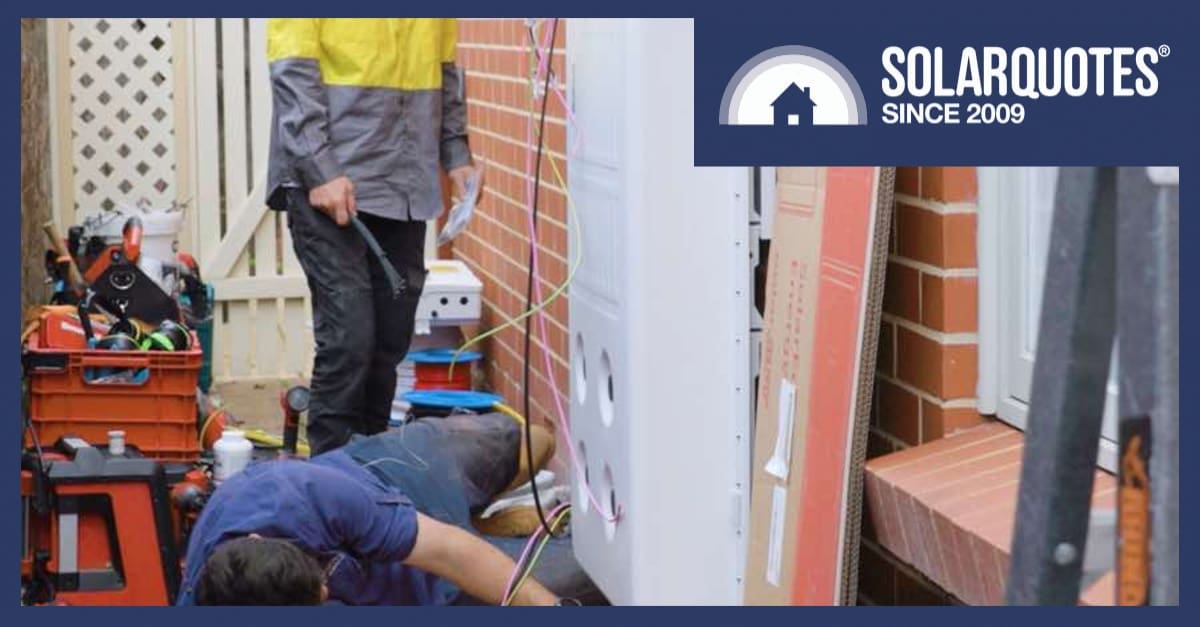
 The rush to get large home batteries before the federal rebate is restructured has seen many reputable battery installers booked out through to May, when the changes to the Cheaper Home Battery Program come into force.
Rob Moffa, who is in continual contact with installers in his client operations role at SolarQuotes, says the race to get in ahead of the rebate changes has filled up the schedules of Australia’s best electricians.
“As each day passes the more I hear from installers that pre May 1 installation capacities for batteries have been reached,” Rob says.
Late last year, the federal government announced a host of changes to the battery rebate, including the introduction in May of a new tiered system that will see the value taper off for larger systems.
The news of impending changes saw installers like Reef Solar & Electrical in Queensland hit with a surge of interest, according to owner Troy Coburn.
“We saw an immediate and sustained surge in enquiries once the December announcement landed, particularly for battery systems and larger solar and battery installs. By early January, battery demand was already pushing past what we could realistically deliver before 1 May. Since then, the phones haven’t really slowed, but the issue isn’t interest, it’s capacity,” Coburn says.
Even before the December changes, the Cheaper Home Batteries Program had turbocharged the market, with battery sales quadrupling for the final six months of 2025 compared to the same period in 2024, at more than 183,000 home batteries sold, the Clean Energy Council found.
Rebate Changes Affect Larger Systems Most
Coburn warns that battery jobs being pushed into May could see complications between installers and customers – particularly for larger systems.
“Up until now, the rebate has basically rewarded scale. The bigger the battery, the bigger the rebate, which has strongly pushed people toward large battery installs. That’s a big part of why demand for larger systems has surged so hard ahead of the 1 May change. From 1 May, that incentive flips. Once the rebate becomes tiered, support drops off pretty quickly as battery size increases, which naturally pushes customers toward smaller batteries instead. On top of that, batteries are already more complex than solar-only installs, with longer install times, more commissioning, and more things that can affect scheduling,” Coburn says.
Coburn says he is hearing from customers that they’ve been promised pre-May installs elsewhere, but cautioned that timelines are extremely tight once approvals, grid applications, equipment availability, weather, and actual installation capacity are factored in.
The original form of the Cheaper Home Batteries rebate saw households incentivised to get much larger systems then they needed, which had the scheme on track to exhaust its budget years early before the recent intervention, which also included an additional $4.9b in funds.
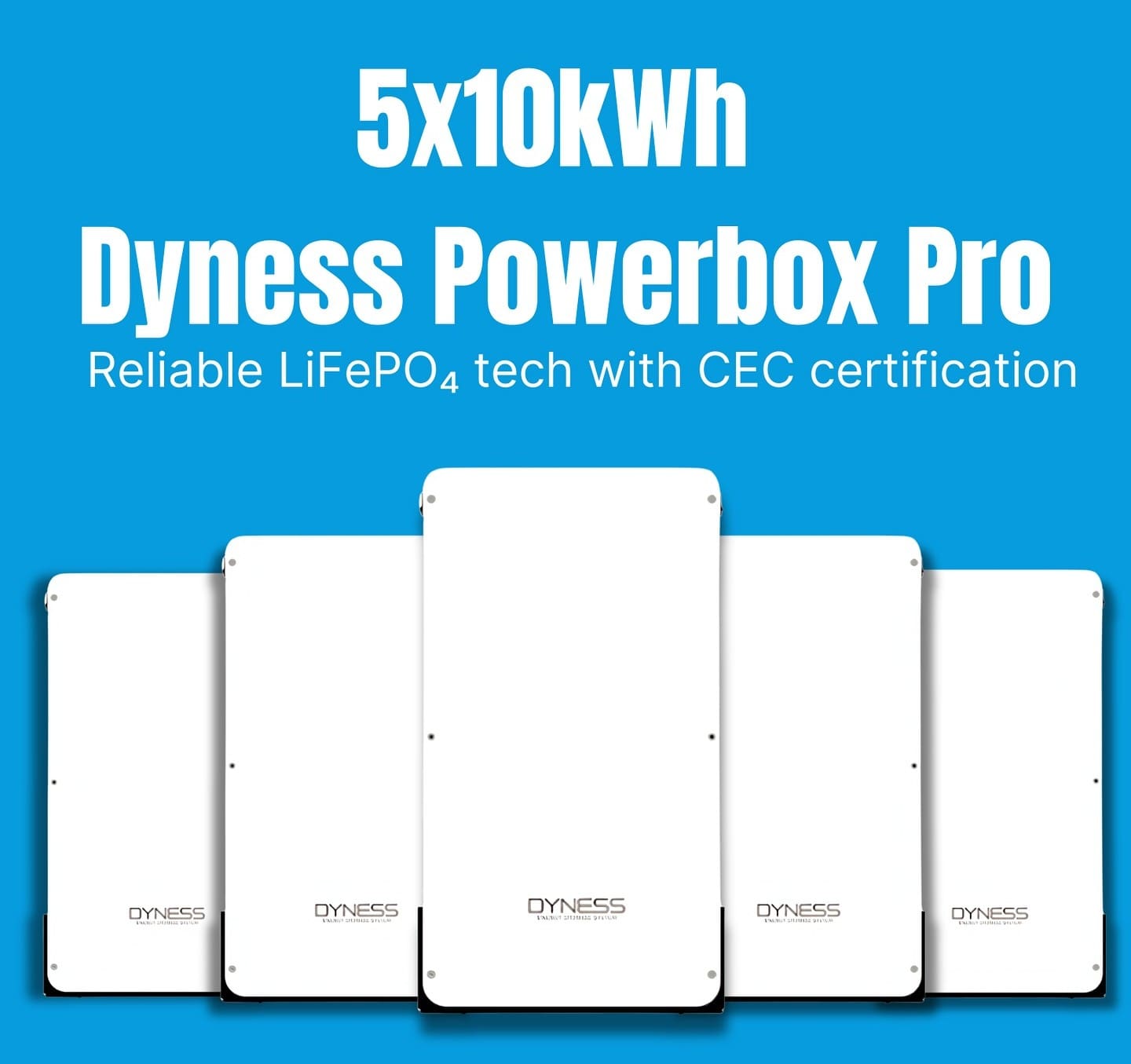
The federal battery rebate triggered a surge in sales of monster 50kWh systems, often paired with undersized inverters.
Installers Under The Pump Nationwide
It is particularly difficult to get a quality installer pre-May in the eastern states, but even in South Australia – where the solar battery market is more mature – available places are getting snapped up fast. All three installers in SA contacted by SolarQuotes reported they were full up through to May for battery jobs.
One of those was Graeme Galletly of Goliath Solar and Electrical, who said he is now quoting customers based on the reduced rebate.
“It’s still better than nothing, and timing is timing so you can’t change that. If [the customer] finds another installer available who might have just started or uses another product to us, that’s their decision,” Galletly says.
Take Precautions With Installers Promising A Pre-May Install
Back in Queensland, Coburn recommends being direct with installers and getting answers in writing for an absolute guarantee of a pre-May install.
“There’s a big difference between being told ‘we’ll try’ and being told ‘we can actually deliver this before the deadline.’ People also need to be wary of pressure tactics or promises that sound too easy this close to 1 May. At the moment, any decent, reputable installer should be busy. If a company is saying they’ve got plenty of availability and can still lock in pre-May installs without any caveats, that should raise questions … if the company doesn’t have its own installation teams and isn’t managing its own calendar, customers need to be extra cautious. Businesses relying heavily on third-party contractors have far less control over scheduling, especially during a rush like this,” Coburn says.
“If the rebate outcome is critical to the customer’s decision, it’s completely reasonable to ask for written confirmation around install timing, and to ask what happens if deadlines are missed. A good installer will be upfront about the risks rather than over-promising and hoping it all works out.”
At SolarQuotes HQ, Rob backs the guidance on getting confirmation in writing. He suggests that customers:
- Confirm that the batteries are already secured and not “expected” – stock shortages have been an issue in the past and may re surface as May 1 approaches;
- Confirm what “installed” actually means – a battery system is considered to be installed from the date a certificate of electrical compliance is issued;
- Be careful with deposits and confirm whether they are refundable. Large and / or non-refundable deposits are a red flag;
- Read thoroughly through the T&Cs;
- Ensure they have a written timeline from the installer & it should include approvals submitted, confirmed install date, plus commissioning/sign-off/certificate of electrical compliance.
Are Solar Installs Also Delayed?
Rob notes that for many installers it is only battery installs that are booked up, and that getting solar only isn’t subject to the same delays.
“If batteries are not included then you are in with a shot at an install pre May 1,” Rob says.
That’s not universally the case however – Coburn says that even solar-only jobs for Reef Solar & Electrical have pushed out to May due to his focus on batteries right now. But he adds that there’s an argument for going solar only initially anyway to get an idea of what size battery is needed.
“There is merit in doing solar first and adding a battery later, mainly because once solar is installed you’ve got real usage and export data. That makes it much easier to size a battery properly rather than guessing upfront,” Coburn says.
For more on the incoming changes to the Cheaper Home Batteries Program, read our dedicated guide to the federal battery rebate.
 About Max Opray
 RSS - Posts






The proposed changes by the Australian Energy Market Commission (AEMC) would significantly undermine the uptake of household batteries.
In practice, they would penalise consumers who use little grid electricity by imposing a high fixed daily charge. Most solar and battery households are now low grid users.
Existing demand tariffs are already severe: a single high-demand event during one demand window can raise charges for the entire month. This was never consumer friendly.
While widely criticised as unfair, this structure was introduced at the industry’s request.
The current proposal appears to reverse that position by shifting toward higher fixed charges, encouraging grid use and discouraging battery ownership – particularly if demand tariffs are not delivering the expected revenue.
Is this interpretation correct?
Write to your MP
https://reneweconomy.com.au/plan-to-increase-fixed-network-costs-will-take-from-the-poor-give-to-the-rich-and-slash-returns-on-pv-and-batteries/
If true, it will significantly incentivize home owners to go off-grid.
Many of us are not on demand tariffs, sticking with flat rates, and low usage. Factor in formerly high feed-in-tariffs, and it was possible to break even. Under the proposal, usage charges look to drop by a third, while supply charges quadruple, which means bills will rise several hundred for low consumers. Those who benefit will be the “grid gluttons”. Factor in plummeting FiTs and the future looks painful for those not off-grid.
No point writing to my MP – said polly rarely travels far from the office, let alone my way, and reportedly has zero interest in responding to constituents with issues, or perhaps that’s just those outside the bubble?
Your MP works for you. So make them listen. Ask for a meeting and have some fun
No, my MP works for the party, and voters like myself and my neighbours can #$%^& off because we’re not useful idiots.
I’m crossing my fingers and hoping that when boundaries are finally redrawn I end up in a different electorate, one with actual representation. Obviously that may be a while!!!
“Your MP works for you.”
In which universe do you live?
This is Australia.
The MP’s work for the people that provide their extra “benefits”.
That is why the ALP works for people like Mineral Resources, that provide them with massive pensions when the ALP MP’s get bored with pillaging the plebs.
And, in WA, the restrictive trading hours legislation was purchased from state MP’s, by the foreign multinational company, that benefits from the legislation, to buy benefit for that company, and, to cause harm to Australian business and to cause harm to the WA company, and to cause harm to WA residents.
Unconscionable business practices, and restrictive trading practices, and the bribery of MP’s are legal
And, remember that the cartel in power has repeatedly deprived Australians of the choice of becoming an independent, self-governing country, and, the oath of allegiance of MP’s in Australia, is to a hostile foreign power, and, is NOT to serve the interests of Australia and its people.
I recently changed to a new supplier (Engine) and was “soft” pushed to TOU ($250 bonus) with seasonal demand pricing- unsure how it impacts consumption cost, apparently 2.5kW is a high draw??. When I asked to return to a flat crate, was told that my smart metre was configured to TOU and ??? Couldn’t becreverted by the retailer $$ for the meter management company – not the distributor (Ausgrid) but Intellihub.
Hand wringing all around it seems.
Nobody knows, everyone else is to blame.
Sadly I have been impacted by this. The company I am going with unfortunately had an unexpected retirement in their installer network due to burnout and my install has gone from February to April. I am lucky it didn’t go out further!
Whilst its frustrating on an individual level, it shows the huge demand in the sector. According to a recent Climate Council report, approximately half of solar owners would like a battery, but only about 10% have one. The return on investment with batteries is now very reasonable. Whilst I have hopes the unit price of electricity will start to come down with more renewables starting to impact the wholesale price, I expect the amount of discount that flows down to consumers will be just enough to stop mass protests and no more than that, so solar and batteries are still a great investment.
If I were a younger man I’d be retraining as a solar and battery installer. There will clearly be plenty of work for years to come!
I just read this this morning https://reneweconomy.com.au/plan-to-increase-fixed-network-costs-will-take-from-the-poor-give-to-the-rich-and-slash-returns-on-pv-and-batteries/ i guess it isn’t a surprise it was talked about last year but given that the majority of DNSPs are owned by state governments and they are the ones trying to speed up transition to electrification I can now see much discussion about disconnection from the grid… in terms of this article I wonder how many of those booked in installations will actually proceed if we move to a billing regime where the quantity of consumption doesn’t actually affect the bill….madness
Andy
I don’t think it means consumption won’t affect the bill, just that it won’t affect the network charges component. That is you’ll still pay generator and retail charges on volume.
Im not sure I agree, as I understand it today there are fixed daily and variable kwh network/ poles and wires related charges. As I understand it these will all collapse into a mega daily charge.
Depending on the time of the day(amount of renewables in the grid) with today’s costings the network charges already represent a significant portion of your current usage based bill ( negative charge for generator, some for government certificate costs and some for retail) the rest today is for the poles and wires mob… If they change that so that all poles and wires charges become only a daily rate independent of use then what is left is pretty much noise.
It also means what can be avoided by PV and more so Battery today wont be avoidable in the future….
Those of us with big solar and battery now already avoid much of the expensive poles and wires charges by simply avoiding using power either at all, or when the TOU rates mean its expensive.
What am I missing?
The socio-political inferences implicit in the title of the reneweconomy article seem chattering-classes-typical. Pausing to think, what real-world choice do grid providers have? Proliferation of prosumers, hundreds of thousands with consumption time-shifting as well as self-generation, irrevocably reduces grid consumption. Cashflow must be maintained, or the grid will not be.
Spreading temporarily avoided cost back onto prosumers seems to be the one viable way to keep paying shareholders, while also keeping the grid fit for purpose. The trick which might stave off the death spiral, is to pluck their feathers as lightly as possible. Pull too hard, and only high consumption industry, and real-estate-poor consumers will remain on-grid.
Microgridding remote communities is probably optimal, but industry needs a national grid – cities too.
A grid-proximity tax seems a last resort – not to be applied until prosumers have paid to lower grid peak demand, saving grid billions.
We are all being drip fed here, who among us couldn’t see that the success of the cheaper home battery Fed Gov program wouldn’t have a significant flow on affect to the poles and wire companies, one that in the main among houses in AU will see over time that the Grid just becomes an insurance policy rather than an actual ongoing source of energy? Chris Bowen’s office must have seen this coming and have a long term plan for it….surely we aren’t all along for a ride that takes us somewhere?? Destination to be determined when we arrive
I would love to see a long term plan that shows how the grid will fund itself in the short term and the longer term. The problem with people exiting the grid is that in the main taxpayer subsidies were expended to get people that ability to choose to exit, once off the grid the value to broader taxpayers for those $ spent is zero
Yep, fully understandable. The drop in rebate for a big battery is in the order $8500 dollars on May 1.
Certainly not to be sneezed at.
I had my battery upgraded a couple of weeks ago (booked in before the backflip by the federal government) and my installer told me they were not quoting any more orders for pre May 1 pricing.
I have a general battery install question: Can a power outlet be placed in the 600mm exclusion zone beside a BESS? (the 600mm is beside a window).
My installer says it cannot, but I found the ERAC (https://www.erac.gov.au/wp-content/uploads/2021/03/Battery_Energy_Storage_System_02Feb2021.pdf)
says an outlet is not excluded. (The installer blanked off the outlet, but I am wondering if that is necessary.)
The issue here is that as a consumer we cannot look at the Australian Standards, or the regulations to ensure what we are being told is actually correct. I am not disputing the installer, but as a retired Tech, I have used Standards for much of my working life, but now have no access to view standards, which I feel frustrating! (If AS are used in Laws & Regulation, they should be viewable by the public at no cost I feel: We can see the
laws, but not the documents they are based on.)
I agree. Very annoying you can’t access standards.
When I moved from UK I was appalled at the quality of electrical work in Australian homes ( including new work ) but I had no reference.
Unfortunately it’s not just what the standards say.. it’s also what the rebate approvers say.
I’ve heard from multiple battery installers now that they’ve had better rebates knocked back for things that are allowed, such as a window to a shed or laundry being within the exclusion zone.
Installers are playing it safe to avoid headaches later.
Is this a case of unintended consequences for Labor?
They subsidised batteries to help relieve the strain on the grid, that threatened retailer profitability, so instead of paying for power use retailers need to charge instead for supply of a connection. It’s a natural and logical consequence, and one that directly targets the poorest. Supply is binary, you either have it or you don’t, whereas consumption is largely a matter of choice – whether to use power or not, and folk can take measures to reduce consumption e.g. only boil the jug with the required amount of water in it, don’t simply fill it to the top and waste the power to boil the excess.
Obviously we’ll need to see how this plays out, but if the changes are as radical as suggested, those getting small batteries may find their benefit far less than anticipated, and off-grid may yet again become far more viable, especially for those in suburbia.
And, of course, the fake launch by Goodwe, of the 10kW/48kWh single phase ESA system, which Goodwe has ensured is not available to the public in WA, was designed to cause victims to be deprived of the subsidy.
Ten months after the fake launch of the unavailable product, no indication exists of whether or when the product will ever become publicly available in WA.
Previous communications to Goodwe, asking for details, regarding the product and availability, are unacknowledged by Goodwe.
From what specifications are known, only two systems are apparently allowed to be installed on this site, to give 10kW inverter capacity and (about) 50kWh storage capacity; the Goodwe non-existent one, and, the even more disreputable one that appears to be an internal combustion system.
And, Goodwe is depriving us of access to the lesser disreputable one, and, to the subsidy of which Goodwe has been determinedly depriving us.
It is no wonder that some regard the household PV/BESS industry as bodgy.
I suspect Hanlon’s Razor applies here
I just got installed before the rebates decreased last year. Even with approvals done in Oct it was the suppliers and manufacturers that couldn’t keep up and actually send product for the install. Some manufacturers are going to have a harder time than others, so it won’t just be installers that limit customers, but what they pick and how the manufacturer responds to the immediate demand.
Maybe it’s just our situation, but after running the numbers many times, a battery still doesn’t deliver a reasonable financial return for our household.
Solar continues to cut our bills, and maximising self‑consumption makes sense now that FITs are low — especially with an EV in the mix. But even with the rebate, a battery of any size still doesn’t stack up for us unless you’re prepared to gamble on market trading. I’m not, particularly with large‑scale commercial batteries increasingly smoothing wholesale prices and limiting the upside.
I’m genuinely pleased for anyone who’s made the economics work for their home. It’s just not a one‑size‑fits‑all solution, and for some of us the maths still says “not yet.”