
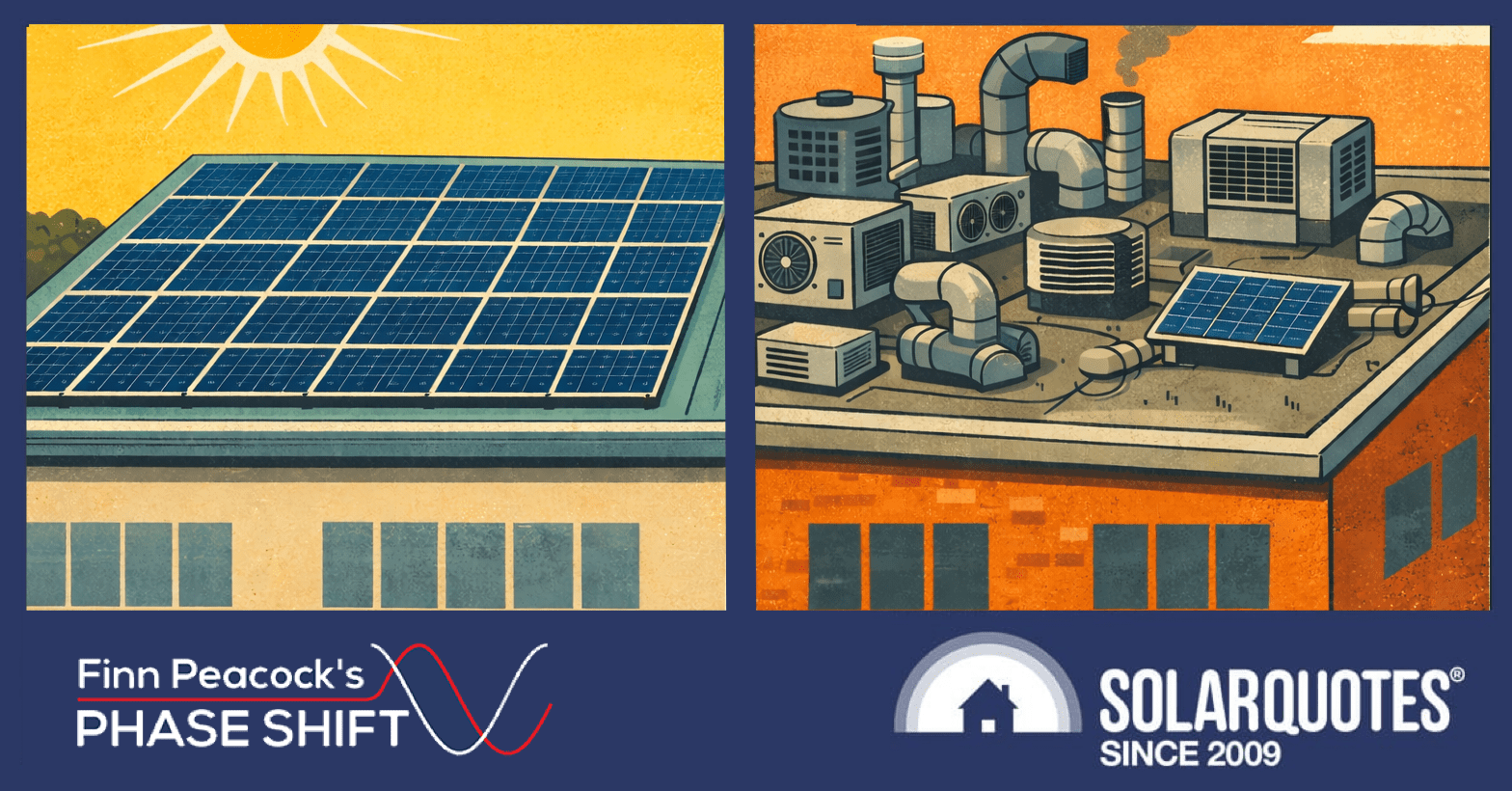
 This week I found myself involved in two commercial solar projects. One will almost certainly print money for decades. The other looked promising at first glance but fell apart the moment we climbed onto the roof.
The contrast between the two was a useful reminder that, despite the current obsession with batteries and ‘three-free’ electricity plans, old-fashioned solar panels remain brutally effective for businesses.
In many ways, businesses are still the cleanest use case for solar for 2 main reasons.
Reason #1: Businesses, in contrast to homes, usually consume the most power when the sun is shining. Their demand tends to rise through the morning, peak in the early afternoon, and drop away overnight. Solar generation fits that profile beautifully.
Reason #2: Once your meter is attached to a business entity, the 3-free hours plans all disappear. In fact – as far as I can tell – there aren’t even any small business tariffs that offer particularly cheap daytime rates. The best I found on Energy Made Easy was the Origin Business Sunshine Special at 28.6c per kWh from 10am-3pm. Unfortunately, an eye-watering 58c at all other times knocked it out of the reckoning.1
A Tale of Two Rooftops
The first project involved a large commercial property with multiple tenants: a brewery, a cafe, a boxing gym, laboratories, and several offices. Electricity for the entire building flows through a single NMI, with an embedded network and sub-metering used to allocate consumption to the individual tenants. Total usage is close to 1,000 kWh per day, and roughly eighty per cent of that occurs during daylight hours. In solar terms, that alignment is almost perfect.
The solution was therefore obvious. The building has a large north-facing roof, so the plan was the longstanding SQ advice: “fill-yer-roof!”. The final design landed at 250 kW of Longi 650 W panels feeding a 110 kW Sungrow hybrid inverter plus an additional 50 kW inverter, with 100 kWh of battery storage added as a finishing touch. Even without claiming STCs for the solar – systems over 100 kW are not eligible – the numbers still work comfortably. The projected payback is just over four years.
The landlord was happy to invest because the incentives are clear. She pays the grid electricity bill, on-charging the clients. Once the system has paid for itself the building will effectively have a large source of low-cost daytime power sitting on the roof. Some of those savings can be passed on to tenants while still improving the operating economics and value of the property.
The second project could hardly have been more different. It was a small but extremely busy cafe/restaurant in Adelaide CBD. Their electricity consumption is astonishing: around 165 kWh per day. That works out to the equivalent of a constant 7 kW load running twenty-four hours a day.
What makes that figure even more surprising is that the kitchen itself is not heavily electric. Cooking is done with wood and gas, and cooling is mostly done with a large evaporative system. The building footprint is only about fifty square metres. Even so, the cafe’s electricity bill is roughly $6,000 per quarter, and the landlord was keen to install solar at their expense to give the tenants some relief.
That all sounded promising until we inspected the roof.
Unexpected Complications
It turned out to be a maze of penetrations. Fridge compressors, flues, evaporative cooling units, parapets, ducting and other obstacles covered almost every available section of space. After working around everything we could, the maximum system that could be installed without turning the job into a major building project was about 4.75 kW.
A system that size would probably achieve around eighty per cent self-consumption and save about $2,000 per year. On the surface that still sounds reasonable. In reality, it barely dents the bill; it would offset less than ten per cent of their electricity costs.
At that point the obvious question arises: why not install it anyway? A three-year payback is still attractive. Unfortunately, there is a complication.
The cafe is currently on a mechanical meter and enjoys a relatively low flat electricity rate. Installing solar would mandate a smart meter upgrade, and that upgrade would move them onto a different tariff structure with a higher average energy price. Their usage would fall a little, but their electricity bill would increase.
Adding a giant battery is pointless – because there is no cheap energy available to charge it.
Where Is The Energy Being Used?
So what are their options? The first thing to do is look at their efficiency, and even that is hard. Because they don’t have a smart meter, their only insight into energy use comes from a quarterly electricity bill.
So the sensible first step is proper measurement. Installing monitoring with 5 5-minute resolution across the main circuits would quickly reveal where the energy is going. In cafes the answer is often refrigeration: cool rooms, display fridges, under-bench units, ice machines and compressors that sit outside in the heat working harder than they should.
One compressor on this particular roof is completely exposed, with its condenser coils visible from the street and no shading or protection at all. That alone could be responsible for wasting tens of kWh per day.
Once we understand where the energy is being used, we can start to improve it, and also be prepared to optimise their tariff when they inevitably are finally forced onto a time of use plan.
The two projects illustrate a simple point. Solar remains one of the best investments a business can make, but only when the fundamentals line up: a usable roof and substantial daytime consumption. When those ingredients are present, the results can be spectacular. When they are not, the smartest energy upgrade goes back to basics – good old-fashioned energy efficiency.
Phase Shift is a weekly opinion column by SolarQuotes founder Finn Peacock. Subscribe to SolarQuotes’ free newsletter to get it emailed to your inbox each week along with our other home electrification coverage.
Footnotes
- SQ is owned by Origin – but this was honestly the best daytime rate I could find – let us know in the comments if I’ve missed a trick here. ↩
 About Finn Peacock
 RSS - Posts





Sounds like the start of a good business case for some of those carports with solar panels instead of a roof – to cover all that ancillary equipment on the roof and provide the solar.
Also – why would they be forced onto a time of use plan when they get a smart meter? I thought all that malarky was stopped.
As for business power costs – its all about your size isn’t it. I fondly remember renting a building in a large refinery complex about 15 years ago – the building had internal metering, but no separate to the grid connection. So i couldn’t get electricity connected, so the refinery said they would just charge me for the kWh i used at the rate they pay – which turned out to be 3c a kWh…
Howdy,
The first example sounds like a winner but I am curious about the battery – given the size of the array and the stated consumption, 100 kWh sounds a bit on the small side? Were there any limitations etc that led to that decision?
Your figures suggest their overnight usage is ~200 kWh (daily usage 1,000 kWh of which 80% is used in daylight hours)… so the battery would be drained about halfway through an average night…?
The aim is ROI, not zero grid draw. 100kWh allows STCs on the first 50kWh. Hybrid inverter allows another 150kWh of battery to be easily added in the future.
Thanks!
Explanation appreciated!
It sounded like there were two inverters, 100 to the grid and 50 kw for the batteries.
And I’d assume the batteries are DC coupled, so they could be using a max 150 KW peak from the solar through the inverters, and possibly still putting the noon excess into the batteries?
Early and late day solar output would be mwell below peak, so they might nearly empty the battery by the end of the day. And it might only cycle a bit in the middle of the day, in winter
It’d be great once they’ve got a year’s data, to post some graphs of the energy flow, and maybe a diagram of how the system is connected.
Before we got our first household solar system it was hard to picture the interplay between rates and where to time shift energy usage to save money.
as per the post: “110 kW Sungrow hybrid inverter plus an additional 50 kW [solar] inverter”