
 I get why people are excited about Vehicle-to-Grid. EVs are giant, relatively cheap-per-kWh batteries, and it feels like a waste to let them sit on the driveway doing nothing.
But as I’ve written before, I think conventional V2G – bidirectional chargers, household regulatory approvals, degraded car batteries – is too impractical to ever really take off. Home batteries are getting cheap enough that the whole complicated dance stops making sense.
Then I watched this video and had to reconsider.
Naked Packs in the Desert
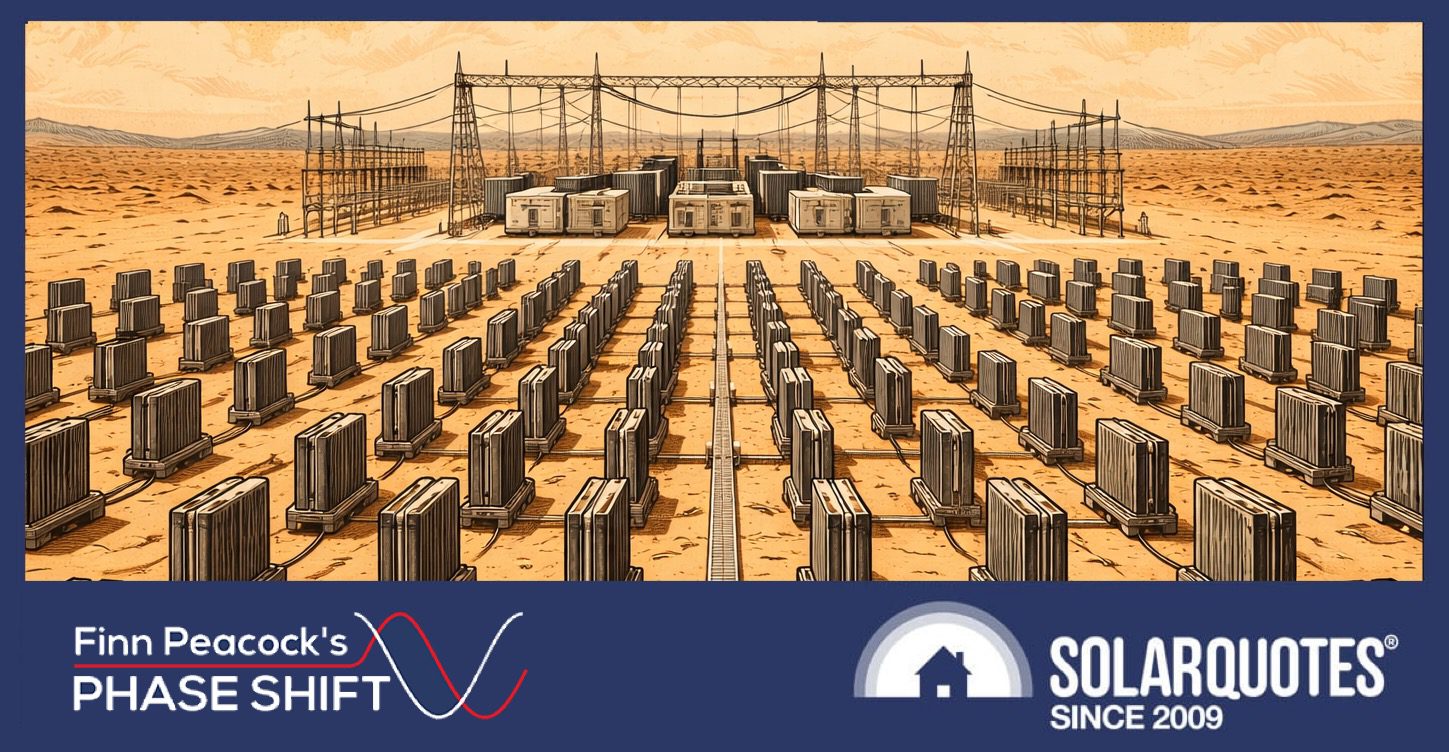
Redwood Materials – founded by JB Straubel, the engineer who helped build Tesla – has been pulling used EV battery packs out of retired cars and standing them upright in the Nevada desert. Just the raw packs, planted in the desert in their hundreds on a couple of acres of scrubland, each connected to a custom inverter.
They’ve wired 792 of them into a 63 megawatt-hour grid battery. It’s been running for seven months at 99.2% uptime. This week, they announced a sevenfold expansion.
In Australia, we’ve had startups promising to repurpose end-of-life EV packs into packaged units for small commercial customers or homeowners. But they have to repackage them, make them safe, and make them attractive to the customer. That gets complex and expensive – which is likely why all those startups seem to have disappeared.
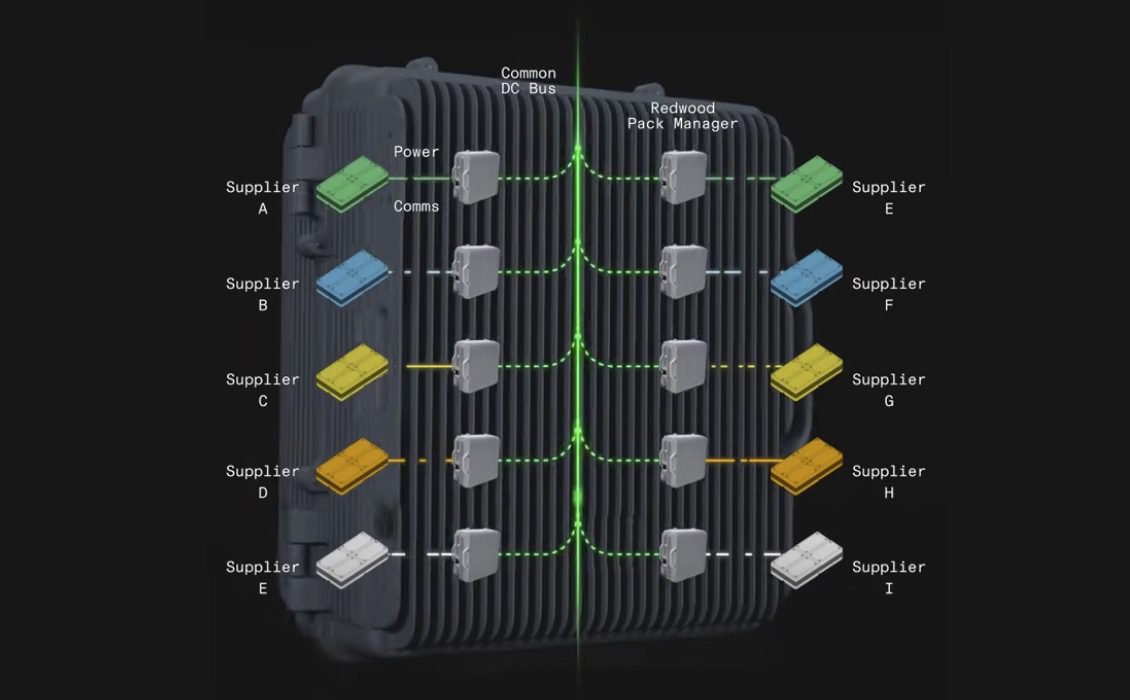
Redwood skips all of that. The packs are already sealed to survive under a moving car in all weather. Stand them in a paddock and connect each one to a bespoke DC-DC converter (Redwood Pack Manager) configured to the electrical specs of its battery pack. Connect the outputs to a common DC bus and connect that to a giant inverter. Done.
Redwood reckons setups like this could eventually make up 50% of the world’s stationary battery fleet. At a fraction of the environmental and financial cost of new.
Australia Has Plenty of Paddocks
We’re a few years behind the US on EV uptake, which means we’re a few years behind on the wave of retired packs. But Australians love their cars, and we’re not short of cheap, empty land. If Redwood’s model holds up – and seven months at 99.2% uptime is a decent start – I think this makes more sense for Australia than any version of residential V2G out there.
Phase Shift is a weekly opinion column by SolarQuotes founder Finn Peacock. Subscribe to SolarQuotes’ free newsletter to get it emailed to your inbox each week along with our other home electrification coverage.
 About Finn Peacock
 RSS - Posts





I’ve heard stories about EV’s put on blocks at the end of their life turned into house batteries, but this is a pretty nifty idea!
I recently visited a commune on the N Rivers, NSW. He has a written off import Toyota PHEV that supplies power to his house. We were at a talk, &
the car started to top up the battery because the panels were undersupplying.
The biggest use I can think of for a power storage system as mentioned is for diesel replacement on farms: Big storage (that can be sent to the grid if there is excess), but smaller (than current huge tractors) robotised tractors that can interleave charging & work 24/7 due to lower noise. Design the power system to allow implements to be changed with no manual intervention. The savings on Diesel would easily finance the transition.
There was work on rural electrification but it seems to have been defunded by the previous ultra-conservative governments (as compared to our current only conservative government: how I wish they would show some initiative! Perhaps bring Gough´s ghost back? Labor needs to throw off the American shackles I feel.
Yes, they recently did a story here or on renew economy (cant remeber which) about a NZ farmer who had electrified his whole opperation and was saving a motza.
There’s a business in WA that offers salvaged BYD Atro 3 battery (60kWh) for grid connection just like any other home battery (but you get no Rebates). There’s also a number of people doing it off grid and even Seal (82.5kWh) battery.
Won’t be long before we see the bigger battery like Zeekr LR/AWD (100kWh). Just need more… accidents. I didn’t suggest this.
My recollection is that Redwood is a battery recycler, one of the world’s first, and their well established battery farm is an effort to utilise capacity remaining in many of the unwanted batteries they receive for chewing up into “black mass”.
The effort they’re putting in is physical evidence of BEV battery longevity and crash resistance, even in the older tech being recycled.
The global environmental saviour, Saint Donald the Peacemaker, is now kicking the world violently to adopt BEVs at a rapid pace. His “Drill, baby drill!” mantra is boring holes in peoples’ fuel tanks the world over. And his reduced arming of Ukraine has ramped up their domestic drone & missile capability, with which they’re destroying Russia’s oil refineries & terminals nightly – 40% smashed so far, I hear. He deserves a medal.
Fully restored fossil fuel supply will likely never happen. Scarcity is highly profitable – expect it until ICE ends, in the mid 2030s – ICE cars worthless long before. Adapt & save.
Erik Christiansen: – “Fully restored fossil fuel supply will likely never happen.”
On 27 Mar 2026, Bloomberg Television posted a YouTube video titled World Is Losing 10 Million Barrels of Oil a Day, Morse Says, duration 6:32. It included a graph at time interval 3:12, showing the Strait of Hormuz closure has apparently choked (20.47 – 6.70 =) 13.77 Mb/d production from Saudi Arabia, UAE, Kuwait and Iran combined. https://youtu.be/zB9WEpe_Ziw?t=192
Of the ~86 Mb/d of crude oil + condensate produced globally, roughly 40 Mb/d was available for trade in international markets, while the remainder is used internally by oil producer countries. https://youtu.be/lJ3DauFIMXU?t=293
13.8 Mb/d has now evaporated from the ~40 Mb/d crude oil that was traded in international markets pre-conflict. Rising fuel prices are now inevitable to destroy sufficient global demand.
Will 13.8 Mb/d come back eventually? Or are we now in a post-peak oil supply world?
With China selling 18,000+ BEV trucks domestically *monthly*, shipping a few thousand per month here, to solve our looming road transport crisis within a year, is a doddle. It’s harder for us to smack in the 1MW/2MW truck chargers fast enough to keep the beer and toilet paper flowing, short term. Melb – Bris is peanuts, but many backblock towns will be waiting for chargers.
A Windrose 729 kWh has 650 km range hauling 36t, and a few of them are doing pilot deliveries in Aus now, not least demo runs by New Energy Transport. That one’s about $360k, if my US$ conversion is accurate. The shorter range one is around $250k, I think. Cutting 40 min off a 480 km run, by doing 98 km/h up hills, leaving diesels in the dust, with $50 “fuel” cost vs $300 for the diesel, is an epiphany.
Even if fuel flow picks up in a year, electric trucking *bankrupts* diesel folk by then. Ukraine will have destroyed *all* Russia’s export terminals & refineries by then. (40% done now)
Post-peak -> rapid end.
Erik Christiansen: – “With China selling 18,000+ BEV trucks domestically *monthly*, shipping a few thousand per month here, to solve our looming road transport crisis within a year, is a doddle.”
It seems to me you are ignoring that demand for BEV trucks will likely substantially overwhelm availability. Trucking companies here in Australia will be competing with many trucking companies elsewhere around the world for limited supplies of BEV trucks. And how will these BEV trucks produced overseas get to Australia? Answer: By ship, powered by petroleum products.
Singapore, the world’s top ship-fueling hub, is grappling with soaring fuel prices & tightening supply.
https://asia.nikkei.com/spotlight/iran-tensions/singapore-world-s-top-ship-fueling-hub-grapples-with-tight-supply
For now, it may be better to convert existing diesel-powered trucks to swappable-battery-electric trucks, like what Janus Electric does.
See: https://www.youtube.com/watch?v=u8V6cVijosQ
Yes, swappable batteries can also be charged more slowly, reducing the need for scarce 1 or 2 MW chargers, and spreading the grid load. The conversion of an already owned rig has to be much cheaper than a new electric one, potentially keeping a lot of struggling owner-operators viable in the face of a disruption which favours the bigger operators with deeper pockets.
It is a highly workable interim solution, more slowly displaced by off-the-shelf electrics as logistics moves into the 21st century at last. (Markedly cutting operating costs and trip times in hilly areas.)
But NET has applied for planning permission for a small 20-truck 5 MW charging station on the Mel-Syd run, with plans for a rapid expansion to 50 trucks. Any operator not planning an imminent switch will be paying 6 times the fuel costs – until bankruptcy.
The die is cast. The past is making gurgling noises.
Erik Christiansen: – “But NET has applied for planning permission for a small 20-truck 5 MW charging station on the Mel-Syd run, with plans for a rapid expansion to 50 trucks.”
How long will it take to have these 5 MW charging stations operational, Erik? Likely a year or more away. Yes?
Meanwhile, the real petroleum fuel crisis hasn’t started yet. If the Strait of Hormuz remains closed much longer, things will get really bad, really fast.
So far, the world has drawn down on afloat & onshore storages that aren’t being freshly pumped out of the Middle East & shipped from the Persian Gulf. These include the 400 million barrels of strategic reserves, as well as the release of Russian & even Iranian oil from sanctions. The world is using up those buffers, & if the Strait of Hormuz remains effectively closed for a few weeks more, then the world will be forced to begin to make do with far less oil/petroleum fuels.
https://heatmap.news/energy/hormuz-oil-buffers
Geoff,
Some oil may be freed up as middle eastern Aluminium production ceases as alumina cannot be brought in through Hormuz. (22% of traded aluminium must have been burning a bucketload of oil to refine.)
But while that oil can’t make it out, the availability is moot.
Iran demands reparations and sovereignty over Hormuz. Peace may take time. Restoring infrastructure: another quarter year just to restart the LNG plant, and refinery rebuilds somewhat longer, I’m guessing.
Donny has done his dash with allies, military & commercial – America won’t fully recover. Hormuz has skewered trust in the fossil fuel sugar hit, revealing the mobility security and economy of BEVs, plus much less range anxiety than ICE on a daily basis. (Sell the caravan, rail instead, hire a BEV at destination. Simples.)
Well restarts will be at reduced delivery capacity – that’s a given. Drilling new wells may be loss business, as ICE becomes unaffordable. Scarcity profit gouging is their best deal now.
Erik Christiansen: – “Some oil may be freed up as middle eastern Aluminium production ceases as alumina cannot be brought in through Hormuz.”
I don’t think most people understand the magnitude of this crisis. Sal Mercogliano, who hosts the What’s Going on With Shipping? YouTube channel, said in a recent post:
“There is a clock ticking right now, as global oil reserves, both afloat and ashore, are being dipped into. We’re sucking that straw on it. And when those begin to disappear, we’re going to run into a period of time when there’s not enough oil to go around, and that is the critical moment. When is that? I don’t know. I, I wish I knew. I can’t give you that number because I’m not as smart on that with a show, ashore, afloat stocks, everything. But it’s weeks, weeks away before we hit that. And that is why you’re going to see the next big evolution here is to get that Strait [of Hormuz] open.”
See: https://youtu.be/ybU29t7rkc8?t=1004
Erik et al, I think Australia should join the Coalition of the Un-willing, ie all the countries that do not want to support Donnie.
We are certainly in uncertain times: sounds like Aluminium will jump in price too & that good for Au producers. The Iranians are dealing oil in Chinese currency & it seems oil purchased in Yuan is being let through (so China is less affected).
afa the Swappable batteries for trucks, one thing not considered is the ability to sell back to the grid at times of shortage. Imagine a park of recycled EV batteries, as much PV solar as will fit on site, & space to charge say 50 trucks: that could be a real money spinner. Best of both worlds: Charging + grid stabilisation. Hopefully they have car charging available too.
Australia Has Plenty of Paddocks?
Oh boy.
We have enough problems building traditional battery farms in rural areas. Everything from “it’s a fire risk” to “it ruins my views and my tranquility”. Plus it needs to be built near to transmission (power lines) and they don’t like those either.
I can’t see country folks warming to this.
T, if rural folk embrace Electrification by electrifying farming, it will turn into a no-brainer. But there needs to be the electric solutions available: perhaps China might also fill that market? I would love to see the stranglehold of US farming equipment manufacturers competed with. China has the capability & the technology to achieve this task too. Farming also needs a Right-to-Repair bill enabled too so farmers can access the tools & software necessary to repair equipment. Atm, many farming equipment repairs are sourced from the Capital cities, at great delay & cost. When farming is electrified, local repair should also be possible (enabled in Legislation).
Monarch electric tractors (USA) told me they weren’t ready to export to Australia. An Indian company discontinued their machine. The European big names are too costly. It’ll have to be orchards, vineyards, and hobby farms first, I think. (There’s a NZ vineyard with over a dozen electric machines.)
My 1.2t electric excavator is OK for clearing fencelines, but I have asked the importer if they’ll bring in a 2.5t machine – the greater breakout force would be handy. Any bigger and it’s a bugger to transport. (The little one walks at 1.5 km/h – 1/4 walking speed, so the tandem trailer & ramps are needed, just to get to the boundary fence.)
The hydraulic auger motor supplied with the little one is also better suited to the supplied 20cm auger, than the 30 cm I also bought – it finds it tough going in gravelly sand as the stones accumulate at the bottom of the post hole, with just sand coming up. Still, it’s grand to put in staysets without a thought to diesel availability. :-))
Maybe we should say plenty of deserts…
Agreed. City folk want battery farms, so let them turn their green spaces into (green) battery spaces. Parkland can be surrendered, maybe even cemeteries? it’s for the good of the planet right? No need to risk cropland or drinking water.
The last attempt at a battery farm (that I know of) by an out of state capital city based company eventually failed, but it took a long time, extensive community effort, and a council that was talking with state government to see what levers to prevent it existed.
John Alba, you should familiarize yourself with:
https://reneweconomy.com.au/big-battery-storage-map-of-australia/
John Alba: – “No need to risk cropland or drinking water.”
Is it OK for coal/gas extraction to risk croplands/drinking water, John?
https://www.lockthegate.org.au/risks_of_coal_and_unconventional_gas_mining
Burning more carbon-based substances is ‘civilisation suicide’!
https://www.ipcn.nsw.gov.au/sites/default/files/2026-02/Geoff_Miell-PresentationSlides-ChainValleyCollieryConsolidationProject%28SSD-17017460%29-20260216.pdf
Geoff, a 30s look at your map shows cities are largely avoiding the battery storage they themselves demand. Curious no?
I don’t believe anyone is arguing for coal or gas to risk croplands or water either, but how often do they overlap? I’m not denying some do, but it’s not common.
Yes yes I’m aware of your view of reliable energy v civilisation survival. On the other hand there was a recent article noting that US temperature related deaths are 12:1 cold v heat. A warmer planet would, in theory, actually reduce mortality. Not the angle the paper itself took, it was more focused on socio-economic considerations e.g. can’t afford to heat the house.
Given the current suggestion Australia is set to face a cold winter, might there be something of relevance there?
John Alba: – “Curious no?”
Nope. Close to generation &/or strong transmission links.
John Alba: – “I’m not denying some do, but it’s not common.”
Have you seen aerial views of the Hunter coalfields or the Queensland gas fields, John?
John Alba: – “US temperature related deaths are 12:1 cold v heat.”
Research suggests official records may underestimate the true impacts of heat by at least 50-fold.
https://www.solarquotes.com.au/blog/new-vehicle-emissions-data-ev-shift-means-for-solar/#comment-1732822
John Alba: – “Given the current suggestion Australia is set to face a cold winter…”
Who’s suggestion? Yours, John?
BOM indicates its long-range forecast overview for Apr-Jun 2026:
https://www.bom.gov.au/climate/outlooks/#/overview/summary
62% chance of El Niño conditions for 2026-27.
John, a slightly longer perusal shows that there are indeed some huge batteries within or close to suburban settlement in most of our capitals. It’s not exactly wind turbines on North and South Head of Sydney Harbour as suggested by a friend of mine, but in your earlier comment I noticed you weren’t advocating for city-folk to also grow all their own food.
John,
Even if North America did have more cold-weather-related deaths, global heating is already exacerbating that too. Their recent intense cold snap was due to the heat-destabilised circumpolar jet stream failing to contain arctic conditions. As the AMOC stalls (slowing already), reduced heat transport from the Southern Ocean to the North Atlantic will (again) intensely freeze Northern Europe, making food production impossible there, and much reduced in North America.
The last time, the Younger Dryas, was apparently due to ice melt close to where Greenland is now dumping one cubic km of icy meltwater every 33 hrs.
As more heat remains down under, Tasmania will become balmy. South-migrating sealife has evidenced the beginnings for some years now. Whether the effect avoids India becoming uninhabitable due to heat, is down to the new heat flows. It’s all a grand experiment – outcome subject to confirmation.
Battery tractors can replace light chores like pulling wagons around, feeding livestock, intermittent PTO work, loading or pulling the manure spreader, etc.
But the packs just don’t have the energy density to do the long, hard pulls needed for field work, or to do heavy PTO work like roto tilling.
Unless someone comes up with swappable packs, we’ll still need some kind of concentrated fuel for big jobs or big acreage.
Yes we do – if you took all the paddocks currently used to grow grain and sugar to produce ethanol for producing blended fuel, and put solar arrays on them instead, you would have more than enough power to run all of Australia.
Hi,
I gather from this blog that you are not too keen on car batteries for use in charging the grid or the house. I understand there are fairly large problems relating to battery degradation with constant small inputs and outputs. However, I have a different method I would like to ask about. I was wondering if there was any car and charging system that charges the car battery in DC straight from solar panels and then instead of going to the grid, it charges the house battery (in DC again) when the battery goes low (especially in winter)? If it is possible to run this in parallel with a vehicle-to-grid system, that would be ideal. In winter, I could drive to a cheap charging point, charge up my 80 kWh car battery (that I haven’t bought yet), and then keep the house going in cloudy conditions for another week.
Regards,
Russell Burton
I’m not sure what these “fairly large problems” are regarding small battery cycles. In general terms, many small cycles are regarded as preferable to fewer deep cycles for most battery types. Memory effects generally haven’t been a problem since the early days of nickel metal-hydride cells.
It’s been pointed out that a battery that isn’t cycling is sitting there doing nothing for you. Both the power draw and the depth of discharge needed to run a household are generally pretty small compared to that needed to drive a car around.
That’s not to say that powering a house is the best use of a powerful and expensive vehicle battery. I’m pretty sure that Finn and others recommend that a dedicated house battery is a better all-round solution, especially as they become more affordable.
As for a DC vehicle battery connection, I agree it seems more elegant that an inverter that connects to DC photovoltaic strings and a DC house battery should be able to connect to straight to a DC vehicle battery. There are ways and devices that do it, essentially convincing the car that it is connected to a DC fast charger, but once you do that, all the issues of connecting directly to a powerful, high voltage and unknown battery become your issues rather than being dealt with by the car. And keep in mind that if there is any DC voltage control or conversion happening, then it is likely by some sort of (higher frequency) AC inside the magic box.
It’s possible to connect an EV’s AC vehicle-to-load to run a house or top up batteries (within power limits) like it was a petrol-powered generator, and this is probably adequate for most peoples’ occasional or emergency needs.
An acquaintance has made a custom connection to his PHEV Mitsubishi, (but then he used to run power stations).
Russell, EV chargers such as the SigEnergy are bi-directional DC at 25Kw charge/discharge (with constraints). Bi-directional AC charging is problematic in Australia under current regulations, I feel.
As far as the use of ex-EV battery re-use, a big issue is standards compliance. In a ´normal´ house, it is not currently an option I feel. However, in a rural setting, it should be achievable because the fire etc compliance on farm sheds is far easier. I feel a big solar system utilising all shed roof space + systems designed to be compatible with agriculture such as raised panel supports to give shade for animals etc with distributed recycled batteries could be the answer for farmers. One issue that needs consideration is bushfire: current LI batteries can be flammable, so area fire control needs to be considered ie if there is a bushfire, ensure any fire is area containable so firefighters can ignore the battery fire & let it burn itself out while the firefighters fight the main fire
As I mentioned above, there are already business in WA (and I swear a different one in SA) offer salvaged EV battery for grid connection. It all compliant with standard, though it’s going to take more work than the home battery to get it approved for grid connection. Some people with 2-4 x BYD Atto 3 batteries.
They provide BMS and software configuration for the inverter to work with the recycled EV battery.
Can you give us the name of this WA company please Chau? I searched online but can’t find it.
Everyone’s situation is different v2g would suit me down to the ground, only go 50 ks to town every fortnight and got solar so use the car as a battery and transport killing 2 birds with 1 stone !!
How about a article on balcony solar its big in Germany !!
https://www.solarquotes.com.au/blog/balcony-solar-panel-system/
Thanks I missed that one but up to date now 👍
An interesting idea, but note that Redwood’s battery farm is in the desert. Does Australia have any desert area with easy access to transmission lines? Or are Australia’s transmission lines largely through farmland?
Most of the instance I’ve heard of or read about are efforts to build infrastructure wanted by a capital city in rural areas that don’t benefit and don’t want it.
In such cases, who gets to set the rules? Is it those who actually dwell in the country, or those who live in a city and want to dictate how country dwellers live?
I think most folk here would agree that using desert regions isn’t a problem – nobody gets affected by them, but if that physically isn’t possible because of how Australia’s electricity system works …
Victoria has REZs (Renewable Energy Zones) near existing feeders and substations. They are prioritised for development. The nearest Gippsland one is in a farming zone. My offer to RELA, of unproductive land for a battery farm, is not currently to be considered, as it’s a bit east of the areas marked on their maps, and interfacing to the passing 66 kV feeder is not cheap. The demands of electrified transport may well necessitate reevaluation of location of DERs (Distributed Energy Resources), as time passes. We’ll see.
Generation and gridscale batteries, regionally distributed, obviate the need for a lot of expensive transmission lines. But until the offshore windfarms are up, Gippsland needs substantial energy inflows, as global heating greatly increases the incidence of overcast – at least by my casual observation.
That’s why Donny’s ICE-killing escapade is so beneficial to broader mankind, not just our cost of living, and balance of trade, in the long run.
Erik Christiansen: – “That’s why Donny’s ICE-killing escapade is so beneficial to broader mankind, not just our cost of living, and balance of trade, in the long run.”
If the Strait of Hormuz remains effectively closed for a few weeks more, then the world will be forced to begin to make do with far less oil/petroleum fuels.
https://www.solarquotes.com.au/blog/now-thats-what-i-call-v2g/#comment-1733553
Oil prices are surging. Inflation is crushing households. And a full-scale Iran war could trigger the biggest economic collapse the modern world has ever seen. https://www.youtube.com/watch?v=Xg03sAMqokY
I think President Trump has initiated a deep global economic recession, perhaps even a depression. That will likely be Trump’s enduring legacy.
Hold the phone here Finn!
We have be reading you poo-poo the ‘cheaper’ batteries for some time like they are going to turn our houses into lithium fuelled wood-fired pizza ovens.
The downfall of the FoxESS/Alpha/GoodWe is they don’t allow the installers (who pay you) to have absurd installation margins. But they are are all legitimately engineered and Australian CEC certified to be house batteries. Now you’ve whiplashed to a position where you are supporting literal bush-engineered battery packs.
From what I can see, it seems they are deconstructing the packs to package the cells up in their own way. Even if they didn’t they’re hardly in OEM environments.
The Australian startups want to do this on home and commercial site scale.
Which is it? Do you believe in these and think well engineered batteries are good ideas, or do you stand by SIG IS BEST propergander?
As a Yorkshire lad, I enjoy a proper gander.
I think I remember Michael Parkinson saying “You can always tell a Yorkshireman, but you can’t tell him much.”
Geoff,
BYD has 25 x 1 MW EV charging stations going in over the course of 2026. That is just the tip of the iceberg.There are multiple vendors offering them for sale now. (But get in quick, I’d suggest.) Local fuel supply will suffice for food transport long enough for an installation surge, as we have LNG and coal to trade, and will pay top dollar for fuel, anyway. The rest of us may though be forced to drive a BEV or walk, as we all like to eat.
My parents got by during 6 years of German occupation during WW2. They were lean years, insecure with family members in the resistance, one caught and put in a concentration camp. Living in interesting times is character building. Let us make the most of what comes our way, not expecting comfort. In any event, it will be educational.
Erik Christiansen: – “BYD has 25 x 1 MW EV charging stations going in over the course of 2026. That is just the tip of the iceberg.”
It’s a start, but nowhere near enough!
https://reneweconomy.com.au/electric-trucks-are-increasingly-competitive-and-could-be-a-thing-if-only-the-transport-minister-would-listen/
Meanwhile, the real petroleum fuel crisis hasn’t started yet, but it’s only a few weeks away. See my earlier comments above on April 1, 2026 at 8:45 am.
I’d suggest unless some miracle happens within the next few weeks to reopen the Strait of Hormuz, fuel rationing in Australia, to control fuel demand, is now inevitable.
https://reneweconomy.com.au/energy-insiders-podcast-is-fuel-rationing-inevitable/
Excellent idea for those batteries that are still in a reasonable condition, and 99.2% uptime is very impressive!
Something that doesn’t quite add up is the suggestion that 972 ‘obsolete’ EV batteries are providing a total of 63 MWH of storage. That averages to 65kWH per battery – which seems a bit high for batteries that date back to the early days of EVs.
Anyway, great idea!
Battery tractors can replace light chores like pulling wagons around, feeding livestock, intermittent PTO work, loading or pulling the manure spreader, etc.
But the packs just don’t have the energy density to do the long, hard pulls needed for field work, or to do heavy PTO work like roto tilling.
Unless someone comes up with swappable packs, we’ll still need some kind of concentrated fuel for big jobs or big acreage.