

A new survey report on Australian household priorities, requirements, concerns, attitudes towards and engagement with the energy system from Energy Consumers Australia (ECA) has been released, indicating many are continuing to struggle with paying their electricity and gas bills.
What’s The December 2025 Consumer Energy Report Card Reveal?
The survey of 4,535 residential energy decision makers across Australia found 43% of respondents were extremely concerned about electricity prices, with a further 36% quite concerned. The combined figure (79%) was slightly lower than for the same period last year (81%).
Almost 80% believed their electricity or gas bills have jumped over the last 12 months. 16% experienced difficulties paying their electricity bill in the last 6 months, while 17% struggled to pay their gas bill.
Only 54% said they can keep their home at a comfortable temperature on cool days without having to use a lot of energy, while 49% stated the same when it comes to hot days. It’s an issue that has a particularly big impact on renters, with more than two-thirds avoiding heating or cooling their homes to save money.
Commenting on this, ECA said:
“Without some sort of mandatory enforceable standards, renters are going to keep living in homes that are too hot in summer, too cold in winter, and very expensive to run … Energy efficiency is the foundation of a fair, liveable, affordable energy future. That’s why we’re calling for nationally consistent energy efficiency standards for rental properties.”
Energy Retailer Relationships – What Consumers Want
With regard to engaging with Australia’s energy system:
- 58% want a basic relationship with their retailer (+4% on Autumn 2025)
- 42% want an active relationship (-4% on Autumn 2025)
A basic relationship is considered getting a good price for electricity consumed (or exported if you have solar panels through feed-in tariffs), a reliable electricity supply and good customer service. An active relationship involves a choice of different tariff structures, the ability to monitor energy use, and control over how distributed energy resources (DER) such as solar, batteries and electric vehicles store or export energy.
Reviewing Energy Plans
The December 2025 report indicates two thirds of households review their energy plan at least once annually and around a quarter review it less than once a year. Close to one in ten households never review their household’s energy plan; one of the major reasons being it’s perceived to be “too hard” (32%).
Energy retailer loyalty, for whatever reasons, can be very costly. Late last year, the Australian Competition and Consumer Commission (ACCC) estimated more than 80% of National Electricity Market (NEM) households are paying more for electricity than they need to through not switching plans regularly.
Household Appliance And Technology Use
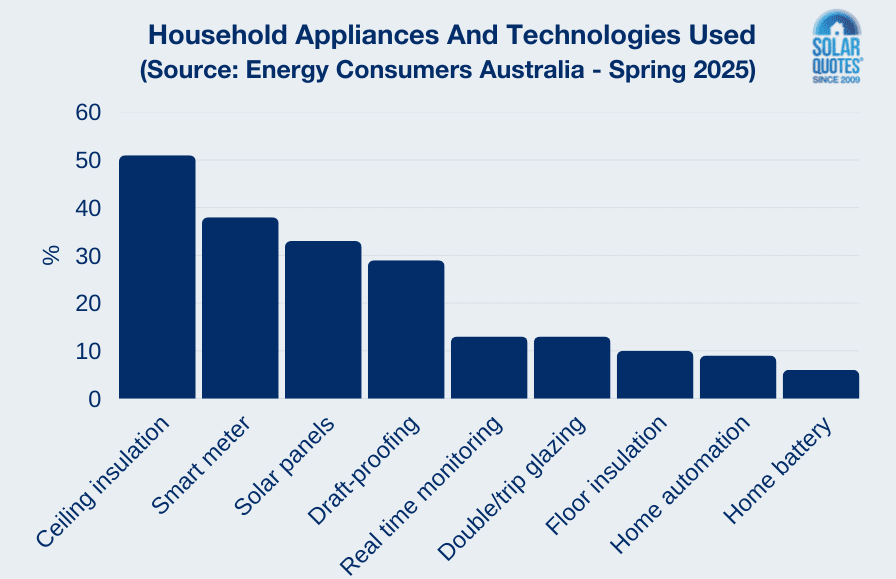
The survey found:
- 51% of respondent households have ceiling insulation.
- 38% have a smart meter.
- 33% installed solar panels (a further quarter were considering or researching installing a solar power system).
- 29% had implemented draft-proofing.
- 13% could monitor electricity use and costs in real time using an app or in-home display.
- 13% had double- or triple-glazed windows.
- 10% had floor insulation.
- 9% implemented home automation.
- 6% had installed a home battery.
It will be interesting to see what the home battery uptake growth is in a year from now given the very generous incentives under the Federal Government’s Cheaper Home Batteries Program that formally launched in July this year. Last year, the December 2024 ECA survey report indicated 4% of respondents had installed a battery.
Vehicles
Per household and on average, 1.7 vehicles were owned among respondents. Most of these are Internal Combustion Engine (ICE) petrol- or diesel-powered vehicles; followed by hybrids (10%), fully electric (4%) and plug-in hybrid (PHEV: 3%) vehicles.
Home Gas Use
56% had piped gas at home, which was most common in Victoria, Western Australia, the ACT and South Australia. A further 9% have gas bottles delivered; which was more prevalent in Queensland and the Northern Territory.
While mains electricity supply may be pricey, fueling a home with gas is even more so. Learn how home electrification and ditching gas will help save you money (whether or not you have solar panels) and protect your family’s health.
There’s plenty more detail in the ECA December 2025 Consumer Energy Report Card. The topline report and data covering Spring 2025 along with previous reports can be accessed here.
 About Michael Bloch
 RSS - Posts




I feel very lucky and privileged to have solar and battery – own my own house that is well setup for solar. My electricity bills are near zero or in credit. And I appreciate all the subsidies that have enabled that for me.
We really need to do something for the substantial majority who can’t do that – renters, apartments or those who just can’t afford it – so unjust and unfair.
Maybe community solar and battery farms that people could buy into? Happy for my taxes to subside such things, time to pay back.
Are you able to say just what it cost to zero the bill and do you consider yourself ‘off grid’
Lindsay,
This is great that you are happy and want to return something to the renting community.
Can I suggest buying a house, fit it with solar and battery and rent it out.
You tenants will thank you and you’ll fulfiil you wish, however this will not work as a business but rather as a charity. Good luck!
Let’s be real. The only reason the energy transition is proving so expensive for customers is that the public *is* a ‘customer’ of energy. We privatised energy, and now the public has to pay for the renewables transition mostly out of their own pockets. Governments could take the lead and fund this transition themselves, shielding the public from the sting of most of the cost. But decades of nonsense about public debt make that an impossible sell now, even if the elected pollies think about that option.
Even where we install solar and batteries to escape the worst of the cost personally it’s still our money being called upon to do a lot of the heavy lifting. Thankfully in Oz it’s well subsidised too, which helps, but the entire transition should have been mostly government-led and funded.
SA Power Networks (51% HK ownership) have been allowed by the Australian Energy Regulator (AER) to pull $A 1B a year out of the SA economy a year over the next five years under the premise of ‘network modernisation’. So much for being a market economy when you have a natural monopoly (polls and wires)
Hi David,
The Liberals deliberately cancelled the NSW interconnector 25 years ago because it meant ETSA was less competitive and they could get a higher sticker price for flogging it off.
They absolutely knew that the private owner would then be in a monopoly position, able to gouge consumers and indeed were fully expecting it because they got more money in the sale.
How is this not treason?
Worst case scenario it was Liberals favouring a private company and facilitating a monopoly market.
Treason: violation or betrayal of the allegiance that a person owes his sovereign or his country, esp by attempting to overthrow the government; high treason
C13: from Old French traïson, from Latin trāditiō a handing over; see tradition, traditor]
Collins English Dictionary – Complete and Unabridged, 12th Edition 2014
For treason you’d need to look at Labor-CCP relations, not economic decisions you disagree with.
Hi John,
Treason: violation or betrayal of the allegiance that a person owes his his country
Example:
In 2003, retail prices jumped 28% as regulation gave way to profit taking. AGL’s standard offers rising ~24% on average and some up to 40%
2007-2012 increases averaged 10%+ yearly, dominated by network costs.
https://www.theguardian.com/australia-news/2016/jul/27/acccs-rod-sims-says-privatisations-severely-damaging-economy
https://www.adelaidenow.com.au/news/south-australia/sa-power-networks-owned-by-billionaire-li-kashing-makes-four-times-more-profit-out-of-us-than-its-uk-group/news-story/d00954c420ee1173a7549360eac879b7
That’s $60-80Million funnelled out to Singapore via tax free Bahamas every year
It would be comical if it wasn’t sad, that blind party loyalty spouts vague baseless whataboutism in the face of hard facts.
We’ve been *shafted* by our elected representatives.
“Mandatory enforceable standards for landlords”?
Sure, if the government is going to pay for it!
So, ECA wants landlods to solve a problem old as Australia, which is magically transform tents in houses!
Why are the electricity prices so high in a country so plentiful of sunshine?
Well maybe our inept goverments have the answer.
“Renters are going to keep living in homes that are too hot in summer, too cold in winter, and very expensive to run”
Isn’t 80% of population in this category, renters or owners?
Yes, owners can do something about it, and renters not, but many renters want to be renters, because are complacent.
“Energy efficiency is the foundation of a fair, liveable, affordable energy future. That’s why we’re calling for nationally consistent energy efficiency standards for rental properties.”
We have energy efficiency standards, but the are too weak and apply to new houses, anyway.
ECA should lobby the government to pay for making all older homes more energy efficient.
That ceiling insulation stat is shameful.
The first thing we did when we moved into our home in 1981.
That should be a minimum requirement for all rental houses and units with a roofspace.
The single-glazed home I built in the Dandenongs nearly 40 years ago had ceiling insulation, but a 5m cathedral ceiling. Eight to ten tonnes of firewood p.a. were not enough to keep the massive lounge warm in winter. Now in smaller digs with double glazing and lower 2.7m highly insulated ceiling, a tiny 700W of RCAC keeps things snug – powered by rooftop photons alone. Not a penny of ongoing cost.This new 7-stars stuff is magic. Should have been mandatory a generation ago, but must be mandated for rentals pronto – not least for old folk whose life expectancy is reduced by temperature extremes.
Maybe a 30% rebate for double glazing, to help make it happen? Single glazing insulates about as well as an open hole in the wall, if you don’t fit heavy floor-length curtains, pelmets, and side containment.
It is unavoidable. The grid needs it too. Do it now to start the savings now.
How much Christmas expenditure is still giving value by New year, anyway?
Why not mandate external blinds\storm shutters then? That’s another layer of shade and\or insulation depending on placement and fit.
Curtains, pelmets, and probably side containment have the limitation they’re dust catchers, plus heavy and awkward to clean. Fine if you’re fit, healthy, and energetic, but if you’re not …
And while double glazing is a decent idea, that assumes the companies and experts selling the products actually support this rather than shrug and simply mumble single glazing is basically the same and double.
People might think about changing providers more if they knew the provider kept their prices the same for say a year, it’s a pain in the arse changing all the time !!
Change frequently and often to get either sign up bonus and or your current provider retention give you discounts to come back. This applies to ISP’s keep churning for signup sweet deals.
Bob, you’ve talked me into it I’ll have a look around in the new year when current deals finish !!
Thanks 👍
Folk are concerned about prices, but how many actually shop around or negotiate for better prices?
For myself, general usage charges are slightly up, but daily supply charges are down. A slight increase overall, but absolutely not a jump. And with a flat 10c/kWh FiT, I’m hoping things stay that way!!! Should things end, the new plan options will be painful!!! : – C
Interestingly enough I recently saw a comment on a skeptic site which claimed that an SA battery can pay for itself in as little as 3 years! (I’m looking at about 15+ years currently) Not sure that’s true – SQ would likely need to run the numbers, but with power being a third more expensive than anywhere else in Australia, and FiTs down around the 2c/kWh mark, it’s plausible!
The heating of the atmosphere allows storage of the latent heat of vapourisation in the atmosphere and that energy powers the storms and contra weather that we don’t like.
My solution would be to minimize transmission of energy on the Grid, put SOLAR PV panels where the load is.
This seems to be our only way to reduce climate change.
Keep SOLAR Systems OFF-GRID wherever possible.
We have very limited choice for shopping around in WA. No much opportunity to make savings except maybe choosing different tariffs. But trying to figure out whether a different tariff will save you money is almost impossible.