
 Ten per cent of new cars sold in Australia are now plug-in EVs. Home battery sales are going through the roof. That means a growing number of homes now have both. Or soon will.
And yet, hardly anyone thinks about how the two will work together.
That is a shame. Because if you do not plan it, the default behaviour is simple:
Whenever you charge your car, any charging power required above your instantaneous solar output will come from your home battery1. Most charging is after sunset, and your car battery is much larger than your home battery, so your home battery simply empties into your car.
Your house is left to buy from the grid overnight and some of what you save on petrol, you quietly lose on electricity.
Let’s walk through your choices when adding a home battery to an EV-driving home:
Option 1: Don’t discuss an EV charging strategy with the battery installer
Whenever you plug the EV in, your 7 kW single-phase charger kicks in. Or worse, your (up to) 22 kW three-phase charger.
Your home battery sees a big load, says “righto,” and empties itself into the car. By supper time your battery is flat.
This only makes sense if:
- You have a very big battery. Think 40 kWh or more.
- It has enough power output in kilowatts to run the house and charge the car at the same time.
- Or you drive so little each day that you are only topping up a few kilowatt-hours from a trickle charger.2
Option 2: Ask the installer to wire the EV Charger upstream of the Battery
This is the boring, simple, rational option.
You wire the EV charger so it sits before the battery in the switchboard.
Result:
- The EV can never charge from the home battery.
- It can only charge from the grid or live solar.
For many households, this makes the most sense because:
- Some retailers offer “3 free hours” of grid power in the middle of the day.
- Some EV plans offer charging at 8 cents per kWh overnight.
- If grid power is cheap at the right times, or you only charge from solar, this option wins.
Option 3: Get an EV Charger That Talks to Your Battery
When your EV charger and battery inverter talk to each other you can choose whether to charge your car from the battery or the grid.
In theory, all this requires is an Open Charge Point Protocol (OCPP) compatible EV charger.
In reality OCPP between brands is a headache, so the practical answer today is usually to buy the same brand EV charger as your battery.
A Special Word for Tesla Owners
If you have:
- A Tesla car
- A Tesla Powerwall
Everything works beautifully. But there is a catch. Tesla controls charging by sending commands to the car, not the wall charger3. So when you buy a non-Tesla EV later, all that clever integration disappears.
If you plan to have a mixed-brand garage, you may want to think carefully before locking yourself fully into the Tesla ecosystem for both battery and family fleet.
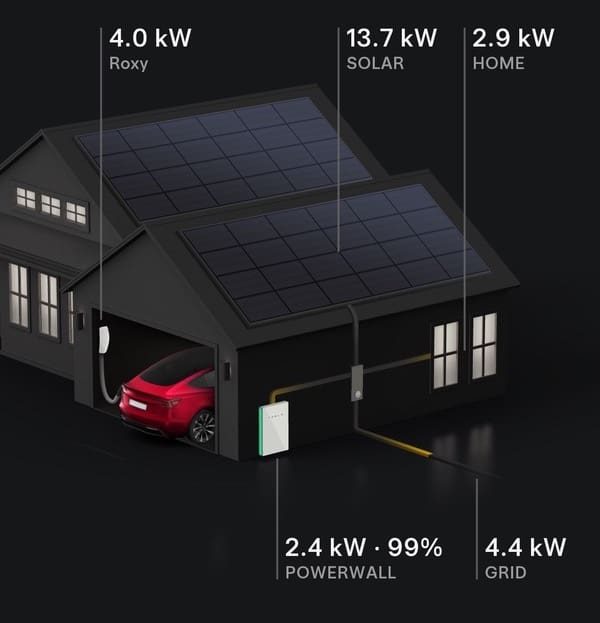
Tesla EVs and home batteries play nicely with each other, but bringing a different brand of car into the mix can cause headaches.
The Bigger Point
EVs and home batteries are both big purchases. Each makes sense on its own. But together, they are a system. If you do not design that system, it will design itself. And it might not work how you want it to.
Before you sign off on your next battery quote, ask one simple question:
“How will this work with my EV?”
Phase Shift is a weekly opinion column by SolarQuotes founder Finn Peacock. Subscribe to SolarQuotes’ free newsletter to get it emailed to your inbox each week along with our other home electrification coverage.
 About Finn Peacock
 RSS - Posts






One of the reasons I stuck with the Tesla ecosystem. If somebody does only low kms, ‘top up’ charging from the battery probably isn’t harmful, to the battery?
You can use third party apps to help control this? You’ve written about it before here too, apps like NetZero and its automations, and others? I’ve played with NetZero before just for fun and found it works, though probably not the approach suggested for people who don’t want to have to fiddle with the tech side.
Hi Finn, as usual, a relevant and useful discussion.
Are there any negatives in your option 2?
My Zappi is wired with all household loads to be powered by a 10Kw Sungrow hybrid and 19.2kwh battery, now at 96% state of health. So, along with the hidden reserve of 5% and usual 5% for backup, that leaves a notional 16.5kwh of battery to power home loads.
My initial installation was such that the power to the ev was being registered as export to grid and took 2 installers and 4 hours to convince them that wasnt right.
At the time I didnt think of wiring it between battery and inverter and am still not sure about it, not being as technical knowledgeable as some, but enough to get into trouble.
My provider is amber. I have never had success with its AmberforEvs system. So, am manually controlling zappi, mostly via the app, and have in car schedule to shut down charging at 3.30pm. But have suffered the charging FROM battery a few times.
Thanks again.
I am in the Solar Edge ecosystem, so has a great app so can tell it not to discharge the battery to the EV . So every morning the battery fills from Solar only and then charges the EV . I am on Amber so can decide wether to use the grid( rarely) depending on price per KWh on cloudy days and when If I need the EV for driving use.
Is this using a SolarEdge One (new) or Home (older) EV charger, or just trickle charging?
Had the Inverter/ Charger installed first with Solar Panels then 1 year later with rebate took the upgraded offer from SolarEdge with 9.7 Battery with new Inverter plus home backup. Charges the EV about 7kwh from grid plus available Solar or can charge with Solar only. , which is what I normally charge with during the day. As I am retired this suits me fine. Again the SE App can control all the options I need.
Solar system ecosystems seem to be getting ignored and I went with SolarEdge for the same reason. My inverter talks to my batteries which will also soon talk to my EV charger once I get the new SolarEdge charger installed. I can then control everything through one single app. You beauty.
Long term netzero & tesla pw owner: netzero automation ‘preserves pw charge’ & stops the car from draining the battery.
I was doing that for a while, but realised a combination of Charge on Solar (with the appropriate minimum on the slider to control how much can come from other sources), and TOU rather than self-powered, stopped the car ever drawing from the battery,
Charging your car from the home battery is the worst thing you can do. Charging and discharging batteries isn’t 100% efficient, you don’t get all of the energy you put in, or take out stored. You’re using one of the admittedly high numbers of charge discharge cycles of your home battery. My technique, with Amber, is to manually preserve battery charge, and charge car from the grid when it’s low, or better, negative.
You can stick with Tesla and hope they don’t go bust. I bought their batteries when I could control them locally, but they took that away to force us to use their VPP, or a VPP that used (and paid for) their API. Personally, I wouldn’t trust Tesla as far as I could throw them, and I could throw them at all. And you have to hope they don;t go bust, or just decide they’re tired of the consumer market and turn off the API (like JuiceBox did in the USA).
Nope, I’ll never buy another battery that’s locked in. If I replace the Teslas, it will be with Victron devices and standalone standard 48V batteries, none of which needs an internet connection to manage,
Tesla’s energy business is very healthy.
Which EV are you using please and does the system conform to Open Charge Point Protocol (OCPP) ? thanks.
Tesla Model 3 (2026 version) long range AWD.
Tesla’s wall charger isn’t OCPP, the car controls charging I believe.
Hi Nick,
Tesla’s wall charger is OCPP compliant if you got one recently.
They can’t sell them in SA otherwise.
Ah, thanks for the update Anthony. Mine is a Gen 3, installed about a year ago, any way if I can check if it is OCPP compliant? Not that I need that right now, but I might down the track. Cheers
Hi Nick,
I’m not sure how to check but at the time of writing, Tesla were assuring us and the Department of Mines & Energy that they had OCPP 1.6j in the bag, however they weren’t announcing anything until the OCPP 2.0 software was done.
Tesla has committed to adding OCPP 1.6 (or higher) support via a future over-the-air (OTA) software update. This assurance was given to the South Australian government to comply with new regulations requiring OCPP compatibility for all newly installed EV supply equipment (EVSE) from July 1, 2024.
https://web.archive.org/web/20230328033037/https://openchargealliance.org/certification/ocpp-16-certification/
And they actually believed them?
Oh Andrew,
It’s not like Tesla ha e ever been creative with their aspirations and delivery timelines in the past…
:S
are starcharge offering Open Charge Point Protocol for Tesla cars in Australia ? https://www.starcharge.com/
https://x.com/i/grok?conversation=2025723639669399603
Good advice, the reality for me is i have solar and a battery already, long before i will have an EV.
So it will definitely be a retro fit for the vehicle charging when it occurs, hopefully the technology available at that time wont be a challenge to integrate with my current system.
But who knows, perhaps public charging will be so fast and cheap by then it will be easy enough to just go to the servo same as i currently do for my ice vehicles, without worrying about a home charging setup.
Public charging will never EVER be anywhere near as cheap and convenient as home charging, especially when you add solar to the mix.
ie: There’s nothing more convenient then charging at home while the sun shines, or while you sleep.
A good example: our efficient diesel SUV costs around seventy to eighty dollars to do a 400klm round trip. In our Model 3, the same trip uses about 28kWh each way, and is very well within battery range for the complete return trip, so 56 kWh is around $4.50 on night rate (8c/kWh), or even less if we can charge from solar (lost feed in tariff). Even at our normal off peak rate (24c/kWh), it’s only about $13.50.
Is it any wonder that we infinitely prefer driving the Tesla? (It’s also more comfortable and does almost all of the driving thanks to autopilot.)
yeah, the last line was more tongue in cheek than anything else 🙂
The caveat is possibly what happens to the cheap EV overnight rates when coal eventually exits. I’m guessing they will probably disappear because big batteries have no incentive to sell you power at or below cost, unlike coal. Maybe daytime Ev charging away from home might become cheap enough to make it viable when there’s enough solar being generated during the day at basically zero marginal cost. Maybe
-A good example: our efficient diesel SUV costs around seventy to eighty
dollars to do a 400klm round trip.
$80/4 = $20.00 per 100 km – deisel SUV
– In our Model 3, the same trip uses about 28kWh each way,
56 kWh / 4 = 14 kWh per 100 km
14 kWh x $0.08/ kWh = $1.12 night rate
14 kWh x $0.24 / kWh = $ 3.36 off peak rate
-In my case 2 litre turbo diesel SUV – 10 years old, still accelerates up hill
4.2 l per 100 km on the long runs
400 km / 4.21 =. 0.95 l x $1.75 per litre = $1.66
Comparable with the Tesla Model 3 on the night rate.
What sort of diesel SUV are you driving ?
“In my case 2 litre turbo diesel SUV – 10 years old, still accelerates up hill
4.2 l per 100 km on the long runs
400 km / 4.21 =. 0.95 l x $1.75 per litre = $1.66”
I’m not sure you’ve got the maths right with this.
I think it should be:
400 km x 4.21 = 16.84 x $1.75 per litre = $29.47
yes you are right- over zealous ! Sorry.
$29.47 is very cheap for 400km using diesel
Our efficient Toyota hybrid can do a 400 km Alberta winter trip on 18 litres, even in -20 C weather. So $40 altogether, to get there and back again.
Our Model 3 in cold weather rode like the only suspension was tire sidewall flex, and used over 200 wh per km if you wanted to not have your breath freeze onto the inside of the windshield. Plus about 10 KWh extra for each long stop, to warm the battery.
The 67 cent per KWh electricity rate for Superchargers has now dropped to 55 cents, so assuming the first 40 KWh is from home at 23 cents per: $9.20 for the first 200 km, $66 for the next 600 km, plus another $5.50 to thaw out the car. Realistically it would cost double.
Advantage: ICE, unfortunately. And my wife won’t move to Australia because of venemous things. Although being eaten slowly, alive, by a grizzly is probably painful too.
Hi Randy,
Perhaps show your wife this cute little bugger.
Contrary to what we tell the Yanks, drop bears don’t fall from the trees to eat you.
Option 3 B get a Zappi charger, with the option to only use ‘spare’ solar power.
Ours uses this option, and doesn’t use grid power, or battery power only solar power after the battery and everything else is accommodated
The option shows as eco,eco,+
There are other options – but why would you
Result = happiness
Going to have to agree with this one. Zappi and a whole stack of CT clamps *installed by someone skilled* means I can charge off excess solar with no headaches.
I’m Patrick Griffin
A retired power industry engineer with 44 industrial years behind me and now 9 years retired. Nine months ago added 8kW solar to my 14 year old 2.5Kw. Was planning a battery but only after monitoring for 12 months. I drive Uber to keep me busy but within two weeks of the solar upgrade my ols Outlander was written off.
Do I need a battery? Suddenly it was a no brainer. New MG ZSEV, Uber driving from 5 to 9 am, using typically only 40% battery. Home for breakfast, plug the EV in changing for free, or very little. Till date my electricity bills increased by $100 per month but saving close to $500 on petrol. My EV charger is semi smart, does not talk to my solar but I can adjust the charging rate from 0.5 to 7kW via the app. Being at home I enjoy my personal interaction with my solar system, the charger and EV to get the best out of it. I have wood burning for winter heating that I supplement with Heat Pumps so have kept old tariffs for now. Watch this space.
I just got a battery, and I have come to the same conclusion about the Zappi. We added solar panels and a second inverter with the battery, and the new inverter does not know about the Zappi. So, “Eco+” (solar only) no longer works. But “Eco” (minimize grid use) seems to work fine and does not use the grid. As long as we are exporting some energy to the grid, the Zappi seems able to grab it and send it to the car. It only seems to charge at about 7KwH max though, but that does not worry me as I can just leave it plugged in.
I realise you’re not a fan, but we have a Myenergi Zappi EVSE wired downstream of our Tesla Powerwall (charging an Ioniq 5). We mostly charge solar only using “Eco” mode, which is smart enough to know not to use battery power (despite the sad lack of OCCP).
For an 80-100% early morning top up prior to a road trip we use “Fast” and pull power from the Powerwall. On the rare occasion that we want to charge on “Fast” without draining the battery, we can set the battery reserve to its current charge level. A little clunky, but rarely needed.
Hi David,
Sounds like a good workaround. Thanks for the feedback.
Thats interesting. My zappi does take charge from battery in eco. But mine is wired as if just another household loads.
You can change the settings. If you dig into them, you will find there is a setting that controls whether it will drain the battery in Eco or Eco+. That assumes your installer was competent and put the right CTs in the right places (and that the house solar/battery went in before the Zappi of course). If it’s not right it’s easy for someone to add the CTs and they’re like $40 each.
Hi Finn, as usual, a relevant and useful discussion.
Are there any negatives in your option 2?
My Zappi is wired with all household loads to be powered by a 10Kw Sungrow hybrid and 19.2kwh battery, now at 96% state of health. So, along with the hidden reserve of 5% and usual 5% for backup, that leaves a notional 16.5kwh of battery to power home loads.
My initial installation was such that the power to the ev was being registered as export to grid and took 2 installers and 4 hours to convince them that wasnt right.
At the time I didnt think of wiring it between battery and inverter and am still not sure about it, not being as technical knowledgeable as some, but enough to get into trouble.
My provider is amber. I have never had success with its AmberforEvs system. So, am manually controlling zappi, mostly via the app, and have in car schedule to shut down charging at 3.30pm. But have suffered the charging FROM battery a few times.
Thanks again.
Thanks for the tip David. Very good idea to use the minimum back up SoC% to maintain house battery at current level, and Eco on the Zappi,. This would allow further charging of House battery as excess solar permits.
If we want to charge both, we could wind down the output of the Zappi to say 4kw to jncrease thr excess solar that can charge battery and other house loads. I try to remember to have incar schedule stop charging at 3.30pm in summer too.
My Zappi still sometimes takes power from the battery even in Eco mode though.
Hi – to stop the car taking the extra power use ‘eco, eco +’ not just eco – it only shows on the app – the display on the device only shows eco
I have been setting the Powerwall reserve to stop the battery drain for so time now. Unfortunately Tesla recently did a software change that doesn’t allow any reserve between 80 and 100% to be set. It’s a bit of a pain.
We have opted for your Option 2. We have a Wallbox charger. Its app allows me to adjust the charging current. So when the Powerwall 2 battery reaches 100% and the system starts exporting to the grid I can start charging the BEV at near the exported value. I have been trying to get Tesla to improve their app to notify me when the exported power exceeds a user-selected amount so I can manually start charging. So far no success!
My charging strategy for a PHEV is different.It charges from a 10A outlet at 2.2kW and only has a capacity of 10kWh. If I know that it will be a sunny afternoon and the PW2 will likely be at 100% by mid-afternoon then I don’t mind charging the car from the solar so the PW2 only gets the scraps (and sometimes ends up charging the car if solar generation briefly drops). The car will usually be fully charged after a few hours and the PW2 can then fully charge from solar, ready for the evening demand.
Of course it would be great if I could automate these strategies
I use a 15A (3.5kW) outlet to charge my EV and have a 30kWh home battery. It’s simple to charge directly from solar, and when total house load (including EV) exceeds solar production, the battery automatically covers the shortfall. This setup has worked very well for me.
On cloudy days, I just manage usage to avoid over-depleting the battery.
On rainy days, when solar generation isn’t sufficient to charge the EV, I switch to the Origin 8c EV plan. To ensure I’m using grid power rather than the home battery, I set the battery’s state of charge (SOC) to a specific minimum level. Once the battery reaches that level, the system draws all additional electricity from the grid.
Yes, this may mean I use a small amount of grid power (e.g., around 2kWh) overnight for household loads, but that only happens during extended periods of poor weather when solar isn’t sufficient to charge the car.
Flat tack solar charging works superbly here. In cloudy weather, the battery supplies the 7.2 kW level-2 BEV charging as a cloud passes, then the arrays give around 15 kW for EV + battery charge in sunny patches. That’s quicker than “solar only” EV charging, as it’s full whack till done.
The house battery can then catch up later, while I’m zooming down the highway. The range gain is a major mobility benefit, and an extra small part-cycle on the house battery for cloud fill is piffle.
With 46 kWh house battery, 51 kWh EV battery here, the system is over balanced, and even a very modest 20 kWh house battery can effortlessly do the same.
It is only 1900’s backward thinking which clings to tiny batteries after gaining a BEV – it saves $3k/18,000 km in fuel – that pays for a bigger battery after rebate, so that ends up free!
Rooftop energy is free – bloody use it, please! A full roof, fat battery & ample inverter (or DC charger) effortlessly power free free free BEV mobility.
Just back from a 65 km trip in the little MG4 BEV, towing a light trailer with 400 kg of steel fencing pickets, towing mode engaged. BEV SoC down from 70% to 41% – it’ll be back up to 100% before sundown.
Charging the BEV + electric excavator is 10.7 kW, add HWS and two aircons for around 14 kW of steady load, and a 63A main switch is close to its limit.
The little excavator levelled a tonne of abandoned wombat diggings, and cleared 20 m² of 2m high Burgan bushes on a fenceline, roots & all, in 90 min yesterday – all on rooftop photons, 13% SoC used. The electric transition is painfully slow, but a start has been made.
Driving past petrol stations showed 1 kWh worth $1.11 street FiT today. Every kWh put through my house battery costs about 5.8c in cycle life, so there’s still $1.04 profit on cycling 1 kWh through the house battery to the car, during clouds or overcast. Who cares about “solar only” BEV charging, if charging early enough in the day for later house battery top-up?
Hi Neil, I ordered an extra CT with the Zappi that monitors power from the battery, maybe you don’t have this.
Using OCPP would technically make a lot of sense, but what if its already used for “Dyncamic EVSE” (Queensland)? Then the OCPP interface is already used and battery integration depends in that case on whether the SEP2 gateway provider will support your battery and can interface to it. I can see a lot of read blocks here and walled gardens.
only makes sense if charging is easily bi-directional, else the one you want to use will no doubt be depleted when say it was suddenly critical to use one or the other. Versatility is the key, so therefore is monitoring and control, if you add vpp to that you have a trifector of tug of war, so no thanks to making a few cents from your $100k+ investment. Although fascinating when you get to combine that with your own solar panels and play optimisation of with your planned day to day usage of the entire system particular over a number of years of stable and reliable use. (fingers crossed 🙂 Realistically I’d stand back with my solar panels and home battery and wait before diving in with adding an ev into the mix and expect not to be disappointed, NO doubt some ai’s will be quickly offered to learn what you do with your stuff and mange it for you for some $$ subscription (& loss of control, go away government its my system behind my meter so i decide who gets what)..
Option 4 – decouple the battery from self consumption mode and manage the battery intelligently to charge when prices are low or solar is available and charge the car when prices are low from the grid. To do this use smartshift or energy autopilot or Home Assistant with EMHASS etc and get your energy costs down to their lowest possible.
These are systems that use Model Predictive Control (MPC) which is a machine learning algorithm that can calculate the most efficient optimisation given forecast data over a limited time horizon (like 24 hours).
At least I think they use MPC. I know EMHASS does.
Every home will have one of these eventually so get in early and understand them. You don’t have to understand machine learning AI systems but it helps to understand arbitrage.
sledgehammer, meet nut
I used this today David and worked a treat. Battery limped to 100% in the rain and I set minimum SoC to 95%, and set Zappi to Eco charge, with pool pump also running. This was working fine with a trickle to grid. Then clouds got thicker, battery dropped to the set reserve, zappi stopped and was drawing minimal amount from grid for the homeloads.
I love a good work around, and this is one.
Cheers.
I have Home Assistant and can set the reserved state of charge (SOC) to 95%, which then prevents the battery from being drained. The EV and battery charges during the super off-peak period. Then reset the SOC to use the battery when the tariff changes. Works every time.
I gor a sigenergy DC charger. As Finn suggests it fully integrates with the rest of the stack and i can choose to charge from AC,DC,via solar or DC via Battery. I can also tell it to take power from the car to supplement the house battery. Given the car is PHEV if really stuck for power the car can turn on the petrol engine and generate power…
I think that covers every possible current option you could ever want
Andy,
Does your DC charging also partly work around the unreasonable (Victorian) 10 kW/phase inverter limit, where a 7 kW level-2 AC BEV charger leaves only 3 kW for the house, but a DC charger can operate independently of sustained 10 kW AC supply to the house? If it can BEV DC charge at 11 kW, that’s 21 kW self-consumption, panels & battery permitting. What does yours do?
As households mature from tiny partial prosumers into capable performers, self-consumption capability must escalate rapidly, or they’ll go off-grid. With 60% of Aussie car sales being BEVs in 2030 (Source: BNEF), a 10 kW self-consumption limit is laughably inadequate – entirely unfit for purpose.
BEVs are becoming cheaper than ICE now, 2030 no comparison, and paying $3k cashback p.a. in fuel savings = $30k cashback in 10 years! That buys a lot of solar: Must be on-grid powerful (>20 kW) or we all go off-grid folks!: “Goodbye & thanks for all the fish.”
Is AER awake? Should we buy them a coffee?
Yes Eric the Sigenergy DC charger with a 10kW inverter can support charging EV at 25kW and also provide 10kW to the house load if the sun is out with 20kW PV attached and have a 40kWh battery.
For me the cost to upgrade to 3P offsets the extra cost of a DC charger compared with AC charger.
Thanks, Luke.
Three phase would have tempted me here, off-grid, but my machines are single phase, so it wasn’t viable here either. I think you’ve found the secret sauce – circumventing the reprehensible indefensible 10 kW single phase power limit is a noble achievement, which all would benefit from emulating. (If not now, then definitely around 2030, when so many will have a BEV.)
Just in from an hour on the little electric excavator, clearing 2m high weed bushes from a fenceline – all rooftop solar powered – zero CO₂ emissions. The machine is quieter, too a delight to operate. Safer on a fire ban day, as well, I figure.
Thumbs up, wherz the button 4 that (?)
UPS ? Just joking that is most bases, does it revert back ok when systems become operational again after some outage / failure ?
Is there an option 4? I’m hoping to manage all this through my home assistant setup. In today’s age it looks like everything that is a big consumer or producer of electricity can all be controlled via API. My hope is to set up some rules that state my EV charger should only consume energy when my home energy setup is trying to send to the grid. Or when there is a free power period.
Admittedly this is a pretty heavy solution to implement, but it has soo many advantages
Catch Power device can be set up to use all the excess solar not being used in the home, or going into the battery . . . uses such as a storage HWS, EV charger, pool pumps, underfloor heating etc.
As long as you have decent solar matched to meet your battery needs for the home in the evening, for HW, EV, other, there will be the extra at various times most days as cloud passes, solar production ebbs and rises.
Evcc.io has what you’re asking for. I highly recommend using home assistant to manage the battery, and evcc to manage EV charging. This is the best option for the tech savvy.
Agree. It’s worth putting the time into creating set and forget home automation, especially if off-grid. If one isn’t tech-confident, the current crop of AI services is quite capable of designing and implementing a solution using open source and custom integration.
No, Finn, it’s not bringing a sledgehammer to a nut feast.
With subscription ? Maybe not yet, but who knows when ? Api’s change not necessarily the interface but more what you get, can get, throttling etc, buffered data not necessarily real time, but when that’s all you got, no choice & just try the ride and see if it works for you. Ensures no privacy, easily falsified, replayed be wary of what you are given and giving up to achieve your aims. Keep logs (timestamped) and examine them periodically.
I can confirm going with one brand (SolarEdge in our case) works great. Our car generally exclusively charges from excess solar. When we add the SolarEdge battery, that won’t change.
With an AC Coupled battery placing the charger “before” the battery on the switchboard doesn’t have an effect.
I use Home Assistant to co-ordinate my solar priduction, Alpha ESS and my car charger.
If the ESS is full AND we’re exporting 1.6kW over and above the house load, then the car charger turns on.
If export drops below 1.6kW plus house load, then it turns off. If the ESS begins discharging, it turns off.
All seamlessly controlled without a thought.
Most days in summer I can get 10% top up from the granny charger using free solar power.
I also have a similar set of rules in Home Assistant for my 7kW charger. But in all honesty, since installation I’ve used it only a handful of times.
If you’re a little tech savvy and willing to learn a new system, this works a treat!
Does the HA integration require mobs/hardware installed or can this be done just with Raspberry Pi and software?
2 options for HA I feel: Go with HA hardware (bit costly, but easy), or use a s/h Intel NUC with a SSD drive: easy & cheap. You may need to clean & lube the fan & heatsink, but I have found this a reliable option for me. I run Linux + HA. Currently, I do not use Zigbee or Matter, but it is easy to add a dongle. If you are in SA or Vic, you can also potentially add a Rainforest Automation reader to get real time data directly off the consumer meter in real time.
My NUC sits behind my computer, on the network. All house monitoring done by an IoTaWatt monitor, & all generation data read from the inverters. I also control a ZJBeny OCPP EV charger.
Currently just installed a Deye battery, so working on the new integrations.
Hi Doug,
Sounds like you could write us an article on HA. (Hint hint)
Let us know how you find the Deye unit. They seem ok for a lightweight but suffer a little from menu organisation & nomenclature designed in a second language & then made engrish.
Students at the training center sometimes have a few stumbles commissioning.
My issue is I am not a programmer, so I adapt others work.
With the Deye, I have an RS485 dongle on order from South Africa.
Heinz seems to know what he is talking about, & his dongle is seen as a web page & allows full control of the Deye inverter.
Because my setup is so diverse, I will need to adapt his HA setup to my needs & integrate it with my Victron & Solaredge + ZJBeny OCPP ev charger.
Happy to write an article after everything is working. I will let you know how the Dongle goes for a start. If it works as planned it should be a good addition to the system. One can use the Deye wifi dongle, but apparently there is less control available:I like my control to be local & immediate, not via a cloud. The wifi dongle will remain, but mainly for Deye monitoring.
Thanks Doug, I will look into this further to see if I can adopt something similar for my Dyness Powerbox G2 with Solis Hybrid inverter.
Surprisingly SQ doesn’t seem to cover Dyness/Deye battery in their articles, we must be in a minority.
Here’s our Dyness review
Hi Max,
Your review don’t seem to cover their latest Powerbox G2 models that are designed to be wall mounted like Tesla batteries and also have an inbuilt fire suppression like Sigenergy. I will appreciate an update on the review and happy to assist if needed as I have been using them for the past 4 months
No mods required. You could run HA on a NUC, NAS (On a virtual drive), raspberry pi etc..
The software inside HA for Alpha ESS talks to the Alpha Cloud, so there’s a little delay in receiving the data, but it doesn’t impact the desired outcome.
You’d need to be a little familiar with HA, HACS, sensor addresses and some very basic logic. But it’s doable and not that hard to learn.
Already have the EV charger outside of the house power (for both battery and solar), which is a bit of a pain, having to stop curtailment of Solar to allow excess to feed the charger, but not a big issue, just a small manual (ONLY) process.
I also have a Zappi and mostly use excess solar to charge my vehicle. However, when I need to use the “Fast” charging mode, I first go to my battery app and adjust the backup reserve to 90% so that it doesn’t drain my house battery.
I asked about doing your Option 2 (for my 15A socket in my garage) when recently getting my home battery installed and the electrician doing install said it wasn’t physically possibly in my switchboard. I wasn’t completely sure he’d understood what I was asking for so drew him a diagram and asked him again and he explained again that it wasn’t possible. The explanation he gave seemed to be a physical constraint in my switchboard that meant it couldn’t be wired up that way. Does this sound legit to those more knowledgeable here?
Size is often the issue my 5yr old Switch bd has 24slots for circuit breakers so have divided it in 2 with the first 12 slots Main switch Hot water, oven, Hot plates then 3 for Air cons,1 for 15A outlet, 1battery feed & 1 for inverter feed & thats all on one link bar as we are single phase. then separate link bar fed from battery to 3 gpo circuits 2 light circuits and 1 bed room Air con as battery can run 3.5kws and spike to 5. as we often hear size does matter & space is precious. hope that helps
I have a fox ess. I’m on OVO’s EV plan (6c midnight to 6AM). I use the mode scheduler in the fox app to force charge from grid at 100W between midnight and 6AM. This prevents it from discharging into the car.
I’ve been using a Tapo smart plug in my power point so I can program the hours my hybrid charges. It works fine to prevent my home battery draining but is it safe?
Sussan,
the issue with using a smart plug is that it uses more connections in the 240v circuit: even at 9-10A draw, things can get hot & melt. This used to happen to me in the days of Granny charger use: I melted 2 power outlets charging my Imiev. The other issue is the relay contacts will fail, possibly welding closed.
Any time one uses a plug-in EV charger, one must check the connections after abt 30 minutes, & check for any plugs getting warm. Even more critical at 15A draw. The problem with Australian plugs is that they can dislodge easily, giving an improper connection. Cheap plugs & leads exacerbate the problem.
Susan, like Doug said – it is very unsafe to use any smart plug to charge your EV as they are not designee to support draw of 10A continuously.
Please reconsider your options and best to consult with an electrician.
Hi Susan,
As others here mention, plug in gear can be a little hit and miss with continuous high loads, but if you have a good clean connection then the equipment must be designed to handle 10 amps.
I have experienced it myself but haven’t melted a cord or timer for a couple of years now.
https://www.solarquotes.com.au/blog/ev-charging-power-outlet/
Thanks for article – I found it a bit unclear but maybe my life is simpler than all this. We have electric Kia – solar panels and tesla battery and 3 hours free power in the middle of the day. We charge battery only from sunrise and from normal powerpoint wall. We are retired so don’t often need it charged overnight. Have no power bills, no fuel bills and no fancy highspeed charges. All works perfectly.
The use of a normal 240 v powerpoint seems to be rarely mentioned when talking about charging car batteries. Many people are still not aware that you can use a normal powerpoint. It works well and as far as I understand means less stress on you car battery and it will last longer.
Marilyn
I have stressed on these pages many times that the Granny chargers are OK, but the 240v plugs are an issue. When we used to charge our Imiev using a Granny charger, we had overheating issues at the power point, mainly caused by partial dislodgement from the socket. This can be fixed by using an industrial power point that has a screw ring retainer. Definitely recommended for consistent use (occasional use of ordinary power point is OK, but check for over-warm connections after 30 minutes use). If one is using 15A, it is even more imperitave to check for overheating.
Possibly Anthony could write an article about Granny chargers & their drawbacks? I really worry about plugs melting (which I have seen happening) due to the use of Granny chargers. Even 2400w bar heaters do not heat plugs as much as a 10A EV charger (Heaters usually have thermostats which reduce time at full power).
Hi Doug,
I’ve continued to charge iMievs & PHEVs with plug in chargers and haven’t had problems recently, but you’re right to exercise caution.
EV charging has no diversity, so the Mitsubishi EVSE with a 10A plug will actually draw 8A, for hours and hours on end, meaning a poor connection can heat up and stay hot, accelerating the degradation of plastics & possible weakening of metal contacts.
The article is here.
OK Thankyou for that info. I didn’t know they were called granny chargers. Maybe it’s ok to use when I’m a granny ) It has been on all day and no warmth anywhere on powerpoint, plug or line.
But thanks
Ill keep my eye on it.
mf
With Plug-in EV chargers (ie Granny Chargers!) that use a 10A or 15A normal powerpoint, I must stress that one should check all connection points for heat build-up after about 30 minutes. Any connection point should be no more than warm (ie warm to the touch, but nowhere near Ouch!).
Add to that one should not use Extension leads: very few have heavy enough cable (ie 2.5 sq mm conductors). These normally have 15A large Earth pin plugs & sockets, but not all 15A leads are 2.5mm sq!.
ps: they are called Granny chargers because they are slow: about 2 days to charge an average EV! (Imiev with 16Kw battery overnight, & when we had an Imiev, it was charged every night for 10 yrs +, & 140000 Kms when we sold it)
A timely article! We’re buying our first EV next week (3 year old MG ZS), and have a 5 kW Fronius Primo inverter (6.6 kW panels) and a Powerwall 2.
In country NSW we can switch to Globird to get 3 hours of free daytime power to charge the EV, but need to ensure it doesn’t drain the Powerwall. Scheduled charging can be set from in the car.
Was just talking this morning to the Powerwall installer (who also do Tesla and Fronius EV chargers) and they said the Powerwall would always see the car as a load. Have forwarded this article to them – hopefully it means we can get a Tesla charger instead of the Fronius which was quoted at $6500!
Am hoping for a reasonably priced solution that just works.
Hi Craney,
What did they quote you for $6500 exactly? That’s full bidirectional pricing in my mind.
Cheers
That was for a Fronius Flex Home 22 C6 22kW EV Charger + 7m Type 2 cable, Fronius Energy Monitor 3P and cabling for 15 m from the meter board.
One option is to set the PW2 backup reserve to 100% in the Tesla app during the free period. This’ll get it to fill up on free electrons also while your EV is charging.
We did this for a few years. First manually, then with the NetZero app, then finally with Home Assistant.
Fronius charger is good, but very expensive. For us, a 32A socket and a Tesla portable charger does everything we need.
I have a Fronius hybrid inverter, BYD batteries and Tesla Charger.
I use third-party software from ChargeHQ, which works with most combinations available in Australia. Configurable to achieve most things raised above, but does cost $7/month.
We come home and plug in the car. Only charges when the house battery is above 85% and solar is available. Battery buffers the system as cloud affects the output and the car charging is ramped up and down slowly, protecting solenoids etc with time delays. If the surplus is below 2Amps car stops charging. Of course you can remotely override at any time and manually take control.
A question on “Option 2″… does net metering solar mean that if 4 kW was being exported to the grid by a 5 kW inverter for an hour (let’s assume there’s another 1 kW of solar being used by the fridge, washing machine and tv), at the same time that 7 kW was being pulled in by the EV charger that had been installed as per Option 2, would the billing for that period of time be for the net difference, ie 3 kWh?
Or would the bill be for 7 kWh with a (much lower) export credit for 4 kWh?
I guess I’m not sure of the network topology, as far as the grid, electricity meter, inverter, battery and EV charger. And am just trying to understand what happens when charging outside of a free tariff period.
Craney,
Net Metering means one is billed for the difference between what is used, & what is generated (by solar, or battery export). If the system is 3 phase, the phases are totalled (meaning one may generate on one phase & draw on another) although these days one is better to use 3 phase batteries if one can, due to the ability to use 3 phase vehicle chargers for up to 22Kw charging. Not all properties can access 3 phase, unfortunately. This is the case at my rural property where we are on the end of a HV single phase line.
Come to South Australia – the highest per household solar panel penetration in the world running no baseload.
Tesla has committed to adding OCPP 1.6 (or higher) support via a future over-the-air (OTA) software update. This assurance was given to the South Australian government to comply with new regulations requiring OCPP compatibility for all newly installed EV supply equipment (EVSE) from July 1, 2024.
https://energymining.sa.gov.au/industry/hydrogen-and-renewable-energy/electric-vehicles/electric-vehicle-supply-equipment-evse-standards
https://x.com/i/grok?conversation=2025010559306150190
At 4.21 lit/100km, 400km is going to use 16.84 lit, which, at $1,75/lit comes to $29.40.
Thanks Finn for this article. When I installed my battery I asked the installer to place the car charger (an EvNex, already installed) UPSTREAM of the battery for exactly the reasons you outlined in your article (Option 2). The installer said he didn’t know how to do that, and I must admit, I couldn’t see how to do it either.
As it turns out, he left it wired into the house circuit, so it pulls from the house battery, and the grid since the NeoVolt inverter is only 5kW.
I have now set it up so it only charges between 11:00 and 2:00 on Globird, so I get the full 7kW without depleting the house battery. But I still don’t understand where you would wire it to be UPSTREAM? A schematic would be great.
I’ve also lost the ability to only route excess power to the car in the unlikely event that the house battery is already fully charged.
Hi David,
We wrote it up here :
https://www.solarquotes.com.au/blog/ev-draining-home-battery/
Cheers