

In a move widely wished and wildly anticipated, Tesla have finally answered the question all Powerwall 2 owners have been asking since August 2024: surely the new Powerwall 3 is compatible with the Powerwall 2? Well yes, it is now, almost.
Is Powerwall 3 Compatible With Powerwall 2?
With the appropriate firmware update drops, Powerwall 2 owners will be able to upgrade using Tesla’s latest Powerwall 3 battery technology.
Though I had some unofficial inkling from Tesla tech support in mid-February, I’m pleased to announce Tesla has made it official. A new PowerWall 3 will be able to talk to the Powerwall 2 if you already own one. If you’ve been thinking about adding more capacity, this really changes the equation.
So finally, they’ve done what they should have from the outset. This has been one of the biggest failures in product planning, only rivalled by Fronius releasing the Gen24 without them being able to talk to the dominant Snap-Inverter range. A problem I’m happy doesn’t exist anymore either.
We’ll probably see fewer used PW2 appearing in the classified adverts, but it’s really going to annoy those who have already jumped ship and quit their Tesla battery in favour of something bigger, and probably cheaper.
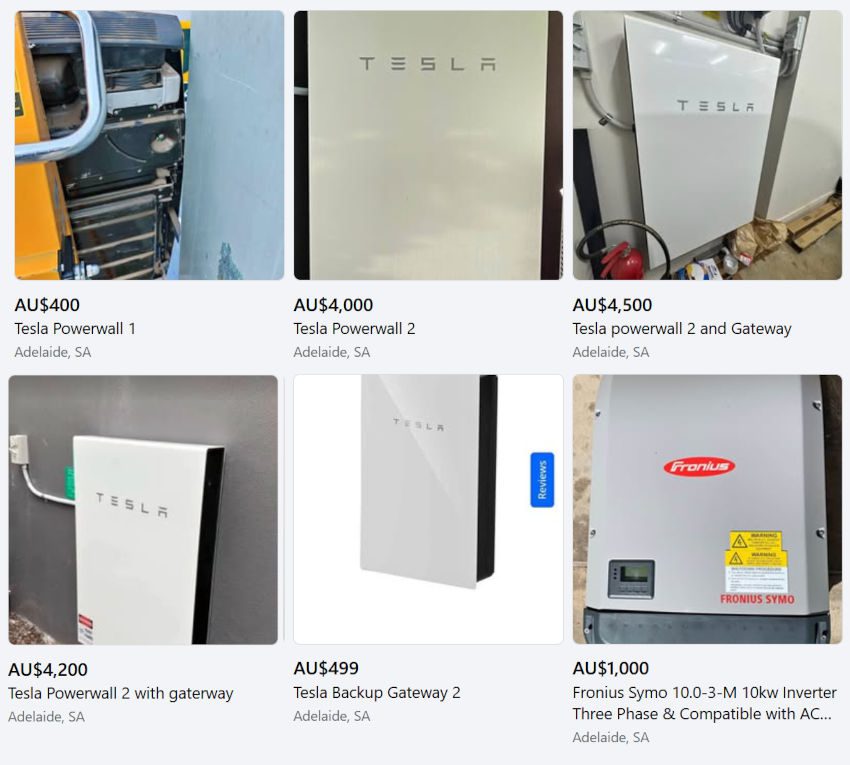
Used PW2 seem to raise about $4000 on the secondhand market – sadly the PW1 and Fronius shown have too many zeroes to sell.
Tesla Are Turning Up At Trade Shows
It’s amazing what a bit of competition will do for a company that was previously a market leader and a bit insular or standoffish to go with it. Prices have fallen, incentive deals are announced and new features and products are coming.
Tesla is celebrating the installation of a MILLION home batteries, so they’re offering the “Next Million Powerwalls” promo. Customers who order by March 31, 2026, (and install by September 30, 2026) will receive rebates up to:
- $750 for a Powerwall 3
- $1,500 for a single Powerwall 3 with an Expansion Pack
- It could also be 2x Expansion packs for $1500
This is in addition to the Cheaper Home Batteries Program incentive of $3,650 for one PW3 or $5,450 for a PW3 + expansion pack.
See the Tesla support page for more info.
What Are The Benefits?
It’s not just about unlocking more storage, even though the standard Powerwall capacity of 13.5kWh turns out to be a pretty good default capacity for many households.
Features include:
- stronger blackout protection
- better EV support
- potential to make more money with a Virtual Power Plant
- and greater solar savings.
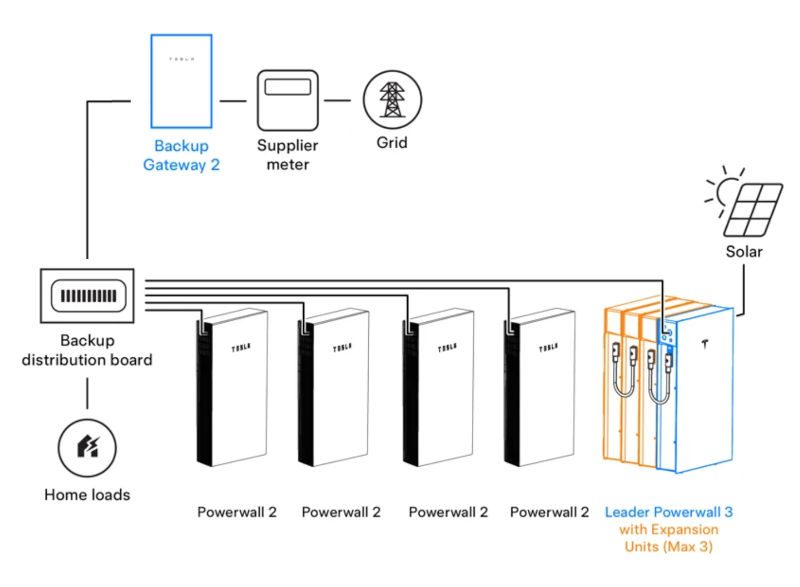
Tesla insist you book in with a Tesla Certified Installer to configure your new PW3 system and make sure it’s fit for purpose.
Sadly there will be problems for those early adopters with gateway 1. Seems the only option here is to upgrade to Gateway 2. 1
Those with a Nurio wireless metering device, commonly used to measure a solar inverter some distance from the main switchboard, will also encounter compatibility issues. However we’re told they can upgrade to Tesla Remote Meter to be compatible with Powerwall 3.
More Power Coming For Powerwall 3
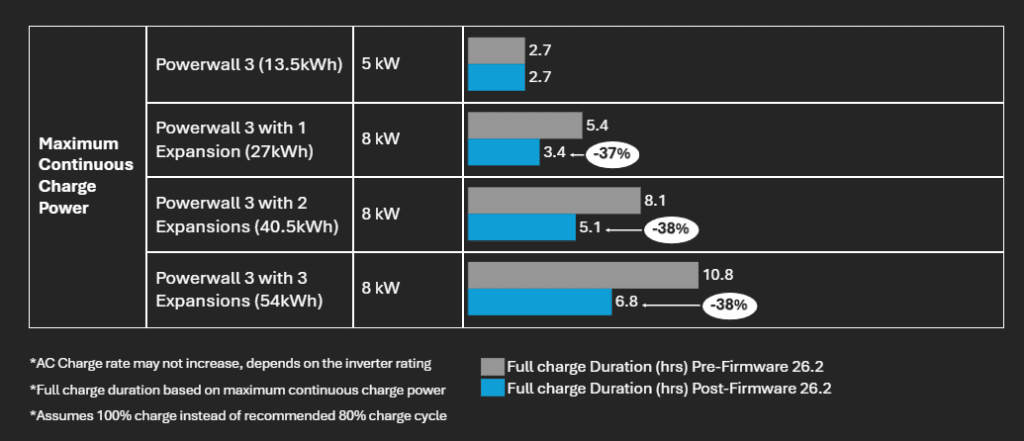
After doing the product launch training day, I know the PW3 can manage a 10kW load, but battery charging is restricted to 5kW. The Tesla people in Adelaide said “the battery is the bottleneck” when we asked, however we were given the impression that the expansion packs (yet to be released) would open up charging.
Charge rate is now upped to around 8kW (depending on the cell conditioning at the time).
Three Phase PW3 Is Coming
Tesla hasn’t always delivered on it’s targets, let alone aspirations like 3 phase, so I collared the local Tesla rep after her presentation at the recent Smart Energy Council roadshow and asked pointedly which Xmas would PW3phase be delivered by?
“This one!” she promised with a smile, but the latter half of the year was as specific as it got.
My other Tesla sources pointed toward the PW3phase launched in Germany, but sadly the technokrauts haven’t released the details yet. Unless there’s some queering brought about by Australian Standard 4777 or the Clean Energy Council accreditation, the unit delivered here won’t be much changed from the European one, aside of course from CSIP-AUS compliance. That has to be working straight out of the box, because world leading Australian networks need extra control.
The More Things Change, The More They Stay The Same
For some years there have been people bleating from the cheap seats about SolarQuotes being biased, or bent by manufacturer kickbacks. It’s rubbish of course, but there was a time when Tesla’s product was such a powerful brand, it had become the default search term for home battery.
If you wanted your articles to show up in front of eyeballs, you had to stitch “Powerwall” into the title, even if it was Alternatives.
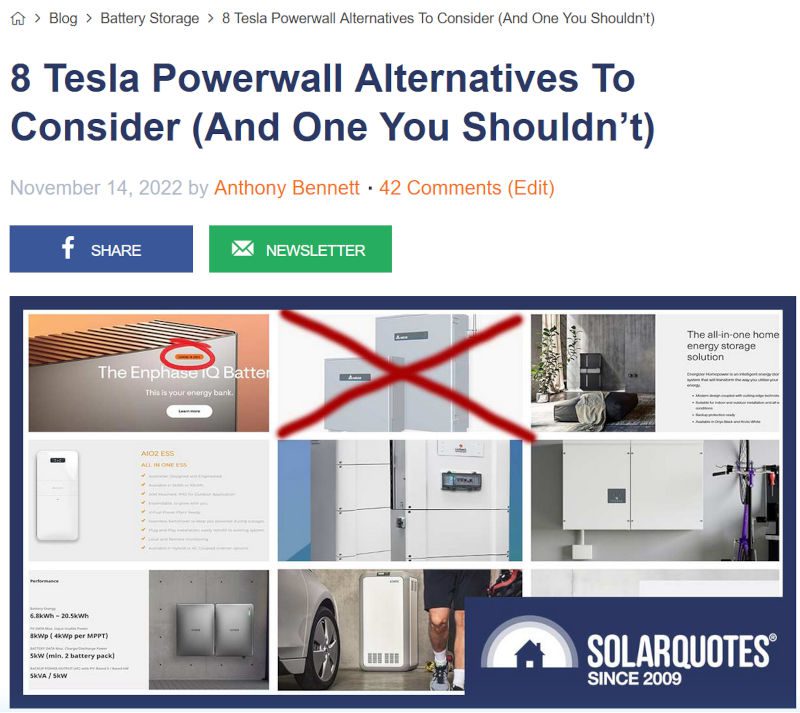
Fun fact, out of these 8 batteries, Enphase is the only one I’d recommend, AND it’s the only one still widely available.
New customers often include notes when they apply for quotes through our website. Often because they want to include a particular brand or need help with a difficult roof perhaps. In an ironic twist, the first time SolarQuotes ever saw requests to exclude a brand, it was because Tesla’s CEO had incinerated his reputation. People couldn’t stand the smell of Musk.
Still you have to give credit where it’s due, of the 8 AC coupled alternatives we listed in November 2022, Tesla is powering on while most are gone.
- Eguana – LG battery recall problems, Australian offices closed
- Q.cells – withdrawn from Australia
- Redback – difficult to raise warranty claims on Pylontech batteries
- Sonnen – difficult to get warranty support. Press articles on Sonnen website lead to PW3 reviews?
- Delta – warranties honoured but no further hybrid solar, remaining presence focused on EV chargers
- Energiser – rebranding different hardware now
- Soltaro – still active but low profile in a buoyant market.
It makes me wonder what the brand attrition is going to be like for the next 3 years?
For more on Powerwall and its competition in the home battery space, check out our solar battery comparison table.
Footnotes
- The honest truth is that gateway 1 was always a pretty ordinary piece of hardware. It’s a tin box designed to work with US switchboard equipment and cable. Whereas the Gateway 2 is much better design for modern breakers, offering more space for using DIN rail switchgear, possibly avoiding the need for other main switchboard upgrades ↩
 About Anthony Bennett
 RSS - Posts






So what are the options for those of us with the “pretty ordinary gateway 1”?
Hi Tony,
I’m not a Tesla installer but as I understand it, your only option is to get a gateway 2.
To little – To late?
You would have to be a really diehard Tesla fanboy to buy Tesla these days.
Expensive, not modular, psychotic CEO…
Was cheaper for me than buying an equivalent Sigenstor, with the rebates (including the Tesla rebate). I got a PW3 and expansion pack for less than it would have cost me not long ago for a PW3 alone.
Love Tesla technology and the entire ecosystem, the integration with the home battery, car, Supercharger etc. Many still consider it the best battery out there in the technology sense.
As for the CEO, I doubt most know who the CEOs are of most of the companies they deal with, and I can promise you many of them are sociopaths. It’s how they get to the top. I don’t see the relevance, to make an omelette you need to break eggs. The fossil fuel culture we live in was never going to lay down for somebody timid or polite.
RE: “As for the CEO… many of them are sociopaths. It’s how they get to the top.”
Yes!
By FAR the most vital urgent and DEEP understanding everyone needs to gain is that a mafia network of manipulating sociopaths/psychopaths are, and always have been, governing big businesses and institutions (eg official medicine, big academia, big tech, big banks, big religions), governments and the world — the evidence is very solid in front of everyone’s “awake” nose: see “The 2 Married Pink Elephants In The Historical Room”… rolf-hefti.com/covid-19-coronavirus.html
“We’ll sit on the edge of our seats watching made-up tales about psychopathic killers while psychopathic killers rule the world.” — Caitlin Johnstone, Independent Journalist
“When a well-packaged web of lies has been sold gradually to the masses over generations, the truth will seem utterly preposterous and its speaker a raving lunatic.” — Dresden James
“Many consider it the best battery out there in a technology sense”. Telsa fanbois may but frankly Tesla is miles behind with battery tech. They are yesterday’s tech and not even playing catch up with the competition.
Actually I was talking about installers and engineers. I’m an engineer, not a fanboy of anything. I’m not aware of other companies innovating in this space to the degree you talk about, but am happy to hear about the innovations.
A bit harsh…
Lets check in 5-10 years. At least a PW owner has a pretty good chance that the company will still exist, be LOCALLY supported at least until the end of its warranty, have software put together with some competence and an installer network with enough familiarity to provide ongoing support if something goes wrong. The price will naturally exclude at least some of the pond scum who are just in it for the grift. Lets see how many of the brands with limited track records, from installers with no profit margin to actually do a decent job are still in operation. Hopefully very few have failed catastrophically. Price isnt always an indicator of quality, but its not irrelevent
As for the CEO. Yeah, fair point. The ethics of the companies I support should matter. Can you name the leadership team of the chinese company that built yours, let alone comment on their ethics, personality or how they conduct their business. I doubt it.
I just had my PW2 removed and replaced with a PW3 and expansion pack. But thankfully the installer kept the PW2 back at the warehouse, and said they’ll be looking at how the integration works when Tesla release the details, and may be able to retrofit the PW2 back into the home together with the new PW3/expansion.
Also saw the new 26. firmware rolled into my PW3 overnight, looking forward to seeing if the higher charge rate kicks in. Interestingly it did straight after they installed it, for an hour or so, maybe that’s part of the installation testing?
Interesting you’ve posted that screenshot of all the second hand PW2s for sale, because there’s a lot of wild speculation out there around the legality (or not) of moving and installing them at another site now that the CEC has expired. One side of the argument insists it’s fine as long as you have an existing PW2 and just want to add capacity to it, while others say it’s completely illegal and anyone who does it under any circumstances is going to have their licence taken away. It’s not as if they aren’t selling either – you see them come and go from places like FB Marketplace all the time. Does anyone actually know what’s going on?
Rather than thinking of this as “adding a PW3” Isn’t this really a case of a new PW3 installation will work alongside an existing PW2? You can’t add an expansion pack to a PW2. The brain of setup has to be in the PW3. PW3 has different comms to PW2 (canbus vs modbus?) so that has to be wired in. If you want to DC couple panels to the PW3 you’ve either got to get more or reconnect the existing ones (and convince an installer to do that). If you AC couple the PW3 you’ve got limited charge rate. What happens in a blackout? Will both work or only one? If you’re in the Energex network (and some others?) and already have a 5kW solar inverter and a PW2 you’ve already used up your 10kW per phase allowance for inverters so you can’t add a PW3 without removing the solar inverter. PW3 is difficult to curtail if you need your VPP to do that to avoid negative FIT. Please have a very detailed discussion with your installer.
How will the PW3 and PW2 be managed together.
Will they be physically linked(power) or just control?
For Charging:
Will it prioritise one over the other, or charge both at the same time.
For Discharge: powering house/car, does it prioritise one over the other, or discharge both at the same time.
Backup: is backup percentage manage separately on both, or does it automatically manage it across both. Does it prioritise 1 over the other etc
I have a PW2 with a Backup Gateway 2 installed back in 2023.
If I want to add a PW3 unit, does my existing Backup Gateway 2 need to be replaced with the PW3 Backup Gateway 2?
Anthony, could you please explain the process a bit more.
Will the PW3 be DC coupled or AC coupled to the existing PW2?
I assume I will see the stats from the two batteries separately on the Tesla app rather than a combined PW unit?
Hi Sam,
At Tesla’s request we’ve made a few edits to the article for accuracy.
I’ve also forwarded your question to them.
As far as I know :
Gateway 2 is the same no matter the battery.
PW2 is an AC coupled machine no matter what.
Tesla’s app and user interface are one of the best in the business, so however they display the data I’m reasonably sure it will make sense, howvweve I haven’t seen it myself to be able to comment.
Hopefully we get some Tesla official commentary here to clarify.
Cheers
Pardon my ignorance Anthony but when you listed ” better EV support ” as a benefit of PW3 what feature of the system were you referring to and is it only relevant to Tesla vehicles.
I have had a PW2 for quite a while(almost out of warranty) but not an EV owner…..yet.
Hi Ian,
I think better EV support is simply having more energy available but if there’s a more technical reason I hope Tesla will clarify themselves.
This is probably Charge on Solar. The system looks at your PV production and diverts whatever excess your house isn’t using into the car. And yes this only works with Tesla vehicles, because Tesla talks to the car to vary the charge current to match the excess production it sees in the Powerwall Gateway. I’ve been using it for a while. It’s not perfect; for example if you want to prioritise home battery charging over the car, that’s not an (easy) option. But as far as charging the car off just PV production goes, it is pretty clever and “just works”.
Saw the Tesla PW3 email and thought bugger I’ve just put a deposit on a Sigen system. On reflection I think I’ll stick with Sigen because Tesla are still resistant to bidirectional.
Hi Anthony. Any idea of the costs involved of adding a PW3 to a PW2 and Gateway 2, taking into consideration the Home Battery as well as the Tesla rebates? Cheers.
Not exactly that scenario, but i just had a PW2 replaced with a PW3 + expansion pack, and it cost about $13,800 (fully installed) re-using the Gateway 2 and with the government and Tesla rebates.
Not sure if this is widely known. My PW2 is one of those that is covered by the Tesla recall and I have been informed by both Tesla and their selected installer that it will be replaced with a PW3.
As I had been looking into it for a while, I asked what the cost of adding a PW3 expansion unit at the same time would be and was informed that if it’s installed when the replacement (Warranty) PW3 is being installed then the Cheaper Home Batteries rebate can be claimed for both the PW3 and the PW3 expansion unit, so I requested a quote to do that.
Imagine my extreme surprise when the quote was for $2900 out of pocket. The Tesla Next Million Batteries rebate of a $750 e-Visa card for the expansion unit is also available if ordered by 31/3/26 and installed by 30/9/26 – so, all up, $2150 out of pocket for the PW3 expansion unit.
I thought about it for a second and said YES!!!
Still some days to go for anyone in a similar situation to me who may be thinking of a PW3 expansion unit.
Hi George. Can you please supply me with the details of your installer. I would like to explore the same or similar deal. Cheers Grant
Apologies for the late-ish reply – just saw your post.
As a courtesy, I asked the installer if they were happy for me to share their details on a public forum. They weren’t so I shan’t. I hope you understand.
I’m surprised they weren’t keen to share their details so I can only surmise that perhaps what they did for me might be in a grey zone. From my perspective, the deal is certainly real enough – the batteries have been installed and are working flawlessly.
What the installer did say was that if you’re having your PW2 replaced under warranty and you’re considering getting a PW3 expansion unit then you should ask for a quote to have it installed at the same time as the replacement warranty PW3. Perhaps you could mention the deal that I received to see if the installers you’re talking to will do the same for you.
I’m sorry that I can’t, with clear conscience, provide the information you requested, but best of luck if you decide to obtain quotes from some suppliers.
So my PW2 is now 9 years old and just about out of warranty.
Why would I invest in a PW3 (stil only 13Kwh)expansion pack for a PW 2 if it dies, esp given the pricing I’ve be given is more than a 47kWH new battery with warranty ?
Hi Mark,
I’m sure you can’t expand an AC coupled PW 2.
PW3 expansion packs need a PW3 to begin with and use a custom made joining cable which is only available in certain lengths.
If I owned a 9yo Tesla, I’d ask myself if a battery 3 times the size for less money is likely to be as good or as reliable?