

The success of the Albanese Government’s home battery rebate is piling pressure on the program’s funding and policy settings. A Smart Energy Council meeting yesterday tackled what could be needed to keep it going until its originally intended end date.
How Much Cheaper Home Batteries Funding Is Available?
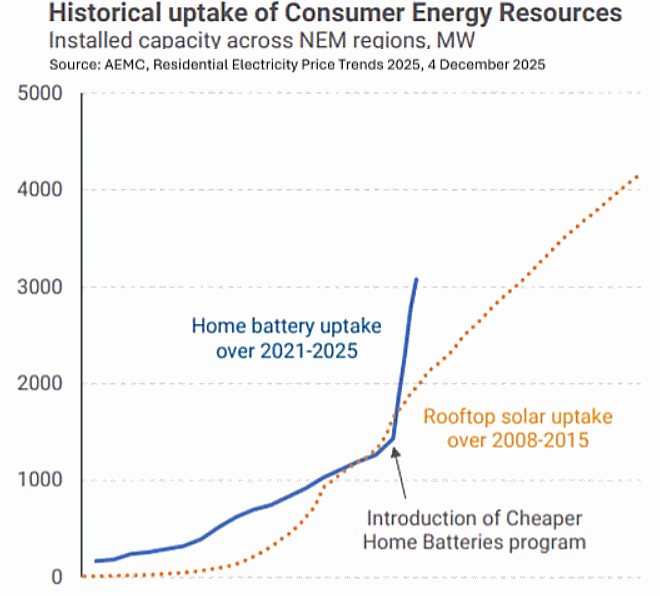
The Cheaper Home Batteries Program (CHBP) was originally launched with a commitment to $2.3 billion in funding. Given the massive uptake, recently updated SolarQuotes analysis indicates that could run out in early June next year; well before the program’s 2030 end. However, Smart Energy Council CEO John Grimes recently pointed out the program is uncapped.
“That means $2.3 billion is the first payment, not the last payment,” he said.
But a blank check under current settings and consumer response isn’t realistic either.
UPDATE: an additional $4.9bn has been allocated to the scheme, along with a host of rule changes. Read a full rundown here.
Big Batteries Blowing Budget
It’s not just the huge number of systems being installed creating pressure on the battery rebate — it’s their capacity, as useable capacity is tied to the level of rebate provided.
In a Smart Energy Council member meeting yesterday discussing the issues — attended by SolarQuotes Editor Max Opray and resident fact-checker Ronald Brakels — the organisation’s Chief Advocacy Officer David McElrea said the average battery size installed since October is probably around 28 kWh. That’s a big jump compared to installations last year that averaged 10 – 12 kWh.
“More and more batteries are larger sizes,” he said. “This is not a bad thing in and of itself … for the network, provided the inverter is the right size and there’s the right number of solar panels, large batteries could provide that broad stability. But from the federal government’s perspective, they’re paying an increased amount out-of-pocket for larger batteries. It’s clear they didn’t anticipate battery size would increase as quickly as it has.”
And obviously neither did the Smart Energy Council, which has played an important role in advising the government on the design and implementation of the CHBP.
“Australia is now the largest residential battery market in the world, thanks to the government’s foresight.” said Nigel Morris, Smart Energy Council Chief Strategy Officer. “Uptake of the program exceeded everybody’s wildest and most optimistic projections … placing obvious pressure on project funding.”
What Does The Smart Energy Council Want?
The Smart Energy Council said its priorities for the scheme are:
- The allocation of additional money.
- No abrupt or unforeseen changes.
- Avoiding a boom/bust cycle for the industry.
- Stable policy settings.
- For more consumers to benefit from more batteries in homes.
- Maintaining high standards of consumer protection.
- A politically and financially sustainable program.
The organisation was keen to emphasise if there are changes, sufficient notice must be given to industry. Installers are in many cases booked out to March, sometimes to April. Wholesalers have ordered stock; so there’s a risk of stranded assets if changes are harsh. The Council also wants some price stability for customers to the extent possible.
What Rebate Changes Were Discussed?
The Smart Energy Council considers the first and most obvious change that could be made is the rebate might need to reduce. They expect the rebate could drop more than planned over the coming years and have made an educated guess of around $100 less estimated value per kWh than in 2025.
Original Proposed Rebate Reduction Schedule
The rebate was always intended to gradually reduce over the years ahead in line with the following provisional schedule. But it was made clear the original levels may need to be tweaked depending on how the program fared.
| Year | Value/ kWh | STC factor |
|---|---|---|
| 2025 | $372 | 9.3 |
| 2026 | $336 | 8.4 |
| 2027 | $296 | 7.4 |
| 2028 | $260 | 6.5 |
| 2029 | $224 | 5.6 |
| 2030 | $188 | 4.7 |
Explainer: In the table above, rebate value/kWh (useable capacity of battery ) is estimated. “STCs” are Small-scale Technology Certificates; the units on which the rebate is based. Unlike the STCs for solar installations that are purchased by “liable entities” such as electricity retailers, the Albanese government is effectively buying STCs at a fixed price of $40 each through the STC Clearing House.
To arrive at an estimated rebate figure before admin fees and charges, the STC factor is multiplied by $40, times useable battery capacity (up to first 50 kWh). But rather than doing a bit of mental gymnastics to get a subsidy estimate for a specific solar battery, try our super-simple battery rebate calculator.
A “Sliding Scale” Alternative
Other than cutting values of the rebate, the meeting noted another option is to reduce the maximum size of battery eligible under the rebate, but the Smart Energy Council doesn’t support that.
At another point an alternative was put forward: a sliding scale with different tiers. It could be the full value of the rebate for a small battery, and less for medium-sized and large batteries.
Ronald’s Take
As mentioned, Ronald attended the meeting and here’s his view on the situation:
“Zero price batteries are bad. This goes for dirt cheap batteries too. They are bad because:
- Because people are not paying the actual price, they have no incentive to not install the maximum, meaning other people potentially miss out.
- Others missing out is bad because 2 medium batteries benefits others more than one big fat one.
- When a range of batteries cost nothing, price no longer acts as an indicator of quality. It’s impossible to say if a battery is merely cheap, which could be desired by someone on a budget, or dirt cheap which may not be a good idea even if money is tight.
Reducing the STC amount per usable kWh is one option. Reducing the kWh cap will also reduce this problem, because, at the moment, it only happens with very large batteries.
But, while two 2 homes with 25 kWh batteries is better for the grid than one home with 50 kWh, 2 homes with 40 kWh is even better. A cut to the cap can cause the new limit to become the ceiling in practice. So, in purely terms of economic efficiency, a lower STC amount is better than a lower cap.
Batteries are cheap to make in China. So we don’t want a system that encourages people to install 10 kWh when for just a few thousand more they could have had 30 kWh put in.
So, again, in terms of economic efficiency, an STC cut is better than a cap reduction. If people are going to get an installer to come out to their place and put in a battery, they may as well put in a big one while they’re at it.”
McElrea said that if the Federal Government is to change the rebate, organisations like the Smart Energy Council need to be on the front foot in advocating for appropriate changes.
“We’re worried that if we don’t act, the patient will die on the operating table”.
Things could change quickly. Stay up to date with what’s happening with the Cheaper Home Batteries Program by subscribing to the SolarQuotes weekly newsletter.
 About Michael Bloch
 RSS - Posts






The Albanese government has certainly succeeded in one area: massively increasing both the number and the size of high-risk incendiary devices now being installed in suburban homes. When you subsidise a product category without proper technical or safety differentiation, you naturally encourage uptake of the cheapest chemistries and the biggest possible units. A perfect political own-goal disguised as climate policy.
Hi Peter,
If you think house batteries are dangerous then wait until you hear about the vehicles parked in your garage.
They’re full of highly flammable liquid and 25 times more likely to catch fire than electric equivalents.
And the filling infrastructure for these things is crazy. Untrained people are just waving hoses around dispensing volatile & highly explosive vapours.
Weirdly it doesn’t make the news much.
https://www.evfiresafe.com/ev-fire-faqs
The killings by ICE motor vehicles in Australia, is mentioned at
https://www.abc.net.au/news/science/2025-08-22/traffic-pollution-study-estimates-1800-premature-deaths-per-year/105677620.
The number is concealed by the feral government, which is directly responsible for the killings, by not implementing in Australia, a subsidy scheme similar to the one that was implemented by the last Labour Party government in New Zealand and abolished by the cartel that now rules New Zealand, the cartel having the primary policy “Do harm and increase the deliberate killing of people in the country”.
Peter – Perhaps you could look up the number of house battery (not dodgy ebike batteries, computer ones, etc etc) fires that have occurred in Australia in say the last 10 years. Then then compare it to the number of house fires from all other sources (this time include all other battery types as well) and to be fair relate it the proportion of premises that actually have house batteries installed.
Then you might realise how wrong your comment is.
Home batteries are extremely safe and have minimal fire risk. The more modern the battery the lower the risk generally. They contain various systems for temperature control, overrun, shutdown systems etc. Of those fires that have occurred, most have been down to incorrect installation and setup and in some cases from batteries that have been recalled for a fault but not fixed/replaced for several reasons – see the recent article on here re recalled LG batteries.
Under the CHBP installs are being checked and some installers barred.
Thanks all. I knew I was walking into the vipers den with that comment and I am not suggesting every home battery is going to explode tomorrow. My point was simply about the nature of the risk, not the raw count of past incidents.
Comparing house battery fires to general house fires or to petrol cars is not really the right metric. A petrol fire is dangerous but at least it is a hazard we have lived with for a century and it behaves within a known envelope. A lithium thermal runaway is a very different phenomenon. Once it starts, it is self sustaining, it cannot be extinguished with water, it releases toxic gases and the only option for firefighters is containment and waiting for the pack to finish burning. That is why aviation bans these chemistries in cargo and why entire buildings have been evacuated overseas when a single home battery went into runaway.
So yes, the absolute number of home battery fires is still small, but the consequence profile is far more serious than most peop
I’m more concerned about how this fire season will play out, with potentially more batteries in their path/at risk. Concerns around increased risk from ember storms and radiant heat fronts are why I skipped a battery when installing rooftop solar a few years ago – I’m not worried about the battery spontaneously combusting, I’m worried about it making things worse in an already risky scenario which we don’t have as much data for 🤷♀️
I’d rather have millions of batteries than submarines that may never arrive.
This policy is so successful, I hope any tweaks are minor.
Maybe a 25% tax on Fossil Fuel exports would help.
Fair dinkum, who cares how much it is costing, it is working, and working well. A very rare result for a government program.
The whole cost so far is still far less than the payments already made to the US of A for submarines we will never get.
How about the renters and apartment dwellers that are funding it too? Is it fair that the get locked out of it while house owners lap up the incentives?
A lot of things in life are not “fair” .
But a lot of things are worth the government subsidising because it takes the pressure of the system, for instance those renters and apartment dwellers wont be subject to the same eye watering price gouging of peak hour power prices if the battery subsidy lowers peak demand enough for example.
Those apartment owners and renters certainly benefited from the electricity handouts over the last two years provided by taxpayers for example. A lot of those renters probably also get government handouts in the form of rent assistance.
They did. But so did those who captured the $18k incentive for a 50kWh battery. The 50kWh isn’t an issue if it’s being fully discharged for the benefit of all grid users. But with a 5kW inverter as most are being installed with, renters and apartment dwellers are missing out on all benefit
Frankie, that is a divisive and fallacious argument that deserves calling out. How about those renters and apartment dwellers, eh? Watching their neighbours mobilise their own private capital along with the government top-up to actually do something good. And do it fast, while alternative fixes like transmission and new wind languish. It is a pinpoint attack on some leading causes of their bill hikes:
1) Diminishing peak demand (inclusive of exporting into it) which calls in expensive (and polluting) gas and allows market price cap gouging;
2) Diminishing day time over-supply that pains the grid and leads to utility renewables curtailment (‘wasted’ carbon-free power);
3) Incentivises further rooftop PV deployment;
4) Pushes some “Wright’s Law” dropping of unsubsidised battery pricing as manufacturing and supply chains learn, much to the benefit of renters and flats when they can get on board.
Spouting specious nonsense for a cohort you haven’t asked is hallmark culture war pap.
Mate I’ve seen the adds for a 50kW battery with a 5 kW inverter for under $4k mopping up over $18k in taxpayer incentives. Got no issues with the program just the poor design that has been rorted for little wider benefit. The latest changes show they’ve realised it was getting out of hand.
I think the big disincentive for landlords to install batteries is the long lead time to depreciate the system. It is an asset and current ATO rules mean they have to write off the cost over 20 years.
I believe that they need an instant asset right-off for rental property solar systems.
-landlords don’t gain any additional write-off, they just get to write off sonner.
-renters get solar and batteries.
Unless the rent can be increased enough to fully recover the capital cost within five years or less, it is not an investment, it is merely slow cost recovery. An instant write-off only changes timing, not economics.
Capital tied up in a rental solar or battery system delivers uncertain returns, carries technology and regulatory risk, and provides most of the benefit to the tenant, not the owner.
Faced with that choice, I would rather allocate capital to a solid ASX company such as Soul Patersons, where returns, liquidity, and risk are far clearer.
Landlords respond to incentives only when they produce real, risk-adjusted returns. Tax timing alone is not enough.
What should be discussed, is not the “cost” of the battery subsidy, but, rather, a cost/benefit analysis of the battery subsidy, considering such things as the reduction in power supply loss to residences and small businesses, due to grid supply failures, thence, increasing productivity, the consequential lesser demand for grid level storage through things like the Snow Job hydroelectric scam, community batteries, grid level batteries (in the hundreds of MWh), increased grid transmission lines capacity (demand for which, would also be lessened by every household and small business, having behind the meter battery storage) , and, the lesser demand for these grid-level expenditures, through subsidised behind the meter battery storage.
So, what should be being considered and discussed, is not the “cost” of the subsidising of behind the meter batteries, but. instead, a cost/benefit analysis of the subsidy scheme.
And, the subsidy rate should not be reduced from the current level.
Wouldn’t be an issue if installers were doing the right thing. But too many installers pushing 50kWh systems with 5kW inverters. Like having a car with a huge fuel tank but it only goes 10km/h. Such a bloody waste of money, once you factor this in you’d realise the benefit is a lot of smoke and mirrors.
There are a few issues with the program:
1. Its a “one shot” system meaning that customers feel they need to install a larger battery than what they actually need. A simple change to allow more than one installation as long as the capacity in total does not exceed the amount would encourage more modest installations.
2. Some of the batteries are cheap, low quality batteries which may cause issues in the future. Now its hard to tell if they actually will cause a problem however we do know that the cheap batteries wont have the same level of engineering as the quality batteries. If someone installs a quality 30kWh battery they receive less subsidy than someone installing a 50kWh cheap battery. It means the 30kWh quality battery may be $15K whilst the 50kWh might be as little as $5K. I dont think that is what the government intended however by the same token we dont want to discourage competition or good value products. Perhaps some independent oversight of the products.
My supplier is struggling to get my batteries (2 x SolarEdge 9.7kWh) to be sent from Melbourne to WA. They keep “not getting on the truck” in Melbourne. My assumption is that the suppliers are prioritising local East Coast installs at the expense of WA. It has certainly happened before!
I went with 2 batteries as the rebate is good, when I would’ve got 1 instead. So I get the push for going bigger. But if I don’t get the batteries here, then the STC value drops and that rebate is not as lucrative anymore..
Great to see the battery rebate being so successful but disappointing to see why. Too many people grabbing huge batteries they don’t need and will never use. This is what happens when policy is not well thought through.
Maybe a cap of 20kWh for the rebate allowing more people to benefit or a mandatory VPP subscription for batteries larger than 20kWh. Share the love a little to benefit more of society.
I still think the rebate needs to be targeted for both CAPEX and OPEX where both reduce over the life of the program to incentivise storage of energy generation and grid stability. Now I get the SRES does the CAPEX part. We need the program to cover the OPEX part.
Let’s be honest, the point of this cheaper home batteries exercise is (or should be) about firming the grid in addition to self consumption.
Let me explain…
The # of STCs created could be flexed using the PV array (in kW) and inverter size (in kW) as a multiplier in the formula (in addition to battery usable kWh). This would ensure those with “small straws”, small PV arrays with no hope of filling batteries, as such incorrectly sized battery systems get less of a rebate.
On the OPEX side, a bill rebate should be given back on energy bills by energy retailers for the amount of import and exported power (in kWh) controlled via a VPP.
Hi Chris,
The idea of a blended total STC/BTC inventive is excellent.
Biggest issue is the solar salespeople who wail about it being difficult to explain & sell.
While it’s not ideal from an economic pov, aren’t those with small solar arrays and big batteries helping to soak midday surplus/peak from the grid?
Yes they are helping. I’m simply saying that the level of help a “small straw” (i.e. inverter size) sucks up in the middle of the day (and gives back to the grid in the evening/peak) is less help than a “big straw” in the same window of time.
Hence the rebate (in your words, the economic pov) on both sides of the blended BTC (as Anthony referred to my proposal) should reflect this relative “level” of help.