
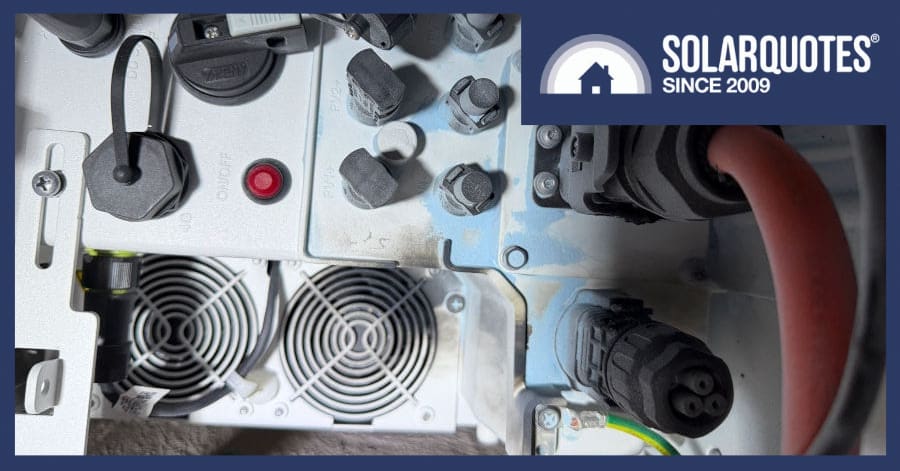
The Clean Energy Regulator (CER) has revealed it warned manufacturers and installers to provide early notification of product risks, after reviewing the spate of melted Sigenergy inverter plugs last year.
In its latest quarterly compliance update for schemes including the Renewable Energy Target, the CER detailed how it had looked into lessons from the SigenStor issues that led to a spate of melted plugs, a small fire and the mass throttling of inverters, as first reported by SolarQuotes.
“In reviewing the learnings from this incident, we have written to all manufacturers and installers to emphasise the requirement for early notification of systemic risks to ensure that these can be assessed and referred to the appropriate regulatory authority. Where a manufacturer fails to notify, we will not hesitate to use our compliance powers to remove participants from the scheme,” the CER statement read.
Faults Must Be Reported Without Delay
The update also included the release of a letter sent to manufacturers in late November, calling for potential safety issues to be reported swiftly in order to protect consumer safety and maintain public confidence in the Cheaper Home Batteries Program.
“Recent incidents, such as the overheating and damage to AC plugs in some inverters, demonstrate that serious risks can arise when faults are not escalated swiftly. While state and territory regulators, the Australian Competition and Consumer Commission (ACCC) and the manufacturer have worked to address the issue, this case underscores the need for manufacturers and industry participants to act decisively including early and proactive notification when faults are identified,” the letter read.
The CER added that all manufacturers must escalate any known or suspected systemic faults or safety risks without delay to appropriate state and territory electrical safety and consumer protection regulators, the Australian Competition and Consumer Commission and the CER.
A product recall was issued in November for Sigenergy’s single phase 8/10/12kW energy controllers that include quick connect AC plugs requiring ferrules and crimping.
As part of its response Sigenergy offered customers free replacement energy controllers with an updated AC plug, although some system owners have been kept waiting for extended periods, with the recall coinciding with a hectic Christmas period for installers.
A New Register To Escalate Issues
The CER letter detailed that a register of significant events across the distributed energy system would be established to ensure issues can be escalated efficiently.
“While our preference is to work collaboratively with manufacturers and regulators to resolve issues, we retain the authority to remove a product from the list of accredited components under the SRES (Small-scale Renewable Energy Scheme) where serious or unresolved safety concerns exist. We will be tightening our regulatory stance, and the timely notification of systemic issues will be a key consideration in our review of events in the future. We will not hesitate to take action if necessary to protect consumers and uphold the integrity of the scheme. We thank the installers and industry members who have been proactive in raising concerns,” the letter read.
Installers Face Additional Requirements
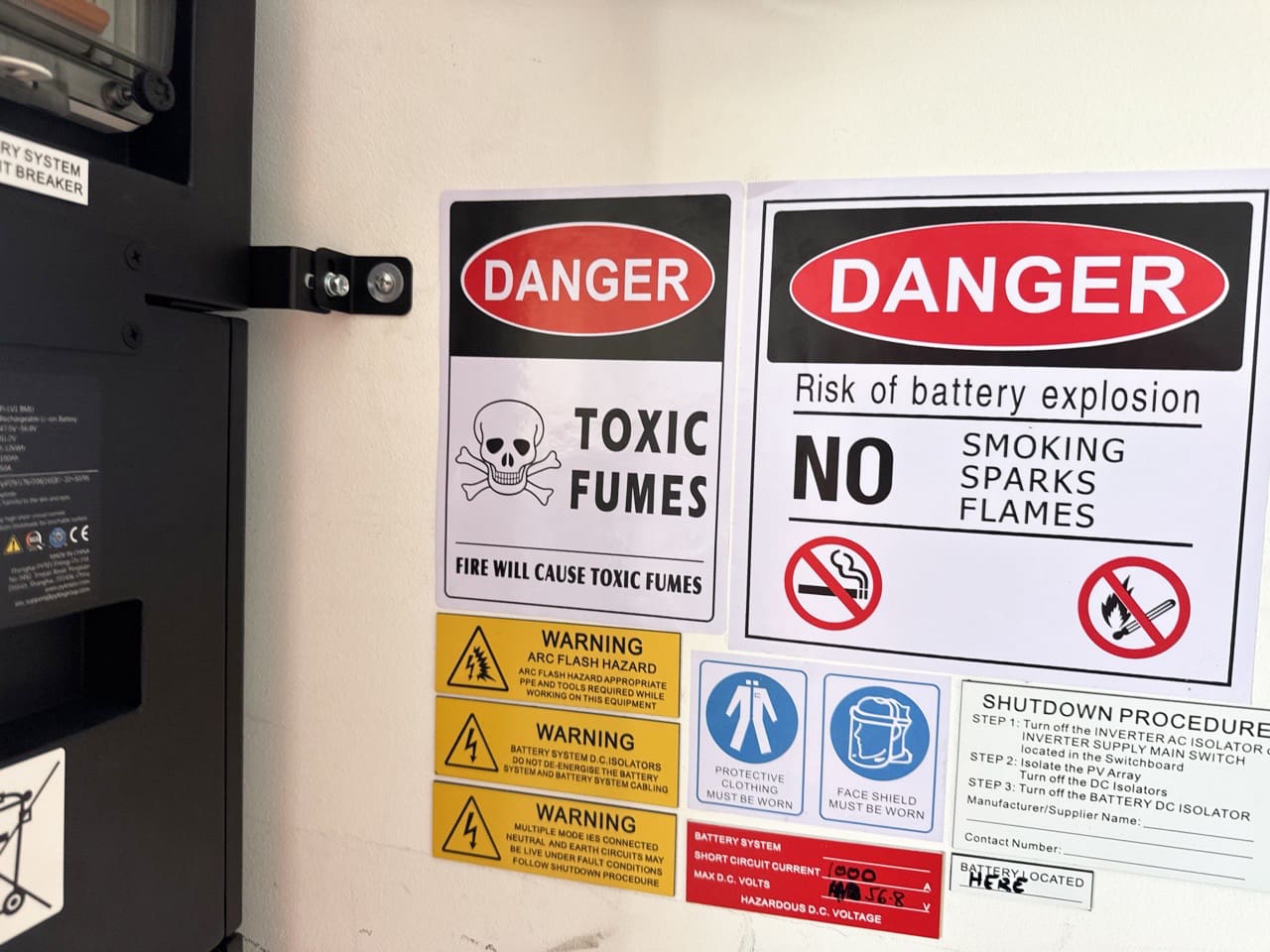
Installers have been warned over mistakes around home battery labelling.
The quarterly update also detailed another letter sent out to installers in December, which noted that the overheating and damage to plugs “demonstrate that serious risks can arise when faults are not escalated swiftly”.
This letter however primarily focused on common installation issues for solar batteries in general – including incorrect labelling for system shutdown and isolation procedures, and missing emergency services labels.
The CER emphasised that installers found to have three or more adverse inspection findings or instances where Australian Standards have not been met will be removed from the scheme.
The regulator noted additional requirements would be imposed in early 2026, requiring installers to take geotagged and timestamped photographs of key labels and signage for each installation, and submit these photographs as part of compliance paperwork.
“These photographs will complement existing mandatory on-site verification photos and may be audited by the CER at any time. Failure to comply will result in failed STC claims and compliance action,” the letter to installers read.
In an article for SolarQuotes last year, electrical inspector Pat Southwell detailed how homeowers can check their battery installer’s labelling.
To stay tuned to all the latest in home electrification, subscribe to SolarQuotes free weekly newsletter.
 About Max Opray
 RSS - Posts





So wet lettuce leaf has been judiciously and rigorously applied by the oversight body, a bit of passive aggressive messaging for good measure, and we can now all move on then?
lol reading the message from the CER I wonder how closely Sigenergy got to being removed from the scheme!
I wonder how it came to be that the Sigenergy three phase gateway was allowed to be supplied for installation in Australia, having the mains connecting circuit breaker not compliant with Australian regulations; missing the Regulatory Compliance Mark, and, the brand of the circuit breaker, having no listed regulatory approvals for components in Australia.
The non-compliant gateway was found to be non-compliant, by an installer opening up the gateway and checking its componentry. It is unfortunate that the “regulator” did not perform compliance checking.
But, I suppose that it is not surprising, with Australia lacking electrical safety regulation, with electrical safety not being regarded as important in Australia.
See
https://www.youtube.com/watch?v=Fyyw2rbs-dA
from 16min 4sec onward.
I like Jason’s videos, no nonsense tells it how it is – even if he is a bit of a tesla fan boy 🙂
The unit in the video did have a CE compliance mark, so i wouldn’t be to worried about quality, but as for compliance – as he said, you had to throw that unit away anyhow, Western Powers rules require a much smaller breaker (at that time anyway). I wonder if other jurisdictions had/have similar requirements.
It’s great that the copycat like Goodwe have copied (almost) everything from Sigenergy for their latest ESA all-in-one battery… up to the plug that Sigenergy has now changed…
Sigenergy must be laughing and Goodwe praying for a miracle. The recall is coming soon…
How did the Sig plug attain certification in the first place?
Mine was replaced in mid-December thankfully. Helps to have a good customer focused installer on your side.
Reminds me to recheck the replacement inverters shutdown as i can’t remember it and they never provided documentation or labelling like the old one had.
The old one was easy just turn 2 external shutoff switches in the right order.
Either way its being replaced with a better system when its off the 42c or i can convince my elderly mother its a good idea to get it earlier for the better rebates.
5kw just isn’t anywhere near enough when it needs to handle 24/7 air conditioning for both climate and medical reasons.
Why don’t you lay off SIGENERGY?
OUR 16kw system has run perfectly since installation.
Des Mundy
That’s great to hear Des, and indeed most Sigenergy customers have a good experience. In fact that’s the case for most customers of most home electrification brands. We’ll continue to cover issues in the industry that arise, no matter the brand.
One of the negatives here has been the lack of communication. Simple updates go a long way to protecting the customer relationship.
4 weeks my system is inoperable due to AC plug combustion. Sig is waiting for failures to issue a “work order” for replacement (rather than recall affected units). Bad business practice. A work order does not get the installer replacement stock when the Sig suppliers make more money selling the replacement units to new installs (brother in law’s recent install is proof). Sig does not use or share a tracking system of units with repetitive breaker trips, nor publish/share with the ACCC or media (like Solarquotes) the recall status of failed unit replacement (length of time to replacement, per cent failed outstanding, % of affected units tripping or failed, etc.). They did not even proactively and properly disclose that they throttled back the affected units. The update derates the spec, which changes the capability of what I paid for. Nonentheless, the inverter AC plug combusted, filling the garage with toxic smoke, tripped the mains and the Sig panel and had my wife coughing for days.
Sounds pretty serious Peter, i hope they extract their digit and fix things for you quickly now.