
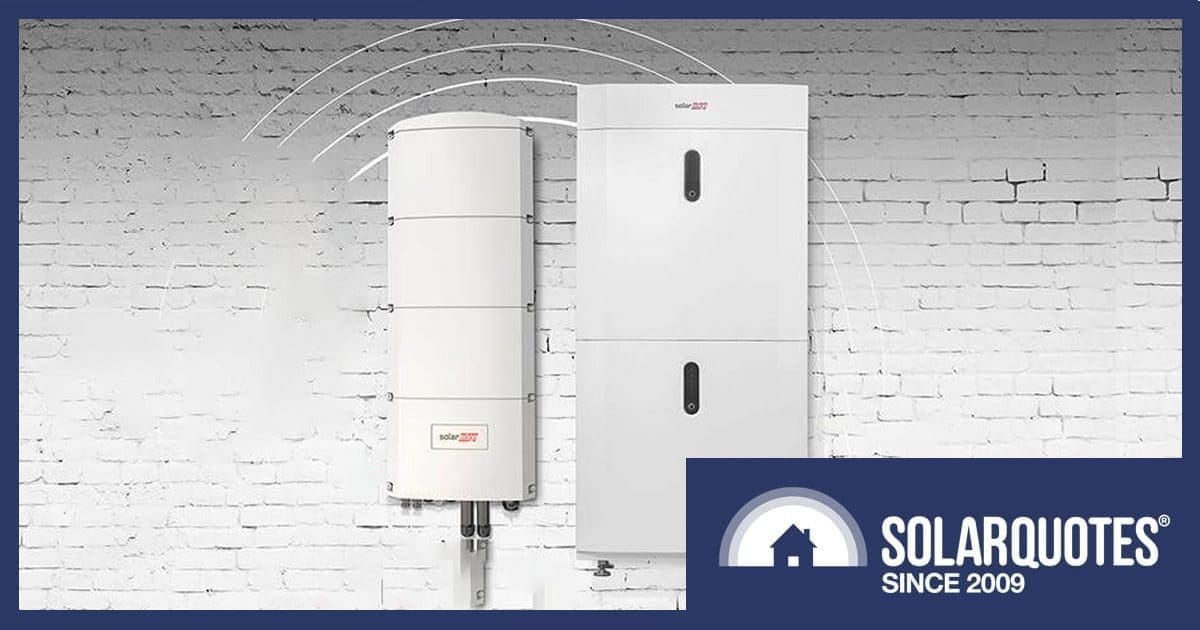
Solar inverter, optimiser, battery storage and EV charger manufacturer SolarEdge has announced its Home Hub Universal 3-phase inverter was last week approved by the Clean Energy Council for use in Australia, following the CEC’s recent tick for the company’s 3-phase battery system.
What Are The Home Hub Universal 3-Phase Inverter’s Specs?
- Scalable from 7kW to 20 kW (10 kW SE10K-RWB48 AU approved).
- 98.4% efficiency.
- Up to 200% DC oversizing when paired with a SolarEdge Home Modular Battery: BAT-05K48.
- Compatible with SolarEdge EV Charger and Load Controller.
- Backup power for either full or partial home loads when paired with the SolarEdge Home Battery and Backup Interface.
- Automatic Switchover Time: ≤ 6 seconds.
- Multiple safety features.
- Module-level monitoring.
- Dimensions (H x W x D) 907 x 317 x 192 mm.
- Weight: 37 kg.
- Operating Temperature Range: -40 to +60 ˚C.
- Fan cooled.
- Noise level: < 50 dBA.
- IP 65 rated for indoor/outdoor installation.
- Manufactured in Hungary, China, Vietnam.
- 12-year warranty standard, can be extended to 25 years.
The backup switchover time noted may be considered slow by some, but the delay has an advantage. Fast switchover means a household may not be aware when a blackout has occurred; which could result in an accidentally drained battery if energy consumption isn’t appropriately conserved during the event.
A full Australian datasheet can be accessed here. If you’re interested in checking out the experience of Australian customers with the company’s inverters generally, see our SolarEdge inverter reviews page.
SolarEdge 3-Phase Home Battery (BAT-05K48) Highlights
The BAT-05K48 is a scalable, modular system that was approved for use in Australia by the CEC on November 20, 2025.
- 4.6 kWh (noted as “kW” on datasheet – likely typo) usable capacity battery modules; up to 5 per inverter for 23 kWh total usable capacity1.
- Battery chemistry: LFP (Lithium-iron phosphate).
- Up to 95.4% round-trip efficiency.
- Voltage Range 44.8 – 56.5 Vdc.
- Operating Temperature (charge/discharge): -10 to +50 °C. Battery power will derate when the internal temperature of the battery is higher than 40°C and lower than 15°C.
- Natural convection cooling (no fan).
- IP65 / NEMA 3R rating – indoor and outdoor (water and dust protection).
- Manufactured in China.
- 10-year warranty and at least 70% of nominal capacity at the end of the 10 years.
There’s also a single-phase version of the battery that’s been available in Australia for quite a while — you can learn more about it on our SolarEdge battery reviews page.
SolarEdge TradeUp Program
For customers with an existing SolarEdge 3-phase residential inverter without a battery, the company is currently offering a complimentary upgrade to the new Home Hub Universal Three Phase Inverter when they add a stack of three modular 3-phase batteries along with a backup interface.
A similar deal applies for customers adding a SolarEdge single-phase battery and backup interface package to an existing single-phase SolarEdge system. There’s a choice between a 10 kW or 5 kW single-phase inverter.
Both offers include a new 12-year Home Hub Universal warranty. The single-phase TradeUp Program ends on March 31, 2026 and for three-phase, December 31, 2026. Further TradeUp details can be found here.
Founded in 2006, SolarEdge released its first inverter in 2010 — a single phase model. The company’s inverters are different to most others as they require a (SolarEdge) optimiser for every solar panel. These small devices maximise the amount of energy each solar panel produces, enable module-level monitoring, mitigate module mismatch-loss issues from manufacturing tolerance to partial shading and aging, and provide additional system safety features.
SolarEdge entered the Australian market with its inverters in 2010, although some sources note it was 2015. The firm set up its Australian office in Melbourne in 2013.
SolarEdge released its first home battery in the US market in 2021, which was formally launched in Australia in late March 2022.
Learn more about choosing a good inverter and selecting the right solar battery for your home.
Footnotes
- Discover the difference between nominal and usable capacity. ↩
 About Michael Bloch
 RSS - Posts





Been waiting for these products. I do hope Evoenergy will approve the changes to my installation. It will be a mix of 2018 and 2023 installs with 3 extra panels to bring one string up to spec for the inverter.
Second question to answer is, “when?”
I’ve been keenly awaiting these the too, but only found out a week ago about the 3ph inverter requirement.
The LFP change and stackable / expandable aspects would have been nice in several ways,
With 2 x 1ph 5kw hub inverters on 2 or our 3 phases, I am not replacing those after just 2 years.
Looks like I’ll be opting back to the BAT-10K1PS0B-01 and trusting the SolarEdge proven track record for reliability / safety of the NMC chemistry.
While I think it best to stick with all SE gear, for both compatibility and that it works well with systems for Amber and possible other systems, I have explored getting a 3rd inverter on the 3rd phase, FOX ESS battery stack on that, and using that as the master for the 2 x SE inverters.
The FOX app is pretty good within it’s own system.
Totally unsure though how it might be working fully with curtailment if ever required (Amber (-) FITs or possible retailer penalty), and being able to porgramme things in the background for HW and EV charging etc.
Im extremely interested as I have solar panels but no batteries. Im literally paying for to electrical bills and was considering canceling my solar. However, I want to give the battery storage a try.. I currently have a solaredge 7w inverter. Need a rough quote on 2 batteries and a higher inverter. I currently have 28 400w panels on my roof which was placed there in 2024
Hi Isaac,
Press the orange “I’m ready” button and stick your details in to get yourself a choice of one, two or three quotes.
Cheers