
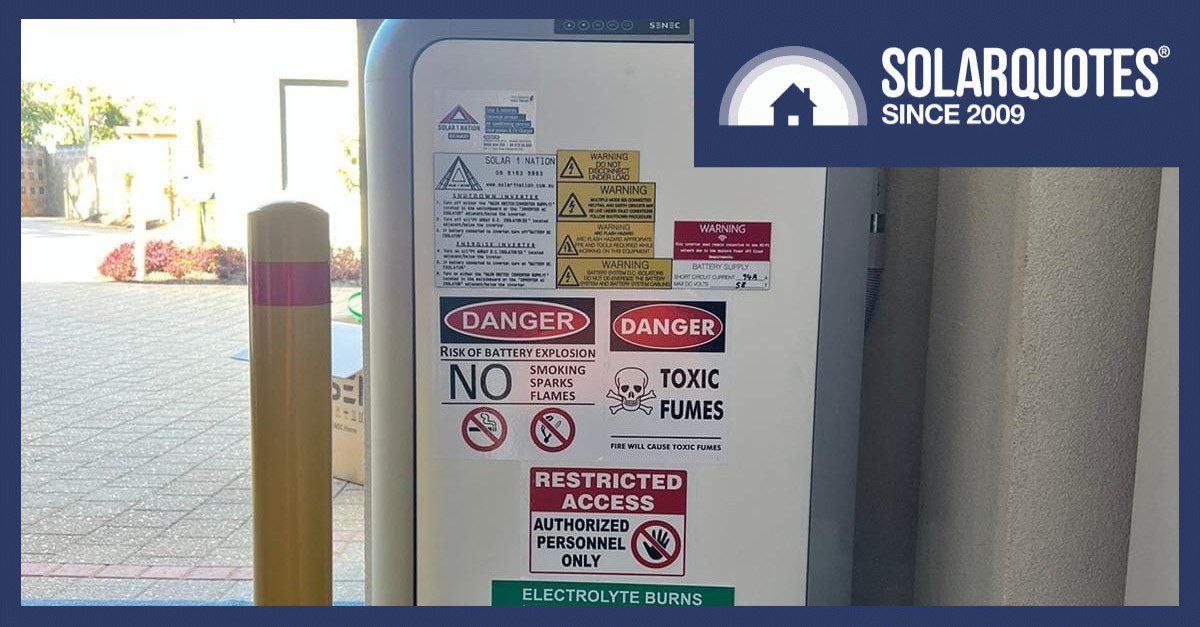
 Solar battery installers will face new requirements starting in March, as Clean Energy Regulator (CER) inspections ramp up amid a surging home battery market. Nearly two-thirds of home batteries inspected to date have fallen foul of the regulator (usually related to labelling issues), with 0.9% found to be unsafe.
Why Are Home Battery Install Inspections Ramping Up?
The CER is dialling up its inspections programme to keep up with a surge in battery installs expected over the next two months, as buyers look to get in ahead of May changes to the federal battery rebate, when the incentive will taper down for larger batteries.
CER Executive General Manager, Carl Binning, says that the industry is on notice:
“This is a busy period for the industry, and our focus is on making sure standards stay high and consumers stay safe. I’m putting installers on notice that unsafe and non-compliant work will be identified, and we won’t hesitate to use our compliance powers. This could result in installers being removed from the SRES (Small-scale Renewable Energy Scheme),” he said.
What Requirements Are Changing?
Starting from March 1, installers will face additional photo requirements to address common issues with labelling, on top of existing on-site verification photos.
The CER says that installers will be required to take clear, geotagged and timestamped photos of mandatory labels.
What Are The Most Common Problems With Battery Installs?
As of of 19 February 2026, the CER had conducted 846 solar battery inspections on installations that have received STCs. Of these inspections, 350 have been finalised. The number of inspections represented a stastically significant portion of the 225,000 solar batteries installed under the Cheaper Home Batteries scheme to date.
Of the inspections:
- 0.9% of installs were unsafe;
- 62.8% were substandard (technically non-compliant but safe to remain in operation);
- 36.2% were adequate and safe.
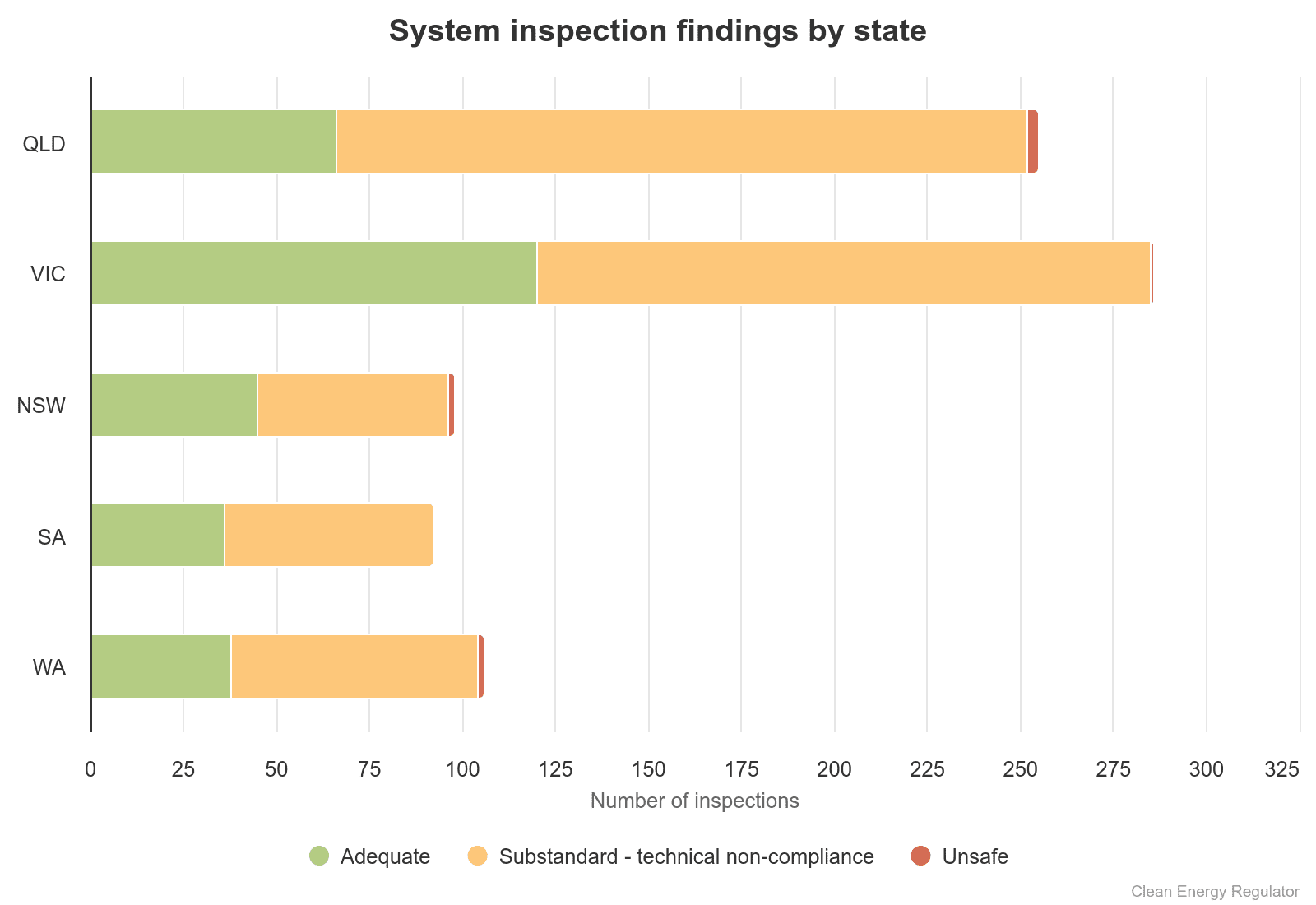
Queensland in particular featured a higher rate of installs that breached regulations.
The issues related to unsafe installs were all related to:
- Wiring: loose connections in pre-assembled battery systems and associated wiring with signs of heat.
- Protections: neutral continuity was not maintained for all circuits operating on an alternative supply.
In its recent solar battery inspection results report, the CER said that as of 17 December 2025, only one eligible product under the SRES has been recalled – the voluntary electrical safety recall for Sigenergy single phase 8/10/12 kW energy controllers, which as revealed by SolarQuotes had suffered a spate of overheating issues. It is not clear how many of the safety issues uncovered by inspectors related to Sigenergy systems.
Labelling Issues Dominate
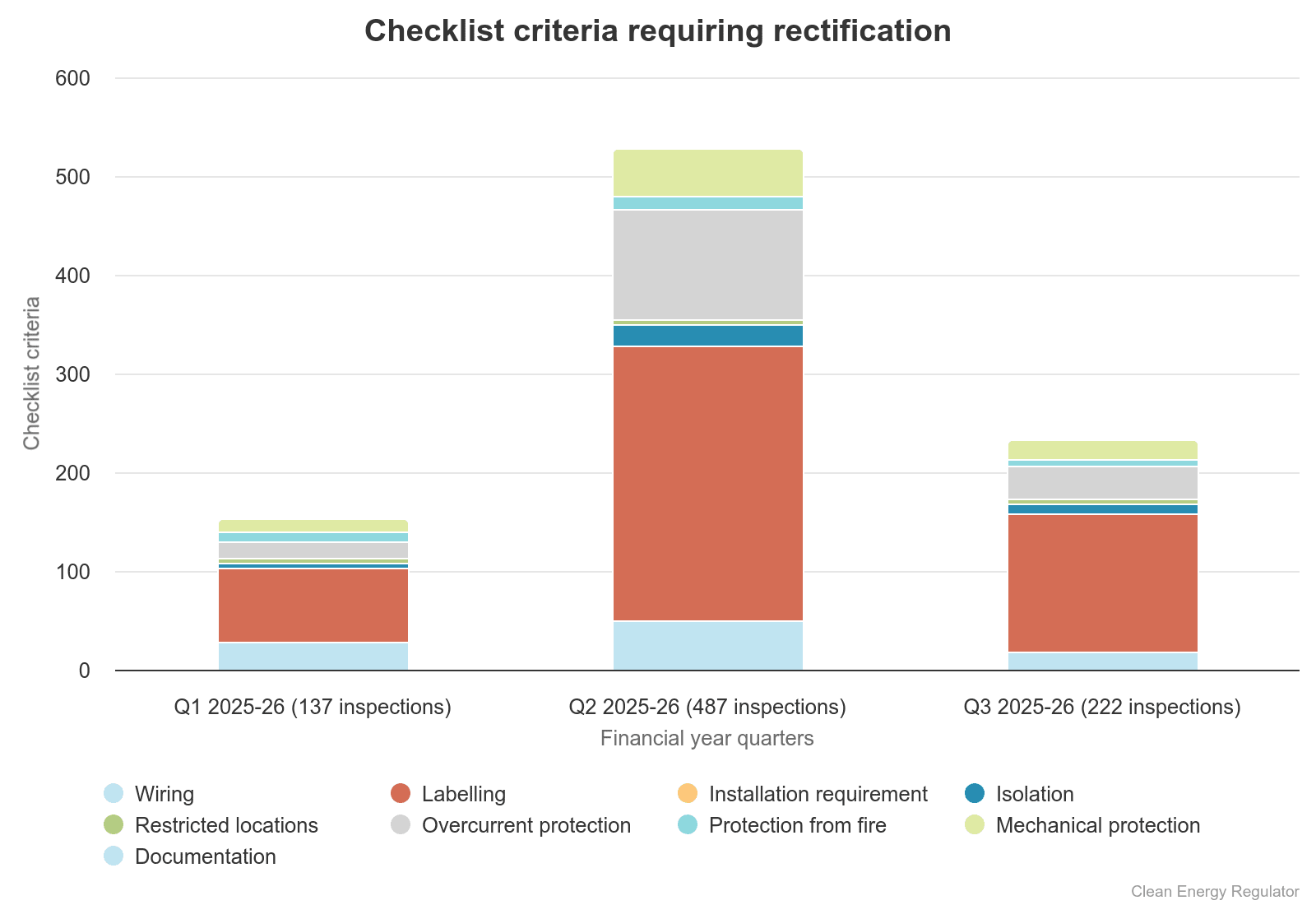
Labelling issues – represented in red – were the major issue uncovered in inspections.
The most common reason for technical non-compliance was due to labelling issues, triggering the additional photo requirements:
- Incorrect or missing warning label: warning labels must be installed at the main switchboard and all intermediate distribution boards to show a multimode inverter with alternative supply has been installed and to follow the shutdown procedure for safe isolation. The sign must also include the text ‘Neutral and earth circuits may be live under fault conditions’.
- Incorrect labelling of backed-up circuits: Battery systems may have a back-up supply feature, leaving all or partial electrical circuits energised. Some battery systems have a time delay before re-energising back-up circuits after the main switch is turned off. To reduce the risk of electric shock, it’s important that this is clearly labelled so that electricians or other trades are aware before they begin work. Backed-up circuits must also be grouped together to make it easier for anyone working on the switchboard to identify any sources of back-up power.
- Incorrect labelling for emergency services: A green reflector sign with the letters ‘ES’ to signify energy storage must be installed on or next to the meter box and switchboard so that emergency services are aware there is a solar battery connected to the solar PV system at the property. This is important for emergency services to be aware of during an emergency response.
The CER argues that labelling is key to supporting the safety of installers, emergency responders and tradespeople who might need to interact with a solar battery system in future.
SolarQuotes founder Finn Peacock last year lamented authorities becoming overly focused on labelling issues, fearing that this distracted from more serious safety lapses.
The most common wiring issue for substandard technically non-compliant installations was for an incorrectly configured or missing residual current device (RCD), which is designed to protect against electric shock and fire by cutting off power when an electrical fault occurs.
What Consequences Are There For Breaking The Rules?
Binning said that the CER is “committed to continuous improvement across the industry”.
“We’ll use sophisticated artificial intelligence as part of our assessment process to ensure all claims are meeting the new requirements. The message to installers is do it once and do it well. Installers are required to return to site to rectify non-compliant work and failure to provide the required photos will result in claims for small-scale technology certificates being delayed or rejected,” Binning said.
For guidance on how to check your installer’s labelling and other issues, read these tips from inspector Pat Southwell. For suggestions on how to make sure your battery is working properly, read Finn Peacock’s piece on the five tests to do before your installer leaves.
 About Max Opray
 RSS - Posts





Hmmm, perhaps last July was the point they should have increased their surveillance activities, as that was the riskiest point in the accelerated battery installations as the demand exploded with the battery rebate becoming available and resources and skilled staff would have been scarce.
But i will also say, if they think they have labelling problems at install time – my solar has been installed for about 18 months now, and the conditions of the labels would suggest they wont be all that good for much longer. Already faded and peeling around the edges.
Inadequate signage. Slightly off topic, but here is a cartoon I made up a few months back about Childcare and notices.
https://x.com/derek_mck/status/2009091757984895117
I have to agree with Derek.
I think slapping multiple signs in and around the installation means no-one will read any of them. Some maybe important for fire authorities although I suggest Fire services training should have filled this gap by now. Any electrician should be well aware of the issues involved and signage will likely not save him/her. So is it bum-covering in case someone sues?
The longevity of the various signs is also in question (like vehicle number plate EV signs).
It also seems the authorities are in a rush for more signage but I raise the point that they are still ignoring the roof top isolator potential issue that exists on many installations. How about a promotion to remove them? (Of course many contactors won’t touch older installations).
Would such a change mean upgrading the installation to the latest specs and therefore many householders would refuse?
Yep, one sign says “here is some important information”. Ten, says “just ignore me”.
My December install was promptly inspected for audit checks with no issues. I find the amount of signage and stickers concerning
1. They wont outlast the system. Will they fade or even fall off?. Probably.
2. What do they mean?
3. Nothing tells anyone what each switch or sign means
4. Nothing tells me how you fully and totally disable the entire solar, inverter, battery. And i believe it can remain energised anyway. I really dont know
Odd. My inverter has instructions for how to switch the system off – from memory, dial on the side to 0, then flick the switch in the power box. Not confident I have that right – it’s not the sort of thing you do on a regular basis!
Now whether that powers down the entire system, or whether the solar panels keep trying to send power to an inverter that’s closed for business, that I can’t say.
If your signs and stickers are made of the right materials they should easily last a decade.
Ditto here with my 13-year old system re labelling.
Engraved multi-level labels firmly attached which are as good as new. Even in direct sunlight.
But your question about shutting down the system perplexes me.
I am under the impression that rooftop solar panles must have an isolator accessible from the ground.
My aging system does. (It also has one on the roof so the sparkie can power off the panels there too.
Hi Paul,
Did you request an inspection or were you randomly selected? I would love to have our system inspected after installation, to identify potential issues early. Can I request that from the regulator? Thanks!
I have repeatedly said that all installations and modifications should be mandatory inspected by statutory regulatory inspectors, especially, before the systems are put into operation, to ensure compliance with regulations and safety standards, and, to ensure system safety.
Also, before customers are required to pay, and, before subsidies can be claimed, a checklist should be completed and signed off by customers, to, amongst other things, ensure that the system is properly configured, and that the customer understands the operation of the system, including performance monitoring and shutdown and startup procedures, and, that the customer has system documentation.
In the absence of this, the industry is unregulated and unsafe.
I thought I was under the solar quotes umbrella.
How wrong I was. 2 years on and my system is not on, and I have a faulty battery. The mongrels who installed it, refuse to honour any warranty, and have said my switchboard needed upgrading, so they won’t finish the job.
Sungrow won’t honour the warranty either, because the installer won’t do the work, unless I pay him, and then seek it back from sungrow.
I wish I had double checked that I was under solar quotes. I think the error was a solarquotes installer referred me to someone else, hence the super expensive error.
What can I do about it? I really need help with this…..
Which is it? Faulty battery or need a switchboard upgrade?
I would be asking why the switchboard needs upgrading now.
You say you have a battery (faulty) so presumably there was a new meter required.
So the new system could be installed using the old board?
So why the requirement NOW?
Or, if the installation required a new board, it wouldn’t have been installed at all.
Once you have that sorted, you can move on.
(Originally posted in the wrong section)
Ditto here with my 13-year old system re labelling.
Engraved multi-level labels firmly attached which are as good as new. Even in direct sunlight.
But your question about shutting down the system perplexes me.
I am under the impression that rooftop solar panles must have an isolator accessible from the ground.
My aging system does. (It also has one on the roof so the sparkie can power off the panels
Simpley fine and de-register the installers that produce substandard work. These industry would quickly pick up its socks if it actually was held accountable for sloppy work (and potentially life threatening). We need less laws and more industry integrity.
I think “the loose connection” has a more sinister cousin – ‘the arcing event”: on the power conductors and connectors.
Wiring & Termination Issues:
• Loose connections
• Signs of heat
• Poor neutral continuity
Loose terminations create resistance. Resistance creates heat. Heat creates fire risk and, more importantly, causes arcing. In the worst case, and this is actually for what one of my other articles alludes to Arc-flash risk key to note is that within an arc-flash (the plasma reached temperatures of 20, 000 degrees C and nothing survives that heat) and thus these faults need to be prevented by proper installation, in the first instance and then a system put in place to monitor them when these are incipient faults. See a more detailed explanation on that issue:
https://www.linkedin.com/posts/ian-boake-0892ab1b_arcflash-workplacesafety-electricalsafety-activity-7405009001404362752-MeNy?utm_source=share&utm_medium=member_desktop&rcm=ACoAAAQi_KkB2srpWFxZzv1cVosy3Q9xTK21dSg
I believe that industries require regulatory bodies and businesses to continuously identify and resolve issues, ultimately leading to the maturation of both the product and the industry as a whole.
The problem with this approach is that after years of every single problem resulting in a bureaucratic fix, any industry struggles to get anything done as all the time and effort is directed into paperwork and bureaucracy rather than giving the customer a good product.
It doesn’t appear Solar/batteries are there yet, but I’ve worked in other industries and seen them destroyed by excessive government regulation.
Hi Derek,
I guess the definition of excessive is what we need to quantify.
Unfettered capitalism gives us rotten milk that’s made saleable by adding chalk or formaldehyde.
Without regulation the “benign hand” of the free market becomes our enemy and eventually undermines itself by destroying consumer confidence and trust in institutions.
We have to strike a balance but “trickle down” economics has so far given us increasingly horrendous inequality.
Those doing the pissing arent even polite enough to imply it’s rain they’re trickling down on us.
Would be good if the private power industry profits were renationalised into training apprentices and doing statutory inspections.
What do i do if i think i have a sub-standard install?
I had a FoxESS KH9.9 Inverter with a EQ4800-L9 Battery installed early Jan. this year, now looking at some of the pics here that don’t comply i think mine is the same, also the bit about backing onto a habitable room where vents must be sealed i was wondering why my installer put strips of thin cardboard with electrical tape on my external wall vent and brickwork next too the battery!
I’ve also got what i consider to be a dodgy-earth connection of 3 wires, roughly soldered with a bit of black electrical tape wrapped around it which is now coming off, also the securing to the wall screws/bolts are crocked, not what i would have expected. This installation was inspected by Access Canberra Inspections and passed inspection.
I’ve tried to contact my supplier & Acc.Canb re this and sent pics of my concerns but they just ignore things, this is just one of many. Any advice would be gladly accepted. I think i’ll need to pay them a visit.
Pay who a visit? Is your installer/supplier local? (If so, lucky for you. Most suppluers are interstate).
Firstly, contact the installer, in “writing” and keep copies. Ditto the supplier.
Take pictures. Be specific as to what the issues are.
You can contact the ombudsman. They will give you a direction to take.
You can contact ACT Fair Trading if you feel what you bought doesn’t match your expectations.
Lucky Me. Don’t know why anyone would buy from ‘interstate’, that’s just asking for trouble, yes mine is ‘local’, about half an hours drive for me. I’ve previously put it all in writing with pics to the ‘supplier’, ie, the company i bought it from, (Prime Solar Energy Canberra if anyone’s interested) and who promised a number of things that didn’t happen all thru the installation and afterwards, i wish i had gone with someone else. I’ve called and left msgs with “Access. Canberra. Installations” who are the one’s who do the final check but they don’t respond either.
I’m been documenting all this and will be taking it up with the authorities who allow these cowboys to operate, and yes i will be paying PSE a visit.