
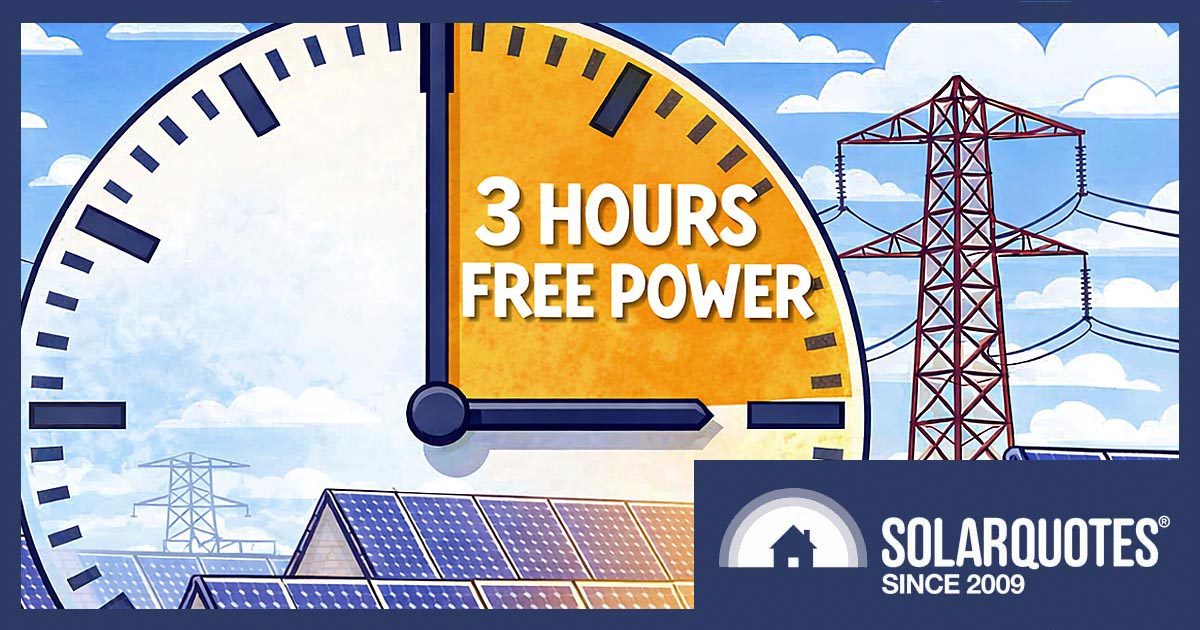
Victoria will roll out its own version of “free daytime power” from October 1, becoming the latest state to introduce free electricity during the middle of the day.
The plan will give households a daily three-hour window of zero-cost electricity, in a similar fashion to the federal government’s Solar Sharer scheme, which begins in July in New South Wales, South Australia and south-east Queensland.
Dubbed the “Midday Power Saver”, the policy will require electricity retailers to offer plans that include the free period, though households will still need to opt in. More details — including the exact time window and pricing structure — are expected in May.
The initiative is designed to encourage households to shift electricity use into daylight hours, when solar generation is at its highest.
How Does The ‘Free Power’ Plan Work?
Under the Victorian scheme, households that sign up to a participating retail plan will receive a set three-hour window — expected to fall around the middle of the day — where electricity usage is free.
To access the offer, customers will need a smart meter and an eligible plan, and must actively opt in. Unlike some earlier retail-led offers, retailers will be required to make these plans available.
Why Is Victoria Introducing Its Own Version?
Victoria operates outside the default market offer (DMO) system that governs pricing in several other states, meaning federal reforms don’t automatically apply.
Instead, the state is introducing its own version of the Solar Sharer concept, aligning with the national approach while retaining control over how it’s implemented. The policy also reflects the rapid growth of rooftop solar, which is pushing increasing amounts of low-cost electricity into the grid during the middle of the day.
Federal energy minister Chris Bowen has said the government is working with non-DMO states to expand the scheme nationwide by 2027.
How Much Could Households Save?
The Victorian government has indicated savings could range from a few hundred dollars per year up to around $1,000, depending on how effectively households can shift their electricity use.
As with similar offers, those higher-end savings rely on maximising usage during the free window. In practice, that means shifting things like laundry, dishwashing, pool pumps, EV charging and even heating or cooling into the middle of the day.
Households that stick to traditional morning and evening usage patterns are likely to see more modest benefits.
The Catch Behind ‘Free’ Electricity
Despite the headline, the electricity isn’t free in the usual sense. Retailers are expected to recover costs by adjusting tariffs outside the free window — particularly during peak demand periods.
That creates a trade-off: free power for part of the day, balanced by potentially higher prices at other times. For some households, the shift will be easy; for others, it may require deliberate changes to when energy is used.
Who Stands To Benefit Most?
The scheme will be available regardless of whether a household has rooftop solar, so households without solar can also take advantage of cheaper daytime power.
Those most likely to benefit include people working from home, households with flexible schedules, and electric vehicle owners. Renters and apartment dwellers may also see savings — provided they can shift usage into the free period.
A Sign Of Where Energy Pricing Is Headed
Victoria’s plan reflects a growing shift in electricity pricing across Australia. As solar generation continues to grow, the gap between cheap daytime energy and expensive peak-period power is widening.
“Free power” offers may grab attention, but the underlying trend is towards more time-sensitive pricing — where when you use electricity increasingly matters as much as how much you use.
Victoria’s free daytime power plans will be released closer to October. In the meantime, more detail has been revealed in recent weeks on the federal Solar Sharer scheme.
 About Kim Wainwright
 RSS - Posts




What a big con job because of the next state election in November and they are trying to buy votes