
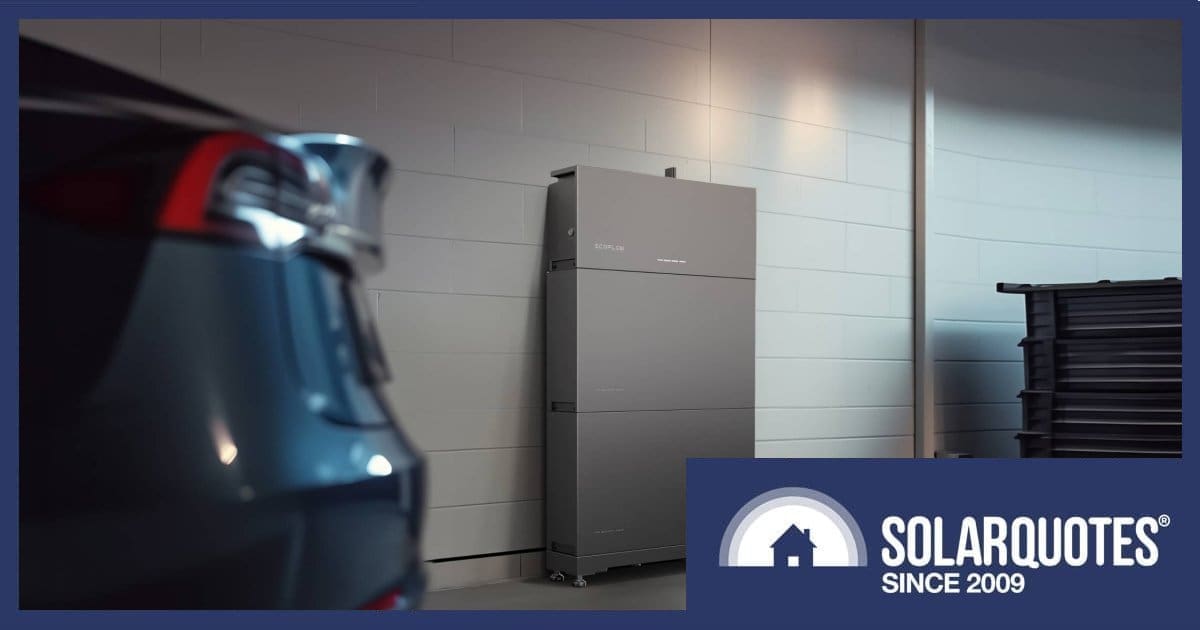
Portable battery specialist EcoFlow also manufactures fixed home batteries that should be available to Australian customers reasonably early in the new year; along with hard-wired EV chargers.
What EcoFlow Batteries Will Be Available In Australia?
The first EcoFlow batteries to be approved by the Clean Energy Council are from the PowerOcean modular all-in-one single-phase series:
- EF BD-5.1-S1 (5.1 kWh useable capacity)
- EF BD-10.2-S1 (10.2 kWh)
- EF BD-15.3-S1 (15.2 kWh)
Beyond 15 kWh, the system is expandable to 45 kWh through parallel connection. But the datasheet also mentions “expandable up to 60kWh”; which is likely due to a 20 kWh model that isn’t currently CEC listed.
PowerOcean Home Battery Single-Phase Features
- LFP battery technology.
- Maximum discharge power: 3.3 kW – 13.2 kW, depending on chosen configuration. The upper end is for the unlisted 20 kWh model. For the 15 kWh, it’s 9.9 kW.
- Maximum charge power: 2.5 kW – 10 kW (for the listed 15 kWh model, 7.5 kW).
- Up to 6kW of continuous off-grid power.
- Less than 20ms switching time to off-grid mode.
- Nominal voltage: 800V.
- Operating Temperature (°C) -20 to 50.
- Aerosol fire prevention module; reacts within 7 seconds.
- High-strength casing — claimed to withstand pressures of up to 40,000N.
- IP65-rated for outdoor/indoor installation.
- Floor/wall-mount options.
- Track power usage, solar input, and battery performance in real-time with the EcoFlow app and Web Portal
- 15-year warranty
- Made in China
A datasheet is available here.
I found the maximum discharge/charge power specs a little confusing as the rated output power for inverter options for this range are 3 kW, 5 kW and 6 kW. Perhaps the numbers above are peak, but that wasn’t clear and is usually specifically mentioned in datasheets.
Assuming the company hangs around to honour it, the 15-year warranty is quite impressive, as 10 years is much more common. EcoFlow guarantees the PowerOcean will have a minimum nominal capacity of 70% after 15 years of use or 6,000 charge/discharge cycles (just over 1 cycle per day over that period), whichever comes first.
On its Australian website, the company also features a three-phase PowerOcean and PowerOcean Plus range that are also not yet CEC listed. But with the initial listings done and dusted, EcoFlow says it is preparing a broader set of product introductions and partnerships planned for 2026.
“Certification marks the beginning of our long-term commitment to Australia,” said Craig Bilboe, Country Manager Australia and New Zealand in late November. “We’re excited to collaborate with local installers and industry partners as we roll out a new generation of home energy technology designed for the needs of modern Australian households.”
Early this month, the company announced a partnership with wholesale distributor Go Solar Australia. That firm is currently only listing the unlisted three-phase PowerOcean. But the CEC also lists several three-phase EcoFlow hybrid inverters: 6, 8, 10 and 12 kW output.
The hotch-potch CEC listings, gaps in information and some conflicting information make specs and availability of what and when a little confusing — unfortunately not an uncommon situation when battery companies are promoting new and upcoming products.
Beyond Batteries – EV Chargers
EcoFlow will also be offering a couple of EV chargers to Australian customers (timing of AU release not mentioned).
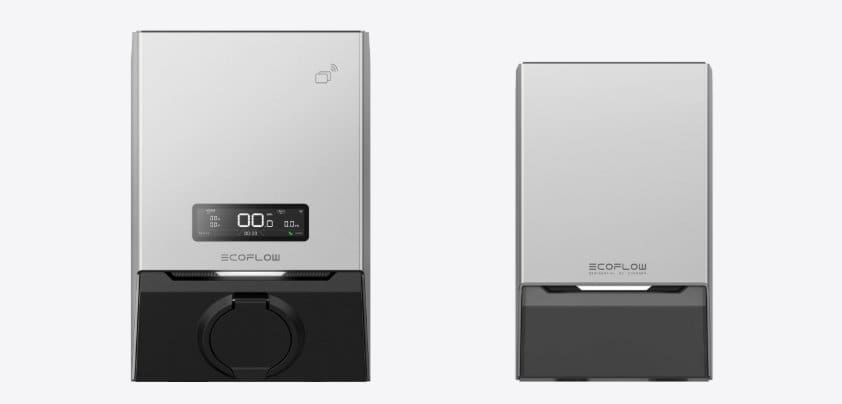
The PowerPlus (right) is a 3.7kW (single-phase) / 11kW (three-phase) charger with solar mode, fast charging and scheduled charging. The more powerful PowerPlus 2 (left) is a 7.4kW (single-phase) / 22kW (three-phase) device offering features including digital display, dynamic tariff support, load balancing, smart mode, solar mode, fast charge and scheduled charging.
Monitoring is via the same app for both. Each supports OCPP1.6-J, integrates with the PowerOcean, weigh 3.3 kg and 3.5 kg respectively, and come with a 3-year warranty.
Who Is EcoFlow?
EcoFlow was founded by a team of battery engineers in 2017 who previously worked for Chinese drone manufacturing giant DJI.
The firm initially focused on mobile storage solutions, introducing the River power station in 2018. EcoFlow launched its three-phase PowerOcean home battery in mid-2023 in various European markets, and the single-phase for UK homeowners in 2024.
The company’s global headquarters are in Shenzhen, China; and it also has country headquarters in in the USA, Germany, and Japan. As for an Australian physical presence if any, I’m not clear on that, but we have an Australian 1800 phone number on our EcoFlow home battery customer reviews page.
The company says it has over 5 million users of its various products across 140 markets worldwide. Let’s see if the company’s success in the portable energy storage space can be repeated on the home battery front here in Australia.
Australians are spoiled for choice when it comes to home battery solutions as the CEC- approved list now contains over 1,000 models and capacities. Given the head-start of other players, EcoFlow will have its work cut out on the Australian scene.
If you’re considering a solar battery for your place in 2026, check out the SolarQuotes home battery guide – it will tell you everything you need to know about selecting the right home energy storage solution for your circumstances.
 About Michael Bloch
 RSS - Posts





This mob have missed the boat really, the Australian battery market is going to quickly reduce from the start of May as the federal subsidy is considerably scaled back, most people interested in batteries will have had them installed by then, and there will be little incentive for anyone still looking to install a battery, to install anything but the smallest of batteries going forward.
“Usable capacity”?
Is this real world capacity or like Sungrow’s “100% Usable” battery capacity stated in its datasheet, which, by Sungrow’s own admission is misleading at best, and a arguably simply a lie.
As with its competitors, the Sungrow battery has a 5% reserve “which is hidden” say Sungrow. Usable energy is only 95% of the stated capacity.
Note, this is not the reserve for offgrid mode, but a hidden reserve that is programmed in by Sungrow. It could, if you wanted to sacrifice the warranty and longevity of the battery, be changed by someone with the installers log in details, I suppose, thereby making the battery energy 100% usable.