
You can find plenty of claims online that smart meters are a health hazard or part of a sinister government conspiracy. I’ve had a look and found these claims to be false.
Are Smart Meters Bad For Your Health?
Smart meters are not dangerous. I’m not saying they’re safe to swallow, or it wouldn’t hurt if someone tried to use one to “blunt object” you to death in a real-life remake of Murder She Wrote. I’m talking about electromagnetic radiation. The levels they emit are harmless, or at least are of so little consequence that I am completely confident it’s not worth worrying about in a world full of obvious dangers, such as Murder She Wrote’s Jessica Fletcher.
But not everyone agrees with me. My plan was to provide links to claims saying I’m wrong, but as I looked them up, I wondered if I should, because many were clearly made by people nuttier than a lumpy chocolate bar. I couldn’t help but feel it could be cruel to publicly point out their claims hold as much water as a dam wall made of fairy floss. On the other hand, one of the people against smart meters is a Queensland Senator, so it is in the public interest to point out he’s wrong.
The first example is from the appropriately named “conspiracybot”:
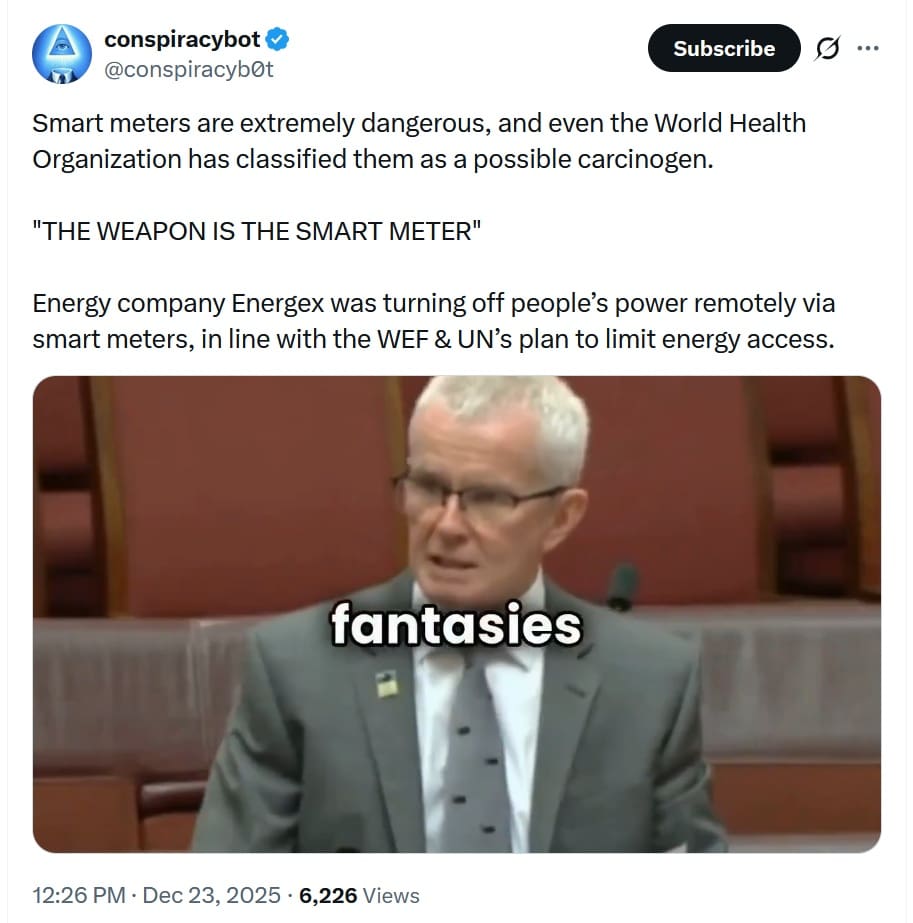
It says smart meters are extremely dangerous and the World Health Organisation has classified them as a possible carcinogen. But you’d think that if they were extremely dangerous, the WHO would get their act together and say, “Hell yeah, smart meters are dangerous! They give you Turbo-granny-cancer!” But they don’t actually say smart meters are a possible carcinogen. Instead, what they do say is that Electromagnetic Fields (EMF) are a possible carcinogen, which isn’t quite the same thing. Fortunately, there’s no good evidence that EMF exposure from mobile phones is dangerous, and smart meters expose you to far less. This is because you don’t walk around with a smart meter pressed against your head. Meanwhile, one thing the WHO says is definitely a carcinogen is alcohol, and we still have plenty of that in Australia.
The link also says in all-caps, “THE WEAPON IS THE SMART METER”, which I don’t think is correct, unless you’re getting Murder She Wroted with one.
The video is of Queensland Senator Malcolm Roberts. In it, he doesn’t say smart meters are dangerous, but he does claim that in regional Queensland, “…households are put on economy tariffs and can only use power for about 8 hours a day.” This statement is so nutty there’s no chocolate bar in the entire world lumpy enough to contain it. My parents have one of these economy tariffs and they have more than 8 hours of grid electricity per day. It’s for their hot water system. These tariffs were first introduced in Brisbane in 1953, two years before Senator Malcolm Roberts was born. In all that time, they have never caused a home to only be supplied with power for about 8 hours a day. I realise he didn’t emigrate here until 1964, but I still think he’s had enough time to pick up how Queensland economy tariffs work.
The Stop Smart Meters Australia page:
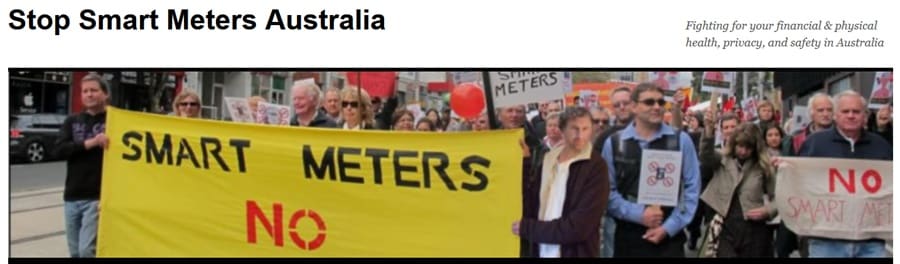
This is your one-stop shop for everything anti-smart meter. If you want to hate on smart meters, I can’t recommend it highly enough. But if you’re into realistic threat assessment, I can’t recommend it lowly enough.
EMF Protection For Sale:
However, if you do think smart meters are a threat, and want to use an online shop, there are people happy to take your money in return for protective gear, such as a website called Aus Security Products, which avoids claiming that smart meters are dangerous, but goes ahead and says you should consider shielding solutions anyway, which they will sell you.
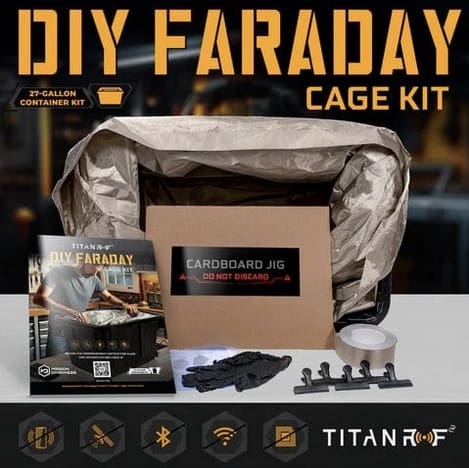
This could be yours for just $285 plus $12 shipping! (Note you can get a roll of aluminium foil from Woolies for $1.90. Personally, I recommend a biscuit tin — because it comes with biscuits.)
With the right shielding, such as a Faraday cage, you can block all EMF from a smart meter. But this won’t necessarily be without consequences. It’s a good way to get a technician to check why your smart meter has failed, and they may not be impressed when they find out it’s your fault and not the meter’s. Expect to be hit with a hefty service charge.
This approach below is a bit more magical:
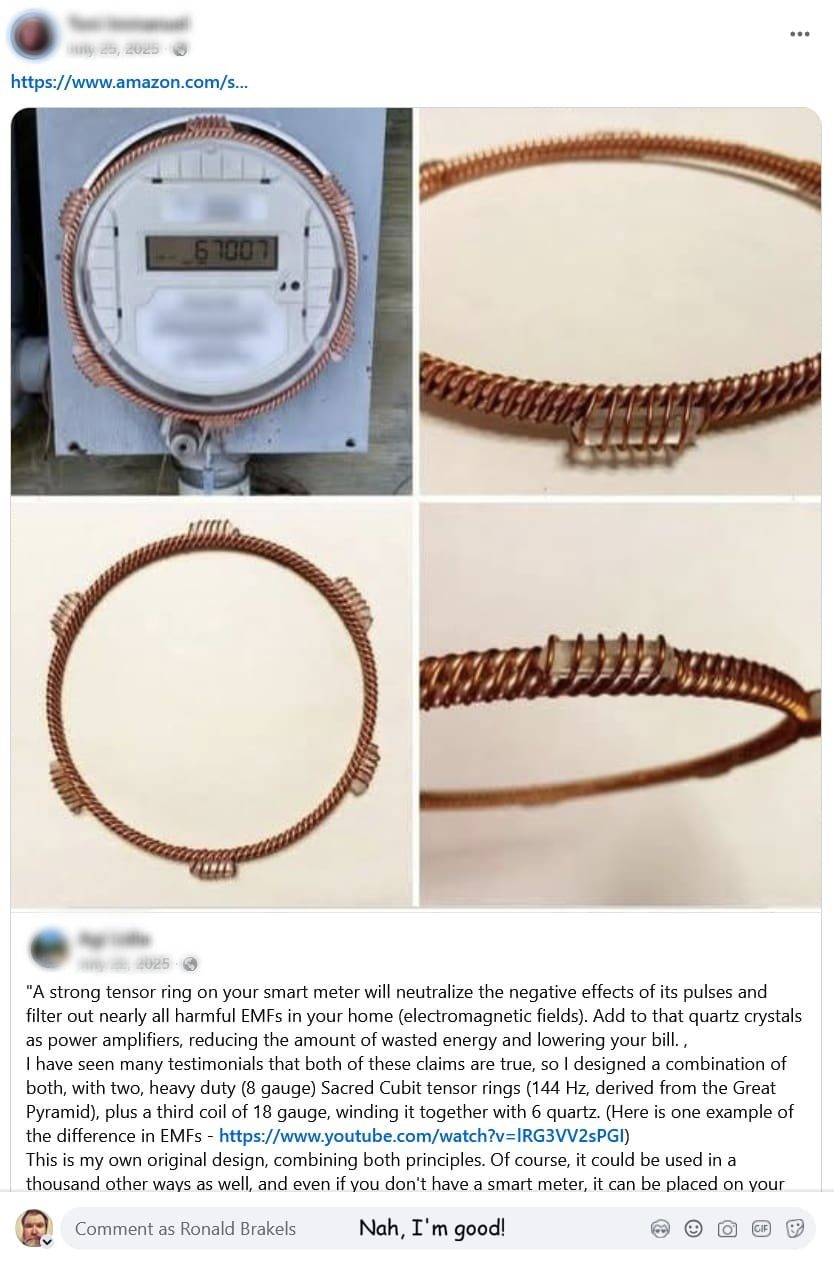
It is true that if you hang a copper band with quartz crystals woven into it from your smart meter, the EMF emissions won’t harm you. But it’s also true if you don’t. While the person who made this could honestly believe they are helping people, I’m still shocked by how susceptible people are to superstition in this modern day and age. I’m also shocked by how it looks exactly like the charm my shaman sold me to protect against serial killers…

Jessica Fletcher: Either she’s so unlucky she just happened to stumble across 286 murders, or something else was going on…
Making Your Smart Meter Dumb Is Expensive
If your electricity retailer wants to install a smart meter, or you already have one, you may have the option of having its communication ability deactivated. Because it will no longer use the mobile phone network to send or receive signals, this can reduce your exposure to electromagnetic radiation, but you’ll also be hit with potentially hefty manual meter reading fees.
Because money costs money, my advice is, don’t do it. Unless you sleep inside a switchboard box — which probably isn’t out of the question given the state of Australia’s property market — you’ll be exposed to far more electromagnetic radiation from using a smartphone than you’ll ever get from a smart meter. Exposure from typical smartphone use is several hundred to several thousand times greater, so I say it’s not worth worrying about. But if you’ve already limited your electromagnetic wave exposure by binning your mobile phone, then I salute your consistency. And be sure to tell whoever printed this out for you that you appreciate their efforts.
While people have genuine concerns about EMF, I’m being genuine when I say there’s no good evidence that emission levels allowed in Australia are harmful, and the amount we receive from smart meters is trivial compared to mobile phones and other devices. Unless you’re willing to cut electricity out of your life, there’s no real point in not having a smart meter. And if you do ditch electricity, you won’t need one anyway.
Smart Meters & Dumb Decisions
A more reasonable concern behind anti-smart meter campaigns is the fear that electricity retailers or grid operators will use them to screw people over.
Depending on location, in the past, getting a smart meter could cause you to be kicked off your flat tariff and forced onto a time-of-use or demand tariff, regardless of whether or not you wanted one. This sometimes resulted in old grannies being dumped onto demand tariffs and being hit with hefty demand charges without understanding why.
Because this rotten behaviour pissed people off and caused them to hate smart meters, the AEMC worked to change the rules so households can remain on a flat tariff after having a smart meter installed. In practice, you can use a flat tariff with a smart meter provided electricity retailers offer them, and at this time, they appear available throughout Australia. This is likely to continue because electricity retailers don’t really care what tariff you’re on as long as they’re making money.
Universal smart meter coverage is coming, although not everyone will be happy about it. But most of the smart meter hatred out there is not due to the meters themselves, which are pretty harmless, but is instead the result of dumb decisions made about them. These include:
- Australia’s first smart meter rollout in Victoria promised lower costs, but charged households for them upfront.
- Kicking people off flat tariffs against their will when smart meters were installed.
- Forcing people to pay fees or higher daily supply charges when a smart meter is installed, even though they lower costs for everyone.
That third point is still going on. If the AEMC wants their accelerated smart meter rollout to go well, they should consider changing it.
Once AEMC gets the 100% smart meter penetration achievement, it will unlock this costume for their Chief Executive to wear.
Smart Meters Can Have Dumb Fees
If your electricity retailer contacts you out of the blue and says they want to replace your old meter with a smart one, you won’t have to pay a thing. At least, not upfront. When an electricity retailer initiates a changeover to a smart meter, it’s usually free. But in Queensland, you may have your daily supply charge bumped up by around an extra $20 a year.
If you get electrical work done that results in a meter changeover, such as getting solar — whether or not batteries are included — then you can be hit with upfront fees. These vary by location, but the meter changeover fee usually isn’t too bad, as you don’t have to pay the full cost. Usually, it’s under $100. You could also be hit with a special meter read fee, but as you’re only paying for one, it’s not too bad. For a straightforward meter changeover, most Australians should get away with under $150 of damage. But when things aren’t straightforward, it can get expensive.
Charges for 3-phase meter installations can be higher, and if additional work needs to be done, you can also be charged for it. If the workers can’t access the meter location because the gate was locked or you have a scary chihuahua, you can be hit with a wasted visit fee. And if your switchboard is ancient or full of asbestos, it will need to be replaced (the switchboard, not the asbestos), which can set you back a couple of thousand.
What If I Don’t Want A Smart Meter?
If you don’t want a smart meter, you have a problem because everybody is supposed to get one. The AEMC is going for universal coverage, which is very ambitious, given they haven’t even put a smart meter on the moon yet. But if you’re on-grid in Australia, your two main options if you don’t want one are…
- Go off-grid
- Get a smart meter, but request its communication capability be turned off.
Going off-grid is the nuclear option. This is because it’s a serious step and because you’ll be running your home almost entirely off nuclear fusion — which is what powers the sun. It’s not a cheap option. You’ll have to pay for a sizeable solar, battery, and generator system, and if you go off-grid first, you won’t be able to use the federal battery rebate. You’ll also have the drawbacks of not being able to receive a solar feed-in tariff or Virtual Power Plant payments. It’s also less environmentally friendly than an on-grid system, because you won’t be able to send your surplus clean energy into the grid for others to use. But, provided you hate smart meters as much as you love being bad with money, it can be done.
Going off-grid may suit those who despise smart meters for having the audacity to not just record how much electricity they use but also when. But if you’re not worried about that and your concern is instead smart meters’ ability to transmit and receive, it is possible to ask your electricity retailer to disable your smart meter’s communication capabilities.
This will stop your smart meter from using the mobile phone network, but your retailer can charge you for special manual meter reads. You could be charged a fee each time the meter is read, or the cost could be added onto the daily supply charge on your bills. Amounts vary by location, but special meter reads can be over $40 each. With one each quarter, you could be charged over $160 per year.
Just make sure you’re not overcharged for special meter reads, because in reality, they’re rarely read each quarter. Usually it’s once every six months and electricity retailers can get away with less than that, because all they’re required to do is make a “reasonable effort” to read them at least once a year. So if you do have to pay special meter reading charges, check if you have to pay them every quarter, no matter what, or only when the meter is actually read.
Smart Meters Aren’t Dangerous
Electromagnetic radiation, such as radio waves and microwaves, can kill you. In some physics labs, there are devices that can expose you to so much EMF you will convulse and die within hours, or possibly seconds if they don’t use eco mode. Also, if you’re warming yourself in front of a microwave communications dish while it’s transmitting “Murder She Wrote” and Jessica Fletcher takes the opportunity to turn it up to full power and pin the blame on someone else, that’s not going to end well for you. (While the transmission probably won’t kill you, once you’re in Jessica’s sights, your days are numbered.)
But this is completely different from the EMF output from a smart meter. There’s no good evidence that EMF from mobile phones is dangerous, and having a smart meter will expose you to perhaps one thousandth as much. While you might decide you’d rather be safe than sorry, to be consistent, you’d have to get rid of every electronic or electrical device, as they all give off EMF in one form or another. So my advice is to just chill and not worry about it.
If, after getting one, you still can’t shake the feeling that there’s a chance there’s some danger, then take the money you save from not having to pay for special meter reads and potentially from having a time-of-use tariff, and buy yourself some buckets of alcohol and packets of cigarettes. Then you can relax, because you can be 100% certain they’re bad for you.
For more on smart meters, read my recent piece on how you’ll need one to cash in on free daytime electricity.
 About Ronald Brakels
 RSS - Posts




Hi Ronald,
Can you comment on EMF emissions from hybrid inverters?
Dave,
You can test it for yourself. If AM & FM radio reception is still good, and non-cable TV reception too, then EMI is minimal. For a tough test, bring the radio close to the inverter, to determine the small area you might prefer not to sleep in all night, just to be sure.
Here, years ago, a Modified Sine Wave inverter put lines on the TV picture. It is RF harmonics of its nearly square wave output which did that, without necessarily being more harmful that the TV transmissions.
EMI = Electromagnetic Interference
RF = Radio Frequency
EMF = Electromotive Force = voltage
If the inverter is metal clad, then the purely electric field (EMF) will be well contained (Faraday Cage), but high frequency EMI can squirt out through small apertures, if generated. (A hole in a microwave oven is seriously bad news! The EMI from an inverter may be a millionth of that – inconsequential when adequately designed and tested.)
I’ve heard all of the crying for a whambulance about EMF from items like mobile phones for the last few decades and guess what? There has not been any significant increase in brain cancers directly related to the position of the mobile device emitting non-ionising radiation, so there is even less chance from smart meters to do so given the distances.
“The International Agency for Research on Cancer classified radiofrequency fields as Group 2B possibly carcinogenic in 2011, the same category as coffee and pickled vegetables, reflecting limited and inconclusive evidence rather than established harm. Regarding smart meters specifically, ARPANSA measurements confirm they emit approximately 0.000002 watts per kilogram at one metre distance compared with the 2 watts per kilogram safety limit, making emissions at typical household distances negligible.”
Good info, do you have anything on hybrid inverters?
Well Ronald, I have to disagree with you in part –
Smart meters may not be bad for your health, but they sure proved to be bad for your wallet when they first started rolling them out.
They were definitely a weapon used by retail electrical companies in an assault against their customers wallets, with time of use and demand tariffs the hidden free gift you couldn’t refuse, that they delivered at the same time as the meters.
Luckily the public outcry produced enough pressure for them to “mostly” abandon that strategy. But it certainly damaged the public perception of the roll out of smart meters.
Malcolm Roberts …. enough said..As for smart meters, I expect to disconnect from the grid in 2028 when the 59c FiT ends so the retailer can stick their smart meter where the sun doesn’t shine. With 24kw of panels, 80kwh of batteries and 15kw inverter, I don’t need the grid. In any case I do not need the constant predations of the electricity crime gang.
Errr … Doug, my brother is being paid to remain on-grid, at single-digit FiT.
How is it that you’re being hard done by at around ten times his FiT?
Regardless of the rationality of the grid hate expressed on these blogs, it seems a sign of poor tactics on the part of grid operators. Free smart meters would have been a one-time cashflow hit, moderated by slow roll-out in any case, and entirely paid for by meter reading savings. A beancounter’s own goal?
It seems advisable to recoup grid repurposing cost gradually, or some degree of death spiral results. OK, losing prosumers may actually be optimal – chop the grid back to serve only the captive market. Less wires = less maintenance cost. Less peak load = less investment = more profit.
Prosumer grid support is now rarely wanted – batteries reducing peak demand is the primary game in town now. But an eye to the long game might obviate a grid proximity tax to help the grid compete with resilient free distribution of free energy.
When we had our solar installed late 2023, there was no discussion about the retailer aspects, things to consider.
I feel it should be a big part of you solar plan, as much as the solar system itself, solar sales could at least talk about it.
While solar is a minefield of choices in its own right, there is as much (or more) to consider with a plan to suit your usage and new solar impacts.
We had 2 new smart meters installed, one for general usage and solar, one for controlled load (CL) for the HWS.
It was just so due to existing setup for HWS and off peak timing.
In hindsight, and since, putting out HWS circuit on a timer and running it in shoulder (or EV night rate 8c as we do), or off free daytime soar with a diverter device would have been a much better option from the start.
We were also taken off single rate to a TOU tariff, no discussions, asking what we want.
As it turns out we are probably better off on that, and combined with the 6 hours of EV 8c early mornings, we save a lot.
Unable to haul my farm close enough to the grid, I can confirm that a fit-for-purpose off-grid installation doesn’t achieve payback compared to proximate grid power – ever. (It’s only when hauling the grid to the farm is costed that the sums have any chance.)
One thing, though – the generator can be a little one, as it only needs to be able to top up the battery at the house’s average consumption rate, not peak. (My little 3.2 kW Honda hasn’t run in two years, except out in the paddock, due to oversized arrays yielding adequately in winter & cloud, plus ample battery, sized for utility, not payback.)
To stick it to greedy grid goblins, I’d save up for a BEV – that maxes solar self-consumption mightily, and achieves a 95c FiT, in fuel cost savings. (There’s not even a need to wear a tinfoil hat for that.) A little BEV is cheaper than ICE now – especially when $3k p.a. fuel saving makes an Atto1 free after 8 years, or an MG4 after 11 years.
I was on a zoom meeting with the Mackay Conservation Group (Qld) last week. I always, in Climate Change discussions, bring up my commitment to renewable energy and strangely an older (very committed) lady said she wouldn’t have smart meters installed because of radiation concerns.
I tried to explain to her using much the same arguments as above.
I have now sent her a link to your story, Ronald. Thank you.
Hopefully, she may take more notice of this more authoritative information.
Whilst I was living in Perth, Western Power/Synergy, WA’s monopoly supplier, installed smart meters grid-wide at no cost to customers. IIRC about ten years ago.
What I found VERY surprising upon moving to Melbourne two years back is that Victoria’s smart meters are mobile-phone connected. The meters installed in WA communicated to ‘head office’ via RF superimposed on the power lines.
I wish I had a photo of the huge 66kV-rated filter coils and capacitors installed in Perth’s switchyards. Why didn’t the rest of Australia follow suit with what seems like a lower maintenance and more reliable system of getting meter data back to base?
Hi Clive,
I think the Victorians use low energy mesh networks (zigbee?) to join meters and even street lights to each other, so the actual comms links to the phone network are much further apart.
However in SA (and other states?) every meter has a sim card to talk to the phone towers.
Batchit crazy part was that we spent 10 years(?) installing dumb digital meters for solar export… with time switches for controlled load, not centralised RF or ripple control.
So short sighted.
The only thing not-so-smart about smart reader are those who oppose them.
Used properly smart readers give great insights into how to manage am increasingly complex distributed grid.
However, I believe one huge opportunity that was missed was for smart meters to measure actual household consumption as well as grid consumption. This means that as a community we really only guessing about the amount of solar and battery self-consumption and the planners have to guess what a maximum grid draw might look like if self-use was limited because of some natural event.
A foil hat will solve any concerns
I on the other hand, thank goodness they never thought to include measurement of self consumption of solar with smart meters.
Because London to a brick, we would find ourselves paying a “self consumption” tax…
Russ from Warnertown.
When I did a Radiation Safety Officer course many years ago, part of the info we received was a video from Dr Karl Kruszelnicki about the difference between ionising (dangerous) and non-ionising (not dangerous) radiation. I have a link to a video where he describes it well: https://youtu.be/gtWLhJIkSCI?si=8QTPbwgj_D0686YK
Of course non-ionising is not totally safe, at high enough power levels it will heat you up: think microwave ovens, or a powerful radar system, but not at the level of Wi-Fi, mobile phones, your car’s ignition system etc. If you are really worried about exposure to “radiation” the most dangerous source we all are exposed to is the UV coming from the sun: stay inside!
Well, I WAS very pro smartmeters. Couldnt wait till they rolled them out. I have had one at home for many years. All good. My electricity retailer provides hourly consimption/export data for the previous day, then way back to whenever.
I can see what (Watt?) I use and when. And given my old inverter”s data capture, I can see self consimption too.
So they installed one at my coastal shack 20th Feb. Now my solar output there has all but disappeared! The retailer’s data shows zero export since install. The inverter’s app shows 2 grid fail incidents per day. The first at 07:06 (grid fail) and the grid comes back on at 10:36.
The second incident happens at 13:06 (grid fail) and that recovers at 22:06.
The retailer’s smart meter team have no idea at all. I have sent them logs etc. No response.
Now if I hadn’t checked the app, I wouldn’t have known about this and I would have received a huge power bill next time.
NO WONDER people are ANTI-SMART METERS
A left field thought, has your export limit been set to the appropriate level on your inverter?
Maybe your new smart meter is curtailing you by switching exports off when they are to high?
Thanks Andrew .
I thought that when i saw it was everyday, twice a day. But the times are almost always the same times. Always XX:06, or XX:16.
The afternoon grid fail ends at 22:06. Not likely caused by excessive output.
The morning grid fail starts at about 7AM, and ends usually at 10:16AM. that would be when the solar output is increasing.
And the weather on site has been on and off cloudy and rainy. Very random.
But, it may be a setting, anticipating excessive output, so it kills the grid anyway??.
Seems like a draconian way to limit output.
And it doesnt explain why the retailer sees NO export at all.
Jeff
EXACTLY.. The retail bloodsuckers never do anything in the interests of consumers. Their culture is parasitic and customers are there to be gouged. One needs to view EVERYTHING they do with a massive dose of cynicism until it is proven beneficial to the consumer. This is not negativity but rather my universal experience in all business dealings with the bloodsuckers.