
 If you want to control your air conditioner properly with solar, it helps to understand how the thing actually works. As an ex-control systems engineer, this is right up my alley. Let’s break it down.
How Air Conditioners Control Temperature
Old-school “bang-bang” control
Early air conditioners used to work on a crude method called bang-bang control. You set a temperature (called the set point) on the remote.
- In cooling mode: if the room is hotter than the set point, the compressor kicks in at full power. Once the room drops below the set point, it switches off.
- In heating mode: same idea, but flipped.
It’s literally all-or-nothing.
Modern inverter control
These days, air conditioners use inverter control. Instead of being 100% on or off, the compressor can run anywhere between 0–100% power. That means:
- Better temperature stability
- Higher efficiency
- Longer lifespan (less hammering the motor on/off)
The Brains Behind It: PID Control
So how does the aircon know how much power to pull at any given moment?
It uses a bit of maths called a PID algorithm. I won’t bore you with the equations (I’ve literally written three books on it), but here’s what you need to know:
- Not all PIDs are equal. Bad implementations behave no better than bang-bang. Good ones keep the room at a steady temp with smooth adjustments.
- The algorithm reacts to “error”. Error is simply the difference between the set point and the actual room temperature. The bigger the error, the more power the system pulls.
Example: your room is 12°C and you want 22°C. The system starts at full power, then gently ramps down around 20°C so it doesn’t overshoot, eventually holding the room steady at 22°C. It might settle at, say, 63% power.1
Electrical vs Thermal Power
Here’s where confusion often creeps in.
- A unit might be marketed as a “14 kW air conditioner”.
- That number refers to thermal output (how much heating or cooling it can push into a room).
- The actual electrical input is much lower, thanks to heat pump efficiency.
For example:
- A 14 kW aircon with a coefficient of performance (COP) of 3 only needs about 4.7 kW of electricity to pump out 14 kW of thermal energy.
- If the COP is closer to 4, then it’s even better – about 3.5 kW electrical input for 14 kW thermal output.
So when you size your solar, always work from the electrical rating, not the flashy marketing number.
Covering Aircon With Solar
Let’s assume your aircon pulls 7 kW electrical at full power.
- A 7 kW solar system only hits its peak on a perfect day at midday.
- Losses (shading, inverter limits, panel orientation) reduce that further.
- So if you want your aircon always covered by solar, you’ll need way more than 7 kW on the roof.
The good news:
- With decent PID control, your system won’t run flat-out all day.
- Once the room is at temp, power demand drops sharply.
- A well-sized battery can also smooth things out – topping up the shortfall when the aircon starts hard or when clouds roll over. Remember you need to think about:
- battery power: kilowatts (kW) to cover initial power (and surge currents if you want it to work off-grid)
- battery energy capacity: kilowatt-hours (kWh) to get you through the evening once the temperature is maintained.
Smarter Use: Pre-Cooling and Timing
Because solar is strongest during the day, it’s smart to:
- Pre-cool (or pre-heat) the house while the sun is out.
- Get the temperature stable by late afternoon.
- Then let your battery take over for the evening.
This avoids smashing your battery with a full-tilt aircon load right after sunset.
Unfortunately, most Aussie homes have such a poor thermal envelope that the pre-cooling doesn’t last long. To improve your home’s thermal envelope, address:
- gaps
- glazing,
- insulation.
Then, unless you live in the tropics, add thermal mass to your home. Use dense materials like brick inside, and for bonus points, swap your plasterboard for something more substantial.
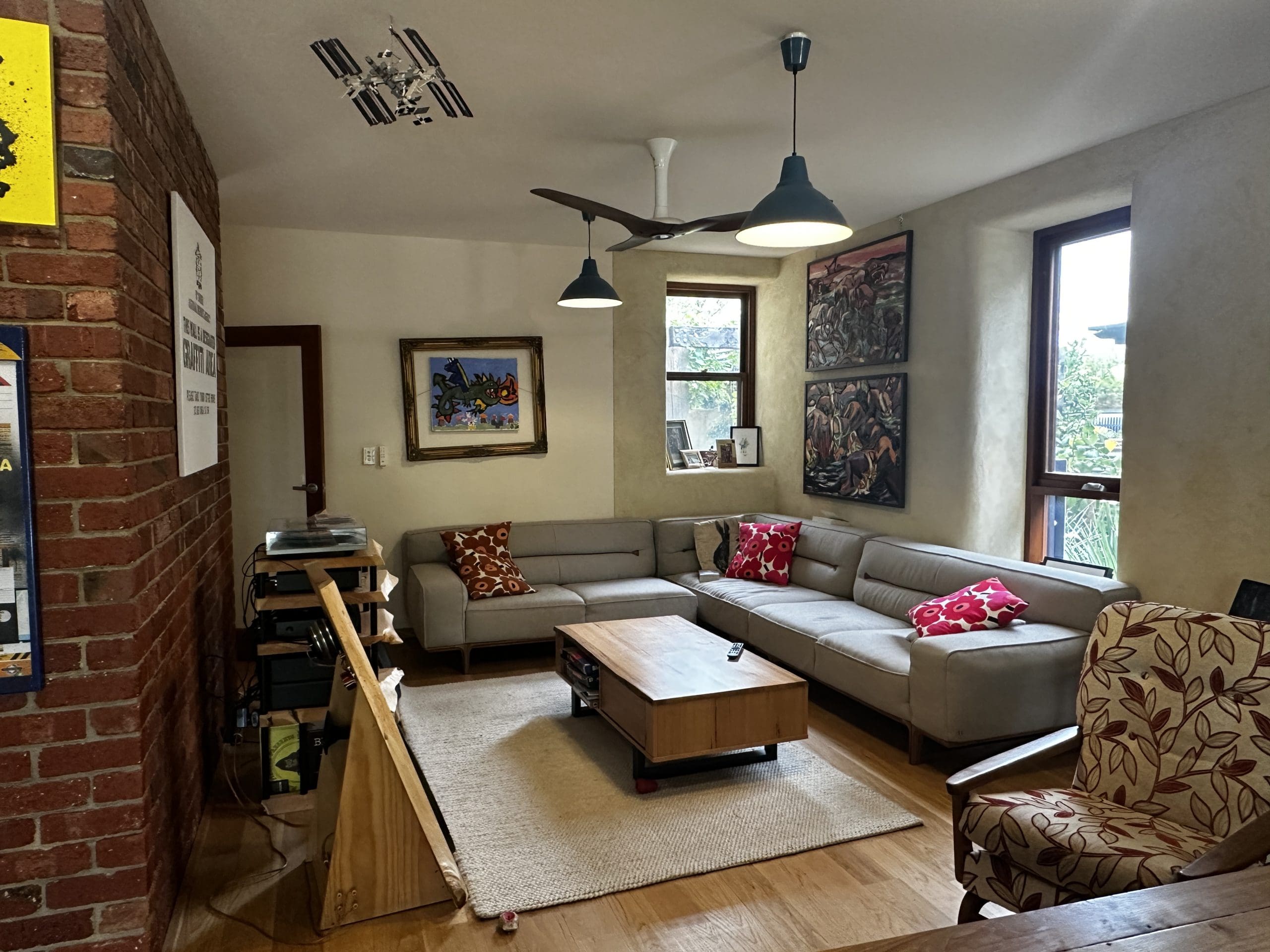
Bricks inside for thermal mass and lime render instead of Gyprock works a treat.
What To Discuss With Your Installer
If you’re serious about covering aircon with solar, sit down with your installer and talk through:
- Electrical size of your air conditioner (not the thermal rating on the box).
- Your usage profile. Cooling in summer is easy – sun is abundant. Heating in winter (especially in southern Australia) is harder, so you’ll want a generous solar array.
- Your habits. Do you want the unit running all night, or just until bedtime? Do you blast it in the morning before sunrise?
- Data. If you’ve got smart meter data (5-minute resolution), you can usually see aircon loads clearly. If not, consider a dedicated meter on the circuit.
From there it’s about sizing:
- Solar array large enough to cover daytime loads.
- Battery sized to stretch that coverage into the evening or early morning.
Wrapping Up
That’s the basics of matching solar with air conditioning. In short:
- Don’t confuse thermal and electrical power ratings.
- Expect higher demand at startup, but lower demand once the room stabilises.
- Solar covers the bulk during the day, batteries smooth the rest.
For verdicts on which air conditioners are worth getting and which brands are best to avoid, check out our new aircon review hub.
Footnotes
- An air conditioner with a good, well-tuned PID algorithm does not need to be set to 16ºC to get it to cool down quicker, the algorithm will know to run at full throttle at first. But good luck explaining that to the rest of the family. ↩
 About Finn Peacock
 RSS - Posts





still waiting for heatpump systems that can be controlled by setting the absorbed power in relation to the available excess solar. I talked to a swimming pool heatpump manufacturer. They said it could be done, but as usual everybody asks for it , but there is no demand. (monty python ..)
The electric car is sofar the only device that can be controlled to adjust its absorbed power from the grid. it´s a long road to go….
All that detail on inverter drives, PID control and solar matching, and no mention of DRED.
In Australia, DRED under AS/NZS 4755 is the only standards based external control path into residential air conditioners. It sits above the internal PID loop and determines whether, and in which limited modes, the unit is allowed to operate at all. Without DRED or a proprietary API, the aircon is completely blind to grid conditions, export limits or available solar.
That said, DRED also highlights the deeper problem. It is coarse, discrete and manufacturer defined. It cannot accept a kW setpoint or smoothly follow excess solar the way EV chargers can. It is a grid protection tool, not a true solar integration mechanism.
So yes, PID explains how inverter aircons behave internally, but without discussing DRED, the picture of how air conditioning actually interacts with the Australian grid and rooftop solar is incomplete.
ah, i want my room cold, (or hot) i really couldn’t care less about how it interacts with the grid. And i just sized my battery so it can run the aircon all night, so i dont really care about how it interacts with my solar or battery either, as long as both have enough grunt to run it all the time between them.
Andrew – I am with you, as I suspect most people are. Just not on here as many here are committed and competent enthusiasts with a level of technical interest and ability well above the average solar/battery/EV buyer. Much as I find Solar Quotes an enormously useful tool, I am not interested in turning my aircon/heating/solar/battery/EV charging into another engineering project and project managing it obsessively. I’m retired and have left that stuff behind for more interesting things to me.
My goal in upgrading my system this year will be to ensure I have enough heating and cooling capacity to always be comfortable in my new (well insulated) house, to have enough solar and battery capacity to cover all loads the majority of the time and to largely “set and forget” the system. I will simply check occasionally that it is all working fine. If it is not the most perfectly efficient thing or I have to pay for a small amount of grid electricity I won’t be filled with DRED about that!
One of my projects this year is to automate DRED based on PV production, remaining battery capacity and external temperature. (A good nights sleep is far more important than avoiding buying energy).
Although there is some incentive in Qld to use units that are controlled by Energex.
Hi Craig,
You might find a CatchControl 6 channel unit is handy, they have DRM terminals as standard.
Very good project documented on the home assistant community site using DRED and 4x relay to match aircon power consumption with excess solar production.
Fair points, and I agree on DRED’s role in the standards.
The reason it wasn’t covered is practical rather than theoretical. Nearly 100% of inverter air conditioners use internal PID control, but the share of residential systems with DRED actually connected and used in Australia really does round down to zero. In practice, most aircons are blind to grid and solar conditions, not because the standard doesn’t exist, but because it’s rarely implemented.
I also agree that DRED itself is coarse and mode-based. It works for grid protection, but it’s not a true solar-following control path. The post was focused on how air conditioners behave internally, and how to use that knowledge to stay under the solar curve in operation, rather than on an external control mechanism that, today, is mostly unused in the field.
Great article. We have an older home, the opposite of modern open plan design. Every room distinct, in a very cold town. When it came to decisions about how to heat the home in particular, we went with 8 split systems, one for each main room. It meant none of the units needed to be above 3.5kW thermal output. All modern inverter units (Daikin and Panasonic). In winter we sometimes have all 8 units going at once. I’ve not once seen them draw even 4kW, even when all running.
I also had all the glazing upgraded to double glazing, and the house is double brick so has excellent thermal mass. I heat or cool the house during the day, as Finn describes, and the thermal mass does much of the overnight work. A home efficiency group was horrified I left the units running sometimes 24 hours per day in winter, saying i’d use much less energy just blasting them mornings and evenings. I had the data to prove that wrong, but left the group instead.
I have a mix of 20 plus year old and new reverse cycle systems (3 out of the 7 have been replaced). It is very interesting to see the power usage curves. The old school units come on with quite a noticeably peak for about 5 minutes every half hour or so at night, (less often if not a stinker of a night). The new units, it is very hard to see there activity at all, just the slightest rise in the power usage here and there above background.
The old units definitely use more power, but still not that much i would race out and replace them. They seem to use about 1 1/2 kWh of power overnight. against about 1 kWh for the same size new units. (Just roughly based on how much extra we use from the battery if we are running one overnight).
Yes, thanks to a Whole House Energy Meter with a dedicated meter for the AC, I watched our 3.5kW unit sit on 1000W until the space cooled then sit on around 350W (300W with a mister). Easily covered by our small solar array most of the time. And now our battery easily covers our AC needs.
I was surprised our space lost its coolth so quickly. We participated in an AGL Peak Event on a very hot day (pre battery) and I shut down the AC after pre cooling. The room temp went from 21C to 29C within an hour.
Be good if you explained what DRED stood for.
I googled it , now I know.
AS/NZS 4755 is Australia/New Zealand’s standard for electrical products like air conditioners, pool pumps, and EV chargers to have Demand Response capability, allowing grid operators to remotely adjust their power use (e.g., reduce load) via a Demand Response Enabling Device (DRED) during peak times, offering financial incentives, with the framework defining how these smart devices communicate and operate in different Demand Response Modes
It seems a pity that Australian building standards seem not to follow the EU or other more sophisticated markets. Australia is still building insufficiently insulated leaky buildings. We try to insulate better, but then increase the risk of mould due to condensation in the insulation due to temperature differentials & building leaks: Air leaks move through insulation, so the temperature differential inside to outside causes condensation.
Tighter building standards must be linked to better air leak management. We do not even mandate blower door testing on new builds yet. These tighter air leak standards must be linked to a decent air-exchange system, because tighter air control can lead to a build up of CO2. MVHR is an efficient way to exchange air while recovering heat or cool. Linked to a heat pump (Air conditioner) the building energy efficiency can be far higher than currently enjoyed by Australians.
This will depend on where you live, the season and what the weather is like on the day however many people forget to just open the windows in the afternoon when there is a cool breeze.
It may not be the exact same temperature as an air-conditioner produces but often its nice to have the fresh air and your body adjusts.
Then the opposite happens. People leave doors or windows open when its hot which lets the cool air out and hot air in. Also close the doors to rooms you are not using and turn the air-con off.
If you are building a new home they tend to have insulation as standard now. Unfortunately people dont optimize the roof style to support solar panels which they should. Its such an easy win and also build a good area for batteries – eg outside but undercover and not adjacent to bedrooms.
With air-cons some of the best ones use very little power and are quiet. For example the MHI Avanti Plus.
About the most useful comment here.
Yes, you can open a door or window. The issue is that Building standards are being tightened, so houses do not leak as much as has previously been the case, BUT if the houses are sealed, the CO2 & other pollutants can build up. An MVHR can fix that problem very efficiently by changing the air. One can still leave a window/door open, but it is not necessary. The issue is the Australian Standards have not addressed all the issues of modern (sealed) buildings.
It’s pretty hard to find a battery with a discharge rate of 15 KW which is what I need for start up when running aircon. Mostly want to start them in the evening and early morning when the panels aren’t producing. Any battery recommendations?
13.2 KW of panels.
Hi Brian,
A 7.5kW Selectronic SpPro will surge to 18kW for 30 seconds.
Australian made, heavy duty, conservatively rated, brilliantly supported, reassuringly expensive.
In a world of lightweight hybrids there’s simply no comparison.
https://www.solarquotes.com.au/blog/selectronic-sp-pro/
Brian & Anthony, I guess you are grid connected, so the start current is not a problem cos extra will be sourced from the grid, but that is a concern when we start paying for Maximum demand. (but the difference is probably not a concern there too). The actual power used to start motors is not high, but the peak current is, but you only pay for power used.
Inverter driven Heat pumps would soft start, so start demand usually would not be an issue. This shows how important it is to choose appliances carefully.
As an aside, my Induction cooktop ran off our 5Kw generator during the ´22 floods. Sticker wattage is not always the full information. Of course we could only use 1 or 2 areas of the cooktop at once on 5Kw, & not at full power.
Is the current Selectronics grid certified? I have an old one that is grid supplied, but not bi-directional.
Hi Doug,
Selectronic SpPro series 2i are grid hybrid approved.
Though they’re technically capable, post 2015 AS4777 firmware means they can’t export to the grid sadly, but I’m told that problem is being addressed.
As I thought: Able to be connected as a ´load´ but not bi-directional. They are a great inverter, & bulletproof. Be good to see them fully approved for export.
Hi Doug,
The AC coupled inverters which are attached to the SpPro will export as usual, but the rules prevent using the battery.
If you aim to make a dollar generating kWh for the likes of Amber after dark, Selectronic isn’t what you want.
However of you want to treat the grid with contempt, there’s nothing better.
Wow. 15kW for startup of AC. What AC is that. In my experience modern ACs are soft start, which limits surge currents. My 20kW unit slowly ramps to just 6.5kW when running flat out. If you have an old clunker with a big surge startup current, I would not worry about that being drawn from the grid, as it is bugger all kWh as it only last for a second.
Are you sure you AC is really drawing 15kW, as I don’t think there would be many domestic AC units doing that, and if there is some old clunker, you have got to wonder if it is time for a more efficient replacement.
But back to original question, Sigenergy have 3 phase EC up to 30kW. Single phase units up to 12kW. Multiple stacks and increase this further.
But again, suggest your check your assumptions about the 15kW AC, and make sure you are not looking at the heating/cooling rating, which is completely different than the actual power draw rating which inverters and batteries need to be sized for.
Need the 15KW for 30-45 min so a 30 second burst uses too much grid at night and morning for summer and winter respectively. Two large daikin units, inverter tecnology, latest models, large house, high ceilings.
The point of a battery is to draw from the grid as a last resort not routine. The lack of high discharge rate is one of the reasons why a battery doesn’t make sense atm and I’m certain I’m not alone.
Wow all you like, the figures are accurate.
What model daikon specifically draws 15kW? And even if you have 2 Daikins that draw 7.5kW each, what’s wrong with a 30kW hybrid that can do way more than 15kW. Does that meet your requirement?
Nothing’s wrong with a hybrid inverter that can process 30KW. But unless the battery can discharge at that rate it is useless. That’s why I asked the question. Do you have a model in mind?
Sounds like you need the Sig 20kW or larger inverter with at least 40kWh of storage. It will discharge happily at 20kW (about 7kW per phase), but the battery would be depleted after a couple of hours so you would likely need two stacks, but the rebate only applies to first 50kWh of storage so could be expensive. 2 x 15kW inverters would get you 30kW and likely remain within any limits your electricity network may impose.
Thanks Luke. The amount of battery storage could be a problem but after everything is up and temperature stable the system draws around 3KW and except for extremes of temperature that’s only for a few hours. I thinking 20-30 KW of storage and if that runs out I’ll draw from the grid. Lots of good suggestions coming, thanks.
With a Sig you will need at least a 32kWh battery to deliver 16kW. The amount of power is related to the capacity. 0.5C where C is the capacity. 40kWh battery can deliver 20kW (or up to the size of the inverter if it smaller)
FoxESS EQ4800-L9 stack (42kWh) will put out about 19kW. The largest CEC Approved FoxESS inverter is the H3-SMART-15kW which will satisfy your requirements, but the H3-PRO-30kW is coming soon if you feel the need to go bigger.
The 15 kW is not just for startup its for running. For 30 to 45 minutes. And yes it is 15 kilowatt. And no I don’t want to draw it from the grid because I want to be able to cover it either from my solar if it’s during the day or from the battery if it’s during the evening or morning. It’s one of the reasons I don’t have a battery yet. I know the figures, I want to know if there’s a battery that can do the job.
Hi Brian,
There’s certainly things available which are capable.
Lightweight Hybrids like Sungrow, GoodWe & Sig offer 20+kW units. Fronius are bringing some out next year I’m told.
Better yet, a Selectronic system can be arranged with three inverters chained together for 3 phase operation.
They can also be paralleld to build out a system capable of 240kW if you want to run a mining camp.
You can treat the grid with contempt if you like, but it makes perfect sense to keep it there as your backup generator.
We can find you an installer, all you need is a healthy budget.
Thanks Anthony that’s the most sensible answer so far. I’ll check out the sungrow. The other reason why I don’t have a battery yet and won’t for the moment is over a 12 month period I’m in credit with the retailer. Reason I’m looking for a battery is for blackouts and for the time when the feed in tariff is reduced.
So… until you find a system that will allow you to use the grid 0.000% of the time, you’ll keep using the grid 100.000% of the time?
The perfect is indeed the enemy of the good.
If I wanted to be free of the grid I’d have been off grid years ago. The grid pays me for most of the solar I produce and is a buffer for consumption not a routine supply. Which currently leaves me in credit overall. The battery I’m chasing is for routine supply when the solar isn’t producing. But not until the fit reduces to make a battery justified.
Instead of thinking of ways to bait people you need to think outside your own experience.
Brian, it all depends on your usage. Even the 2026 rebates make it worth considering a battery. The middleoftheday FIT will reduce to 0 soon anyway, & only pre abt 8am & post 6pm will give good FIT. Even the battery FIT will reduce in time (the greedy gentailers wings should be clipped!).
However, to charge your own battery, then discharge for self consumption will be viable if your peak demand is enough to warrant the battery.
Currently, I have a 12Kw battery (2018 vintage), & we flatten it every day between 5pm & 8pm. I am considering an extra ~20Kw battery, mainly for blackouts on my rural line.
Yes it depends on use. But also on how much I’m feeding to the grid and how much I’m earning from it.
I am in net credit overall now. So it doesn’t make sense to complicate the system with a battery.
When the fit goes down so much that I’m not making money I’ll install a battery. I’m expecting the retailer to do that any time now which explains why I’m shopping for a battery that can cope with the discharge needed at peak times.
“Then, unless you live in the tropics, add thermal mass to your home. Use dense materials like brick inside, and for bonus points, swap your plasterboard for something more substantial.”
Correct. However there is a good argument for having an insulated solid floor (tile & concrete) to act as cooling thermal mass. Over time the cool air in contact with the floor cools the floor down which then acts as a thermal buffer (mass) which can be pre-cooled in solar excess times. The floor must be insulated from the ground.
What is the required formula when you like the bedroom cold enough to use the heavy blanket?
So far I use 18° with two power 💪 💪 cycles at bedtime, and one everytime I wake.
Hi Steve,
To be honest I’d look at a weighted blanket. One that’s thinner in a thermal sense, but feels heavy to climb under.
One of the recent comments (buried above) was lamwnting the fact that one needs to be an Engineer or Nerd to manage your system.
I feel this is both right & wrong: Many of the battery systems can be externally managed by groups such as Amber, but one must be aware that there are batteries etc that can not be easily managed. Buyer beware!
One area is for people with disparate equipment: These can be managed by Home Assistant, but that is atm, still a nerd area. There are 2 things happening: AI is slowly being incorporated into HA, & I feel there will be a market for external services to manage HA integrations (It is possible to manage HA remotely).
So, at the moment I would definitely look at using one manufacturer for a new system, & it may be advisable to consider that during an upgrade.
It is hard enough for the average consumer to pick an energy supplier (eg I transferred months ago to a product that suited me, but the reseller just announced a price rise of abt 30% !
Hi,
Need input from knowledgeable people here.
Nearing completion of our 2-storey home build in Sydney area (post 2560). We have a 3P supply at our property and have installed 12.32kW solar array (the max we can fit on our roof space) with Anker Solix 3P 20kW battery (hybrid inverter). We’ve asked for power backup on all phases and wondering about the air condition model that would be more energy efficient and would make sense for our setup (hoping to be able to backup the aircon if possible). As the builder is supplying Actron brand aircons, we are limited to choosing the model for ducted installation that can support individual zoning (6 zones in total). It is our understanding that a 3 Phase outdoor model will be the better choice with our setup and is more efficient but happy to be corrected. Of the 2 outdoor models, the 1-phase CRV13BS and 3-phase CRV13BT, which is more energy efficient? https://actronair.com.au/wp-content/uploads/2025/08/Advance-brochure-v14.11-WEB.pdf
Hi Emillio,
I can’t comment on the particular brand but you need to be sure the Anker can run a large ducted compressor unit.
Modern systems with inverter or variable speed drive generally don’t have the massive start up demand which a modest solar system struggles with, but I don’t know how much a whole home AC will ramp down. There would be a minimum air speed, compressor speed & number of zones.
My preference is for split systems because ducts are a waste of energy, zone motors aren’t the most reliable things and having smaller individual units mean you have no single point of failure.
The only trap is that a 20kW 3ph solar inverter would deliver around 6.7kW per phase, so a single phase AC can’t exceed that.
We have 8 split units at home )between 2.5-3.5 kW), it’s an older home so not very open plan. But it works fantastically for us, we’re single phase (63A) and even when I only had a single PW2 as the home battery, we had 6 of those split circuits backed up. It was never an issue, not once have we come close to tripping anything.
Important Question: (Really appreciate answers)
Building a New Home (All Electric 7.5 Star Energy Rating)
I will be installing a 3 Phase Sigenergy 10kw Hybrid Inverter (Might I need 12.5?) System with 16-24kwh Battery Capacity.
Currently Assessing my Air Con needs, Unit is a Panasonic 12.5kw (3.55 kw Input Power) Shall I pay the extra $2000 to have the unit connected via 3 Phase or save the $2000 and stick with Single Phase Connected AC? I intend to pre cool my home all day but what are the differences in how the AC will integraet with the 3 Ph Solar Battery System if its a 3 Phase connected AC or a Single Phase AC connection?
My Electrician has said they can load balance the Single Phase AC fairly easily but as he is not doing the solar install Im curious what downsides having Single Phase AC will do to my intergration?
Sticking with Single Phase AC connection saves a lot of money due to the need of only 1 RCBO vs 4 RCBO’s. This tips it over into needing a second Load Centre.
With the use of solar, we can ensure a comfortable home without worrying about our electricity bills.