
On Xmas day 2025, millions of rooftop solar panel systems installed across Australia did their bit to make the electricity consumed during celebrations cheaper and greener for all with impressive contributions to grid exports. Added to this major contribution were a bunch of shiny new home batteries seeing their first Xmas operations.
How Much Did Rooftop Solar Contribute To Grid Demand?
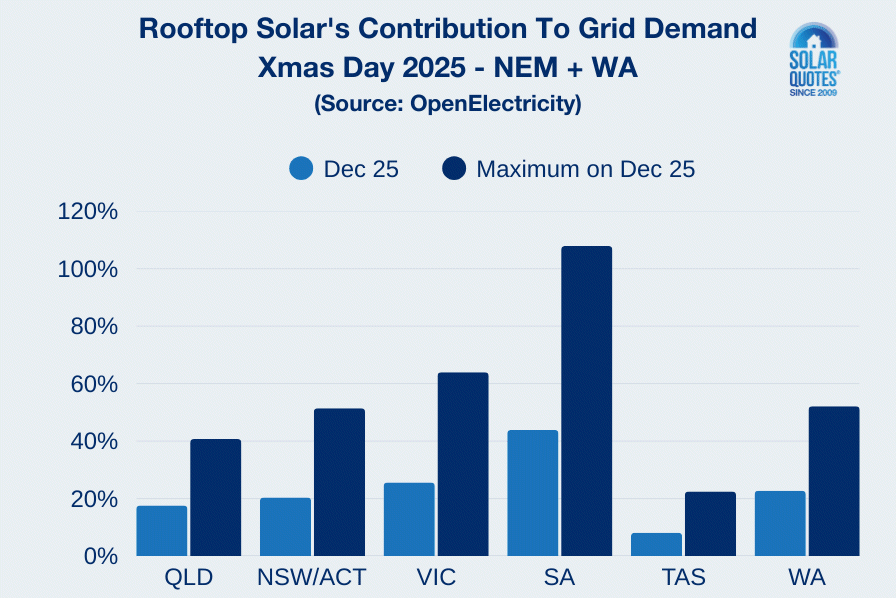
According to OpenElectricity, overall the contribution to demand across the National Electricity Market (NEM1) on December 25, 2025 just by rooftop solar power (not including utility/large-scale) was 21.5%. This was sold into the wholesale market at an average (and negative) spot price of -$54.76 per megawatt-hour.
At 21.5%, the contribution wasn’t quite as high as Xmas Day 2024, which was pegged at 22.9% of overall demand. Peak contribution for the NEM occurred at 1pm AEST this year, at 50.3%.
State By State Contribution
As for the states individually, the contribution over the full day followed by maximums and times they occurred:
- Queensland: 17.6%, and 40.7% at 11am AEST
- New South Wales/ACT: 20.4%, and 51.4% at 12 PM AEST
- Victoria: 25.6%, and 64.0% at 2 PM AEST
- South Australia: 43.9%, and 107.9% at 12.30 PM AEST
- Tasmania: 8.1%, and 22.5% at 1 PM AEST.
- Western Australia: 22.7%, and 52.1% at 11.30 AM AWST (note: Western Australia is not part of the NEM, but OpenElectricity includes WA figures.)
- No figures for NT (not covered).
And, in a graph:
In terms of the amount of solar energy slurped up by the grid on the day (all regions except NT), that reached 135 gigawatt-hours.
Rooftop Solar Uptake In 2025
While solar power system installation figures for 2025 won’t be finalised for some time and the following total number will wind up being significantly higher, the Clean Energy Regulator (CER) reports 221,713 solar systems less than 100 kW capacity had been installed this year to 30 November 2025; compared to 319,044 for the full year of 2024.
Just as some indication how high the 2025 number could eventually go, when I reported on the 2024 tally on December 26 last year the total at that point was only 267,000 systems — finishing up at the 319k mark for the year when the dust had settled from the permitted registration period. But while 2025’s total will climb significantly, it looks like installations could be down a bit this year on last.
The year with the highest installations in Australia was 2021, with 377,458. Although annual levels have been less since, the size of systems installed has grown from 8.8 kW capacity on average (Source: APVI) in 2021 to a 10.2 kW rolling average for the period January – June 2025 (Source: CEC).
Since 2001, more than 4.264 million home solar systems have been installed across the country.
What About Home Battery Uptake In 2025?
The big story for home electrification in 2025 was the launch of the Albanese Government’s Cheaper Home Batteries Program (CHBP). Formally kicking off in July this year and according to the Clean Energy Regulator, 125,447 solar battery systems had been installed and registered since July to 30 November, 2025.
But there are also thousands of already installed systems currently going through the registration pipeline. On December 13, Federal Minister for Climate Change and Energy Chris Bowen said:
“163,016. That’s how many Australian households have put in a battery since 1 July.”
Close to 75,000 home battery systems were sold in Australia in 2024, up from 46,127 in 2023; for a cumulative total of 185,798 installed across Australia by the end of last year (Source: CEC). And after 6 months of the CHBP, some forecasts peg the total installed/commissioned since July 2025 at 175,000; representing around 3.9 GWh of useable capacity when all is said and done.
“To put this in context,” said the CER on December 10, “this is more capacity than the five biggest utility-sized batteries currently operational in the National Electricity Market (NEM) – and all that capacity installed in just six months.”
On top of that there were the systems installed early in the year not covered by the CHBP; so it’s quite possible the overall total for 2025 might eclipse the cumulative number of batteries installed in the years before that.
Not only has it been a stellar success in terms of numbers, installed battery capacities have skyrocketed under the CHBP: from 10 – 12 kWh in 2024 to ~28 kWh since October this year2.
Demand has been such that changes are being made to the battery rebate to ensure it can continue out to its intended finish in 2030. There will be accelerated battery rebate reductions and other tweaks, but many more Australian households will benefit from the CHBP and the extra capacity will provide more benefits for the wider grid.
Going Solar In 2026: Start Getting Ready
While many solar installers are taking a break over the Xmas/New Year period, you can learn everything you need to know about installing solar in our 101 guide; ready to make enquiries and get quotes when they are back on deck. For existing solar owners considering maximising self-consumption using residential energy storage, read our comprehensive home battery guide.
With generous solar panel rebates continuing, the battery subsidy and low solar panel prices, 2026 will be another great year for Australian households to embark on or continue the journey towards home electrification.
Footnotes
- The NEM consists of Queensland, New South Wales, ACT, Victoria, South Australia, and Tasmania. ↩
- Read SolarQuotes founder Finn’s latest column: Supersize Me: The Rise of the McBattery ↩
 About Michael Bloch
 RSS - Posts




Yep, my solar an battery did a sterling job on a stinking hot christmas day here, ran all the aircons all day and night, hours and hours of cooking etc. Didn’t pay the scum sucking pigs one brass razoo for power!!
Not surprising the level of feed in is slightly down on last year. There is little incentive to feed in solar power these days with the rates on offer being 2/5ths of bugger all. People probably use their generated power with less of an eye to maximising feed in, and of course all those extra batteries don’t charge themselves!
The figures quoted at the start of the article are for solar PV contribution to grid demand. I assume that this does not include solar PV used by the residences where the Solar PV (and batteries) are installed. So Solar PV penetration into the market would be much higher than the figures indicate.
Are there any figures that could indicate the level of grid demand and if this is reducing over time?
Well I agree with your opening summary till you mentioned it was cheaper. Yes its cheaper because of massive direct and indirect rebates & incentives that have been supporting the renewable rollout complements of the taxpayer since 2007….
Oh you mean you and me ( taxpayer) great so are we actually better off financially and also how come we now take on all the financial, fire, insurance etc risk of self supply? So when it breaks we chase the installer and manufacturer to fix it hopefully under warranty otherwise bad luck. How is this a good deal again?
I just want cheap power and only think about turning appliances on or off not managing my power station and ky demand and also the community grid. Seems on reflection I think we have sold a scam…unfortunately I now have PVs an Home batteries to manage. What a sucker I/We have become….