
 There’s a strange certainty creeping into battery talk lately. The idea that DC coupling is the grown-up option, and AC coupling is something we did back when we didn’t know any better. I keep seeing installers and Facebook pundits claiming the only proper way to attach a battery to a house is with a DC-coupled system. Anything else is framed as inefficient, messy, a historical mistake or just deeply uncool.
I don’t get it.
Stylish Simplicity
AC coupling is simple. You have one inverter for your solar panels and a separate inverter for your battery. The battery charges using solar that has passed through the solar inverter and become AC. The solar is coupled to the battery via an intermediate AC conversion in the solar inverter.
DC coupling removes the solar inverter. The solar panels share the battery’s inverter. This allows the raw DC solar electricity to go directly from the solar panels to the battery. The solar is coupled to the battery via DC electricity.
For years, AC coupling was common, mostly because the Powerwall 2 was AC coupled. The Powerwall 2 had an integrated battery inverter but relied on a third-party solar inverter, making it easy-peasy to retrofit. It sold in big numbers. Then Tesla released the Powerwall 3 with an integrated battery and solar inverter. It was DC-coupled, and the mood was already shifting.
Integrated, DC-coupled battery systems were becoming fashionable. Sigenergy arrived on the scene with their stacked tower of white plastic that integrated everything. Separate inverters began to look old-fashioned, even if they worked just as well.
I’ve got both types of coupling running. Two DC-coupled systems, Sungrow on the Airbnb and iStore on the shed, with one AC-coupled Powerwall 2 plus Enphase solar on my home. If I’m honest, the AC-coupled setup is the one I trust and enjoy the most, and not for sentimental reasons.
The biggest reason is no power bottlenecks. A DC-coupled system is constrained by the rating of its hybrid inverter. That inverter becomes a choke point for everything. Imagine a house with 12 kW of solar panels, a 10 kW hybrid inverter, and a battery that can also push out 10 kW. Now picture an EV charging at 11 kW while the air conditioning is pulling another 5 kW. The house wants 16 kW. The system can only deliver 10 kW. The remaining 6 kW comes from the grid, even though the sun is shining and the battery is sitting there ready.
With AC coupling, those limits don’t stack in the same way. The 12 kW of solar can feed the house through its own inverter. The battery can add another 10 kW through its inverter if needed. You get full use of the solar being generated, and the battery can cover the extra. No single inverter throttles the whole system. You get access to the capacity you paid for.
Single Point Of Failure
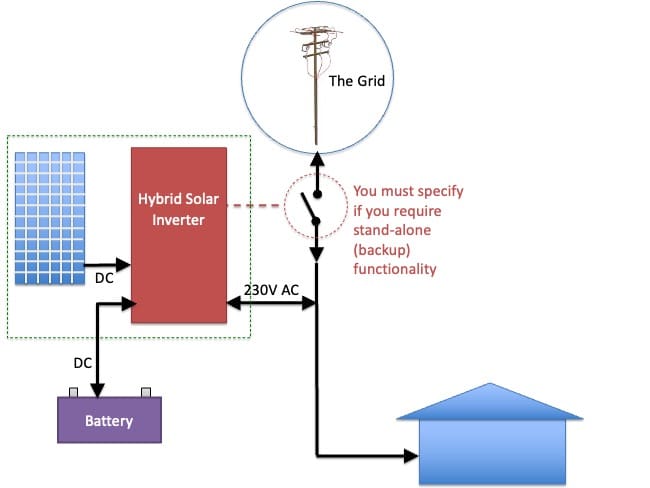
With DC coupling, if your hybrid inverter fails, both solar and battery stop working.
There’s also the boring but important matter of redundancy. Hybrid inverters eventually fail like any other electronic device. When one fails in a DC-coupled system, everything stops until it’s fixed. Solar, battery, all of it. You flip the bypass switch, and you’re back on grid-only. With AC coupling, solar and battery live separate lives. One can keep working while the other waits for a service visit. That redundancy becomes more valuable as systems age.
Upgrades tell a similar story. AC coupling is forgiving. You can add solar later without redesigning the battery system. You can add a battery later without touching the solar. DC-coupled systems are more rigid. Often perfectly good equipment gets replaced early just to make room for something else.
Many objections to AC coupling are leftovers from another era. Whole-home backup used to be awkward or impossible with AC coupling. That changed years ago when inverter standards allowed batteries to control solar output using frequency shifts. If someone says AC coupling can’t do whole home backup, they’re repeating something that stopped being true over 10 years ago.
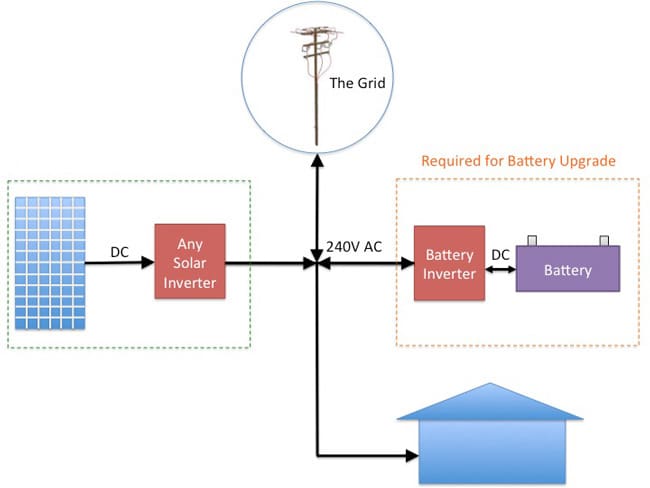
With AC coupling, one inverter failure doesn’t take out everything at once.
An Argument That Never Goes Out Of Fashion
The efficiency argument is another one that refuses to die. Yes, AC coupling involves an extra conversion step. The losses are real. They’re also small. I’ve already run the numbers. It’s not something a normal household should lose sleep over, and it certainly isn’t a reason to rule out an entire system design.
The real issue in Australia is that we’ve drifted so far from AC coupling that we barely have any batteries designed for it anymore. Right now, the only decent-sized, decent-looking battery specifically designed for AC coupling I can think of is the Franklin.
So when you hear folks insisting there’s only one correct way to install a battery, take them with a grain of salt. AC coupling isn’t a mistake. It isn’t obsolete. In some homes, it’s the better option, even if it means a second inverter on the wall.
Phase Shift is a weekly opinion column by SolarQuotes founder Finn Peacock. Subscribe to SolarQuotes’ free newsletter to get it emailed to your inbox each week along with our other home electrification coverage.
 About Finn Peacock
 RSS - Posts





I was under the impression that the powers that be allow you a maximum of 10kw of inverter in any configuration / configuration here in Qld for single phase.
I also thought the issue that remained with AC coupling was black starting?
AC coupled batteries play into the hands of retail electricity bloodsuckers whose culture is exploiting / gouging consumers, whereas DC batteries are infinitely more advantageous ib that they go down the road toward total independence..The bloodsuckers are absolutely guaranteed to parasitize consumers at evert possible opportunity. .. anyone who doesn’t work toward total immuniry is certain to be screwed.
Thankfully here in Sydney on Ausgrid you can have a 10kW solar inverter + a 10kW battery inverter on one phase
I also have an AC coupled only system (with a 40kWh battery and 10kW battery inverter) but my system has a black start setting for AC coupled PV (it reserves a small portion of battery capacity to allow the grid forming and black start when the sun comes up)
My main comment is you’ve forgotten to mention oversizing and DC coupled batteries.
Here and i assume most regions don’t always let you just add more inverter capacity.
For Ergon last i checked they take as standard contracts 1-10KW and 30-100KW system capacities.
The 11-29KW range requires a negotiated connection which i could find literally no references on how that goes last i went searching.
Though I haven’t checked if they still count battery inverters to the inverter capacity limit.
They do include battery inverters, and when I was adding AC coupled batteries to my solar I could not find any details on or any installer who knew how setup dynamic connections. Incredibly frustrating.
Hi Lindsay,
there’s 17 different DNSPs across the country and they all have similar rules, however the devil is always in the details they change. For example we’re going to update our advice on WA connection rules as they’ve been improved.
Where are you?
Qld, Brisbane – this was last year. Trying to 2 NeoVolt 5kw AC Coupled Inverters to an existing 5kw Fronius solar.
Ended up just going with a single 5kw NeoVolt. Its good enough for now.
We’ve had a rash of comments like this spruiking a particular brand.
However this comment below is incorrect.
While it’s true that in some places battery inverters are excluded from solar generation capacity, with 17 different DNSPs across the country the rules vary. A 30kVa site limit applies almost universally.
-admin
They don’t count battery inverters but your sugar installer will not know this, It is a simple part of the application.
Your battery inverter can be huge, the limitations are in the solar inverter.
Having recently gone through this I don’t disagree with your points but I think you neglect a couple. Firstly installer simplicity- the all in one seems to have won the battle here. Secondly price. I had a really good quality but a couple years old pv which I originally planned to ac couple. However by the time you buy another inverter and the gateway hardware etc it was thousands cheaper and neater to get a high quality dc coupled battery. Anyone wanting a barely used fronius inverter please get in touch 🙂
What model and capacity is your inverter?
Primo. 8.2kw (snapverter style). Installed 2 years ago in the garage.
The power bottleneck argument doesn’t stack up on Energex, as they limit total combined inverter capacity (solar + battery) to 10kVA per phase.
So if I have two 5kW AC coupled inverters, then I am power bottlenecked to 5kW of battery charging in the day and 5kW of usage at night.
With my 10kW hybrid inverter I can supply the house with 10kW of solar AND simultaneously charge the battery.
The rest of the arguments stand, but DC coupling is a helpful strategy to get the most out of your investment without breaking the rules.
There is no rule breaking.
My 7.25 kWh Enphase inverters can deliver all AC to the house the extra charges three battery in 3h. The Battery inverter can output 10kwh. Any spikes are covered by the 17kwh max. Not that we draw that much.
He’s stating that his DNSP/retailer doesn’t allow that.
It counts battery inverters capacity to a fixed allowance on capacity.
I.e with a 10kw limit they can have either a 10kw hybrid inverter or a 5kw inverter and a 5kw battery inverter for a total of 10kw capacity.
Hi Nathan,
Some DNSPs (like SAPN) allow 10kW generation plus an additional 10kW of battery inverter on a single phase.
However a DC coupled hybrid counts toward both allowable limits.
A hybrid could also be set up just as an AC coupled battery, but as soon as you connect solar, the rules have been broken.
Hi Anthony,
You mean sometimes SAPN allow both. It depends on who you talk to in SAPN and the installer. I have three phase power but I am maxed out with 20 kW solar inverter (2 x 5kw fronius Grey Primo and 10kW Sumo Gen 24) and 10 kW with 2 Powerwall 2 as they cost the 10kW to the generation side. As much as I argued the writing that the battery inverter is counted separately to the solar inverter the installers will not accept anymore solar.
Good piece Finn. I guess the main draw back for many residential installations is that adding two inverters for a.c. coupling (solar one and battery one) means you may be limited by DNSP rules on maximum IES capacity (total inverter power) at your site. Typically 5-10kW for single phase homes.
Would have liked to keep my old inverter, but the local rule for only a max of 9.99kW inverter and hybrid battery combined meant it wasn’t possible.
However now I will be able to charge an EV at 12.5kW and provide another 9.99kW to rest of the house without drawing anything from the grid with a DC only coupled setup.
Hi Finn, thanks for the reminder on the differences between AC and DC coupled systems.
I’m AC coupled 6kw Trini panels, with 20kWH Enphase batteries.
So I have Enphase micro inverters on the roof, and my batteries have micro inverters incorporated in them.
Regards
Jenko
Would you say the inverter capacity limitations with certain networks play a part to some degree in certain cases? Especially if someone wants to be able to expand upon the system at a later date. In Ausnet for example, if someone had an 8.2kW Primo and a Tesla Powerwall 2 they are well and truly stuck having already utilised a manual assessment with the network to exceed 10kW with an AC coupled battery. Throw in Emergency Backstop requirements into the mix and it makes things even more complicated.
Hi Alex,
You’re really onto something here.
DNSP limits are a pain in many instances & backstop requirements are causing a lot of good functional equipment to go in the bin.
I’m going exactly through this right now. I have an existing fronius (6kw) PV system and have an Sig battery (with 10kw inverter) about to go in.
Different installers recommend different setups.
My only thought on this is that I regularly see my fronius maxing out at 6kw from my 8+kw panels on the roof. Am I missing out on a potential of 2kw generation each day by having the fronius sit in the middle?
Hi Dreg,
Fronius have superior current capacity so depending on how the strings are arranged, your Sig may not be able to handle all the DC solar without rewiring the array.
The number of hours your inverter spends under full insulation is quite small, so the “extra 2kW” really doesn’t yield much.
My advice is to add more solar, doesn’t matter which direction, correct orientation is facing UP.
On my DC coupled system i have 12kw of AC inverter attached to 24kw of battery and 19kw of pv.i also have 12.5kw of dc EV charging. I can be running at full speed on the EV charger and/or putting 12kw into the house battery and still have everything the AC inverter is capable of producing available if i need. Of course I actually can’t, the PV capacity is the limit but if it produces 19kw i can use it all… if everything ran through the inverter then only 12kw would be available in sum… complex modern systems have both DC and AC loads so use what ever backbone coupling works for you but make sure the bottleneck that exists, and there will be one, doesn’t restrict what you want to do. in other words AC or DC coupling is used as marketing to differentiate, above all make sure your total system does what you need…once your boxes are ticked why would you care what the backbone is?
Not sure I understand the point you were making about the Franklin. My sig is clearly designed to support a number of strings on the DC side, but in my case there are none and it is more than happy to accept my enphase output via AC coupling (even when islanded). All the pretty charts show solar production and where it went between battery load and grid.
So what’s the advantage of a battery that must be AC coupled (vs one that can be either)?
If the grid is down, and the battery was exhausted overnight, so it is in self-protect shutdown, then Black Start is normally only possible at sunrise, if you have sufficient DC coupled charging (PV to MPPT-charger to battery), and the battery inverter can grid-form, i.e. its output power can pull the PV inverter off-frequency for power delivery regulation.
A claimed climate-resilient installation must be off-grid capable, for grid failure immunity.
Export limiting must eventually suffice in lieu of useless dopey generation limits. In NSW, 20 kW generation & 10 kW export is OK, in places.
To add BEV charging freedom, just go Off-grid-Garage, and put the HWS on that switchboard – an aircon as well. Now you are free to do as you choose!
Here I have 24 kW of inverters – 12 kW PV, 12 kW battery. With 27 kW of arrays. 3% loss one way is less relevant than still 2 kW yield in heavy overcast, due to array oversize – no issue on your off-grid garage installation.
Just do it your way!
Ok but it doesn’t really answer my question. I didn’t ask why someone might want to use strings on the DC side.
I asked what the advantage of a battery that must be AC coupled given batteries that support DC coupling can do that too.
I recently installed a system with 14kW and a battery. I already had a 10.8 kW system. I struggled to find a new inverter that would also permit the old system to function. Many installers suggested throwing it away but I have plenty of available space for both systems.
However, my Sigenergy system will take one AC coupled connection allowing me to keep the old Fronius run system and have the new one. Doesn’t work perfectly because the Sig doesn’t control the Fronius output but it does what I want most of the time.
Victron can control Fronius AC coupled solar via data comms when the Fronius inverter(s) have the appropriate firmware installed. Here, off-grid, mine just uses delta-f throttling; the grid-forming Victrons simply ramp the frequency up toward 52.8 Hz when there’s too much sun or too little consumption.
With the Victron battery inverters, you can use whatever batteries take your fancy. (My brother uses Zenaji LTO. I use EVE LFP, at much lower cost.)
You missed the main benefit of DC coupling – making the most of solar oversizing. There are products available where the 10kW battery inverter (DNSP limited) can have 20kW of solar directly connected. This allows opens up much more solar to the single phase homes and avoid clipping (at least until the battery is full).
As raised in the other comments, this is mostly a response to DNSP rules, in a lot of cases it’s a no brainer to throw out old inverter/s and max out the solar via DC coupling.
/\ THIS /\
DNSP rules are forcing a lot of good functional gear to go in the bin, along with the archaic Australian 133% oversizing rule… which really technically means you can’t oversize solar using an AC coupled battery. However this is thankfully a rule everyone ignores.
For some amusement have a read of Energex’s requirements for a two phase site: 5kW inverter capacity per phase. So do you put a 5kW string inverter on one and a 5kW battery inverter on the other? Or two 5kW hybrids? Or delete a phase and then they’ll let you have a 10kW hybrid on one phase? Or spend thousands to get three phases?
Hi Mark,
Deleting a phase should be cheap but I’d either install two 10kW machines or 1 x 10kW hybrid with a 5kW standard inverter on the other to get balance.
There’s a lot of ways to go about it.
Or install a 3 phase system that supports 2 phase operation.
We currently have a 7kW (Enphase micro-inverter total) and I read a lot about older Enphase users switching to a non-Enphase battery solution.
When I examine things I’m willing to consider paying a slight premium for an Enphase 5P battery based on a few things:
– Micro-inverters in batteries can be switched off if not needed (less drain)
– Integrated software (including HA data access)
– Modular battery upgrade options with configurable limits to keep within current (and future) DNSP limits.
– A boost function for short higher energy startup draws
– Reduced DC currents involved
– Metal structure cabinets
– 15 year vs 10 year warranty
– I did read Enphase have an excellent BMS and lower risk for long-term degradation to actually achieve any ROI I calculate today
My question is, what is a reasonable premium price for Enphase 5P solutions compared to others on the market? What is it that tips people in a different direction?
I have 4 x 5kWH Enphase batteries,
paid between $4.5 – $5k each, plus installation, minus whatever Fed Gov rebates are available.
I have a similar solar system but connected it to a Sigenergy battery for 14k when the Enphase systems were being quoted at 21k to 25k.
Also the battery is so stupidly huge all of it v would not fit in my garage wall while the Sigenergy stack hardly takes up any room. The system charges a 16kwh battery in 3h.
Worse is Enphase keeps Australia behind by 1 year so the smaller batteries are unavailable (the 10C) and it is not compatible with the previous generation.
I’ve got 10kW Enphase micros (AC coupled) and seeking 20kWhr storage for an on-grid set-up now that I can switch to permanently fully off-grid later (20kWh is enough)
Seems my choices are limited to either an all-in-one box,(eg. 2 x Sonnen Evo10) OR as my local installer recommends, change all my panels to DC, add a Fronius inverter + a Selectronic inverter + 20kWh of rack batteries.
Surely there a cleaner/simpler way to achieve what I want, keeping my AC coupled solar?
When you talk about your choices, did you consider Enphase batteries and then rejected it for a particular reason?
Not allergic to Enphase as an all-in-one solution, just that Sonnen use the most confident language around “off-grid” for their Evo, more than Enphase do.
Still, there has to be something better than a proprietary-box solution?
OK, I was thinking having an IQ System Controller 3 INT provided a very fast grid outage support and simplified/standardised wiring solution for whole house. One of the other areas I was pondering was balancing was current limits on DNSP inverters and if these change in future I’d already have a modular system that would be easy to add to when rules change (e.g. around bi-directional chargers and their inverter capacity).
I understand looking at Enphase means a smaller battery solution for now given both higher price and DNSP limits, however I do wonder what the long term game looks like over the lifetime of any system.
Rod I have a whole Enphase system mix of 7s and 8s for the solar and 3 5P batteries. Admittedly I am on grid. But I never even notice when the power goes out. It might be days later when I check the app to see that we were off grid for a few hours and I was none the wiser.
As a complete system it’s pretty good. I feel integrating with home assistant can make it better.
But for a KISS set up it just works. And has redundancy in spades.
And having the ability to take full advantage of grid draw when power is free is an absolute bonus. I simply love that when the weather is decent I can be (3 phase) pulling close to 32kW into a mix of the house, EV and the batteries all for free. Having AC coupling takes full advantage of that.
In fact in bad weather the drained batteries can recharge from the grid in under 2 hrs with zero input from the solar system. That’s great meaning I can take full advantage of the battery and solar working in harmony while also being independent.
Sorry if this is a silly question.
I have Fronius Symo Gen24 Plus 10.0.
I was under impression that it only supports BYD and Fronius Reserva batteries. That’s what Fronius website is saying.
Does it mean I’ll lose warranty on my inverter if I try to install any other battery?
Would it even work with any other battery brand?
If you AC couple with a system that supports it the Fronius basically won’t know about the battery. You just need an Fronius export meter installed to comply with any export limits.
I went this way to avoid touching the existing install Fronius install.
New hybrid (Sigenergy) 2x5kW inverters and an additional 20kW solar array. Which is the advantage of a hybrid system more solar allowed to be connected to inverter. Which means I can still charge battery even if outputting the full 10kW into house.
The disadvantage that Finn didn’t really cover is if you are charging the battery from just AC coupled you are limited to whatever the Solar inverter can put out minus house loads unless you also draw on grid.
It’s certainly a good option to allow a existing system to remain in place untouched and expand with a hybrid preferably with its own solar.
As somebody beginning to wonder if my AC-coupled solar and battery system is now tired and old-fashioned, I enjoyed every single word of this article. Thank you.
Nick,
I fully concur with your comment.
I’m an owner of a large AC Coupled battery & solar system.
I prioritise the fact that the various sub-systems simply work together as a system – not a kit of parts fighting each other like kids at a birthday party.
I don’t need to constantly fiddle with the various apps or settings. I CAN – but my time is more valuable to me than a few cents I could save.
DC coupled only is the current fad and now all the rage. I expect because the impending changes to the battery rebate scheme mean every installer and their dog is out there pushing the simplest system that works for them. Not necessarily what’s going to benefit the system owner over the lifetime of the installation.
So it’s just a re-run when AC coupling was all the rage ’til recently.
The pendulum will swing the other way.
For the record my AC coupled battery system inefficiency is about 41 cents a day, (the so-called “AC Tax”). DC-DC conversions are not cost free either.
I have 12.6kW of panels with two arrays to a 5kW DC inverter and another two arrays to a 5kW DC hybrid inverter which serves 15kW of battery storage.
The two inverters run together well providing 10kW, and for short periods around noon up to 14kW of throughput, when the panels output is sometimes much higher than their rating. I live in the tropics and the sun is strong.
Anyway this way the battery can be charging at 5kW, the home can be fully supplied fluctuates around 3kW, and my EV can be charging at 3.5kW through a cheap 15amp charger. On a sunny day this works between 9am and 3pm.
On a less sunny day it still works but the home battery recharges at a slower rate.
This is adequate for our needs and we feed enough into the grid to pay for what we draw on wet days and the flat connection fee so get no power bills and free fuel for the car.
SO and I were recently crunching the numbers on putting in a PV system plus a battery. With a (for Australia) small-ish energy efficient house any battery looked like having a 20-25 year payback. The planned installation of a RCAC means winter consumption – peak period here – will drop significantly making the numbers even worse. Supply is reliable so no strong backup case and we’re not interested in energy trading.
PV gets across the line at 7 years or so. If batteries eventually get cheap enough maybe we will end up part of the unfashionable few with an AC coupled battery?
Our thinking is now shifting to considering if the money for a home battery would be better spent on a battery with wheels, and so bring forward the purchase of an EV. That would tick some other boxes as well as upping the PV self-consumption.
TLDR: consider you circumstances and what you’re really trying to achieve. Don’t let battery rebate FOMO distract you from other options as to where to spend your $$$.
If you drive enough, and buy an MG4 or Atto1 BEV, at $33k or $24k respectively, then ~$3k fuel cost saving p.a. effectively brings the new car price down to $18k / $9k after 5 years. The Atto1 is FREE after 8 years, and driving is also FREE, given ample solar or free hours. (Servicing is cheaper on the MG4: $173.50 p.a. for me, over 2 years.) So why burn fossils, your budget, and the planet?
If ten million Aussie households swapped out one ICE commuter for a superior driving experience, then the national CO₂ emissions reduction would improve your childrens’ survival chances. That is ignored by the majority, it seems, but for how long will inaction insulate?
Can a battery compete?
P.S. Yes, a BEV boosts self-consumption out of sight – paying $1.05 per car-consumed kWh, day in, day out, via fuel-free driving in my MG4. Charger losses might make that 95c for gross input, but it still beats FiT rather handily.
I do not consider return on investment the only issue to be considered … what I call ‘the up yours factor’ … the ability to tell the retail bloodsuckers committed to gouging customers to go do something physically impossible has considerable value to me. I never need to try interpreting the shenanigans behind VPP / smart meters / TOU billing and whatever jiggery pokery that various authorities dream up. Whatever they do it will not affect me. Probably my thinking goes over the heads of most and thats fine, but independence from the electricity racket allows me to spend more time on things that matter.
I would rather have a DC coupled battery during an extended power outage. Quite a few notable occasions in the last 2-3 years where parts of S.E QLD have been without power for up to a week or more. Also you can take better advantage of oversized PV with a DC coupled battery ie. A Sungrow SH10RS with 20kW of solar. If the solar was producing 18kW, you could effectively put 10kW of charge into the battery, with the remaining 8kW to supply loads and/or export. On top of this In the next 12-24 months we will start to see a few DC EV chargers hit the market that tie into the DC side of the system. I agree with others, DC couple as your first choice.
And a DC coupled array can be any size you like, given an MPPT or two. My 27 kW may yield 9 kW on a grey day, when a 6.6 kW yields only 2.2 kW. And in deep dark overcast, my 1 kW would be only 0.24 kW, AC & grid constrained.
Production trumps storage, as it offers unlimited independence. Having some DC coupled production provides Black Start, and array sizing freedom. My DC arrays also respond to load much faster than the AC coupled, reducing battery load and cycling.
There’s nothing wrong with a bit of AC coupled solar as well – after the DC coupled is in place. The former slightly more efficiently drives my AC BEV charger, but a DC charger instantly reverses that.
A 50:50 AC:DC coupled system is well placed to exploit the advantages of both, while minimising any awkwardness in either. It does seem easier to expand on the DC side, if system demand increases.
An off-grid garage/HWS/aircons/pumps seems a fine way to lose grid-nuff-nuff interference. Anyone’s sparky can do it.
I believe in QLD you can have a 10kw solar inverter and 10kw battery inverter on single phase if you have a dynamic connection. For us, I think the real reason we don’t often AC couple is the lack of true AC coupled only batteries.
Hi Ben,
Franklin WH might be of interest if you want an AC coupled battery.
Hmm read this just now https://reneweconomy.com.au/plan-to-increase-fixed-network-costs-will-take-from-the-poor-give-to-the-rich-and-slash-returns-on-pv-and-batteries/ wonder if AC or DC coupling is all that important when you take in whats in the url I just sent……
Andy
I pay about $4 a day “grid tax” (daily fixed connection charge) – that’s before I use (or feed to the grid) any kWhs of actual electricity.
So the so called “AC Tax” I now pay for having an AC Solar and AC battery system in terms of the AC/DC round trip losses is a tenth of that per day.
So yeah numbers don’t lie about where your actual costs are to be found. Hint the biggest “tax” is likely not going to be the one from your AC only battery or solar system!
And if you go off grid you can eliminate the grid tax – but that too comes at a real cost in needing to over size everything to ensure you can self-manage your peaks or you’ll have to curtail your demand to fit the available energy.
I know which option I (and the others in my household) will actually follow.
I find that turning stuff off ‘cos it’s dark or the battery is near empty won’t wash.
In 2024 my daily charge, or grid tax as you call it, was $557.33 and what I sold to the grid was $1,123.49. Going off grid would therefore not only cost me to oversize even more but would also cost me $566.16 in lost net sales to the grid. Everyone’s situation is different but for me it makes sense to be on-grid. I also had a warm fuzzy feeling from making the grid a little bit greener.
It’s already in play. Ergon/Energex last July increased most network daily fees by about 20% Your feed in went down by 20% as well…. but hey; they decreased your flat tariff by .3c!
How generous is that?
Exactly why I contend that the ONLY way one can permanently keep ahead of the retail bloodsuckers is a big array, big battery and disconnection. The parasitic grubs will never stop dreaming up ways to gouge customers.
One advantage of a DC coupled battery is that 15 kW of panels can produce 15 kW of power even with a 10 kW inverter. This is because a DC coupled battery allows up to 10 kW to flow through the inverter and, for my battery, up to 5 kW to the battery.
In fact, before I upgraded my system, my previous 13.25 kW of panels could produce up to 15.2 kW by sending 5.19 kW to the DC coupled battery, 8.56 kW to my house and EV and exporting 1.44 kW. See fig 1 at https://www.johnrogers.com.au/solar/increasing_solar_output.html
My current system has 10 kW of DC coupled battery plus 5 kW of AC coupled battery in a rather inelegant configuration.
In your example what happens to the extra 5kw that’s generated after the battery is full.
It’s all well and good people saying that you can oversize your panels with dc coupling, but once the battery is charged that extra solar panel generation is wasted as it is bottle necked by the inverter. If it was me and I was going dc coupled I wouldn’t oversize the panels by 200% in relation the inverter. I’d stick with 133%, eg 15kw inverter and 20kw of panels.
My panels are only 5% oversized since getting a DC coupled Powerwall 3, and I like the fact I can get 100% out of the panels at all times (until my battery is fully). I think the oversizing ratio is more important in relation to your battery charging limit than the inverter power with DC coupling.
I have an AC-coupled system – solar panels + a SolarEdge inverter + Sigenergy gateway, inverter and battery. Single phase. It’s working fine apart from one problem – when there is a power cut, the solar panels cease to work. It’s not clear to me if this is because the system is AC-coupled, or if the installer just neglected to set it up correctly. Does anyone have any advice to correct this?
Thanks
Device page – “Sigen System device” click on inverter under it – 3 dots top right – Enable frequency control. Accessible as user but missed by many installers.
At 90% full battery the system will ramp frequency up to reduce solaredge output. At 95% it will be at 52Hz and the solaredge will cease production but still be online.
This leaves the Sigenergy a buffer to absorb load changes raising voltage.
It will cycle between 90-95% depending on AC coupled output vs load.
If you have DC coupled arrays the system will charge to 100% only using those arrays which it has direct control over.
Assuming physical install is correct the above is how it should operate.
I gave a more in depth answer as to why, but it’s not passed the censor for some reason.
Post on Sig app for assistance.
Darren, you posted your original comment at 12:15am and this comment was six hours later 6:19am.
All comments are human moderated – or the site would be a spamified hell hole.
We are a small team who needs to sleep.
Great read, Finn! I’ve gone full ‘fashion crime’ with a SigEnergy stack and honestly, the DC-coupling is a lifesaver for my bottlenecks. I’m running 15kW of solar which pumps out over 90kWh on sunny days here in Queensland.
Between my 40kWh battery storage and 25kW DC EV charger, I can soak up almost all that generation directly without hitting the usual AC inverter limits. My home is heavy on the ducted air con and induction cooking (using upwards of 70kWh/day), so being able to dump 20kWh straight into the EV via DC while the batteries are charging at full tilt is brilliant.
If I had my time again, the only missed opportunity was not stepping up to a 20kW gateway to really open up the AC side, but for now, the DC-to-DC efficiency is doing the heavy lifting.
Great post as usual Finn, but I’d be keen to see those numbers you refer to.
DC-DC efficiency in a hybrid inverter is typically around 97%
When you use 2 separate inverters as you recommend, you will wear around 90-95% each way (solar DC to AC to Battery DC) which ends upo around 81% worst case. I dont think that difference is negligible.
Having said that, I hate waste and we as an industry are sending perfectly good inverters to the tip when we rip them out for the “fashion statement’ rather than wearing the inefficiency of AC-coupling. Not to mention the travesty occurring in WA at present with the ludicrous whole of site compliance so our monopoly gentailer can aggregate (sorry – off topic).
Summary – every site and consumer are different, and should be treated as such. There is no ONE right answer here.
In addition to the conversion loss, under an AC coupled system, won’t the hybrid inverter pull at least 5-10% less than what is sees being exported to charge the battery?