
 The government’s decision to taper the battery rebate every six months feels like it’s been borrowed straight from a hard-sell playbook. There’s nothing like a rolling “price goes up soon!” to push people toward a decision before they’ve properly thought it through.
The pollies have, almost by accident, structured these rolling reductions to neatly align with a few well-known cognitive biases. It’s got to the point where, from the consumer’s perspective, making a rushed decision can start to feel like the sensible thing to do.
Most people won’t notice it happening. The decision just starts to feel obvious. But if you know which biases are in play, you can keep your footing.
Here are the three I see tripping up battery buyers in the current “rebate drops soon!” cycle, which is locked in all the way through to 2030.
Cognitive Bias #1 Scarcity Bias
When something is time-limited, we naturally give it more weight, and any decision becomes urgent. Quotes get accepted faster, and the focus shifts toward locking something in rather than making sure it’s the right fit.
How to counter it: Ask yourself whether you would still go ahead with the same system if there were no urgency at all. If the answer depends on acting quickly, that’s a reason to pause.
Cognitive Bias #2 Social Proof
When lots of people are doing something, it starts to feel like the default.
Right now, installers are flat out, neighbours are talking about batteries, and social media is full of people maxing out the rebate with giant 40 kWh+ stacks.
That buzz creates a strong signal that buying a big battery stack is simply what you do next, even though battery size and payback depend heavily on how your own home uses energy.
How to counter it: Replace the crowd with your own data. Pull your interval data from your smart meter and run it through the SolarQuotes add-a-battery calculator. It’s not instant, and getting your NEM data takes a few steps, but that’s part of the benefit. The friction forces you to slow down and look at your actual usage, which is far more useful than relying on what others are doing.
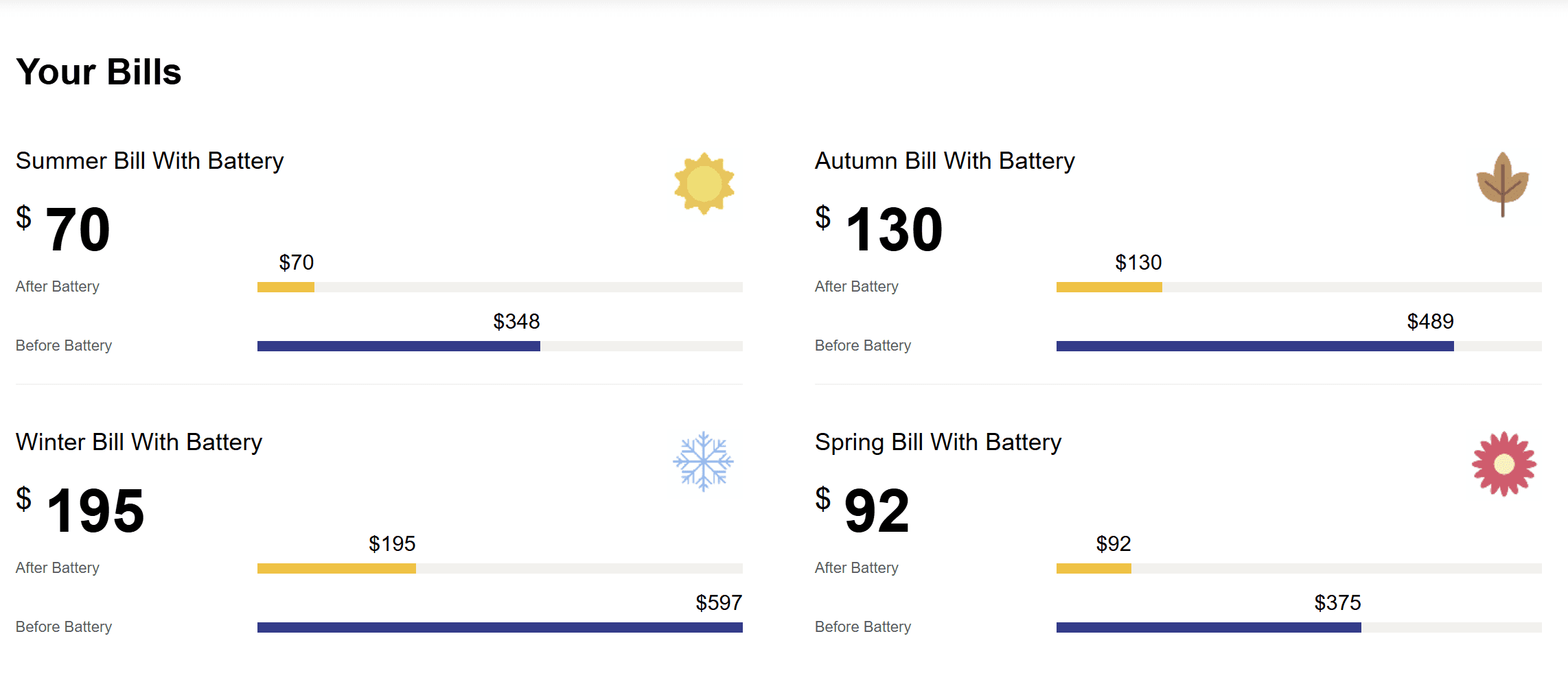
The battery calculator will estimate savings based on your actual energy use.
Cognitive Bias #3 Overconfidence
Batteries look simple from the outside, but savings and performance depend on design, configuration, and how the system interacts with your tariffs, solar, appliances and EV charging.
Many homeowners assume it will more or less do what they expect and skip the step of properly working through how it will fit into their home. In a busy market, it’s easy to accept an emailed quote, pay a deposit, and trust that the details will sort themselves out.
That combination is how you end up with systems that look fine on the wall but infuriate the owner when they get their first bill or grid outage.
How to counter it: Remind yourself that if you can’t explain exactly how your battery will behave in your home, you’re not ready to buy one.
Don’t Buy A Battery On Instinct
Smart people are getting this home battery thing wrong all the time because their built-in biases are doing more of the thinking than they realise.
Push pause on those animal instincts, and you give yourself a much better shot at making a good call.
Phase Shift is a weekly opinion column by SolarQuotes founder Finn Peacock. Subscribe to SolarQuotes’ free newsletter to get it emailed to your inbox each week along with our other home electrification coverage.
 About Finn Peacock
 RSS - Posts





If car batteries are getting cheaper why aren’t home batteries not only getting cheaper but larger to 50kw minium
Hi David,
Car batteries roll off a ship fully installed with all compliances ticked off.
Home batteries are fitted and finished by locals here being paid first world wages & conditions.
That’s just the start of it…
Currently May 1 is a real cliff for batteries, but going forward after that it is a moderate drop rate, but still enough for your average pushy sales team to have a field day for years to come.
People also need to consider the 3 hours of free power, and what their actual goal is in getting a battery.
Many solar pundits assume it is to reduce daily power bills, my goal was backup capable of running for days of bad weather combined with grid outages at the same time. So my goals required a bigger battery than most.
With the 3 hours of free power, some may see benefit in minimal solar and a bigger battery.
People have missed deadline for current rebates (install, inspection, approval, commissioning, etc).
Smaller batteries will be more common going forward.
Back in 2023 considered going battery only, charge at 8c, use for other 18 hours a day shoulder and peak.
But then I would be at the mercy of retailers keeping such deals, not moving goal posts . . . as seen with caps on battery charging in the 3 (or 4) hours free, and the possible $5 a day supply charge being considered by the AEMC for a “fairer” electricity market.
The small solar big battery thing has been debunked quite well, the roof access, running wiring, all to do anyway, with some extra racking / panels (cheap), and the extra labour for install, then a suitable size inverter etc, you are much more able to be in some sort of control of your own power needs.
(You would need a larger inverter anyway for larger battery only, to download lots of kwh in free hours, perhaps even larger than you would need for solar / battery.)
it is a constantly moving target isn’t it.
I didn’t get my setup for ROI, I got it because is was sick of the blackouts in cyclone / storm season and sick of being ripped off for power. So I am happy regardless of what they do going forward.
But if you are in the market for ROI, how can you even remotely start working out a 5 or 10 year return when the goal posts are constantly moving.?
2 big changes this year, and a 2 more being talked about –
– big drop in battery rebate,
– 3 hours of free power,
and the proposals lurking in the wings
– to charge you a motza for a grid connection
– the likelihood of a road user tax for EV users
All would / could significantly change your calculations, and that’s just in a 6 month period!
Any wise buyer should ensure they AND the people quoting have a full year of past actual consumption data. Its useless to have somone quote 12kw solar, a single phase 10kw inverter and a 12kwh battery based on a headline price that seems cheap. The house may have high average demand and it includes 3 phase. Paying more may not mean paying far more but the satisfaction from a correctly sized system will payoff for a decade plus.
We noted this problem when we started. There were two types of quotes. 1. Ripoff installers quoting very high cost instilling fear. Prices often double others. Anti-chinese. 2. Cheap as chips headline prices.price not features were the pitch.
I accessed the data and had a few new quotes. Totally different spec. 30panels of 15kw solar, 15kw 3 phase inverter and 42 kwh battery. Works well. Not the cheapest but not under performing.
Very good advice!
Working with energy controls including BESS controls for some years now I can very confidently say that many people will not benefit from installing a battery at all. The pay off period is often longer than the battery lifespan given their typical usage and this is quite easy to calculate using such aids as the one mentioned.
For fixed rate tariffs (with solar) it is fairly easy to calculate on paper based on how much power your home imports and exports each day from your last bill. Take the smallest value of these as the number kWhs a day you would potentially draw from your battery. Multiply this figure by the price/kWh and you have the maximum potential savings per day as well as an estimate for how large your battery should be. Don’t forget to increase that size by at least 20% to account for Depth of Discharge, if you want your battery to last longer. I should note it still requires smart control otherwise it will be less than optimal.
You forgot the bit about if your electricity bill is a few dollars a month or in cedit each month there’s not much point buying a battery.
Unless your circumstances are changing there is not much point complicating your energy supply with a battery which, unless you think about how it will mesh with your electricity demand, could leave you paying a similar amount each month for electricity as you were without it but leave you thousands more out of pocket and having to manage the battery.
Until your feed in tariff drops to virtually nothing.
it already has for many Andrew, 2c is very common now, I can see it falling to 1c or even a token part cent.
Hopefully for those with batteries, we’ll see more peak evening high FITs ofered, as is becoming more common already.
Ultimately, most home / solar hoseholds can / would benefit from a battery, and careful retailer / plan choice, it’s just the payback time analysis that matters for every individual’s situation.
The $5 a day supply charge being floated with the AEMC is a bigger issue, and affects everyone on the grid if it gets the nod . . . even battery owners can’t escape it.
Another possible shift in goal posts that affects people’s investment choices.
yep absolutely.
The big trap with batteries is not the batteries, I think, but how they are charged, If DC coupled, with separate MPPTs, they can charge at a good rate, while the all too common tiny 10 kW AC inverter limit serves house loads. When you’re also Level2-charging a BEV, there’s barely 3 kW left for the house, so nothing for house battery charging.
The 11kW/25kW DC BEV chargers offered by Sigenergy (and some others?), when connected to the solar array, can bypass AC inverter limits, making the installation much more capable.
It is bottleneck-based poor system design which leads to underperformance. If there’s even less petrol next year, and you have two BEVs in the driveway, and a big house battery to time-shift their charging, adequate throughput gains far over $1 per kWh car-FiT.
The electricity companies could never pay the golden FiT your BEV pays, especially now. (But even Buying their kWh yields great returns in your BEV battery.)
I have been informed and ready for many years, the payback/aforability equation didn’t work. It like does now, but my issue is lack of options re the need to run a 3 phase load, else the equation still doesn’t work.
What are my current options re this, needs to be AC coupled as I have enphase micros???
Hi David,
Most hybrid systems will be capable of using your enphase as an AC coupled source.
If there’s an outage, Sungrow will control the system using frequency shift to throttle the solar once the battery is charged.
I think GoodWe will do the same but we’re waiting on a firmware update from Fronius, at present they do not AC couple during an outage.
If daily charge goes to five dollars that will provide an incentive for people to go off grid. And the grid loses all of the micro powerplants that can help the problem of electricity distribution.
Hard to think those recommending a high daily charge have thought through the physical repercussions, not to mention the uneven effect of the fixed charge will have for those on lower incomes.
If this happens – in conjunction with lower usage costs, as suggested – it completely changes the payback calculations that everyone has/is making to justify spending shedloads on solar and batteries.
Such a massive rugpull on the electricity buying (and voting) public won’t be popular in our household and I’m sure many others who have stumped up tens of thousands on systems which become significantly less financially sensible.
Everyone who needs/wants access to the grid needs to pay for the infrastructure. If you want the insurance the grid provides, you need to stump up the same as those who don’t have access to solar.
I view this cost the same as fire services levies applied to properties at the same value.
Hence the likelihood of people going off grid for a service they dont want once the price of that “insurance” gets exorbitant. The potential for a grid access fee being over a $1000 dollars a year is ridiculous.
The other side of that coin is if you have a smart meter, you can have the power connected in half an hour during business hours, so the potential risk of going “off grid” is quite minimal.
If the retailer’s didn’t pad the grid charges and just passed the actual cost on to consumers it might seem fair but when I’m paying over two dollars a day while others pay around a dollar the cost of maintaining the grid is unfairly distributed.
Grid charges have become another source of profit rather than a cost of insurance.
The way the charges are applied is another example of the sale of retailing electricity has failed.
I am looking at getting a 40Kw battery to go with my 13.2Kw solar panels. I got several quotes and compared each offer. Buyer beware, some of the low-priced system deals are cheap for a reason, many catching buyers off guard. However, by the time some buyers realize the system they purchased would not do what they thought the system would keep running during a blackout. The cost of installing an improved system significantly adds to the cost of your system. Some battery installers don’t offer blackout protection, the ability to run many household appliances, things like air conditioning, fridges and freezers. Many companies just offer the ability to operate lights, fans and other low energy appliances. Do your homework and make sure the system you are installing will fit your needs and expectations. Ask the critical questions, Blackout protection, how big a battery do I need, what appliances can I run and for how long.
I ran the numbers 12 months ago. Payback in Canberra is complicated by our low power price (good problem) and the fact that winter solar output can be next to nothing on many days.
I decided my best return on funds was a heat pump to replace our large 400l resistance HWS. It has worked a treat.
Now I wonder whether the funds for a battery would be better placed toward a small EV that we charge during the day – particularly now with the likely ongoing volatility with fuels
I think I may overcomplicate things??
We spend about $30 a month on Hot Water . A good number of families spend more on streaming services. We have a standard 315 lt electric hot water system operating off a Controlled load circuit for about 18 cents per kWh. I recently got a quote for a heat pump…few local installers are available…lots of unscrupulous out of town suppliers are. I was quoted about $9000 after Victorian rebates. It just doesn’t add up.
We have a 5kw roof top solar set up.