
 I went to the AC/DC PWR UP! gig in Adelaide last weekend. There are two ways to look at that show.
- One: a couple of blokes in their 70s who don’t sound quite like the records anymore.
- Two: an inspiring wall of grit and showmanship, built on a formula they’ve refined over fifty years, still holding a stadium-sized crowd for two hours and fifteen minutes.
I chose the second view. It reminded me I’ve got zero interest in growing old gracefully.
Lying in bed afterwards, ears ringing, unable to sleep, I started thinking about the Enphase microinverters on the roof above my head (it’s not the first time a gig has got me thinking about solar.)
All AC, No DC
Enphase are solar’s loudest defenders of AC coupling. They can’t stand DC. As soon as the panels make DC, Enphase flips it into 230 V AC right at the solar panel and sends it to the switchboard. No DC isolators. No special cabling. Brilliant on complex roofs because you don’t have to worry about DC strings. And if you own an Enphase battery, it goes back to DC only at the battery itself, driven by the same electronics as the microinverters on your roof.
I’ve always liked Enphase, which is why they power my home. Thankfully they’ve proven reliable despite sceptics’ claims that they’d never survive the heat on Aussie roofs.
Next year they’ll hit twenty years as a company. In residential solar terms, that’s veteran rock-god status.
So the question is fair:
- Is Enphase’s AC-coupled architecture now past its time, given that almost everyone now wants DC-coupled batteries? Even Tesla dumped the AC Powerwall 2 for a DC Powerwall 3. Why pay for microinverters if you can stick panels straight into a hybrid inverter?
- Or… is Enphase still an example of solid engineering and a company backing a technical ideology that’s worked reliably for two decades?
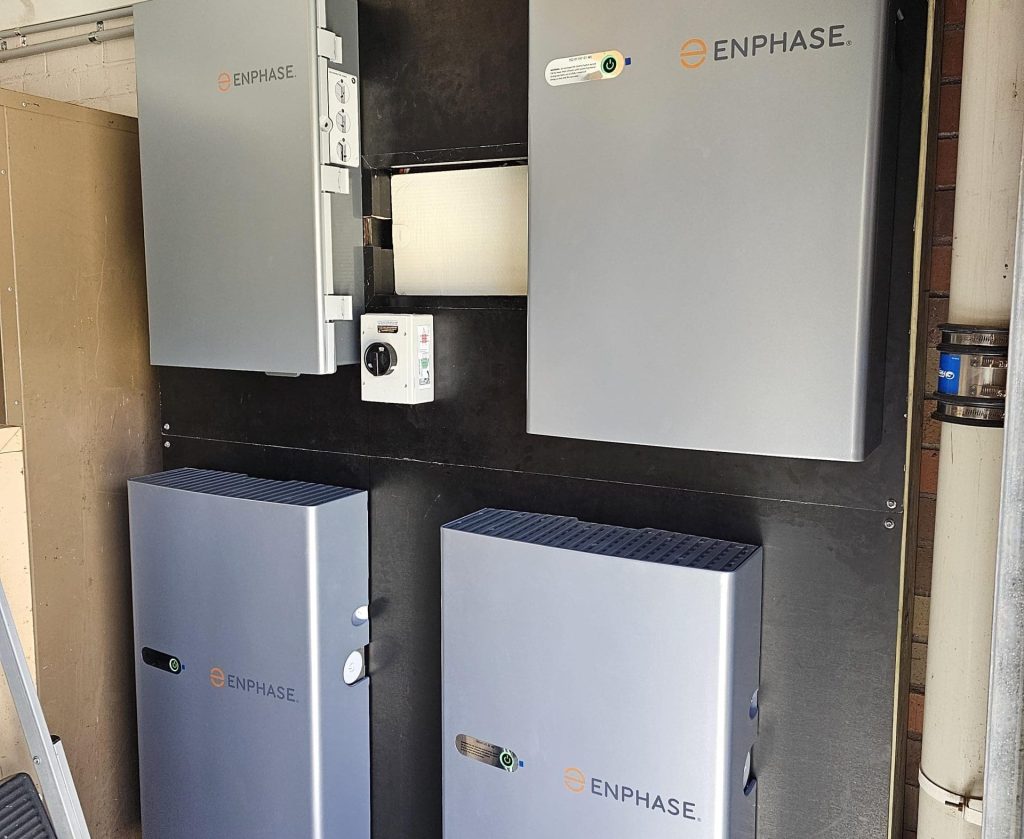
You need a small army of Enphase home batteries to reach the energy storage needs Australians are expecting these days. Photo: Conjola Electrical and Solar.
Enphase Batteries: Dirty Deeds, Not Done Cheap
Right now, the answer hangs on one thing: the Enphase battery.
The problem: it’s a huge box with a tiny battery inside, sold at a wild price. Over a thousand bucks per kilowatt-hour after the rebate. Each one-metre-high box stores only 5 kWh of energy. If you want the 30 kWh many Aussies are buying today, you need six of them, a mansion to hang them on, and a bank balance to match.
It’s a real loss. The hardware is rock solid. Users highly rate the software. The solar, battery and EV charger play nicely as one eco-system. It’s easy to install and commission.
If Enphase could just compete on battery energy density and value, they’d be near the top of my list of solar/battery systems to recommend.
But right now? I can’t recommend them – unless you have a roof more complex than the guitar work in Thunderstruck.
Phase Shift is a weekly opinion column by SolarQuotes founder Finn Peacock. Subscribe to SolarQuotes’ free newsletter to get it emailed to your inbox each week along with our other home electrification coverage.
 About Finn Peacock
 RSS - Posts






P.S Finn. I had 22 Enphase micros installed 21/11/25. Installers here today to install 3x8kWh Sig batteries with 9999W hybrid inverter and gateway for total house blackout protection. 2 staged because of Clayton’s, then ACCC recall on the inverter, but posting to show Enphase can be AC coupled to Sig batteries and I believe to PowerPlus Whispr (sic) 7.
Can they charge their battery during a blackout?
I ask because you say it is AC coupled.
In the recent storm outages where a mates system didn’t work for him. Amber had drained his battery down to 20% just before the storm took out the grid, he was out of juice before dawn, but when the sun came up, the battery wouldn’t charge.
Got onto his installer – apparently to save money, instead of replacing his inverter, they AC coupled things, and the battery wont charge from the panels from flat. So his backup is only good for whatever is left in the battery at the time the grid power goes out.
Sorry to hear that. My AC coupling is thru the Sig smart port and I won’t sign up for VPP.
Enphase is dying a slow death in Australia.
On the July 2025 earnings call, the Enphase COO said they had “flat to down growth” for Australia in the last year. This would easily imply market share being down a lot considering the increasing uptake in solar and batteries. Once you start losing market share, installers lose interest as they can get better volume deals with other inverters. It is a death spiral. The COO mentioned the “lucrative battery rebate” but they couldn’t be bothered to send the new 10C battery to work here which would at least have been a massive upgrade on the 5p.
Meanwhile in the last month I’ve had the foxess 42kwh battery stack installed alongside my 15 440w panels which have enphase micros (4 north shaded, 8 south, 3 flat shaded, total taking up 80% of my roof space). It works fine, and takes up a fraction of the room the 8 enphase 5ps would at a fraction of the price.
Rip enphase Australia
Not sure what Suti’s reply has to do with your comment.
I have full Enphase system and my system can charge from flat in a blackout.
cheers Kobi!
It was supposed to be a new comment, but it ended up in this tree instead.
How do the other batteries mentioned above play with the enphase app? Can they be installed as a generator as such?
I recently sourced a few quotes for an additional 5P battery and it is more 30-40% more expensive now than it was 12 months ago when I installed my system. This is including the rebates and a large reduction in the price of lithium over the same period. Disappointing, since this pushes the ROI out to 7-8 years Each 5P really should be $5-5.5k installed. That said, I do believe the enphase batteries will last longer than any other battery due to the staged output of the microinverters though … and I really do like the enphase system as a whole though.
I feel how the V2H/V2G ends up playing out with Enphase will seal their fate. i.e. if their vehicle chargers end up being much cheaper if you already have an enphase system due to the flexibility of the microinverters and superior software
A blog on maximising scalability of an initial installation might be interesting. OK, new stackables with battery/inverter/EVSE mixes romp it it, but how do the rest of us fare? That’s all over the shop, I figure.
Mine’s a funny one, 14 kW of DC coupled solar plus 13 kW of AC coupled. Can’t just add panels & another PV inverter on the new tractor shed, as the grid-forming battery inverters won’t deal with more than 1:1 competition.
But I could run 450 Vdc the 60m to another MPPT at the house, then run 230 Vac back to the shed for lights & BEV excavator charging.
Batteries enable a real energy transition. As 6.6kW PV + one tiny 5 kW inverter go the way of pioneer < 1kW systems, and gas goes extinct, more will drift to greater system capability, e.g. two EVSEs + HWS + cooking & RCAC, with minimal grid draw, if any.
Given big cheap batteries, the sun is ample grid for domestic use, & a smaller robust wired grid can be for industry & the roofless? We must adapt faster – for the kids.
Amber have only recently enabled beta support for solar curtailment with emphase and it doesn’t work great so far. I went straight back to home assistant and a usb relay which feels like a horrible kluge but at least works.
I installed Enphase inverters and SunPower solar panels nearly five years ago, and last month I added AC coupled 27.2 kW FranklinWH battery. The system is now working perfectly together.
So if you need to use an AC‑coupled battery, Franklin is a good choice.”
They are nominally a great product. But are they worth the premium on installations where shading or other complexity isn’t an issue?
I think the long delay it bringing out micro-inverters they can support larger wattage panels probably means some self harm.
I’d happily put in Enphase, but not at any price.
Interesting read,we have 21 Enphase inverters with an Enphase battery that charges before midday and empties before 9pm,great system and happy with performance but want more out of the battery,would like to add to it but as pointed out Enphase are very expensive and rather small even with subsidies I’ve decided to sit and watch.
Hi Glen,
Am in almst exactly the same position as you. All my enphase batteries out
of juice by 9:00. pm. Suspect many others in same boat.Wonder why Solar Quotes dont do a piece on possible solutions with a few working examples. There should be many solutions from USA – unless they dont need big batteries overthere ?
Same here, started exploring options to expand my Enphase system with 3th party battery.
Frustrated by Enphase not offering different battery options, otherwise rest of the Enphase system works great for me.
Fully backed up house even during black-outs. Just want to expand battery capacity as 3 5p batteries are emptied by 10pm when using aircon…
There are issues with Lithium batteries usage for storing excess power during the midday sun. Specifically, the charging algorithm limits the charging voltage, while the charging current declines exponentially. In effect, the solar panels will be generating much more power than the battery can consume, power that is wasted.
This is why the future lies with grid attached vanadium flow batteries for residential use. For example, ZH ENERGY Hunan China, Cost: US$5,000 Capacity: 20KWh-50KWh, System Voltage Range: 200-500 V.
https://www.alibaba.com/product-detail/Advanced-2-5kW-Vanadium-Redox-Flow_1601568532485.html?spm=a2700.7724857.0.0.26776855nNVcoJ
https://zhenergy1.en.alibaba.com/index.html?spm=a2700.details.0.0.64767b05DmF7f6&from=detail&productId=1601568532485
The following link includes a photo of a complete unit on an outside wall.
https://vsunenergy.com.au/vrb-applications/residential/
The flow battery would be complementary to the Lithium battery!
Vanadium flow is such a great, simple tech. I think as community batteries not home storage though. Unless they can get the system the size of a lithium.
The future should be multiple community batteries at every substation. Unfortunately, the generatos, retailers and government won’t let that happen.
As I understand it you cant just connect Enphase micro inverters direct to the switchboard. They instead connect to a special AC trunk cable, Envoy device and then to the switchboard. I get that Finn is making the point that they are already AC however he paints the picture that the micro inverters are trivial as they simply plug into the switchboard and you dont need an Envoy or anything (which is also a point of failure).
The end result is they are less efficient as you might have as many as 100 micro inverters on a roof vs one or two regular DC inverters.
By efficiency I mean firstly the conversion process of AC to DC but more importantly the resource efficiency of having to manufacture a device for each panel vs one or two string inverters to support the panels.
Further to this with a hybrid inverter you can take advantage of the additional power available in over sizing the array to charge the battery (assuming its not already full by lunch time).
I went with a sungrow system and each of my panels have a Tigo Optimiser on them, I doubt they are any different to the micro inverters on each panel for the enphase system as far as power draw, but like the enphase system, the benefit they provide in increased performance far out ways any loses they incur.
Wish I had roof space for 100 micros (1 per panel).
The Sig is a hybrid inverter so allows for the over sizing.
I prefer Enphase’s panel efficiency of working independently and better (how much is debatable but isn’t every thing) in shade or misadventure compared to DC strings where one panel shaded or underperforming for any reason, means all panels in that string get throttled back to the lowest performer. The Envoy device is the intermediary but it also provides panel specific performance data thru the app rather than aggregated string data. Add the safety factor of having 240v AC not 400v DC on and in your roof and a 25yr warranty on each inverter and it is worth it to me but not to everybody. Freedom of choice beats freedom from choice.
Andrew raises some good points. However, the optimal solution depends on your roofing. If you have a sloping roof with a tangent pointing due north and no shadows throughout the day, then great. All your panels will be contributing equally, and you can wire them in series to increase the voltage.
But suppose you have one roof with a tangent sloping east, and another roof sloping west, with various shadows cast across them at different times of the day. In this situation, one micro inverter per panel works out very well.
I note that a roof containing 100 solar panels would be much bigger than anything I have seen on a house, more like a factory roof.
So, yes Andrew is correct for some situations, but not all of them.
Well said thanks Peter
Last Thursday/ Friday I had my 10 yo 20 panel / 4kW (actual peak) Enphase S230 micro inverter system replaced with a 30 panel DC coupled / Tesla Powerwall 3 system.
The Enphase system never missed a beat and paid for itself in around 6 years. The Enphase app was adequate but the Envoy monitor only updated every 15 minutes.
This new system however is next generation by comparison. It produces over 10 KW peak but importantly the low light performance is noticeably better.
The real star of the show though is the Tesla gateway and Tesla app. It just automatically and seamlessly manages the battery charge and discharge, powering the house and feeding excess to charge the EV from excess solar. The Tesla app is also very good. Not only does it oversee my vehicle and it’s charging, now i get almost live detailed information about my home, solar generation and powerwall energy flows.