
 The Iran war is ushering in an extended period of supercharged oil and gas prices. Experts say Australians can insulate themselves from rising bills by electrifying their home and transport – here’s how.
How Vulnerable Is Australia To The Oil Crisis?
The war in Iran is causing widespread damage to key oil and gas infrastructure in the Middle East which could take years to rebuild, and has largely halted traffic through the Strait of Hormuz – through which roughly 20% of the world’s oil and gas supply flows.
Six oil tankers that were supposed to head to Australia have been cancelled in recent days, with the disruption to fuel supplies just beginning.
A new report from the Institute for Energy Economics and Financial Analysis (IEEFA) warns that Australia is in a vulnerable situation as it only keeps very low stockpiles of key petroleum products, including just 37 days of petrol.
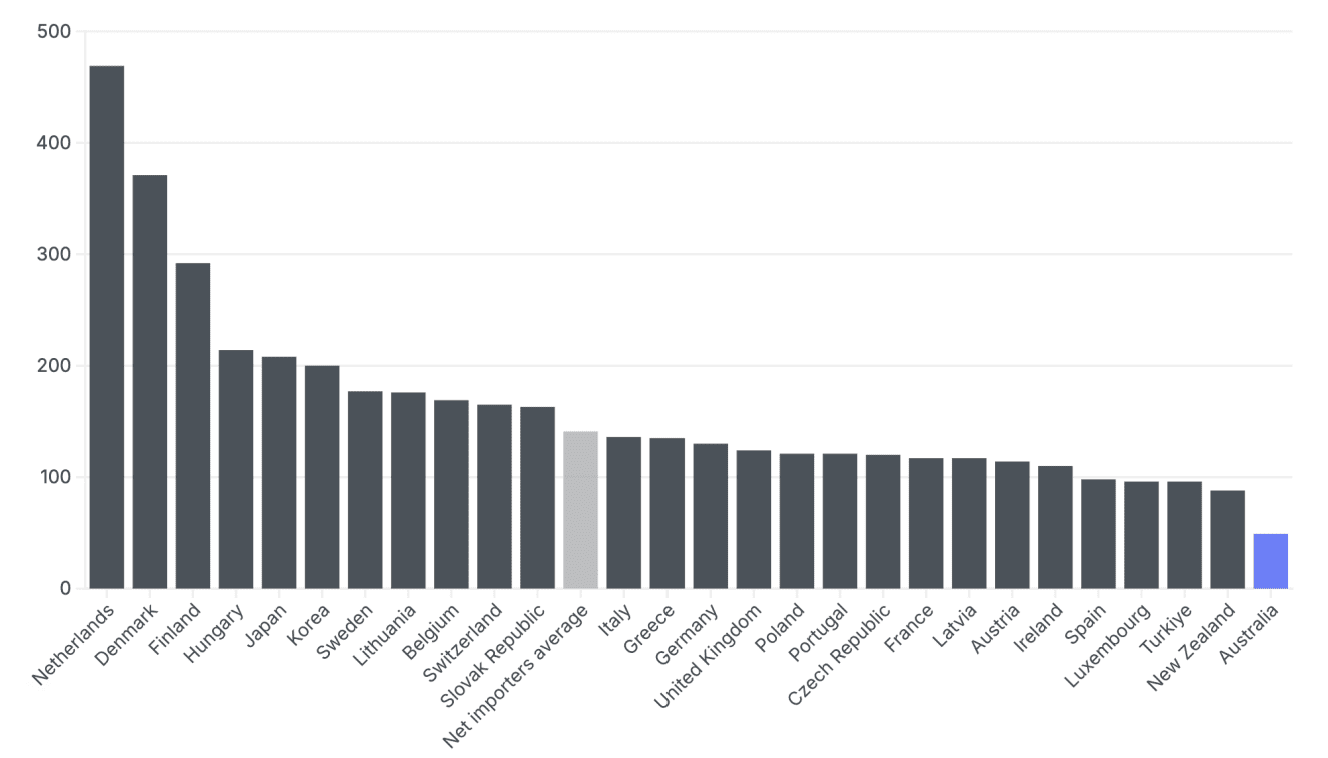
The days of net imports worth of oil stocks kept by IEA countries at the end of December 2025.
What About Gas Prices?
The situation with gas is different – unlike oil, Australia is a major gas producer, but international prices are already surging and analysts expect that to be reflected locally, just as supply disruptions at the start of the Ukraine war saw domestic prices rise as gas companies cashed in.
Rystad Energy expects that Australian east coast gas prices will climb to $28 a gigajoule over the May-August period if the Strait of Hormuz remains closed – up from recent spot prices of $9-$10 a gigajoule.
Build An Electrification Fence Around Your Home
The IEEFA report finds that electrification is the most effective way for Australia to build resilience to fossil fuel disruption, finding that it is “the only solution that is mature, cost-effective and which can deliver reductions in oil imports at scale, replacing them with domestically supplied clean energy. The current oil shock is the first one to happen at a time when renewables and electrification offer a credible alternative.”
IEEFA research shows that upgrading homes with electric appliances, solar, batteries, and energy efficiency improvements can cut home energy bills by up to 90 per cent.
Luke Menzel, CEO of the Energy Efficiency Council, said the crisis highlights how fossil fuel reliance leaves Australians vulnerable.
“While the immediate impact of this crisis has been on petrol prices, a prolonged conflict could result in higher gas prices as well. Accelerating the switch from oil and gas to clean, efficient electricity reduces running costs and insulates Australian households and businesses from future economic shocks … Electrification is a better way to meet our energy needs in every way. It’s more efficient, cleaner, and almost always reduces running costs. Wherever we can – across buildings, transport and industries – we should electrify. And the earlier we do so, the faster we can enjoy the benefits,” Menzel said.
Menzel said that Australian households are increasingly embracing electricity over gas, but the transition needs to go up another gear.
“Around 5 million homes remain connected to reticulated gas networks, with another 2 million using LPG. They all need to make the shift from gas to efficient electric homes by 2050. We need a large-scale, long-term, national effort to upgrade our existing housing stock over the next 25 years into energy efficient, electrified homes through a range of improvement measures such as insulation and draughtproofing, and upgrades to efficient electric appliances,” said Menzel.
The Energy Efficiency Council wants to see Australian federal and state governments strengthen electrification incentive programs and standards to bolster resilience to global energy shocks.
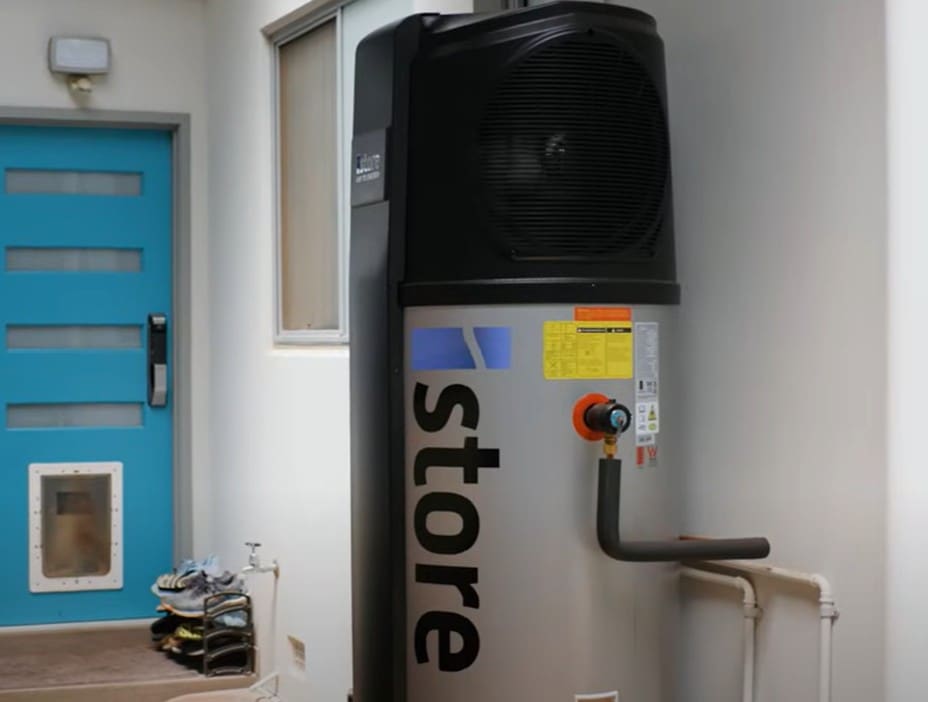
A hot water heat pump is just one of the ways to electrify your home and reduce reliance on fossil fuels.
How To Electrify Your Home & Transport
There’s no need to wait for the government to act. There’s a host of ways Australian households can take the initative to insulate themselves at a time when the immense disruption to oil and gas markets is only just beginning:
- Electrify your transport: Interest in electric vehicles is surging due to rising petrol prices. If you haven’t got the patience to trickle charge your EV from a regular power point, you’ll also need a home EV charger. Get started by reading our guide to home EV chargers.
- Electrify your heating: Don’t expect to count on stable gas prices to affordably keep your home warm as we head towards the cooler months – switch from gas heating to efficient reverse cycle air conditioning. Do your research by checking out our guide to air conditioning.
- Electrify your hot water: For many Australian homes, gas hot water is the only reason they have to continue paying a daily gas connection fee. To electrify your hot water read our guide to hot water heat pumps.
- Electrify your roof: Getting solar and a battery means you can power all of the above yourself, providing a level of self-reliance that’s not possible when relying on turbulent oil and gas prices to fill your car and heat your home. To learn more, check out our guide to solar panels and guide to home batteries.
For more on how to electrify your home and protect against current and future energy shocks, subscribe to our free newsletter for weekly updates.
 About Max Opray
 RSS - Posts





Pre-conflict, roughly nearly half of internationally traded petroleum products passed through the Strait of Hormuz. I’d suggest that’s a far more significant perspective. There is no where else in the world that has anywhere near the combined production capacity to compensate for the current shortfall caused by the conflict affecting shipping, particularly tankers, through the Strait of Hormuz. The longer the Strait of Hormuz is effectively blocked the greater the risk of global fuel & food shortages & economic collapse.
https://www.solarquotes.com.au/blog/new-vehicle-emissions-data-ev-shift-means-for-solar/#comment-1732886
No diesel fuel = no food, no pharmaceuticals, no goods & services.
Gee that’s grim Geoff even by my typically pessimistic standards.
Perhaps instead of bothering with this electrification stuff we should skip straight to hoarding tinned food and ammunition?
Bruce: – “Gee that’s grim Geoff even by my typically pessimistic standards.”
Do you have any evidence/data to indicate the situation isn’t as pessimistic?
Dr Fatih Birol, Executive Director, International Energy Agency, addressed the National Press Club of Australia yesterday (Mar 23). Birol said:
“Situation is very severe. I can tell you that. In fact, I as it started some 3 weeks ago, I decided not to talk to press 3 weeks. But last Friday, I thought I should say a few things, because I thought the depth of the problem was not well appreciated by the decision makers around the world. Let me explain you how challenging the situation is. … if you want to, uh, put in a context, this crisis as it stand now 2 oil crisis and 1 gas crisis put all together. And if I may, not only oil and gas, some of the vital arteries of the global economy…”
Hear at: https://youtu.be/Ou-0lscXBY4?t=115
What’s REQUIRED is to reopen the Strait of Hormuz. Trump has blundered!
Fatih Birol. IEA’s executive director
The 10 points of the plan to reduce fuel are:
Reducing speed limits on highways by at least 10 kilometers per hour (6 mph)
Working from home up to three days a week where possible
Introducing car-free Sundays in cities
Making the use of public transport cheaper and encouraging people to walk or cycle
Alternating private car access to roads in large cities
Boosting car sharing and another practices to reduce fuel use
Promoting efficient freight and delivery driving
Opting for high-speed and night trains instead of planes where possible
Avoiding business air travel where alternative options exist, such as economy travel or video conferencing
Encouraging the adoption of electric and more efficient vehicles
Air drag increases as the cube of speed, so dropping from 100 km/h to 90 reduces fuel consumption for punching through air by 27%. At 100 km/h, air drag is 60 to 80% of fuel consumption, so that’s a neat net 22% fuel saving.
And that’s money in the bank. Or if you’re driving an EV, it’s longer range.
(If the proposed $40 bowser limit comes in, ICE range might require hitching a donkey in front, two if you’re in a hurry.)
A TV news channel yesterday reported one EV retailer had sold 8 BEVs last month, but 25 in the last two days. It begins to look like it is not only fossil fuel which will have difficulty meeting demand.
We’ll be better able to afford to pay for teachers and healthcare, long term, as short term bulk BEV imports end eternal burning of cash in flammable liquid form. The balance of trade boost is golden, and living standards rise.
But ICE car resale value trends to zero, quicker than expected.
Assuming nothing drastic changes e.g. Iran starts bombing oil, gas, water, and power facilities throughout the wider Middle East, as it is threatening to do, Australia already faces a major crisis.
Agricultural groups are warning of skyrocketing prices come next month, halved food production, that 2 in 5 farmers may not plant next season, and that vegetable growers will shortly make the decision of whether to bother planting or harvesting crops, and that many may simply opt out of farming altogether because of shortages, high costs for critical materials if they can get them, and grossly insufficient prices offered for their goods given the costs involved in producing them.
While skyrocketing prices isn’t quantified, given urea prices have basically doubled, diesel is already up about 50%, and scarcity is going to be an issue, a doubling of crop prices may not be unreasonable – note crop price =/= supermarket shelf price, but the duopoly will doubtless look for profit too.
John Alba: – “Assuming nothing drastic changes…”
An aspect that appears not to be gaining attention is that shutting in oil wells risks oil reservoir damage that might be difficult or even impossible to fix. JP Morgan’s recent analysis shows many Middle Eastern oil producers are approaching a full storage situation.
Hear Nate Hagens at: https://youtu.be/vveYYZN_p48?t=812
The longer crude oil & gas wells in Iraq, Kuwait, UAE, Qatar & Saudi Arabia are ‘shut-in’ the risks increase that they may never recover to pre-conflict production rates.
John Alba: – “…diesel is already up about 50%…”
The Terminal Gate Price (TGP) for diesel in Sydney has risen from 165.5 (as at 28 Feb 2026) to 303.6 cents/litre (as at 25 Mar 2026); an 83.4% rise.
https://aip.com.au/pricing/terminal-gate-prices/SydneyDIESEL
TGP is the daily, wholesale spot price for purchasing bulk fuel (typically 35,000+ litres) directly from a refinery or import terminal. Add transport, taxes…
I, along with any decent cook, will never give up gas! People like you are frightening others into giving up gas, and you know what? They aren’t going electric!
Many of them are migrants from overseas, where a naked flame is used for cooking. What I’m seeing now is people using charcoal on their gas and electric stovetops. Our Aussie upright stoves mostly have seperate grills, which are perfect for putting charcoal in.
Stop frightening these people; gas is cheap and works better than electric.
We have a gas stovetop and instantaneous hot water system that is 25 years old and works so well, I dread the day it will need changing.
A lot of people think of traditional electric cooktops some of us grew up with, which were indeed pretty rubbish. Modern induction cooktops are far better to cook on than gas, as top chefs are finding, and have the added bonus of not leaking poison into your house. Getting off gas when you have solar is demonstrably much much cheaper.
Sorry to say Eric, but the age of your appliances are about how out of touch your opinions are. Gas is on it’s way out and won’t be coming back. We’ve had an induction cooktop for a decade now and it’s SO SO much better than the gas we had in pretty much every way for cooking, let alone the cost AND the health benefits. And now that our whole house and our cars are electrified we’re reaping the benefits, especially at the moment – no extra gas bills, very small power bills through solar, and we haven’t been to a petrol station for a very long time – how good is that!
I agree. We currently cook occasionally on LPG, when we’re not cooking in the microwave and air fryer, which actually isn’t very often.
Our home LPG will likely be gone too within the next year when we switch to an induction cooker. My wife uses one at our son’s place and LOVES it.
We also have microwave, airfryer and a portable induction cooker in our caravan. We use very little LPG in the van as we have LOTS of solar and around 6kWh of storage in our LFP batteries. In three months out bush off grid last year in the caravan, we used only about 1kg of LPG- pretty much just for the gas oven.
“no extra gas bills, very small power bills through solar, and we haven’t been to a petrol station for a very long time”
And how much did you have to spend on the induction cooktop, all the solar gear and EV(s?). People who go on about the “savings” seem to conveniently forget about the massive initial investment, which is simply not an option for someone living on an age pension.
I have just purchased a Devanti five ‘burner’ induction cooktop for $ 350, delivered. Okay it’ll probably cost me a similar amount again to get a sparky to hook it up. Requires two phase @ 16a circuits or can be wired single phase 32a.
No need to spend $ 2 – 3k on ‘name brand’ cooktops. The technology is pretty basic.
Now if anyone wants a good deal on a 20yo used-but-clean-and-working-perfectly-fine Linea five burner gas cooktop…
Bearing in mind I neither have nor want gas, many, possibly even most, of my neighbours do use it. It has the significant advantage it works in a blackout (off-grid capacity 😜), and plenty of folk still prefer it. If it’s mostly found in older homes with less affluent residents, or even newer homes with retired occupants, habit and\or financial limitations may discourage conversion.
My instantaneous gas HWS is electric ignition so won’t work in a blackout no matter how abundant the gas supply is. Likewise my gas ducted heating system which also relies on electricity not just to ignite but for the fan, too.
So yes, I’m looking forward to migrating to an all-electric home.
Eric Ozgo: – “I, along with any decent cook, will never give up gas!”
The Australian east coast gas 2P reserves-to-production is less than 17 years – see AEMO’s Gas Statement of Opportunities – March 2025, Figure 27. Gas will only get scarcer and more expensive.
https://www.aemo.com.au/energy-systems/gas/gas-forecasting-and-planning/gas-statement-of-opportunities-gsoo
https://www.aspistrategist.org.au/its-time-for-australia-to-step-off-the-gas/
Burning more carbon-based substances is ‘civilisation suicide’!
And what of the reserves in all the untapped areas? The reality is Australia could produce vastly more oil and gas than it does, but red tape, politics, and ideology over basic economics prevents a lot. Yes there may be some legitimate environmental matters some places too e.g. fracking in prime agricultural areas or contaminated aquifers, but legitimate considerations tend to get ignored.
Australian civilisation will collapse if it fails to come up with the fuel it needs to function.
John Alba: – And what of the reserves in all the untapped areas?”
What reserves? Are you confusing reserves with sub-economic resources or contingent resources?
The limits to mineral extraction are not limits of quantity, but of energy.
Extracting minerals takes energy, and the more dispersed the minerals are, the more energy is needed.
Technology can mitigate the depletion problem, but cannot solve it.
Australian shale oil & onshore unconventional resources generally require oil prices in the US$70–$90 per barrel range—or sometimes higher—to be economically viable, largely due to high capital costs, specialized technology requirements, & a less developed service industry compared to the US.
https://www.ga.gov.au/aecr2025/oil
High oil prices = high fuel prices = high cost of living
If we/humanity continue to burn more carbon-based substances then human civilisation is on the road to collapse well before 2100.
https://press.un.org/en/2021/sc14445.doc.htm
I consider myself to be a “decent cook” and find induction far superior. I would never go back to gas! Residential gas cooktops don’t get nearly as hot as induction. I’ve found stirfries have improved markedly since making the switch to induction – wok hei is actually easy at home now!
💯% agree.
It’s amazing how out of touch many people are.
Another good example is people who won’t give up ICE vehicles. I had a mate like that, who was always rubbishing our Tesla and believing the lies spread by multiple biased media outlets.
Then he finally came for a lengthy drive with me the other day.
He was so impressed that he immediately booked a test drive, and has now ordered one – (though he will have a lengthy wait as there are lots of people ahead of him in the queue.)
I’ll take great delight in rubbishing him now! 😉
On ditching unreliable ICE tech:
Habit is habit, and not to be flung out of the window by any man, but
coaxed down-stairs a step at a time.
– Mark Twain, “Pudd’nhead Wilson’s Calendar
The government is reacting to the fossil fuel crisis at glacial speed, but lightning fast compared to general adaptation to total global energy disruption, as fossil fuels go extinct, and renewables/batteries amply do it all. Slow-witted to a T, we have to be forced to go the easy way, the clean way, the way which could have saved Florida, Bangladesh, and London, if we had been awake last century. Now the points are tipped.
But if the AMOC stalls, Europe chills – an antidote at first, but then too cold, if we can halt global heating at +3°C, with an extreme war-effort energy transition.
This comparatively trivial fuel fright is a tiny taste of what’s coming – a whiff of greater adaptation soon required. Let’s muscle up, and get with the program before it becomes serious.
I like how you have nominated yourself as a spokesperson.
my wife and I have been using a single electric induction cooktop for years now and we turned off the gas to the house – we dont do charcoal meat just veggie and pasta and we are still alive. Go electric is what I say!
To be fair IEEFA aren’t a non-partisan entity – they’re a US non-profit pushing renewable energy over traditional fossil fuels. Their assertion that electrification is the solution to fuel disruption is thus predictable, and fundamentally at odds with claims elsewhere.
And contrary to IEEFA’s claim’s, Australia doesn’t face an unprecedented oil security challenge, rather it faces a predictable one. As recently as 2021 retired Air Vice-Marshal John Blackburn AO and the former Chief of the Defence Force approached the government saying there was a serious problem and a risk assessment was critical. He was heard, and promptly ignored.
The Institute for Integrated Economic Research-Australia has offered what it considers options to boost fuel availability, but they range from weeks to years at best, and that’s assuming red tape is treated with extreme prejudice.
Ironically if gas were reserved for domestic use, and vehicles ran on it, there may be no fuel crisis in Australia!
Hi John,
The defence force recognises that climate change is the major global security threat going forward.
Burning more fossil fuels only makes it worse.
Maybe the retired warhawks aren’t up to speed, but doubling down on the problem isn’t going to help in the same way as completely replacing the energy system with something better.
If the ADF think climate change is the major global security threat then they’re even more ideologically driven and unfit for purpose than I realise.
There are only 2 forms of power available to the military – fossil fuels, and nuclear, with the latter pretty limited. Yes there were dreams of atomic tanks once upon a time, and even nuclear trains, but those never really developed, which leaves just subs and ships, neither of which Australia has many of, and none nuclear powered. Thus fossil fuel reliance – you can’t run military vehicles off batteries.
Hi John,
What do you think allows Australian submarines to patrol so quietly they can photograph the keel of a US aircraft carrier?
Batteries…
Whereas nuclear boats are impossible to make truly quiet.
The ADF treats climate change as a security risk, including a risk that can amplify instability and affect global or regional security dynamics. Public ADF-related commentary and Australian defence material describe climate change as a “threat multiplier” and link it to conflict, instability, disaster response demands, and broader national security.
The ADF and wider Defence community have increasingly acknowledged climate-related security impacts, though some commentary argues Australia has been slower than allies to fully integrate them into planning.
John Alba: – “Ironically if gas were reserved for domestic use, and vehicles ran on it, there may be no fuel crisis in Australia!”
What gas, John? See Figures 3 & 4 at: https://www.aemo.com.au/energy-systems/gas/gas-forecasting-and-planning/gas-statement-of-opportunities-gsoo
How are vehicles designed to run on diesel/petrol going to function using gas?
John Blackburn AO prepared a 2013 report titled Australia’s Liquid Fuel Security: A Report for NRMA Motoring and Services. The Executive Summary included:
We’ll see soon
Off-grid here, with two BEVs currently, the 65 panels are powering the house and putting a very modest 3 kW to the 46 kWh house batteries in total murky overcast. *Production beats storage*. Both EVs were topped up yesterday, when it was merely cloudy. Timing is everything – attentive opportunism pays.
And dropping the highway speed to 80 km/h on the 65 km round trip to town left more BEV battery reserve. Following ICE cars mostly declined opportunities to overtake – smart driving is proliferating. (If air drag is 70%, rolling resistance 30% at 80 km/h, then the drop from 100 km/h can reduce fuel consumption by 34%, I figure. That goes a long way to combating the price blowout, while fuel stocks last.)
The HWS is also storing energy from yesterday. Indoors, its slow heat leakage warms the house. This is not the time to clobber the record of two years without running the backup generator for house power.