
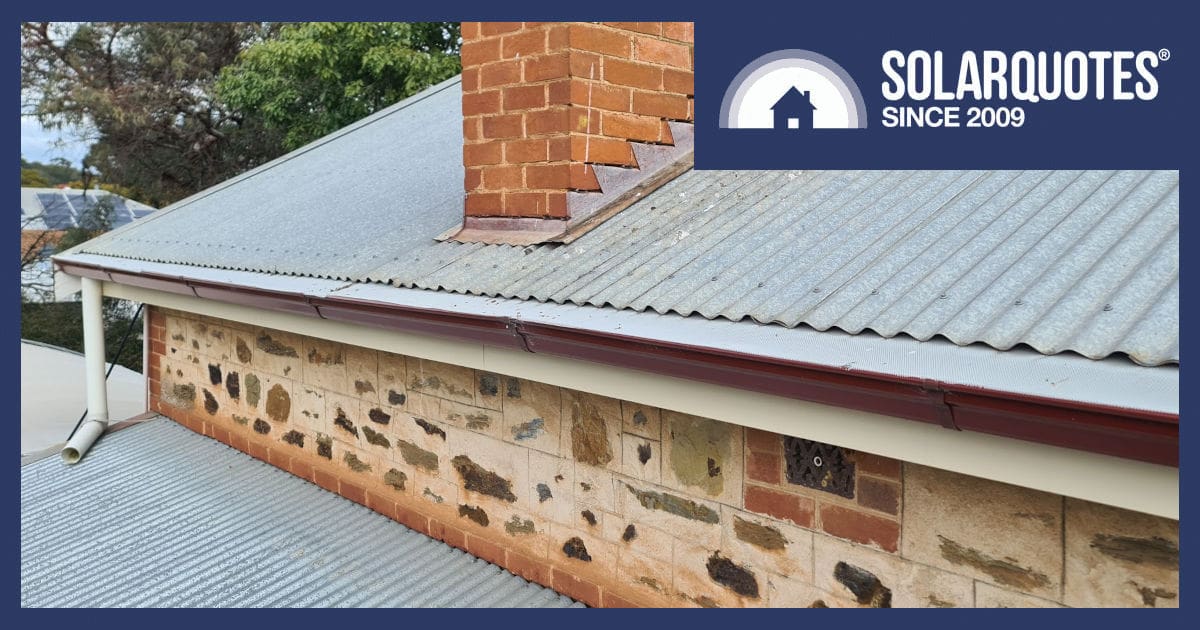
With fire season in full swing, it is worth considering what you can do to maintain your home, even if solar on the roof makes things a little tricky.
Clearing gutters is a never ending chore but the question that’s always bothered me is; why can’t anyone offer a self cleaning solution that really works?
How Does Solar Affect Roof Maintenance?
If you have an overhaul in mind for your house – say a re-roof and insulation upgrade before you install solar – bear in mind that the new glass on the roof can obstruct roof maintenance activities important for fire safety, as I explained last week.
One of the most crucial chores up on the roof is clearing the gutters.
As a child I was often the chief gutter cleaner at home and as a roofer I’ve seen a dozen different approaches to supposedly reduce maintenance.
The answer is a blend of tradition and aesthetic I’m sure, mixed with an unhealthy dose of what will the neighbours think!?
Here’s the thing: unless the neighbours are offering to clean your gutters regularly, you’re not obliged to care what they think. What’s more important, especially during the fire season, is that the place is well maintained.
Read on while we outline the best solution for reducing your fire risk and extending the life of your gutters.
Standard Practice Is A Liability
For those who’ve looked through the building rules, there are specifications on gutter size, overflow slots and rates of fall. Plus there’s calculations on the number and size of downpipes for a given roof area.
There are also cross sectional diagrams that show your roof cladding must protrude at least 50mm into the gutter. This is deemed essential to make sure the rain runs off the sheet and doesn’t end up tracking back along the underside, down the fascia, or anywhere else it shouldn’t.
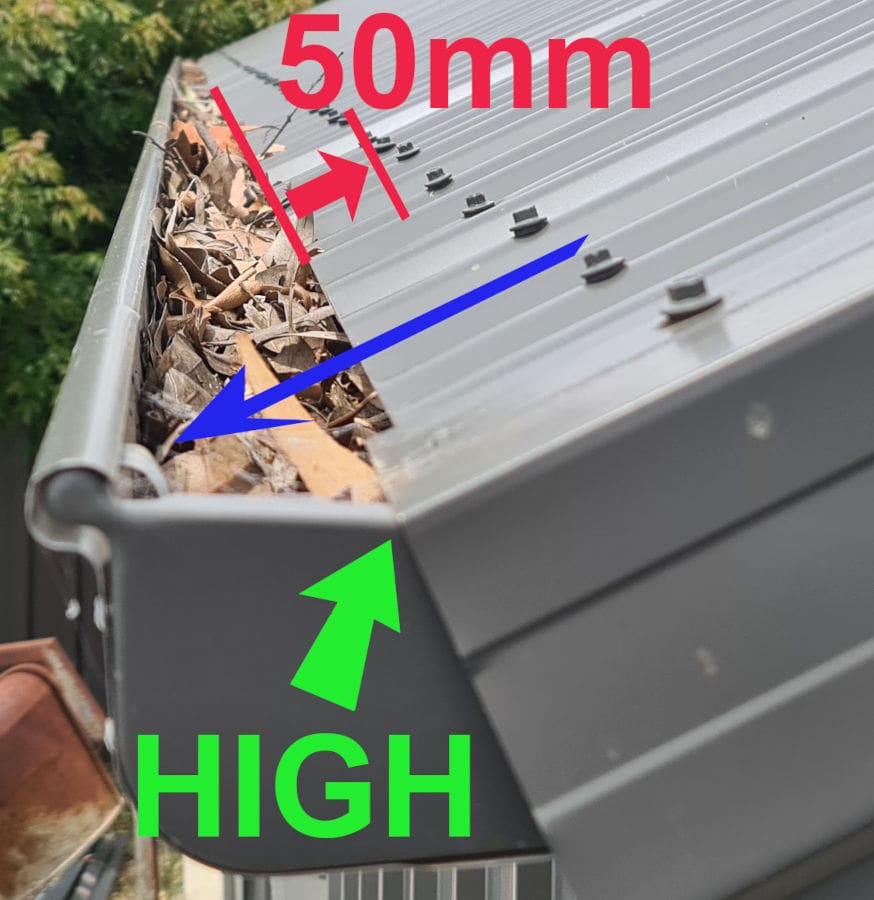
Garden variety gutter installation with variety of garden debris decomposing into wet sludge. Blue arrow shows cladding quite deep behind the outer edge.
However if you’re in Darwin, all that goes out the window. They don’t bother with any of it because during wet season, gutters are about as useful as trying to catch a deluge in a paper cup.
Darwinites are pretty relaxed, so nobody bats an eyelid at the corrugated edge of a roof being visible.
Screening The Ideas
Gutters are a curse, channelling more leaves than water. And the gutter guards of various kinds aren’t much better.
There are many novel products like flashings, screens, or oversized bottle brushes and they all work on the idea of keeping the leaves out of the gutter, so they tend to dry and then blow away.
However conventional solutions you buy and retrofit are something I would never contemplate. My best carpenter mate will rant at length about how much he hates them, and he’s had a career dealing with them when installing pergolas.
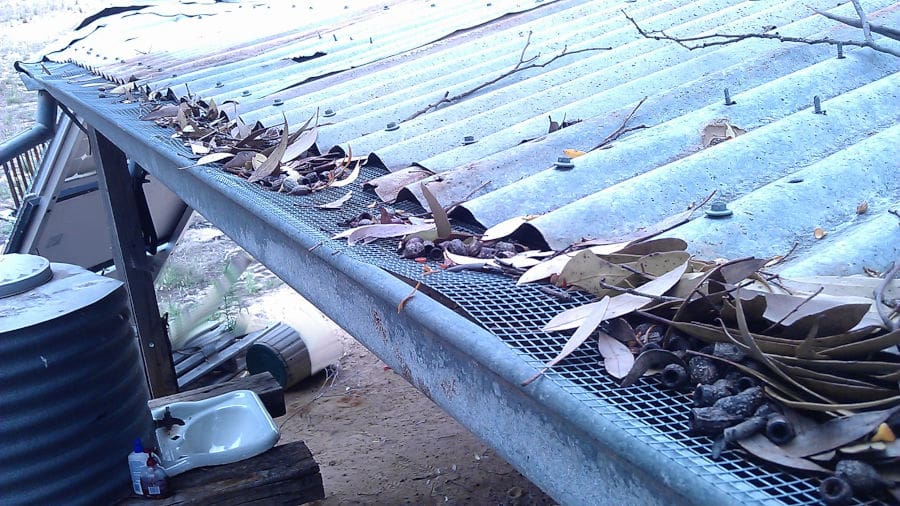
Years ago I did this experiment on a low pitched garden shed. It worked but the coarse mesh had holes which were the perfect size to trap gumnuts.
There’s plastic mesh that cracks and falls apart, hundreds of holes with clips held by tiny screws, edges that catch pine needles and leaves, metal sieves that actually prevent you cleaning the gutter.
Imagine trying to drain your spaghetti by pouring it onto outside of an upturned colander. Retrofit mesh, screwed down to the outside of the house is just as silly.
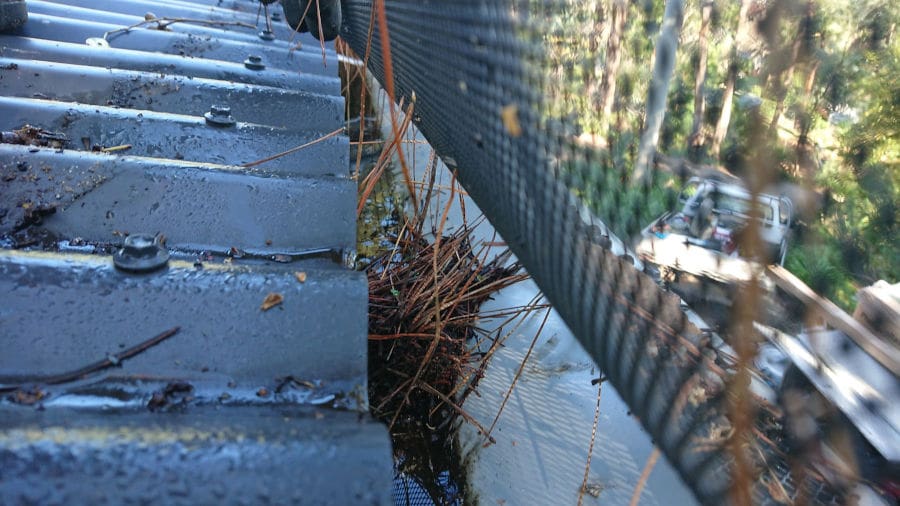
This roof was a couple of months old and despite gutter mesh screwed on top, was already collecting pine needles when we had to temporarily remove part of it to install solar.
About the only off-the-shelf systems I think are worthwhile are those fitted to a tile roof, which lap under the first row of tiles and are grouted under the ridges. However it is expensive work and tiles are hateful things anyway.
Set Your Gutter On Autopilot
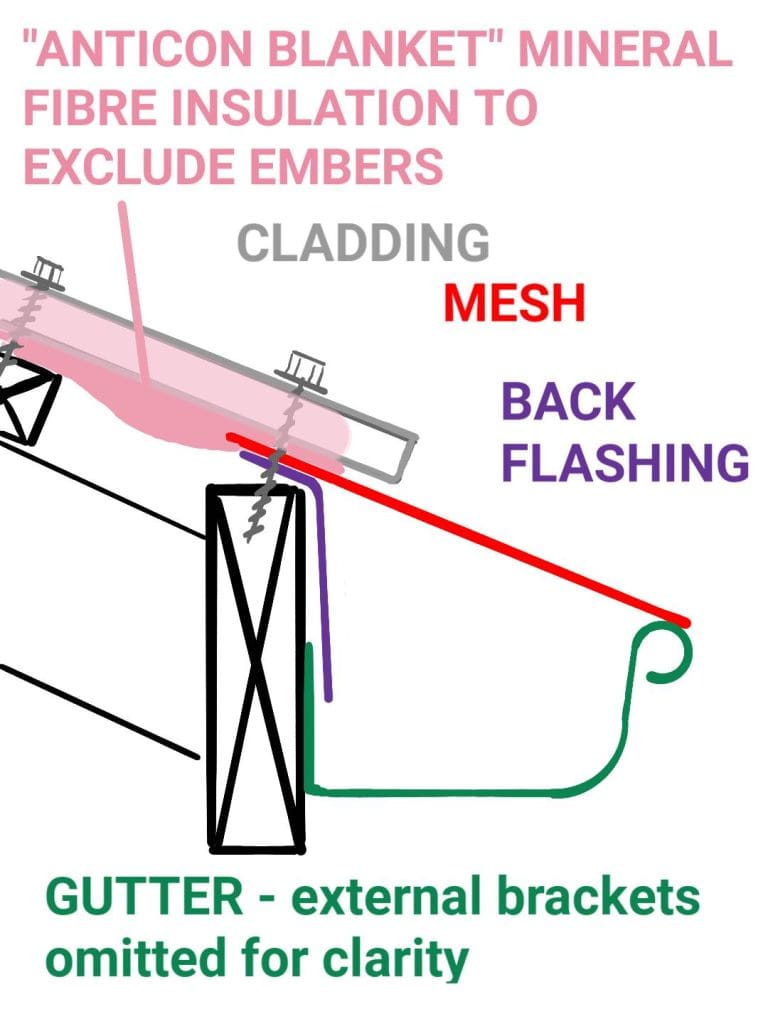
The key to making your gutters clean themselves is this:
Put the mesh under the cladding.
Hang the gutters lower than usual.
The concepts aren’t rocket science but if you have a builder doing the work you’ll probably have make the point more than once (or show them this article).
Proof Is In The Pudding
I have done the experiment in a few places, but none show the results more vividly than two identical sheds which were built two years and one metre apart.
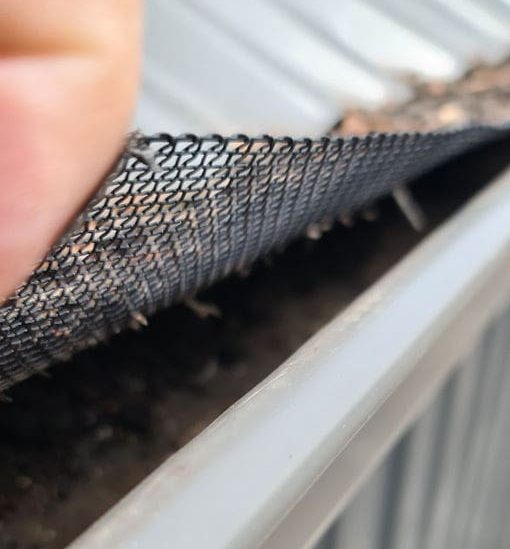
This gutter has a little dirt and dust, but it’s not full of mud which causes rust.
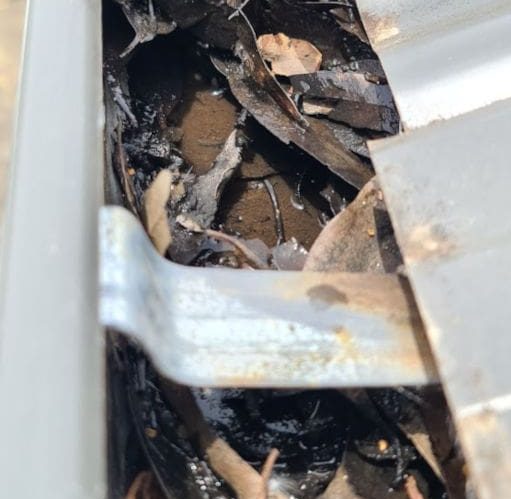
This newer shed has gutters chock full of wet leaves but it looks nice from the ground
There was nothing particularly special or difficult about doing this installation. The stainless mesh came from the hardware shop and everything else was just standard shed parts, though external gutter brackets would make for a better job.
The only real change here is that the gutters are hung a little lower than normal. While some pedants might argue the sheets aren’t IN the gutter, lifting them to the conventional height would just create a deep ledge to collect leaves.
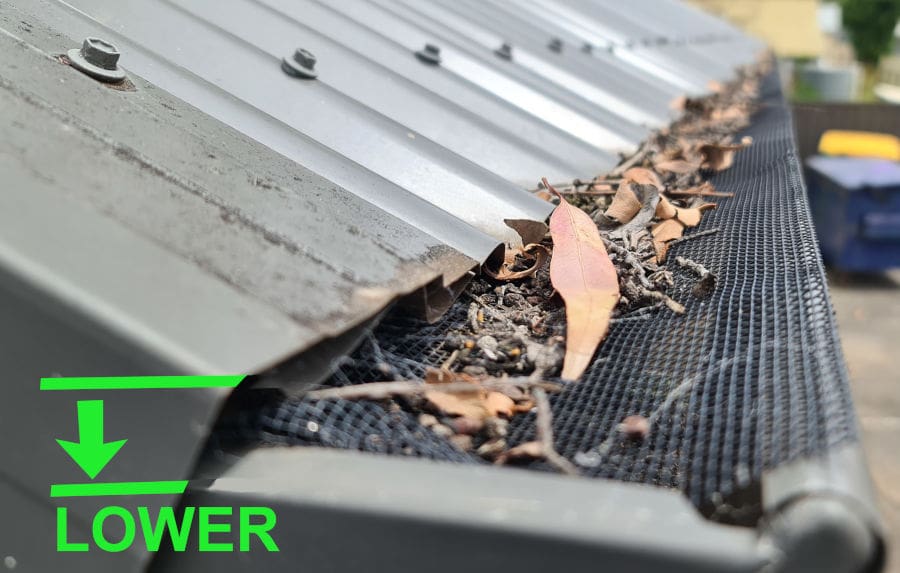
This could actually have been lower to make it better at self cleaning, but either way it stops large volumes of crap collecting in the gutter.
By lowering the gutter there’s less chance that leaves and sticks will stop at the edge. However what does collect will be a smaller volume that’s easier to shift with a garden blower or broom. What doesn’t blow away dries out. You no longer have a matt of compost rusting the gutter & growing weeds upstream of your rainwater tank.
The only compromise is that you’ll be more likely to see the wrinkly edge of the roof – depending on the elevation of course.
Accept No Substitute
With building work, you have to realise the industry is pretty conservative, and not necessarily in a good way. Builders are good at conserving effort as well as profit. They like to do what they know and new ideas, however good, are a challenge to this tradition.
Of course there’s good reasons for sticking to your knitting – in some instances standard building products like metal fascia and internal gutter clips won’t allow for much variation in measurement. Plus we have reams and reams of rules to explain how things should be done and hopefully prevent corner cutting and shoddy work.
In fact the image below shows a roof that was cut short. With hardly any overhang, water dripping off the sheets would blow back, run down behind the gutter and drip from the fascia. Without the expense of a re-roof, it presented an opportunity to turn a sow’s ear into a silk purse.
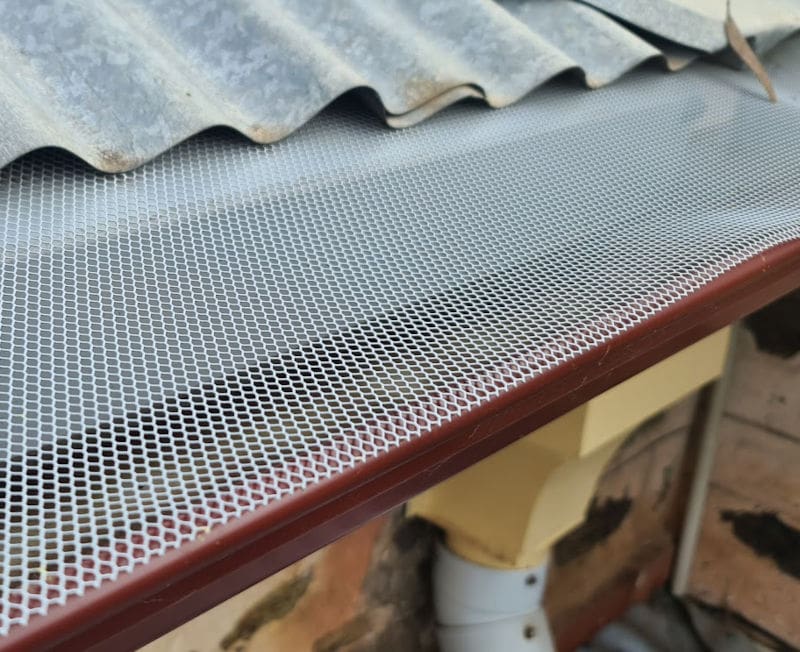
This aluminium gutter mesh has been in place for years now. It just works.
Firstly I found a supplier of gutter mesh and after explaining what I was doing, convinced them to sell me a whole 1 metre wide roll of aluminium mesh. I was surprised to see they cut it with a stanley knife but I prefer roofing snips.
The standard kits they sold included 200mm wide mesh, plus clips, screws and angle flashings. The whole roll gave me 4 times more material for the same linear metre price, and the option to cut strips in the widths and lenghts I needed.
The process looked like this :
- Old gutter removed and the timber fascia repaired where needed.
- Fascia covered with a simple J shaped metal flashing in durable colourbond finish, saving hours of sanding and painting.
- New external gutter brackets installed around 40mm lower than the old ones (you may need to paint these to match).
- New gutters installed & joined.
- Unique new flashing installed as a flange that extends up under the roof sheets and down into the gutter (this means the short roof sheets would spill into the gutter no matter what).
- Finally the aluminium mesh, cut into 200mm wide strips, was dragged under the roof sheets and positioned.
- Bottom row of screws was reinstalled to secure the sheets and the mesh.
Solar Is Part Of A Suite
Whether you’re just looking for some energy bill relief or planning to make a stand with durable renovations on your forever home, it’s worth thinking about what you’ll need when the hot water service goes bang, the stove turns up its toes or the roof starts leaking.
A little planning goes a long way to getting the best results. Being that falls disproportionately affect the older homeowner, anything that keeps you off the ladder is a good thing.
This is the latest in our series on solar and bushfires – read our stories on why you need to maintain solar in high bushfire risk zones, and on what to actually do with your solar and battery should you need to evacuate.
 About Anthony Bennett
 RSS - Posts






Hi Anthony,
You might like to check out EasyFall Gutters (easyfall.com.au) They have come up with a promising solution to the gutter problem which I am about to install on my mother’s house near Robertson, NSW. I will let you know how it goes.
Cheers, Andy
Hi Andy,
Looks pretty interesting.
I’ll be curious to know if the metal shroud gathers much detritus.
Let us know how it goes.
Good luck with that guttering it has no way to clean mud or dirt or small particles from the bottom of the actual inner gutter. Best ensure they install it with the largest possible fall and hope the muck washes away every time.
Their web site shows a cross section.
If you could pull one end off the guttering, and flush it out, or pull the rubbish out with a gadget like the half-moon thing mentioned below. Eh? Strange idea!
If you could let down a section of guttering, then put it back???? Hinges, or inserts?? Nah, cant do that.
If you could take out a section of piping, to stick a hose up? No!!!!!
Could guttering be arranged to curve, instead of angle sharply? Definitely not!
All absolutely impossible! Tradies wont consider anything different. I think that it should be possible to flip the length of guttering down somehow, let the stuff be dumped onto the ground as great mulch, then push it, empty, back into place.
Good article on a very difficult topic that has not traditionally been adequately addressed. I am wondering if there would be a galvanic reaction between the aluminium screen and the steel gutter? A friend has a 300mm wide half round gutter with the supports under the gutter and the top fully open. He says the leaves get blown out of the gutter and he only has a big handful of leaves to take out of the tank filter once a year!
Please provid a cross-sectional drawing of your scheme. The photos didn’t give me a clear idea of the scheme.
That’s my gripe too. The “Photo Gallery” doesn’t show anything identifiable at all.
Nearly 40 years ago, I had Monier Leafless Guttering installed. It was a bullnose roof on the spouting, touted to pull the water into the gutter by surface tension, while leaves shot over the edge. That scientific wonder didn’t exclude very small leaves or the large amounts of eucalypt pollen – mud still accumulated. The product vanished after some years.
I figure any kind of netting will admit even more stuff that turns into mud. So it all needs to come off after a while, I figure.
I’ve just finished digging 6 buckets of leaves and muck out of mine. They say “Don’t go up a ladder in your 50s.” so it’s good I’m 20 years past that. What surprises me is that despite the leaves and mud, the water tastes much better than town water.
A long J-tube for pump-powered flushing of the spouting, on foot on the ground, can only flush residual mud here – a 3 cm deep leaf layer is a bit much for it.
Same problem here – lots of leaves and twenty (plus) years past 50. Trouble is also we have very messy trees, with lots (millions?) of small leaves and flowers.
The other trouble is – talk to literally ANYONE who goes even near a hospital emergency department and they’ll tell plenty of total horror nightmare stories about we “older” folk and ladders.
I’m extremely careful – but realistically shouldn’t go up a ladder at all. I try to get sons to help, but they’re always too busy. It’s a very big problem.
If I had one of the better gutter ideas described here, it might be possible to suck out leaves from down on the ground, with a 50mm diameter J-tube and powerful vacuum. But the roofing plumber ran the steel decking 50mm downhill into the gutter, so it’s even hard to fish out wads of leaves without leaving a few fingers behind on the steel edge. (Not ideal, up a ladder.)
For the other side of 80, I might have to give thought to ripping it down, in favour of a better solution. Maybe just space it out 50mm, so a suction tube fits in. (Roof edge down in the gutter also obviates any possible use of mesh, even if that could be adequate.)
Erik, I was in your situation when I replaced my roof after a hailstorm. The old guttering was Quad, on top hangers off a metal fascia.
I had the roofer install external 6″half-round guttering. Unfortunately, he installed them too high, but that is another story.
What I did right was to use 100mm outlets, & no 90 degree bends: only 45s.
This half round gutter allows me to pull the leaves to one location where I get easier access. (easier during rain too). I tried vacuuming, with little success.
On my shed recently built, I used G&G gutter brackets which mount on the laps (no Fascia). The gutter ends are 45 degree slopes (made from offcut of 1/2 round guttering. There I just push the leaves over the end: easy!
I find the big downpipes, easy bends, & leaf filters at accessible height keeps the gutters fairly clear. Sometimes I get a blockage, but easy to clear.
btw, I am only few yrs behind you!
Hi Peter,
Sorry about the delay but I’ve now included a cross sectional drawing.
Hope that helps.
Cheers
Thanks Anthony. This is similar to what I have and it works very well. I have the mesh attached to the top of the corrugated sheets, not underneath.The advantage is that it keeps animals out of the roof.space. This systme is commonly available from many installers.
Absolutely correct but you missed the really stupid way things are done in WA. Builders use a metal pressed facia with a ridge for the spouting to sit on. Think about this for a minute it is a roll formed product which means that the gutter support will be level all the way around the house!
The location of the facia ridge is specially done to achieve the same result as in your shed picture with the gutter half covered by tiles and thus cleaning out leaves is almost impossible.
Of course the outside edge of the gutter is above the level of the facia metal to ensure that in heavy rain the soffit floods.
We tried to order Queensland specification guttering in WA as it has a lower outer lip to allow excess water to overflow and also this would allow easier cleaning of the gutters. Local roofing contractors do not want to install this product and the chance of getting it here undamaged seems to be nil.
Does anyone know if there is a WA roofing contractor that can roll sensible section
The house i have gutter guard mesh over my gutters, far better than nothing, and the cleaning is pretty easy compared to before.
Still a work in progress with my leaf issues under my panels though. Looking into bird mesh as a possible solution.
I fixed my gutter problems on my shed though, that was easy – I took the gutters off… no leaf collection problems now!
If i ever sell the place, I’ll just go down the big green shed and buy a couple of hundred bucks worth of guttering and fit it.
My solution for gutter:
-use 150mm Half Round gutter.
-Use external brackets
-use 100mm outlets, roll the gutter edge into the 100mm outlet so no lip (tap it with a ball-peen hammer). Use 45 degree bends on downpipe.
-Use leaf diverters at the end of the 100mm pipe. One can also step down to 90mm at this point. I keep the leaf diverters at a level I can easily reach.
-At the end of the gutter, instead of using a square stop, use an offcut of gutter to make a 45 degree end.
I made a half moon of heavy plastic on a Pool pole with a bend at the top. From the ground, I can move the leaves to a point I can reach more easily. Easier to do when it is raining cos the water helps movement.
For a new build, consider using G&G gutter brackets. They screw to the roofing laps, & you can even build with no soffits or eaves, a big saving. 300mm unsupported, or outrigger batten on bracket off wall.
So, no gutter mesh & easy maintenance. My gutters are ~6M off the ground.
Hi Doug,
That sounds very well thought out, unlike most run of the mill houses sadly.
Half round gutters are great.
About your lowering gutters, one needs to tell the roofer to install the guttering so the outside edge is in a straight line from the top of the roofing profile, which is another way of describing your recommendation.
Another factor that should be considered during re-roofing is to install 300mm wide rockwool under the roofing on the last batten for ember protection. Insurance companies sometimes do not bring the specs up to the latest standard. There are other methods for ember protection, but that is the easiest.
Hi Doug,
I’ve included a new diagram to show just that.
Thanks
Thanks for that: Good to see the Ember exclusion too!
Your solution for leaves in gutters seems like hard work.
I found a product called Leaf Stopper, which is a preformed aluminium mesh to match Colourbond corrugated roofing profile and is easy to attach. I fitted it to my shed about 4 years ago, due to overhanging trees and regular blockages, and it has been trouble-free since. It looks good, comes in a range of colours and cost $200 for 15m at the time.
My house has a “flat” pitched steel roof with a 2 degree slope and parapets all around. There are lots of Plain Trees with very large leaves that clog normal gutters. I got the builder to install made to measure colour bond gutters behind the parapets. They are approximately 300mm wide and (crucially) around 120mm high at the outer edge and 150mm high at the inner edge (under the roofing iron) with the 120mm high outer gutter edge overlapping the parapet so that any flooding runs down the outside of the walls.
The gutters run down two sides of the house (It is townhouse style, long and narrow). At all four ends there is a large drain hole that directs water into a wall mounted rain head surrounding each downpipe. If the downpipes get blocked, the clearance in the rain heads allows all water and leaves to drain down into the garden. Each rain head is simply a semicircular piece of colour bond screwed to the wall. The rain heads have no base, hence no blockages by leaves.
Is there a good solution for the inbuilt type box gutters, where the fascia is sitting on the outside of the gutter? I’ve just done the gutter with a leaf blower, where the street tree (Agonis) dumps loads of leaves
Being a bit cynical a self cleaning system would also be free draining and if curved on the bottom would not build up mud over time. The problem with such a system is that a whole business for lots of installers and gutter manufacturers would disappear. Crappy systems keep the business rolling along.
I cannot find a roofing plumber in Perth who wants to install a sensible system. They say not to regulations etc and no warranty. Interestingly they also say they are booked out for months ahead.
Sorry that is my rant but