
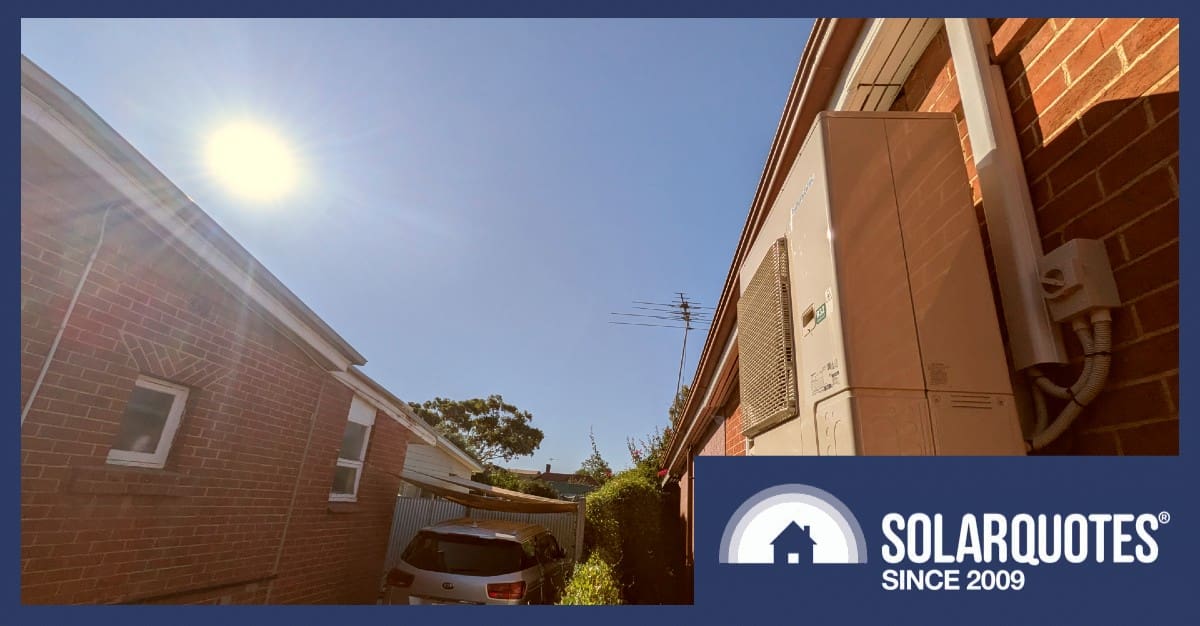
 It wasn’t even 11am in my neck of the woods in Adelaide on Tuesday, and the temperature had already reached 42.2C. After several days roasting in the forties, it’s fair to say that if I didn’t already have air conditioning, I’d have given up one of my kidneys to get it. Maybe even both of them.
Fortunately, air conditioning installers don’t typically expect human organs as payment – although that doesn’t mean a quality new system comes cheap. Here’s how much it typically costs to install an air conditioner in Australia in 2026.
What Does An Air Conditioning Install Cost In Australia?
The cost of installing a reverse-cycle air conditioner depends on a range of factors, including what type of air conditioner you get, the size of the system, the brand, extra features and the complexity of the job. Including install, reverse cycle ducted systems typically cost $12,000 to $17,000, multi-head splits between $4,200 and $8,000, while a single split system is around $1,800 to $4,800.
Don’t Rush Your Purchase On A Hot Day
Like much of the country in recent days, here in South Australia we’ve been copping an absolute monster of a heatwave. It hit 44.7C in Adelaide on Monday, while Ceduna was cooked to the tune of 49.5C, at which point you might as well be living on Venus.
Fortunately, I got a reverse cycle ducted system in 2024 that’s sheltered us from the worst of it. Ducted is on the expensive side, but given we wanted to cover four different rooms we decided to make the investment instead of a handful of different split systems (here’s how to choose between ducted and splits).
We went with a 12.5kW Panasonic ducted system (our review of Panasonic explains why it is also one of our recommended aircon brands for split systems) and I don’t regret it, particularly at times like this when you can cook an egg on the pavement before midday.
It took a few days to get an installer to visit and there was a lead time of three weeks to get the system installed, so there’s no point racing out to get a new system based on the day’s weather – particularly for complex ducted installs.
When I bought the system in 2024 it cost $11,680, but I opted against a few extra bells and whistles that would have added to the bill. I chose not to get a Polyaire AirTouch 5 that would have given me wireless control for $620 extra.
I also opted against mounting the outdoor unit on a concrete slab, saving $270. Instead the outdoor unit is attached to the wall with brackets, which means there’s more vibration and noise, but for us it is located out of the way and we haven’t noticed it anyway.
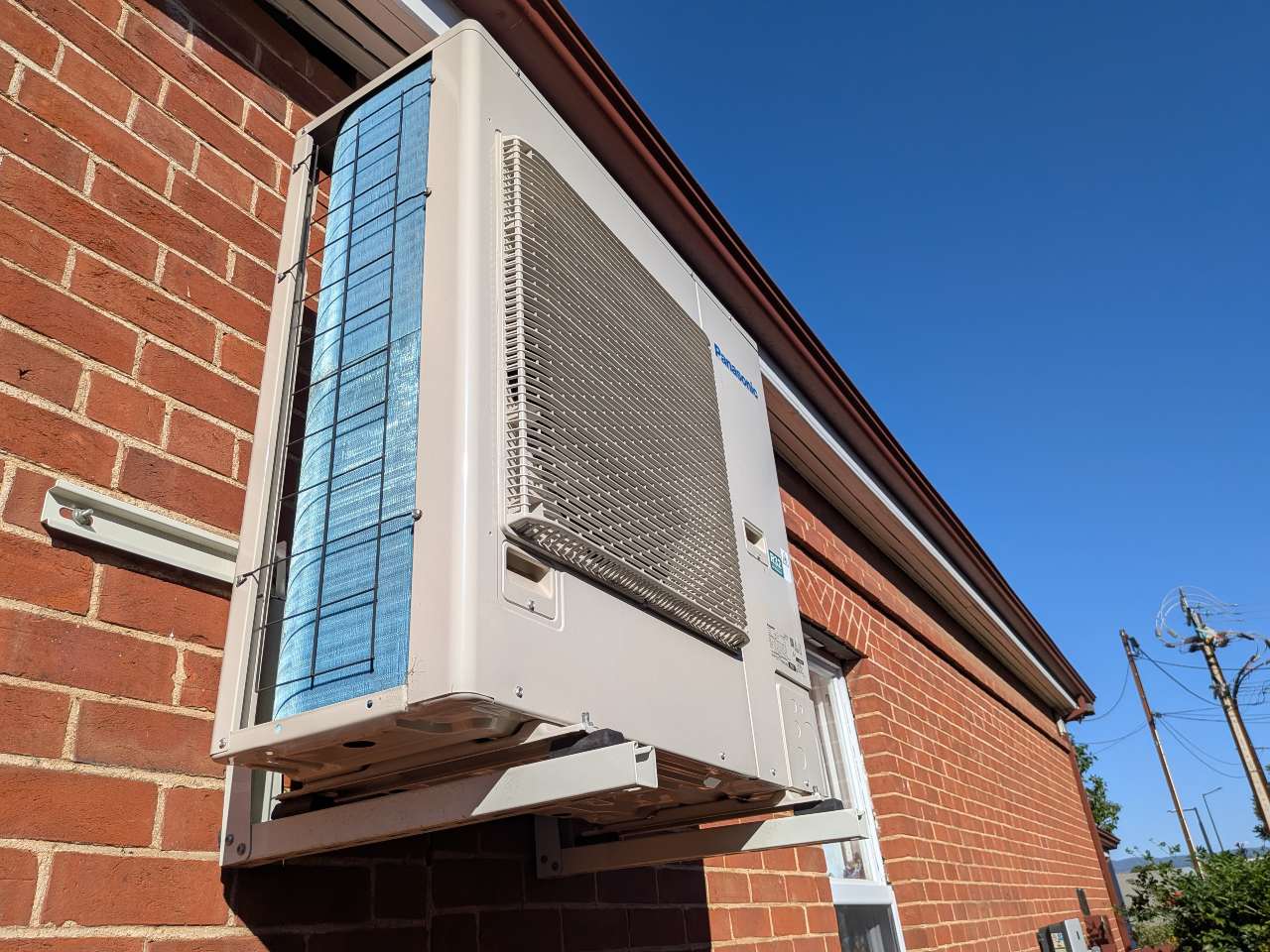
Installing the outdoor unit of my ducted system on the wall instead of atop a concrete slab reduced the cost of the install by a couple of hundred bucks, but the extra noise may not be worth it, depending on location.
Typical Air Conditioner System & Installation Costs In 2026
Prices have gone up since I got my system in 2024, unsurprisingly. The SolarQuotes team did some research and found that these days the air conditioner and install costs vary significantly:
- Ducted systems typically cost $12,000 to $17,000, although the figure can soar past $20,000 for complex jobs;
- A multi-split system connecting multiple indoor units to a single outdoor unit is cheaper, averaging between $4,200 and $8,000. A top-tier two-head multi-split starts at $4,200-$4,500, but add $1,000-$1,500 per extra head;
- Regular split systems are cheaper still, at around $1,800 to $4,800 for supply and installation, of which $1,000-$1,200 would be just installation cost;
- Portable air cons cost even less, but the downside is they don’t actually work in most cases.
Other Aircon Installation Cost Factors
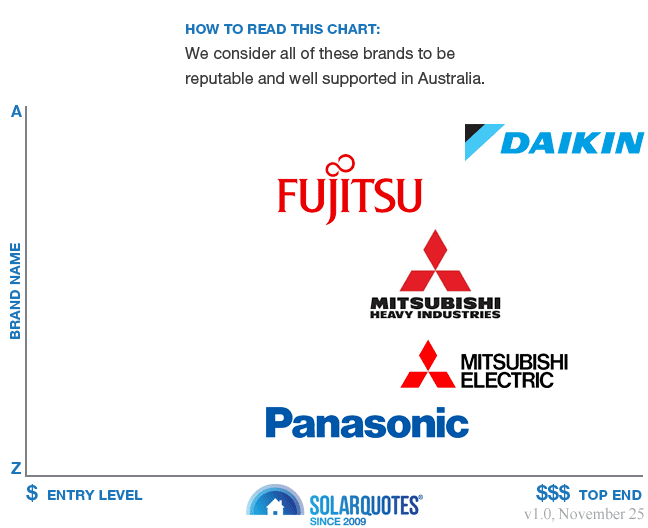
The aircon split system brands recommended by SolarQuotes – the further to the right the brand name, the more expensive the air conditioner.
There’s plenty of other factors that can influence the final bill:
- Premium brands like Daikin can cost more, but cheaper alternatives like Gree could inflict an emotional toll down the line if you run into issues;
- Installing a replacement unit exactly where the old one was can shave a bit off the price, provided existing wiring can be reused. Warranties typically require that the piping be replaced.
- Complex installs for large or multi-level homes require more materials and labour, and some installations require significant electrical work, such as running new cables or installing a new circuit breaker.
- Remote locations may incur extra travel fees, and labour costs can vary by region;
- As noted above, additional features like wireless control or the addition of a concrete slab can add to the final cost;
- Some installs require plumbing work like connecting to the wastewater system. In the case of evaporative systems, they also need a water supply to run up to the roof unit;
- A misleading quote may not include the costs of system commissioning and warranty registration – this is worth checking before you sign on the dotted line;
- Surprise obstacles like insulation issues, problematic wall/ceiling types, outdoor unit location, site access and wiring can change after the quote if the installer didn’t ask the right questions before locking the job in.
So there you have it – a rough idea of install & system costs for air conditioning. A quality installer will be able to give you a more accurate estimate. To decide on your preferred aircon brand, take a look at our air conditioner reviews portal. Considering ducted? Read our ducted air conditioning guide for costs, zoning tips, and whether it beats split systems for your home.
 About Max Opray
 RSS - Posts





I’m old school, one split system for each room and just run what you need to.
But yes, it is getting to the point where air conditioning is mandatory, not just for comfort, but for health as well.
I’d hate to be some poor pensioner or someone who was ill stuck in a hot box this week. It would definitely be life threatening for such people
Central QLD here i was flabbergasted when I learned its actually not a legal requirement to provide in rentals here.
Yesterday was 39C 70%+ humidity. – and thats not actually that bad as far as it can get.
If i could i would consider ducted but I don’t even want to think of the cost of the install in my house not helped by the roof being separated into two sections new/old.
Nathan Holt: – “Yesterday was 39C 70%+ humidity. – and thats not actually that bad as far as it can get.”
A 39 °C dry bulb temperature at 70% relative humidity (at sea level) means the wet bulb temperature would be 33.7 °C.
https://people.tamu.edu/~i-choudhury/psych.html
Exposure (for as little as 20 minutes for those biologically compromised, to as much as 6 hours for the supremely fit & healthy) to wet bulb air temperatures above 30.5 °C are potentially lethal.
See Figure 4 at: https://www.pnas.org/doi/10.1073/pnas.2305427120
Exposure to a wet bulb air temperature of 33.7 °C & direct sunlight risks a rapid onset of heat stroke, organ failure & ultimately death for humans in general.
https://www.nature.com/articles/s41467-023-43121-5
In hot enough weather, even going for a walk outside can be deadly.
As the planet continues to warm, thermal limits are more likely to be exceeded on increasingly more frequent occasions.
I also prefer separate single reverse cycle units, if your multisplit goes down…….
Over the last 20 yrs I have used Mitsi Heavy, Panasonic, Mitsi electric and bought a house with an Aussie brand ( Chinese) which was still functioning over 10 years post installation ( but outside unit rusted badly – close to beach).
Had a Kelvinator die at about 10 years but a second one must be nearing 20. Fried Geckos put paiid to one of my Mitsi Electrics.
My son has Gree units – about 11 years old – 6 or 7 single split- and has only had to replace one since his house was built about 11 years ago.
So generally have had a positive experience with these units over the last 25 years.
Why did you not include reference to ducted evaporative air-conditioning?
My understanding is that Adelaide is similar to Perth in terms of climate, and, may be a bit dryer than Perth in the summers.
We have ducted evaporative, and, whilst it is not as precise as refrigerative, in terms of temperature control, when the outside temperature is in the mid-forties, the inside temperature is in the mid-twenties, and, the installed cost and the running cost, are, according to my understanding, both less expensive that ducted refrigerative.
It does not have heating, but, it does circulate fresh air (other than when we are under attack from government arsonists), which ducted refrigerative, I believe, does not.
And, a properly designed ducted evaporative system does not need windows and doors to be open (exhaust vents in each room, remove that requirement), and so does not pose a security risk, where household security is risky.
Also, I would like to see more reference to HVAC.
I did mention evaporative can involve additional install costs for plumbing. For a full breakdown on evaporative vs reverse cycle, we dive into it here.
It must have improved greatly since I last experienced evaporative air conditioning. My experience in western Queensland when they installed it in the single men’s quarters was it dropped the temperature from 45 degrees and 30 percent humidity to 35 degrees and about 90 percent humidity.
Less than a pleasant experience.
Swore I would never touch it for my own house, bought and installed my own reverse cycle air conditioner.
Andrew: – “My experience in western Queensland when they installed it in the single men’s quarters was it dropped the temperature from 45 degrees and 30 percent humidity to 35 degrees and about 90 percent humidity.”
A 35 °C dry bulb temperature at 90% relative humidity (at sea level) means the wet bulb temperature would be 33.4 °C.
https://people.tamu.edu/~i-choudhury/psych.html
Exposure to wet bulb temperatures above 30.5 °C are potentially lethal.
See Figure 4 at: https://www.pnas.org/doi/10.1073/pnas.2305427120
ABC reporter Tyne Logan investigated at what point does heat become deadly. https://www.youtube.com/watch?v=poQklIrdEI8
Andrew: – “Less than a pleasant experience.”
A form of torture perhaps?
We have both installed. The original evaporative cooler, and various heat pump aircons around the house.
It’s a good combo – at night we just run the evap cooler push the colder night air into the house in preparation for the next day.
When the hot season is over I stuff my poly insulation into the outlets and seal them up so there is less (hopefully none) heat loss through the outlets.
Hello Max, my apologies for an off-topic question but is a main circuit breaker in new housing on West Australia still restricted to 32 amps? I remember you mentioning this topic some time ago.
Those rules were revised – read our breakdown here.
Thanks! Sorry I missed the earlier discussion.
Regarding wireless operation, I have been using a Sensibo Air remote controller with a Mitsubishi split system. It integrates with Apple HomeKit home automation system so I can remotely control heat/cool/off and temperature setting of the aircon. I also have a couple of Siri voice commands that control it.
I expect the Sensibo can also work with Google and other home automations. Most popular brands of aircon seem to be supported.
A tip for installing the Sensibo Air = – I needed to temporarily disable the 5Ghz band of my router in order for it to connect to 2.4GHz wifi.
Yes- common issue with both wifi bands. I have other devices that don’t play ball with 5Ghz.
You’d think they would be smart enough to choose the system that works.
Tip. Deco allows both. You can easily flip one off using the app then pair 2.4g then when its done resume both. This issue is common to heaps of devices incl our inverter
I have 2 Sensibo Sky units (the older, less fancy models cf. Sensibo Air), one with a Daikin and one with a Mitsubishi Heavy Industries. They do exactly what I want (without needing the fancy extras in the subscription service) and seem to be way cheaper than the $620 quoted in the article (about $120 for each unit).
Rather than the expensive thing like Sensibo, I just buy $20 Tuya Smart IR controller off AliExpress. Has USB-C port and temp sensor built-in (although I run a bunch of Tuya Zigbee Sensor inside AND outside the house). Can integrate with HA if you want and natively support Google/Apple Home and Amazon Alexa. Cheap as chips and works great, everything is on Automation Routine based on condition trigger (Aircon, Eglo ceiling fan, Hydrotherm X8 heat pump hot water, LED lights).
Cool – I think that’s a great solution (and probably more fun / satisfying, certainly cheaper) if you have the tech skills to make it work. A lot of folks don’t, though, and for them a pre-made solution might be better.
(I am not paid by the company, I am just a very satisfied customer… other brands are available!)
They are not really any more complicated than Sensibo and if one doesn’t want to meddle with AliExpress, Woolies Coles Bunnings BigW Kmart etc. all carry the older micro USB version branded Mirabella Genio Laser or even Arlec etc for similar price ($20-$25). They are all Tuya, works with Tuya SmartLife App or the brand name skin Tuya App (Genio for example). The only reason I go with AliExpress is because the local branded versions are older, that’s all.
And the reason I go with Tuya is because they are huge, they have a very very big catalogue of smart home products, for instance I have LED strips, Eglo fans, Hydrotherm (Aquatech) Heat pump hot water all natively Tuya, so they talk to each other and most importantly the many Zigbee sensors I have. Even some of the Japanese AC has Wifi module that is Tuya but at marked up price, can’t remember if it’s Panasonic or Daikin or Mitsubishi. The appliances made by Midea or Haier for instance are mostly Tuya too.
Nice overview!
I noticed that ActronAir RCAC is not on the recommended list. I am particularly interested in the ActronAir Advance ducted series — is there a reason it isn’t included?
Also, would you consider ActronAir a premium or standard brand relative to others on the list?
Actron ducted systems have a better reputation than their split systems, which are built by budget brand Midea.
We installed Actron fully ducted. With Nero remote. After 30 years Evap cooling, we are impressed with Actron and features. Highly recommend solar panels for day use and a battery for evening. Our Kw increased to around 50Kw a day – still happy as most covered by solar systems. Actron were in the high $ price point, but super quiet, exhaust verticle not horizontal, big plus and ramp down feature worth in running cost reduction. We are in Melbourne and removed our Evap and ducted gas cooling and heating systems.
I am in Melbourne as well. May I ask what the kW capacity of the ActronAir system you installed was, the approximate installation cost before the VEU rebate, and which installer you used?
I have a 52-square double-storey home and am currently considering the 24 kW ActronAir Advance model.
Thanks!
ActronAir Advance, single phase power, largest is around 17Kw. Replaced gas ducting and evaporation ductwork, installed Actron with new higher rated R ducts. Added 3 new outlets, total 13 outlets and 6 zones with master remote (Neo wifi) that can be geo fenced, remote access and control temp, etc. Allows Actron to remote in to check system, upgrade or fine tune. Geelong company that services Melb. Found two in Keilor and Airport West as well. No VEU when we purchased as unit model not rated at time. Actron can give you names of installers. Paid $22k approx for 2-3 days work onsite to remove everything in room, incl ducts and units and have a clean install. Power ramp down feature suggests saving up to $1000 a year for all your heating and cooling costs compared to other brands ? Heating is ‘thinner’ compared to gas, run a few degrees higher. Cooling excellent, esp when combined with ceiling fans.
We have a ducted system. Its not energy efficient. We added a split for the downstairs area we frequent. Its is energy efficient. We have solar and battery and tge ducted eats power around 4.5kw. on real hot days its running and does not satisfy. The split uses little..Maybe 1kw. Other mild days the ducted uses far less power. We often will turn it off to allow upstairs to heat on very hot days to preserve battery..Use the split. To save power. Later we turn it on. All our AC is on solar + battery. Cost is now $0
On very hot nights the battery lasts…just. Mild nights ots off or rarely kicks in
Battery makes a massive difference.
I stand to be corrected, but I was under the impression some of the AC splits being marketed by some companies were “grey Imports”. Same big brand names, but the offered models were not imported into Oz by the manuf and they had no warranty or parts support by them, you have to go back to the installer/seller to be supported. Additionally splits have a max run of piping to individual heads, like 30m and a combined run and return piping to outside compressor of 100m for some brands. If you fail to estimate distances you could be running your unit at max stress all the time. One final issue to be aware of, if head units mounted on internal walls, not on external wall inside home, then a concealed pump has to be installed, when these pumps fail to remove waste, there is a real risk to water damage to internal plaster and mould. Pump failure alarms are not offered as far as I know. Sellers never tell you limitations, its buyer beware !!
Tony,
No pumps here; three split heads, two above interior doors, one above a window. Condensate runs out through a corrugated PVC hose, run beside the working fluid piping, in the same duct. Gravity is the only required pump in essentially all cases, I figure, except if you need to aircon a cellar?
I’d plant a cactus at the discharge point, as we don’t have enough humidity to drip irrigate anything more demanding through the summer.
Incidentally, when my house grows to the point where 100m of piping is needed from one end, I suspect it’ll be possible to pipe to the other end – so that “issue” becomes real-world when the house is an eighth of a kilometer across?
If gravity suffers a pump failure, then we have bigger problems – whales & petunias come to mind.
Yes understand. Was trying to explain if 5 heads, each 10m to unit and 10m back to compressor, = 20m x 5 units = 100m combined run ( allowing for vertical and horizontal runs). Some units will have smaller runs, possibly one with a longer run. Some brands only designed for max 70m combined piping. Multi split systems need to be designed with limitations in mind. Head units in the middle of house sometimes do not have the luxury of gravity and a pump is required, again owners not told of need for regular servicing and checking. Most people are ‘set and forget’ and rarely clean air filters and never rinse fins in unit to keep clean and healthy.
Purchased a split system a few years back from the local Hardly Normal shop, I paid for it and being green between the ears asked about install. The sales guy said “Don’t you worry , we will arrange everything”. A few weeks later two guys that looked like they just got out of jail arrived and proceeded with the install, (I even ran the power cable for them). We paid them a small fortune. It was a couple of weeks before we decided it was hot enough to turn it on, nothing happened, we contacted the purchasing store and they said it was a contractor install, cant help.
We ran the manufacturer who gave us their agent in our town, they came and found a gas leak, we paid them. The purchasing store would not honor the warranty as it was an install problem, and the cowboy installers did not want to know about something called warranty. Even NSW fair trading was not interested. Buyer beware.
John,
Big city? Anonymity in a big herd + ample fresh prey evolves that behaviour.
Retailers have long decoupled from installation, to avoid this problem. So it’s all on us.
I bought my three at a country town Betta branch, and even brought them home in the trailer, as my chosen installer was a bit busy. He lives in an even closer, even smaller town – where you can’t hide – all the locals know you – perform or go out of business. Where that’s not feasible, there’s a lot to be said for spending serious effort seeking word of mouth recommendations, or maybe looking at a Whirlpool chat group?
The retailer probably won’t even recommend an installer, due to implied warranty, but a wink and a nod can probably evince mention of “a guy some of our customers have used … I’ve heard.”. That’s about as good as it gets these days.
Trust, like truth, is a rationed public commodity these days.
(Peaking with the guy with the orange hair, admittedly.)
Thanjs Max.
You haven’t included Sansung in the table? I know they are fairly common here in S.E. Queensland whith mild winters and less extreme summers. Is there any reson you chose to exclude them,
Reviews are more mixed for Samsung than some of the other major brands so we haven’t included them at this stage – check out our review here.
This prompted me to add my Samsung review. You are right to not recommend them.
I would give a big plus to Mitsubishi but dont buy the cheaper versions as they gut features like app support and reverse cycle etc.
Glad to have had our 4 splits for the recent 40+ days, at 4 corners on the home like an X.
4 running free in solar soak on the 43c day, fired up in turn as solar production starts, just turn 2 off as production drops in the afternoon shutting those doors, by the time evening comes the other 2 can often be turned off as well, or if hot overnight left on we’re drawing some to maintain 2 areas, but they are pretty modest in power needs when the home is pre cooled.
All 4 of them draw under 1kw each when ‘working’, and probably that similar draw with all 4 when ticking over.
Can’t remember what they cost as we gradually added them (along with more floor space), but I’d be surprised if each unit cost more than $800, and install about the same.
I absolutely must take the covers off the compressor units and do the gentle cleaning of the fins etc after this summer, youtube shows how to do this safely, and it will be good to see how much dust and other debris might be removed.
About a year ago, I bought two 3.5 kW and one 7 kW Mitsubishi splits for about $7k, and had them installed for $2.8k. OK, I already had a dedicated 20A circuit pre-wired to the porch for the two 3.5 kW compressor units, but the other had to be wired 8m back to a sub-board, with a new breaker. That’s not a bad deal for 32 km out of town.
The installer said he wasn’t licenced for multi-head splits, and I figured separate splits provide redundancy anyway – if one fails, open the intervening door for some cooling from the other. Then waiting for a repair/replacement is more tolerable.
Battery prices will fall – aircons not so much. Better to have the benefit now, if finances permit, I figure. And with ample solar, it doesn’t even cook the planet with increased CO₂ emissions. Here, off-grid, one unit has run the last two nights, dropping the battery to 94% overnight, back up to 98% by 8:00 a.m.
That’s zero operating cost – just a pile of capital cost to amortise.
Most folk don’t have industrial size battery systems Erik so your 6% battery consumption will be far far more for homes with only a 10 kW battery. Worse still, homes with vastly smaller batteries and multiple split AC, or ducted, operating overnight.
Yes,
Even with a 19kWh battery I cant run my big air conditioners long after the sun is off my array – 3 or 4 hours, and if i keep them going longer I run the the risk of running out of power before morning if running the air conditioners in the bedrooms overnight.
But now is the time for them to be upsizing those small batteries. If you get in before 1st of May, you can max out your battery quite cheaply, if after, you can still add up to 14 kWh to your existing system and get an okay rebate.
My extra 19kWh went in today.
Our 42kwh satisfies a split and ducted and all household demand. On very hot nights it gets close to minimum. Its easy to manage. Frankly see no point to tiny batteries if you have any air system
I installed 2 x single Daikin splits downstairs and 4 multihead Daikin units with a single external compressor upstairs. 18kw RC capacity handles everything needed in a large 2 story home. All head units have WiFi and are controlled by Home Assistant. When I had a small 6kwPV system I used to look at PV output and turn units on and off (load shed) depending on PV generation so that I wasn’t using Grid power to run AC. Now that we have a large 19kw PV system with battery we run AC when ever we want and it costs nothing because either the PV supplies it or the battery does. Again HA sits over the top and can load shed if the Battery SOC demand it. With HA I have a set of screens that control AC they range from full complex control per head on 1 screen down to a single on/off button on another where each head resumes what it last did when on or ceases operation if the one button is off. Ducted control on single split systems. No regrets with any choices.
Andy
We have installed an AC/DC solar split system.
It can run purely off dedicated solar panels with no AC/grid required, or mix of solar and grid/battery.
It is incredibly efficient and doesn’t load the system.
On Adelaides 40c+ days we were keeping a constant 21c inside.
We are in an offgrid, 48v/240v solar power stand alone power situation.
We wanted air-conditioning, but after searching the net we found that considering our particular power circumstances, providing it was going to be a challenge.
In the end, two choices…. increase the size of the 48/240v inverter to provide the load capacity for the 240v aircon unit, or alternatively, buy an aircon utilizing 48v DC only, increasing the number of panels for each as required.
We decided to go with the extra pricey 48v unit.. in retrospect, not the best choice.
Cons – available in small capacity only. Expensive! $3000 for aircon unit, delivered: too small for what we wanted, but the largest available at the time. Installation, new 48v wiring and extra panels, a further $7000. Total $10,000.
Retrospectively…. it would have been better to go with the bigger 48/240v inverter at around $6300 installed, and installed a larger 240v aircon unit ($1,500) utilizing the 240v supply.
Warren,
The bigger-inverter solution would also have expanded your other energy utilisation options – not least eventual BEV charging with a 7.2 kW level 2 charger, even if not at full whack when also delivering to other loads.
Changing an initially frugal energy conserving mindset to greater exploitation of free energy with zero incremental environmental cost, is not achieved without some re-evaluation. (The end-of-life hardware impact is about the same, mostly recycled now, as volume makes it profitable.)
When the old fossil-burner gives up, and BEVs are no dearer than a planet-destroyer, then it’s *very* nifty to already have a more capable solar system.
I went for 3 splits to replace my ducted gas system. The benefit is cooling and heating and solar powered at times. Upstairs was already a 10 yo console system from Fujitsu that I’d like to upgrade when it fails. It does a great job heating the space but can struggle to cool on severe hot days as it’s underpowered for the space and the area is poorly insulated. The living area downstairs is a MHI console unit that is mostly used for heating as it’s a cool room and heavily insulated so the cooling function is minimally used in summer. Finding installers for it wasn’t simple and a few licensed (apparently) installers couldn’t/wouldn’t do it. Two didn’t even know what it was and I had to explain. The third unit is a standard split in the main bedroom. The unit was originally going to be installed in the living area with another larger split to give flexibility but after I switched to the console, I found it was more than adequate and the small unit was used in bedroom. Melb.
I’m unsure what criteria you used in your comparison table, but one thing that I find very annoying is the outdoor units susceptibility to damage from vermin.
I originally installed Fujitsu 1 x Single unit and 1 x 3 headed unit.
Within a year or so, both outdoor units failed. Inspection noted that geckos had entered the outdoor units and did their business causing a failure of the controller boards and due to the fact that the damage was caused by vermin, it posed an issue with warranty.
I repaired the multi unit myself and replaced the single unit with a Mitsubishi.
My question is why don’t the manufacturers make the outdoor units so that geckos can’t enter. I understand that ants and spiders may be able to get in, but not geckos and larger species.
I’ve been in the electronics field for decades and manufactured many vermin proof enclosures, so I can’t understand why it’s not done.
The Invasive Asian House Geckos?
They’re notorious for killing electronics and infesting everywhere in an expanding area.
As well as killing the native geckos off.
One problem is they chew through sealants over time to get access and also don’t seem to care if it kills a number of them.
My roof is infested “older house so not much i can do to actually keep them out without almost rebuilding the entire roof”.
Learned that when i tracked back an infestation in the liveable areas to an exposed hole in an internal wall “due to plumbing issues” that hadn’t been patched.
On the warranty issues no one covers for damage they cause.
They’ve so far been seen as far as Melbourne in limited numbers last i heard.
Agree that Asian house geckos can be a problem – as well as mice! We had a mouse get into the motherboard section through a gap in the housing to allow for wiring to connect to the motherboard in the condenser unit and while it didn’t chew through any wiring, it deposited its business over some the delicate internal components, thus forming a bridge across connections which in turn shorted out and destroyed the circuit board. Replacement motherboard was nearly $400! It would be very easy for manufactures to make internal component parts mice and gecko proof, surely!
Ouch at least i assume you weren’t right next to it when it went.
I was when i got my old pc up to setup for a family member left me deaf in one ear for about a day as the pc was on the desk right next to my head when its power supply went off like a gunshot pointblank.
It had only been sitting turned off for about a month or 2 at the time.
On pest proofing
You would be surprised how hard it would be to reliably do so on any larger electronics.
Especially without causing the parts to have a significantly shorter lifespan.
As well as wiring/etc theres the thermal issues/etc that start to rack up as you make it more firmly sealed as well as exponential costs.
Low power DC appliances its much more of a possibility but still usually not considered due to sheer costs in most cases and in others things like weight limits.
For PC’s for example thermal issues is one of the biggest considerations.
Its also why there are so few pc cases with actually significant air filtering.
Sorry but I disagree. My former job as a designer of equipment, a good part of it entailed vermin proofing.
It’s not that hard and doesn’t add too much cost, especially when the cost is spread over thousands of units.
As I mentioned, tiny insects may get in, but anything bigger shouldn’t.
For the OEM’s its got nothing to do with costs, its about not shooting yourself in the foot.
For those that live near the beach you not only have to worry about geckos destroying Mobo’s but also salt driven corrosion. It can destroy much of the metal parts of an RCAC way before it would in more friendly locales. As such if The OEM fix these problems, suddenly the amount of units you sell will fall, customers will be excited, your OEM’s management accountants not so much.
As an educated consumer I may well argue I’m never buying brand X again, it didn’t last like it should have, I now buy a Y replacement. At the same time A previous Y owner is saying the same thing and is buying an X instead…same issue same replacement bought, what is there to drive the improvements we seek?
Both the corrosion and the Motherboard sensitivity to Gecko P#ss issues are easily solved at an engineering level, at a finance level they never will be
3rd party fix’s exist for both but cost $/warranty
A mistake not getting the Air Touch 5. It works so well with Home Assistant that in these days of stupid demand charges, I reckon it’s saving me $50-$100 a month. On Amber, probably more.
Moving/renovating house now and my only ask for the aircon installer is “an AirTouch 5 system, I’ll leave the rest to you”.