

Subsidies for Australia’s Cheaper Home Batteries Program (CHBP) are being adjusted to ensure the program’s ongoing viability out to the intended finish date. We take a look at the impact the rebate reduction will have on financial support for some popular home storage systems.
How Much Will The Battery Rebate Reduce By?
Just as the rebate works now, the impact will vary based on the useable capacity of the installed system. The following table provides examples of the effect of the changes out to the end of 2026 on some popular battery systems of various capacities, and a few big battery packages I’ve seen being promoted about the place.
Note that the rebate values indicated below are approximations only, and *before* admin fees and charges; which will vary but can be around 10% of the full rebate amount.
| Models | Useable Capacity |
2025 Rebate Value |
Jan-April 2026 Value |
May-Dec 2026 Value |
|---|---|---|---|---|
| Sigenergy Sigenstor | 15.6 kWh | $5,803 | $5,241 | $4,243 |
| Tesla Powerwall 3 | 13.5 kWh | $5,022 | $4,536 | $3,672 |
| Sungrow SBR Series | 16 kWh | $5,920 | $5,360 | $4,120 |
| BYD Battery Box | 16.6 kWh | $6,175 | $5,577 | $4,315 |
| iStore Smart Battery | 15 kWh | $5,560 | $5,040 | $3,960 |
| AlphaESS Smile | 13.34 kWh | $4,962 | $4,482 | $3,628 |
| Fox ESS | 13.9 kWh | $5,170 | $4,670 | $3,780 |
| Dyness Pro Package | 50 kWh | $18,600 | $16,800 | $6,960 |
| VoltX Neovolt Package | 48 kWh | $17,840 | $16,120 | $6,880 |
| Anker Solix X1 Package | 30 kWh | $11,160 | $10,080 | $6,160 |
Or, in a graph:
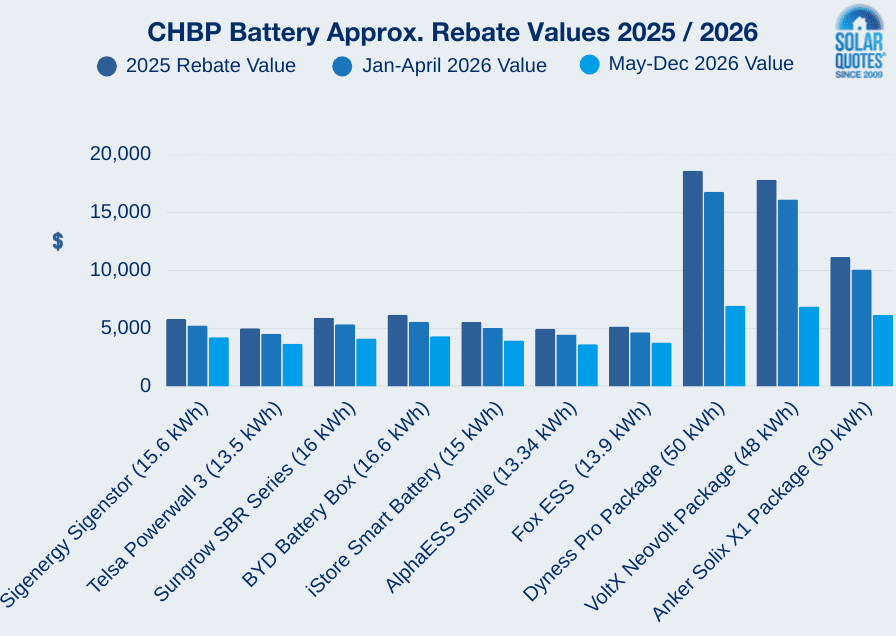
The above listings are examples and not necessarily product recommendations. To learn everything you need to know about choosing the right system for your circumstances, see our comprehensive home battery guide.
Why Is The Home Battery Rebate Being Reduced?
It started becoming clear very early after the formal launch of the federal battery rebate that the scheme’s originally announced funding would run out (much) sooner rather than later; as early as June 2026. This was in part due to the rapidly growing capacity of battery systems being installed1, as a bigger battery means more rebate.
The situation was such that subsidy structure changes were needed fast — and changes were always on the cards based on the program’s performance. That happened on Saturday. In summary; the changes are:
- Original $2.3bn budget has expanded to $7.2bn over the next four years and is anticipated to deliver an additional 40 gigawatt-hours of storage capacity.
- The subsidy will be accompanied by tightened requirements, will reduce over time at a higher rate than originally planned — and every six months instead of annually.
- While the first 50kWh of a system up to 100 kWh will still be eligible for support, the subsidy will be reduced significantly for larger systems under a new tier structure.
- The changes will apply to home batteries installed from the start of May, 2026.
Those are the nuts and bolts, and you can find more discussion on the battery rebate changes here.
“Promise Made, Promise Kept”
Commenting on the changes to the scheme and its ongoing success, Federal Minister for Climate Change and Energy Chris Bowen said the Cheaper Home Batteries program has assisted more than 160,000 Australian households to date; with around three-quarters of installations in Australia’s suburbs and regions.
“… it’s all about making sure that the support remains available right up to 2030 like we promised at the last election. Promise made, promise kept; and it’s great to see so many Australians taking up the Cheaper Home Batteries policy,” he said.
For Australian households that don’t wish to or can’t install a battery, there will be flow-on benefits. According to the Minister, the Australian Energy Market Commission (AEMC) found increased home battery uptake could deliver a (conservative) 3% reduction in bills annually across the energy system through smoothing out peak pricing; particularly in the evenings when wholesale electricity costs can go sky-high.
Stay up to date with what’s happening with the program, solar generally and Australia’s home electrification revolution by subscribing to the SolarQuotes newsletter; delivered to your inbox each week.
Footnotes
- Average battery size since October 2025 is estimated at ~28 kWh, compared to installations in 2024 averaging 10 – 12 kWh. ↩
 About Michael Bloch
 RSS - Posts






Only a politician could use a statement like “promises made, promises kept” while substantially changing what he originally promised…
Here’s hoping Wright’s Law starts kicking in: “for every doubling of cumulative production [and we can include supply chains and installation skills in the early stage], the cost per unit decreases by a fixed percentage as a result of increased experience, efficiency, and economies of scale”.
We should also see maturation of return economics (helping payback and returning export value to PV) as retailers see value in peak period battery feed-in-tariffs of 20c/kWh or more. This exceeds the highest hour of wholesale prices across the last year and should be viable up until batteries themselves (including utility) might smooth that out. In which case, the scheme can be posited as having worked in a way that will save consumers the seven billion $ it cost them as taxpayers.
The government seems finally to have understood you’ll never win this in the toxic world of social media politics, or by relying upon a fictitious market. Just invest heavily in where we need to go, the people will follow. Target households above all, go straight to the voters. As Kissinger once said, you only win hearts and minds when you have people by the balls. Do as the opponents do, seek forgiveness, not permission. People will forget the debates when they’re living the realities.
Seems like a reasonable change to stop excessive subsidy on a battery size households wont reasonably need outside a VPP/Amber arbitrage situation.
As always thanks for this great summary and informed comments from others. May I suggest next update (each six months now), exclude the graph, add another field ($ per kWh) and sort table by this additional field. Adding the warranty in years would also put your recommended manufacturers on notice that we value this information.
There are many unknowns about this change. Since October many installers are scheduling their work for after 1 May. How will the arbitrary date of 1 May affect these customers? Will the new or current rebate apply?
So can I order a battery before the end of 2025 even if the installation doesn’t happen until early 2026 and still be eligible for the full rebate?
As I understand the wait times for installs are quite long?
I am not sure who is buying a 13.9kwh Fox Ess system (3 * 4.66kwh)?
Everyone is jumping on the 41.9kwh (9 * 4.66kwh) version.
I would have been skeptical but they have been in the UK for years with a good fan base.
Any battery subsidy should only ever have funded the household’s capacity to charge and discharge the thing. Capacity beyond that has no economic value, either to the household or, equally importantly, to the taxpayer. Capacity to use storage comes down to the size of the solar installation, the local climate, and the use or not of gas in the house. Surely it wasn’t too hard for those nuances to be accommodated in the design of the subsidy scheme? If too hard, then a simple ceiling on the kWh capacity subsidy surely should have been set?
A larger battery has the capacity to take more excess out of the grid which stabilizes the network more than a small battery. Having a larger battery also means people are more likely to export back to the grid in peak demand. I have a 48kwh sig and export 15kWh a day. Very happy I got my $18k rebate when I did though.
Hi John,
Glad your system is working well. Biggest problem with BIG batteries is that many have been super cheap and only connected via a 5kW inverter, so they can’t be charged or discharged quick enough to make good use of the capacity.
Yes, a 20kw inverter is enough for me to charge from the grid or charge a future EV. 5kw inverters are rather pointless.
I think promise made, promise kept is correct. they had 3 billion and that is gone, just quicker than expected because people obviously tried to maximise their value. And now they’ve extended the program but with some stricter guidelines, to make it last longer and reach more households.
It’s also not a sudden bait and switch. you will have another 6 months to install a large battery if you want and get the promised (old guidelines) discount.
Hi John I’ve got 16 junkies panels about 3 yrs old and thinking about a battery would a 13 kWh be sufficient as I have electric all through the house with an I store electric heat pump. There’s only 2 of us and both work during the day so at the moment we wash at 6 pm and cooking is it to much
Thanks Brad
I have 13kw of panels that are 8 years old but still generating 70kwh on a sunny day. You are better putting the extra money into a bigger battery with the current rebates. Go with someone like globird or ovo and you get 3 hours free a day. If your inverter is big enough you’ll get your battery fully charged for free every day regardless of the sunshine. We are averaging 60kwh use a day and am in credit.
Enjoy this blog, the rebates received are great, but, what additional for installation?
Really wish they started the rebate reduction at 16kwh not 14.
A lot of really good systems start at around that 15kwh number e.g. Fronius Reserva.