
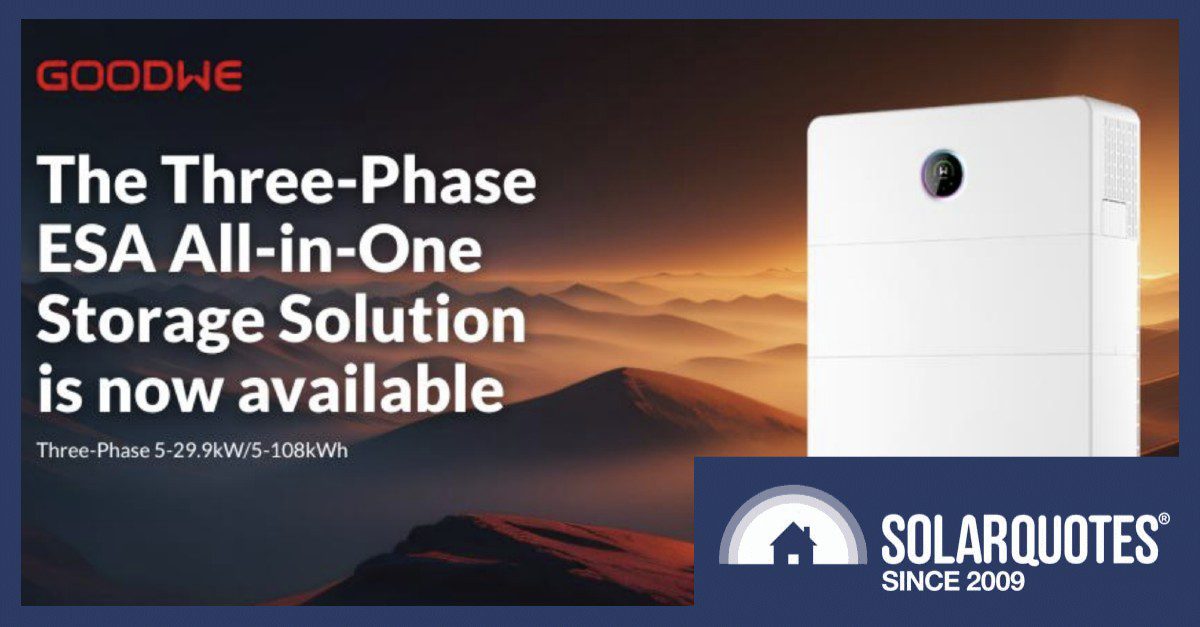
 With debate raging about the affordable end of the battery market, a fortuitous press release hit my inbox recently.
Can you get a system that offers full backup of synchronous 3 phase loads at an affordable price point? I’m pleased to report that yes, the GoodWe ESA series has now been CEC approved and will be rolling out from late March.
Are GoodWe Batteries Any Good?
We knew the Three-Phase ESA was coming after the single-phase model was released at the All Energy Convention last year. The timing isn’t bad for expanding GoodWe’s all-in-one battery range, but with many installers already booked out, there won’t be much opportunity for a fully subsidised 50kWh battery before the rebate reduces sharply for bigger batteries post May 1, but let’s be honest, 14 to 28kWh will still be a pretty good deal.
GoodWe have been making pretty honest bang for buck systems with separate high or low voltage batteries for years, however ESA is the all new product line which we covered when the single-phase range was announced.
Enough For A Small McMansion
I’m told 80% of east coast connections are single phase, but for properties with three-phase power the ESA packs a solar inverter, high-voltage battery and energy management system into one neat stack of up to six batteries plus inverter.
The spec sheet says inverter power ranges from 5 kW to 29.999 kW, (lets call it 30kW for clarity) with storage from 5 kWh to 54 kWh, so that should be enough to suit anything from a small McMansion to a serious cafe setup. If you’re looking to run a small supermarket, then parallel units will offer 60kW of power and 108kWh of storage.
DC Solar oversizing is a healthy 200% so for a max effort system, you can have a 30kW inverter with 60kW of panels on the roof. Under ideal conditions in Adelaide, that means a potential average yield of 264kWh every day. Your mileage may vary but it’s nothing to sneeze at.
Batteries Are Well Specified
GoodWe uses lithium-iron-phosphate battery chemistry to prioritise safety, durability, and longevity. The latest point of difference in marketing speak is “layers of protection” which we are assured the ESA has many of, not limited to advanced arc-fault detection and fire suppression technology.
Right now there are 5 & 8kWh modules available, though 6 and 9kWh are promised to be coming soon. In any can they can be mixed if you choose to add capacity later.
The charging temperature range is listed as +2 ~ +55ºC or -18 ~ +55ºC for the models with internal heating, which can be quite handy for inland southern Australian mornings. However the discharging temperature range is -20 ~ +55ºC for both.
Pass Through Simplicity
The ESA is a series connected machine, (like Sungrow) so it’s best installed near your main switchboard, with a bypass switch just in case things go pear shaped and you need to revert to mains power.
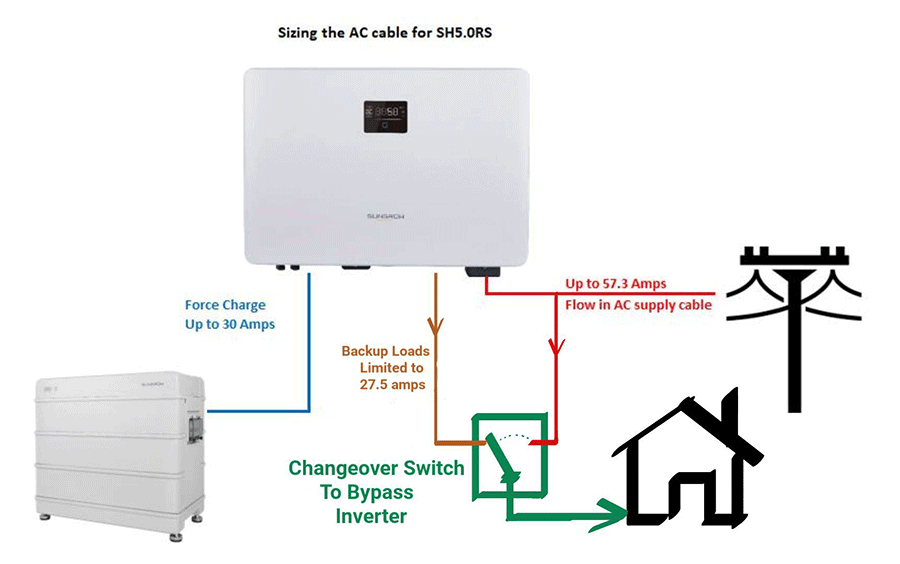
Some systems are being delivered with a manual backup switch as a cheap way around doing a proper switchboard rebuild. If you’re paying for backup power, insist it’s automatic.
While Fronius, Tesla and others use a parallel architecture with a gateway, which does offer priceless flexibility, it’s also an expense to buy and wire up. If say you have a rural install where the main switchboard at the road feeds two or three buildings, a parallel system is the only way to do it properly.
However for many, perhaps the majority of customers, who can fit the stack within coo-ee of the main switchboard, wiring to and from the inverter is quick, simple and lower cost.
The ESA is rated for “whole home” backup so most models offer 63Amp pass through current, but there’s 80Amp rating for 25 & 30kW models.
Integration For Amber And Home Assistant
With beta testing in its final stages, ESA owners will be able to play games on the wholesale energy market trading with Amber soon. It’s not for everybody, but if you’re looking for a new hobby and you know which season the prices can be volatile, you’ll be able to capitalise on extended savings with GoodWe, but probably not in Victoria.
Another interesting detail I’ve found comes from the automation enthusiasts who use Home Assistant to extract some really nitty gritty data from behind the scenes. While the normal SEMS user interface shows “inverter temperature” there are more measurements taken inside the machine.
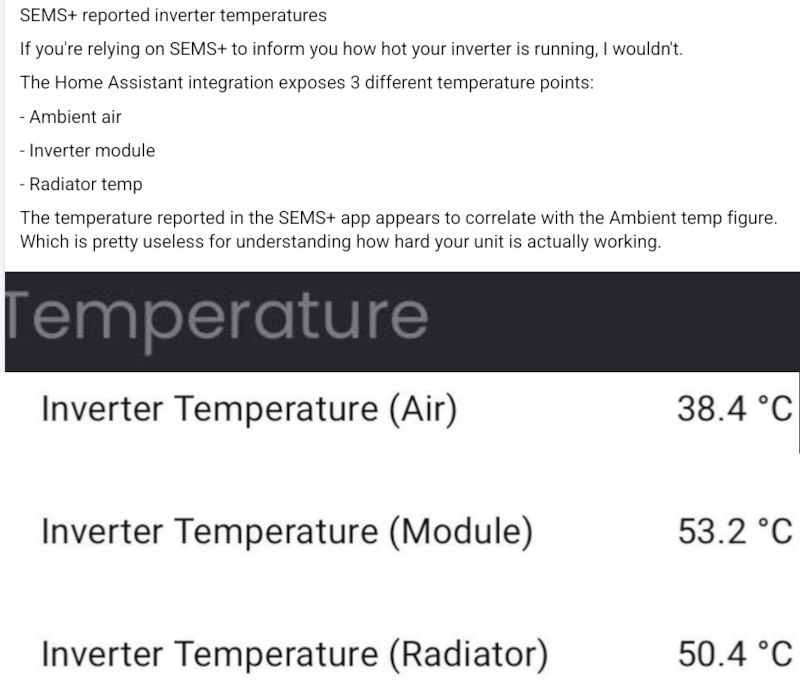
The temperature inside is what counts.
*Correction*
GoodWe’s Warranty Is Good
Unfortunately we selected the commercial warranty document for 125kW inverters when we wrote this article. To be honest that’s my mistake but I was misled by the ESA document title. As a C&I customer it might be a little disappointing to only have 5 years warranty on the inverter, but in that space the hardware is likely to be doing much harder work than an average domestic customer.
Happily both the domestic and commercial scale batteries have a 10 year warranty.
So the whole ESA inverter and battery stack has a 10 year warranty, and thanks to GoodWe checking up on us, you can find the document here.
Pretty Gutsy Solar Specifications
Having seen a few inverters let the smoke out, it’s nice to see the current crop of hybrids stepping up to take their place.
Where previously an ABB Aurora Trio 27kW was difficult to match for solar specification, there’s a good chance you can add batteries to your winery or sailing club without being forced to rewire the roof, a step which can render a whole system uneconomic.
The larger ESAs have two inputs rated at 21Amps, and two more rated at 42Amps, so provided the DC wiring isn’t too crazy, you can replace an old SMA Sunny Tripower, Fronius Symo or ABB without much hassle.
All In One Is All The Rage
As we wrote last year, all the cool kids have ditched cable connections and are are stacking batteries sky high. It’s really been a step change in the market, much like plastic plumbing was for houses, simply because installation is so simple and fast. However, just like plastic plumbing, once you’ve picked a brand, you’re stuck with that range of pipe, fittings and installation tooling.
If your particular brand has a model update, they may abandon legacy batteries, like AlphaESS does for instance. Thus an expansion later in life you might mean you’re looking for obsolete stock. However if the manufacturer or monitoring dies an early death, then re-using any part of the existing system will be impossible.
If you want really adaptable systems that don’t tie you to anybody, start with 48V batteries and a remote area solar expert.
Stackable Sort Of Started With Sig
It’s brilliant, in terms of reliably getting things correct, to have all the connections plugged together automatically, right up into the inverter, such that Sigenergy stormed the market with the idea. Sadly they couldn’t execute a simple AC plug connection.
Perhaps what’s more remarkable is that having rapidly claimed 30% of the market, I heard from industry sources that Sigenergy allegedly started throwing their weight around. Nobody is going on record but the new ESA is conspicuously absent from some wholesalers, who otherwise carry all of the GoodWe range. The Sigenergy rep I quizzed however flatly denied this was happening.
When Dollars Make Cents
If you’re looking for a well supported system with a company who’s been around for 15 years not 15 months, GoodWe are a pretty good option. They don’t specify incredible off grid surge capacity or flashing Xmas lights but neither do they ask a premium price.
GoodWe have long been making some interesting hardware, not all of which I would have recommended in the past, but they do offer a well established local team for support and a more mature product range than ever.
We recently added GoodWe to our recommended battery brands list, so if you’re looking at the cheap end of the market, they are one of the safer bets.
 About Anthony Bennett
 RSS - Posts





I wonder how many years before the Goodwe three phase ESA system becomes publicly available, if it does ever become publicly available.
The single phase one has yet to become publicly available in WA, eleven months after being “launched”.
Maybe the three phase one is a similar hoax.
How is it eleven months from launch? I’ve been following the introduction of ESA on MEEH group. The announcement came around early October and one of the first installations was around early – mid November in VIC.
Installers can now have access to the 3 phase inverters pricing and they’re impressed with how competitive they are against Sig. All been discussed in Goodwe group.
For WA, you can try contacting JS electrical for quote/info on the Goodwe ESA.
The fake launch of the Goodwe single phase ESA system has been repeatedly mentioned in posts in this forum.
The earliest reported fake launch of which I am aware, occurred, as mentioned in a previous post;
“The new Goodwe single phase ESA all in one series, with up to 10kW/48kWh capacity, was launched in Australia, at the Smart Energy Conference and Exhibition 2025, on 9 and 10 April 2025 at ICC Sydney. ”
In having contacted multiple potential installers, with having searched for installers who advertised the product, and, installers who advertised being installers of Goodwe product, only one responded, that would perform a site assessment, and, they have not yet provided a quote, with not stock being shown as being publicly available as yet in WA.
Hi Bret,
Mate, I don’t know how to break it to you. The problem you’re having getting quotes isn’t because GoodWe aren’t offering stock.
It’s you.
SolarQuotes has referred 5 installers to you over two requests since 2022.
However word has got around the solar installers in WA. Nobody wants to deal with endless complaints, accusations or conspiracy theories.
I’ve personally tried to help you and I’ve sought help from GoodWe in the process, but it’s never enough.
We have no less than 38 support tickets under your name.
Even moderating your comments here is a chore.
Now I’ll be the first to admit, all of us are guilty of going off topic from time to time, but moving forward, if your comments aren’t helpful, informative or constructive, you’ll go out the airlock.
Tell you what else no one wants to deal with. Arrogant, dismissive and unknowledgeable installers referred via this service, who in a request for more information reply in capital letters, “WE INSTALL SOLAR PANELS AND BATTERIES”
Ah well, if you want something done, …..
Hi David,
If you’ve had a poor experience, we want to know about it.
In many cases we become the quality assurance for our client installers, because you the punter are more likely to complaint to us than to the installer themselves.
So we sometimes alert an installer that their new sales staff or subby installer arent up to snuff… but we must have your feedback to work with.
Leave a review on the SQ page for the installer, or speak to us directly.
We’ll help sort it.
You got me cacking myself spinning around in the office chair.
What a serve.
Appreciate this whole post as per usual, the homework you guys do really helps us out heaps.
Love from a mystery installer outside of SQ
Cheers
Hi Anthony,
Here is my first stupid question, I have 3 phase at my home, with in round figures 16 kW of solar panels, and a GoodWe inverter. It was installed just over 3 years ago and inspected by a very well-known person from this website.
Fortunately, this said person picked up on a few minor issues, and after a slight alteration, my system was able to pump out over 100kW per day in the height of summer.
Since installation, I have never had an electricity bill with me owing them. Currently, I’m about 1K in the black. Given that the FIT is going backwards very quickly, I can see the day possibly when I start owing them again.
And finally, here is the question (phew), would we benefit from installing a battery, and what size if ever?
Hi John,
We have a calculator on the website for that, you’ll have to chase down some data but it’ll give you a great answer.
However it’s worth noting that a heat pump hot water service is also a good option.
And if you get wheels on your battery, an EV will both eliminate your petrol bill AND use more of your solar.
Failing that, 15kWh is a good default number.
can you say who your retailer is ?
The big question for me is how does it deal with “Per phase” export limits?
These limits are set very low in some places like WA, flexible exports are now common and may sometimes be down to 0 or only 1.5kw, but even with 5kw per phase they limit the ability in some cases to leverage net metering. In many cases you can’t export 2kw on one phase to cover the other phases due to these restrictions. Though I suspect actually most 3 phases inverters simply adhere to a total limit and not the DNSP specified per phase limits.
When on grid do these always just output the same on each phase?
Or can vary to maximise per phase limits and net metering?
Sigenergy have two modes to allow for these per phase limits, though still could be designed better to deal with it. I am unclear how other manufacturers deal with them.
I think I’d rather the gateway be external to the inverter, there are multiple contactors and breakers involved and having them external in a gateway means easy to replace
Hi Thomas,
To my knowledge an inverter that’s on grid must have balanced output under AS4777.
They might be able to match phase loads during an outage but when synchronised with the mains, phase balance is locked.
I understand New Zealand uses “weakest phase” limits for export but in Australia, where retail metering is designed to register net consumption, the export limits are measured as a total.
WA might be different but last I heard they industry were basically ignoring the problem and with informal/tacit approval of the DNSP, carrying on with total export as the rule.
Remind me and I’ll ask more people.
Firstly many DNSPs do specify export limits as per phase. I’m in SA and SAPN definitely does for fixed limits, and pretty certain the wording for flexbile exports also means it is per phase too. Ausgrid appears to, though it is high at 10kw. Jemena does too and I’m sure some others.
I believe most if not all flexible export schemes or trials are specifying it as per phase but I haven’t read into them all.
I don’t know the standards but someone told me they changed recently. I do know the TP Sigenergy systems VERY well though and they have two modes.
Total Power mode is what you described, it will output the same on every phase all the time (except when off grid), so it just measures total export/import and adjusts it’s total output to match, so leverages net metering.
Per Phase mode however works the same as when off grid, it entirely seperately varies each phase output to match the load on that phase, it never exports on another phase to leverage net metering.
The export limit rules come frm the DNSP. What is the nearest town to which you live ?
See my above comments. I am not asking for my setup, I am already setup with a SIgenergy but interested generally how other 3 phase systems work and deal with specfically per phase export limits as it can limit the ability to leverage net metering. I’m in SA and here most people have to go on Flexible exports, which is specficed as ‘per phase’ so can mean during the day you may not be able to export at all on any phase, meaning if the inverter always outputs the same on all phases as per previous standard and common practice then it will not be able to run at all !
I’m looking at having a complete solar system installed asap, I’ve had 3 quotes, one from my energy supplier. I’m considering 2 of the quotes, one is suggesting Longi 475kw panels with Goodwe inverter and 19.2 battery at under 20K for a 10kw system. The other is suggesting Trina 450kw panels along with the all in one Sigenergy 16+ battery at 5K more. Not knowing anything about solar systems my question is which one should I have installed. It’s a 3 phase system and the above quotes come with the rebate already calculated in. I should note that as far as I’m aware they are reputable companies.
Apropos array oversizing, my 27 kW of panels is yielding 0.25 kW in total deep overcast with intermittent rain. That’s meeting consumption, with HWS off, and has brought battery SoC up to 99% so far today. But it’s not a day for BEV charging.
Even with Selectronic or Victron and 48v batteries, battery expansion seems less flexible than the new battery stacks with integral DC/DC converters, which allow adding new modules to old. You can’t just parallel new 48v batteries with old, and expect great load sharing. I have a large cycle disparity between two banks and the third, though that might be a lot less if I didn’t operate above 90% SoC most of the time.
And if you’re on-grid, the new in-stack array-connected DC EV chargers overcome the horribly common 10 kW/phase inverter limit by taking EV charging out of that equation, leaving useful amounts of solar energy for house loads.
Oh-Oh, black thunderheads & lightning -> zero yield. But we badly need the rain, so no complaints. :-))
In this 3 phase article this comment (below) seems a strange one as this issue is ONLY related to Sigs single phase, as the sig 3 phase uses a different and more robust connector
“Sadly they couldn’t execute a simple AC plug connection.”
I had heard some of the commentary regarding sig may be related to payment to SQ – that would be a shame and I am hopeful that is not true – but comments like those above give an unfair view of the situation
It would be interesting to hear why the Goodwe ESA range gets recommended as a specific range but SQ have withdrawn support for the whole of Sigs ranges based on a specific issue with the single phase situation
I hope you see the direction I am coming from here and can clarify
Hi Sean,
First of all, SolarQuotes doesn’t take any money from any manufacturing or sales operation. Zero.
Not that Sig (or others) don’t run junkets to China for wholesalers, distributors or retailers.
Our only income is from installers buying leads.
Secondly, when GoodWe had a recall for a pretty minor issue (plug that didn’t have a secondary tool fixing) they ran a press release, dedicated webpage, warranty procedure & payment to fix the issue.
GroWatt said “nuffin to see here” and sent a few emails and decided the ACCC could do all the publicity.
When Sigenergy was forced into a recall, they threw the installers under the bus.
The recall page on their website was only linked to the ACCC site. No front page notification, no admission that they knew there was a fundamental design flaw.
Sig were deliberately hiding the issue while flogging stuff they knew was a liability; for months.
It’s about company culture.
It was the poor treatment of their loyal installers really at the end of the day. Electrical components fail, it’s par for the course, it’s about how it’s handled.
There is recalls for melting plugs. For installers, recall work is not just a technical exercise, it involves scheduling, travel time, customer communication, business disruption, and reputational risk. Timely support and compensation are critical. Instead what they got was confusion, a convoluted process to claim warranty, supply chain disruption and lack of post sales support.
It’s also fair to acknowledge that on paper, the product architecture and feature integration are innovative. However, advanced functionality ,whether marketed as “5-in-1” or AI-enabled , does not outweigh the fundamentals: reliability, transparent communication, supply chain strength, and post-sales support.
Is this another example of ‘building a plane while flying it’ at the consumers expense ? what happened to the Office of the Technical regulator (OTR) in your State ?
Your bias against Sigenergy is extremely laughable.
This is supposed to be an article about Goodwe’s ESA product, which is a complete copy of Sigenergy by the way, but you can’t help sticking the knife into Sigenergy in the article.
The payment rumours sound increasingly likely as time goes on!
Credibility in your articles drops with every one you write!
NOT FOR PUBLICATION
In case SQ hasn’t seen it, this may be of interest: https://www.news.com.au/technology/motoring/car-advice/how-long-do-ev-batteries-last/news-story/fd6d9b88b72a414223715911dea6a1ac
https://www.generational.ac/2025-battery-performance-index/
I remain an EV skeptic, and the article overstates the anti-EV case and understates the degradation IMHO, but data is data.
Over 60% of the EVs they tested were 3-4 years old, and a further quarter were 1-2 years so the data heavily skews towards newer vehicles.
Most vehicles with <80% battery health were 2-6 years old, most 10+ year old vehicles look to be 80%-85% so 15%+ loss in range. (Except WLTP range and real world range don't match. According to one site 80% of WLTP is more accurate given coarse AU bitumen v smooth EU tarmac, AC in 35°C heat, hills …)
Report asserts batteries will outlive EVs which seems a dubious claim to me but then skeptic.
Curiously age seems to matter far more than mileage, unlike ICEVs.
Hi John,
Thanks for the articles.
My first hand experience with two EVs is:
13yo, 36,000km
Showing 74% battery state of health.
16 years old, 64,000km and 64% SOH.
We joke that a major service includes pumping up 4 tyres, fitting one wiper blade and topping off the washer bottle.
The PHEV hit 10years old and 50% SOH when I had the battery replaced under warranty. It hadn’t failed, was just doughy.
With only 12kWh capacity, being used in an 1850kg, 120kW, 4wd SUV has worked it into an early grave.
However it’s almost hit 150,000km now and still has about 75% of its factory fitted brake pads.
Hi there,
The single phase version of ESA is not meeting published specifications (eg 9.999kw version is listed with max charging of 35.6kA however it is limited to 25A).
Are we likely to see the same limitations with the 3 phase units.?
Mine charges at the full 9.9KW from the grid ~ 9.6kw after conversion losses.
The ‘fuil’ 9.9kW is what the inverter side can supply to the charger side from the grid, however the charger side is listed as being able to charge at 13.5kW with a 35.6A limit as a continuous rating. Presumably this would rely on DC coupled solar to supply the difference.
When DC coupled solar is producing 5kW, 10kW, or even 15+kW the charging side is still limited to 25A, more than 30% less than the sales documentation indicate.
Does this one AC couple?
Yes it can
How will the ESA go with my Enphase iq7+ setup (29 of them)?
Will previously mentioned AC coupling be all that’s needed?
I’d be interested to know how much power this system uses in normal idle operation. I was disappointed to learn that my 48kWh Sig battery stack was using around 300W which adds up to 7.2kWh across the day.