
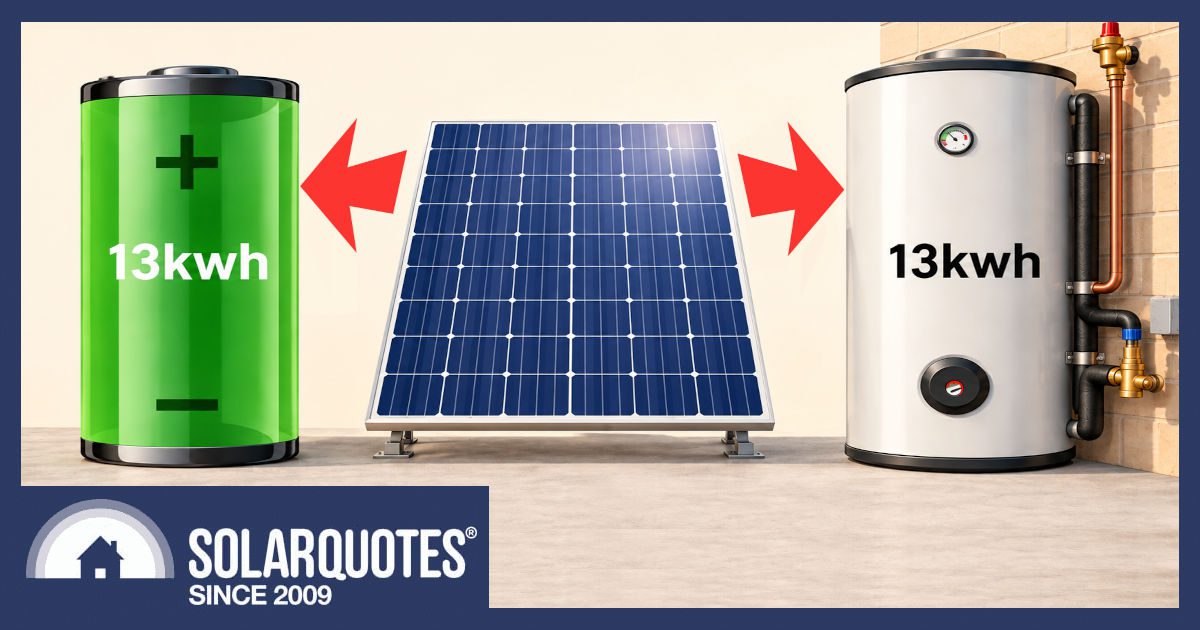
Customers buying home batteries are often going for “whole home” backup on the assurance that going forward, everything will be solar powered.
People are however alarmed when bills lob in the letterbox with hundreds of dollars consumption charged out. How is that even possible?
Is Your Controlled Load Hot Water Wired In?
The answer is often controlled-load water heating, which, not everyone appreciates, is a separate supply to your house, often with its own meter (or a separate register).
Hot water can be 30% of your home’s energy consumption, and if it’s not wired in, your solar can’t power it and the monitoring app in your pocket can’t see it either.
Customers Feel Betrayed
People contact SolarQuotes for support because they’re bewildered about getting a big bill when the shiny shoe salespeople promised otherwise. It’s not unreasonable to expect when you’ve spent a lot of money on a heap of new hardware that your next power bill will be significantly cheaper.
However the confusion is perfectly understandable.
It’s not that dodgy solar companies are setting out to fleece people, but when you break the word down into three basic parts, assumed knowledge and assumed language makes an ass of u & me.
Assumption One
For an electrician it’s really basic. Hot water uses off-peak power, and of course it’s common knowledge that it’s metered separately to your daytime supply. Off-peak is cheap because the network only switches it on for a few hours, usually overnight, that’s why it’s called “controlled load” after all. Everybody knows that, right?
Assumption Two
For a customer who’s never really understood the intricacies of electricity billing and never needed to open their meter box to find the boost button, it’s also really basic. When you buy a solar power system with “whole home” backup, then it must cover the whole premises. Everything is included, right?
If you’re buying a solar power system with battery backup for blackout protection, you must document your wishes with the salespeople. Write down what you expect will work during a power outage.
I have to point out assumption one is an understandable failure. As someone immersed in the industry, it’s easy to forget the average punter just doesn’t have the base knowledge you do. However, it’s not rocket surgery to let the customer know that a resistive hot water heater is a big, heavy load you probably don’t want eating up your battery during a power outage.
Solving The Problem
The solution is simple. Have a contactor fitted to your switchboard to effectively create your own off-peak supply.
It should be outlined as a feature during the sales process and offered as an option when your solar is installed. If it wasn’t, well, I’d say it’s a little lazy on the solar retailer’s part. It’s a bit like installing a major new electrical load and not offering a switchboard upgrade to accompany it.
If they didn’t explain it to begin with, I’d be asking your installer to come back and do it for the cost of the parts. Be nice though – they’re the people you’ll need for warranty support, so you want a good relationship for the next ten years.
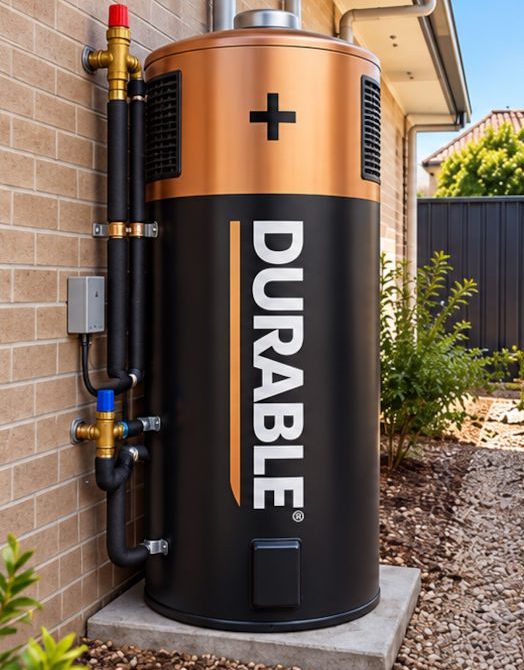
A tank on your house is a cheap way to soak up solar, it’s thermal energy storage, a battery you already own (This isn’t a real brand, it’s just food for thought).
Even if you didn’t opt in for “whole home” battery backup, a diversion or sunshine circuit makes great sense for solar-only households because it’s just the cheapest battery; one you already own.
There are a few different ways to get there, depending on your budget, type of hot water service and model of solar inverter.
If You Have A Heat Pump:
Relax, it likely has an onboard timer and has already been wired to run during the day. It’s worth checking the timer setting but you probably won’t notice any difference because the incredible efficiency and thus low electrical demand of a heat pump means it’s just not expensive to run.
I have a heat pump running on controlled load because it’s cheaper than eating up a legacy premium feed-in tariff. Interestingly, the monitoring run by Solar Analytics is smart enough to recognise the electrical signature of a heat pump, and they’ve emailed to alert me to change my behavior.
If You Have A Resistive Electric Hot Water Tank:
It probably needs 3.6kW, supplied for a few hours straight to keep it happy, and there are a few ways to get that.
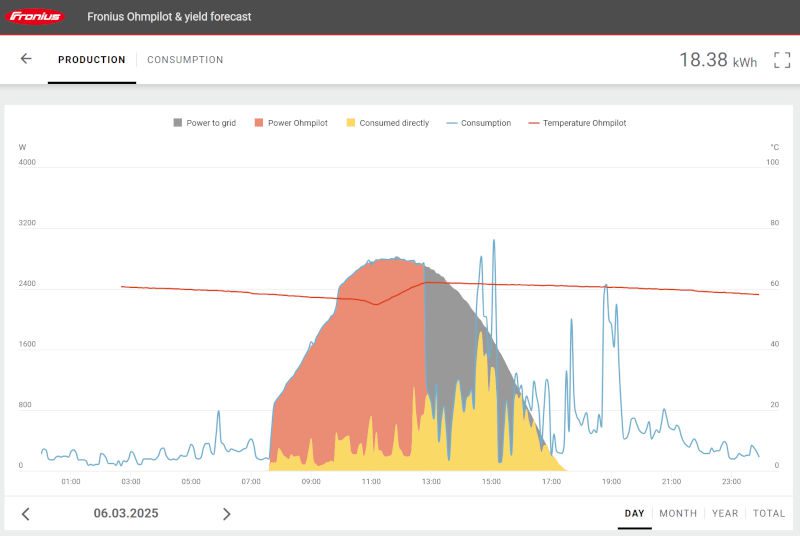
Fronius have a dynamic resistive heating controller that works seamlessly with their solar, battery & EV charger ecosystem. Here the yellow is house consumption, red is water heating & grey is export to the grid after the water is hot.
You could install a timer (with a contactor) to bang the hot water on for 3 (possibly free) hours in the middle of the day.
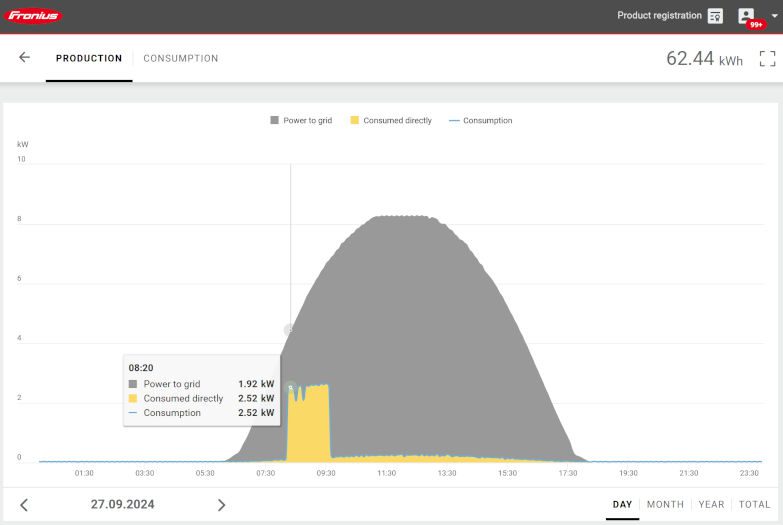
This solar power system is a bit of a monster, but it shows a nice, square slab of yellow hot-water consumption under the grey solar curve.
Probably a better option is to use the same contactor, but control it with your solar inverter (or CatchControl) so it only comes on when the weather is sunny and you’ll otherwise be getting a pittance for exported energy.
Fronius have a dynamic resistive heating controller that works seamlessly with their solar, battery & EV charger ecosystem. Here the yellow is house consumption, red is water heating & grey is export to the grid after the water is hot.
Get a dynamic diverter to intelligently harvest every watt of surplus solar power. There are a few available but the GreenCatch device is a good example. Dynamic diverters aren’t compatible with heat pumps or some battery hybrid systems, however the most refined solution for resistive heating is the Fronius Ohmpilot, but this only works for a 3kW element and Fronius solar ecosystems.
The Best Of Both Worlds
This winter my own resistive hot water ran conventional, overnight, off-peak power for three reasons:
- Despite 15kW of solar on the roof, the yield wasn’t enough to reliably recharge my battery when the air conditioner was running it flat every night.
- It’s still cheap enough and doesn’t shorten the overall life of my battery.
- South Australia often has abundant wind energy in winter, so grid power is pretty green when we’re running a rolling average of 75% renewable per annum.
There are of course some sunny days in the low season though, so the contactor I’m using to divert solar power into the hot water tanks is actually a changeover relay.
At rest, it connects to the controlled load circuit, so the default position is to draw through and pay via the off-peak meter.
When it’s sunny, the relay changes over to daytime supply and the hot water “charges up” on solar power until the tank is hot. With some luck, the tank temperature doesn’t fall much overnight, so we don’t pay for any off-peak power because the thermostat is still open.
Conversely, if there aren’t enough sunny hours to fully heat the tank, off-peak will top it up after 11pm. This sort of control system often works best with a smaller element in the tank because there will be more hours in the day when you have enough surplus to power it.
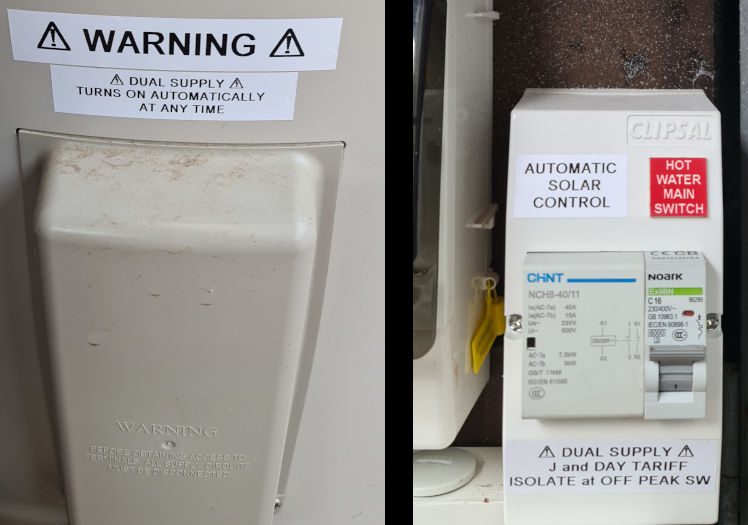
This is an example of a solar-controlled contactor, with some labelling to keep the plumbers informed.
Sorry Queensland
There’s nothing in the AS3000 rule book against this kind of changeover device – indeed the GreenCatch diverter has dual inputs to make it work seamlessly, however the poles and wires people from Energy Queensland aren’t about to have you helping them flatten the duck curve.
Even though every other DNSP in the country ignores the technical retail regulations because soaking up daytime power helps everyone, Queensland insists that controlled loads must be hardwired to off-peak meters. If you want to switch them, you can’t have the cheap rate.
Though they were doing the same thing for EV charging, the rules have at least been updated recently, so Queenslanders don’t have to pay coal-fired prices for their own solar power.
To reiterate, Queensland is a great place for solar and you’ll do better than the deep south by simply running your hot water during the day, but you can’t top it up overnight with off-peak power.

GreenCatch is an excellent dynamic diverter, but it doesn’t always play well with battery systems. Check with your installer before buying one.
BE AWARE Of Solar Companies Promising ZERO BILLS
With high daily charges and low feed-in tariffs becoming the new normal, it’s simply not possible to guarantee a solar and battery system will deliver enough kilowatt hours to meet your needs and a heap more energy to earn export credits. It’s not impossible, but not probable either.
Even electricity enthusiasts playing with wholesale prices using Amber have noted that with the expansion of grid-scale batteries, there’s less market volatility, meaning fewer opportunities, lower price spikes and shorter windows to make profitable exports of electricity.
Don’t Use Your Battery For Hot Water
Plugging surplus solar into a thermal battery like a hot water tank makes great sense, but collecting solar power, shunting it into an expensive electrical battery, then shuffling it across into a bucket of water using a big dumb resistive jug element isn’t really smart.
When you include all the environmental, efficiency & capital costs, the energy coming from a battery is still pretty expensive. Some argue you are paying 50c each for warranted kilowatt hour delivered by a battery.
For more, read our dedicated guides to hot water heat pumps and to solar batteries.
 About Anthony Bennett
 RSS - Posts





We had just this happen when we got solar late 2023, SAPN (SA) came out, put a new digital meter in, AND as we had off peak timer for the HWS on the old analogue setup, they put in a 2nd smart meter for CL.
Of course the retailer said nothing, but to my later realisation, neither had the solar company.
None of the solar companies back then mentioned this !!
Now, I hope that has changed.
A couple of years ago I finally got my sparky around to take the HWS (3.6kw element) off CL, put it on the general circuit, Hager timer breaker, and while we can time for solar soak much of the year, we just timed for 0000-0600 EV 8c rate, a all power to the home is at that rate for the 6 hours.
With a battery now, I’ve been playing with using more solar during the day for the HWS, just got a Shelly relay and will be automating that soon to just run off excess solar (like a Catch Power only different).
On CL the HWS daily used about $1.40 worth of power, on the EV rate 30c – 40c, so a good saving.
Thanks Anthony,
Wasn’t aware you could still have a controlled load with a smart meter.
I have a 300 litre tank in my roof with solar thermal panels ( installed 1995 ) and have resisted going for a smart meter. ( i get free hot water for 6 months of the year and minimal boost for another 3)
I’m now well informed when I upgrade my 14 year old 3 kw solar, add a battery, up grade the main board and are forced on to a smart meter.
Some Time Of Use plans have middle of day prices that are little different to the controlled load price, so even without the smart systems to juggle surplus power to the hot water, its smart to fit a timer and contactor to run from 10am onwards.
This will either use your own solar alone if sufficient, or make up any shortfall with the cheap power.
If you have free 3 hours then even better as long as the prices outside the free hours are not a “Gotcha”
Yes, good advice Anthony.
I actually dumped the control load have a catch relay, used primarily as a smart, app controlled timer.
As many contemplating home battery would or should consider Amber wholesale pricing, the Catch Relay strikes a problem when Amber curtail, shut off, solar exports when the wholesale price is negative. Then, the Catch doesnt see any excess solar to power my resistive HWS. So my default timer is 2 hours 11am to 1pm when FiT is lowest and production greatest.on low solar days i manually restrict that or turn off, as can have hot water 2+ days with it off.
Youre spot on about the reduction in FiT spikes. Some of the cream on that cake has been wiped off along with the $20/kwh cherry. Byt that a good thing, for the greater good.
Anthony, Is the diverter allowed in NSW? I’m currently running a resistive HWS via timer on the main circuit to capture as much of my unused solar as possible, but as you say when the the sun is not shining I’m paying top $ for imported grid KwH. Be nice if allowable to be able to use CL power at a third of the cost. What were the components in the solar controlled contactor pictured?
cheers
Tony M
Thankyou Anthony for this article and especially the final paragraph. I have been off grid but with a grid connection for the last 17 years and have toyed with installing a new system with new battery. My off peak hot water bill is about $60 per quarter and I use the grid for welding etc.so don’t mind paying for a bit of power. At the age of 84 I see no point in spending $35,000 or more when my existing system allows me to run cooking, laundry, lights, fridge and small appliances (TV etc). I’ll probably add a few new panels ads some my existing BP ones are losing performance. Yes controlled load is cheap compared to hardware.
It’s unavoidable that some customers have only a fuzzy image of where those sneaky electrons burrow, and when, to give hot water. But *retail* installers should have a pre-install checklist – questions to probe the customers needs. Some tickbox options might serve well, e.g. “You have ample panels on the roof, so use that for HWS, with a boost switch, and ditch the outdated controlled load strictures altogether?”, and “Heat pump, due to smaller roof?”
My brother has a couple of resistive HWS on timers, so they’re rooftop powered, 19 kW of panels and weather permitting. (Almost always) Here, I had the 3.6 kW element swapped out with a 2.4 kW, and the HWS is plugged into a GPO. Having not yet bothered with a diverter, I just flick the switch on or off, depending on weather.
With a bit of “Fill the roof” and an ample battery, the controlled load thing can well be dispensed with, I figure. A “three free hrs” timer instead, gives a user-controlled load – Much Better!
Thats interesting Erik. I didnt think of swapping element for a 10amp job. You could probably use one of those $15 smart switches from the Big Green Shed to run a timer for it and turn it off and on and save you the walk to the garage or where ever the powerpoint is, provided it has wifi signal there.
Neil, If your 10 am power point is going to the 2400w element for 4 or 5 hours then, any other loads on that same circuit would want to be very light to avoid tripping the safety switch and ending up with unexpected cold showers.
It might be better to have a dedicated circuit for the HWS.
Ours is the usual controlled load with a day/off/night switch in the sub board, so we can easily choose.
Neil,
This old fox has the HWS elevated in a brick niche, with woodstore under, beside the woodheater in a wider niche. The in-flue heat exchanger then heat-siphons to the HWS, for hot water in winter gloom, when BEV charging takes precedence. With no wife to complain, the doors are still not on the HWS niche, so I can reach in to the GPO switch on the way from the sofa to the kitchenette for coffee.
The HWS is on a separate 20A breaker, so a 15A outlet would have allowed the original 3.6 kW element to remain. (I had it replaced to drop the HWS load in days of overcast, and that has worked brilliantly, as the 27 kW of PV yields 3 kW in even medium heavy overcast, just enough for HWS and the 200 – 300 W house idle load.)
HWS doors are on the list, but I have just put a 40 cm dia Redgum strainer post 90 cm in the ground – photon powered digging with the little electric excavator. Half a tree had fallen on the fence, but provided the strainer & firewood, so all good in the end.
Neil,
I’ll have to try your smart switch suggestion – for a proposed HWS in the old house, now powered by my solar installation in the new build. But it’s about 45m to the far veranda from my sofa, the 9m open walkway in between builds not helping much.
Ah, the google AI says ” 15 to 45 meters indoors” for wifi, and it’s straight down the length of buildings. Running a data cable instead would involve roofspace crawling and rat droppings. I’m not keen.
I have some tiny low power radio data modules with a 250m open range, but finding the time to hook them up to a microcontroller and hack enough code to make it go, is more difficult on the other side of 70 – the brain tires faster, and coffee has a lower octane rating.
Better would be to finish the off-grid delta-f controlled power diverter design I started – its surplus-solar-only loading would preserve battery SoC. I’ll have to move that back up the list. Some high power triacs for it came in last moth. One day I’ll get there.
I don’t think the cheaper timer switches are made for 2400W loads so I’d urge a bit of caution there. I have a timer in my switchboard which works great. I set a window of 11am-4pm to do the bulk of my water heating, with an extra 30mins at 4am to ensure I don’t get a cold morning shower after my teenager attacks the tank late at night!
I’m not sure if WA ever had a controlled load, and we don’t get 3 free (yet).
Indeed, thats a legit concern. The adapter, which is rated for 10A, is perhaps on the cusp, espec if voltage fluctuates i understand.
The Smart GPO rating isnt published in the advert for it, but would expect to be same as any other, as the one the HWS already plugged into.
15A connections all round would be safer.
Erik,
“so I can reach in to the GPO switch on the way from the sofa to the kitchenette for coffee.”
Sounds like you need to drink more coffee on those pesky partly cloudy on again off again days. 😉
I tell ya, Neil, there are days when that’s doubly true. The tax return can’t be put off much longer – that’s a three-cupper tomorrow morning for sure. (It’s too easy to say “mañana”, when retired.)
Just had another 25 mm of rain yesterday, on top of 122 mm three weeks ago. Very nice after 9 low rainfall months. That looming El Niño doesn’t have to mean drought, but full dams and charged soils are a super comfort.
Saw a feral cat yesterday. They do evolve a little bit bigger, it seems. Should get my licence again … more paperwork.
Got 300l roof top Solar hot water on off peak. Just bought a 300l Heat Pump that is powered from a 10amp GPO. The plumber put in two valves so I can select which one supplies the hot water to the house. Currently working out how I can get my hot water at the lowest cost. Got solar.
I live in a victorian rental with no solar panels and gas hot water. I see my neighbours getting new batteries and it gives me a warm fuzzy feeling. We all understand that electricity companies are trying to make a profit while paying for future transmission line projects. It would be nice if panels, batteries, inverters and switchboards became ubiquitous, even for renters. Now I see plug in panels are about to become legal. How much more of a nightmare for electricians when some old rentals don’t even have safe 240v wiring to begin with?
There may also be some current purchased during the night even though you have adequate power in your battery and ample solar to fill it during the day. My system generally buys around 100 watts during the night.
I presume this is related to some communication with the grid.
For a while I amused myself by doing a soft disconnect from the grid every evening to save myself the 2.7c but I’ve decided this is a bit silly.
I already have an alarm set for 6pm to remind me to sell excess electricity to the grid during peak prices and watch the weather so I can switch on my resistive HW and/or car charger when the sun comes out. I don’t want my wife to think I am totally obsessive……
Hi,
When I connected the battery, I got the electrician to quote to remove the hot water from the controlled load, and had the electrician install a 30amp smart switch which I can control the heater element of the hot water from an app on the phone.
The App allows scheduled and/or manual control of the hat water element.
Not recommending but this is similiar: https://www.amazon.com.au/Veumoie-85-250V-Controller-SmartLife-Control/dp/B0CGNNMPBH/ref=sr_1_7?crid=20T2XBCRRAXH1&dib=eyJ2IjoiMSJ9.WO8ARF5BfMj4Que-rDpi5znHhUZyO3QIBDsNXEI1tiL8Ef0_pWpm2JY_vFmNwdfk8fyP8ciTjIy12-edlJwb6cYUdjTIXW1Vuufkj0oRxOJinACzGP7VqRZM6yLD22zMtC0PS5RB6dKbmodlo-uw90Mv2Wvb9qGPZk4uz_gDYhP3eTOcsOXfpg_9-k5ggjVAZLsg5v-x7a_Yrx9gJsuMNrW5kizS6fs4_Cui6Cf0bim-vAcEwgl8gqDCbTviKyzhqosdOwGGAJLvhv4WE7F4fvGovYOfmOr04XHsj_0WY64.jnSPeksjjJl4eNdfytAoyCEcyZsJHYOYlqeGoTU6oyI&dib_tag=se&keywords=tuya+35amp+switch&qid=1793062249&sprefix=tuya+35amp+switch%2Caps%2C231&sr=8-7
Interesting Craig. Have been curious about these on Amazon. Is that the one you actually installed or something more locally sourced. Any feedback from the el3ctrician aboutnit?
This is not the unit I have, but a later version of the same, switch both active and neutral.
I am the electrician in the case of the switch. It has been in service now for about 4 years switching a 3.6kW/16A load. The previous water heater was 29A, and it handled that unit for about a year. No burn marks on the unit, still going strong. I have the switch working off home assistant, so it switched on off with Price fluctuation as I buy energy on wholesale rates.
You can now replace your circuit breaker with wifi switch, which would be a cheaper installation cost.
I live in WA where gas isn’t the anathema (yet) that it is in the Eastern states,. We only have 3 residential electricity plans to choose from and one main electricity provider.
We have a large newly built house and we use bottle gas for our hot water needs (4 people) and stove top, with 2 instantaneous gas heaters on either end of the house fed by one 45kg cylinder. So far, we have used one bottle from Dec-June/July, and the other one is still going. It is not cheap ($150/bottle if I remember well + annual fee), but I am glad I don’t have to juggle an electrical hot water system on top of everything else.
We have a 15kW solar system, 15kW inverter and 25kWh battery which provides backup for the whole house. We’ve gone through 4 blackouts so far without a hitch. The only thing to be careful in a blackout is the space heating. And check the app for when the grid comes back on.
It was like pulling teeth getting my installer to disconnect the hot water from the off peak meter and remove the meter from the panel. He was worried we would end up paying more for power in winter if the solar couldn’t handle the extra load. That was because the worst day last winter we exported only 5kWh to the grid, but it was only one day, and i was adding another 4kw of panels at the same time i doubled the battery size. Eventually he agreed to do it, and i have just gone through winter and had no issues.
I didn’t put in a switch, instead i put the cost of the switch to a bigger battery.
My hot water system kicks in 4 or 5 times a day in winter, uses the equivalent of about 2% of the battery each time. But as both my wife and I shower in the morning, most of the heating is dont directly from the solar, so it takes about 6% of my battery overnight.
By the way, that controlled load meter is still sitting in my power box waiting for energex to come and get it 12 months later.
I also doubled my battery up and had to get a new switchboard for compliance, I told the electrician I wanted to heat water using the free mid day electricity and he wired the hws to a breaker with a timer set to start 12 noon. If you can get 3or4 hours free elect. go for it. My October bill is just $31. and I charged up both cars and used aircon when needed, now the sun is high enough to give me 40+kwh a day I am expecting to use more AC and still pay less until autumn reduces my solar to about 5kw and less in winter, but my free 4 hours of power will still charge my battery to provide all my power needs but I wont be exporting in the late afternoon to reduce my connection fee.