
Last week two flaws in PHP went public. PHP is the programming language behind SolarQuotes and a big slice of the web, and these bugs had been sitting in its code for about 14 years. AI models found them. Within 45 minutes of the announcement, Cloudflare was seeing tens of thousands of attempts to exploit them. By that evening it was millions.
PHP doesn’t run the grid. But AI has made finding and weaponising software bugs faster and cheaper, and almost everything between the power station and your toaster now runs on software: the network operator, your retailer, the market operator, and the cloud platform your inverter uses.
Then there’s the weather. The Bureau declared an El Niño in June, and its models have it potentially the strongest on record. Heat, fire and the storms that follow are what take out power to homes for days.
Put the two together, and I reckon the chance of a serious, multi-day disruption to Australian electricity has gone from fairly unlikely to reasonably likely. And it won’t get better as AI improves and CO2 keeps climbing.
The Poms Have Been Told To Stock Up
Last Thursday, the UK government published guidance asking every household to buy bottled water, non-perishable food, a torch and batteries, a radio, blankets, copies of important documents, and cash.
I think that’s smart, and you don’t need to panic buy. Every time you go shopping, drop a few extra non-perishables into the trolley, get $50 cash out and put it under the mattress.
None of that makes you a prepper.
When Did Backup Get Uncool?
Now think about your electricity supply. Somewhere in Australia’s battery boom, worrying about backup became almost uncool. The conversation moved to bill savings, VPP payments and tariff tricks, and blackout protection got treated as an optional extra for nervous types.
So plenty of people have ended up with a cheap and cheerful system that has no backup at all, or backup that was badly designed. And with the el-cheapo installers, it’s rarely tested before the van leaves the driveway.
We hear too many stories where the backup’s first test is the first real blackout, and it fails. Some owners discover their “backup” needs someone to flick a manual switch in the switchboard, in the dark. Others discover the battery won’t run the aircon after dark. Either way, they find out at the worst possible moment.
In this threat-heavy environment, I think you’re nuts to invest in solar and batteries and not have backup that’s robust, tested and well understood.
“But I Never Get Blackouts”
I can hear the comments already. “It’s not worth the extra cash. I never get blackouts.”
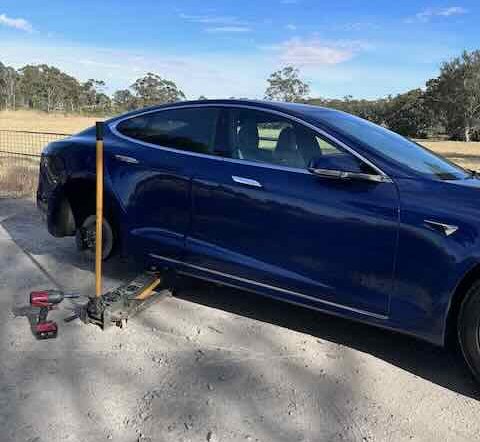
Which reminds me of an idiot with a Tesla who’d never had a flat, so never bothered buying a spare tyre. You can guess what happened next. A flat in the Clare Valley, a night in a cheap motel, and a long wait for the local tyre place to open. Luckily, I had my bike in the car, so I could cycle to the nearest accomodation.
Tesla’s so-called roadside assist was useless. “It’s a Sunday!” “You’re a long way from Adelaide!” Serves me right for waiting until I needed the backup to test it, I suppose.
Years without a flat told me nothing about that particular trip. A decade of reliable grid supply tells you about the last decade’s weather and the last decade’s hackers, and this summer is shaping up with a nastier set of both.
What To Do About It
Yet to buy a battery? Go with an installer who is competent enough to design and install backup properly, tests it before they leave, and can tell you what it will run and for how long.
Already have a battery but never tested the backup? Now’s the time.
Did your retailer talk you out of backup? I think that was terrible advice. They’re using a history of good luck as evidence that bad luck won’t happen. Get a quote to add backup.
Partial Backup? Have A Plan For Dead Circuits
Partial backup is common and perfectly fine, as long as you know which circuits go dark and have a cheap alternative for each one.
- Induction cooktop not backed up? Keep a portable induction unit in the cupboard. IKEA’s TILLREDA is about $50.
- Oven not backed up? An air fryer on a backed-up power point will handle most of what the oven does.
- EV charger not on the backup circuit? Make sure you’ve got a portable trickle charger that plugs into a normal power point.
Whole-Home Backup? Know Your kW From Your kWh
Whole-home backup means everything can run. How long it can run is another matter.
Two numbers matter. kW is how hard your appliances pull at any moment, and your inverter has a ceiling. kWh is a measure of how much energy the battery holds. Big loads hit both: they can trip the inverter, and they empty the tank fast.
So when the grid drops, switch off the pool pump. Keep a close eye on big aircons. Switch the EV charger off, unless it’s set to charge on solar only.
That leaves the battery to do its real job in an outage: keeping the fridge cold, the lights on, and the internet up until the sun comes back.
One more catch for three-phase homes. Some three-phase inverters can only put a third of their output on each phase, so one big single-phase load can trip the backup even when the total looks fine. I covered that here.
Make It A Conscious Choice
I’m not a doomsday prepper. I’m fairly optimistic about the future.
But if you’ve invested in solar and a battery and you choose to forgo backup insurance because “long outages never happen”, that’s your call. Just make sure it’s a conscious one.
And make sure you’re happy explaining it to your family when they’re sitting in a hot, dark house for hours or days, with a big shiny battery on the wall and a load of solar panels on the roof.
Phase Shift is a weekly opinion column by SolarQuotes founder Finn Peacock. Subscribe to SolarQuotes’ free newsletter to get it emailed to your inbox each week along with our other home electrification coverage.
 About Finn Peacock
 RSS - Posts




We are currently living in a rental house while we build our new house in regional NSW. We experienced our first blackout (90min) since 2018 last month caused by a thunderstorm.
Prior to moving we had 10kW of solar with 10kWh of battery with UPS auto switch (65ms) and EV charger. Our new house is having a similar system installed with 25kWh of battery installed. Having blackout protection is really useful in any solar/battery system.
Why such a small battery in a new build?
All we can afford this year have spent a lot of $ on building house
25kWh is not a small battery. We were fine in our energy-efficient solar-passive house from 2018 to 2025 at 800m East of Queanbeyan in Southern NSW with 10kWh battery.
What do you consider a useable size battery, noting many people have been sucked in by sales people to buy unnecessary overlarge batteries?
Agree. When we get a battery, 25 kwh is around the size I’m thinking .
On a normal night we only consume around 2 kwh over 12 hours. Even running our bedroom split AC for a few hours on a hot night, we would use around 10 khw.
Terry,
On-grid, 25 kWh would suit most folk, I expect. Here, off-grid, I have 46 kWh for (intermittently) two households, and 30 kWh would have been ample, as I’ve never had SoC below 65%, and had to dump a chunk into the BEV to get it down that far. The backup generator has not been needed in nearly three years of operation. I’ve run one aircon all night, and this summer expect to run two. We’ll see if that warrants more than 30 kWh of battery. It’d take some murky December weather, I think.
Maybe a family increases battery loads?
Generation beats storage – in the event of an extended grid outage, ample solar and an adequate battery are the optimal solution.
A few years ago, our street in the Dandenongs was without power for 5 weeks, I missed out on the generators shipped in from NSW after a Victorian sell-out. It was cold, but a wood heater, and a camping stove for fried eggs & hot coffee saved our bacon. And a couple of decades ago, 1 km of power lines were down in (and on) that street, again due to storms. Three SEC trucks were there for days.
Here, off-grid, an ample battery runs a couple of small split-system aircons all night when it’s hot. Half a BEV charge works too, when home late. Even when it takes time to build up, self-sufficiency is a resilience which will pay off, this decade or next.
My brother, on-grid, made throwing the grid isolator a system commissioning requirement. Avoid a modern inverter generator as backup for a Victron system. It may not sync up, due to harmonics. A simple low tech alternator works better. (No, an AC line filter didn’t help.)
Chocolate keeps well in the fridge … if out of sight.
Also in the Dandenongs. Our power was only out for 12 days, presumably the same time. I have an 8KVA generator that ran everything almost though it couldn’t provide quite the right signal for the induction cooker. Luckily I had enough diesel for the generator for the three days it took to clear access to our property. Since then we’ve had a couple of 24+ outages and we’ve installed a battery backup so we don’t notice the outages.
Hopefully we don’t have a long multiday outage in mid-winter though. We might struggle.
The Daily Niño 3.4 (OISSTv2.1) was at +3.47 °C, & the 30-day mean was at +3.31 °C, as of 24 Oct 2026. A “super” El Niño is ongoing, forecast to peak near +4.0 °C in Dec 2026.
https://dashboard.theclimatebrink.com/#enso
The 2026 super El Niño is now the strongest El Niño on the instrumental record, having already surpassed previous historical benchmarks, exceeding the prior +3.08 °C record set in Nov 2015.
Berkeley Earth’s September 2026 Temperature Update, published 22 Oct 2026, included:
https://berkeleyearth.org/september-2026-temperature-update/
Doom and gloom is often the best way to get funding and attention.
2024 was a terrible farming year with very dry growing season, and the climate alarmists were touting the inevitable doom. Full of self proclaimed knowledge, the seasoned warriors in Bureau of Meteorology were claiming this season was going to be dry, but low and behold, 2026 is a beautiful wet growing season with plenty of rainfall to grow feed for our stock, to feed Australia, and the world with our surplus.
Perhaps we should stick to sound financial decisions on energy generation etc,…but be careful that the decisions favoured by todays markets and prices. do not suddenly take a tumble when next year the wholesale price of electricity falls in line with the increasing reliability, and increased energy storage,… for those who buy EVs which should increase demand these same also often buy increased PV and batteries to reduce the grid demand too. So we watch with interest and don’t overspend on the unknown.
Finn, as you have a Powerwall 2 do you know if the actual Powerwall 2 battery charges during sunny periods if the grid is down? I noticed that our Powerwall 2 was not charging during g and all day outage for local grid maintenance. I asked Tesla about this and got no satisfactory answers although along the way I did numerous observations and “tests” at their direction.
In the end I found a local company experienced with Powerwall 2 installations and was told that what I had observed was in fact normal.
Can you add anything to my observations and is this really “normal’.
Do you have the gateway Ian ?
You don’t mention it.
If not, then no . . . no battery will charge from solar if the grid is down without a gateway.
With a gateway, yes your solar keeps (or should keep) actually doing something during solar hours.
I think the whole scenario is called ‘islanding’, where you can stay self sufficient if enough solar to charge the battery to get you through the the next lot of non solar hours.
Some systems cannot ‘black start’, where if your battery uses all it’s stored power, the next morning the system cannot restart soalr generation without (grid or) some battery left to kick it over.
I am pretty sure my SolarEdge / Sig battery will black start, not sure what other brands will, or if it’s the SE or Sig giving us that ability.
Les we have a Gateway and the system has been in service for 7 years. I felt sure that at the time we purchased the Tesla system that it was supposed to be fully functional in the event of a grid outage. That is to say as long as there was power in the battery and there was surplus solar power available that this surplus would charge the battery.
This is in effect full off grid operation as long as the power consumption is not too great for the system.
I seem to remember that the system functioned that way early on.
During the past 2 years I have paid particular attention to periods when the grid was out. In all cases the panels were effectively off line and not doing anything.
I have not been able to get a resolution from Tesla despite several attempts and many communications.
As I mentioned I was told by a large and well known solar installer and service company that what I have now is the way the system works.
This is disappointing to say the least.
Ian, do you use the Tesla app? Does the app visualusation show panels on the roof and the associated power being generated when in normal daily use? If the app doesn’t show the panels in the graphic, I assume the gateway can’t see them.
We have the standaTesla app and it just shows no output from the panels during an outage. We have Enphase micro inverters and at all other times we can see the individual panels working normally during the daytime but they simply flatline during an outage.
The Tesla system can control the micro inverters by raising the frequency to reduce their output and this is how they used to manage whilst the grid was down.
I cannot seem to get any sense out of Tesla and the only company I have been able to find who is familiarity Tesla and Enphase products telling me that what I am seeing is normal.
I had a PW2 in my previous house (moved in 2020) and then also installed a PW2 in my current house in 2021 – both systems would charge from solar during grid outages. The PW2 in my new place was replaced in April 2026 under Tesla’s recall program and it also charges from solar during grid outages. It sounds like something went awry in your system at some point as it used to charge from solar during grid outages previously but no longer does so.
I’d keep calling Tesla support until you get hold of someone who is diligent and genuinely interested in helping you. I had to do this some time ago when I had an issue that the installer and several Tesla support people couldn’t ….. and then I finally managed to get hold of someone on the Tesla support desk who was just pure gold !!! It really does pay to be a squeaky wheel sometimes …. even if it goes against our nature. Being “too nice” can sometimes be to our own disadvantage.
Good luck. I hope you manage to resolve your problem.
Thanks for the advice, I felt I was being given the run around but I will renew my efforts to get things sorted.
My PowerWall 2 with gateway certainly charged from solar on the same phase during a grid outage (the inverter on the other phase would shut down).
It’s odd that you say you remember it used to work. Have you had any changes to your setup? New inverter? New panels? I’m no expert, but I wonder if the panels are no longer operating through the gateway. Any chance a new installer bypassed the gateway?
Thanks for responding to my shout for help. We have had no recent changes to the system. All the micro inverters were replacesyears ago as they were early products and had a known fault. Enphase provided the replacement items. That was before we had the Powerwall insta.
I have noticed that the changeover switching now results in a notpower blip whereas when we got the Powerwall 2 the changeover was seamless to the point that even clocks on appliances would not be upset. Nowadays the clocks have to be reset after an outage. Again Tesla said this was “normal “,
We live in regional NSW. When we moved here we asked the previous owners about blackouts. They insisted they were rare: definitely incorrect. When we had solar installed (no batteries), we also had a changeover switch installed and bought a large inverter generator. Some of the best $$$ spent since we moved here. Suffice to say, our power backup system has been well used. In a blackout, we can have the whole house powered in about 5 minutes.
My partner works for a state-owned electricity infrastructure company and regularly speaks to customers who have life-supporting medical equipment, but no power backup whatsoever. It astounds me that these people can be so short sighted. Even the simplest, crappiest inverter/generator will give them some form of backup power if they need to, for example, run oxygen therapy devices. Crying foul and trying to make the problem someone else’s seems to be their option of choice. Boggles my mind.
I have a 32kWh Sigenstor with ‘black start function’ and whole house backup. 5/9/26, a local storm event knocked over a power pole in a closeby street and the local Grid went down and out. I didn’t know it the time, the Sig did what it it was setup to do. When I noticed a lot of foot traffic on the street, I was told a power pole snapped, ‘the power is off ‘ – not for me though! The Grid was down and out for 28hours – I sailed on through it all. Neighbours rather jealous of me, the ones with rooftop solar but without battery, said ‘Its past Time’ to get the battery on, I gently reminded them of the 54 hour Grid blackout event that we experienced in December 2021, now this latest Grid outage, and that Minister Christopher and his CHBS is there to assist, some more demand coming Christopher’s way.
Just wanted to check that battery backup function can be tested by briefly switching off the house’s main breaker.
This inadvertently happened to me in early Spring when I had a pool heater running, several appliances on and the two Powerwalls decided to charge from the grid. This tripped the breaker. The Tesla app notified me that there was a “grid outage” and I could see that the Powerwalls were powering the house so backup was working.
I turned off the pool heater and appliances then flicked the main switch back on to resume normal operation.
BTW – I realised that in Winter/Spring, when heating is likely to be needed, the Powerwall (AI?) anticipates a cloudy day and starts to charge from the grid during the last hour or so of off-peak supply (e.g around 6am). So I changed the pool heater timing to avoid that period.
The other BTW is that the Tesla app allows me to manually top up the Powerwalls if I anticipate a big demand soon with little solar expected, such as heating the house on an overcast winter’s day. This is in addition to the “Storm watch” function of the Powerwall system, where it uses storm forecasts to fully charge the batteries.
I live 40km from the central Brisbane post office.
In the last two years i have been without grid power for a total of 14 days, one of those periods was 7 days long, the second longest 4 days.
It is cheap at triple the price if your alternative is a 3 day conversation with she who must be obeyed about how much you spent on solar and a battery and politely enquiring why she cant have a hot shower…
Which lead to an inverter upgrade, full house backup and doubling of the size of the battery, which led to a much pleasanter 7 day conversation a few months later…
Dont skimp on your backup.
I’ve very recently purchased my “new” home about 90 mins inland from Brisbane earlier this year. I did my research on the area but didn’t find any issues with power but I’ve had in my head since I bought the place that I’d go solar and battery. All my friends said that the roof space wouldn’t support a large battery with solar etc and there was a lot of negativities thrown around overall. I’ve since had the biggest solar I could put on the roof being 8.8kw and the biggest battery I could afford being 36kWh usable. Since the install, it’s been cloudy every day but that hasn’t stopped the system from topping up the battery and very happily running the house. It’s on a full gateway system and last night I did a test drive of the AC overnight. Battery this morning was only at 78%!
As I write this, it’s 6.30am and I’m in the office. The solar is kicking in 1.4kW and only .2 is being used by the house with the rest going into battery. I’m happy with this outcome!
Good to see someone put in a decent system despite the naysayers. That should easily see you through 2 or 3 days of heavy rain / cloud etc as we can see her in SE Qld.
As long as your array gets a reasonable look at the sun in winter you shouldn’t have any issues keeping things charged over winter either.
I have a similar sized battery, with 10kw of panels over the first winter, and only getting 3 hours of uninterrupted sun for 8 weeks in the dead of winter (trees shading to the north the roof, only getting 2 or 3kw the rest of the day with partial shading) I had no issues keeping my battery charged. I didn’t get curtailed for those 8 weeks though (power going to the grid never exceeded the 5kw limit).
The way I see it I have never in my life bothered buying a petrol genset for backup, why would it make more sense to pay as much to make my battery function for backup? Having a car with V2L already makes it seem even less essential.