

You have to hand it to the fossil fuel disinformation machine; they’ve done an amazing job of keeping people poor in many senses of the word. Driving through Adelaide recently, I caught sight of another mind-boggling example and thought I’d capture it for posterity – Australians stuck in a huge queue for discounted fuel.
Australians are cheap – they’ll waste hours lining up around the block for a small discount on petrol.
However, when fuel is well over $2/litre, and I tell them my EV does less than $3 per hundred kilometres, the reality sets in. No amount of range anxiety, hyperbolic fire risk or lies about battery life will stop the transition to electric transport.
Hundreds Of Metres Of Car Culture
I was sadly unsurprised to see a newly rebranded petrol station was attracting 375+ miserable metres of crawling cars on the side of Daws Road. Seems if you pay a $100 subscription (and there was a special introductory offer of $50 bonus fuel) you’ll get a better than average discount going forward. Based on prices at the time of writing, you’ll save maybe 15c/litre on petrol or 30c/litre on diesel using this single suburban station.
For someone earning $25/hr on the minimum wage, who is cash poor because of crazy rents and the dismally titled “cost of living crisis”, I understand why you’d be out to save $8 putting 40 litres in a Corolla.
For others who are time poor, yet can afford a LandCruiser with 125 litre fuel tank, I can’t quite figure out why you’d spend an hour for maybe $25 benefit, minus the fuel spent idling in a queue.
Despite the dangers of lining up 30 cars on the side of a busy road, it seems we’re caught in a weird kind of Stockholm Syndrome – we’ll engage in the self-flagellation of sitting in traffic, so long as we think we’re sticking it to the man. Perhaps it’s just a leftover from being an English colony – we like forming orderly queues and have a stiff upper lip when approaching the cash register.
The thing I find really curious is that we hate the faceless corporations fleecing us, but when one billionaire in Adrian Portelli puts his face to discounting, suddenly Australians are proud to throw their money at him (even after he complained about Australian taxes and relocated his business offshore).
Seems we’re all time poor these days, but I really wonder about people’s sanity sometimes, when you’re going to work just so you can buy fuel it’s not conducive to good mental health.

The head of the queue was marshalled by a traffic controller, but I find it ironic that 30-plus passengers stretched for hundreds of metres, when all of them could be condensed into one vehicle at that bus stop.
Viva La Revolution
This sort of time-wasting malarky should soon be a thing of the past, because petrol for transport is going the same way as oil for space heating did, after the last significant oil shock.
EVs are now around 25% of new vehicle sales without the direct subsidies dual-cab utes get. Tesla alone is looking to shift 10,000 cars a quarter. In any case we need to get cracking with more EV chargers, everywhere. It is even happening with diesel vehicles.
It remains to be seen how the legacy markets will hold up – if competition will drive prices down in the short term before the infrastructure costs for petrol, per litre sold, begin to mount up.
Change Is Nothing New
Here in a city that holds one of the world’s biggest veteran, vintage and classic motoring events, in a state with one of the oldest average car fleets, there’s some bravado amongst petrol heads who love V8s and proclaim diesel will never die. But 125 years ago, steam was the established technology, while infernal combustion was the noisy, smelly, difficult, unreliable upstart.
EVs weren’t uncommon, despite the performance of lead-acid batteries. They were simpler, more civilised, easy to operate & started reliably. Sound familiar? What really limited them back then was the lack of electricity beyond city centers. The country expedition range of a circa 1901 EV was halved because you had to get home, whereas an intrepid motorist could have fuel dumps of petrol sent in advance using rail freight or horse-drawn drays.
As a student of motoring history, this enthusiast is just interested to see how fast the collapse of traditional fuels will happen. At least we’ll still be able to get methanol for short bursts of fun, I trust.
There are no petrol refineries out bush, you know.
How Cheap Are We Talking?
My Dad’s latest electricity bill was a $600 shocker. Despite 38kW of rooftop solar, his feed-in tariff had fallen to 0.02c/kWh, which is the kind of rate I understand drives people to despair, but then drives them to an EV dealer – where they can get much better value for their solar by using it to power their car. Giving up less than one-third of a cent on his electricity account, Dad will now power Irene the iMiev for 0.29c/100km.
If you’re not already driving an EV, it’s time to crunch the numbers on your own circumstances.
We’ve just released a new EV charging cost calculator that lets you compare the fuel cost of any petrol car against an EV, allowing you to adjust for how much charging you’ll do when the sun is shining, or if you have an electricity plan with free hours of power. Give the EV charging calculator a crack yourself – it’ll be time better spent than queuing up for slightly discounted petrol.
 About Anthony Bennett
 RSS - Posts






Dinosaur juice addicts subsidising middle east terrorism
And Australia buying the ‘blood oil’, subsidising Putin’s terror on Ukraine.
It’s funny how the ICE drivers have the time to line up to get cheap petrol, like you say maybe saving $25, but are always criticizing EV drivers for having to spend an hour recharging their cars, conveniently forgetting that most EV owners charge up overnight at home or if charging on a road trip coincide the charging with a nature break and/or a coffee/meal, so not actually “wasting” any time – unlike them!
“Driving on sunshine” sounds like such a simple ideal but in reality it’s not for a lot of people.
It cost quite a lot of $ to make/dispense your own “fuel”, it’s not all that simple to set up/use, and is often beset with technical challenges.
Plus of course having the ability to install/use such infrastructure at home in the first place. Many don’t have that luxury.
We are fortunate to have all of it and make the most of uber cheap energy, but it did cost quite a bit and will take some years to recover. e.g. my wife’s solar/schedule capable charge station will take about 4 years to pay for itself based on fuel cost savings. It was more about her convenience than the $.
Even for EV charging fully integrated with a home’s solar/battery system, the soft/firmware updates constantly baffle even the most experienced and tech savvy EV drivers. “It worked fine before the update” is not an uncommon phrase to read” on socials by people looking for answers.
I was thinking the same thing, Alex. I’d like to see an EV calculator that includes the huge initial investment. I’m sure it will be much the same as getting solar panels or a battery – you might expect to break even some years down the track, but until then there are no actual “savings”.
There doesn’t have to be a huge initial investment. I got a secondhand Nissan Leaf a couple of years ago and was perfectly happy trickle-charging using a regular power point which I plugged in when the sun was shining – I only invested in a dedicated home EV charger recently.
If you want a solar-smart EV charger specifically, we have a separate calculator that includes estimated payback on the initial investment.
Max, is that your only car? If so, I’m guessing you have no need to do any interstate trips pulling a trailer. 🙂
Why does it need to be a “return on investment”? Have you done a ROI financial analysis on previous ICE vehicles before purchasing?
EVs needn’t be a huge “investment”, as I mentioned in a reply to someone else you can buy a pretty decent new one under $50K (as low as $20K if you want) or buy a used one.
Don’t need solar panels and battery for your house to recharge your vehicle, a dedicated EV charger is about $1500 or you can make do with a standard 10amp GPO (powerpoint) and an extension cable.
It is better to calculate your driving needs and usage (ie distance and locations you regularly drive to and is towing heavy trailers a consideration) rather than be fixated on price (IMO)
Vehicles are a consumable item, not an investment, unless you are buying some high end collectable Ferrari or GTHO Falcon and even then the market is quite speculative and all the planets need to be aligned and you hope you can find a buyer that has the money and is willing to give you a good price.
Mate, you just lost credibility on your comments when you said charge your EV with an extension cord. I know what you mean, but you’re re taking of drawing 10’s of kWh over a long period of time.
You need at least decent infrastructure at home if you’re really into EV, and complimented by a cheap EV plan, else just do public charging.
I disagree, I recently took my Zeekr up to my old home on the Mid North Coast, 90% when I left Sydney and about 70km range on arrival (320km) away, I took the Granny charger from my MG4 and plugged it in over the 2 days I was up there and left with 85% charge and drove home, no stops, the same trip in my ICE vehicles always included a halfway stop at a cheap servo with decent toilets, the toilet stop was missed but I can still go 4hrs. comfortably. I have a dedicated 7kw charger at home which is very convenient but not essential.
Maybe you should try reading and comprehending before commenting then you’ll have some credibility.
Maybe you are confusing me with Max Opray who said until recently he charged his car with a 10amp outlet.
I said trickle charging CAN be done. Thousands of EV owners do it.
A trickle charger will add about 80km range overnight, that’s enough for some people for a week or more.
Someone on a budget that’s scraped together just enough to purchase the vehicle and $1500 isn’t down the back of the lounge.
Even a 15amp outlet would work out to be around $500, only adding about 18km per hour.
Back of the beer coaster maths says the $20 extension cord has better ROI than a $1500 dedicated EV charger even taking into account the extra power used.
You may make that $1500 back though (possibly more) when it comes time to sell the house.
Most.of my cost / benefit calculations include what I call the ‘up yours’ factor … the ability to flip the bird at avaricious industries and entities.
Electricity, LPG and dinosaur juice are three in particular.
Hi Alex. I understand most of what you say having been done the same path but I would not complain about a 4 year pack back. That’s a 25% ROI. Where can you get better than that use of money at the moment?
In Victoria I charge my EV at 5 cents per kWh on the night EV plan. That works out at, say, 5×15 cents or 75 cents per 100 km. My Kia Cerato used to get 10 litres per 100 km around town which today would cost 10x $2 or $20 per hundred km. The cost of EVs is now pretty much on par with the cost of petrol cars and EVs need less servicing work with their mechanically straight forward drivetrain. Used EVs have depreciated mainly because of the falling cost of new EVs and as EVs become the mainstream, there will be a glut of used petrol cars on the market.
Ive got a reliable 2004 Prius that is hybrid only,…. is there a way to add some batteries without breaking the bank to run on my own PV? Generally only shorter runs, so a smaller battery would fine,….. maybe just sell and buy a $19990 battery on its own wheels??
Tim,
Ya get a nice long warranty with the latter. Paying someone to do an EV conversion can cost more than the purchase price of that Atto1.
I’d test drive it, then sleep on it. But it’s a free car after 7 years, with average driving and sufficient roof fairies.
What can you get for the Prius, to buffer the upgrade?
While i i get the gist of the story, and have even been to a EV showroom, I doubt at least in short term you can convince me to go EV.
I drive a car that’s almost 3 years old, bought new. Economy isn’t too bad around town and very good on a trip. eg 5.3L/km on a recent drive upto Cobram. Return trip on a tank in our i30. (1.6L turbo engine)
Apart from the cost of an EV that I might be happy with, that costs around 60k, trade in price willl further increase the cost of going EV. Plus, being retired, ‘savings’ on running costs pale into insignificance compared to the other utility, rates, insurance etc costs.
The EV I might like to buy, is the Zeeka ‘X AWD’. I have misgivings though of brand support in Australia for long term.
“Why Queue For Discount Petrol When You Can Drive On Sunshine?”
Because batteries are still far to heavy to be practical with a motorcycle + sidecar.
“If you’re not already driving an EV, it’s time to crunch the numbers on your own circumstances.”
Oh, I have. Or rather, a guy down Melbourne crunched them for me. It turns out, fully loaded for a road-trip, I can get perhaps 25km range. Anything more would be too heavy to be certified. As I told the guy, that’s not a range, that’s emergency reserve for if I’ve stuffed up.
Alternatively, with petrol in the tank, I’ve got 200km range
I’m still sad about it all. 🙁
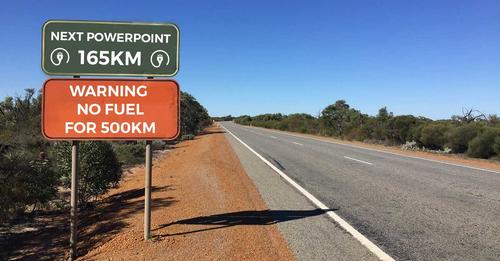
Just had a thought about that sign “165km to PowerPoint, 500km next petrol”
I can easily pack an extra couple of jerry cans and make that 500
There’s no way I can tote enough energiser bunnies to make that 165
A guy down in Melbourne has built a company now building impressive BEV motorcycles. This (sadly but tolerably AI narrated) clip has interesting information from 6:30, and a compelling punchline after 18:00;
https://www.youtube.com/watch?v=3Y8ltrnWUoA
With an assembly operation in China now, they appear to be getting serious.
Few motorcyclists are masochistic enough to want a tourer, I suspect, so 220 km of range is ample for many. Overnight charging at home beats paying at a petrol station. The first one is heavy, but some serious motorcyclists seem to like it. I’m a bit old to dare put it in Sports mode.
This one won’t replace all ICE motorcycles, but it’s a snappy contender, and a sign of what is to come after these very early pioneering days. (Now we just need Elon to make the flying one. 😉
I’ll check it out, but the problem that defeated the engineer I was talking to is we’re talking a 4 person motorcycle/sidecar, with a dry weight of 400kg, and fully loaded (people and gear) of probably around 800kg.
The amount of battery needed to push that just blows out, adding even more weight, past what can be certified.
Do note, I already HAVE the described bike, in ICE. I was trying to replace it with BEV. (She’s a pretty thirsty old girl, and starting to spend more time at the mechanic’s then I like).
Malcolm Dent: – Because batteries are still far to heavy to be practical with a motorcycle + sidecar.”
Verge Motorcycles offers high-performance electric superbikes centered around their patented hubless “donut” rear-wheel motor design.
E.g. Verge TS Pro Performance:
* Torque: 737 lb-ft (1,000 Nm)
* Power Output: 136.8 hp / 102 kW
* Acceleration (0–60 mph / 0–100 km/h): 3.5 s
* Top Speed: 124 mph (200 km/h)
* Battery & Range: 20.2 kWh or 33.3 kWh solid-state battery options; up to 370 miles (city) / 196–217+ miles
* Charging: Fast-charging support up to 100–200 kW (adds significant range in under 10 min)
* Weight: 507 – 518 lbs (approx. 230 kg)
* Brakes & Suspension: Brembo M4.32 / dual 320 mm front discs with radial calipers, Verge-patented rear brake, & fully adjustable Öhlins or Wilbers suspension.
https://www.vergemotorcycles.com/ts-pro/
See Munro Live at CES 2026 on Verge/Donut Labs video: https://www.youtube.com/watch?v=wqcW-yNO42w
Future tech now?
OK, firstly I will note that those stats are for the bike alone being ridden one-up in perfect conditions, not with a pillion and somewhere around another 350kg hanging off its side. If you did attach a big-arse sidecar to that thing, you would probably snap the bike in half, what with its modern frame.
That’s ignoring that that’s one ugly bike (although, to be fair, not as ugly as the Savic), and I would sooner shave with a dropsaw than have “Over the air updates that keep your bike evolving!”
BUT that’s goal-post shifting, because I was complaining about the battery, wasn’t I? And as far as I can tell, the battery here seems to have significantly more capacity than others. Is it enough? I don’t know, but I do know I’m going to get back in touch with that Melbourne engineer and ask him.
Malcolm Dent: – BUT that’s goal-post shifting, because I was complaining about the battery, wasn’t I?”
I’d suggest one needs to look at the whole system, NOT just one part of the system.
Claimed Battery Cell Specifications (Donut Lab):
* Gravimetric Energy Density: ~400 Wh/kg
* Volumetric Energy Density: ~804.7 Wh/litre (V1.5)
* Charging Speed: Fast-charging up to 80% state of charge (SoC) in under 5 minutes (rates up to 11C/5C)
* Lifespan: Claimed up to 100,000 charge cycles (though adjusted in later statements to ~5,000 fast-charging cycles or higher under gentle conditions)
* Operating Temperature Range: −30 °C to over 100 °C
* Voltage Range: V1.5 supports a recommended range of 2.3V to 4.25V (V1 supported 2.7V to 4.15V)
* Architecture: Bipolar solid-state/custom geometry design
https://www.donutlab.com/battery/
Independent testing by Finland’s VTT research organization verified an energy density of 409.3 Wh/kg on specific customer-supplied test cells.
The Melbourne guy’s gotten back to me, and according to him those battery numbers would be exactly what I need, but unfortunately Donut Labs are a bunch of lying liars who lie, and it’s all a hoax. The cells are actually high-performance lithium.
I bought 6 x 16kwh LiFe with 10 year warranty from a trusted supplier recently for just over $15,000
Malcolm Dent: – “The Melbourne guy’s gotten back to me, and according to him those battery numbers would be exactly what I need…”
Several solid-state & semi-solid-state battery technologies achieve or target an energy density of 400+ Wh/kg (compared to standard EV lithium-ion cells at roughly 250–260 Wh/kg):
* Chery (Rhinoceros S / Rhino Series);
https://carnewschina.com/2026/10/20/chery-pairs-12c-liquid-battery-cells-with-400-wh-kg-solid-state-technology/
* CATL & Changan (Golden Bell);
https://www.youtube.com/watch?v=CY9FwCdLYas
* Gotion High-Tech (Jinshi);
https://battery-tech.net/battery-markets-news/gotion-solid-state-battery-targets/
* Geely / Ching Tao Energy;
https://www.youtube.com/watch?v=QHJ_RhCuTVA
* Enpower Greentech (SWIFT Platform);
https://www.enpower-greentech.eu/batteries/roadz-series-and-kosmos-battery
* Grepow.
https://www.grepow.com/semi-solid-state-battery/400wh-kg-series-semi-solid-state-battery-pack.html
I remember when LPG was touted as a cheap and environmentally friendly (relatively) way to run your car. Then when it became popular the government increased the tax on it so it wasn’t cheap anymore. How long before this happens to electricity?
Yes certainly, however that is impossible with regular commutes and a decent solar system. They will.do their worst with public chargers but no politician yet has figured how to meter the sun.
I have a perfectly functioning Mazda 3 using 6.2 litres 100 km. I own the car outright so I’m not convinced taking on new EV at around $300 a week payments is going to help me anytime soon.
Not sure how much you are borrowing and over what term but that sounds very expensive.
A quick calculation I did with ING for a loan of $50K gives repayments of $448 per fortnight over a 5 year term.
Plenty of decent EVs under $50K depending on your wants and needs.
Of course used EVs are available too. There are currently over 6400 on carsales.com.au starting from $6300.
But of course if your current car is still functioning well and getting decent fuel economy then there’s no point in upgrading, as you said.
It’s really only if you have an older car that is starting to cost you money in repairs and maintenance and also if you drive a lot (and use a lot of fuel) then you probably should consider an EV.
Let’s hope things don’t get worse supply wise, otherwise your Mazda won’t be functioning at all.
Paul K: – “Let’s hope things don’t get worse supply wise”
Australian diesel stocks are currently (as at 20 Oct 2026) hovering around the level seen on 3 Mar 2026.
https://crudeoilpeak.info/wp-content/uploads/Diesel-stock-off-on-shore-MSO-20Oct2026-800p530.jpg
Australian petrol stocks are currently back to Apr 2026 levels.
https://crudeoilpeak.info/wp-content/uploads/Petrol-stock-off-on-shore-MSO-20Oct2026.jpg
Australian jet fuel stocks are currently just 2.6 days above the Minimum Stockholding Obligation (MSO).
https://crudeoilpeak.info/wp-content/uploads/Jet-fuel-stock-off-on-shore-MSO-20Oct26-800p530.jpg
Meanwhile, tanker traffic through the Strait of Hormuz continues to be constrained, while global onshore oil inventories continue to be drained at rapid rate, getting closer to “operational floor levels.” See the graphs shown at: https://youtu.be/lOMk6xf1yus?t=379
The era of cheap, abundant petroleum is over!
And if it is the yank mob you are talking about – they dont even sell unleaded, only ethanol blend or premium in my neck of the woods – be surprised if it was any different down there.
Australia came close to petrol rationing around May/June (other countries lost out and motorists there queued for fuel). And, of course, diesel ran out in regional areas of Australia. That is probably a bigger incentive for an EV than avoiding queues for discounted petrol.
Also the numerous adverse health effects of fossil-fuelled vehicles effectively means that society is subsidising these vehicles through long-term health issues.There was a US study several years ago that found every dollar of gasoline pimped into a vehicle caused at least 50c of societal harm. And that doesn’t include climate change.
Why.has the issue of dinosaur juice subsidising middle east terrorism never been addressed ?
It’s amazing what.happens when megadollars are at stake !!
Every disruption S-curve comes about because there are late adopters to straggle in after the rational majority has confirmed the wisdom of the risk-taking early adopters. The stragglers will buy more for less, as economies of scale and technology improvements amplify bang for buck. (But pay through the nose for fuel in the interim)
Our government has given over $1B for development of biofuel production, with Bob Katter adding encouraging words in parliament today. A similar amount for chargers & grid upgrades would do more good.
Avoidance of debt might be wise, as bursting of the AI bubble in 2027 seems inevitable. But a well-timed BEV switch can save over $3k pa, paying off a level2 charger in less than a year, and make an Atto1 free in another 7 years or so. ICE just costs & costs, money, lives, and shorelines: +2°C before 2037, then getting worse faster.
A 15% decline in the AMOC since 1960 may in continuation cool Europe, but freeze them, if it tips. Here there be dragons.
I drove past that same service station in my EV later in the evening and the queue had grown to 1.5kms. There was a truck in the line about half way along with a large display sign at the back saying that the service station would be closing once the truck reached the front, yet there were STILL cars queued behind for another 750m. Can’t read? Who knows.
Interestingly there were brand new looking ICE cars in the queue… I tried to hide my smirk but likely failed.
They should have put a second line of text on that sign on the truck that read.
“You have to be *this* stupid to queue behind this truck.”
Seems that 750m of cars and drivers were *that stupid* (or desperate enough) to do so.
Kinda sad really.
Of course if that queue had been 1 or even 2 EVs that were waiting their turn to use a popular charging station on a long weekend – it would be all over the news as a major “see what EV owners have to do for their fix”.
When it’s cheap petrol causing massive queues it’s accepted as a “smart way to manage your fuel bill.”
It’s interesting how this article is about ICEV drivers queuing but most drivers never seem to have that issue. EV drivers on the other hand …, but apparently that’s acceptable?
A relative just got a new vehicle. Petrol engine of course because EV isn’t an option, even with all the subsidies Labor have thrown at them.
It’ll be interesting to see whether stiff upper lips are to be seen in a few years when EV drivers are told by their mechanics that they’ll need to buy a new car because their pride and joy is no longer supported in Australia – can’t get parts, can’t get (affordable) database access to check the error codes their baby is spitting out.
Where do you live that there’s subsidies for EV’s?
Theres no federal ones and most states don’t have much if anything last i looked. None for my state. – used to be a corporate fleet only one but its gone too.
Also you do know those fancy complex computer systems you’re worried about are also in the new ICE cars?
Nathan,
Multiple posts suggest that John lives in a place called Unreality.
While there are FBT rules specific to EVs, I’ve heard, the strong EV-specific technophobia is logically unsupportable, as:
Currently manufactured batteries mostly outlast first and second car buyer, then go to other uses.
ICE cars burn 25 times as often.
The extra cameras, lane & speed limit smarts, collision avoidance radar, etc hold up well in my experience.
Free rooftop fuel & no engine oil changes ~ $10k saved in 3 years.
Approx $300 servicing here so far is the only running cost. Regen braking => pads as new after 3 years.
The MG4 is a delight to zoom about in, the Sealion is a fine long distance cruiser. Tesla sells a mozza. Buyers don’t go back.
The smelly horseless carriage was scary when it displaced horse and cart; as its buggy days end (next decade), its attendants will follow farriers, ostlers, and wainwrights into the dusty pages of history, plodding behind Cro-Magnons.
This too must end.
NVES is the big one, but FBT changes also skew things. I believe there are other bits of legislation but can’t recall which off the top of my head.
I wouldn’t touch MG4 or Sealion. Tesla, maybe.
Horse and cart may be rarely seen these days, but there’s still the odd rider around. Now whether there’s more riders or EVs in my area, that I wouldn’t want to guess at.
Daughter’s 2024 MG 4 is going well.
On what basis would you ” not touch one ”
At least Chinese MG have been in Australia since 2013 and a long term Holden dealer sells and services them here in SA.
Paul,
My MG4 is a delight to drive, and at nearly 3 years, it won’t be long before it has saved me $10k in fuel and service costs. (I’m not sure that John has ever seen one.)
An exponential rate of technology disruption is often ignored during the initial flat bit, but this explosive phase is disconcerting for slow learners, who fear that they may not be able to adapt.
But very few fossil cars, if any, will be made in a decade – likely only for towing, biofuel powered, as global heating soars exponentially, and awareness of looming +3.5°C to +4°C slowly dawns. The fossil-burner market will be too small to continue. E.g. Subaru will sell only EVs in Europe from 2027, reportedly. Even the slow-learner manufacturers begin to face reality.
Before long, it won’t just be China making the most sought-after cars, but perhaps the only cars outside USA’s domestic production?
John, a Tesla bought here is made in China.
Most EV owners dont seem to have a queue to wait for charging in their garage that i have noticed…
According to the Australian energy regulator – 70 to 85% of all EV charging is done at the owners home.
The Magic Petrol Fairy
I’ve a fairy in my garden
She really is alive
She lives behind the chimney
Halfway up my drive
There is no other fairy
Who ever could be sweeter
She fills my car with magic fuel
At fifty cents a litre
She makes the fuel up on the roof
Just above my yard
No risk of drones or privateers
Or US Coastal Guard
The magic fuel protects my car
And stops all engine wear
The garage scarcely sees me
I’m hardly ever there
The motor gives off lots of power
Thanks to the fairy’s spells
My car drives quietly down the road
And never, ever smells
There is no need to feel glum
There is no need to grouse
You too can have your own fairee
Living at your house.
You do not need a magic chant
Just do the same as me
When you go to buy your car
Just shout out loud, “EV”!
very good, but your magic fairy makes very expensive fuel at “50c a litre” 🙂
Tim,
That makes me smile. It’s not always easy to avoid being glum, but EV can also stand for Existential Viability, perhaps, as BEVs are a vital step to bringing global heating back down after +2°C before 2037, and +3°C by 2060 or so. Add grid transition, currently exponential, and the parts of the world which become uninhabitable may be able to be minimised.
I’m just hoping food production can migrate to previously colder regions as current foodbowls fail us. Anyone in the future, referring to “the good old days” will be referring to pre-2030, I figure. After 2050, children will not believe how good we had it.
In an exponentially changing environment, the past stretches back flat, barely changing, but the future looms steeply, rapidly ramping to a cliff. We cannot adapt to that. The only survival option is to stop pouring oil on the fire.
The evidence is in the numbers, visible in the climate graphs, CO₂ and temperature. Beware the coming feedbacks.
I would expect that “traditional” ICE car manufacturers are just as likely to fold up in Australia as the new (EV) brands. Look at the list of brands that have abandoned Australia over the years before the current onslaught of models from China.
Errrr … Michael,
As ICE sales plummet, VW is scheduling the sale of three car factories, and the sacking of 150,000 workers, 100,000 first. Without a govt bailout, I don’t like their chances. Not all Japanese car makers will make it to 2040, either, it seems. It is legacy makers who are switching to rebadging Chinese EVs who have a chance.
A few wobbly Chinese EV makers have a different problem – cutthroat competition for growing EV market share. Xpeng has nice cars, but finance was an issue some months back.
Norway: 98% EV sales; Denmark: 96%; Australia waking up, ramping the catchup. As service stations close down over the next two decades, and ICE mechanics go the way of wainwrights, ICE cars will cease to be made. It’s basic economics. Irresistibly inevitable now.
(But parts can be custom CNC produced to special order, for nostalgic keepsakes.)
I sometimes still reach for a gearstick to upshift out of corners … but that’s gone now. “Alas poor Yorick! I knew him” Sigh.
“Norway: 98% EV sales; Denmark: 96%”
Interesting. They must have access to really cheap grid power, as both countries are so far north they see next-to-no sun for three months of the year.
“As service stations close down over the next two decades”
Firstly, service stations have been closing for the last several decades. Many of us remember major road intersections where at least three of the corner blocks were servos, sometime all four. Some of these very same intersections now sport only one servo, or none. A mixture of tighter margins and greater mileages between ‘lifting the bonnet’, brought about by engineering more reliable ICE vehicles.
Secondly, I suspect more a transition of the types of fuel they sell. From dinosaur juice to fast-charge electricity. Along with the current side hustle of over-priced coffee and stale chips developing into more of a proper cafe serving meals while the electrons take their time migrating into the waiting EVs.
Over 95% of Norwegian power is hydro, about half of Denmark’s power is wind, but they also import over a seventh of their power from the likes of Norway. Denmark has the highest costing power in Europe, while Norway has low cost energy.
Since hydro isn’t an option for Australia, outside Tasmania …
Service stations are unlikely to shut down in a hurry. I know of at least one new one being built, and another was just completely rebuilt. Why spend money on an industry if it’s dead?
Then again, EV stations aren’t really a thing in my region.
What region is that John?
John Alba: – “Since hydro isn’t an option for Australia, outside Tasmania …”
Pumped-hydro energy storage is an option for all states/territories in Australia, and around the world, per the ANU Pumped-Hydro Energy Storage Atlases.
https://re100.eng.anu.edu.au/pumped_hydro_atlas/
John Alba: – “Service stations are unlikely to shut down in a hurry.”
Only if they continue to have affordable and/or abundant fuel to sell, John.
Meanwhile, tanker traffic through the Strait of Hormuz continues to be constrained, while global onshore oil inventories continue to be drained at rapid rate, getting closer to “operational floor levels.”
Accumulating evidence/data indicates the era of cheap, abundant petroleum is over!
https://www.solarquotes.com.au/blog/why-queue-for-petrol-drive-on-sunshine/#comment-1737753
I see the advantages of electric vehicles, development has a long way to go be for they will be fit for my purpose towing. Infrastructure in our rural areas needs to be dramatically improved before its even a consideration.
There seems to be a lot of comments about the cost of an EV being $50k. I recently saw an advert for a BYD Atto 2 plug in hybrid for $25k on the road.
Sounds good to me, I might just buy one.
And the Atto1 is $19,990. OK, it’s a shopping buggy / commuter unit, but just the thing for a multi-car family to cut running costs.
And for towing, the $1B the govt is spending on biofuels could make ICE a pricey but still viable go-to, with only small residual climate impact, able to be offset by other measures. Trucks are better as BEvs, once charging infrastructure builds out, but it may take a decade or two of battery technology improvements before sufficient capacity for substantial towing fits in a car. (My modest MG4 tows a half tonne trailer load 150 km – that’s more than I need.)
Paul, I’d test drive one. I think the MG4 is around $33k. Try it too, just for the fun of it. (The demonstrator is often the 2-motor Xpower model … well worth the test drive, while you’re legitimately considering options. 😉
The cost of home charging infrastructure is as much a financing issue as long as you have your own off street parking.
When I bought my first (secondhand import Nissan Leaf) EV over 4 years ago, I had no plans to go back, so was happy to install a Zappi which could charge from available solar – I already had 7kW of panels. The Leaf could only charge at 3.5kW and required a type 1-type 2 adapter cable. When I bought my second EV, also secondhand (MY22 BYD Atto 3), I was all set to charge at up to 7kW with direct plugin.
The cost of charger and installation was less than $1500. Zappi warranty support has also been awesome.
It’s all literally horses for courses. Not every use case you can imagine is a suitable for an EV to do even now.
So yes there are folks who need to tow stuff inter state who will struggle with an EV right now.
But a lot of folks can switch – & are doing so.
But I’m also mindful that my long dead grandfather had a team of Clydesdale horses he used for contract ploughing fields for farmers.
Petrol Tractors of the day would not cope and diesel power wasn’t a thing – and the old Traction Engines were prevalent – but even then expensive to buy and very costly to run compared to his team of horses.
Eventually the farm tractor tech matured and the horse powered ploughs and Traction Engines went out of fashion – unfortunately (or fortunately) he never saw that come to pass – he died (of TB) before then.
But this shows that tech comes – & goes & his team of horses was new-fangled once-upon-a-time then superceded by inferior replacements.
So it will be for those driving on Dino juice.
I have home solar and battery, also an EV, but the EV is almost exclusively charged on the 3 hours free electricity plan I am on. and I also then fully charge by 27 KwH battery at no cost to power my home the rest of the time.
A 15 amp wall socket gives 25 Km range every hour, and the minimal servicing costs and convenience of charging where I park have won me over.
The car should run equally well for at least 10 more years, and I notice that used ICE car prices are already softening noticeably (That from an interview from Pickles auctions).
Not paying for petrol or gas and little more than connection fees for electricity plus minimal vehicle maintenance and lower depreciation makes financial sense to me.
I have also increased the value of my dwelling as a side benefit.
John Alba: ” Denmark has the highest costing power in Europe, while Norway has low cost energy.”
And yet BEV sales are 96% there, proving that dino juice is the most unaffordably expensive option now, not just in climate consequences. Here, BEVs are even more profitable to drive, as is being exponentially discovered.
Our lack of hydro is irrelevant, as our surfeit of solar is cheap as chips, even when battery-sustained. Snowy 2.0 cost has blown out x12, and it could be abandoned before completion. (If we’re wise.) Falling battery costs seem likely to displace all that rabbit-like digging, and reliance on water availability.
Let’s see if the super El Niño is the last straw for the Thwaites Glacier, hanging on by a thread. But will even initiation of a 65 cm sealevel rise make us act with intent? After all, “in a hurry” takes decades, so the unobservant are caught unawares.
“Overshoot” is globally admitted to take us over +2.8°C now – at best, +3.5°C likely despite all action.
Erik Christiansen: – “Let’s see if the super El Niño is the last straw for the Thwaites Glacier, hanging on by a thread.”
At the April 2019 General Meeting of the American Philosophical Society, glaciologist Professor Eric Rignot confirmed that the whole of the West Antarctic Ice Sheet is now committed to melting. Rignot also referred to the Meltwater Pulse 1A event at: https://youtu.be/DnOykSCOf0c?t=131
The Meltwater Pulse 1A event occurred between 14,700 & 13,500 years ago, during which the global sea level rose between 16 m (52 ft) & 25 m (82 ft) in about 400–500 years, giving mean rates of roughly 40–60 mm (0.13–0.20 ft)/year.
https://en.wikipedia.org/wiki/Meltwater_pulse_1A
The current global warming rate is roughly 10 times faster than the average warming rate coming out of past ice ages. Thus, the rate of global mean SLR could potentially accelerate to faster than the peak rates experienced during the Meltwater Pulse 1A event in the coming few decades.
Q: Is there intelligent life on other planets?
A: I fervently hope so, ‘cos there’s no sign of it here.
An inability to apprehend deferred consequences, or appreciate the blinding speed of exponential progression once it’s past the sneaky slow start, is incompatible with a claim to be intelligent. In such an environment, experiential learners wake up too late to avoid severe civilisational damage, possibly terminal.
Here, I went carbon negative some years ago. The world needs to do the same, immediately, just to minimise the deaths and uninhabitable global regions. Food supply may be the population adjuster.
The Great Adjustment will fall on your children and grandchildren, folks. The current heedless hedonism will skewer them, blighting the lives of survivors severely. A rapid energy disruption now, is very cheap compared to the later cost.
It’s the feedbacks now, both triggered and inevitably to be triggered by inaction. We have the tech – move uphill, live underground.
Erik Christiansen: – “The Great Adjustment will fall on your children and grandchildren, folks.”
I’d suggest anyone 60 years of age, or younger, is likely to experience a substantial “adjustment”!
As at Aug 2026, global warming was at +1.44 ˚C.
https://apps.climate.copernicus.eu/global-temperature-trend-monitor/
Since 2015, the rate of global warming has been about 0.35 ˚C/decade.
https://www.pik-potsdam.de/en/news/latest-news/significant-acceleration-of-global-warming-since-2015
Thus, at current rate of warming, then:
+1.50 ˚C by year-2028;
+1.80 ˚C by early-2039;
+2.10 ˚C by 2044;
+2.40 ˚C by 2054.
The animated map of the world (see link below) shows the expanding regions of the world that would become unsafe & unliveable (i.e. where mean annual temperatures would exceed 29 °C, represented in purple colour).
https://images.squarespace-cdn.com/content/v1/5bc6826490f904980a50659a/0105c0ea-c715-4925-97e3-c484b9e04380/HCN-FullSequence_c.gif?format=1500w
Geoff,
That 25m sealevel rise in 500 years is 5m per century, consistent with the Pentagon’s estimate of not wholly unlikely 2m to 4m sealevel rise by 2100. And race memories of post-glacial megafloods, repeated in biblical stories, are anecdotal evidence of prior global population displacement from fertile coastal belts onto higher, dryer, less hospitable lands.
More concretely, a couple of ancient Indian cities are now found at depths down to 37m below today’s sealevel, so the imminent global flooding is a mere repeat. One set of ruins spans 5×2 miles = 26 sq km, mostly side-scanning sonar explored, as it’s a bit wet.
Back then, they had no choice. This time we have chosen to act to add London and New York.
Yes, the rise is yet barely perceptible. No, it’s not linear – it snowballs – that’s what exponential action does. Then the feedbacks speed it up yet more, without useful possibility of late moderation. It is act now, or try to survive the ride when it’s too late for that.
Erik Christiansen: – “Yes, the rise is yet barely perceptible.”
Global mean sea-level has risen about:
* 23 centimetres since year-1900;
* 11 centimetres since year-1993;
* 9 centimetres since year-2000.
Per State of the Global Climate 2023, in Figure 6, from satellite altimetry data, the global mean rate of SLR was:
* 2.13 mm/year decadal mean for Jan 1993-Dec 2002;
* 3.33 mm/year decadal mean for Jan 2003-Dec 2012;
* 4.77 mm/year decadal mean for Jan 2014-Dec 2023;
with an acceleration rate of 0.12 ± 0.05 mm/year².
https://wmo.int/publication-series/state-of-global-climate/state-of-global-climate-2023
Per a NASA-led analysis, year-2024’s rate of rise was 5.9 mm/year.
Erik Christiansen: – “No, it’s not linear – it snowballs – that’s what exponential action does.”
See some plausible global mean SLR scenarios in Slide 13:
https://www.ipcn.nsw.gov.au/sites/default/files/2026-08/77436%20Geoff_Miell-PresentationSlides.pdf
Maybe 1 m SLR by 2060s?