
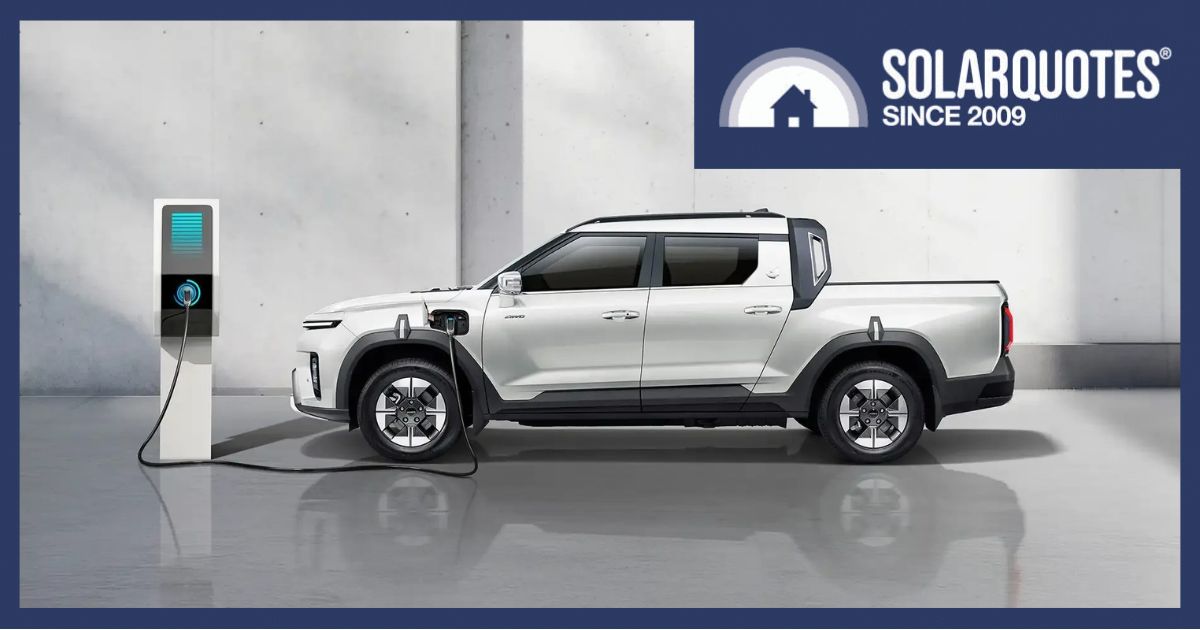
As wars overseas push fuel costs higher at home, diesel prices in particular have been skyrocketing – up by more than a third since February to over 280c a litre at the time of writing.
An electric or plug-in hybrid ute can now do the job for many tradies and weekend warriors at a fraction of the cost – provided you get the charging situation right. Here are the main challenges, some practical solutions, and honest advice on who should make the switch now.
Is An Electric Ute Cheaper To Drive?
The cost savings from switching over from diesel to electric are stark – especially if you do most your charging at home.
Here’s a quick look at the costs, based on our EV charging cost guide: about 30c per kWh from the grid, around 3c per kWh if you use your own solar (the feed-in tariff you give up), and 40–75c per kWh at public fast chargers.
Let’s say a diesel ute uses 9 L per 100 km and an electric ute uses 28 kWh per 100 km. (These are illustrations, not promises. Load, speed and the weight of your right foot all move them.)
| How you fuel it | Cost per 100 km |
|---|---|
| Diesel at $2.85/L | about $25.65 |
| Grid electricity | about $8.40 |
| Your own solar | under $1 |
| Public fast charging | about $11-$21 |
If you drive 20,000 km a year, you’d spend about $5,130 on diesel, compared to around $1,680 for charging from the grid. Even if diesel dropped to $2 a litre, it would still cost $18 per 100 km.
You’ll see the biggest savings with an electric ute if most of your charging happens at home.
What Electric Utes Are Available?
There are two main types of electrified utes, and the difference is especially important when it comes to charging.
Fully electric utes run on the battery alone. Options include:
Of those three models, braked towing ratings run from 2 tons up to the 3.5 tons diesel buyers expect, so check the figure for the exact variant you’re interested in. There’s also the Deepal E07, an SUV-ute crossover, though it’s rated to tow just 1,500 kg. Isuzu and LDV have electric utes confirmed for Australia too.
Plug-in hybrid utes (PHEVs) combine a battery you charge with a petrol engine. Options include but are not limited to:
- the BYD Shark 6
- the Ford Ranger Hybrid
- the GWM Cannon Alpha PHEV and GWM Cannon Hi4-T
- the JAC Hunter PHEV
- Chery plans to add a diesel plug-in hybrid ute late in 2026.
All of these can tow up to 3.5 tons, depending on the model, and prices start at about $50,000.
A PHEV avoids most charging hassles because the petrol engine takes over when the battery is empty. But towing can still be a challenge.
You can’t always tell if a ute is a plug-in just by the name. For example, Ford calls its plug-in Ranger the “Ranger Hybrid,” but some diesel utes are sold as mild hybrids that don’t plug in and only save a bit of fuel. When you’re shopping, check for a charge port.
Sizing A Home EV Charger
A 100 kWh battery takes about 14 hours to fully charge on a 7 kW single-phase home charger, or around 9 hours on an 11 kW three-phase charger, if your ute and power supply allow it. For a 100 km workday, you’ll only need about 28 kWh, which takes around 4 hours at 7 kW. Our home EV charger guide covers installation tips and recommended brands.
The Tradie Twist
On workdays, your panels are generating cheap power, but your ute may be parked somewhere else.
There are ways to work around this:
- Charge overnight on an off-peak or EV electricity plan.
- Top up from solar on weekends and days off.
- If you’re home at lunchtime, you can use a free midday power plan, like Solar Sharer in NSW, South Australia, and South East Queensland, or Victoria’s Midday Power Saver. Both plans give you three free hours, capped at 24 kWh, which is about 85 km of ute driving.
- Add a home battery to store daytime solar for the ute. However, a big ute battery can hold more than the home battery filling it and will drain it quickly.
Your Ute As A Generator On Site
Many electric and plug-in hybrid utes can power tools directly from the vehicle, thanks to a feature called Vehicle-to-Load (V2L). Output levels vary. Some utes offer 6 kW or more, while others only provide 1.5 kW. Check the specs before you get rid of your generator.
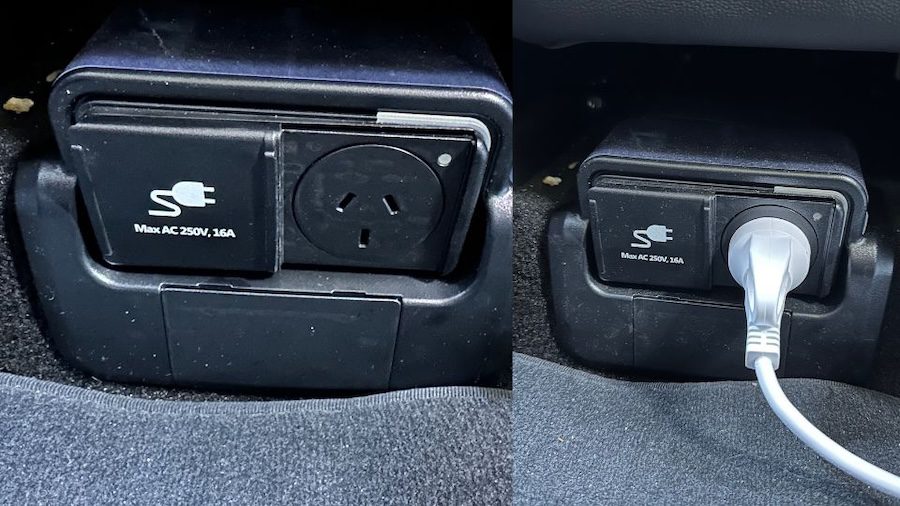
The Hyundai Ioniq 5 has a 250V, 16A power point under the middle backseat.
A few rules of thumb:
- If you run a 2 kW load for 8 hours, you’ll use 16 kWh. That’s about 57 km of range in an electric ute with a 100 kWh battery.
- A standard 10 A power point tops out at about 2.3 kW, and a 15 A outlet at about 3.5 kW. Some heavy-duty tools have 15 A plugs, which won’t fit a 10 A socket, and your ute’s own output can cap you lower than the socket does.
- Some PHEVs will start the petrol engine to keep supplying power once the battery is empty. It’s useful, but at that point, your ute is basically a petrol generator on wheels.
If you set it up properly, you’ll enjoy no fumes, much less noise, and you won’t need to carry an extra fuel can in the back.
Homeowners get an extra benefit, too. These outlets can keep your fridge and some lights running during a blackout, as explained in our V2L guide.
Read The Weight Limits, Not The Tow Rating
Because batteries are heavy, many electrified utes can’t carry as much as their diesel counterparts. Even with diesel models, you can’t tow the full rated weight and fill the tray at the same time. If you’re towing the maximum, you might only have a few hundred kilos left for passengers and gear. Remember, the trailer’s towball weight also counts toward your payload.
3.5 tonne towing capacity is the maximum for light vehicles, the class you can drive on a car licence.
While car makers compete on numbers, utes are passenger cars, they’re simply not designed for heavy loads. In reality, it’s the sales department specifying 3.5 tonnes, while the engineering department puts lots of asterisks on the brochure and the lawyers write the fine print exclusions. Heavy loads are best handled by trucks, with many available you can derate for car licences.
Payload is the total weight your ute can legally carry, including people. Gross Combination Mass (GCM) is the legal maximum for your ute, its load, and the trailer together.
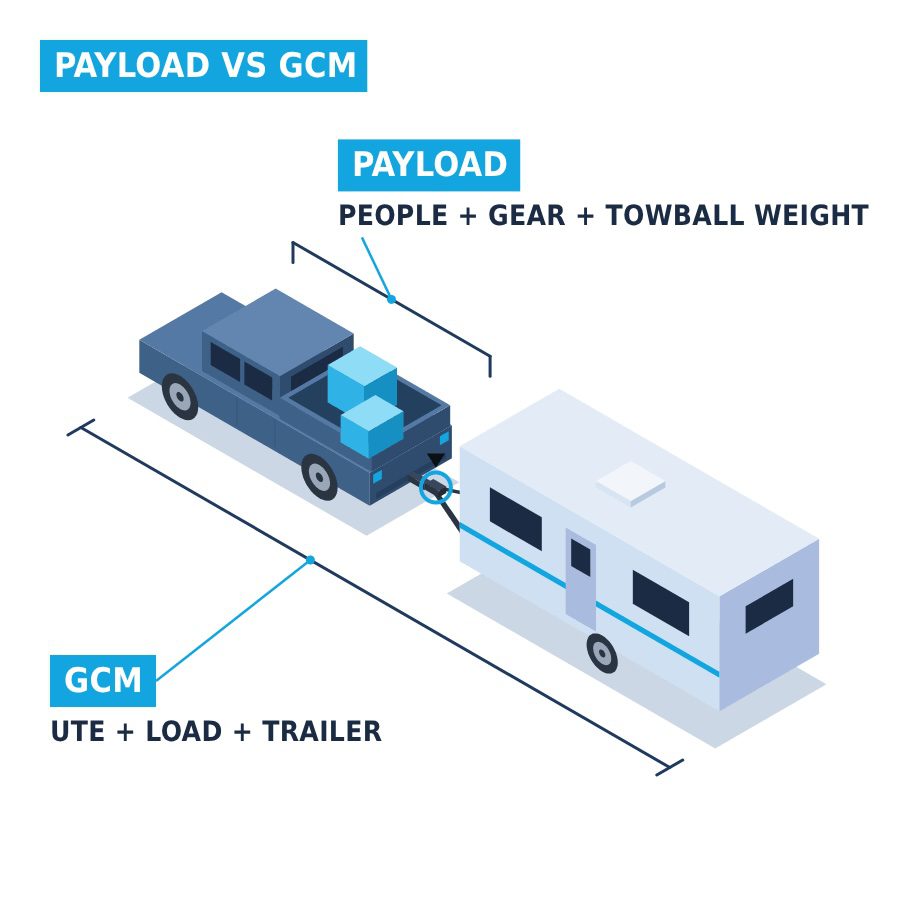
Payload is what the ute carries, including the trailer’s towball weight. GCM is the limit for the whole rig.
Always check the manufacturer’s spec sheet to make sure you’re within the limits for what you carry. Going over these limits is illegal, and it can also give your insurer a reason to deny a claim if anything goes wrong.
Accessories like canopies, ladder racks, and drawers add weight, reducing your payload. They also create drag, which lowers your range whether you’re towing or not. Ask if a bull bar is approved for use with airbags and safety sensors.
Also, check the final height of your load. Tall canopies can stop you from entering multi-level car parks where many chargers are located.
Towing Costs You Stops
Towing a trailer uses more energy because of the extra weight and drag. With an electric ute, a full-size caravan could cut your range in half or more, according to the NRMA.
If your electric ute is rated for 400 km in lab tests, real highway driving will reduce that. If your range is cut in half, you’ll need to stop before 200 km, which is every couple of hours at highway speeds, and each charging session takes longer than filling up at a petrol station.
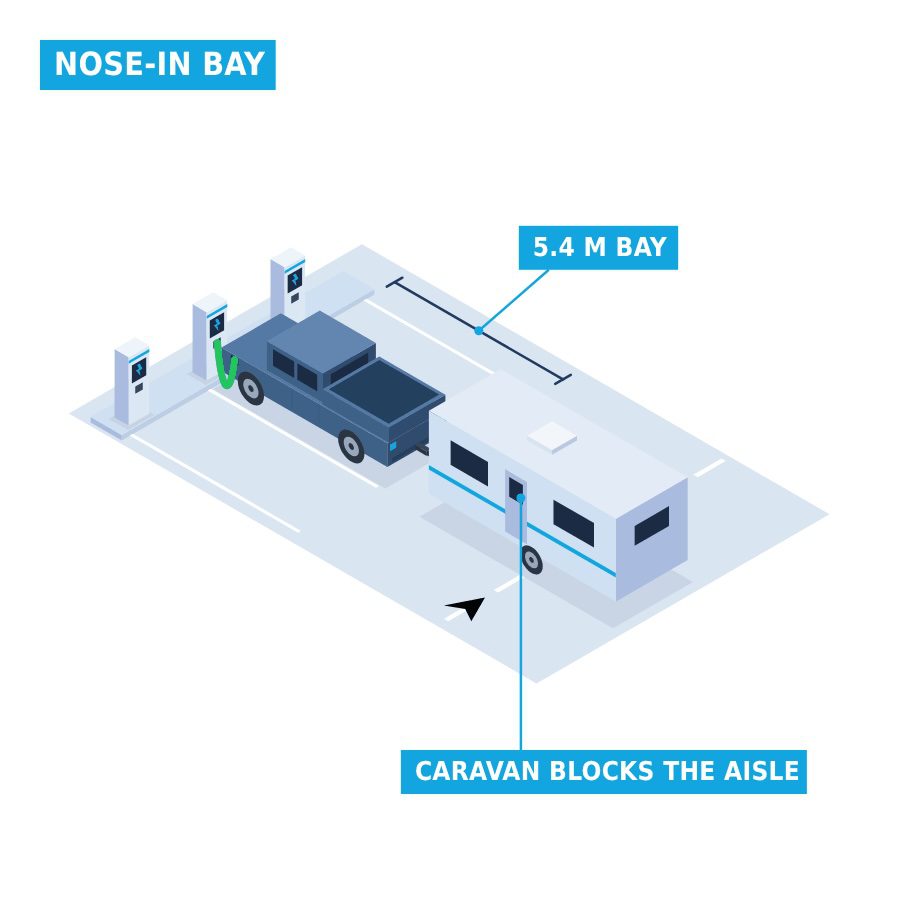
Utes barely fit many EV charging bays.
Public Charging Problems For Electric Utes
Most fast chargers are in bays where you drive in nose-first and reverse out. That’s fine in a hatchback. With a caravan attached, it usually means unhitching in a car park, charging, then hitching up again. (Ideally, without an audience. But you’ll have an audience.)
A standard Australian parking bay is 5.4 m long, according to Drive, and Toyota lists a HiLux double-cab pick-up at 5.32 m. Many dual-cab utes are even longer. Add a towbar (it’s a ute, so there’s always a towbar), and the tail hangs into the aisle.
Another issue is that each manufacturer puts the charge port in a different spot. In a kerbside charging trial funded by the Australian Renewable Energy Agency, operators found that 4 m cables were too short to cope and switched to 7 m ones. Imagine trying to park a ute at an angle just to reach the charging port.
Some Plug-in Hybrids Charge Slowly, Or Not At All
Most PHEV utes that take DC fast charging top out at around 50 kW, a fraction of what electric utes accept, and Ford’s plug-in Ranger launched with AC charging only. Speeds are only as fast as the onboard charger’s rating.
A small battery means a session still takes about half an hour, but that half hour buys only a few dozen kilometres of electric driving, and it can cost more per kilometre than petrol. For most PHEV owners, the smarter move is to charge at home and let the engine handle the highway.
Where To Charge Without Unhitching
There are pull-through charging bays out there. You just need to find them.
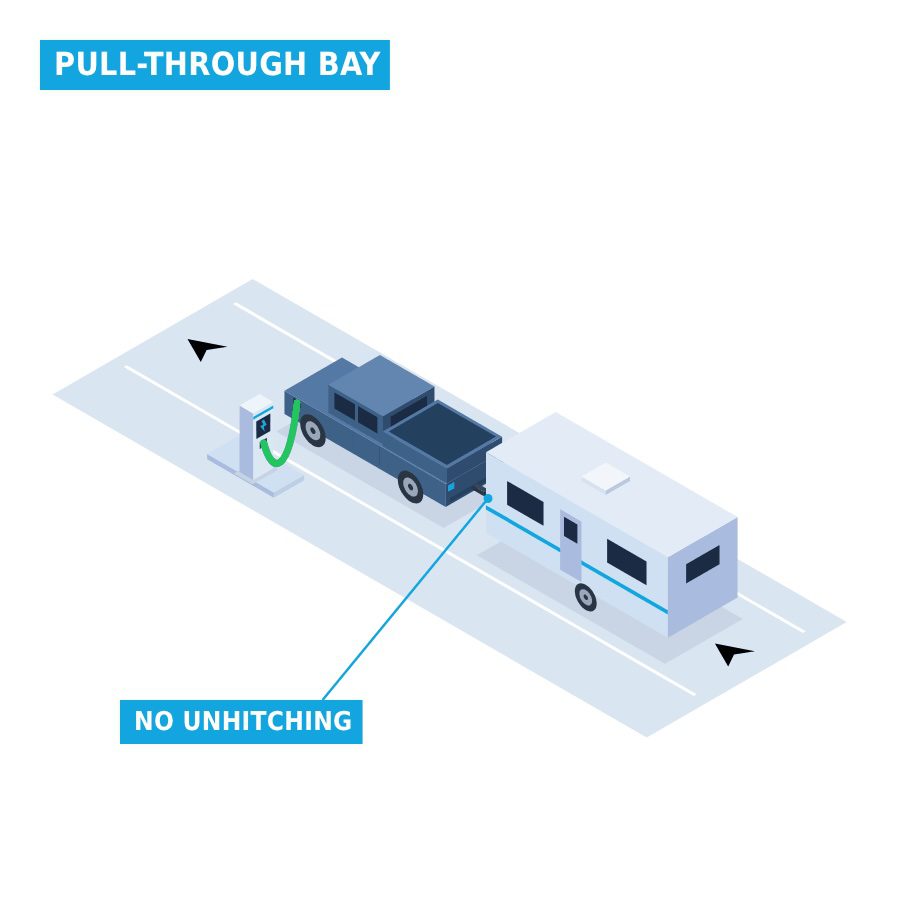
A pull through charging bay.
- NRMA lists pull-through bays in Victoria (Marong, Lakes Entrance), New South Wales (Jerilderie, Lithgow), Queensland (Ingham, Alpha, Toowoomba, Barcaldine, where they’re reserved for vehicles towing) and Western Australia (Eneabba).
- Tesla’s site finder flags trailer-friendly Supercharger sites, such as Kojonup, WA, which is also open to other brands with a CCS plug.
Lists like this can quickly become outdated, so use PlugShare instead. Its map has “Pull through” and “Trailer friendly” parking filters, and drivers report which sites work (and which don’t).
So, Should You Switch?
- A fully electric ute is a good choice if your days are predictable, you can charge at home, and you only tow light loads or do it rarely. For tradies who drive 100–150 km around town, it’s ideal.
- A PHEV is better if you often tow long distances or travel routes with few charging stations. Just be prepared for higher fuel use when towing.
- If you regularly tow a heavy load through remote areas, it’s best to stick with diesel for now. The charging network isn’t ready yet, and towing can quickly use up a fuel between distant service stations.
No matter what you choose, make sure you have the right roadside assistance. Most electric vehicles shouldn’t be towed with their wheels on the ground, so you’ll need a flatbed tow truck if you break down.
In remote areas, you can’t just bring extra fuel for an EV. If you plan to go off-road, check the wading depth and how well the battery is protected underneath.
Fuel isn’t the only running cost. What will servicing cost, and where’s the nearest workshop that can do it? The nearest qualified workshop can be hours away if you’re in a regional area. Also ask what the battery warranty covers, and if using V2L changes that.
A quick note for business owners: fully electric utes designed to carry less than 1 ton are classified as “cars” for fringe benefits tax, so they may qualify for the electric car exemption if they meet the other requirements. PHEVs lost this exemption from 1 April 2025. Check with your accountant before you electrify your fleet.
What To Do Next
Choose a ute based on the trips you make every week, not the rare ones you do once a year.
Before heading to the dealer:
- Calculate your numbers: average daily kilometres, the heaviest thing you tow, what lives in the tray, and your longest regular trip.
- Check those numbers against the payload and GCM, not just the tow rating.
- Check the routes you drive most on PlugShare, with the trailer filters switched on.
- Get your home charging sorted first. Especially if you already have solar, the right charger can make owning an electric ute much more affordable.
The utes are ready, but public EV charging is still catching up. Plan ahead, and you’ll be fine.
For more on finding the best charging solutions, read our detailed guide to home EV chargers.
 About Jacob Boyd
 RSS - Posts





Speak Your Mind