
As clocks go back one hour on April 5 across much of Australia, most households will simply enjoy an extra hour of sleep. But for some electricity customers on time-of-use plans, daylight saving can quietly eat into their hard-earned money if their usage isn’t timed just right.
Recently, ActewAGL customer Nick Ilić was surprised to find his latest electricity bill was roughly three times higher than expected.
“I pulled the smart meter data because something didn’t add up,” Nick said.
Nick is on a Time-of-Use (TOU) electricity plan, which includes a super off-peak window where electricity is completely free. With solar panels, a battery and EV charging set up to take advantage of those cheaper periods, he typically uses very little grid power during peak times.
But this bill told a different story — with peak usage far higher than expected.
After digging into the data, he found the problem: electricity he had deliberately scheduled for off-peak and free periods was being billed at peak rates.
Why Are ‘Free’ Hours Being Charged At Peak Rates?
The issue comes down to timing — specifically, how some retailers apply time-of-use tariffs during daylight saving.
Smart meters across the National Electricity Market record usage in Australian Eastern Standard Time (AEST) year-round. They don’t shift when daylight saving starts. But in states that observe daylight saving — including NSW, Victoria, South Australia, Tasmania and the ACT — local time moves one hour ahead during summer.
If tariff windows continue to be applied in AEST without adjusting to local time, those windows effectively shift by an hour for the customer.
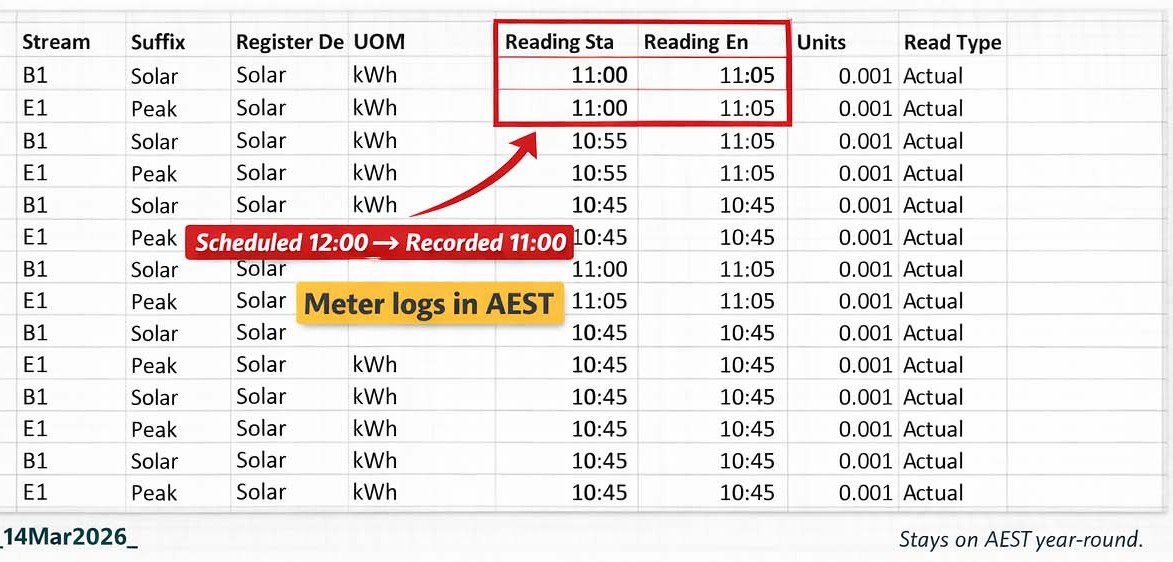
In Nick’s case, that meant usage he had scheduled for midday was being recorded an hour earlier by the meter — and falling outside the cheaper window.
“Charging at 12pm was being recorded as 11am peak,” he said.
Nick was able to demonstrate this by comparing his EV app logs with his retailer’s usage data from the same day.
Here’s how the same charging event shows up in the two data sources:
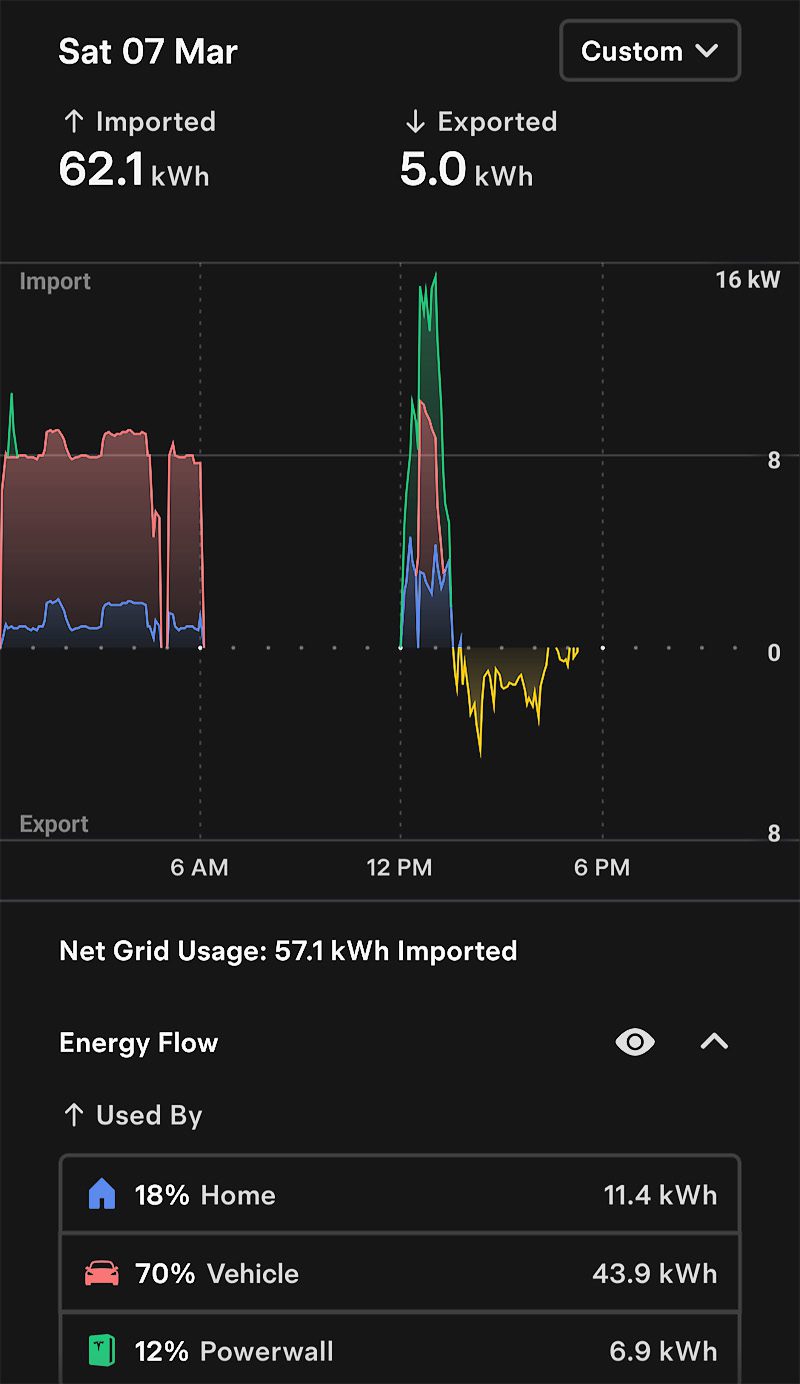
Charging scheduled at 12pm on 7 March, within the advertised off-peak or free window.
In the retailer’s data, the very same event shows up an hour earlier:
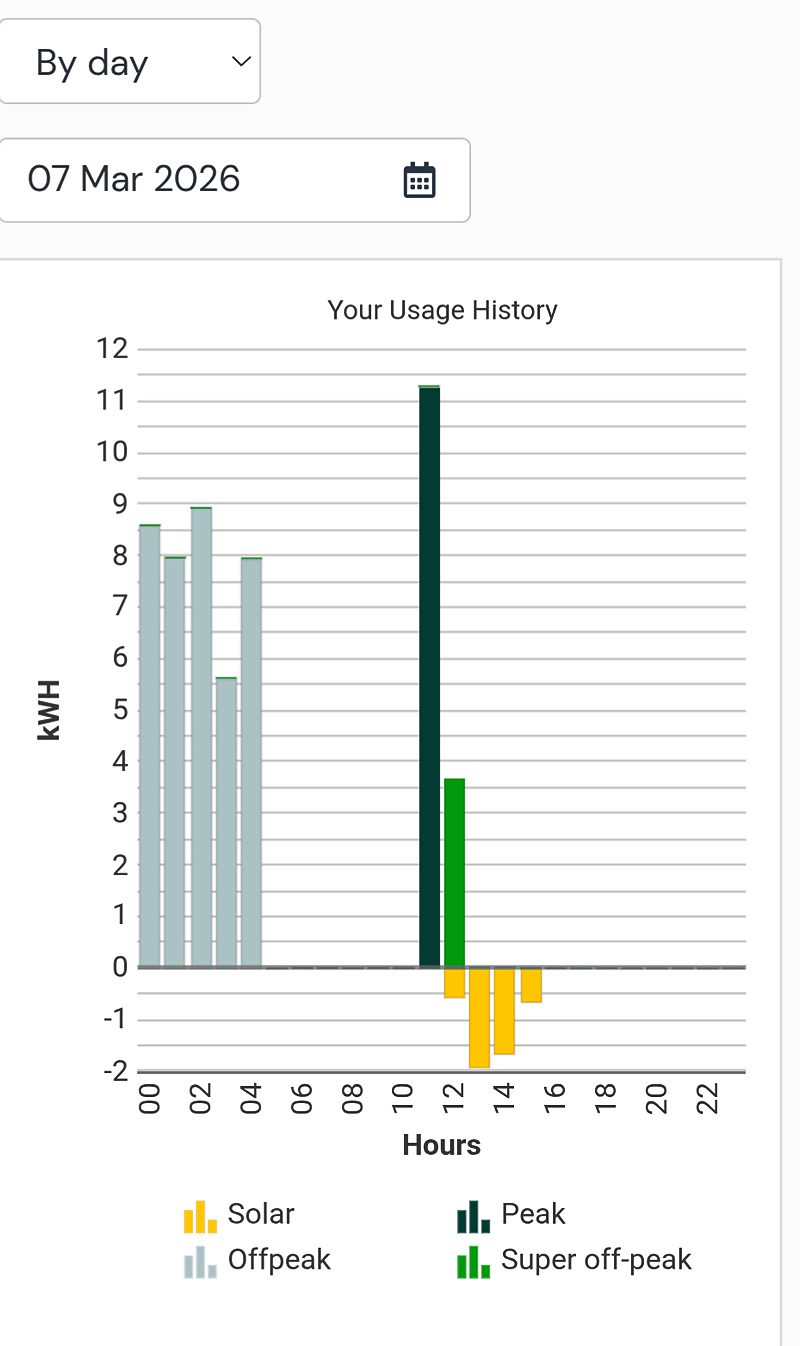
The same usage appears at 11am in the retailer’s data — outside the cheaper tariff window.
A Billing Issue Hidden In Plain Sight
Nick’s investigation didn’t stop at usage data — he went back through the plan details to understand why this was happening.
He found the plan information inconsistent — some documents mentioned AEST, while others showed standard clock times with no clear explanation of how daylight saving affected the tariff windows.
“My complaint is not primarily about whether the meter records in AEST,” Nick said. “It’s about the clarity, consistency, and practical adequacy of how this tariff was disclosed.”
In his case, the impact was significant — and it showed up clearly in this summary Nick put together after reviewing his bill:
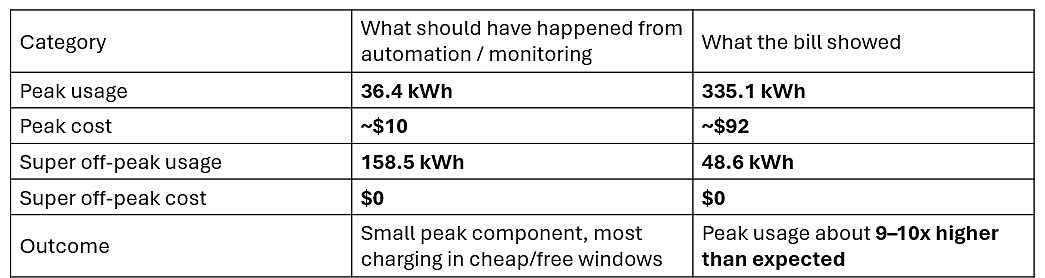
Despite scheduling usage during free and off-peak periods, peak usage was around 9-10× higher than expected.
Nick argues that if customers are expected to adjust their behaviour twice a year, that should be made obvious upfront — not something discovered after receiving a bill.
“The burden should not simply be pushed onto the customer to discover and manage themselves,” he said.
Why It Can Go Unnoticed For Months
What makes this issue difficult to spot is that it doesn’t jump out on a standard electricity bill.
Time-of-use plans group usage into peak, off-peak and other categories, but they don’t usually show exactly when that energy was used.
In Nick’s case, the mismatch had likely been affecting his billing since daylight saving began in October. But because the shift is only one hour — and buried inside total usage figures — it wasn’t immediately obvious.
It was only when his latest bill looked significantly higher than expected that he dug deeper.
That’s when he turned to interval data — a detailed breakdown of electricity use over time — to line up what actually happened.
Who Is Responsible For Getting The Timing Right?
Nick raised the issue with his retailer ActewAGL, which told him the system was working as designed. The retailer explained that smart meters operate on AEST year-round, and that during daylight saving customers may need to adjust their usage timing accordingly.
But for Nick, the problem isn’t the technical setup — it’s how this expectation is communicated. Unless a customer already knows to look for it, Nick feels there’s little to suggest they need to proactively shift their timers by an hour during daylight saving.
“Customers are effectively required to manually shift their behaviour by one hour… that is the core issue,” he said.
He has since escalated the matter and is pursuing it through the ACT Civil and Administrative Tribunal, arguing that the way the plan is presented can be misleading in practice.
And this isn’t just a one-off. Retailers don’t all handle daylight saving the same way. Some keep their tariff windows fixed to AEST all year, while others align them with local time. The plans can look identical on the surface, but that one hour difference in how they’re applied can quietly push usage in or out of cheaper periods — a detail most customers would never think to check.
ActewAGL advised SolarQuotes that the issue only affects their customers in the ACT (the majority of their customers), as the territory’s distributor Evoenergy does not adjust tariff times to align with daylight saving. They say their NSW customers are not affected.
“Customers in the ACT on a time-of-use tariff may want to consider aligning their electricity usage pattern to AEST during daylight saving. You can check the times in the standing offer pricing schedule,” a spokesperson for ActewAGL said.
The spokesperson added that the ActewAGL website specifies the daylight savings issue and that customers should consider aligning their electricity use to AEST.
“Information about how tariff times are applied is included in customers’ acceptance packs and on our website… we continue to review how we present this information to ensure it is clear and accessible for customers.” the ActewAGL spokesperson said.
How To Check If You’re Affected
This is where things can get a bit tricky — but you don’t need to dive straight into spreadsheets.
Nick confirmed the issue using detailed “interval data”, which breaks electricity use down into small time blocks. It’s precise, but not exactly user-friendly.
Most customers can spot the same problem much more simply.
Start by logging into your retailer’s app or online account and looking at your usage graph — the one that shows how your energy use changes throughout the day.
Then:
- Pick a time you clearly remember using power (like EV charging or running appliances)
- Check when the system says that usage occurred
- Compare that to your tariff windows
What you’re looking for is a mismatch — where the time shown in your app doesn’t line up with the time shown in your retailer’s data. If the same usage appears an hour earlier in the retailer’s graph, that’s a sign your tariff windows are being applied in AEST.
Although Nick confirmed the issue using interval data, he could also see the same pattern by comparing his EV app logs with his retailer’s usage graph — where the same charging event appeared an hour apart.
“My automation was designed to push charging into the cheap windows,” he said. “Instead, the bill showed a very large peak component and much less in the free period than expected.”
If you do spot a mismatch, the fix is straightforward: during daylight saving, shift your timers forward by one hour so they align with the meter — not the clock.
Why April 5 Is A Useful Reminder
When daylight saving ends on April 5, clocks go back and local time lines up with AEST again. That means this particular mismatch disappears — at least until spring. But the broader issue doesn’t go away.
If you’re on a time-of-use plan — especially one with EV charging or “free” periods — it’s worth checking how your tariff windows actually work. Because as this case shows, the difference between saving money and paying peak rates can come down to a single hour.
For more help understanding electricity plans and tariff types, visit the SolarQuotes Electricity Comparison Plan tool.
 About Kim Wainwright
 RSS - Posts





I find my DNSP (SAPN) graphs easier to use than the Retailer (AGL) but good to know this could be a problem.
I can imagine a few frustrating interactions with the Retailer trying to explain the issue.
Thanks for this Kim, and special thanks to Nick for doing the hard work. I had my system installed during daylight saving period a few months ago, and probably fell into this trap. My trust in the ACTEWAGL was a significant factor in choosing them over Amber. They have now lost a lot of credibility with me for not explaining more clearly – with reminders to adjust time periods provided.
Affects not just free EV charging time, but also topping up hot water before the morning rush at 6am.
Now that I know it should be a fairly simple fix because I have a Tesla PowerWall and can set seasons (Summer = AEDT, Winter = AEST). But am very disappointed that a previously highly regarded retailer has failed me.
To expect users to be across all the details which may be buried in the depths of product information documents with no explanation of effect on the user is seriously wrong. These documents are often long, unwieldy, to hard for many to read and understand, let alone remember months or years later. Some suggest they are so in order to confuse the customer, not inform them. And given the large number of such “information” statements one is hit with these days it is impossible to be across them all. As a person whose career regularly required reading and analysis of often long and complex documents such as contracts and legislation, I can’t keep up with the barrage that I am faced with now.
It would take almost no effort on the part of energy providers who follow this tactic to alert their customers at the start and end of daylight savings and remind them to changed any timed loads as required. But of course, that might harm windfall profits……
The ACCC should look into this.