

Common sense says refineries process oil, not make it, so more Australian refining capacity would be useless in the current oil shortage. But common sense isn’t always right. Here’s how the federal government’s New Australian Refinery Plan, announced April 1, will help the nation power through the fuel crisis.
On Saturday, January 28, 2026, the United States attacked Iran. This has made a lot of people very angry and been widely regarded as a bad move. And not only in Iran. This is because, in response, the Strait of Hormuz was closed. Despite regional pipelines going all out and Iran allowing some tankers through, it has reduced world oil supply by around 10%. While good news for EV sales, it’s a disaster for the world economy.
Many regard Donald Trump’s attack on Iran as a terrible blunder, but before we condemn him, I think it’s only fair to consider how much pressure the American President is under. Think about how you’d feel if you were falsely accused of horrible crimes. Now imagine how much worse it would be if you knew you were 100% guilty.
Here in Australia, some have come close to panic over the fear we’ll run out of fuel. Fortunately, that won’t happen. A lot of the concern has revolved around our lack of oil refining capacity. Politicians calling for more on-shore refining capacity have been widely sledged because refineries only process oil; they don’t make it. But this isn’t entirely true, and is why the federal government is launching the New Australian Refinery Plan (NARP) to improve access to petroleum products.
There Will Be Fuel, But It Won’t Be Cheap
Lately, many have made themselves miserable by larping online as logistics experts and convincing themselves we’re running out of fuel. But that’s not on the cards. We have a whole heap of cards in this situation, and it’s not on any of them.
The three main reasons why Australia will have no problem maintaining a supply of fuel from overseas are:
- World oil supply is down by around 10%. While enough to have severe economic effects, 10% less is nowhere close to running out.
- Australians are in the world’s richest 5%. So long as we’re willing to pay current high prices, we can afford to bid supply away from poorer nations. Basically, 10 people in the Philippines will leave their scooters at home and walk so one Australian can drive an SUV.
- Australia is the world’s 3rd largest exporter of energy. We export 6-7 times more than we import. No one is going to intentionally piss off the country that supplies a large chunk of the world’s energy during an energy crisis by withholding petroleum products. Liquid Natural Gas (LNG) prices are currently through the roof, and Australia is the world’s second largest exporter. Because LNG is so expensive, coal prices are up, and Australia is also the second largest exporter of that. Finally, we produce petroleum equal to 30% of our own consumption, and we’re not about to send that to an overseas refiner in return for nothing.
Despite the poor average fuel efficiency of Australian passenger vehicles and our heavy reliance on diesel, Australia is in a better position to weather this crisis than any other developed country. And that’s a lead we’ll maintain until the US gets a new President. (An event that will also put Canada in front of us.) But this doesn’t mean fuel prices won’t be sky high, or there will be no temporary disruptions, or no rotten economic consequences. It also doesn’t mean things can’t get worse.
Some are certain the situation is doomed to deteriorate because Trump is not the very stable genius he makes himself out to be. Personally, I’ve known isotopes with 160 neutrons that are more stable than he is. Saying the President is unhinged is an understatement, because the last time his hinges were seen, they were exiting the solar system at high velocity. But if you point out to his supporters that the Emperor has no sanity, they simply say that because hinges require oil, being unhinged is a conservation method.
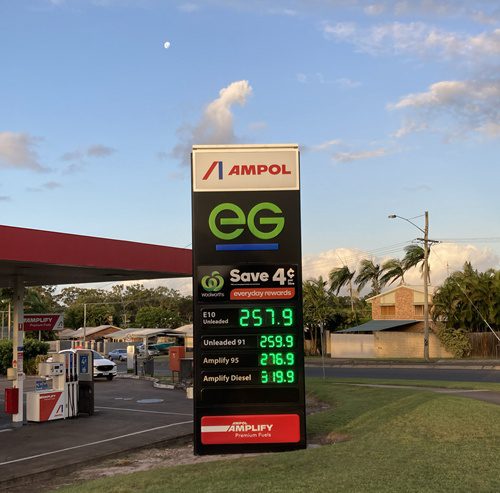
This shows fuel prices in regional Queensland are sky high. And if I’d gotten there a little earlier, they would have been moon high.
Australia’s New Refinery Plan
Over the past month, the fact that Australia only refines 20% of the fuel we use has been a point of contention. But it’s not strange because our crude oil production is only equal to 30% of our consumption, and the blends we produce don’t match our consumption profile. Also, while there have been disruptions in refinery production resulting from the world’s oil supply falling 10%, we’ve only effectively lost around 3.2% of refining capacity. This means the world can now refine more oil than it has available. So even if Australia had additional capacity, it wouldn’t help, as refineries only process oil and don’t create it.
Or at least, that’s what you’d think. There are actually good reasons why the right sort of refining capacity can help Australia tackle the oil shortfall and ensure the supply of petrol that most private vehicles burn, as well as the diesel that agriculture and industry rely on. This is why the government announced the NARP, which will result in a complete reorganisation of Victoria’s Geelong refinery. This will increase its output, and the upgrade is expected to be fully online within three months. In time to help meet demand and lower prices when the fuel excise reduction that starts today comes to an end.
The improved output will result from a four stage process.
Stage 1: Refinery Gain
If you put 100 litres of crude oil through a refinery, you won’t get 100 litres of petrol, diesel, and potentially other fuels at the end. While it will depend on the refinery and the type of black goop you’ve poured into it, in general, you can expect to get about 106.5 litres out. This increase in volume is called refinery gain and results from longer hydrocarbon molecules being broken into smaller ones. The weight stays the same, but it takes up more space.
If you have a mischievous bent, you may be wondering, “Can the fuel be put through the refinery several more times, causing it to increase in volume with each pass through?” The answer to that is… yes it can. That’s exactly what the NARP refinery reorganisation is designed to do. However, there are some constraints that apply, and it’s not a matter of simply running it through the same process again.
Stage 2: Green Hydrogen
Australia has a considerable number of hydrogen electrolysers left over from various harebrained hydrogen schemes. South Australia has several. There’s one that was used to add trace amounts of hydrogen to domestic gas at Tonsley, and several more left over from an abandoned plan to build a hydrogen power station. All of Australia’s disused electrolysers are currently on their way to Geelong, where they will be used to hydrogenate refinery products, increasing both volume and energy content.
The electrolysers have a planned capacity factor of around 50% and will mainly run when renewable generation is high. While the electricity they consume won’t be completely green, it will be greenish.
Stage 3: Low Pressure Atmospheric Treatment
In the third stage, the hydrogenated fuel is forced into a flash chamber where it’s mixed with air at low pressure. This allows atmospheric oxygen to combine with the fuel, increasing both its mass and volume, effectively making fuel from thin air.

Because times are tough, I sold the antique lighter my grandfather gave me for $200. After I handed it over, the buyer immediately emptied it into his car and threw the lighter in the gutter.
Stage 4: Blockchains To The Rescue
If you’re familiar with chemistry, you’ll know that simply oxygenating the fuel won’t increase its energy content. But this is where blockchains come to the rescue. You may have noticed blockchains have faded from public view over the past couple of years. This is because so many companies promoting them have either gone bust or been charged with fraud. However, their blockchains are still around, with both defunct ones and those confiscated for legal reasons going into the government’s blockchain repository. As part of the response to the Trump energy crisis, the contents of the repository have been made available to the Geelong refinery.
Blockchains can contain a lot of energy. On average, one bitcoin represents around 35,000kWh, but a recent one from 2025 has an energy value of roughly 840,000kWh. The blockchain energy is delivered to the fuel through pulsed fibreoptic cables. The digital energy is mostly transmitted in base 4 to energise carbon atoms’ 4 valence electrons, but binary is also used to energise hydrogen, and base 6 for oxygen.
Only A Fool Wouldn’t Double Their Fuel
And there you have it — using this four stage process, the Geelong refinery will roughly double its fuel output and produce an estimated 207 litres of fuel for every 100 litres of crude oil. Of course, this extra fuel doesn’t appear by magic, but through hydrogenation, thin air production, and the addition of blockchains. Although I guess blockchains are magical, as curses are a type of magic.
The doubling of fuel production that can result from a properly organised oil refinery goes to show that the people and politicians currently calling for Australia to build expensive new refining capacity, at the exact point in time that Donald Trump is running the world’s largest and deadliest advertising campaign for EVs, are not idiots. They are people intelligently seizing an opportunity for Australia to take control of its fuel. Not just petrol, but all the fuels our country requires, including diesel and those used for aviation. Having independent control of these fuels is of such national importance that I’m certain today will forever be known as April Fuels Day.
 About Ronald Brakels
 RSS - Posts





Nice one. Can you elaborate more on April 2 ?
Tomorrow I’ll explain how the International Standards Committee’s changing horsepower to catpower will save fuel and make engines purr.
Dammit – I had completely forgotten the date and there I was thinking magic could be applied to fuel refining.
Except for the idea of blockchains containing energy – that did my head in and made me question my sanity. Luckily some vague semblance of sanity arose in the far corners of my brain and I remembered the date.
Well done Ronald!
But I am flexing and readying my keyboard fingers for outrage mode to launch a serious tirade about tomorrow’s article. I love horses, great things to pat and they are faithful friends.
Whereas cats are evil things, not only treating humans as slaves (worse than the coming AI powered robots) but self-centred destructors of our native wildlife. And they are slowly and insidiously taking over the world via cute pictures on the internet. Never underestimate them.
We must stop this takeover NOW!
After seeing the Kwinana refinery here in WA dismantled it is time to re-establish this refinery (with haste) as far as Trump he well may get another 4 years in power if not his party will ….
Great article!
Oz went from 7 refineries to 4 under Abbott, who also killed off the car industry, leaving manufacturing in the state it is. Then Covid cut demand during Covid, so two more became uneconomic (Kwinana and Altona).
My question is: Were the WA Government, the mining companies, the agricultural sector and the fishing industry asleep at the time?
Between them, they could have done a risk assessment (remember those before government department functions were outsourced?) and compared the “do nothing” approach to a subsidy from all of the sectors to keep Kwinana open or build a new refinery that would have been built by now (less CFMEU influence).
We are ruled by idiots, but we also bear responsibility for accepting it.
I had the Coopers ‘strength’ to read through till then end…took me a good 10-15mins (hope I wont ask myself why 2moro!).
Anyway I then saw author’s picture then literally Coopers lost its -OH factor instantly!!
What was that!
Abbot didn’t kill the vehicle industry he just shut the door, it was the Button plan imposed by the Hawke and Keating governments that started the rot, the final nail was sunk in by the then US government, applying pressure to the big 3 to pay back there debts after the 08 crisis. Which moved profitable manufacturing / sales back into the US.
Ronald for President!
Have you put this proposal to parliament?
They will need the ‘thin air’ component as a critical measure to fund this bigly proposal.
I think Pauline might pick this policy up.
I didn’t catch on until stage 4.
Okay, it took me until stage 2 to realise it is April 1st…
But seriously, I understand from an ex trucker that there are oil wells in the Australian outback that have been dormant for decades. And Australia has dormant oil refineries.
Since the feed in tariff for solar falls below zero most days, why isn’t hydrogen being split out from water using the solar power that is being curtailed to avoid oversupply?
This 2023 report says that the 12 Hydrogen refueling points at that time all produce Hydrogen on site by electrolysis. Surely this fits into the distributed generation that we are starting to have. Sell me cheap Hydrogen for my car and you can have my curtailed electricity capacity.
https://www.csiro.au/en/news/All/News/2023/November/CSIRO-and-Swinburne-University-of-Technology-launch-renewable-hydrogen-refuelling-station
In the meantime, no Toyota Mirai or Hyundai Nexo for me. I’ve pre-ordered a Leapmotor A10, 800V 🙂
And other uses for green hydrogen exist:
https://www.csiro.au/en/research/environmental-impacts/fuels/hydrogen
Go ahead and open one up. You can fill your car with one half and I’ll drink the other half.
There are definitely decommissioned oil wells in Queensland. Also, two sites where oil shale/oil sands were exploited. But no one has found oil deposits that are both large and easy to extract. While there are resources that could be exploited, by the time any production comes on line, oil prices will probably have fallen thanks to the electrification of road transport and they won’t be competitive. The total amount of oil produced in Queensland through it’s history is probably under 50 million barrels. Less than 1.5 months of Australian consumption.
As for oil refineries, Australia used to have some in mothballs, but their hardware has since been scrapped and they are either gone or converted into fuel import terminals.
But good choice getting an EV. Green hydrogen will have its uses, but road transport isn’t going to be one of them.
I don’t think the uptake on EV trucks will be anywhere near the levels of EV cars, if viewing the ignorant/luddite comments on various FB articles about EV trucks are anything to go by.
The few EV trucks that are available only have a relatively short range (for trucks), about 600km, which limits them to around town or shorter routes such as Sydney to Canberra or similar.
Also, there isn’t the charging infrastructure for them. Trucks generally (especially prime movers) are too big to access the EV car charging points that are often in shopping centre car parks and the like.
There are the trucks with the batteries that can be swapped over quickly but I’m not sure if this service is available in Australia yet, I’ve only seen videos of it in NZ.
The negative publicity generated in recent media reports of a hybrid fire truck in ACT that cost ~$1.8M spending more time in the workshop than out of it, due to some battery issues (fixed under warranty), hasn’t helped the EV truck love either.
Owen: – “But seriously, I understand from an ex trucker that there are oil wells in the Australian outback that have been dormant for decades.”
Australian unconventional resources are estimated at 400 billion barrels of tight oil, of which 17.5 billion barrels are considered recoverable. Australia uses 1.15 million barrels of petroleum products per day, thus it seems Australia has 42 years worth of tight oil. https://youtu.be/AEXCFszIYYY?t=37
But the limits to mineral extraction are not limits of quantity, but of energy.
Extracting minerals takes energy, & the more dispersed the minerals are, the more energy is needed.
Technology can mitigate the depletion problem, but cannot solve it.
Australian shale oil & onshore unconventional resources (such as shale & tight gas) generally require sustained, higher oil prices to be economically viable compared to conventional oil, often cited in the range of US$70–$90+ per barrel.
Higher oil prices = higher fuel prices.
The reason why they are no in use is electrolisers are consumed not plated.
Just like Cavitation on a boat propellor causes tiny bubbles and pitting of the surface of the blade, the formation of hydrogen and oxygen bubbles causes the same pitting in the electrolyzer material. So even if you make it if something crazily hard like titanium it is still consumed and is expensive.
Plant and equipment that you need to further compress and perhaps liquify this hydrogen is also not maintenance free.
When you build a facility that can do it for say a billion dollars it’s needs to run 24/7 for an established customer to pay for it.
If you don’t have that customer then it gets mothballed.
You need a lot more than a few hours a day to make such investments and whilst they will happen into the future when we have an abundance of clean green energy…….
That hydrogen is much better turned into ammonia and that ammonia turned into ammonium nitrate fertilisers well before it’s used for transpor
That should kick ass at these voltage .😁
April fool? But very good
IIRC, Zaphod invaded on the 28th of *FEBRUARY* 2026.
This is absolutely brilliant, you had me sucked in till you mentioned blockchain.
Good one. Ha ha You had me till the blockchain bit to.
Finally a decent Brakels article about Labor implementing some intelligent policy for a change. It’s so very very refreshing! At this rate some of the people I know might even consider voting Labor for at least a second or two.
A pity that it’s a 04-01 piece.
What a brilliant article. Also sceptical at step 3 and checked publication date at step 4. Mate, my hat’s off to you. Laugh I did.
Finally people who tell it like it is! I lean towards clean energy,the quicker we get to be a society that doesn’t rely on fossil fuels the better we will be! Secondly remove Donald Trump from the Whitehorse & things will improve overnight!
Thirdly I have been to ukraine 3 times in 3 years, australia doesn’t need to go through what they have and are going through! We have always stood on the right side of history,that’s the right thing for us to do now & always.
Dagnabbit. I got to stage 3 before my spidey senses woke up.
I enjoyed the HHGTTG reference anyway.
Had me going all the way, till the 1st of April line, bloody good one mate.
Good April 1st joke. Got me until the 4:Block chains. LOL at me.
.
Now, serious time, SASOL.
.
Sasol is the solution to Australia’s fuel dependency. Sasol has two technologies that deal with the problem, their oldest technology is our solution. Coal to petrol, diesel and jet fuel.
Developed in Germany and used by them in the early 1940’s. Adopted by South Africa in the 1960’s and developed further. This technology allowed them to ignore the oil embargo imposed on them during the apartheid years. Still in operation today. Sasol now also has a process that converts gas into petrol, diesel and jet fuel.
Expensive to build, but what price do we put on insuring ourselves from global oil shocks like this one. Being mostly self-sufficient will make us all a lot safer too. Ask the ADF about it.
John Lunsmann: – “Coal to petrol, diesel and jet fuel.”
Coal-to-liquids (CTL) fuel is generally 3-4 times more expensive to produce than refining an equivalent amount of conventional petroleum.
Key factors:
* High Capital Investment;
* High Operational Expenses;
* Cheaper Alternative Processes.
CTL requires high crude oil prices to be economically competitive.
High crude oil prices = high fuel prices = high transport costs.
Meanwhile, the Chinese-made Windrose prime mover costs around $475,000, not much more than the asking price of a Kenworth T909, between $400k and $500k.
https://reneweconomy.com.au/electric-trucks-are-increasingly-competitive-and-could-be-a-thing-if-only-the-transport-minister-would-listen/
A Windrose electric prime mover covered a trip from Sydney-Canberra in a single charge, & completed the trip 25 minutes faster than a diesel truck.
See also Janus Electric:
https://www.solarquotes.com.au/blog/now-thats-what-i-call-v2g/#comment-1733600
Sydney to Canberra isn’t the real challenge – that’s Melbourne to Sydney, Sydney to Brisbane, Brisbane to Cairns etc. If a truck can’t do a run on a single charge then you’re adding complications, costs, and risks.
And this is all without even considering whether CCP vehicles are safe to rely on for anything.
John Alba: – “Sydney to Canberra isn’t the real challenge – that’s Melbourne to Sydney, Sydney to Brisbane, Brisbane to Cairns etc.”
I’d suggest the limitation for long distance road transport is the driver; not the truck.
https://www.nhvr.gov.au/safety-accreditation-compliance/fatigue-management/heavy-vehicle-fatigue-management-primary-producers
The Janus Electric system can swap batteries within 4 minutes. Diesel trucks take 15+ minutes to refuel.
Geoff,
Yes, battery swapping looks optimal, as the prime mover can continue after e.g. 500 km, with a fresh battery & driver – the expensive vehicle is rapidly back to earning. But New Energy Transport, claiming to be our first 100% BEV trucking company, is going the (Windrose) fixed-battery route. I sense that many of the other 140 long-haul trucks out there are the same.
The logistics companies will have compared the cost of the charging downtime against a physical battery swap. It may be that driver break or swap, and load/unload or trailer swap, comes close enough to the 30 – 40 minute top-up time, that battery swapping (with the capex of a pile of extra costly batteries) doesn’t cut it.
What happens in the next 5 years will reveal the economic winner. The only certainty is that diesel is now the path to logistics bankruptcy, especially on transport’s wafer thin margins.
Erik Christiansen: – “Yes, battery swapping looks optimal, as the prime mover can continue after e.g. 500 km, with a fresh battery & driver – the expensive vehicle is rapidly back to earning.”
The Janus trucks, with 2x 310 kWh swappable batteries, have a range that’s good for a claimed 300km to 400km.
You can either use Janus infrastructure, own your infrastructure, rent your batteries from Janus, or buy batteries.
https://www.drive.com.au/caradvice/four-minute-battery-swaps-is-this-the-future-of-evs/
The Windrose electric prime mover, with 705 kWh LFP battery, typically charges in about 1 hour for its 670 km range (fully loaded, single charge), or ~38 mins (20–80%), using Megawatt Charging Systems (MCS).
The Tesla Long Range Semi has ~500 miles (800 km) range with up to 800 kW total power over 3 motors, with 900-1,000 kWh battery capacity, with 1.2 MW fast charging up to 60% range in 30 minutes.
It seems to me a Kodak moment has arrived for diesel trucks.
You all look a bit green around the gills. If only we had a large supply of gas could ship it around the country in Australian crewed tankers to the capital cities. Do a deal with China to change fuel tanks for gas tanks and we are home and dry. Failing that put a coal burner on the back of the steam turbine and double up with a barbie!
I was getting a bit dubious around stage 3, but liberating the embodied energy within blockchain is pure genius.
And here I was wasting my time working out how to fabricate a full-length roof rack for a Tesla (to get rich delivering food to the roiling masses).
Alternatively, researching how to construct a wood gas generator for a big (petrol) 4WD, like Grandad used to talk about from the war time:
https://en.wikipedia.org/wiki/Wood_gas_generator
It wouldn’t be too hard to reprogram a modern car to run on a stream of greasy carbon monoxide, surely?
I’m a bit surprised you didn’t mention our genius ex-premier Sir Joh Bjelke-Petersen’s water-fuelled car project, though I imagine that was bought up and suppressed by the oil majors.
Had a good laugh with the blockchain gag and April Fuels Day hint. Admittedly, I had to read the paragraph a couple of times before the penny dropped.
Haha – if only
Sometimes the best inventions come from necessarily (tick) and
fanciful notions (tick)
You may be onto something RB
Donald Trumps attack on Iran was Saturday 28 of February not January