
Noise is a common concern raised by people considering a heat pump hot water system.
People often ask questions like:
-
Will it keep me awake at night?
-
Will it annoy the neighbours?
-
Are they as loud as an air conditioner?
These are reasonable questions. Heat pump hot water systems contain a fan and a compressor, so they do make some noise when operating. However, the reality is that in most homes, heat pump noise is far less of an issue than many people expect.
Let’s look at a few of the key facts.
Heat Pumps Should Run During the Day
While many older electric storage systems run overnight on off-peak electricity, heat pumps work differently and should run during the day.
In most situations, running the heat pump during the day makes far more sense.
There are several reasons for this.
First, many households now have solar panels. Running the heat pump during the day allows the system to use solar electricity to power the unit, which can effectively result in free hot water.
Second, the air temperature is higher during the day. Heat pumps work by extracting heat from the surrounding air, so when the air is warmer, the system can operate more efficiently. In simple terms, the unit doesn’t need to work as hard to heat the water, improving efficiency, shortening run times and extending the life of the unit.
Finally, electricity tariffs are changing in many parts of Australia. In some cases, daytime electricity can actually be cheaper than evening peak periods, especially for homes on time-of-use tariffs.
Because of these factors, there is usually no reason for a heat pump to be running at 2am outside someone’s bedroom window. Most modern systems can easily be programmed or timed so they operate during the middle of the day instead.
How Loud Are Heat Pump Systems?
A helpful way to understand heat pump noise is to compare it to something familiar.
Most outdoor air conditioning units operate in the mid-60 decibel range. Many people are used to having an air conditioner running outside their home on hot summer days.
By comparison, most heat pump hot water systems operate somewhere in the low-40 decibel range. Even the louder models tend to sit in the low-50s.
That means that in many cases, a heat pump will be significantly quieter than an air conditioner.
Of course, it’s always sensible to treat manufacturer specifications with a little caution. Some marketing material suggests certain systems are “as quiet as a fridge”. In my experience that comparison is a bit optimistic. Heat pumps are not completely silent.
But they are generally relatively modest in terms of noise output.
Some premium systems are noticeably quieter than others. For example, Reclaim heat pump systems are extremely quiet, and that’s one of the reasons they sit at the higher end of the price range.
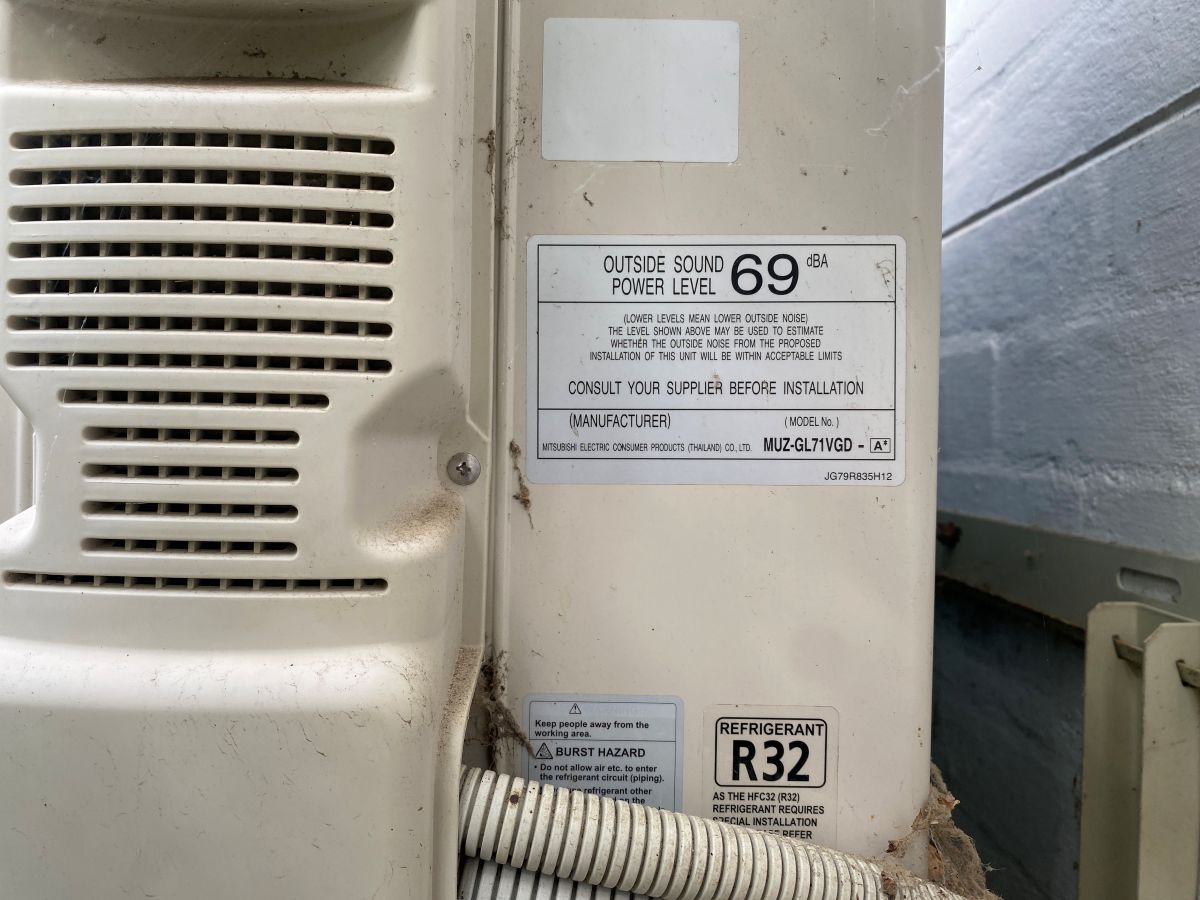
A label detailing the level of noise emitted by my air conditioning unit.
Installation Location Matters
Like most things in plumbing, the quality of the installation makes a big difference.
Even a relatively quiet unit can become noticeable if it’s placed in the wrong area.
One customer of my heat pump hot water installation company Powrhouse had an old hot water unit a few meters away from their outside table. They told me they really enjoy having lunch outside on weekends. I suggested we think of alternatives as I wouldn’t want my peaceful Saturday lunch to be interrupted by the white noise of the heat pump.
Referring to the section above about running times, in this case we wouldn’t want the unit to be running from 12pm-2pm, so we looked at either relocating the unit (which increases the installation cost) or simply running the unit at different times. For example, they could run a morning cycle from 8am to 11am using a timer and then an afternoon cycle from 3pm – 5pm.
The vast majority of old hot water services are installed on the “dead side” of the house, so in most cases, noise and installation location don’t really matter.
What Do You Do If Your Heat Pump Is Too Noisy?
The best way to judge whether noise is an issue is to look at real-world experience.
At Powrhouse, we’ve installed more than 650 heat pump hot water systems across Melbourne homes.
Out of those hundreds of installations, we’ve received just two noise complaints.
The first involved an elderly customer who had accidentally set her system to operate at 2am. Once we adjusted the timer so the unit ran during the day instead, the problem was immediately resolved.
The second situation involved a customer who raised a concern about noise around six months after installation. The system itself was working normally, but to make sure the customer was comfortable we switched the unit into “quiet fan” mode, which reduces fan speed and operating noise. That solved the issue and the customer was happy.
Both situations were easily fixed without replacing equipment, moving the system or concluding that heat pumps don’t work.
The Bottom Line On Heat Pump Noise
Heat pump hot water systems produce some noise when operating, but in most homes it’s much less than people expect.
They are typically quieter than air conditioning units, and when installed sensibly and set to run during the day, they rarely cause problems for homeowners or neighbours.
And based on hundreds of installations, noise complaints are uncommon.
For more on choosing the right system for you, read SolarQuotes’ guide to heat pump hot water.
 About Tim Johnston
 RSS - Posts






Why is it than in almost all the discussions about reducing the cost of hot water the only reference seems to be to heat pump units. These days many people have excess solar output and FITs are reducing o=to almost zero in many cases. Or being curtailed.
I am building a new house but with ample solar already on the property and more being installed. I have compared installing a resistive hot water service vs a reputable brand heat pump. The latter doesn’t make sense financially. It is much more expensive, higher maintenance cost and less reliable than a resistive unit run on a timer.
So why do they not get a mention other than the desire to sell a more expensive option up front with more profit down the track too. I have asked this of several installers and none of them disagreed with my logic but they were not willing to agree with my choice.
Conventional hot water vs heat pumps is covered in detail here:
https://www.solarquotes.com.au/blog/heat-pump-vs-resistive-hws/
A resistive unit on a timer will still draw 3-4x as much as a heat pump unit during the day, for those who maybe want to charge an EV or use other high loads during the day they may find themselves importing from the grid. With the more popular hybrid inverters now used, you are taking up a fair chunk of your inverter capacity just by heating hot water. May be an issue for some, for others, not so much. Heating water in winter will also be a energy intensive activity with just a resistive system that will likely incurr grid importing where as a heat pump will easily run fully of solar even in winter with only 1.5kw of input power.
Also, if you get a heat pump that also has a resistive element, even if the heat pump side fails at say 5-10 years you still have a perfectly functional resistive hot water system. Over 10 years, the extra cost is more than outweighed by the eventual lower amount of grid import you will have. Its all about the ‘worst case scenario’ in terms of energy use.
Both of the regions I have lived in with solar systems had good winter solar performance – a major city and populous coastal regional area. I was a long time worker from home(mostly) and can time my use of solar power a fair bit of the time. I have a decent sized solar system. As yet I don’t have an EV but may well do in the next couple of years. There is nothing particularly unusual about my life pattern and I am not a big electricity user. There would be plenty of people in my situation though if you lived in Melbourne or Tassie say, went out to work, had kids, a pool etc a heat pump may work well for you. In winter I would still use minimal or no grid power for heating on a timer in coastal NSW.
But in most of the articles I read resistive systems are not even mentioned for those people who may find they are a better, more affordable option. They should at least get a mention when so many people have excess solar and no or little FIT.
Patrick: – “I have compared installing a resistive hot water service vs a reputable brand heat pump. The latter doesn’t make sense financially. It is much more expensive, higher maintenance cost and less reliable than a resistive unit run on a timer.”
What maintenance costs? Are you speaking from experience, or are you just conjecturing without basis?
I’d suggest a hot water heat pump system is no more complex than an air conditioner, & a bit more complex than a refrigerator. Do you use air cons & fridges, Patrick? When was the last time you paid someone for maintenance on your air con(s) &/or fridge(s)?
My first-hand experience with heat pumps (i.e. hot water, air cons & fridges) suggests you don’t know what you are talking about. I’ve had 2 immersive element hot water heater units fail.
The Sanden HPHWS is far more energy efficient compared with gas & resistive.
https://www.solarquotes.com.au/blog/heat-pumps-win-the-hot-water-efficiency-war/#comment-1727052
I’m the same as you excess solar going back to the grid for 1c and have a resistive hot water with a diverter which uses all excess power to heat the water so practically free hot water and no noise !!
I know heat pumps are more efficient but if you’ve got excess solar who cares !!
Everyone’s situation is different !!
I went through the same process analysing the replacement for a rooftop solar hws. Which was costing small change to run.
Plenty of solar panels, exposure to the noise from neighbouring heat pumps, reviews showing poor reliability and noise as concerns and expense compared to electric element hws meant the decision was easy.
My house has two electric element hws’s that tap into solar during the day, rarely using grid electricity, are silent, require minimal maintenance, cost me two hours of electrity from solar each daybajd should last 15 years.
Wasn’t a hard choice to make. It will be unlikely you’ll save the thousands extra to purchase a heat pump hws instead of a traditional hws. Why complicate your life unnecessarily?
I agree 👍
If you’re living below about 32 degrees south latitude, then heat pump is best for the grid because Winter is the highest demand season and tripling hot water heating demand at the time of lowest solar and highest heating demand makes no sense.
If you’re blessed with warmer & sunnier climes like Queensland or northern NSW, then electric would be great, as the AC isn’t used much and you’ve got heaps of spare solar.
I agree Patrick,
We have a Gramall 300 litre tank in the roof connected to thermal solar panels. Replacing the 300 litre tank that was installed in 1972 when the house was built. ( so lasted 23 years)
Installed June 1995, started leaking March 2025. Replaced 1 float valve in the header tank in 30 years. Use a pump to give better shower pressure.
Solar thermal heats water for about 5 months of the year with no boost, then boost from solar during the day when needed.
In 2014 I had Gramall manufacturer another tank with the connections in the same place. Cost $1200. (Gramall closed down a year or two later ) Wasn’t expecting to store it for 11 years.
My son in law helped me install it. No need for a plumber. ( tile roof)
Because the solar thermal panels work on convection (thermosiphon) they are still performing well. No noise.
I shouldn’t need to replace it again in my life time.
Although i don’t think any one makes the 300 litre, copper lined tanks any more.
Agreed Patric! I’ve said it before.
I have a Apricus Solar Hot water system; the water is heated cleaverly by UV from the sun, not from Electricty driving a compressor with a big bladed fan wizzing around.
It does have an electric boost element as standard, but we have never used the boost in 8 years in Melbourne climate, for 2 people and once for 5 people in the summer.
Power used for Control Circuits and Circulating Water Pump, rated at 20W / 25W / 30W (depending on speed).
More efficient than using kilowatts of power to run a compressor and fan. NO Noise! UV for heating the water, cheap to run!
I have solar panels and 16.5kWh battery so rarely use any power from the grid!
Other Solar Hot Water Systems not good because the maintnence necessary eg sacrifical anodes.
Once lost 3 tubes in a hailstorm with hail literally orange sized but the remainder of the tubes continued as designed, until the plumber simply unpluged the faulty frosted tubes and plugged in the new!
Quick and easy.
30 Watts for the pump running up to 10 hours a day is using a little less energy than my resistive hws heating for less than one hour a day.
That sounds like an expensive purchase (about 4k more than a resistive HWS) and a complicated system for a similar outcome (with regard to running costs) to a resistive HWS.
My calculations were out by factor of 10 wrt the circulating pump for the rooftop hot water. 3500W for the day to heat conventional hw v 300W for the day to circulate water with the solar.
One more thing I break down with the circulating pump and still never recoup the extra cost of the solar over resistive hws.
I install it for few years and noise never a concern
Conventional hot water vs heat pumps is covered in detail here:
https://www.solarquotes.com.au/blog/heat-pump-vs-resistive-hws/
I have a noisy heat pump on the dead side of the house and running during the middle of the day. Cheaper heat pump.
Parents needed a much quieter unit so didn’t recommend that one and I think it works to spec, ~ 30db which is undetectable above ambient noise. Still runs during the day.
If noise is an issue, be careful with your choice and focus attention on the db spec making sure you understand the non-linear nature of db.
Eg 30db is 1/6 the sound made by my heat pump at 56db.
Big difference, so choose wisely.
I installed a Sanden Inverter Heat Pump at my holiday home in 2016.
It came with a 7 year warranty on the Inverter (basically an AC unit working back to front to a normal AC) and 20 year warranty on the 320 litre tank.
It is whisper quiet.
We run it during the day at the period of peak sunlight and have never paid a cent for hot water.
I was so impressed with it that I changed out our gas water service in Adelaide with the same Sanden model and have never looked back.
I stayed at an old motel a while ago and thought that a motorbike had started in the parking lot, however was amused to find it was the 3 big heat pumps on the side of the room starting at the same time (from memory Stiebel Eltron and they looked bigger than 300L).
Needless to say, my home Sanden heat pump makes so little noise the easiest way to tell if it is on is to hold my hand in front of it.
Another vote for Sanden HPHWS units being very quiet. I can barely hear it from <5m away hanging out the washing, and since I pulled out the small patch of agapanthus that was in a garden bed directly opposite, from inside I can't use the jiggling of the leaves to tell if it's on. I certainly can't hear it.
FWIW ours just passed 7 years old and – despite the best efforts of inadequately supervised landscapers to bury it (?!) – it still works fine, though I suspect the tank will have a shortened life as a result of damage incurred due to the above. It runs during the middle of the day on a timer and we've never had an issue with lack of hot water.
I checked out a friend’s Reclaim ‘split system’ HWS a few months back. I think their largest model. We were standing only three metres away discussing his experience with it as it was fairly close to his master bedroom. I asked how noisy is it when it’s running? He looked at the fan – blades spinning – and pointed out “it’s running now”. I wouldn’t have noticed it was so quiet.
I have one on my bucket list.
I’m talking about a Solar Hot Water System, where the sun heats the transfer fluid within the copper tube down the middle of each evacuated glass tube, and the heat transfer fluid within the copper tubes heats the cold water pumped through the header up the roof from the various copper tubes.
I’m not talking about solar panels providing electricity to run a resistive element HWS.
Do you need me to explain the system more?