
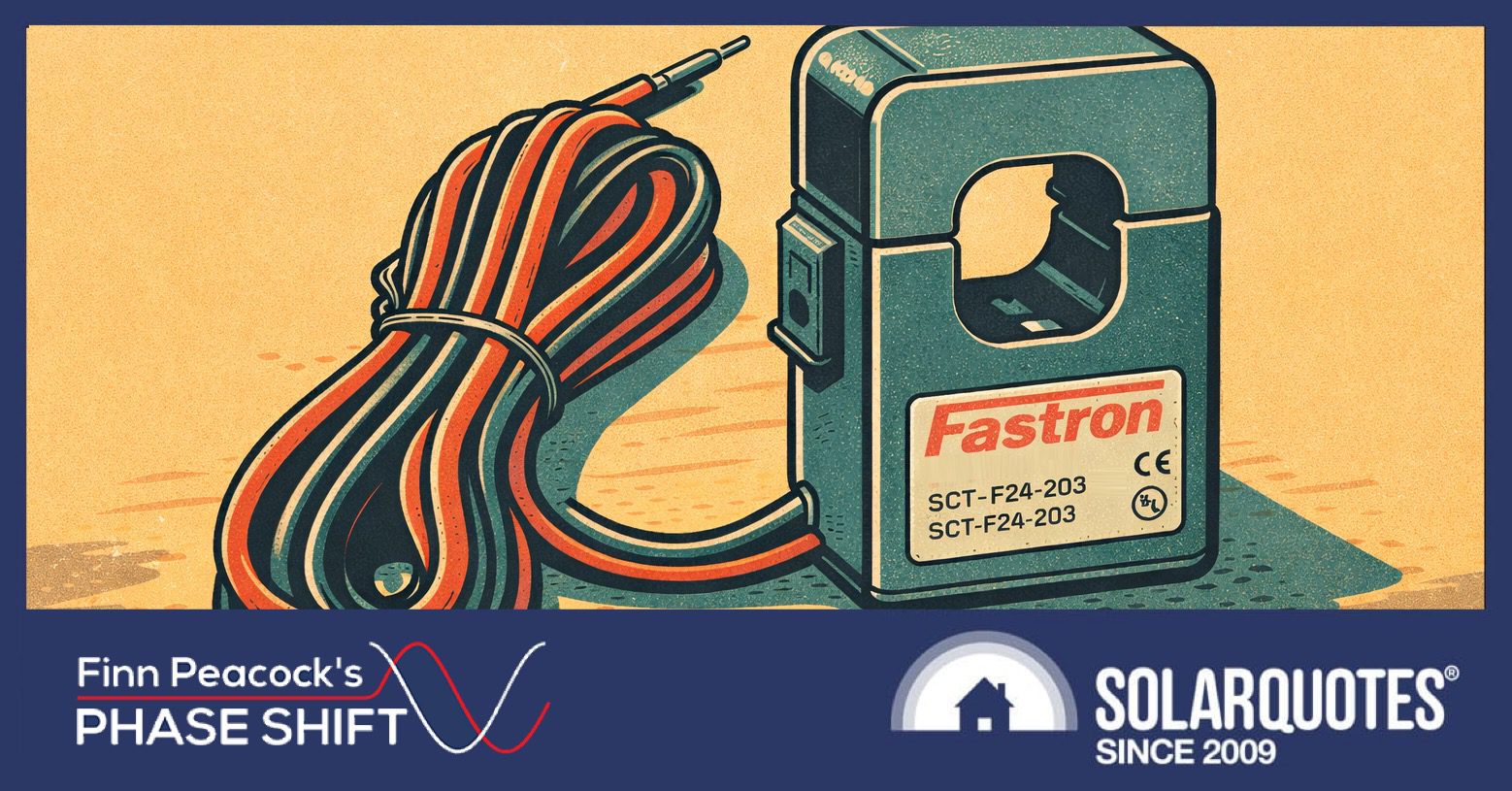
 If you open the switchboard in a modern, all-electric home, you are increasingly likely to find little black clamp-on rings everywhere.
Those rings are CTs. Current Transformers – the most important sensors in your home energy system. A CT is a clip-on current meter. It clamps around a cable and measures the electrical current flowing through it by sensing the magnetic field around the conductor. They are quick to install, safe, and cheap1.
Your system depends on them because they are the only practical way for your equipment to know what the house is actually doing in real time. Put a CT on the cable connecting your switchboard to the grid, and suddenly you can see whether you are importing or exporting. That single measurement unlocks most of the functionality people expect from a modern solar, battery, and EV charging setup2.
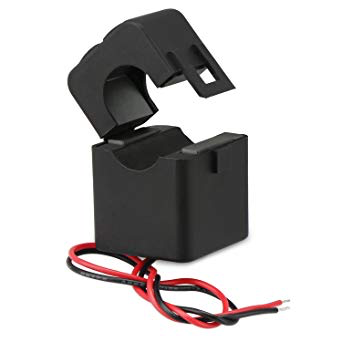
A Current Transformer (CT). It clips around the wire you want to measure current in. Current x Voltage = Power (Watts)
Features that need a CT on your grid feed
Feature #1 – solar monitoring: Your solar monitoring system uses it to work out household consumption. Your inverter knows how much solar it is producing, and the CT tells it what is going to or from the grid. Subtract one from the other and you get what the house must be using.
Feature #2 – flexible exports: All modern solar systems should have the ability to curtail solar. Instead of exporting all the surplus solar, the inverter watches the CT and throttles solar output so only the desired kilowatts flow back to the street. This can be enabled as a fixed export limit, or a flexible export limit controlled by your Distribution Network Service Provider (DNSP), or dynamically in response to electricity prices on plans like Amber.
Feature #3 – dynamic load management: If all your house loads can overload your main breaker, dynamic load management dials things back so that never happens. The system will monitor the grid feed, and if it gets too close to the limit, it will dial back your big loads, such as EV or home battery charging, to prevent the walk of shame in the dark to the switchboard.
Feature #4 – basic home battery operation: Batteries can’t operate properly without one. If the CT says you are importing 2 kW, the battery pushes out 2 kW. Grid import goes to zero. If the CT says you are exporting solar, the battery soaks it up just the right amount.
Feature #5 – EV chargers when solar charging: If the CT sees surplus power flowing to the grid, the charger ramps up just enough to only use the solar. That is how “charge on sunshine” works. Hot water diverters do the same trick, just with a heating element instead of a car.
Now for the problem: Each manufacturer ships their own CT.
Your solar inverter has one. Your battery adds another. Your EV charger brings its own. Third-party monitoring wants one too. The clever hot water control box insists on its own sensor. If you have three-phase power, multiply everything by three.
Before long, multiple CTs are clamped around the same cables, each feeding a different device that believes its measurement is authoritative. They do not share data. They do not coordinate. Each box is making decisions based on its own private view of reality.
A Puzzle Box With No Manual
The first casualty is physical space. Modern boards were not designed to host a plastic centipede. Future electricians inherit a puzzle box with no manual. The real damage, though, is each device making decisions based on its own private measurement. When those decisions interact, things get weird.
Consider a home set to zero export, paired with an EV charger set to “solar only”.
- Your solar inverter’s CT sees that the house is using 3 kW. Even though the sun could deliver 10 kW, it throttles output down to 3 kW to keep grid export at zero.
- You plug in your car.
- The EV charger looks at its CT. It sees no surplus going to the grid, because the inverter already suppressed it. Conclusion: no sunshine available. Charging does not start.
- Seven kilowatts of potential solar power is sitting on the roof doing nothing, while the car is sitting in your drive in need of a charge.
Both the solar inverter and EV charger are doing exactly what they were told. Together, they achieve nothing.
As systems become more sophisticated, these conflicts multiply. Dynamic tariffs make them more obvious. If export prices go negative, software may sensibly curtail exports, while a third-party charger refuses to run because it thinks there is no excess solar – exactly when you would want to consume energy locally. Users on price-responsive plans see this kind of behaviour frequently. The retailer’s software is optimising for price. Your hardware is optimising for something else. Nobody is coordinating the whole house.
Workarounds exist, but they quickly become messy. Adjust thresholds, disable features, reassign sensors, add software bridges. Each fix solves one conflict and creates another. The system becomes fragile and hard to understand.
A Single Source Of Truth
The clean solution is one CT per phase, measuring grid flow, shared by everything. One measurement of import and export that every device trusts as the source of truth. With a single signal, solar, batteries, EV chargers, and smart loads can coordinate instead of competing.
Unfortunately, there is no universal standard for sharing that data across brands. In practice, the only reliable way to achieve this today is to stay with one brand so the devices can exchange information internally.
Which leads to a very practical takeaway.
If you want your home energy system to behave like a system rather than a committee meeting, buy your solar inverter, battery, monitoring, and EV charger from the same manufacturer.
Phase Shift is a weekly opinion column by SolarQuotes founder Finn Peacock. Subscribe to SolarQuotes’ free newsletter to get it emailed to your inbox each week along with our other home electrification coverage.
 About Finn Peacock
 RSS - Posts





Why I love the Tesla ecosystem. One thing I have discovered though, which I’d love to see a column on, is the difference between physical flow of energy behind the meter, which the Tesla or other solar control app monitors, and the actual house-grid interface, that the retailer manages. I’ve found sometimes divergent numbers between my Tesla app, in terms of imports and exports, and the retailer app, but then realised they’re not always measuring the same thing.
Particularly if you have multiple TOU rates on your retail plan, the Tesla app captures the entire flow, but the retailer app won’t bother with any free grid hours (for example) in its count, because it doesn’t need to charge anything for them. So that can lead to a divergence between the two apps that is correct, but at first confusing.
I also use NetZero and have noticed it double-counting my home and vehicle usage.
Tesla is good until you want to add an extra battery Powerwall 2 is no longer available and is not compatible with Powerwall 3.
Hi Ferenc,
I spoke to Tesla tonight, they’re about to release software to make PW2 & 3 compatible.
3phase will follow in rhe latter half of this year.
Whaaaa…bugger. I just had my PW2 replaced and could have kept it, but thought it was never likely to be integrated with the PW3.
i wouldn’t be holding my breathe waiting on anything Tesla promised, they have a long history of over promising and under delivering.
Hi Andrew,
I made a particular point of asking them at a recent trade show, which Xmas will it arrive by?
They said the latter half of 2026.
Are you suggesting those current transformers can indicate current direction as well as amplitude?
yes
How?
Very easily. When the current flow reverses, the induced voltage reverses too.
How so with AC?
Perhaps it’s more accurate to say the phase flips 180°, as the voltage reverses 100 times per second either way. Thus it’s necessary to compare the CT’s output phase with the phase of the supply *voltage* to know the direction of the *current*.
So, yup, Horst, a simple CT cannot sense current direction by itself. You’ll generally find a microprocessor in the inverter/diverter/whatever doing the phase comparison, in addition to measuring the amplitude of the CT output voltage to read current. (The primary of the CT is a single turn – the load cable, and it must have a “burden resistor” on the secondary, both to accurately read current, and to avoid insulation breakdown due to overvoltage on the secondary.
A Hall Effect sensor, needed for DC, as a transformer is useless there, does in contrast, directly sense polarity as well as current magnitude. But that’s a different animal – silicon chip instead of a simple coil on a toroid.
I have been advocating for a way to get real time data off the grid energy meter for some time. In Victoria & SA, it is sometimes possible to use the Rainforest Automation Eagle 3 to directly read data from the Energy meter directly & in real time. Of course, one then needs to use this data, which means possibly using Home Assistant. In NSW, Qld & possibly elsewhere, there is no current method available. However, all Australian meters use a variation of the European standard for the optical port (the metal ring on the front of the meter). Under the European standard, it is possible to program the meter to transmit real time data. This would require the the metering company in conjunction with the Energy supplier to reprogram the meter to allow access to this data. There is an open source interface ´Piggymeter´ that might be adaptable. If this was programmed to emulate a RS485 energy meter, it could be readable by Inverters, etc, inc Home Assistant!
Yeah, every second post in facebook groups is some poor bugger trying to get some idea of how to get around these sort of conflicts / issues with their system.
Perhaps it is time for industry to get together and make an Australian standard for a monitoring system that everything plugs into with uniform comms.
This is why I think all consumers must be able to get real time data off the Supplier energy meter. By using a reader that sits on the Optical interface, the reader could interface to any inverter or other device via bt or wifi etc. This could easily emulate one of the recognised Energy meters, but use actual read data from the meter. This would mean a non-contact reading that is completely safe. All it needs is the Energy suppliers/Metering Co´s to program the meters to transmit the data (available under IEC62056-21 based protocols, but which Australia has modified).
This is the only method that might be available to Australian consumers until 2028 when Open access to metering data is mandated (but might need a change of meter). The Piggymeter or similar hardware might allow access for ALL Australian consumers. The user would need a decryption key to read the data, which would be sourced from the Energy provider.
I have experienced exactly this dilemma. 3 CTs around the mains. One for solar inverter, one for hot water and one for the EV charger.
None of the manufacturers was prepared the take data from the other device even though the solar inverter offers it in standardised SunSpec format.
And the utility meter offers that data as well in a standardised format, its just that the utilities disable the optical data port on purpose rather making it available for whatever reason.
Under the IEC62056-21 based protocols standard, there is a read only mode that can be enabled by the metering controllers. Due to the restrictions on Standards access in Australia, I am not sure if that is part of the Australian equivalent Standard. btw, some Australian meters use the flag standard D interface & some use the round IEC connector. Apparently both of these connectors conform somewhat to the IEC62056-21 based protocols (so in Australia, Flag is not Flag)
Does anyone have access to the Australian Standard for Electricity Meters?.
Probably worth pointing out that, like all transformers, CTs can’t be used to monitor DC loads.
Would you consider making an article on independent CT meters?.
Iv had another go of finding one that could be reasonably installed before the 44c ends but they’re all either single source monitoring i.e grid only without solar or not certified for Australia. Or in a few cases just plain not available.
And with the availability of electricians here you cant even talk to them until after you know what you want.
I prefer the CT meters with RS485 output. This allows a distance of at least 100m between the metering point and the unit to be controlled like an EV charger or feed-in limit on the inverter. Had to install 2 meters even while the inverter and EV charger were the same brand.
Good One Finn,
I am with the big E. I have micro inverters and 3 5Ps. I would love to get an EVC(harger). However the EVs are at work most days. My batteries are flat by 8 or 9 every day (massively inappropiate air con). I need a battery large enough to provide power above 15kwh. Does anyone know if Enphase makes cars?
No one has said it yet…so let me….. dont buy 3 different devices that require 3 different CT’s and all devices are not aware of or worse clash with each other. Home Assistant was built for exactly this… I have a sigenergy system and arguably because it includes batterys, inverter and DC EV charger its all integrated, but at the end of the day if I want my storage hot water and my Aircons to behave nicely with Batterys and PV etc then only something like HA can do that. In fact much of my Sigenergy system is in dumb mode with all the smarts done in HA. If people are looking for smart CTs that can discern flow direction and integrate nicely with HA then look at the Shelly EM Gen3 device
yeah, but you shouldn’t have to be the modern equivalent of a ham radio enthusiast tinkering in home assistant just to get your electronics to do what you want in synch. It should be easier.
You can control your own destiny and learn something useful along the way… or you can bemoan the shortcomings of the electronic …. everything …. forever…
Those that understand the thing will control it, those that don’t will be taken advantage of by the bottomfeeders of whom there seem to be no shortage of and always more on the way forever….
My family laugh and call me Nerd boy (showing my age) but at the same time I’m their first port of call when things are in need of a good moan … and then some action to actually address the issue!
Given the choices all over again Ill be a doer not a moaner….
The reality of power systems:-
1) they are complex, real life is complex
2) when ever we try to simplify something to make it easier to understand we gloss over edge cases and focus on the 80 in the 80:20 rule
3) when people understand, or think they understand the 80 they then complain about all the things they notice that fall in the 20…..
Easier said than done! My solar system & first battery was installed in 2018. Since then, I have added an EV charger (ZJBeny OCPP controlled by Home Assistant), then just added a big battery. All this is from different suppliers. Add to this I am on rural 2 phase….
Only option is Home Assistant.
All the comments add to my frustration of not having an easy way to access real time data from existing Smart Energy meters. I feel that in order to make modern batteries really useful a consumer needs to know exactly the energy use that one is billed for. I am also surprised that more people are not pushing the Pollies to allow this access which I feel could easily be accomplished. If the existing smart meters had firmware upgrades that allowed the Optical port to be easily read (once one has the decryption password), the inverter & equipment manufacturers would be able to supply a dongle to read the Optical port & use the data for much better control. This would be far safer than the current clamps currently used & would mean real data was accessed, not the current variation from measurement using 3rd party metering to the actual measured data from the Energy suppliers meter. This discrepancy can be large due to inaccuracies in voltage, current dmeasurement & power factor.
Hi Doug,
Have you considered a Catch Control from CatchPower?
They give you a suite of monitoring options and the ability to switch a load.
They do not offer a local API or interface to access data. You are forced to use their cloud endpoint which has two issues. First of all data is lagging behind and secondly the fees are substantial if you want to poll for example every 10s or 30s.
The Catch control is a good product, but I do not need it. It would add another variable to a mixed system.
My argument is that any consumer should be able to access real data in real time from their energy meter. Having a reader that could access read-only data, decrypt, then have that data available is becoming a necessity. The PiggyMeter does that, & as an Open-Source project can be modified if the energy suppliers give access to read-only data. Chances are the Australian meters do comply with IEC62056-21 already, so only need metering firmware modification. I feel it would be a good outcome if the meters were enabled because then consumers could also have a real time display that might even have the red-orange-green signals for energy usage. The manufacturers will always meet the market! But the regulations must be updated to allow read-only access.
AS 62056.21-2006 Rec:2016 is the metering standard I would like access to. It is the Metering communications standard, & should have the Read-only Optical access described.
Useful Information: Australian Standards are available to read (but not copy) on the Standards Australia site:
then navigate to bottom of page & click ´Public Access´, then follow registration setup.
Except! The one I want is not viewable?? Sent a request to view…
I just found out that real time data will be available for everybody in Australia by November 2028 using an API. Refer to https://www.aemc.gov.au/rule-changes/real-time-data-consumers. Because of that I doubt that utilities will provide access through the local port.
The problem, as I see it, is that there are a lot of existing meters that will not be changed. I feel consumers need real-time access to data that is not unreasonably delayed. (Max 10s delay?). I feel the Optical port is a way to get access to real-time data with no danger to consumers.
I also found out that one can request local access to the smart meter:
https://energy-rules.aemc.gov.au/ner/179/35865
Clause 7.15.3(g) of the NER states that a read only password shall be provided to the retail customer within 10 business days.
So the password and an interface adapter should make it possible to read the data in theory. I wonder if anybody ever has managed to get such a password.
Unfortunately, the rule Clause 7.15.3(g) does not give access to real time data, only data stored on the database (& usually 24H old, so useless!)
I am one of the participants in the CSIRO energy project (just started), & suggested to them that perhaps the participants could use an optical meter reader, if access was allowed to read-only data. This may be possible as part of a trial. What I also thought was the data might be accessible to participants as a phone app, & imagine if the background colour changed with real time energy use! (Red for excessive>orange etc until green for export) Apparently this was done in a future energy project
The Optical data can be read by a meter such as this open-source project:
. Apparently all Australian smartmeters are International Standard IEC 62056-21:2002 compatible, but with some local mods?? (Even if the port is a D shaped Flag port).