
 For some years now the solar industry has been labouring under the auspices of the New Energy Technology Code of Conduct.
Invites have recently gone out so you can offer feedback to an independent review of the scheme.
So we have an opportunity to offer guidance, but where to start? I’m sure there are a lot of people involved in this organisation and they’re operating in good faith when they set up and ran it. I’m likely to be a bit harsh in this critique but read on and you’ll understand why.
The NETCC is a body dedicated to offering consumer confidence for people buying solar, batteries and associated electrification products. It’s also a nice little earner for the Clean Energy Council, and if you’re a solar retailer, it’s effectively just another tax and a barrier to fair trade.
What’s In A Name?
NETCC… It really doesn’t roll off the tongue, commonly referred to as the “Net-Cee-Cee”. Whoever named it didn’t think very hard about having a memorable user-friendly title, but even in a technical sense it misses the mark on explaining what it does, or who it’s for.
It’s about energy and technology, but does it help the industry, the consumer or the hardware itself? Perhaps the best way to answer that is to explain what it isn’t.
In my view the NETCC offers little-to-no additional protection over and above Australian Consumer Law – it is effectively a marketing exercise, wrapped in a voluntary code. The main obligation involved is paying for the endorsement, which for some incentive schemes is compulsory.
Despite all the bureaucracy, rules and rigmarole, they have little power over an errant retailer other than to eject them from the scheme and remove the blue tick of endorsement. There’s no significant fines, meaningful enforceable undertakings or other penalties for misbehaving.
How Do You Get It?
The people I’ve spoken to who have participated in the NETCC have described it as simple: if you want the blue tick of approval you reportedly have to do little more than pass the CEC’s stringent cheques. Once the payment clears you’re good to go.
The website says it’ll take you just 20 minutes to apply.
When you compare it to the 75 point vetting procedure SolarQuotes runs for our approved installers, it’s pretty transparent. We spend something like a dozen hours checking up financials, reviewing licences, examining feedback, auditing web presence, sorting commercial structure and ringing people up to see they answer the phone.
We end up as part police and part business coach, because if the installers we recommend make mistakes, we have real skin in the game with our Good Installer Guarantee. No only do we potentially lose a client, but we lose money paying for repairs or forgone deposits. And we lose face with the end user, which at the end of the day is priceless, because the currency our business runs on is trust.
Good installers tell me they consider SolarQuotes approval a more valuable and credible badge to have, because it has to be earnt, and can’t simply be bought.
When we reject people at SolarQuotes they either go away for months to build up reviews and reputation, or they go out the airlock. NETCC just takes a $750 fee to reconsider your application.
So Why Do We Have NETCC?
The question here is probably best answered by this table, which explains how much money the CEC takes to run it.
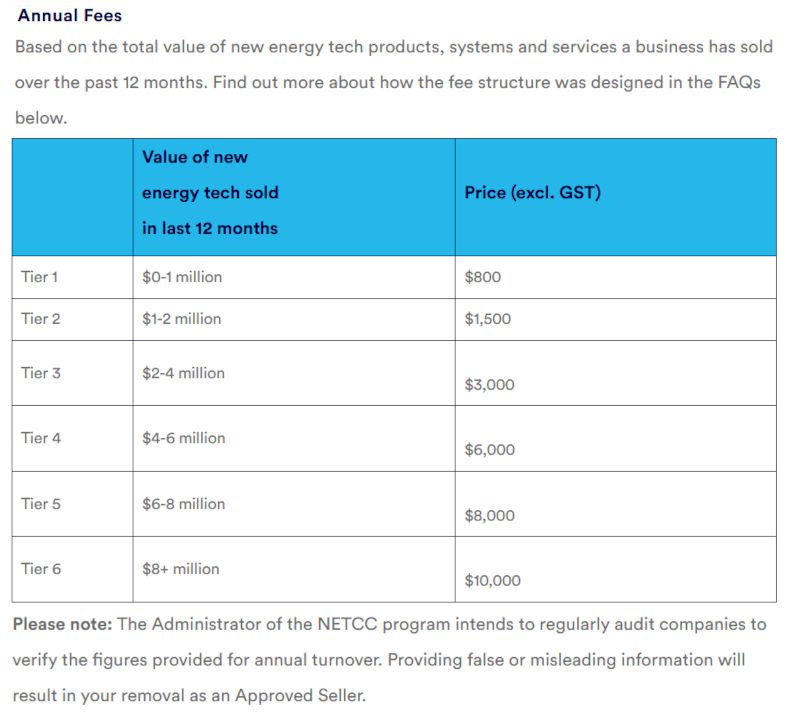
It’s not like a flat rate builders licence, but rather more like an insurance scheme perhaps. The higher your company turnover, the more it costs because I suppose larger companies will naturally have a few more problems to police?
The NETCC was set up as a replacement for the Approved Solar Retailer scheme, also administered by the CEC. That one proved unworkable because the number of shonks who carried the approved badge meant it was meaningless. In the solar industry the ASR acronym was pronounced “Arse” because many saw it as a badge of disrepute.
Door Knockers, Dodgy Finance? You’re Welcome
While Solar Victoria specifically banned doorknockers for good reason, the NETCC couldn’t bring themselves to do the same.
Nor did they crack down on Buy Now Pay Later financiers. These crowds were expected to take part in another voluntary code of conduct specifically aimed at BNPL providers, and so the NETCC would welcome their money on that basis.
On Face Value
Various state government incentive programs and private loan providers have decided that NETCC endorsement is a prerequisite for participation.
The problem is that blue tick goes to everybody, the best of the best, and the worst of the worst – everyone gets the authority of the CEC behind them and the confidence of the consumer in the whole scheme.
Some installers pride themselves on great work (whether they’re SolarQuotes clients or not) but they have a general principle objection to being forced into what some describe as a confidence scam. They’re effectively excluded from the pool of incentivised customers if they refuse to pay the CEC tax.
So What About This Review?
Social enterprise Pathmaker is undertaking a review of the NETCC from March through to June 2026. Consumers, approved sellers, and industry stakeholders are invited to contribute to an online survey on “how the NETCC is working in practice and where improvements are needed”.
The online surveys will be open until 16 April 2026 – give feedback yourself so we can all push for standards that act as more than just a box ticking exercise.
 About Anthony Bennett
 RSS - Posts






Unnecessary regulation. We are so lucky in Australia to have incredibly strong consumer law (I think some of the best in the world) that takes care of us. This should really cover almost all consumer confidence cases with an attitude from the customer of “strong due diligence”. The customer needs to be aware of bad actors and I refuse to have sympathy for those who stupidly hand over cash without any due diligence. Even then, consume law should be there for them
Great points, Anthony.
Experience is everything, and your blend of industry skills and personal character gives you a significant advantage. While everyone has these traits to some degree, it is the specific gaps in experience that usually bring things unstuck. That leads to ‘band-aid’ solutions or, in the words of Clive Palmer, ‘shuffling the deck chairs’ while the ship goes down.
I’ve seen these performance and integrity issues escalate globally for years, particularly in management and engineering. Being active in the international Water & Energy Tech sectors for over 50 years, I’ve noticed it’s getting harder to deliver projects that are truly “done and dusted; economically sound; and executed with confidence.”
Practical; educated; and experience derived and inspired governance, has collapsed. It has been replaced by ad-hoc; hobbled together; and visionless governance at just about every level.
That is what you are referring to Anthony.
Lawrence Coomber