
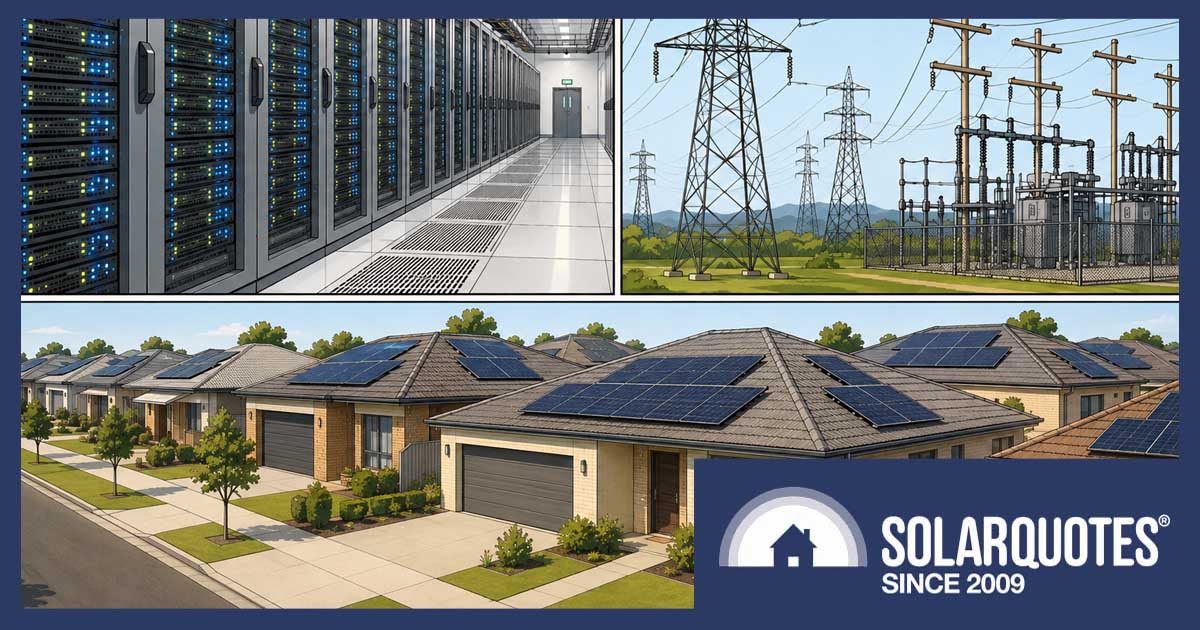
Australia’s data centre boom is going to need an extraordinary amount of electricity. Without the right rules, households and small businesses could end up sharing the bill.
Governments are now moving towards requiring data centres to provide additional energy supply and to pay for the network upgrades they require, rather than passing those costs on to everyone else.
Will Data Centres Push Up Your Power Bill?
It could if the extra demand isn’t properly managed. State and federal governments are moving towards making data centres bring additional electricity supply, help keep the grid reliable, and pay for the network infrastructure their enormous new loads require.
And enormous isn’t an exaggeration.
AEMO’s 2026 Electricity Statement of Opportunities forecasts data centre electricity consumption in the National Electricity Market (NEM) will jump from around 5 TWh in 2025–26 to 34 TWh in 2035–36. That takes data centres from around 3% to 13% of all electricity supplied through the grid within a decade.
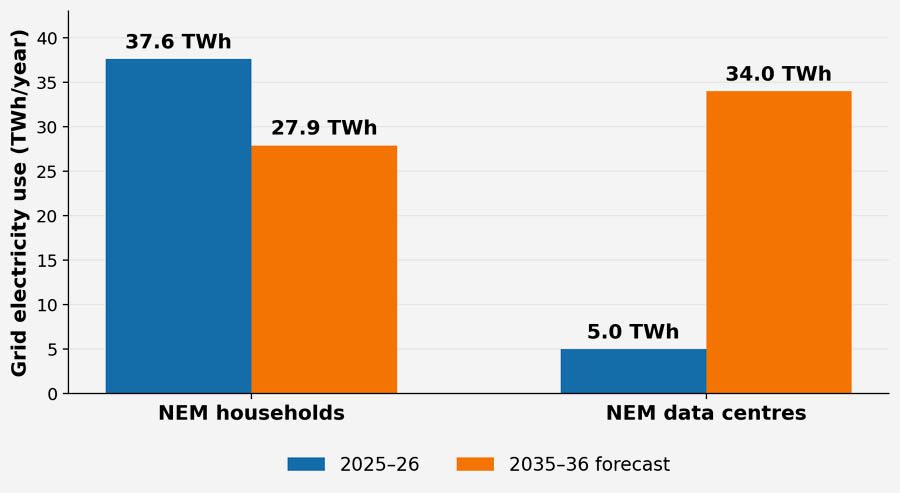
Grid electricity use by NEM households and data centres in 2025–26 compared with AEMO’s 2035–36 forecast. Household grid use falls as more electricity is supplied behind the meter by rooftop solar and batteries—source: AEMO 2026 Electricity Statement of Opportunities (Step Change scenario).
For some perspective, 34 TWh is almost as much electricity as all the homes in NSW and Victoria currently consume combined. AEMO says the number of known data centre projects under development has more than doubled over the past year, from 97 to 225.
Bring Your Own Renewables – And Backup
Energy ministers agreed in May that data centres should offset their electricity demand with renewable energy generation. The Australian Energy Market Commission (AEMC) has since recommended how that could work.
Large data centres would need to demonstrate they are supporting new renewable generation, rather than simply competing with everyone else for the renewable electricity already available. They would also need to contract enough firming capacity to support their load when renewable generation isn’t available, using options such as batteries or stored hydro.
The AEMC also recommends requiring data centres to register as market participants, giving AEMO better visibility of how much electricity these enormous loads are likely to consume.
AEMC Chair Anna Collyer put the consumer argument this way:
“Data centre growth does not have to come at a cost to other consumers, but that depends on getting the settings right from the start.”
But exactly what will count as an acceptable new energy supply remains unclear. The National Cabinet has agreed to develop nationally consistent mandatory standards covering data centre energy, water, and land use. Still, its communiqué did not specify that the additional energy must come from renewables.
Queensland and the Northern Territory claimed they had secured freedom to use coal and gas. Federal Energy Minister Chris Bowen subsequently rejected that interpretation, saying there are “no carve-outs”. States will be able to seek approval to use other energy sources, but Bowen says the Commonwealth will have the final say.
Don’t Send Us The Network Bill Either
Finding enough electricity is only half the problem. A data centre wanting hundreds of megawatts from the grid can require substantial new transmission and connection infrastructure.
The planned 800 MW Bundey data centre in South Australia gives some idea of the scale of connection infrastructure involved. Its proposal includes four substations, two parallel 330 kV double-circuit transmission lines and two parallel 132 kV double-circuit lines.
Somebody has to pay for infrastructure like that.
The federal government has asked the AEMC to change electricity rules to close gaps in how data centres pay for network upgrades triggered by their connections, rather than allowing those costs to fall on other electricity customers. Those rule changes remain pending.
NSW is taking a strong position on this. Its new data centre framework includes a principle that developments should impose “no net cost to consumers and communities.” At the same time, separate proposed electricity reforms are intended to make data centres pay for the network infrastructure they require.
The scale of what’s knocking on NSW’s door is remarkable. As of July, data centres were seeking NSW electricity network connections totalling up to 28 GW, with around 13 GW already in advanced discussions.
The NSW Government points out that 13 GW alone exceeds the state’s average daily electricity demand. Not all of those projects will necessarily be built, but they give some idea of why governments are worried about who will pay for the infrastructure needed to connect them.
The Rules Aren’t Locked In Yet
Exactly what Australia’s national data centre energy rules will look like is still being worked out.
That leaves an important question unresolved: whether data centres across Australia will ultimately be required to support new renewable generation, or whether states will have greater freedom over what powers them.
The separate AEMC recommendations on renewable generation, firm capacity, and market participation also require further design and implementation. Proposed changes governing who pays for network upgrades are going through separate rule-making processes.
AEMO is planning for data centres to consume around one-eighth of the electricity supplied through the NEM within a decade. Meeting that demand will require more generation, storage and network infrastructure.
Governments increasingly seem to agree on one thing: the data centres creating that demand shouldn’t leave everyone else with the bill.
With the rules still being worked out, we’ll keep an eye on where they land. Sign up for the SolarQuotes Newsletter to keep up with the latest solar, battery and energy news.
 About Kim Wainwright
 RSS - Posts






Speak Your Mind