
Australia’s data centre boom is going to need an extraordinary amount of electricity. Without the right rules, households and small businesses could end up sharing the bill.
Will Data Centres Push Up Your Power Bill?
It could if the extra demand isn’t properly managed. State and federal governments are moving towards making data centres bring additional electricity supply, help keep the grid reliable, and pay for the network infrastructure their enormous new loads require.
And enormous isn’t an exaggeration.
AEMO’s 2026 Electricity Statement of Opportunities forecasts data centre electricity consumption in the National Electricity Market (NEM) will jump from around 5 TWh in 2025–26 to 34 TWh in 2035–36. That takes data centres from around 3% to 13% of all electricity supplied through the grid within a decade.
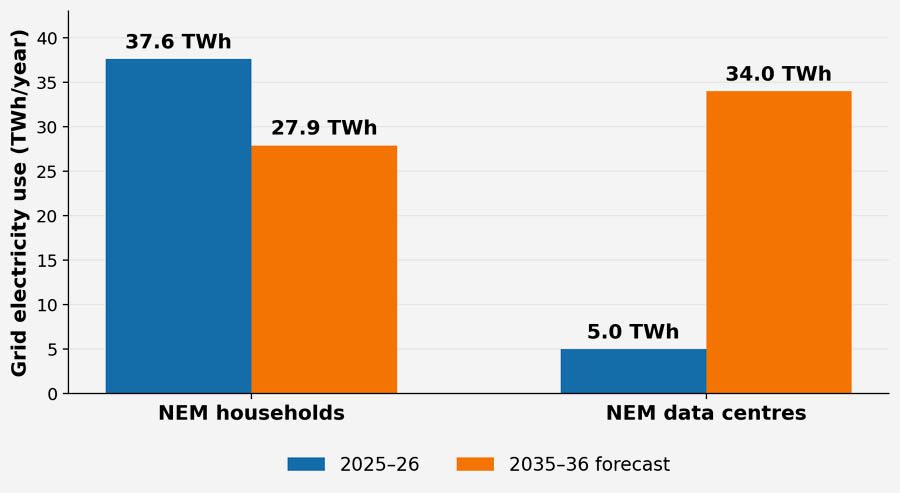
Grid electricity use by NEM households and data centres in 2025–26 compared with AEMO’s 2035–36 forecast. Household grid use falls as more electricity is supplied behind the meter by rooftop solar and batteries—source: AEMO 2026 Electricity Statement of Opportunities (Step Change scenario).
For some perspective, 34 TWh is almost as much electricity as all the homes in NSW and Victoria currently consume combined. AEMO says the number of known data centre projects under development has more than doubled over the past year, from 97 to 225.
Bring Your Own Renewables – And Backup
Energy ministers agreed in May that data centres should offset their electricity demand with renewable energy generation. The Australian Energy Market Commission (AEMC) has since recommended how that could work.
Large data centres would need to demonstrate they are supporting new renewable generation, rather than simply competing with everyone else for the renewable electricity already available. They would also need to contract enough firming capacity to support their load when renewable generation isn’t available, using options such as batteries or stored hydro.
The AEMC also recommends requiring data centres to register as market participants, giving AEMO better visibility of how much electricity these enormous loads are likely to consume.
AEMC Chair Anna Collyer put the consumer argument this way:
“Data centre growth does not have to come at a cost to other consumers, but that depends on getting the settings right from the start.”
But exactly what will count as an acceptable new energy supply remains unclear. The National Cabinet has agreed to develop nationally consistent mandatory standards covering data centre energy, water, and land use. Still, its communiqué did not specify that the additional energy must come from renewables.
Queensland and the Northern Territory claimed they had secured freedom to use coal and gas. Federal Energy Minister Chris Bowen subsequently rejected that interpretation, saying there are “no carve-outs”. States will be able to seek approval to use other energy sources, but Bowen says the Commonwealth will have the final say.
Don’t Send Us The Network Bill Either
Finding enough electricity is only half the problem. A data centre wanting hundreds of megawatts from the grid can require substantial new transmission and connection infrastructure.
The planned 800 MW Bundey data centre in South Australia gives some idea of the scale of connection infrastructure involved. Its proposal includes four substations, two parallel 330 kV double-circuit transmission lines and two parallel 132 kV double-circuit lines.
Somebody has to pay for infrastructure like that.
The federal government has asked the AEMC to change electricity rules to close gaps in how data centres pay for network upgrades triggered by their connections, rather than allowing those costs to fall on other electricity customers. Those rule changes remain pending.
NSW is taking a strong position on this. Its new data centre framework includes a principle that developments should impose “no net cost to consumers and communities.” At the same time, separate proposed electricity reforms are intended to make data centres pay for the network infrastructure they require.
The scale of what’s knocking on NSW’s door is remarkable. As of July, data centres were seeking NSW electricity network connections totalling up to 28 GW, with around 13 GW already in advanced discussions.
The NSW Government points out that 13 GW alone exceeds the state’s average daily electricity demand. Not all of those projects will necessarily be built, but they give some idea of why governments are worried about who will pay for the infrastructure needed to connect them.
The Rules Aren’t Locked In Yet
Exactly what Australia’s national data centre energy rules will look like is still being worked out.
That leaves an important question unresolved: whether data centres across Australia will ultimately be required to support new renewable generation, or whether states will have greater freedom over what powers them.
The separate AEMC recommendations on renewable generation, firm capacity, and market participation also require further design and implementation. Proposed changes governing who pays for network upgrades are going through separate rule-making processes.
AEMO is planning for data centres to consume around one-eighth of the electricity supplied through the NEM within a decade. Meeting that demand will require more generation, storage and network infrastructure.
Governments increasingly seem to agree on one thing: the data centres creating that demand shouldn’t leave everyone else with the bill.
With the rules still being worked out, we’ll keep an eye on where they land. Sign up for the SolarQuotes Newsletter to keep up with the latest solar, battery and energy news.
 About Kim Wainwright
 RSS - Posts





How on earth is this going to work. Data centres traditionally have been capital city based because the company’s that use them have appropriate IT teams in city’s and the fibre network infrastructure needed is also present. Much of the discussions I have seen focus on generation but it seems to me a doubling or more of consumed power will cause equal grief to the distribution networks and we’ve only just seen how the times and costs of those blow out significantly…. Self sufficiency is again looking like it should be plan A for anyone who can execute it.
So long as the Governments (Federal and State) ensure that data centres do not diminish the power available for households and other businesses, as recommended by the AEMC then we don’t have a problem.
The critical thing now is to pressure those governments not to water down that recommendation as they certainly will be pressured to do – by the fossil fuel industry, the Coalition, One Nation and State Governments who run generation and the transmission lines.
Why do you think the fossil fuel industries have so many lobbyists running around the various parliament houses? They have a huge amount of money to lose if data centres have to provide their own exclusively renewable power and transmission lines. And also with the continuing and rapidly increasing unreliability and uncompetitiveness of fossil fuel based power sources is the best way to force those power sources to close down and increase investment is clean and safe renewables as the cheapest power in the grid by far.
Andy,
Doing a 160 km range top-up to the BEV, and heating the HWS, here off-grid now, 10.2 kW flowing. Fully AI & fossil-free mobility & living. I’m planting a bunch of potatoes, as the UN WMO yesterday warned governments of 2027 food issues, due to the super El Niño. The 218,000 L of water tanks will allow me to water them. (If the equatorial Pacific Niño-3.4 region’s SST crests +3.6°C, as modelled, then that’s unprecedented, effects unpredictable. +0.5°C is an ordinary El Niño.)
The initial AI bubble seems ready to burst fairly soon, but it could then come back in 5 to 10 years, as with the dotcom bubble. But if AI can be made to fund grid infrastructure before it implodes, then isn’t totally useless.
Our motorists pay A$1B per week to foreign fossil fuel pushers for no good reason. So maybe we’re dumb enough to fund AI to steal our water?
Power your car with a star – it’s so much cheaper, and doesn’t fry your planet.
That’s how to do it. These data centres are going to make massive profits for sure, they can afford to pay upfront to make sure their energy needs are self met. Water too. Self sustaining.
Check out community impacts in the USA, many videos on YouTube.
Power AND water.
Power issues and costs skyrocketing for many there, centres like Musk’s have installed 59 (or more, supposedly there are now up to 69) big gas turbine generators, that cause all sorts of respiratory issues for nearby communities.
Nearby is often right in town.
Look at the huge one in Footscray, Google maps NEXTDC Melbourne Data Centre (M3), right across the road from a street of homes.
Heaven knows what sort of things are emitting from these places.
Now, talk about water.
Up to 14 million litres a day, and this is clean potable (drinking) water.
There are 162 to 165 completed in Australia right now, and 90 to 125 under development already or awaiting final approval.
Bill Gates was so hot on climate change before the $$$$ lit up with AI.
It’ a race now to see who ends up controlling information and AI, and many in the AI game are very concerned about where it’s going, how fast, and dangers facing us.
Yes, yes, yes, and water!!!
Next DC M3 is in sharps Rd Tullamarine beside the creek. On the other side of Sharps Road is residential. I think they are now constructing stage 3 of this massive site. Next door on the other side of the creek they have started to build a massive AWS centre with only a church between on a massive site that was a textile company. Despite the massive site they have that runs for a whole block they have build a structure into a lane of Sharps road blocking the road and creating a dangerous safety hazard. It looks like it is planned for this structure built on the road to be in place for at least 5 years. Sharps Road used to be very wide and safe for cyclists now they are pushed into the path of a constant stream of b Doubles. Already one vehicle has crashed onto this structure unnecessarily built onto a public road. I have reported it as unsafe to VicRoads but have been ignored. (Money Talks) A further 2 km west a third massive data centre is being on the huge old Honda site. 3 massive.
That’s about 290 data centres already on or in the pipeline for Australia?
Who is approving them?
Is it Federal or State approval?
Maybe local councils are deciding, based on the revenue these data centres will bring?
The panic over AI data centres straining the grid may be a current grid engineering issue, but is a rounding error. AEMO forecasts they’ll use ~34 TWh by 2035–36 — about 2% of Australia’s current 6,000 PJ energy use (that’s total energy not just electricity). Actually electrifying transport, buildings and industry — lifting electricity’s share from 24% to 50% by 2035, per the Energy Efficiency Council — needs roughly 433 TWh more. That’s 13 times the data-centre load. Now you can panic.
Don’t forget to factor in that by 2035 almost 62% of coal power is supposed to be decommissioned, and that coal power regularly supplies roughly 70% of NEM power. That means Australia is looking at losing roughly 43% of power in less than a decade.
Don’t bother suggesting more solar panels – they don’t work at night. Wind can, but almost never generates even half of its capacity. Given Australia currently has ~15.6 GW wind capacity to coal’s 22.3 GW, Australia would need over 50 GW to cover good days, and more like 100 GW for less windy days.
I don’t see that sort of development happening, especially in states opposed to massive wind, solar, and battery farms, do you?
Hi John,
It’s not difficult and the actual engineers running the grid have 5 years historic data to prove it.
Coal is in terminal decline, even in China where coal miners are building new plants, the utilisation & profitability is falling.
In 75 years the world built a nuclear steam engine fleet that now averages 40yo and 420GW total, wich isn’t growing either.
In 67yrs the world deployed 1 Terrawatt of solar.
The next Terrawatt took 2 years.
The third Terrawatt took 18 months.
Worldwide solar now out *yields* nuclear.
https://www.facebook.com/groups/NEMWatch/posts/2915340608864564/
John,
Blindness to inevitability can, with effort, be maintained for a while in the face of linearly gradual change, I guess. But as Anthony reminds you, the renewables transition is exponential, with the first 67 years of fossil replacement now being equalled in closer to 6.7 months. Na+ gridscale batteries are now so cheap that overnight grid support is effortless and economical – cheaper than obsolete dead coal. Good Chinese batteries do it, where the backward Yanks have lost their mojo.
Neither closed eyes nor fingers in ears changes the fact that fossil power plants will be gone by 2035, yet grid power will be much higher than today – not because it is wanted – because it is needed for civilisational survival.
Only the wealthy can fail to learn from the 2027 food shortages, and the seas come later, but we begin to cook now, as the crops fail. We hit +2°C in 2037, +3°C in 2050, and ICE transport will be banned by then – as we finally wake up, far too late for many.
John,
This purely technical reveal of recent roll-out of just one Queensland grid-forming battery + solar replacement for ageing coal clunkers is an eye-opener:
https://www.youtube.com/watch?v=0LXfRrV1sUc
The improved grid stability, and ability to sell real-time shares to multiple grid corporations is interesting, but most impressive is that when the coal clunkers do clunk to a halt, one after the other, in a decade or so, no-one will notice. At all.
OK, it’ll take a 4th and 5th stage with cheaper Na+ batteries to extend from the stage three 4 hr (if at full output) grid supply to 8 or 16 hr, as the market demands, so coal has a diminishing limited life yet.
And yes, 98% coverage is enough. Let gas peakers have one week per year – that can be offset a dozen different ways.
That one battery + solar farm will soon cross the $1B investment line … but we smoke that in a week – out our car exhaust pipes – with zero ongoing return. Next week we do it again. That’s plain nuts.
Tony,
Ya gotta be a scientist, for sure. This mere engineer can’t mentally compare petajoules and terawatthours, so running “units”, I get:
$ units
You have: 6000 PJ
You want: TWh
* 1666.6667
Adding 433 TWh for transport has multiple benefits: The A$50B we now dozily burn every year in ICE engines can painlessly pay for the electrification instead, as the expensive burning gradually ends. Balance of trade then booms, the money circulates here, creating jobs. Motoring is much cheaper. Food delivery is immune to diesel shortage.
AI data centres create no jobs, and almost all the initial cost goes to USA for GPUs. My water comes off the roof, but what if you’re in town, competing with thirsty AI?
We can always cut the grid feed to AI data centres, and I guess that stops the pumps, taking our water back. Nevertheless, it is water pricing and restrictions, which will cause much greater financial and lifestyle pain than energy – that’s effectively limitless, when renewable.
Your article only mentioned “water” once. In WA we’re being warned to reduce consumption this coming summer, even though we’ve got desalination plants up and running. Why not get the data centres to pay for building (and running) a desal or two? Without the taxpayers funding them?
It is my understanding that the AI bubble has spent US$750 billion of borrowed money so far, with only modest income, not nearly enough to avoid a bust before long. So long as they pay up front for their required energy infrastructure, then their imminent demise merely boosts the grid for the coming influx of electric trucking and the BEV boom, as fossil fuel prices respond to availability issues.
The data centres produce nothing, beyond AI slop, so maybe the buildings can better serve as semi-freerange megabarns for chickens, as birdflu spreads, threatening egg production. Projected Aussie wheat yield is down 41% on last year, as the super El Niño threatens food supply globally. The UN WMO yesterday warned governments to prepare now.
DIY energy infrastructure is growing. Molslinjen’s electric ferry to Samsø loads the grid on the small island, 100% renewables powered since 2007. A modest 12 MWh battery will offload the charging surge, from March. Simples.
Help me understand why federal approvals are needed. Isn’t this something for states to do as they please?
As I understand it data centres and power plant approvals are state matters, but climate change and national security or something.
Both Queensland and the Northern Territory want reliable coal and gas power plants funded, but Bowen is saying windmills, sunshine, and Chinese batteries only. That probably means nothing will eventuate, legal fights, or a change in government – Victorian polling is suggesting a strong result for One Nation, and the Liberals (or Coalition?) replacing Labor in power. Time will tell!
Hi John,
What’s more reliable than sunrise? Not steam engines, especially Callide.
As more renewables are deployed the grid reliability only goes up.
It’s so obvious even the “conservative” party is claiming credit for it.
https://reneweconomy.com.au/five-years-after-blackout-south-australia-now-only-state-with-no-supply-shortfalls/
https://www.electranet.com.au/strength-reliability-boost-to-south-australias-electricity-network/
https://www.facebook.com/groups/NEMWatch/posts/2915340608864564/
Believing that AI data centres will be built here this decade and achieve operation is a monumental leap of faith, I submit. The latest ABC Finance Daily report: https://www.youtube.com/watch?v=fd0ZCw1ZVNE confirms my view that the AI bubble does not have long to run. TLDV; skip to 17 minutes for the inevitability of the implosion of the great delusion. (It’s not just the AIs which hallucinate. 😉 The guest predicted the 2008 GFC. (OK, others did too, and I pulled my super from stocks in time, back then.)
So, if they build some grid supply beforehand, then the US$ trillions will not be totally wasted – a bit can be used to charge trucks & BEVs – which will actually be needed, due to the coming diesel situation.
This tulip fever is just as delusional as smoking $1B per week out our exhaust pipes, wrecking our childrens’ future, when BEVs can drive cheaper, without the climate refugees, floods, fires, and tens of thousands of deaths. AI 1.0 just busts faster.
How long have governments known that data centres were coming not already planned for the consequences. The horse has bolted already and they are still looking into answers. we should be paid to install solar and batteries to free up the grid and bill that cost to data centres. The downside is to apartment dwellers who have no means to connect to renewable energy.
Governments are still pushing mass developments and high density yet only reluctantly and belatedly, or not at all, providing critically needed upgrades to roads, water, sewage etc. Why should AI or data centres be any different?
AI is already pricing itself out. Businesses that replaced staff with AI are re hiring. It’s a wonderful thing to behold.
I find all the anti-AI stuff like the anti-Tesla stuff of a year or two ago. Absolute drivel. And from the same source, a culture so hijacked by social media that all of its idiot viral trends seem like reality to people.
This whole debate is delusional. The uptake of AI is orders of magnitude faster than anything else in history. i don’t know a single person who isn’t using it every day, all the time. The same people spouting the anti-AI viral drivel.
AI is a wonder of the world. Like every other wonder we’ve seen in our lifetimes, most will live through it not even realising, in social media bubbles of continuous whining and complaint.
But it’s really not. AI is wrong 50% of the time. Case in point and this not just a one-off, I wanted a campsite near a golf course in the UK I am playing in. (Amateur Seniors so nothing flash). AI (Gemini) gave me wonderful instructions / recommendations to a campsite that was 376 miles from the golf course. It had the same name as one near Tadbury where the golf course was but couldn’t figure out that might be a tad inconvenient for an early morning tee time. AI is wrong more than 50% but it has balls of steel in its conviction that it is right. Bit like my ex wife.
Again this is more social media. ‘My individual case = the whole story”.
Absolute nonsense, wrong 50% of the time. Just another social media meme. Social media is wrong probably 90+% of the time, and yet nobody shuts it down for the social train wreck it is, with its trending rubbish.
It’s all there, in the data. AI is a revolution being gobbled up with ‘more more more’ by just about everybody. Usually the same people imitating each other on the socials, saying how terrible it is.
I’m very glad to see government now pushing ahead with further pressure on social media, to shut down its algorithmic destruction. Good on them, we’ll get far fewer fairy tale anti-AI memes too.
“Social media is wrong probably 90+% of the time”
Errr… Nick… you do realise that AI is trained on social media, don’t you? Most of the AI answers I got referred me back to some random person on Facebook or Reddit. I gave up on it. I prefer a more authoritative source.
That’s how it knows the difference between rubbish and information. AI neural networks absorb knowledge from all sources, because that creates the contrasts which then generate the weightings in the network, that allow it to understand differences.
If you go to the very end of an AI created “answer” there’s this disclaimer.
“AI can make mistakes, so double-check responses”
Caveat Emptor.
It’s not so much that it makes mistakes, it’s the fact that with a human you vary your language depending on how sure you are of your answer. If a human thinks they know the answer it’s clear, if there is an element of doubt then generally that is equally inferred. With AI it produces language that infers accuracy when there is none.
For example when the Air India crash occurred there was discussion in the media about “weight on wheels”/squat switches and whether aircraft on ground, or not in this case, should prevent an inflight shutdown of engine. I seperately asked chatgpt, Gemini and Microsoft to check Boeing published 787 documentation and to identify if the inflight shutdown of engines had any weight on wheels logic applied to vary or prevent shutdown. I got 2 no’s 1yes and 0 I don’t know answers. I’m none the wiser and have no simple way for a non Boeing commercial aircraft maintainer or pilot to find myself what the answer is. I needed a printed fact not an interpretation.
Believing it’s 50% inaccurate is a wild take. I use it everyday to program business processes where it is higher than 95% correct in its coding. And some of the 5% is down to poor or unclear prompting on my part. It’s 99% accurate in image and video creation. 99% accurate in email composing. Report construction and analysis. MT4 coding. Chat GPT is a bit dodgy when it comes to math though. It would be useless if it was genuinely 50% inaccurate. Instead it alllows me to create usable processes without any prior training or experience in the language or programming or deployment environments
Regardless of the source of energy (nuclear, fossil or renewable) the centres themselves are going to be dumping their excess heat in the local environment, creating Urban Heat Islanding.
https://en.wikipedia.org/wiki/Urban_heat_island
“The main cause of the UHI effect is from the modification of land surfaces, while waste heat generated by energy usage is a secondary contributor.”
As the local area heats up from UHI, more energy is expended to cool houses etc. A losing battle in my view.
I agree. As a Computer Programmer it has completely revolutionised the way I work, but way beyond that I use it for almost everything i would have used Google and YouTube for, but in a much more natural, interactive way. I describe it as “GPS for ideas”. Even in it’s current, often hallucinating, form, it’s incredibly powerful, and useful, even just utilisng ordinary LLMs. When we finally crack AGI…sky’s the limit.
The AI data centres may want to line up some contracted grid supply, with massive batteries, even if not forced to. With a doubling of NEM gridscale batteries in the pipeline now:
https://www.youtube.com/watch?v=YnlF5QoCdQw
coal is more dead than ever, and those power-hungry data centers will be paying gas peaker prices when gridscale batteries run flat. OK, that’ll fund ever more batteries, but it’s expensive electrons in the interim.
And, yes, that all spells the end of full 3-free-hrs in a year or two, I figure.
The trick with exponential disruption is that it accelerates, until saturation, and we’re a couple of $Trillion short of that yet. My sense is that 2040 will hardly be recognisable. (OK … yes, weather-wise too, but that’s another story, not very popular.)
You mean we dont want things going on like the Australian Public paying for Snowy 2 and its connection infrastructure, only to find the government then promises a large chunk of the output of Snowy two to a private aluminium smelter for a price that is 1/10th of what retail customers pay for electricity?