
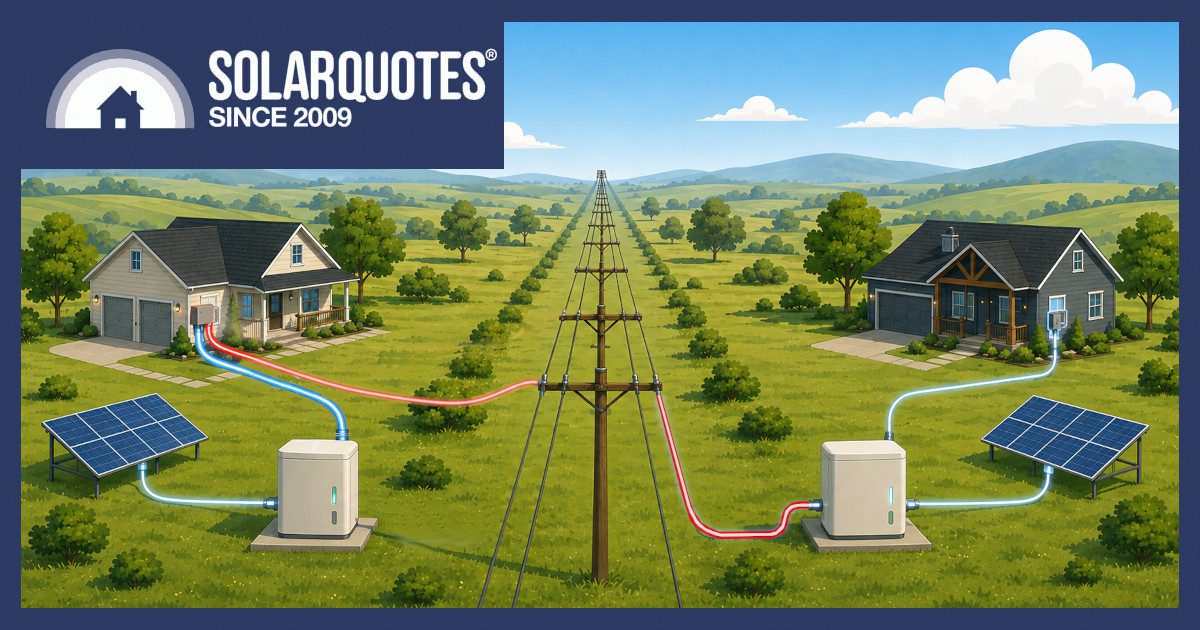
Parallel supply to the house on the left – Series connection on the right
Everyone buying solar wants lower bills, but adding expensive batteries should be more about a reliable supply than straight-up bean-counting.
The solar industry has, for a long time, glossed over a pretty basic point in battery-backed systems, so strap in while we explain the difference between series and parallel-connected supplies, and why it matters.
With the proliferation of batteries and blackout protection, there has, of course, been a rise in complaints. Many are fairly justifiable, but sadly, they’re often down to a poor sales experience.
The grid is your strong, silent, primary supply, but when you add a new hybrid system, there are two basic layouts to choose from.
Parallel connected
- Where the inverter provides additional energy, alongside the grid, in parallel.
- If either one disappears, the other keeps working.
- Uses a separate gateway to isolate the grid.
Series Connected
- Where the grid is wired through the inverter, in series.
- If the grid disappears, the inverter keeps working.
- If the inverter fails, whatever is downstream stops too.
- The inverter is the gateway.
Parallel machines
Parallel machines are battery hybrids from Fronius, Franklin WH, Tesla Powerwall, Sungrow,1 Sigenergy, and Solar Edge. Any standard grid-connected solar inverter is also a parallel supply.
- The inverter doesn’t limit the mains supply, but can replace it if the mains fail.
- It doesn’t matter if the inverter fails; the grid supply is unaffected, and a bypass switch isn’t needed.2
- The inverter can be wired in almost anywhere, so it’s very flexible for large properties or multiple buildings.
- Requires a “gateway” to disconnect the grid during an outage, which must be hard-wired back to the inverter.
- This metering and control wiring is extra low voltage, so they’re cheap cables even if trench digging isn’t.
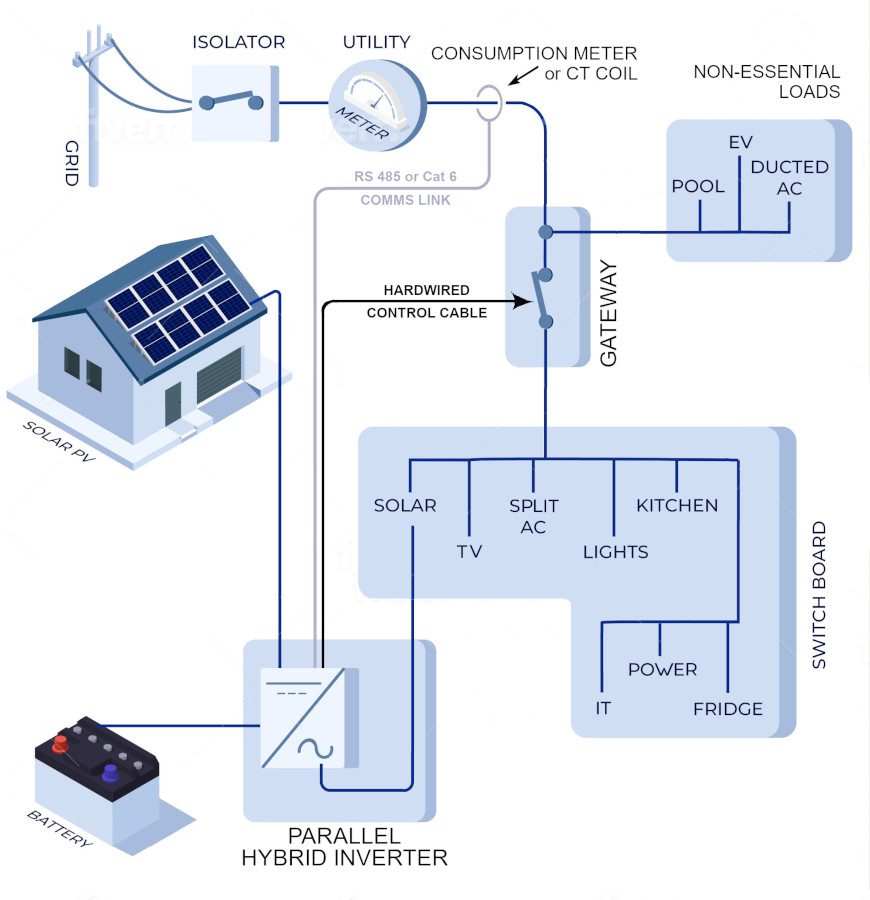
Having a separate gateway makes this system less simple, but separate components make deployment more flexible; they don’t even have to be in the same building.
Series machines
Series machines are the bulk of cheap and cheerful battery hybrid inverters, starting with Sungrow,3 GoodWe, FoxESS, SoFar, AlphaESS, Neovolt, etc.
- The rated capacity of the backup port limits any circuits connected to it.
- Whether the grid is available or not, the inverter is a choke point.
- If the inverter fails, so does anything connected to the backup port.
- You must have a bypass switch to reconnect “essential” circuits to the mains in the event of an inverter problem.
- Generally, the inverter must be very near the utility meter box.
- Wiring backup circuits through the inverter makes it impractical or impossible to put the system on an outbuilding.
- Gateway is incorporated inside the inverter, but an external consumption meter may be required for AC-coupled solar.
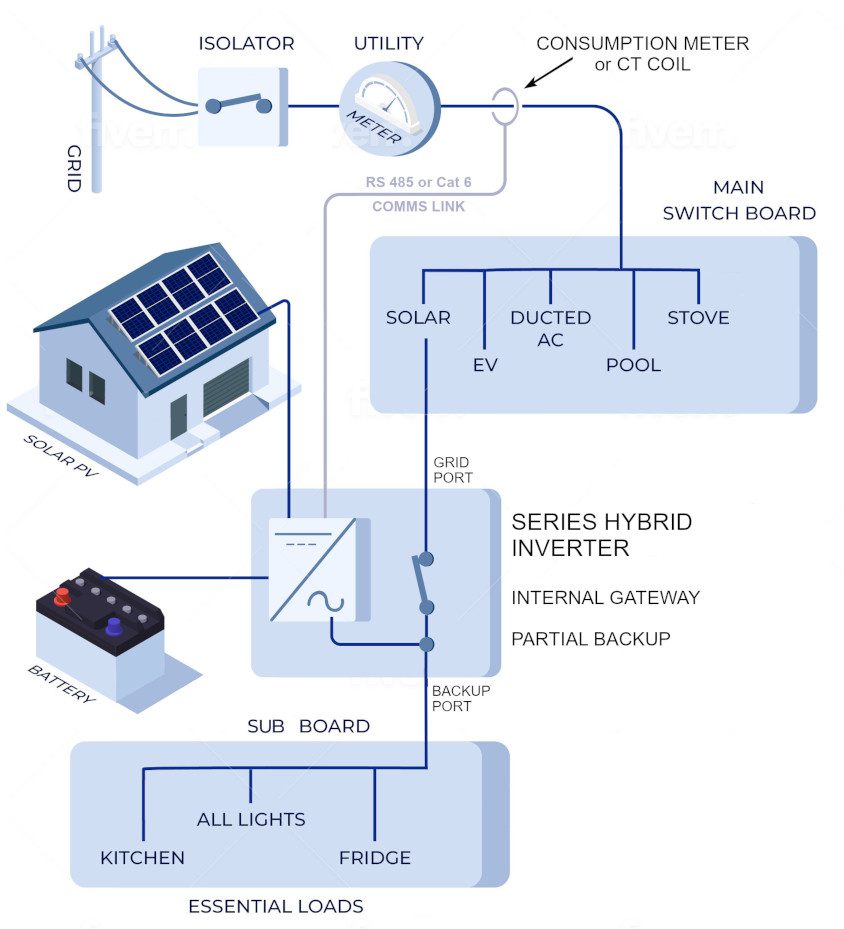
This is a typical series hybrid setup, offering partial backup for essential services connected to the backup port. For clarity, a bypass switch isn’t depicted here.
Be Aware
Some solar industry experts gloss over critical details while drawing up the quote, either because they’re poorly trained or just aren’t good at explaining the minutiae. Sometimes it’s just because they only have one product to offer and don’t want to confuse matters.
We all know a little knowledge can be very dangerous. Problems arise when the customer has a rough handle on the concepts, but doesn’t care for the fine print. If the person who bought the system doesn’t explain the limitations to their significant other, installation day can be very awkward when I’m the electrician explaining that a partial backup will NOT run the whole house.
Whether it’s your solar, air conditioning, rainwater, or bore pump, whatever you want working during a power outage must be written on the quote.
Signing a generic contract, viewed through rose-tinted glasses, is a recipe for disappointment.
Series Connection Is Cheap, Until It’s Not
You must understand the system architecture before buying something that could be completely inappropriate.
If you have a garden-variety house, a switchboard near the front corner, and space beside it on a blank brick wall for a battery, it’s a simple matter to connect your incoming supply to a series inverter like the GoodWe ESA hybrid. Next, your installer will run a similarly short, fat cable back to the switchboard to distribute power for “whole home” backup. Easy, fast, efficient, cheap.
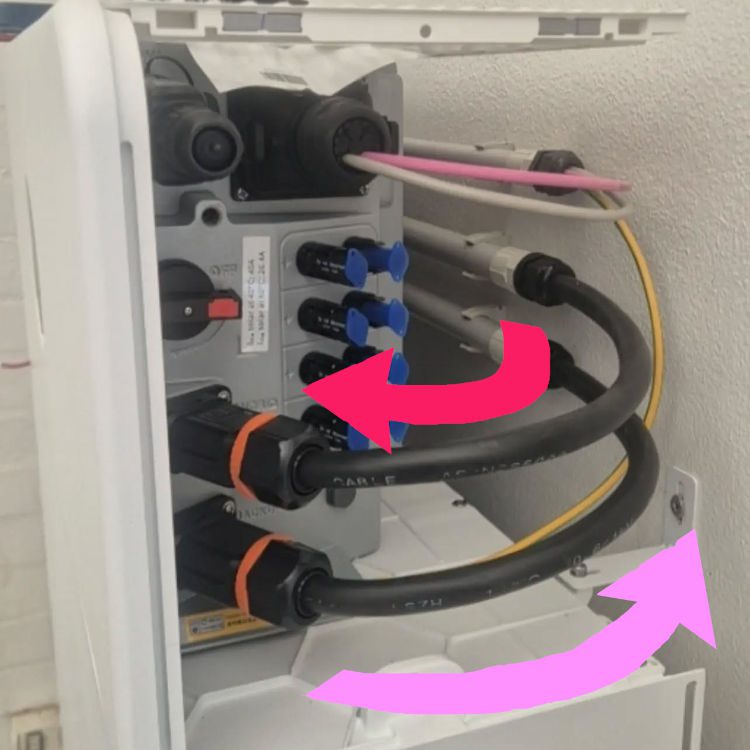
GoodWe ESA very neatly installed by JPM Electrical and Solar. Mains power comes in (red), passes through the inverter, and then goes back out to the house (pink)
However, if the battery needs to go to the other end of the house, there could be 30 metres of cable to run, plus 30 metres to get back. To address the significant losses, the cable sizing must increase from expensive to ridiculous. We could be talking 70 mm² instead of the 16 mm² your mains are normally wired with.
The difference isn’t just the weight in copper; the bulk makes things difficult and ugly. It’s four times the work to actually make connections because the hardware requires 16 mm² tails fitted on both ends.
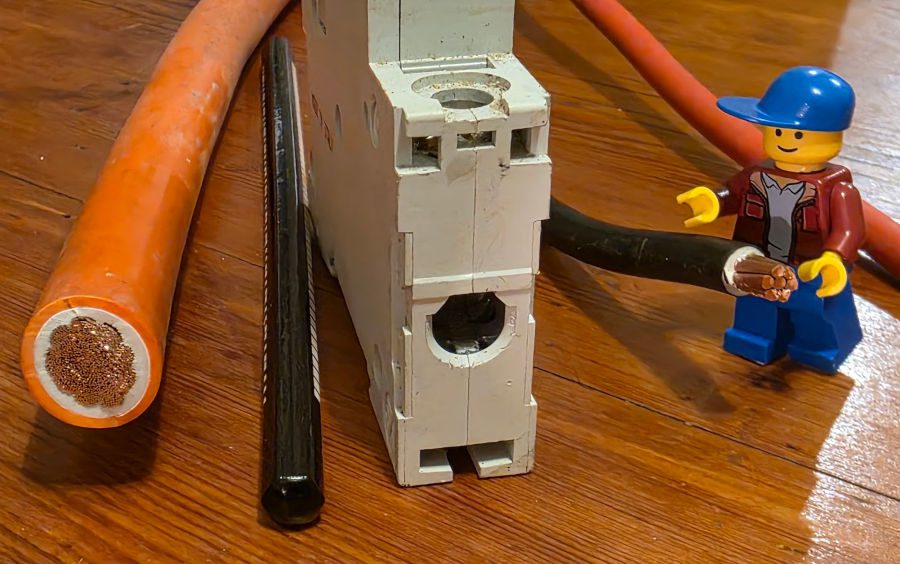
Using a black pencil for reference, this is 16 mm² copper in the hands of our Lego figure. The circuit breaker has a hole that accepts maybe 25mm². Obviously, your switchboard or inverter simply won’t accommodate the 70mm² on the left without lots of cable joints.
Sometimes Series Makes No Sense
Say your mains power arrives on the premises to a free-standing meter box. Next, it branches to the house, 80 metres down the driveway, to where the fridge and the backup circuits are needed. The roof is too shady for solar. The shed, where your existing solar power has been for years, is 20 metres in another direction.
A series-connected system on the shed can’t back up the house without digging 100 metres of trench and laying mains cables sized to support a bridge.
It may be possible to put the battery on the house, then AC couple the solar, but you need a consumption meter and a communication link to measure what’s going on. The solution is either an 80-metre trench, a network cable, and a wireless bridge, or WiFi and two CatchControl devices, depending on compatibility, site requirements, and budget.
And the solar on the shed still won’t work to recharge your battery during an outage.
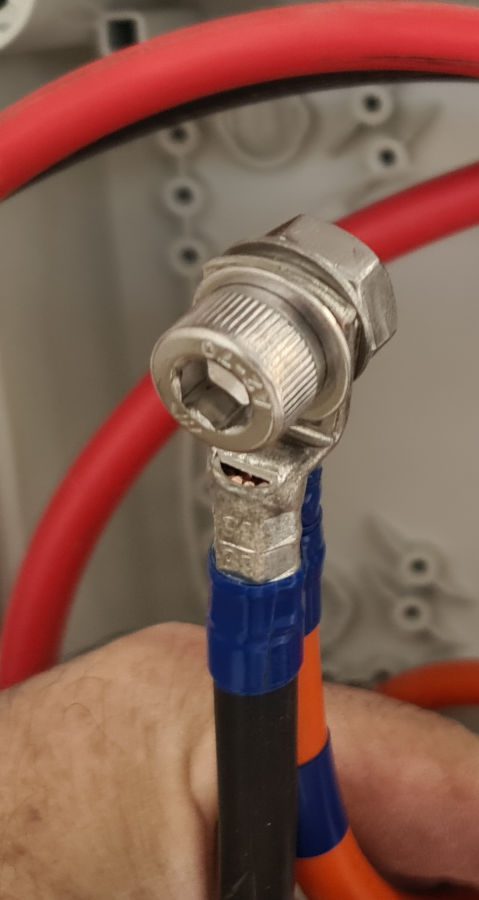
This black cable is a 35mm² with a thin single layer of insulation. It’s lugged and bolted to a 16mm² flexible, which looks fat because it’s double insulated with an extra layer of orange plastic.
Parallel Connection Is Often The Answer
Put a Fronius Gen24 or Verto on the shed, and you can use the existing copper in the ground4 to feed power back to the meter board, and then on down the driveway to back up the house.
DC coupling the solar straight to the inverter is more efficient. It will keep humming during an outage, and it can also restart the system if the battery goes flat overnight during an extended blackout.
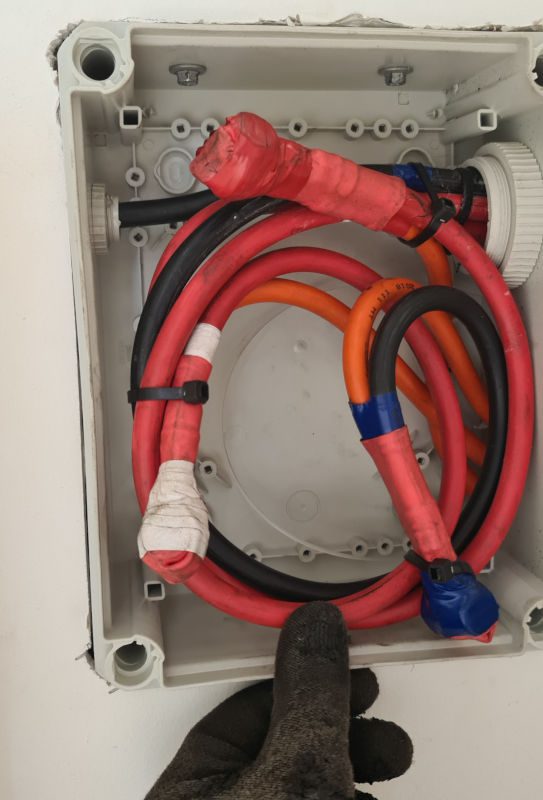
There’s a good deal of work needed to break down cable sizes at both ends of a long run.
The consumption still has to be measured in the meter box, and the gateway function can’t be connected wirelessly, so there’s still a need for trenching, but it’s only 20 metres. And because it’s defined as extra low voltage, the rules aren’t as stringent. You still want it done properly, but the cable is cheap, and the requirements are similar to those for irrigation controls. There may even be an old phone cable you can use.
Partial Versus Whole Home
For many years, most people bought a modest 5 kW system, good for essential circuits like the fridge, internet, lights, and maybe a small split-system air conditioner.
Consumption by heavy loads like the stove, ducted air conditioning, pool pump, or EV charger is measured and offset by solar when the grid is available. During an outage, these large consumers are left off the backup supply. Only the lighter but more important demands are connected downstream to a separate backup port on the inverter.
Connecting this backup port to a divided switchboard in your house can get awkward quickly if it’s in a separate building, over a long distance, or through a two-storey house. And whatever the backup port is rated for is as much as you’ll get, whether mains power is there or not.
There are automatic workarounds and manual bypasses, but it’s not optimal.
However, if you have a parallel-connected inverter, there’s only one main cable (and a supplementary comms cable). It can be connected to almost any switchboard on the premises. There’s no chokepoint limiting your supply when the grid is available. If there’s an outage, the inverter will give everything it’s got to all parts of the house, but if need be, you can still exclude heavy loads and have partial backup when the main switchboard is wired.
Single Versus Three-Phase
We’ve recently outlined how a three-phase inverter can be inadequate during a blackout. There’s more to it than a single number, but the thing to remember is:
A 10 kW single-phase inverter is pretty gutsy; that’s 68% of your normal grid supply, so it’s not unreasonable to expect it to back up the whole house.
However, 10 kW spread across three phases is only 3.3 kW each. It might run the fridge on one phase and the lights on another, but compared to the mains, you only have a very modest 22% available to any one appliance.
I recommend, at minimum, a 15 kW three-phase inverter with at least the same capacity as the modest 5 kW machine mentioned earlier, making partial backup more feasible.
For Outright Reliability
There is one series-connected hybrid system that is literally and legally in a class of its own. The Selectronic SpPro is genuinely Australian made and designed as a battery inverter for remote-area power. It’s a heavy hitter that you can also grid-connect, but it shouldn’t be confused with a lightweight hybrid that might pretend it can go off-grid, i.e., everything else we’ve mentioned in this article.
Selectronic doesn’t tie you to any particular battery, solar inverter, or regulator. It offers infinite DC-coupled solar capacity, but can’t technically export from the battery to the grid.
Whether the grid voltage is high or low, frequency is fast or slow, an SpPro will keep calm and carry on. Nothing else I’m aware of will cope with grid overvoltage, a 180º split-phase supply, or automatically control a diesel generator to charge the batteries during a grid outage.
To give you an idea of sheer, bloody-minded capability:
- A reputable Sungrow 5 kW inverter will surge to 6 kW for 10 whole seconds.
- A 5 kW SpPro will deliver 7 kW for half an hour or 12 kW for half a minute, that’s 240% for three times as long.
They’re reassuringly expensive, of course, but now you know they exist.
Wrapping Up
When it comes to home batteries, a reliable supply depends on how your system is designed and connected.
If you’re looking for vetted installers who will walk you through which layout is best for your home, compare some quotes.
If you want more articles like this one that will tell it to you straight, sign up for our free weekly newsletter.
Footnotes
- Sungrow is principally a series-connected inverter; however, they now offer a “mini gateway” they call an energy bridge, which allows parallel connection remote from the main switchboard. ↩
- For those who really want second, third, and fourth layers of redundancy, a bypass switch or generator inlet socket can still be installed. ↩
- So yes, Sungrow have a foot in both series AND parallel camps. ↩
- Bear in mind that a shed might have a skinny cable that limits the power you can feed from it ↩
 About Anthony Bennett
 RSS - Posts





Excellent clear diagrams. Being able to draw, explain and then apply this information into a variety of scenarios should be a mandatory requirement for all installers and “sellers”.
The three phase invertor issue is something sellers / installers should all be informing customers of along with raising the possibility of some three phase appliances / equipment.
Congratulations Anthony. Its taken you a long time to finally break free of industry dogmas (including Solar Quotes) regarding DC Coupling theory. Thats good news. You are also breaking out on AC theory; and Kirchoffs and Ohms Laws. Good work.
Hi Finn. I may be an x builder , and age might have made me a bit thick in my understanding , have read the piece on Solar re series or parallel , and am lost.
Next week we are , they are fitting a 6.6 kWh and inverter to our home. There battery price would add 10,000 dollars to the price which l thought was impractical , so we did not include.
There battery price 16 panels are just under 5000. I am getting near lost in confusion.
Do you have any honest direction to take ?
Ronald C. Of Wandana Heights
Hi Ronald,
We’d need to know more details, but we have average pricing if you click here :
Price Explorer
I would recommend installing as much solar as you can afford, or as much as will fit on the roof. Batteries aren’t always great value for everybody but a heat pump hot water usually is.
A standard inverter, with no battery, is a parallel supply. When it’s sunny, it supplies your house first and exports to the grid if you aren’t using the power yourself.
I would probably specify a hybrid inverter that you can connect a battery to later,
Excellent points raised here that most owners (including me) would have little to no idea about! Thanks.
(I’m actually starting to think I’m glad our house is single phase after also digesting the information on the topic of three phase vs single.)
We’re still on the tail end of Qld’s high feed in tariff. I’m still trying to decide if we should jump ship and say goodbye to it with new solar and battery to replace our tired 16 year old system, or hang in there to the end and then likely pay more due to reduced government rebates, but also benefit from further advances in all the technology- both solar and battery.
If only I had a crystal ball.
That selectronic SP Pro sounds interesting – inability to feed back into the grid isn’t really an issue these days, its not like your energy company pays you enough for the power you feed back in to make it worth while doing so. Indeed you might even have a bit more freedom in what you do if your system isn’t going to feed power back tot he grid.
The 16mm cable caption has me confused .
Regards,
Bob
Hi Bob,
Caption modified to help.
Cheers for the feedback
An important point for system design engineers to get reacquainted with by integrating Alloy Rods (conductors) instead of copper wire, in those DC runs that are appropriate. There is an instant saving with no downside at all. Alloy is 1/4 the price of copper. I have been using overhead as well as underground (in suitable conduits) unsheathed alloy for many years in commercial off grid DC systems, where suitable. The key is experience and core knowledge about what the precise circumstances are that makes this a best design practice.
Lawrence Coomber
While negotiating with possible suppliers, even those on the SolarQuotes recommended list, I get the feeling that they are not on your mailing list.
Perhaps, if they are recommended, they should get copies of the SolarQuotes news.
It is certainly interesting, but also confusing. I recently had a Goodwe ESA battery installed (and I would not call it “cheap and cheerful”!), but contrary to the article, Google claims that it offers a parallel connection. Which is correct, and how do I find out?
GoodweESA is a series hybrid, the backup circuits pass through it.
Word is there may be a external gateway device coming but it’s not here yet.