
On 1 July 2026, it became much cheaper to permanently disconnect from gas in New South Wales (NSW) and the Australian Capital Territory (ACT). Like many regulatory changes, this news was tucked away in a PDF that most people never read.
What Changed, And Why Nobody Announced It
If you’ve put off disconnecting or abolishing your gas because you thought it would cost over $1,000, here’s some good news.
- In NSW, the standard fee has dropped to $259 (plus GST) for most households.
- In the ACT, it’s fallen to $747 (plus GST).
Both changes took effect on the same day, due to two separate regulator decisions. If you’ve been reading electrification forums and wondering if the discount is real, it is.
There were two different distributors and two separate regulatory decisions, but both started on the same date. In NSW, the Australian Energy Regulator (AER) made its final decision on Jemena Gas Networks’ pricing for 2025 to 2030 in May 2025.
Jemena, which supplies gas to most of Sydney and the Hunter, wanted to increase its abolishment fee to $1,472. The AER said no and set a lower price. The new pricing kicked in on 1 July 2026, the date Jemena needed to get its systems and its retailers up to speed.
In the ACT, Evoenergy’s new pricing for 2026 to 2031 also took effect on 1 July 2026, with a lower permanent disconnection fee than the previous five-year period.
Neither change was announced directly to consumers because these decisions are written for distributors and industry insiders, not the public.
No one was legally required to let you know about the price drop. That’s one of the main reasons for this article.
Abolishment Vs. Disconnection: Get This Difference Right
It’s important to understand the two definitions. A lot of confusion online comes from people using these words for different services as if they mean the same thing.
Disconnection (sometimes “temporary disconnection”) switches the gas off without touching the pipework. It’s reversible, it’s cheap, and in the ACT it currently costs $100 for a standard meter (or $187 for a larger one).
The downside is that it leaves a pressurised, capped gas line inside your property boundary, unused, until you do something about it. This is usually fine unless you need renovations and risk hitting the capped gas line.
Abolishment is the complete process. A technician removes the meter, regulator, and riser, then squeezes off, cuts, and caps the buried service pipe. This ensures gas cannot reach your property again unless a new connection is installed. It’s the thorough option.
Both terms now have consistent national definitions for the first time, thanks to a new framework from the Australian Energy Market Commission (AEMC). This body writes the rules the AER then enforces.
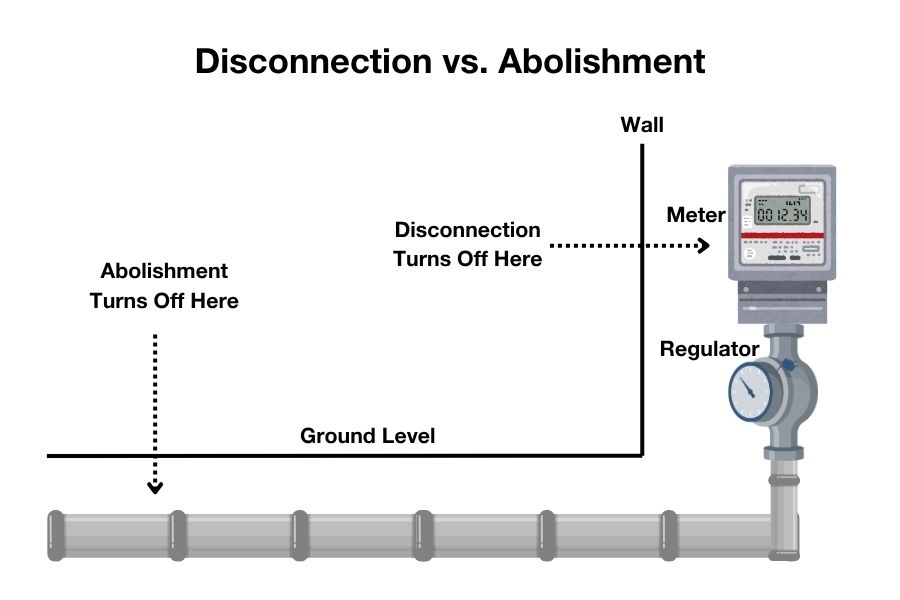
Abolishment turns off near the street, but disconnection is a simple switch off.
The framework for quitting gas, without the confusion, comes down to separate definitions of “abolishment” and “disconnection,” whether you’re in Sydney or Canberra.
One thing to note: Evoenergy’s paperwork doesn’t use the word “abolishment.” Instead, it calls the service “permanent disconnection,” either basic or urgent. It’s the same job, just a different name. If you’re in the ACT, searching for either term will help you find the right service.
If you want to stop using gas completely, the abolishment option removes the pressurised pipe from your wall. Disconnection alone does not. Regulators have spent the past year working to close the gap between these two services, especially the price difference.
This Discount Has A Use-By Date
If you’re thinking about abolishment, here’s why you might want to act soon. The AEMC finalised a new rule that moves Australia toward “cost-reflective” abolishment pricing.
In short, as more people leave gas, it becomes harder to justify spreading the abolishment cost across a smaller group of remaining customers, especially renters, apartment dwellers, and those with limited energy choices. The AEMC’s solution is to charge the real cost to the person choosing to leave.
This won’t happen everywhere at once. Each distributor only has to switch to cost-reflective pricing when its current five-year pricing period ends and a new one begins, under the AEMC’s final determination. Jemena’s current period runs until 2030, so NSW’s shift happens then. Evoenergy and South Australia’s gas network are on a cycle that runs until 2031, so theirs happens a year later.
So, the current low prices are not permanent. They’re what NSW and ACT regulators decided for this period, and they will expire in a few years.
That’s a real reason to act soon, not just a sales pitch. If you’ve already replaced your gas cooktop, heater, and hot water system, and the only thing left is a pressurised pipe behind your wall, now is probably the cheapest time to get rid of it.
The Real Cost and Two-Tier Pricing In NSW
Here are the prices again, clearly stated:
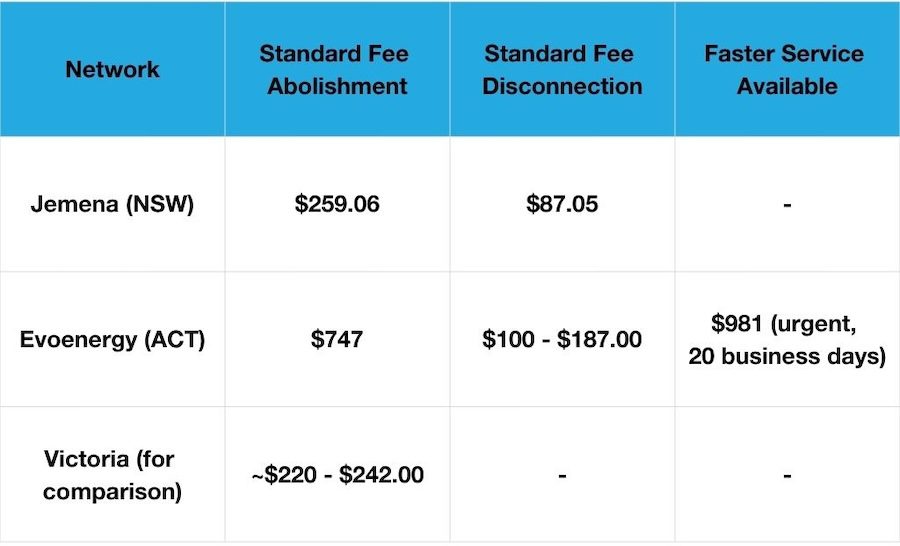
How the cost of abolishment compares to the cost of disconnecting.
NSW has pricing that many people online seem to miss.
- If you’re abolishing your connection for good with no plans to reconnect, you should be quoted $259.06.
- If you want the option to reconnect later, or if there’s a renovation on file, the full-cost tier applies at $1,244.13.
- If you change your mind and want to reconnect, it costs $122.28, or $203.11 for a faster service.
All these prices are before GST. Add 10%, and you’ll pay about $285 in NSW or about $822 in the ACT on your invoice.
Evoenergy’s basic permanent disconnection fee is now $747, down from figures reported at various points between roughly $870 and $950.
The old pricing created a big gap between a cheap temporary disconnection and abolishment, an expensive permanent one. This led people to pick the cheaper option: turning off the gas, capping the pipe, and leaving it pressurised.
Closing the price gap, as the NSW safety regulator suggested, was meant to encourage more people to finish the job properly.
How To Request Abolishment
The process itself is mostly the same, even though the price has changed.
- Start by contacting your gas retailer, not the distributor. If you’re closing your account completely instead of just switching providers, make that clear. Retailers must explain the difference between disconnection and abolishment and direct you to the distributor, according to new AEMC rules. This rule doesn’t fully apply until January 2027, so the person you speak to might need a moment to check the details.
- Ask your retailer to request abolishment for you, and they’ll pass it on to Jemena or Evoenergy. The basic rate is already published for NSW with the distributor’s current tariff schedule. That’s where the figures above come from. From 1 October 2026, distributors also have to publish plain-English information explaining the process and respond to enquiries about it, under the AEMC’s new information rules linked above.
- Check which tier you’re being quoted. For a standard house with no renovation plans, it should be the basic rate, not the full-cost or urgent tier. If the price doesn’t match what’s listed above, ask for an explanation before agreeing.
- A technician will do the physical work, which includes removing the meter and then cutting and capping the buried pipe. This ensures nothing can flow to your property unless a new connection is installed.
Two scenarios come up:
First, if a plumber has already capped your pipe after the meter, that is not the same thing as a formal abolishment. Even if you closed your retail account months or years ago.
The pipe leading back to the street may still be live and pressurised until the distributor completes the work. This is exactly the safety issue the reform aims to fix.
Second, it’s not clear whether you can request abolishment without an active gas retail account.
Jemena’s guidance says you should contact your retailer first, but it’s not clear what to do if you no longer have a retailer. If that’s your situation, the best approach is to call Jemena or Evoenergy directly and ask.
Here’s What To Do Next
If you’re partway through electrifying your home and gas is the last thing left, don’t leave the job unfinished. Having a plumber cap the pipe is not the same as a proper abolishment, and a cheap disconnection leaves a pressurised line in your wall for good.
If you’re ready to replace your gas with electric, look into hot water heat pumps as a start. Heating hot water is gas-intensive and will be cheaper as you electrify your home. You can save money by comparing electricity plans once you get off gas too.
 About Jacob Boyd
 RSS - Posts






Would be nice if this included replacing my hotwater and stove too in the process. I was then unaware of this cost too.
A gradual shift away from gas can be a meaningful step toward cleaner and more affordable energy. The key will be ensuring households have reliable alternatives, strong electrification infrastructure, and practical support throughout the transition.
When I went through this joyful process last year, Jemena originally wanted to charge me nearly $3K to abolish my gas. I had ‘disconnected’ the previous September, and thought I was done, until I noticed I was still receiving monthly gas bills, despite using no gas. This turned out to be the ongoing service fees for just being on the network. I argued on the phone that Jemena had not been clear enough about the definitions of ‘disconnection’ and ‘abolishment’ and that this would be borne out in their recordings of our previous conversations. They then caved and waived the $3K.In the vortex of the gas industry’s death spiral, anyone not willing to stand up for themselves would be stuck with a large fee so I encourage anyone doing this to stand your ground. Good Luck!
Great article. I wanted to share my experience as I went through this process somewhat recently.
There is a third option, called “meter removal”. This might only be in Victoria, I’m not sure. This is capped (no pun intended) at $75+gst, and is the option if you live in a strata and abolishment is not possible because the rest of your neighbours are still using gas.
In Victoria at least, my distributor Multinet removed the meter from my property and capped the line. Because I did not have an active gas account, I contacted the last retailer, which was Alinta. Initially they told me I would need to create a new account. I said that I was happy to pay the meter removal fees, but not supply charge. They put me through to the complaints department, eventually did the work and haven’t charged me anything for it. Good riddance gas!
This is likely to be an unpopular thought, however:
My electricity connection fee (without usage) is now more than my total gas bill (including usage).
I already have gas hot water and heating, solar and batteries. There is ample solar in summer for cooling and gas will cover heating in winter. Feed in tariffs of excess solar are not even worth considering anymore.
Going off the electricity grid and keeping gas is starting to look like the more financially viable option (assuming the environmental consequences are ignored).
I’m not a fan and have been working towards getting off gas for some time. However, the latest electricity market changes appear to have turned the tables a bit and begs the question, is gas abolishment a smart thing to do at this time?
Hi Paul
Gas won’t get any cheaper as the death spiral gains pace.
Have you noticed all the gas adds focused on food? The sponsorship of cooking shows? The food influencers? Why is the gas industry madly advertising cooking when it’s only 2% of their business..?
They want you to make an emotional decision about food, not a rational decision about cost, they know all electric houses are cheaper and people are disconnecting gas.
They’re not talking about the glass induction cooktop that’s easy to clean, superbly controllable and won’t set your house on fire.
And there’s zero mention of indoor air quality, that gas will poison you with NOx, Benzine & carbon monoxide
https://reneweconomy.com.au/gas-industry-knew-about-air-pollution-problems-from-stoves-in-early-1970s/
Yeah, the indoor air quality thing is real.
And my induction cooktop boils water about 3x as fast as my gas cooktop ever did, when I turn it up to 11.
Hi Anthony,
Did you miss the line in Paul’s post where he said “My electricity connection fee (without usage) is now more than my total gas bill (including usage).”
Forget about all the gas ads, I think the electricity companies with their constant money-grubbing tactics are doing the best job of convincing people to stay on gas.
Yes, you won’t be popular around here, Paul. 🙂
My gas connection fee is now 27c per day! That’s about $100 a year (entirely covered by my pension rebate). I use gas for cooking and heating – so I pay a bit for 3 months and almost nothing for the other 9. I can’t see myself getting off gas any time soon.
Why is there such a large difference in the abolishment fee between NSW and ACT?
Why is the ACT cost nearly 3 times the NSW cost? At some point the whole network will be shut down – might be cheaper/ free at that point.
“Abolishment” is such a funny word. First came across it 22 years when we demolished our old house which included “abolishment” of the gas service (although it was later reinstalled in the new build). Why aren’t they using the plain English word “abolition”?
What do the gas companies charge for a connected but unused supply?
What is the charge for a gas connection with no usage.